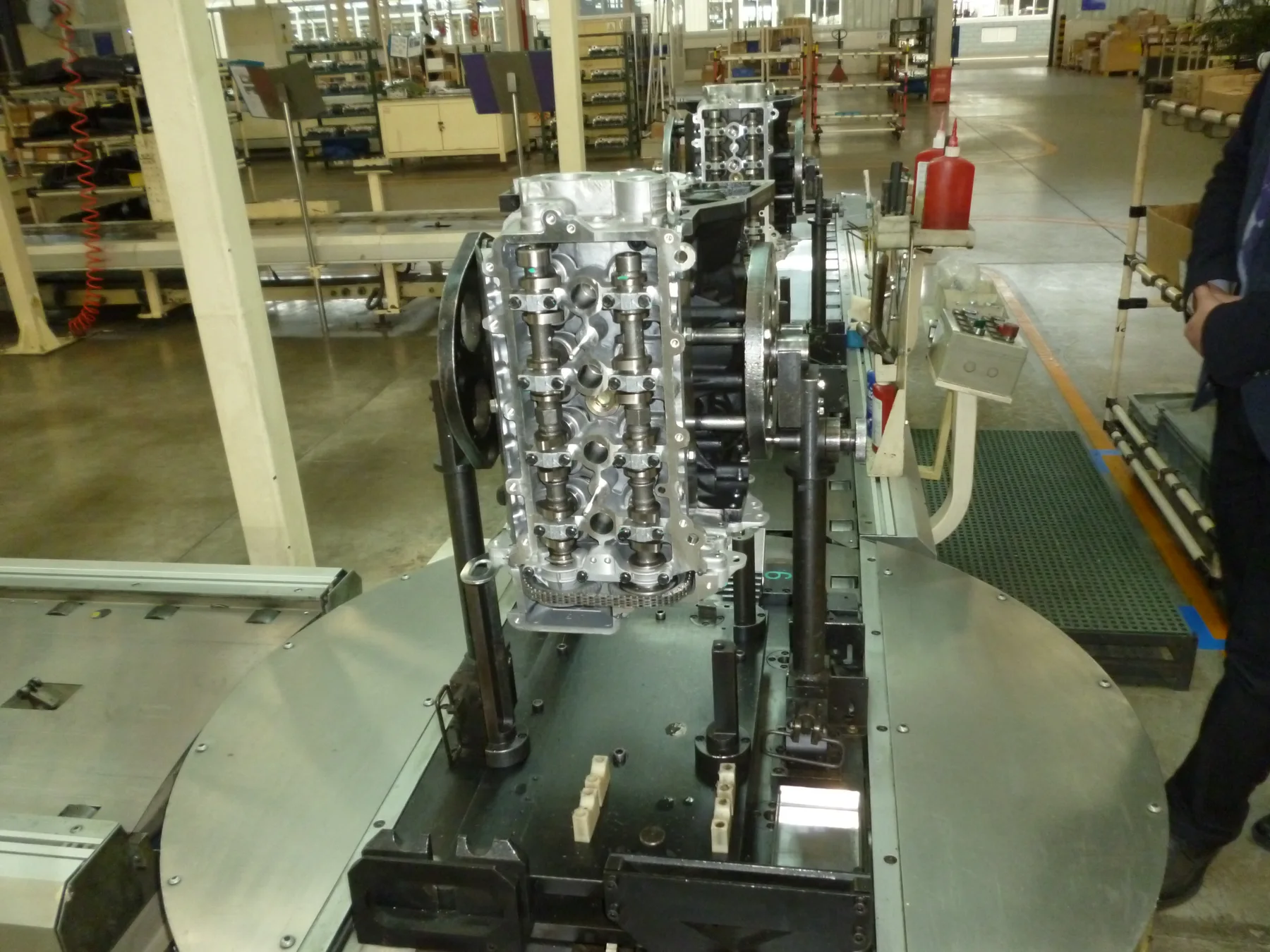
China manufacturing is not one enormous low-cost factory. It is a network of regional product clusters, specialized processes, trading companies, wholesale markets, ports and individual suppliers with very different capabilities. Match the product to the right cluster first. Then verify the particular supplier's process, capacity, quality control and export path. A famous city can improve the odds of finding expertise; it cannot approve a factory for you.
China manufacturing: choose the product cluster before the factory
Imagine sending the same request for quotation to ten suppliers: a custom hotel chair, a circuit board, a porcelain cup and a small batch of wigs attached in one spreadsheet. Replies arrive within hours. Every company says it is a factory. Every catalog looks comprehensive. Three prices are impossibly low. One salesperson promises any color, any certification and delivery in twenty days.
The spreadsheet looks efficient. The sourcing logic is broken.
The engine assemblies in the cover photograph make the missing question tangible: which operation is this supplier actually equipped to perform? Fixtures hold the parts in position; nearby tools belong to a particular production step. That is the level of specificity I want behind a factory claim. The Mianyang photograph by Tangray-nick dates from 2016, not a current supplier inspection. The resized WebP is shared under CC BY-SA 4.0.
China manufacturing becomes useful only when the product is placed inside the right production geography and the quotation is tied to a visible process. A supplier near component makers, tool shops, finishing specialists, packaging plants and an experienced port route can solve changes faster than an isolated low bidder. That concentration is the real advantage. It is not magic, and it is not evenly distributed across China.
The World Bank's manufacturing value-added series for China shows why a single national label is too broad to guide a purchase. The category covers radically different materials, tolerances, labor systems and regulatory burdens. “Made in China” tells you the country of origin. It does not tell you who owns the mold, plates the board, mixes the glaze, tests the motor or packs the carton.
Product requirements identify a useful cluster; the cluster only improves the odds; evidence still has to approve the supplier. Skipping either step creates a false shortcut.
Choose a product cluster before choosing a supplier
China's industrial map is better read as constellations than provinces. Product knowledge gathers where orders repeat. A furniture cluster attracts timber, hardware, foam, upholstery, finishing, showroom and freight services. An electronics cluster pulls together component distribution, PCB fabrication, assembly, testing, enclosure tooling and fast prototype work. A ceramics center develops clay preparation, mold making, decorating, kiln firing, sorting and packing knowledge.
That is why the most useful first search is often city or specialized town + product, not “best Chinese factory.”
| Product decision | Cluster route to investigate | What the place can help you find | What it still cannot prove |
|---|---|---|---|
| Furniture and interiors | Foshan; Lecong in Shunde for furniture showrooms | Compare designs and finishes before arranging a separate production check | Structural testing, finish consistency or one factory's subcontracting |
| Electronics and hardware | Shenzhen, Huaqiangbei and surrounding Pearl River Delta networks | Components, prototyping, tooling, assembly and testing services | Component authenticity, firmware quality or production yield |
| Porcelain and decorated ceramics | Jingdezhen and other specialized ceramic centers | Skilled forming, decorating, firing and small-studio variation | Food-contact compliance, batch consistency or export packing |
| Small commodities | Yiwu wholesale market and linked Zhejiang supply networks | Fast product discovery, consolidation and low-complexity assortment | That a stall owns a factory or controls every upstream process |
| Wigs and hair products | Xuchang and Qingdao supply networks | Material, ventilation, coloring, styling and export experience | Hair origin, colorfastness or repeat-order consistency |
| Toys | Chenghai and wider Shantou networks | Design translation, molding, electronics, assembly and packaging | Age grading, chemical compliance or market-specific certification |
| Lighting | Guzhen, Zhongshan | Compare lighting ranges and arrange meetings around the fair or market visit | Electrical safety, driver reliability or suitability for the destination market |
| Fabric | Keqiao, Shaoxing; China Textile City | Compare fabric samples and discuss composition, width, finish and repeat orders | That a swatch and a later production lot will perform identically |
| Leather clothing and home textiles | Haining, with separate market routes for each category | Narrow a visit to clothing or home-textile suppliers | That a leather-garment seller controls a curtain-fabric supply chain |
| Socks and hosiery | Datang, Zhuji | Investigate a specialized hosiery production network | Fiber content, fit, wash performance or an individual supplier's capacity |
Use this as a product-to-place shortlist, not a list of approved suppliers. The linked Shenzhen, Yiwu and Jingdezhen guides answer different next questions: finding a component, assembling a mixed order, and understanding a material. A familiar city name is the beginning of the investigation, never the acceptance test.
A finished consumer product can expose the other end of the same network. The Li Auto L9 is useful here because its cabin, range system and passenger-first layout look like one branded object, yet each depends on coordinated software, electronics, chassis, interior and service decisions. Admiring the finished SUV does not identify a supplier; reading it as a system makes the phrase “China manufacturing” less abstract.
One hotel brief, three different buying routes
Consider a hypothetical small hotel buying chairs, lamps and welcome gifts. Putting all three into a search for “hotel products factory” hides the work. The chair decision begins with frame, upholstery and dimensions: Foshan's furniture route belongs on the shortlist. The lamp decision begins with light, mounting and maintenance as well as shape: investigate Guzhen. The gift decision might begin with ready-made objects, assortment and packaging: start with Yiwu.
The point is not to visit three cities automatically. First ask which decisions require seeing a sample together and which can be settled through drawings, material references and a documented remote review. A coordinator may combine purchasing, but should still identify who controls each product's defining process. Three invoices do not guarantee clarity; one invoice does not guarantee confusion.
I would organize the trip around the hardest unresolved choice. If the chair's comfort and finish still need comparison but the gift is an unchanged stock item, give the furniture appointment the time. If a lamp must fit an existing installation, settle the mounting and replacement parts before choosing a dramatic silhouette. The city map becomes useful when it tells you where attention belongs, not when it produces the longest itinerary.
Foshan: a showroom address is not a factory address
Lecong is a town in Shunde district, within Foshan. These are nested places, not three competing furniture destinations. The Louvre operator's contact page makes that hierarchy concrete and also lists a separate Guangzhou location. Check the actual address before arranging meetings; the brand name alone does not locate your appointment. The dedicated Foshan furniture market guide turns that geography into a sample-to-delivery comparison and inspection record.
I object to the phrase “factory-direct” when it is used to end a conversation that has barely begun. A room full of beautiful chairs answers a design question. It does not tell you who makes the frame or what happens when your chosen upholstery runs out. Ask the showroom to connect one specific sample code to its quotation and production site. Then compare the frame, covering and finish you ordered with the specification the workshop receives. A useful intermediary can explain those handoffs. A factory badge cannot explain them for you.
Xuchang: the first wig sample is not yet a repeat-order system
Xuchang's hair-products cluster can connect material, cap construction, coloring, ventilation, styling and export work. That makes the city a sensible place to look for depth, but it also means the front door may coordinate several specialist handoffs. The Xuchang wigs guide turns an attractive sample into separate fields for hair or fiber, cap, density, length, color, construction, finish and packing. Its real test is the second order: can the same approved identity survive another material lot, another production team and one controlled change?
Chenghai: fast toy development needs slower evidence control
Chenghai is a district of Shantou, not a second unrelated toy city. Its development density can make design, tooling, molding, electronics, assembly and packaging move quickly. The Shantou toys guide keeps that speed attached to a controlled drawing, BOM, age grade, test record, label and traceability code. A prototype that works is a development milestone. It is not permission to change resin, pigment, battery or packaging without reopening the affected evidence.
Guzhen: buying a lamp and buying a lighting supply chain are different jobs
Guzhen belongs to Zhongshan. The Guzhen Lighting Fair's organizer page provides a concrete entry point for the lighting trade and identifies the event venue. A fair has a schedule; it is not interchangeable with a market visit. Use the organizer's current dates and registration instructions before booking around it. The dedicated Guzhen lighting guide separates showroom attraction from mounting, output, electrical, replacement and destination-review questions.
The fixture that wins your attention must still fit the job. For a hotel project, that means recording dimensions, mounting arrangements, light output requirements and replaceable components, not simply sending a chandelier photograph. My first question after “I love that shape” is “What will we do when a component needs replacing?” That question connects visual taste to ownership. The answer belongs in the supplier discussion before the order, not in a desperate message after installation.
Zhejiang: choose the material before joining the cities together
Keqiao's regional profile identifies China Textile City and the local textile industry. It also places that industry alongside Shaoxing's rice-wine and cultural life. That is the kind of city connection I want to keep: the buying district belongs to a living place, not an isolated sourcing pin. But a pleasant cultural detour does not settle a fabric specification. Keep the sample code, composition, usable width and intended finish attached to every quotation.
Haining's leather and home-textile markets require different appointments. A leather-jacket buying trip is not a curtain-fabric buying trip. Further inland, Datang in Zhuji has a documented hosiery industry. That makes socks a sensible research direction; it does not turn historical production statistics into a promise about today's supplier. For a first trip, I would rather leave with three comparable, traceable samples than photographs from six unrelated markets.
I like China's manufacturing cities because their expertise often escapes the glossy city center. In Guangzhou, commerce is visible in wholesale streets, logistics rhythms and the way one category of goods takes over an entire building. A useful coordinator can translate between that commercial world and a specialist workshop. Ask them to explain the route of your product, including which work takes place outside the city where you meet. That explanation is more revealing than the address on a business card.
Before you leave a meeting, ask the contact to send the agreed sample code, requested change and next step in writing. The Chinese business culture guide helps with the human side of those conversations. Hospitality can make a meeting enjoyable; it must not be mistaken for agreement on a specification.
A factory, a trading company and a market solve different problems
Buyers often treat “Are you a factory?” as a moral question. It should be an operating question.
A manufacturer controls at least the critical process you are buying. It may still outsource coating, printing, heat treatment, testing or packaging. A trading company coordinates one or more manufacturers, translates requirements, consolidates products and manages communication. A wholesale market vendor gives access to existing products and rapid assortment, often without deep customization.
None is automatically good or bad.
The manufacturer can offer process depth but may be weak at English documentation or multi-product consolidation. A capable trader can protect a small overseas buyer from fragmented factories and missed handoffs. A market vendor can be exactly right for low-risk, ready-made goods. The danger is not the middle layer itself. The danger is paying for one model while receiving another.
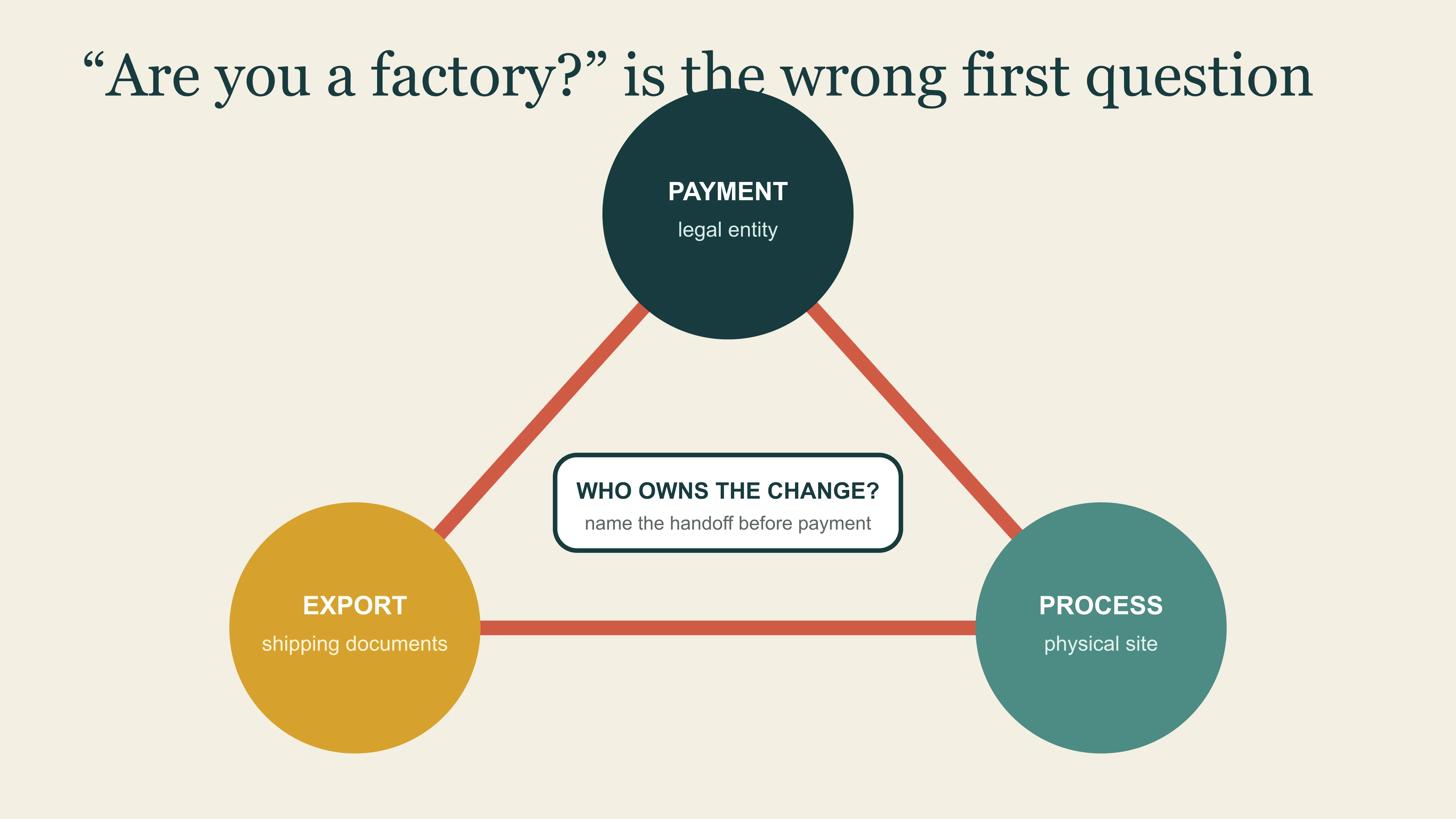
Three names can describe a legitimate supply arrangement. The danger begins when nobody will explain which entity receives money, exports the goods and controls the process.
Request three identities separately: the legal company receiving payment, the export entity on the shipping documents and the physical site performing the critical process. If the names differ, ask why. A clear answer may reveal a normal and useful arrangement. An evasive answer reveals risk before money moves.
Then ask for evidence tied to your product: a live walkthrough from raw material to finished goods, the machines used for the critical step, current work-in-progress, the quality station and the packing area. A pre-recorded showroom tour proves only that someone once filmed a showroom.
Verify the process, not the gate
A large factory sign, landscaped entrance and framed certificate make a reassuring photograph. They say little about whether the supplier can hold your tolerance next month.

The Lankao photograph shows why a building belongs in the record but cannot finish it. Keep the exterior as an orientation image, then ask for the route of the mattress through the facility: which layers are prepared here, where assembly occurs, how the cover is finished and what happens before packing. That sequence gives the follow-up call a subject. Another impressive photograph of the gate does not.
Start with the critical process. For a PCB, that could include layer construction, drilling, plating, imaging, etching, solder mask, surface finish and electrical test. For upholstered seating, it could include frame construction, foam specification, seam strength, finish and load testing. For porcelain, forming and decoration are only part of the risk; kiln control, sorting and export packing determine how much of the order survives as saleable product.
Ask the supplier to mark each process as in-house, routinely subcontracted or arranged only for this order. Record the subcontractor for any step that controls safety, appearance or tolerance. If the sample was made on a prototype line but mass production will move elsewhere, treat that as a process change, not an administrative detail.
Quality certificates belong in this review, but they are not shortcuts. The International Organization for Standardization's quality-management principles describe a management system built around customer focus, process, evidence and improvement. A valid ISO 9001 certificate can support confidence that a system exists. It does not certify your specific product, approve today's shipment or replace inspection.
Write the RFQ so two quotes mean the same thing
“Same as photo, high quality” is not a specification. It is an invitation for ten suppliers to quote ten different products.
A useful RFQ fixes the comparison before the price arrives. Include drawings and revision numbers; dimensions and tolerances; material grade; finish and color reference; performance tests; labeling; unit packaging; carton limits; expected order quantity; destination market; required sample stages; inspection method; and the trade term with a named location.
For appearance, use a physical reference or controlled standard where possible. Screens do not hold color consistently. For packaging, state not only the box style but also drop, compression, humidity or pallet constraints that matter on the actual route. For software or electronics, define firmware ownership, programming, test fixtures and failure logs. For regulated products, identify the destination-market rule before tooling begins.
The quotation should separate unit price from tooling, molds, sample fees, testing, packaging, labeling and domestic freight. Ask who owns paid tooling, where it will be stored, how maintenance is handled and whether it can be transferred. Cheap tooling that exists only in a supplier's sentence is not an asset.
Keep the approved sample beside its production record
The best sample in the room is dangerous if nobody records how it was made.
A salesperson can personally select the cleanest unit, polish it twice and send it by air. Mass production will not receive that attention unless the accepted sample becomes a controlled reference. Sign and date the approved unit. Photograph it under consistent light. Attach the exact drawing revision, material and finish. Keep one sample with the buyer and one sealed sample with the supplier. This is the golden sample.
Then separate three questions:
- Can the design be made once?
- Can the process repeat it at production speed?
- Can the packing and logistics deliver it in saleable condition?
A handmade prototype answers only the first.
Porcelain makes this visible. The Chinese porcelain guide explains why “ceramic” is not one interchangeable body, and the porcelain-making process shows how forming, drying, glazing, firing and sorting each change the result. A buyer who approves only a painted photograph has not approved body, glaze, firing variation, foot finish or packing.
MOQ is a map of setup cost, not a number to defeat
Minimum order quantity usually hides several minimums: material purchasing, machine setup, dye or glaze preparation, printing, packaging, production-line efficiency and the factory's commercial appetite.
Ask which minimum is binding. A supplier may reduce quantity if you accept a stock material, common color, shared mold, neutral box or longer lead time. Another may quote a low MOQ but move the order to a sample workshop with a different cost and repeatability profile.
Do not negotiate MOQ in isolation. Calculate how many sellable units remain after expected defects, destructive testing, samples, transit damage and replacements. A smaller order with a high unit price can be cheaper than a warehouse of the wrong revision. A larger order can be rational when tooling and setup dominate, demand is proven and quality controls are already stable.
My own rule is simple: the first order should buy information as well as inventory. Its job is to expose communication gaps, production drift, packaging weakness and real lead time while the financial consequence is still survivable.
Inspect while correction is still possible
Final inspection is valuable, but it is the most expensive time to discover a process error. The cartons are closed, the vessel is booked and the factory wants the balance payment.
Build checkpoints around irreversibility:
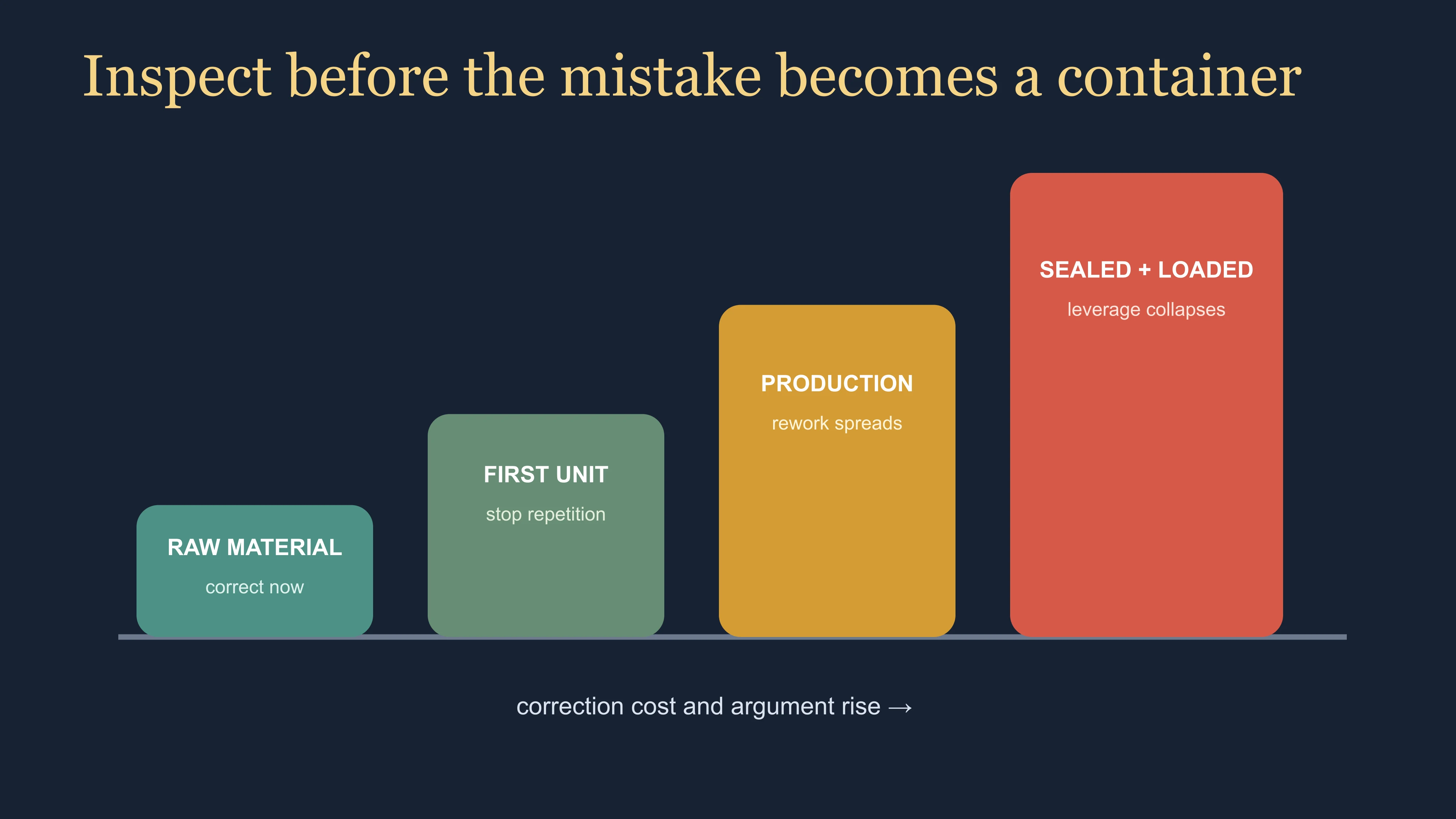
Inspection is not a ceremony before the balance payment. Its value comes from catching a wrong decision while the line can still change it.
- Check raw materials before they disappear inside the product.
- Check the first production units before the line repeats the error.
- Check appearance and dimensions during production, not only after sorting.
- Check function and safety tests against named methods.
- Check labels, manuals and country-of-origin marks before packaging is printed in volume.
- Check carton count, assortment, sealing and shipping marks before loading.

For the Heyuan line pictured here, the useful follow-up is the batch record: where does the batch identifier first appear, and which later record retains it? A wide factory photograph cannot show that continuity. Ask for an example with confidential information removed, then follow one batch through the documented checks. The image earns its place by directing the inspection question toward the moving product rather than the tidy room.
Define what happens after a failed check before failure occurs. Who can stop the line? Who pays for rework? Will repaired units be reinspected? Can a material change be made without written approval? The strongest quality plan is not a ceremonial checklist; it is a decision system with authority.
For goods entering the United States, the overseas factory does not absorb every product-safety responsibility. The U.S. Consumer Product Safety Commission's importer guidance is a useful starting point for applicable consumer products. Product category, age grading, materials, claims and destination market determine which rules and tests apply. A supplier's “CE/FCC/FDA available” message is not a compliance conclusion.
The cheapest quote is rarely the lowest-risk order
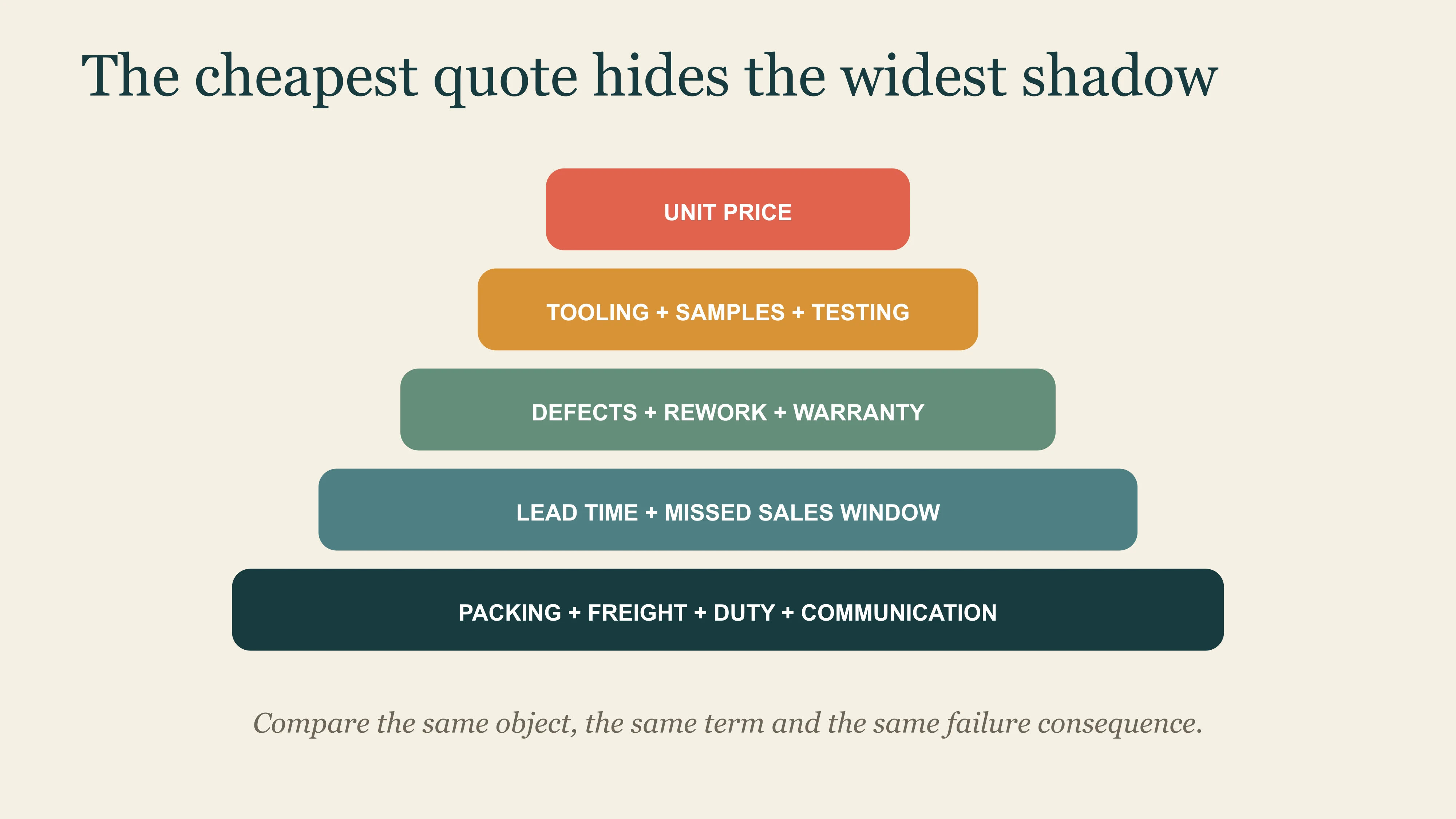
Unit price is the smallest visible layer. A quote wins only after the hidden layers are compared on the same specification and trade term.
Compare total landed exposure, not only unit price:
Product: unit price, tooling, development, samples and testing.
Quality: inspection, destructive-test units, rework, replacements and warranty reserve.
Time: production lead time, holiday shutdowns, component shortages, approval delays and the cost of missing a sales window.
Logistics: inner packing, cartons, pallets, consolidation, export handling, freight, insurance, duty and destination charges.
Communication: engineering hours, translation, revision control and the cost of an ambiguous change.
Ask every supplier to quote the same Incoterm and named place. EXW Shenzhen and FOB Yantian are not directly comparable. Neither predicts the final landed cost without freight, duty, tax and destination charges. Incoterms allocate tasks, cost and risk between buyer and seller; they do not determine product quality or transfer title by themselves.
Shipping is another production stage
An order is not finished when the last unit passes inspection. It is finished when the correct, compliant and saleable goods reach the agreed destination with documents that match reality.
Run a packing test before the full order. Confirm unit protection, carton dimensions, gross weight, pallet pattern, moisture control and loading plan. Photograph open cartons and sealed cartons with their marks visible. Reconcile purchase order quantity, packing list, commercial invoice and inspection count. A one-digit model error repeated across documents can delay a shipment more effectively than a broken machine.

China's supply chain advantage includes dense logistics infrastructure, but the handoffs multiply responsibility. Name who books, declares, loads, insures and receives the cargo.
The World Trade Organization's China trade profile gives national trade context. Your order still moves through a specific factory, freight forwarder, customs declaration, port, carrier and destination broker. Map those handoffs before the production deposit, not after the cartons are waiting.
When China fits the buyer, and when it does not
China is a strong fit when the product benefits from a mature component ecosystem, tooling depth, scalable capacity, process variety or export infrastructure; when the specification is stable enough to communicate; and when the buyer can fund sampling, verification and working capital.
It may be a poor fit when demand is unproven and inventory risk dominates; when the product must change every week; when local installation and service matter more than unit production; when freight overwhelms value; when regulatory obligations are unclear; or when the buyer expects a distant supplier to finish product strategy on a marketplace chat.
The right question is not “Is China manufacturing good?” It is: Does this product gain more from the relevant Chinese cluster than the order loses through distance, complexity and verification cost?
If the answer is yes, follow this sequence:
- Define the product and destination requirements.
- Identify the relevant cluster and critical process.
- Decide whether a manufacturer, trader or market route fits the order.
- Verify legal, export and physical production identities.
- Issue one comparable RFQ.
- Approve a controlled sample and production method.
- Inspect at irreversible checkpoints.
- Engineer packaging and document every logistics handoff.
China's greatest sourcing advantage is not merely low price. It is the ability to place many specialized capabilities close enough to respond to a real product. Its greatest trap is that this density makes almost any promise sound plausible.
Still choosing a city? In the comments, name your product and the hardest requirement: material, customization, quantity or repeatability. An unresolved question belongs here as much as a completed order. If you have a sourcing lesson to contribute, make a Moment with one photograph you own of the sample detail or packing decision, explain what changed, and remove confidential order information. If production is still underway, return with the result. That follow-up is more useful to the next buyer than another untested supplier recommendation.
Continue into Guangzhou's commercial culture, follow porcelain from forming to firing, or join the working discussion in East Moment's community.