
Travel to China is easier when you solve the practical questions early and leave the human questions open. Confirm how you may enter, prepare more than one way to pay, choose cities for their character rather than their fame, and learn enough about transport and etiquette to move with confidence. Then allow the journey to become less efficient and more alive.
Travel to China before the journey becomes a photograph
China often reaches an overseas traveler first as a sequence of enormous nouns: the Great Wall, the Forbidden City, Shanghai, pandas, high-speed rail. All are real, and several deserve their fame. Yet a country does not become understandable merely because its landmarks fit neatly inside a camera roll.
After living in China for four decades, I think a first trip succeeds through two kinds of preparation. The first is almost comically practical: a passport name entered correctly, a working payment backup, the hotel address saved in Chinese and enough time to find the right railway entrance. The second is quieter: the willingness to notice how a city wakes, how people share public space, what breakfast smells like and when a conversation changes the day's plan.
Handle the admin first. Then get it out of the way. The point of preparation is not to turn travel into project management; it is to leave enough confidence for curiosity to take over.
Travel to China without letting one failed app ruin it
None of this is glamorous. All of it buys freedom later. Before building an ambitious itinerary, make sure the trip can survive a dead battery, a rejected payment or a station entrance that is nowhere near the pin on your map.
- Confirm the entry rule for your passport, route and travel date.
- Check that your passport has the validity and blank pages required for your circumstances.
- Save accommodation confirmations and addresses in both English and Chinese.
- Prepare mobile payment, a physical card and some renminbi cash.
- Decide how your phone will connect and which essential apps will work.
- Book only the transport that would be painful to lose; keep some hours unclaimed.
- Store copies of important documents separately from the originals.
| Before departure | Primary plan | Backup plan |
|---|---|---|
| Entry | Confirm the exact visa or visa-free rule through an official channel | Keep digital and printed evidence of onward travel and accommodation where relevant |
| Payment | Set up an eligible mobile wallet and international card | Carry another physical card and a modest amount of RMB cash |
| Connectivity | Arrange roaming, a SIM or an eligible eSIM for your device | Save addresses, tickets and translation notes offline |
| Navigation | Install a map service that works reliably in mainland China | Keep hotel and destination names written in Chinese |
| Rail | Use Railway 12306 or a reputable booking service | Leave extra station time and retain the booking details offline |
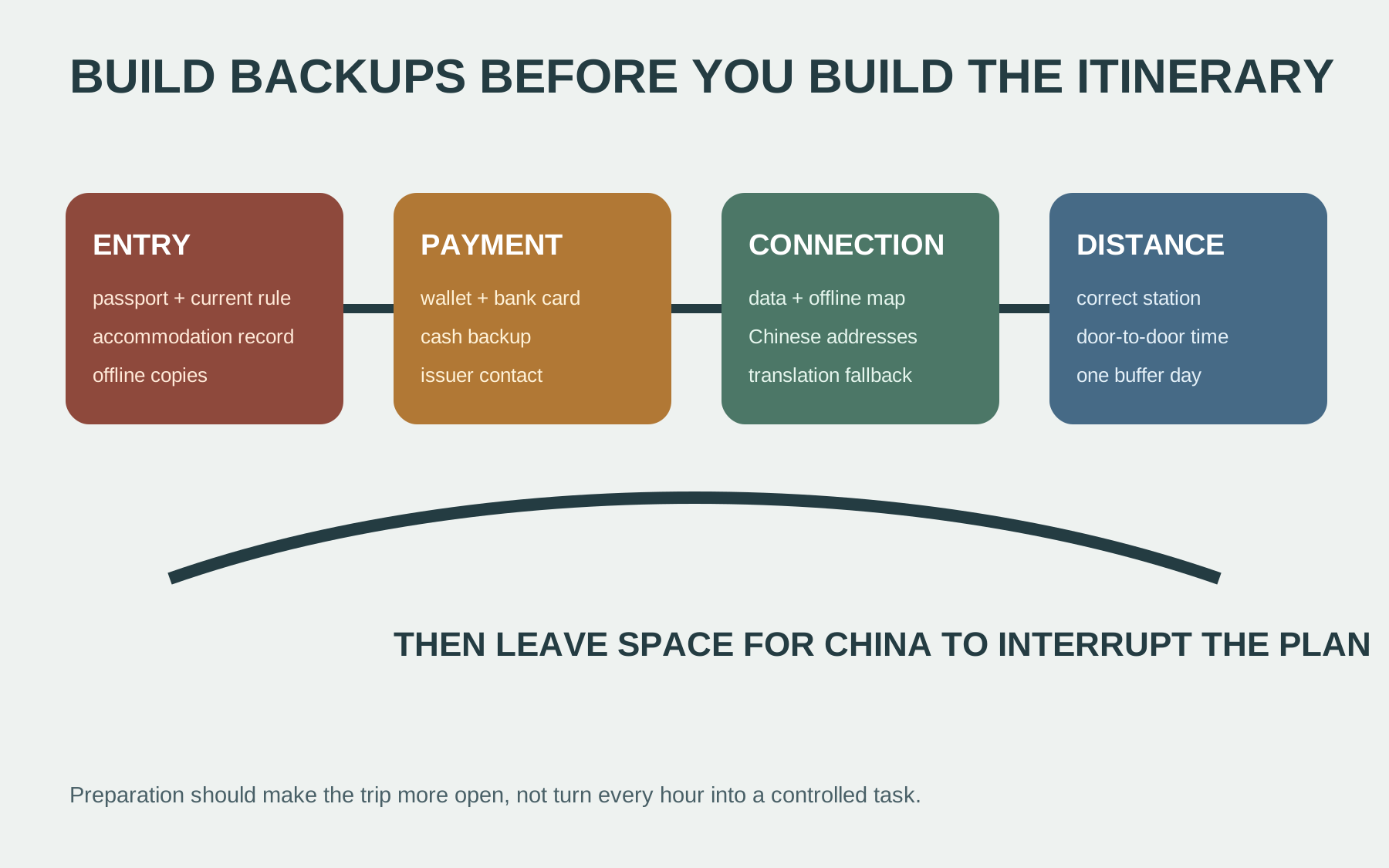
The goal is not to predict every inconvenience. It is to prevent one failed app from becoming the main character of your holiday.
China visa and entry rules: verify, do not generalize
There is no responsible one-sentence answer to “Do I need a visa for China?” Entry can depend on nationality, ordinary residence, destination, arrival and departure points, purpose of travel, length of stay and the policy in force on the day you travel.
China has ordinary visas, nationality-based visa-free arrangements and transit-without-visa policies. A transit policy normally requires a qualifying onward route and should not be treated as a general tourist visa exemption. Hong Kong and Macao also maintain entry systems distinct from mainland China, so a journey connecting them may involve more than one set of rules.
Use the National Immigration Administration for current border and immigration notices. For an application, document list or rule applying to your place of residence, begin with the relevant Chinese embassy or consulate and the official Chinese Visa Application Service Center. Check again shortly before departure because a policy remembered from a video or an earlier trip may no longer apply.
Accommodation registration and documents
Hotels commonly register overseas guests as part of check-in. If you stay in a private home or certain non-hotel accommodation, local registration requirements may need separate attention. Ask the host how registration will be handled rather than assuming an online booking completes it automatically.
Carry your passport when a transport, accommodation or official identity check requires it, but keep a secure copy elsewhere. The Roman-letter name used in bookings should match the passport. A missing middle name or reversed name order can turn a simple counter conversation into a long study of everybody's patience.
Current-information note: entry and registration details in this guide were reviewed on July 29, 2026. Official instructions for your passport and itinerary take precedence over this article.
Paying in China without depending on one screen
Mobile payment is woven deeply into everyday life in mainland China. A fruit stall, taxi, restaurant and museum shop may all display QR codes. Many international visitors can register for Alipay or WeChat Pay and link eligible overseas bank cards, although verification, card issuer approval, fees, limits and acceptance can vary.
The mistake is not using mobile payment. The mistake is believing any single payment method is immortal.
Prepare a small system:
- Mobile wallet: register before departure when possible, complete identity verification and test the interface.
- Physical bank card: bring at least one card enabled for international use; acceptance is stronger at many hotels and larger businesses than at small local merchants.
- RMB cash: keep useful, modest denominations for backup. Cash is valid, but a small shop accustomed to QR payments may not have change for a large note.
- Issuer contact: know how to reach your bank without relying on the phone number printed on a card you may lose.
Do not let a stranger take control of your phone to “help” with payment. Check the merchant name and amount before confirming, just as you would anywhere else.
Connectivity, maps and translation
A working phone removes a remarkable amount of friction in China. It can also become a tiny glass single point of failure. International roaming, local SIM cards and eligible eSIM products have different prices and service conditions, so confirm device compatibility before departure and keep the essential journey somewhere that does not need a signal.
Save the following offline:
- your hotel name, address and phone number in Chinese;
- passport and visa copies;
- train or flight booking references;
- the Chinese names of stations and destinations;
- emergency and insurance contacts;
- a short note describing allergies or essential dietary restrictions, if relevant.
Translation apps are useful, particularly camera translation and downloadable language packs. Use them as bridges, not courtroom evidence. A literal translation can sound abrupt or absurd; a smile, a simpler sentence and a second attempt often communicate more.
How to choose Chinese cities for a first trip
A good China itinerary is not the maximum number of pins connected by the fastest train. Cities have emotional temperatures. Beijing can feel ceremonial and immense; Shanghai fast, layered and visually restless; Chengdu sociable and unhurried in the middle of considerable urban energy. Choosing well means asking what kind of days you want.
Use the best cities in China for first-time visitors guide when you need a direct two-city comparison rather than another long national list.

| City or region | Strong reasons to go | The trip feels richer when you also notice |
|---|---|---|
| Beijing | Forbidden City, Great Wall access, temples, museums and capital history | Hutong life, parks at dawn, contemporary art and the scale of ordinary commuting |
| Shanghai | Bund architecture, design, food, museums and contemporary city life | Lilong neighborhoods, ferry crossings, adaptive reuse and nearby Jiangnan towns |
| Xi'an and Luoyang | Ancient capitals, archaeology, religious exchange and monumental heritage | Local noodles, evening streets and how present-day cities live beside famous history |
| Chengdu | Sichuan food, tea houses, pandas and a relaxed public culture | Use the culture guide for Ancient Shu and public life, then the food guide for eating systems |
| Changsha | Mawangdui archaeology, Yuelu Academy, Hunan media culture and late-night energy | Start with the museum and academy, then use the food guide for rice-noodle mornings and snack districts |
| Guangzhou and the Pearl River Delta | Cantonese foodways, trade history and dense urban networks | Morning tea, subtropical streets and connections among Guangzhou, Shenzhen, Hong Kong and Macao |
| Yunnan | Mountain landscapes, biodiversity and culturally distinct towns and communities | Altitude, long travel times and the need to avoid turning minority cultures into spectacle |
| Dali | Bai culture, Erhai settlements, mountain landscapes and a slower highland base | Look beyond the old town and allow time for villages, lake routes and the effects of tourism |
| Lijiang | Naxi culture, Dongba traditions, water lanes and Jade Dragon Snow Mountain | Use the travel guide for altitude and a practical route |
| Lhasa | Tibetan Buddhist pilgrimage, the Potala Palace and highland city life | Plan permits and acclimatization before treating it as an ordinary city stop |
| Quanzhou | Maritime Silk Road history, temples, mosques, shrines and a working Fujian port city | Read living religious practice and ordinary neighborhoods alongside UNESCO-listed heritage |
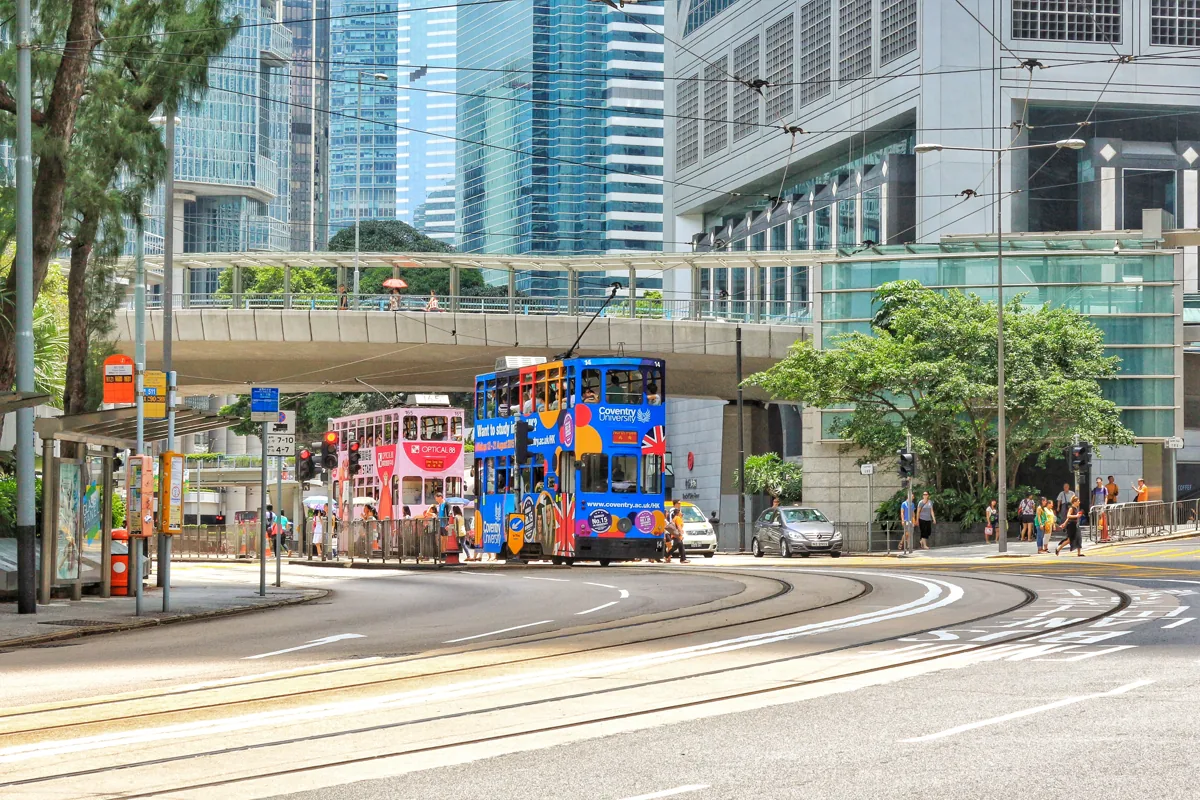
| Hong Kong | Harbor geography, hiking, film memory, food and vertical city life | Its distinct history, language environment, currency and border arrangements |
| Macau | Chinese temples, Portuguese urban layers, Macanese identity and compact walking | Use the travel guide for separate border and transport planning |
| Jiuzhaigou | Clear lakes, waterfalls, forest and a protected mountain valley | Give the park two days and follow current shuttle and boardwalk operations |
| Daocheng Yading | Sacred snow peaks, alpine lakes and demanding high-altitude routes | Acclimatize first and treat the shorter route as a complete experience |
| Zhangjiajie | Wulingyuan's sandstone pillars, forest valleys and the separate Tianmen Mountain vertical circuit | Protect two Wulingyuan days, give Tianmen its own day and choose the sleeping base for tomorrow morning—not for a vague “Zhangjiajie” label |
Three useful first-trip shapes
History and contemporary life: Beijing, Xi'an or Luoyang, then Shanghai. This route makes change visible rather than placing “ancient China” and “modern China” in separate boxes.
Food and neighborhood rhythm: Shanghai or Guangzhou, then Chengdu or Changsha. Chengdu rewards tea-house time and layered Sichuan flavor; Changsha combines rice-noodle mornings, Hunan heat, media culture and a city center that stays active late.
One region, seen slowly: Beijing with nearby excursions; Shanghai with Suzhou, Hangzhou or water towns; Chengdu with selected Sichuan destinations; Quanzhou within southern Fujian; or Dali as one carefully paced part of Yunnan. Depth often produces better memories than national coverage.
Seven to ten days is usually better with two principal bases than four. China is large enough to make an itinerary look elegant on a map and exhausting on a platform.
When to travel to China
China does not have one national travel season. Climate varies from tropical south to high plateau, desert, coast and cold northeast. Public holidays also change demand dramatically.
| Period | What to expect | Planning implication |
|---|---|---|
| Lunar New Year period | Family travel, closures and intense transport demand; dates change annually | Do not improvise major transport without understanding the holiday calendar |
| Early May and early October holiday periods | Heavy domestic travel around major public holidays | Read the Golden Week China field guide, book early or choose quieter local days and less famous destinations |
| Spring and autumn | Often comfortable in many cities, with strong regional variation | Popular routes can still be busy; check local weather rather than relying on a national summary |
| Summer | Heat, humidity and rain in many regions; school-holiday travel | Build rest into the day and consider altitude and sun exposure carefully |
| Winter | Cold in the north, milder conditions in parts of the south and fewer visitors in some places | Heating, daylight and weather disruption differ greatly by destination |
Festivals can deepen a journey, but they are not performances scheduled for tourists. Our Chinese festivals guide explains their calendar, family meanings and regional differences.
Trains, planes and the real scale of China
High-speed rail is one of the most useful ways to travel between major Chinese cities. It is comfortable, frequent on important routes and usually brings the traveler closer to the urban center than an airport. Yet “China has fast trains” does not mean every pair of destinations belongs in one short itinerary.
Use the official English-language Railway 12306 service or another reputable booking provider. Passenger details must match the passport. At many stations the passport serves as the identity credential connected to the booking, but procedures and available lanes can differ.
A calmer railway routine
- Confirm the station, not only the city. Large cities may have several major stations far apart.
- Arrive with time for identity checks, security and a long walk to the gate.
- Look for the train number as well as the destination.
- Keep the passport and booking information easy to reach.
- Check the carriage and seat before boarding; trains may stop only briefly.
- Carry food and water sensibly, but remember that many stations and trains sell refreshments.

Domestic flights remain useful for very long distances, plateau regions and routes poorly connected by rail. Compare the whole journey: transfer to the airport, check-in time, weather exposure and arrival distance. A four-hour train can be gentler than a shorter flight once the edges are included.
Getting around Chinese cities
Metro systems in large cities are generally efficient and often include English station names. Ticketing and security procedures vary. Rush hour is not the ideal moment to learn a new machine while guarding a large suitcase and your remaining dignity.
Taxis and ride-hailing are useful, especially beyond metro hours or with luggage. Save the destination in Chinese and confirm that the pin is at the correct entrance. Large compounds, railway stations and shopping centers may have several pickup zones separated by roads, floors or a surprisingly philosophical distance.
Buses can reveal a city beautifully, but route information is less accessible to a first-time visitor. Walking is essential and sometimes deceptive: blocks, crossings and gated compounds can make a nearby pin take longer than expected. Plan fewer appointments and allow cities to remain physically large.
Chinese food is part of the route
A traveler who eats only beside famous attractions learns less than someone who visits a breakfast shop, market or neighborhood restaurant. Food introduces climate, working hours, migration and local ideas about hospitality.
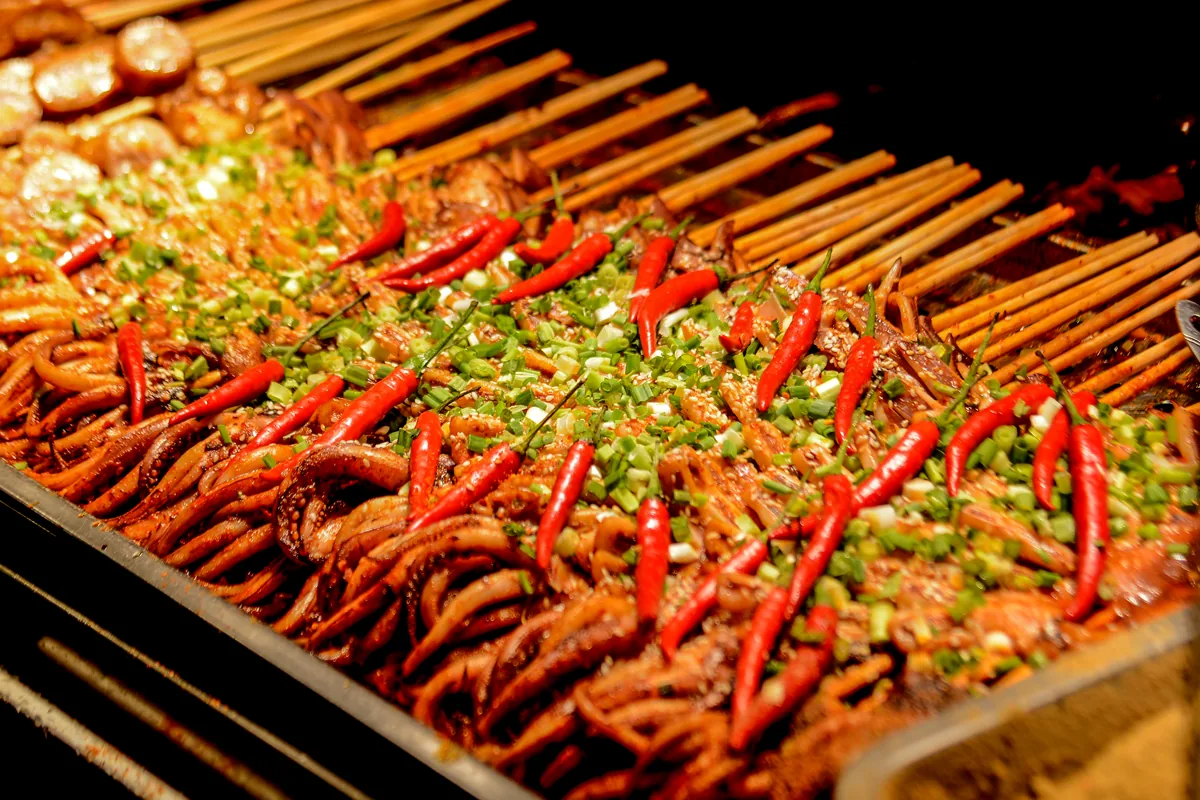
Begin with a regional question rather than a bravery test. Ask what people eat for breakfast, which ingredient is in season or how a familiar dish changes here. Chengdu should not be reduced to chili; Guangzhou is more than dim sum; Shanghai is more than sweetness; Beijing is more than roast duck.
Our Chinese food guide maps regional cuisines, staple grains and shared-meal culture. The Chinese tea guide follows another kind of hospitality, from an office thermos to a carefully prepared table.
Travel etiquette in China: attention is better than performance
Overseas guides sometimes turn Chinese etiquette into a minefield of forbidden gestures. That makes ordinary social life seem more rigid and exotic than it is. Region, age, relationship and setting matter. Contemporary Chinese people also disagree, tease one another and ignore supposed rules.
Useful etiquette begins with attention:
- Names and greetings: follow the formality offered to you. Do not assume every Chinese name follows the same order in every international context.
- Shared meals: wait a moment and observe how dishes are served. Use shared utensils when provided and do not rotate a turntable while someone is taking food.
- Hospitality: an offer of food or tea may be repeated warmly. Accept or decline clearly and kindly; you do not need to perform a ritual you do not understand.
- Public space: queue where a queue is forming, keep doorways and escalator exits clear, and notice that standards of personal space vary with crowding.
- Photography: ask before taking close portraits, photographing children, entering private courtyards or recording worship and ritual.
- Temples and heritage sites: obey signs, lower your voice where appropriate and distinguish an active religious space from a decorative attraction.
- Tipping: it is not a universal everyday expectation in mainland China, although practices may differ in international hotels, private tours and other service contexts.
The best cultural preparation is not memorizing that one number is lucky or one color means celebration. It is understanding that symbols change with context, people are not representatives appointed to explain a civilization, and curiosity becomes respectful only when it can also listen. Our Chinese culture guide begins from that living, changing ground.
Beyond the famous landmarks
The Great Wall may be unforgettable. So may the moment after dinner when a neighborhood square fills with dancers, the ferry deck in Shanghai, rain on a Chengdu tea-house roof or an elderly passenger making sure you do not miss your stop.

Historical architecture deserves context rather than costume. Some sites preserve old fabric; others contain extensive restoration or reconstruction; many combine both. Ask what period you are seeing, what has changed and how local people use the place now. The Chinese architecture guide explains courtyards, timber structures, gardens and the movement of bodies through space.
Travel also changes when the camera is lowered. Buy fruit without turning the transaction into content. Sit in a park without collecting a lesson. Let a street remain ordinary. A culture becomes visible not only when it performs its difference, but when people are allowed to continue their afternoon.
A realistic ten-day China itinerary
This example balances orientation with breathing room rather than promising complete coverage.
| Day | Base and focus | Why it works |
|---|---|---|
| 1 | Arrive in Beijing; neighborhood walk | Recovery, payment testing and orientation before major sights |
| 2 | Central Beijing and palace history | One concentrated historical day with time to walk |
| 3 | Temple, park and hutong context | Public life balances monumental architecture |
| 4 | Great Wall excursion | A full day without stacking another distant attraction |
| 5 | High-speed train to Shanghai | The journey itself reveals distance and infrastructure |
| 6 | Bund, ferry and historic urban fabric | Architecture read from both sides of the river |
| 7 | Museum, design district or contemporary art | Modern China enters the itinerary as more than a skyline |
| 8 | Suzhou, Hangzhou or a slower Shanghai neighborhood day | Choose one excursion, not all of them |
| 9 | Food, market and personally chosen interest | Space for the trip to become yours |
| 10 | Departure with a generous transport margin | Final days should not depend on perfect traffic |
Swap Shanghai for Chengdu if tea houses, Sichuan food and a slower neighborhood rhythm matter more than the east-coast urban contrast. Swap Beijing for a southern base only if imperial history is not central to your first trip. An itinerary is an argument about attention; make one you actually believe.
Frequently asked questions about travel to China
Do I need a visa to travel to China?
It depends on your passport, destination, route, length of stay and date of travel. China has several visa-free arrangements and transit policies, but they are not interchangeable. Confirm your exact circumstances with China's National Immigration Administration, the Chinese embassy or consulate responsible for your residence, or the official Chinese Visa Application Service Center before booking non-refundable travel.
Can foreign visitors use Alipay or WeChat Pay in China?
Many overseas visitors can register and link eligible international bank cards to Alipay or WeChat Pay, although identity checks, card issuers, transaction limits and merchant support can vary. Carry a physical bank card and some renminbi cash as backups instead of depending on one app.
Is cash accepted in China?
Renminbi cash remains legal tender, but some small merchants may have limited change because mobile payment is common. Use sensible denominations and combine cash with another payment method.
What are the best cities for a first trip to China?
Beijing is strong for imperial history and monumental urban scale; Shanghai for architecture, design and contemporary city life; Xi'an or Luoyang for older historical layers; Chengdu for neighborhood pace and Sichuan culture; and Hong Kong for a distinct southern and international urban experience. The best combination depends on what you want to feel, not how many landmarks you can collect.
How do tourists book trains in China?
Travelers can use the official Railway 12306 website or app and other reputable booking services. Enter the passenger name exactly as it appears in the passport, use the correct document number and allow extra time at the station for security and platform finding.
Is China difficult to travel around without speaking Chinese?
Major airports, railway stations, hotels and central attractions often provide some English signage, but coverage varies. A translation app, saved Chinese addresses, screenshots of bookings and patience make independent travel much easier.
What should I avoid doing as a tourist in China?
Avoid treating people as scenery, photographing faces or worshippers without consent, assuming one local custom represents all of China, or arguing that an online stereotype matters more than what people tell you about their own lives. Observe first, ask when unsure and leave room for regional and generational difference.
Travel slowly enough to be changed
The practical systems are learnable. Entry rules can be checked. Payments can have backups. A railway station that feels like a small country on day one becomes readable after the first journey. A few Chinese words and saved addresses remove a surprising amount of anxiety.
What cannot be optimized is the encounter itself. China is too large, internally varied and rapidly changing to become a finished conclusion after one trip. That is not a failure of planning. It is the reason to go with care.
Arrive prepared, but not already certain. Notice who is living beside the landmark. Eat something ordinary. Ask a better second question. Leave a day with fewer plans than your ambition thinks necessary. The country will still be larger than the story you take home, and your story will be better for admitting it.
Editorial note: This is original East Moment writing shaped by Lijun's forty years of lived experience in China. Entry, payment and transport details were fact-checked against official services on July 29, 2026; travelers should recheck time-sensitive rules before departure.