To travel to Lijiang well, design the trip around elevation and distance, not around the number of attractions you can save to a map. Dayan Old Town, Baisha, Shuhe and Jade Dragon Snow Mountain form a north-south sequence, but they should not be compressed into one exhausting photo run.
This is the practical trip-planning page. Read the Lijiang culture guide for the deeper story of Naxi history, Dongba manuscripts, Mu family rule, mountain trade and the old town's water system.
Start from the Chinese cities travel hub if Lijiang is one stop in a longer route. Here the decision is narrower: how to sequence this one destination without wasting the first day, exhausting the mountain day or booking a beautiful room that a car cannot reach.
The UNESCO Old Town of Lijiang record confirms the linked heritage areas and their cultural landscape. It does not provide live ticket rules, cable-car status or a personal altitude forecast, so verify those close to departure.
Travel to Lijiang at a glance
| Travel decision | East Moment recommendation |
|---|---|
| Ideal first stay | 3 full days; 4 if arriving from low elevation or planning a mountain excursion |
| Best first base | Near Dayan Old Town, but outside its loudest bar and shopping lanes |
| Strongest route | Dayan and its water system, then Baisha and Shuhe, then a weather-dependent mountain day |
| Best for | Urban landscape, Naxi cultural context, mountain light, photography and slower Yunnan travel |
| Main mistake | Treating every old-looking lane as timeless or putting the highest-altitude excursion immediately after arrival |
Choose your route through this guide
| If you need... | Start with... |
|---|---|
| A first-trip plan | Geography, trip length and the four-day sequence |
| Cultural context | Naxi culture and tourism in modern Lijiang |
| Photography advice | The old town by hour and the northern plain |
| A quieter experience | Baisha, Shuhe and the residential edges of Dayan |
| Mountain planning | Jade Dragon Snow Mountain, altitude and weather |
Geography should decide your Lijiang itinerary
Dayan, usually called Lijiang Old Town, is the central visitor base. Shuhe and Baisha lie farther north, on the broad approach toward Jade Dragon Snow Mountain. That geography creates a sensible progression: understand the old city first, move outward through settlements with different relationships to tourism, then decide whether your body and the weather support a high mountain day.
Do not automatically combine Jade Dragon Snow Mountain, Blue Moon Valley, Baisha and Shuhe because a tour advertises them together. Transfers, ticket procedures, queues and elevation can turn that plan into a day spent looking at the clock. One coherent landscape day is more memorable than four hurried stops.
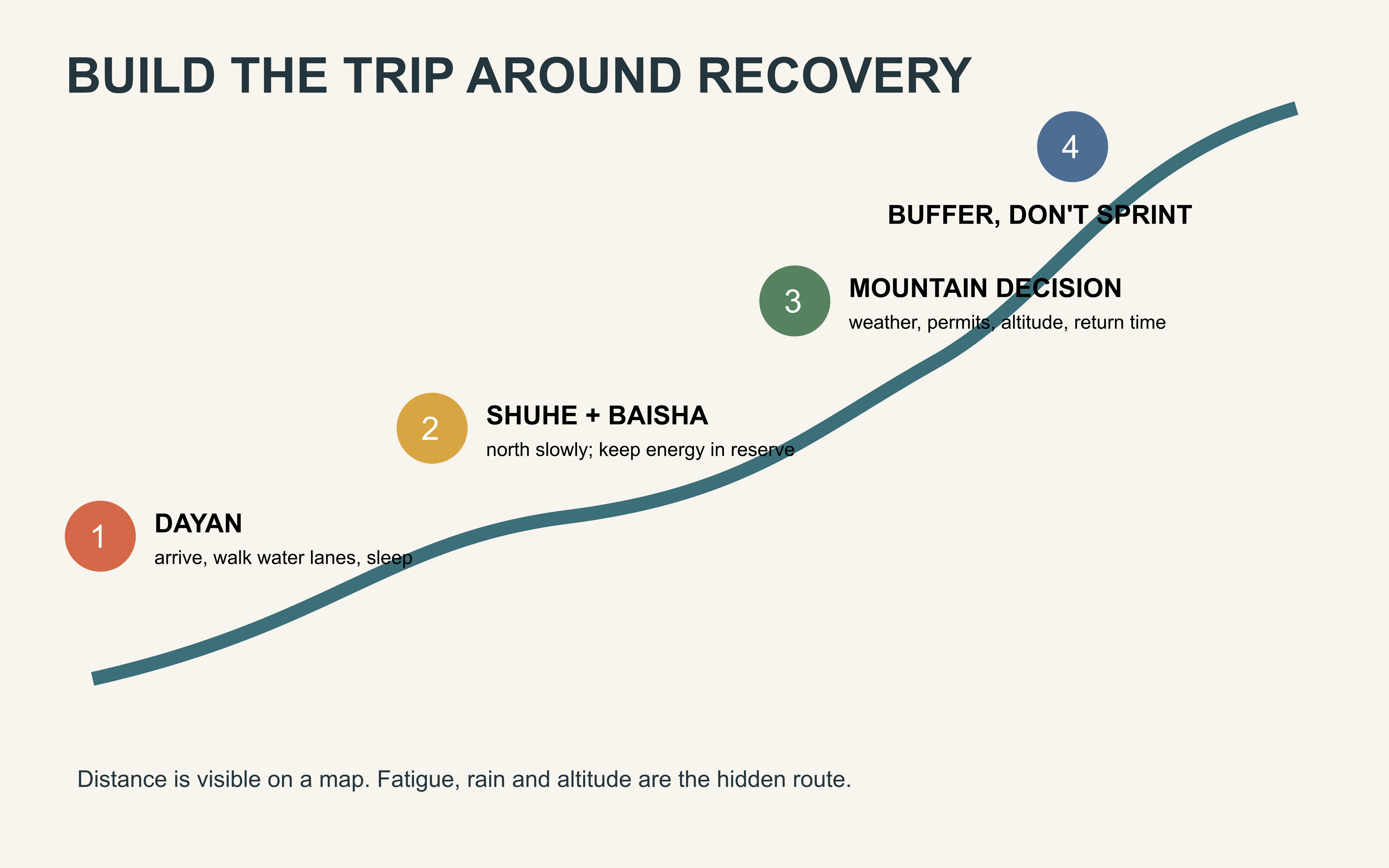
Use this as a planning sequence rather than a scale map; weather and altitude should decide the final mountain day.
Essential Lijiang experiences
Dayan Old Town: follow water before following shops
Enter the old town early, when delivery work, washing, breakfast and school routines are still visible. The canals are not decorative borders. Their branching pattern helped organize movement, household use and fire protection. Look at how channels divide, how bridges change street direction and how buildings turn toward water.
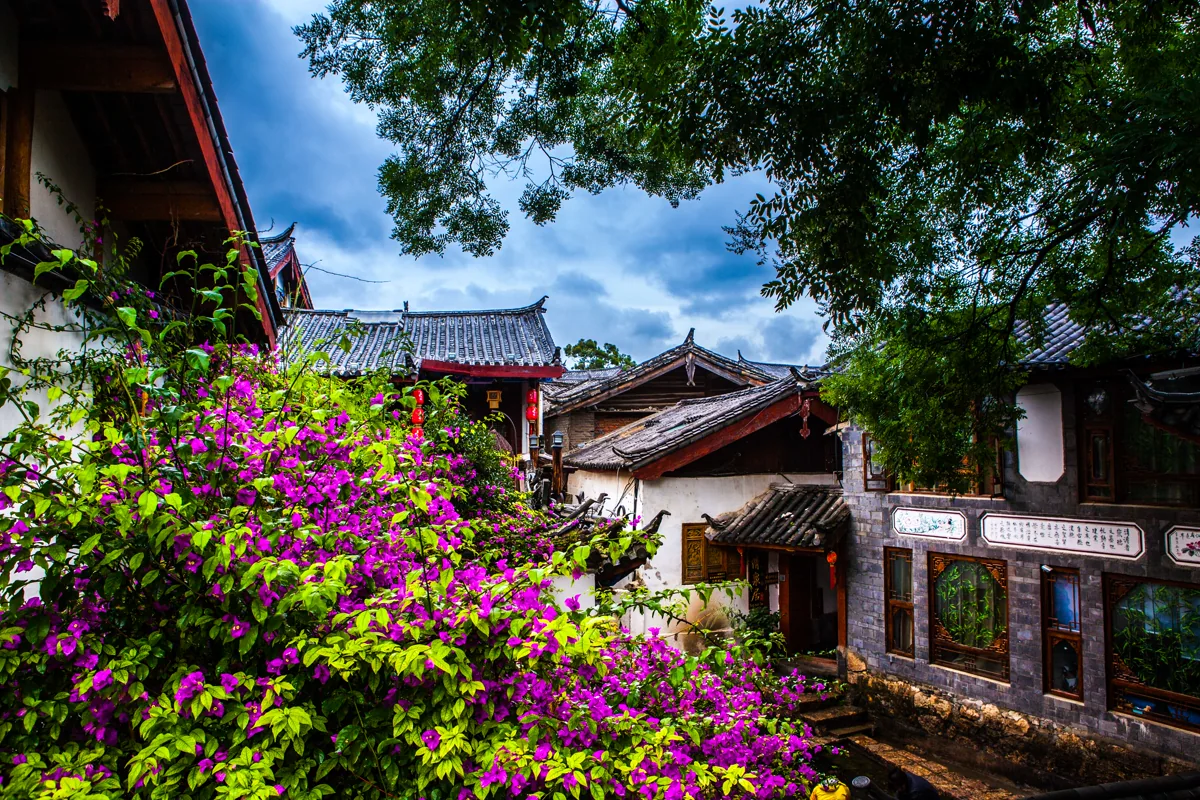
Later in the day, commercial Lijiang takes over. That does not make the town "fake," but it changes what can be observed. Instead of judging every shop, compare the busiest routes with residential edges and ask which activities are serving residents, visitors or both.
Lijiang changes character by the hour
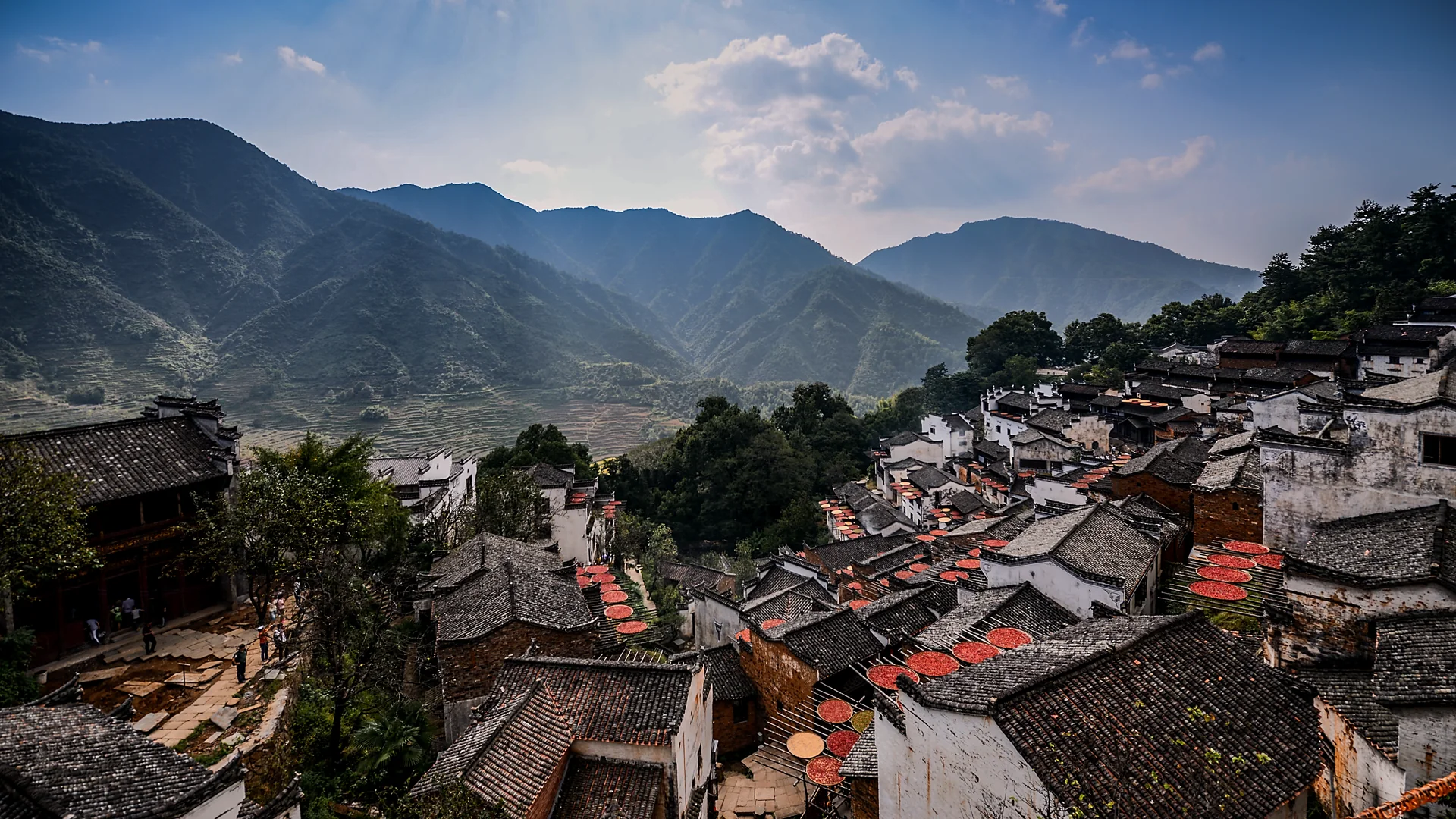
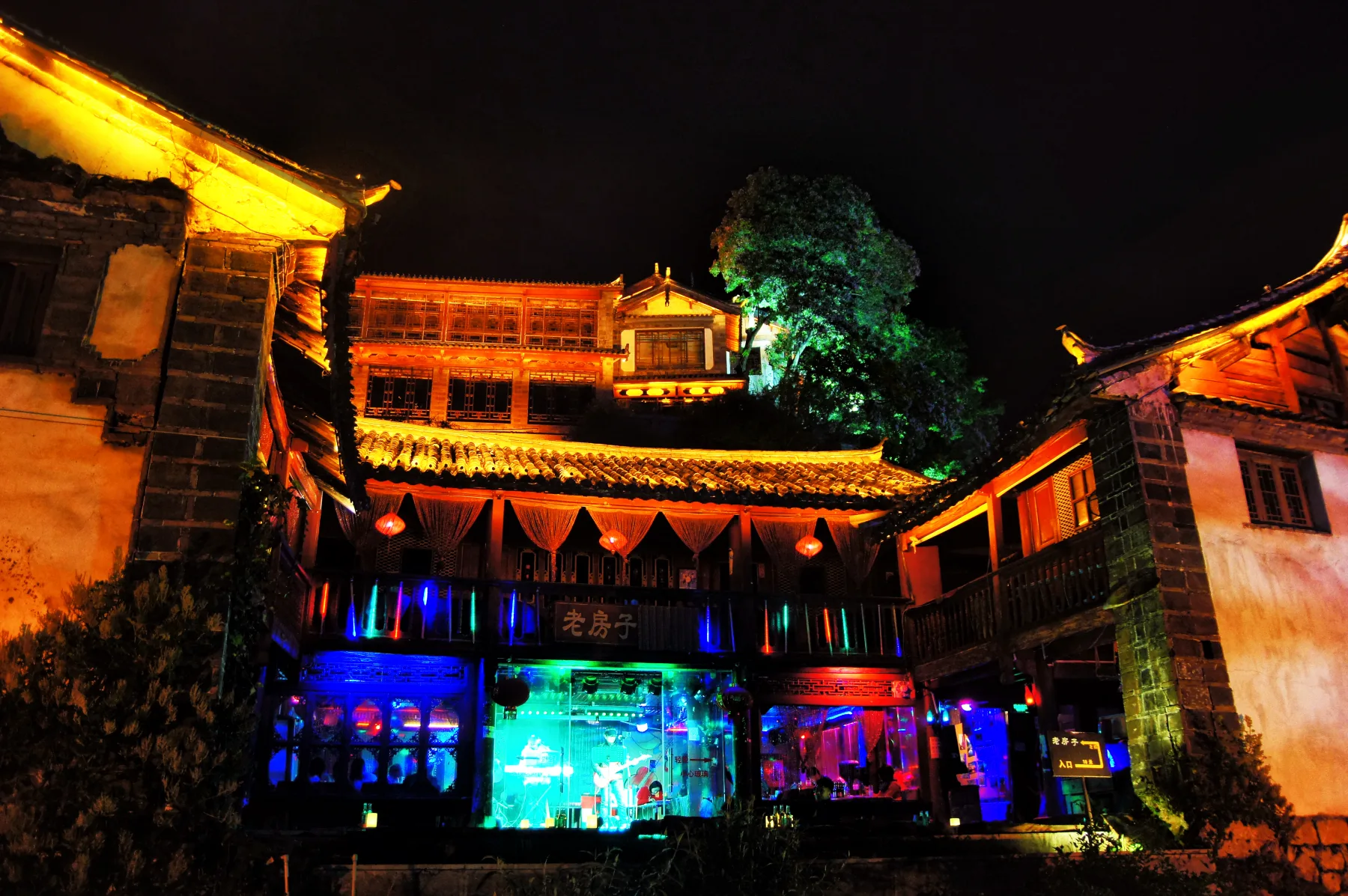
Many visitors describe Lijiang as if it has one permanent atmosphere. In reality, the old town is several different places during a single day. Before breakfast, it is a working settlement: shutters rise, deliveries arrive, residents cross the lanes and water moves through streets that are still readable as infrastructure. By late morning, tour groups and portrait photography begin to dominate the best-known routes. In the evening, restaurants, bars and illuminated facades create a deliberately theatrical city.
None of those versions is the whole truth. The useful travel decision is therefore not simply which attraction to visit, but when to encounter each part of town. Walk the central water network soon after sunrise. Use the busiest part of the day for a museum, Mufu or lunch. Return to the lanes near dusk, then decide whether the night economy interests you or whether you would rather leave the commercial center and look back at it from a quieter edge.
This time-based approach also improves photography. Morning light reveals stone texture, rooflines and everyday movement without requiring strangers to become the subject. Evening shows how heritage is staged and sold. Photographing both gives a more honest account than producing only an empty dawn fantasy or only a neon nightlife reel.
A useful observation exercise
Choose one bridge or canal junction and pass it three times: early morning, mid-afternoon and after dark. Notice who occupies the space, what is being transported, which sounds dominate and how the same building changes function. That small comparison explains contemporary Lijiang better than rushing through ten nearly identical souvenir streets.
Give Mufu and Black Dragon Pool different jobs
Mufu is useful for understanding the political position of the Mu family and for seeing the old town from above, but much of the visible complex is modern reconstruction. Treat it as historical interpretation, not untouched Ming architecture.
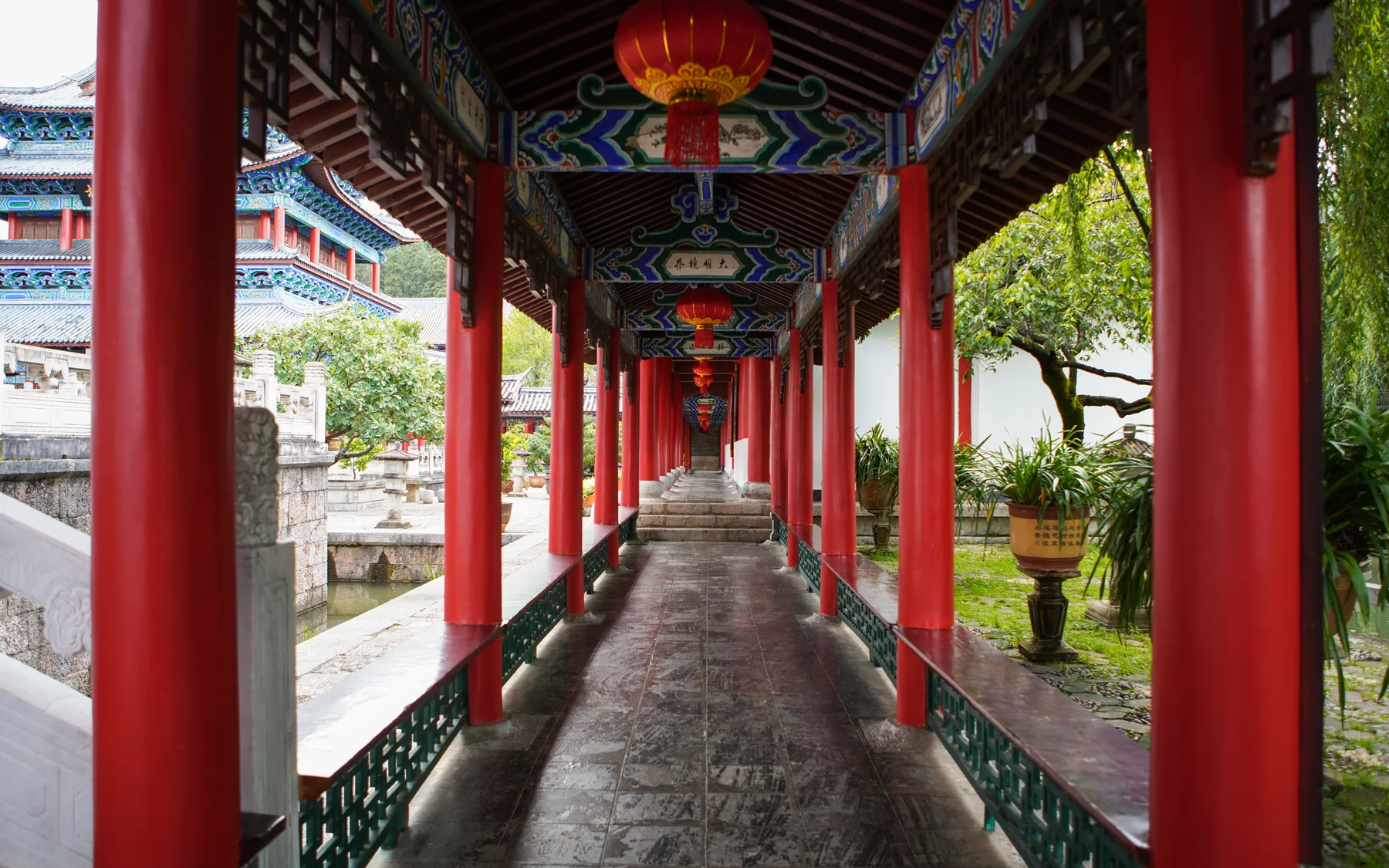
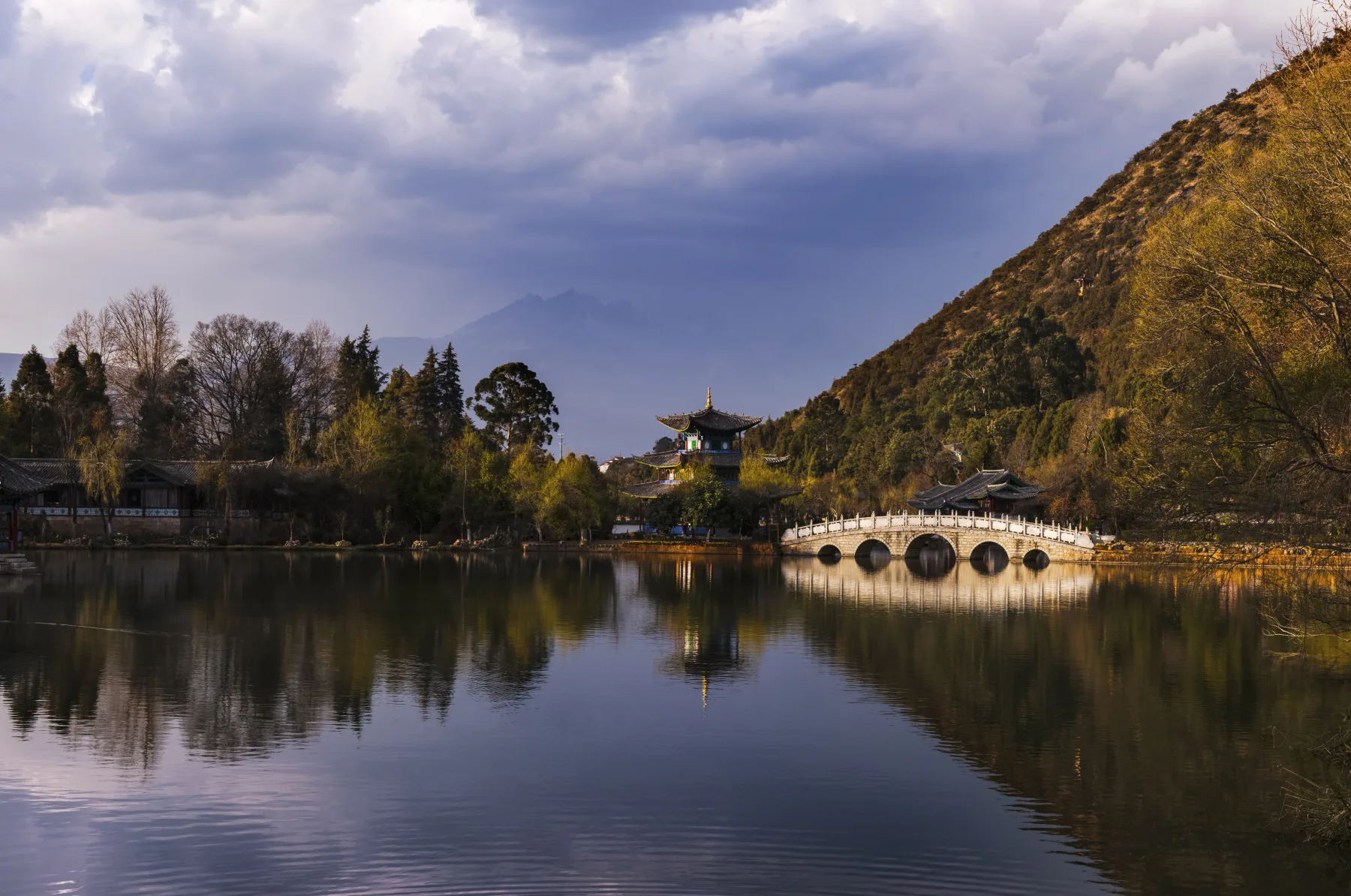
Black Dragon Pool works differently. It gives distance from the dense lanes and, in clear weather, a strong relationship between water, park architecture and the mountain skyline. It is best paired with a walk rather than inserted as a five-minute photo stop.
Read the old town as a living system, not a preserved object
Lijiang's heritage status encourages visitors to look for an "original" city hidden behind modern commerce. That search can become misleading. Timber buildings have been repaired, adapted and reconstructed over generations; earthquakes, fire risk, tourism investment and changing household needs have all shaped what is visible now. A heritage city survives through management and continued use, not through perfect physical stillness.
The better question is how the system holds together. Follow water downhill and watch how channels split. Look for changes in paving where major routes meet smaller residential lanes. Compare an inward-facing courtyard with a shopfront opened toward visitor traffic. Notice where vehicles stop and handcarts or porters take over. These details show the negotiation between historic form and contemporary logistics.
Do not assume that a lane is more "authentic" merely because it is quiet, worn or occupied by older residents. Quietness may reflect time of day, property use or distance from the commercial circuit. Authenticity is not a visual filter. It is the more demanding task of asking what evidence supports the story you are telling about a place.
This is also why staying just outside Dayan can be instructive. Walking into the old town each morning reveals the boundary between vehicle-oriented modern Lijiang and the pedestrian heritage core. The transition makes the old town's scale and operational constraints much clearer than sleeping in its center and treating everything beyond the gate as irrelevant.
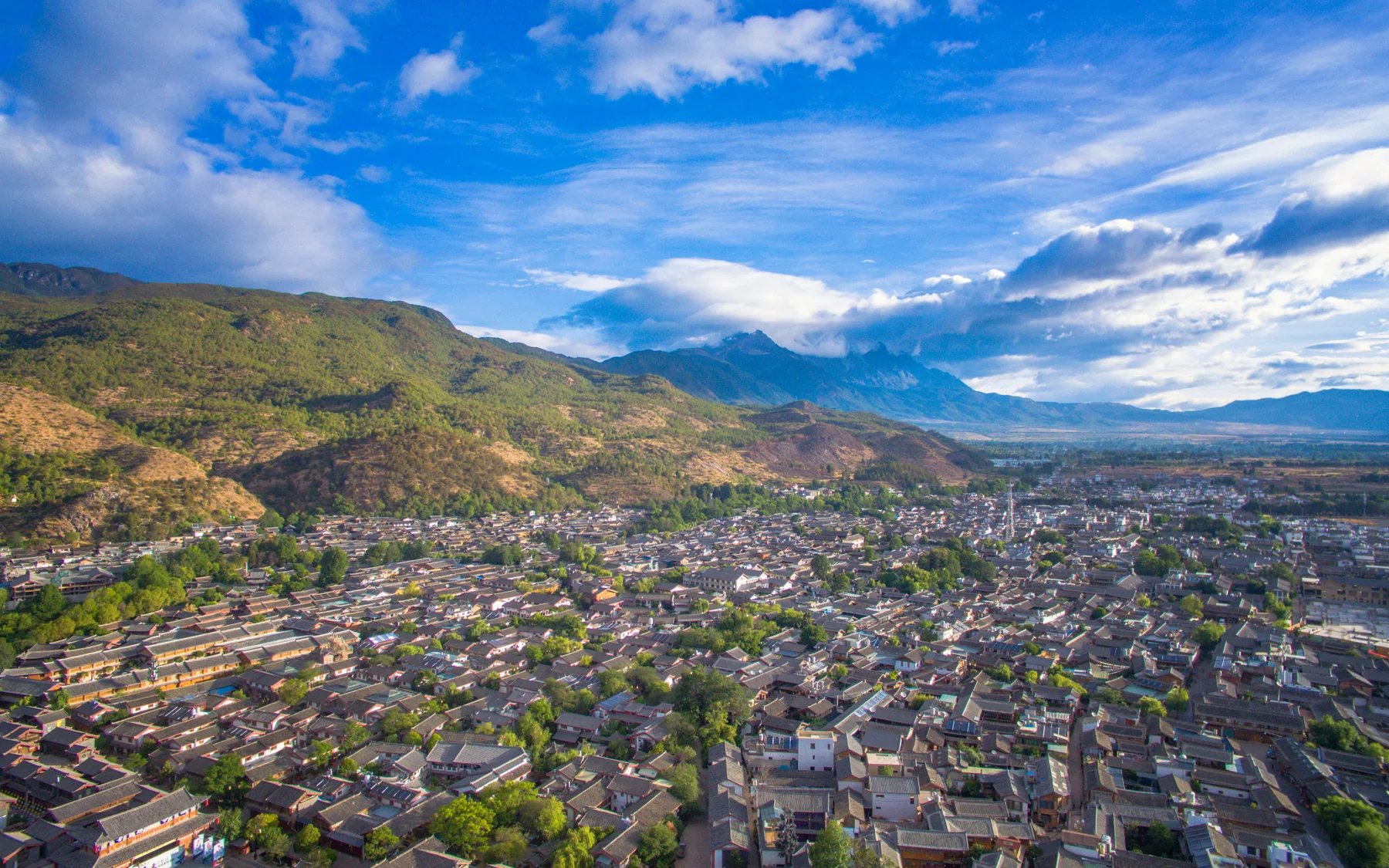
Baisha and Shuhe are not interchangeable "quiet old towns"
Baisha gives the clearest opportunity to connect the northern plain, Naxi history and the mountain landscape. Shuhe has a long relationship with travel and trade and now has extensive visitor infrastructure. Both are commercialized in places; neither should be marketed as a pure village that tourism somehow forgot.
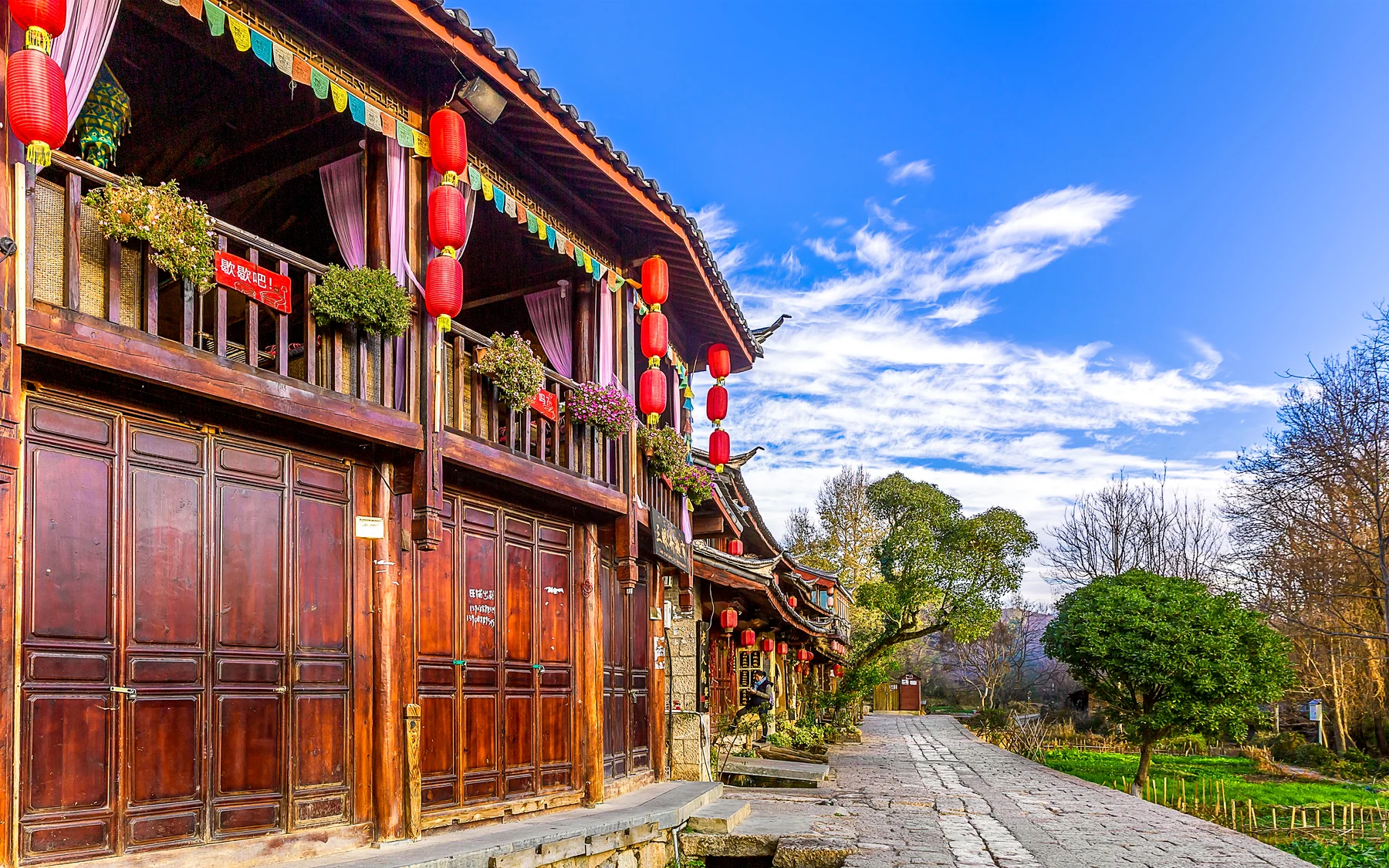
Choose Baisha if you want a more focused cultural and landscape day. Choose Shuhe if you want easier cafes, a long walk and a gentler extension of the old-town experience. With four days, visit both slowly and compare how streets, shops and public space respond to tourism.
The northern plain is the key to understanding the city
Dayan can make Lijiang feel like an enclosed world of water lanes and tiled roofs. The journey north corrects that impression. As the urban fabric loosens toward Shuhe and Baisha, the mountain becomes more dominant, roads widen, cultivated land and newer construction appear, and the relationship between settlement and landscape becomes easier to read.
Treat the route as a transect rather than a transfer. A transect is a line through different environments that allows comparison. Starting in central Lijiang, moving through Shuhe and continuing toward Baisha shows how one tourism region contains several levels of commercialization, mobility and visual control. It also explains why a short map distance can require more time than expected: the interest lies between the named stops, not only at their gates.
Baisha is especially valuable when approached as part of this wider plain. The village should not be reduced to one photogenic street or a distant mountain backdrop. Spend time looking at how older lanes meet new cafes, how local services coexist with visitor businesses and where the settlement opens toward fields and surrounding peaks. When a site or mural hall has access restrictions, follow the posted rules rather than building the entire visit around one promised image.
Shuhe offers a different lesson. It demonstrates how a settlement associated with older travel networks can become a mature visitor district with accommodation, dining and leisure infrastructure. Its convenience is real; so is its commercialization. Comparing the two places without declaring one "real" and the other "ruined" produces a more useful understanding of how tourism develops unevenly.
Naxi culture requires more than a costume photograph
Dongba pictographs are visually memorable, but they belong to a specialized ritual and manuscript tradition. A symbol printed on a souvenir is not the same thing as understanding who reads a manuscript, how knowledge is transmitted or how Naxi identity changes in a tourism economy.
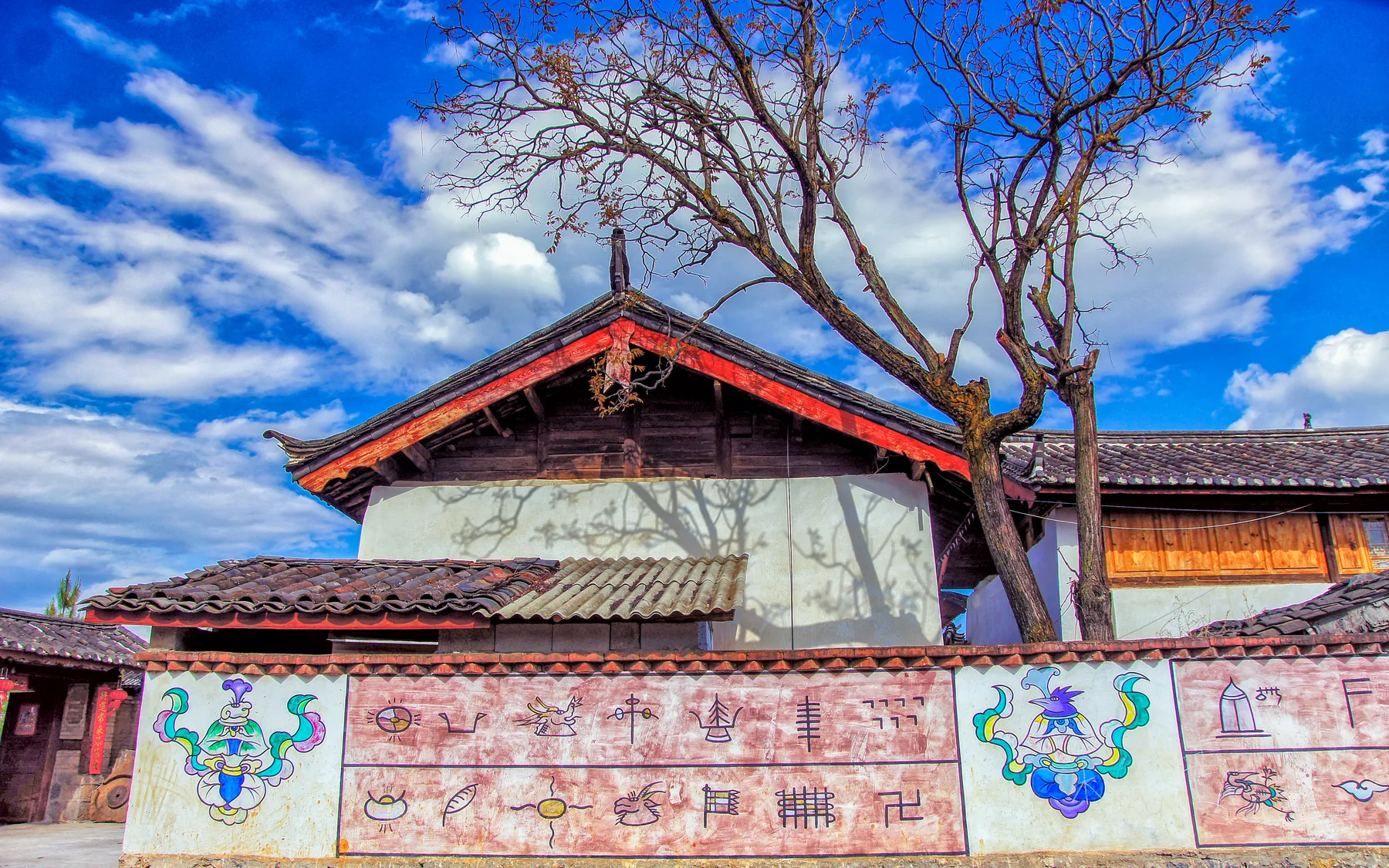
Use a museum, documented cultural center or careful local guide to establish context. Ask before photographing people closely, especially during ceremonies or performances. The point is not to avoid cultural tourism; it is to participate without turning a living community into visual property.
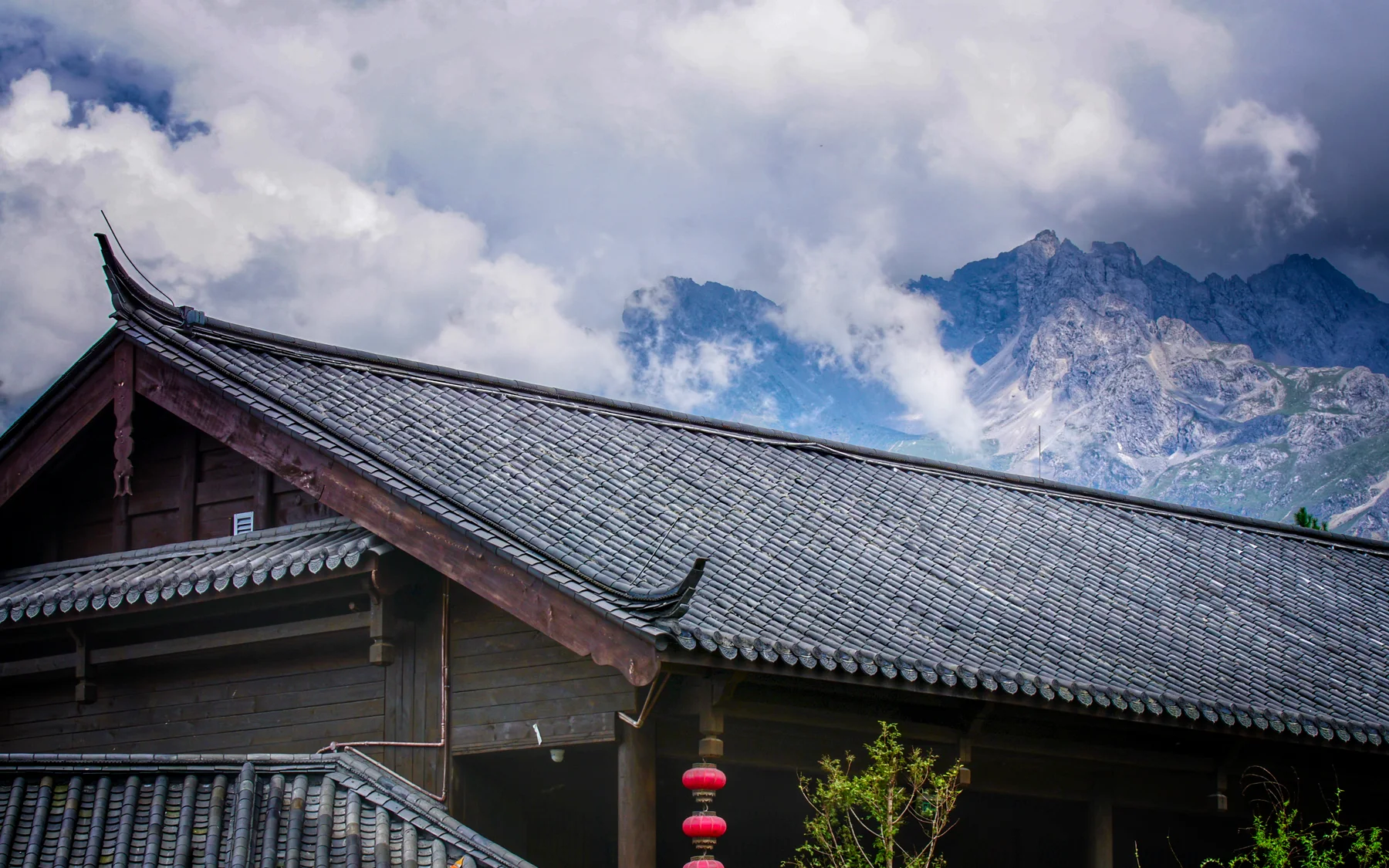
Tourism is part of modern Lijiang, not an interruption to it
It is easy to write about Lijiang through a before-and-after story: an intact old town existed, tourism arrived, and authenticity disappeared. The reality is more complicated. Tourism has altered rents, employment, retail, architecture, migration and the rhythms of public space. It has also funded conservation, created livelihoods and connected Lijiang to a much larger national and international audience. The results are uneven rather than purely good or bad.
For a traveler, this matters because disappointment often begins with the wrong expectation. If you arrive looking for an untouched minority town, crowds and chain-like souvenir shops will feel like evidence that the trip has failed. If you arrive ready to study how a famous heritage destination manages popularity, the same streets become more revealing. You can compare standardized storefronts with family-run businesses, observe which cultural symbols are repeated for visitors and ask what forms of local life remain visible outside peak hours.
Spend money in ways that support the experience you value. A documented museum, a knowledgeable guide, an independently run meal or a carefully chosen craft purchase usually creates more meaningful contact than buying several objects whose origin you cannot establish. Do not pressure a seller to perform cultural identity, and do not assume that every person wearing traditional clothing is available for photography.
The goal is not to achieve a morally perfect trip. It is to recognize that your choices help shape the economy you are observing. Lijiang becomes more interesting when tourism itself is treated as part of the city's present tense.
Let sound, water and elevation organize the visit
Lijiang is unusually easy to experience through more than sight. Water changes volume as channels narrow or pass beneath buildings. Stone paving changes the sound of footsteps. Music from commercial streets fades quickly once a route bends toward a residential edge. At the same time, the mountain remains a visual orientation point whenever weather and street alignment allow it.
Use those signals when you feel lost. Rather than checking a phone at every intersection, follow one channel for ten minutes, note whether the ground rises or falls and listen for the shift between commercial and residential space. This does not replace navigation; it turns navigation into part of the experience.
Elevation should also shape daily pace. Lijiang itself is already high enough for some arrivals to notice dry air, stronger sun, disturbed sleep or unusual fatigue. A traveler who treats the first afternoon as a competition may mistake physical stress for dislike of the city. Build in an unambitious arrival walk, drink water, protect against sun and postpone heavy alcohol or strenuous activity. The reward is not only safety. A slower first day makes the old town's small-scale details visible.

Jade Dragon Snow Mountain is a full planning decision
The mountain rises far above Lijiang, and visitor routes can reach elevations where some travelers feel significant effects. Weather changes quickly, cableway operations and access arrangements can change, and the clearest morning is not guaranteed.
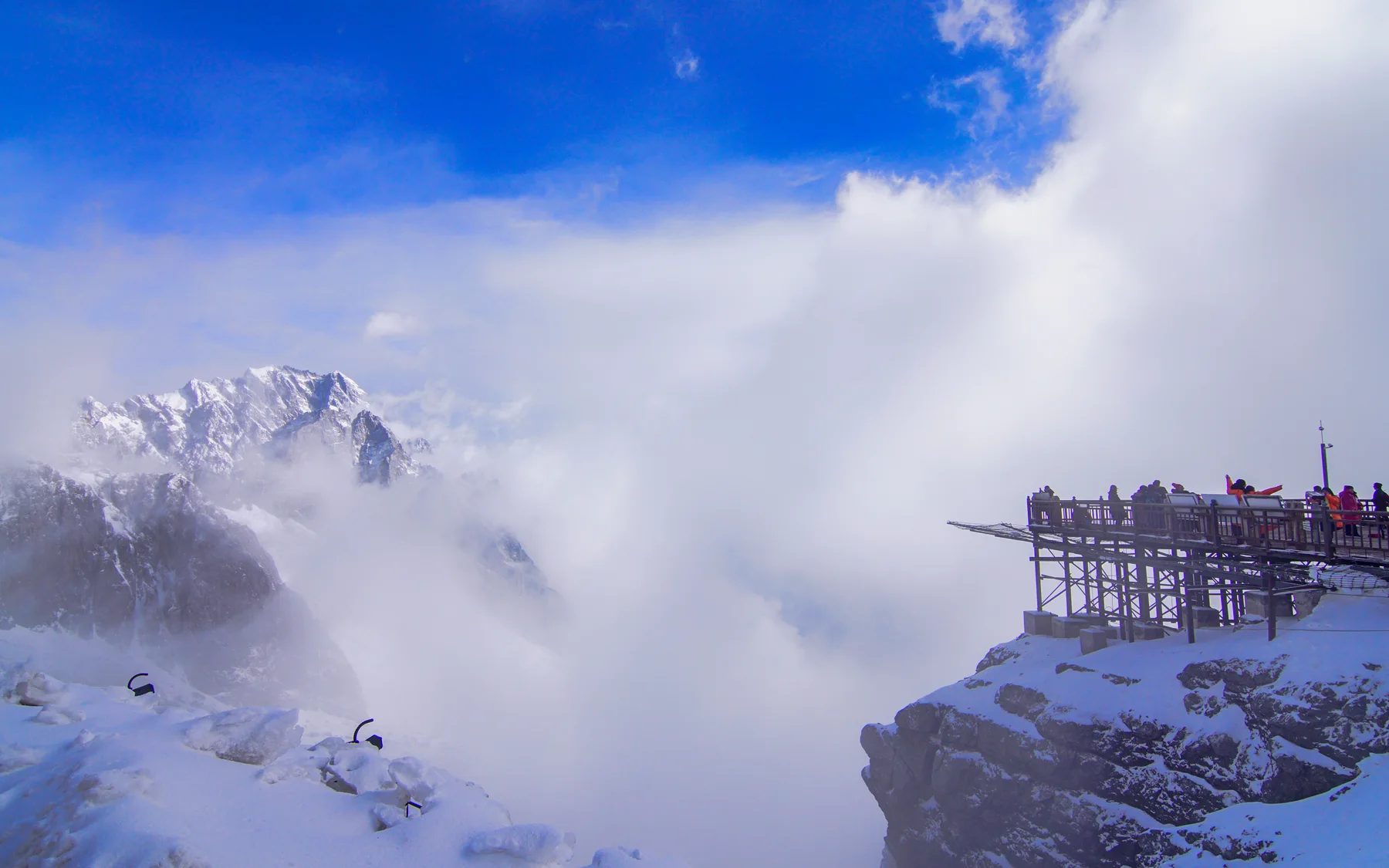
Schedule the mountain after an easier arrival day. Sleep, hydrate, avoid heavy drinking the night before and do not use bottled oxygen as permission to ignore symptoms. Travelers with medical concerns should seek professional advice before high-altitude excursions. If conditions are poor, keep a city or Baisha alternative rather than forcing the booking to justify itself.
Tiger Leaping Gorge is another serious landscape journey, not a spare afternoon in Lijiang. Transport, trail choice, weather and accommodation deserve a separate plan.
Choose your version of Lijiang
What most guides get wrong
They treat Dayan, Shuhe, Baisha and the mountain as items in one attraction list. They are different environments requiring different times, expectations and physical effort. The strongest trip is built around contrast, not completion.
Lijiang works best for travelers who enjoy comparing landscape, urban form and cultural representation. It is strong for photographers willing to work with changing light, for first-time Yunnan visitors who need accessible infrastructure and for travelers continuing toward places such as Dali or Shangri-La. It is less satisfying for anyone expecting solitude in the central old town or trying to complete every famous viewpoint in two rushed days.
Before booking, rank four possible priorities: heritage streets, Naxi cultural context, mountain scenery and nightlife. The ranking changes the entire trip. Heritage and cultural context favor early mornings, museums and time in Baisha. Mountain scenery requires weather flexibility and physical caution. Nightlife favors a central base but conflicts with quiet sleep. Trying to maximize all four usually produces poor decisions.
| If your priority is... | Give more time to... | Accept this tradeoff |
|---|---|---|
| Old-town atmosphere | Dawn and late-afternoon walks in Dayan | Midday streets can feel crowded and commercial |
| Naxi cultural context | Museums, Baisha and a well-researched guide | The trip becomes slower and less checklist-driven |
| Mountain landscape | A flexible Jade Dragon Snow Mountain day | Weather may force a last-minute change |
| Cafes and easy leisure | Shuhe and central visitor districts | Convenience comes with heavier tourism infrastructure |
| Quiet photography | Residential edges and early starts | You must respect privacy and cannot stage every scene |
Making this decision in advance prevents a common mistake: blaming the city because one highly commercial district did not deliver an experience it was never designed to provide.
Travel companions should make the ranking separately before comparing answers. One person may imagine quiet heritage walks while another expects nightlife and a major mountain excursion. Those preferences require different sleep locations, wake-up times and spending priorities. Resolve the conflict before booking a courtyard room inside the busiest lanes. Lijiang is flexible enough to satisfy several interests, but only when the group accepts that people may separate for part of a day and meet again for a meal. A trip becomes deeper not because every hour is shared, but because each traveler has enough time to observe what genuinely brought them to the city.
Choose the right number of days
| Trip length | A realistic Lijiang route | What to leave out |
|---|---|---|
| 2 days | Dayan early and late; one day for Baisha plus Shuhe | The high mountain unless it is your overriding priority |
| 3 days | Dayan; Baisha and Shuhe; one mountain or cultural landscape day | Tiger Leaping Gorge and long county-level excursions |
| 4 days | Add weather flexibility, a museum, slower neighborhood time or separate Baisha and Shuhe days | Trying to turn all of northwest Yunnan into day trips |
A strong four-day sequence
- Arrive, rest and walk Dayan's water network without a shopping checklist.
- Visit Mufu or a museum, then continue to Black Dragon Pool and a quieter edge of town.
- Travel north through Baisha and Shuhe, allowing time to compare rather than rank them.
- Take a pre-arranged mountain day if health and weather are suitable; otherwise use the day for deeper cultural context.
Where to stay in Lijiang
Stay inside Dayan if atmosphere after dark matters most and you can manage stone lanes, luggage and possible noise. Stay just outside the old town for easier vehicle access, quieter sleep and short walks into the historic area. Shuhe can suit travelers who prefer a slower base, but it adds transport time for central Lijiang sights.
Before booking, ask whether a car can reach the entrance, how far luggage must be carried and whether the room has reliable heating or cooling for your season. A romantic courtyard is less romantic when a suitcase must cross wet stone steps at midnight.
What to eat without turning dinner into another checklist
Build meals around contrast: a simple bowl or chickpea jelly, a Naxi-style meal, seasonal Yunnan vegetables and, if appropriate, mushrooms from a reputable kitchen. Preserved foods and robust flavors reflect climate, storage and movement through the mountain region.
Wild mushrooms can cause serious poisoning when misidentified or undercooked. Eat them only through knowledgeable, responsible kitchens and follow local safety guidance. For a wider regional frame, continue with our guide to Pu-erh tea or compare Lijiang with the very different urban rhythm of Dali.
When to go and what to prepare
Spring and autumn often offer comfortable walking, but popular holiday periods bring heavy crowds. Summer rain changes paths and views; winter can deliver clear mountain light alongside cold mornings and nights. Conditions vary by elevation, so a city forecast is not enough for a mountain excursion.
Save hotel and attraction names in Chinese, carry your passport where required and confirm real-name ticket procedures close to the visit. Our Travel to China guide covers mobile payment, rail booking and connectivity. Lijiang adds three local priorities: altitude, luggage access and enough time to let the landscape make sense.
Frequently asked questions about travel to Lijiang
How many days do I need in Lijiang?
Three full days cover Dayan Old Town, Baisha or Shuhe and one carefully planned mountain day. Four days is better if you are arriving from low elevation, want both northern settlements or prefer weather flexibility.
Is altitude a concern in Lijiang?
Lijiang is at significant elevation, and higher excursions rise much further. Responses vary; rest, hydrate, avoid overexertion on arrival and seek medical advice for individual risk or symptoms.
Is Lijiang Old Town too touristy to visit?
It is heavily visited and commercialized, but its water system, urban form and living communities still deserve attention. Early mornings and respectful exploration beyond the busiest lanes create a more balanced visit.