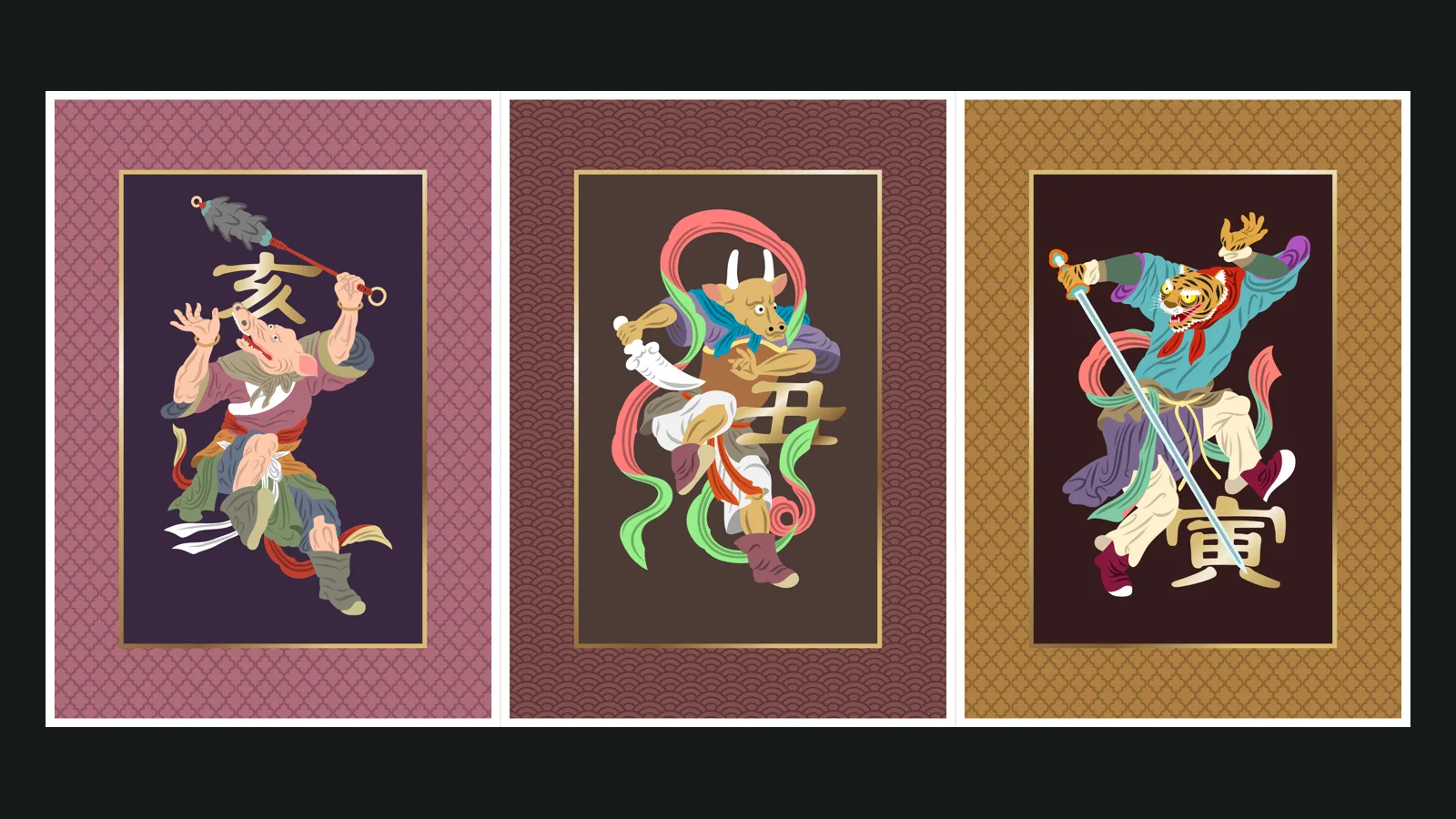
Chinese Zodiac: Meet the 12 Animals and Find Your Sign
Find your Chinese zodiac animal correctly, learn all 12 signs and understand birth-year boundaries, Earthly Branches, folklore and living traditions.
Read the deep guide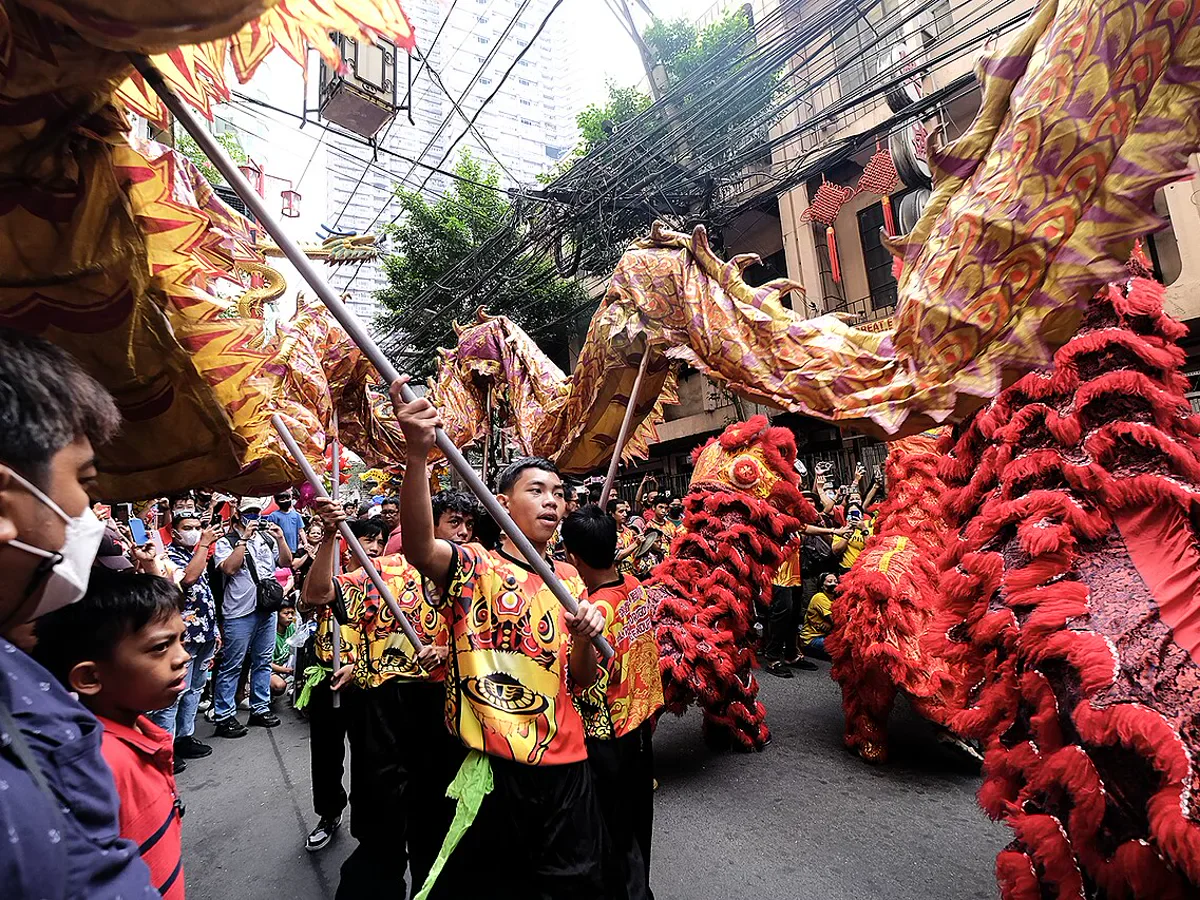
Object · sound · occasion · changing meaning
A contextual guide to symbols as they appear in homes, art, gifts, architecture and celebrations.
Read the symbol in context29 published guides across 5 core paths.
Keep the symbol attached to its object
A dragon, bat, lotus, color or number does not carry one portable definition. Read the visible object, the sound or wordplay, its companion motifs, the occasion and the period together. Context turns decoration into evidence and stops a search result from becoming superstition.
Published guides, organized by intent
A collection page must do more than list recent posts. Choose the question that brought you here, open a focused guide, then keep moving through works, people and related cultural context without returning to search.
5 published guides
Begin with the branch-and-year system, then check date boundaries, elements and compatibility folklore. The animal is memorable; the calendrical structure is what keeps the answer from becoming a random internet label.
Find your Chinese zodiac animal correctly, learn all 12 signs and understand birth-year boundaries, Earthly Branches, folklore and living traditions.
Read the deep guide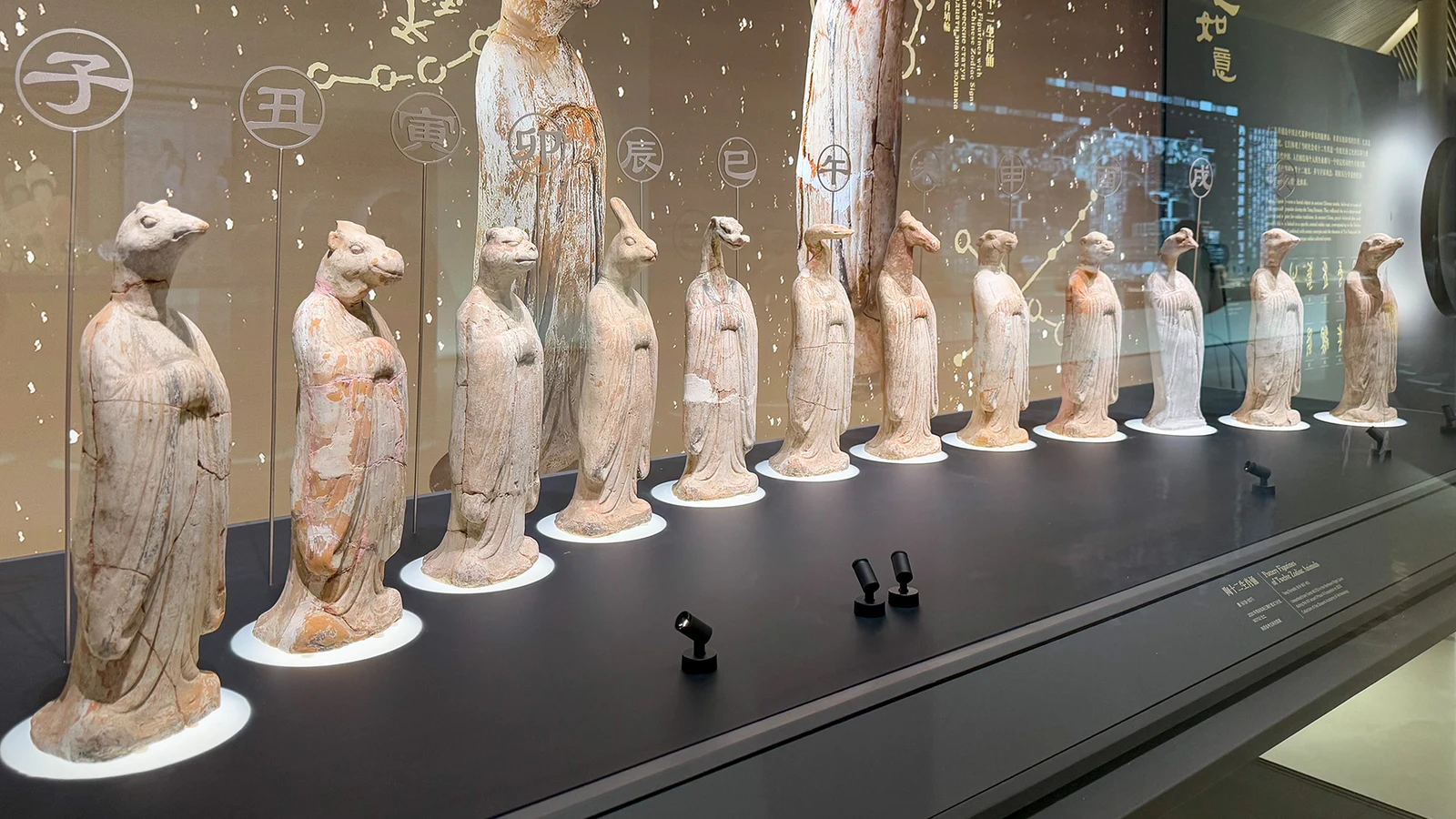
Find Chinese zodiac years from Rat to Pig, check recent New Year boundaries and avoid the January-February mistake that makes most year charts unreliable.
Read the deep guide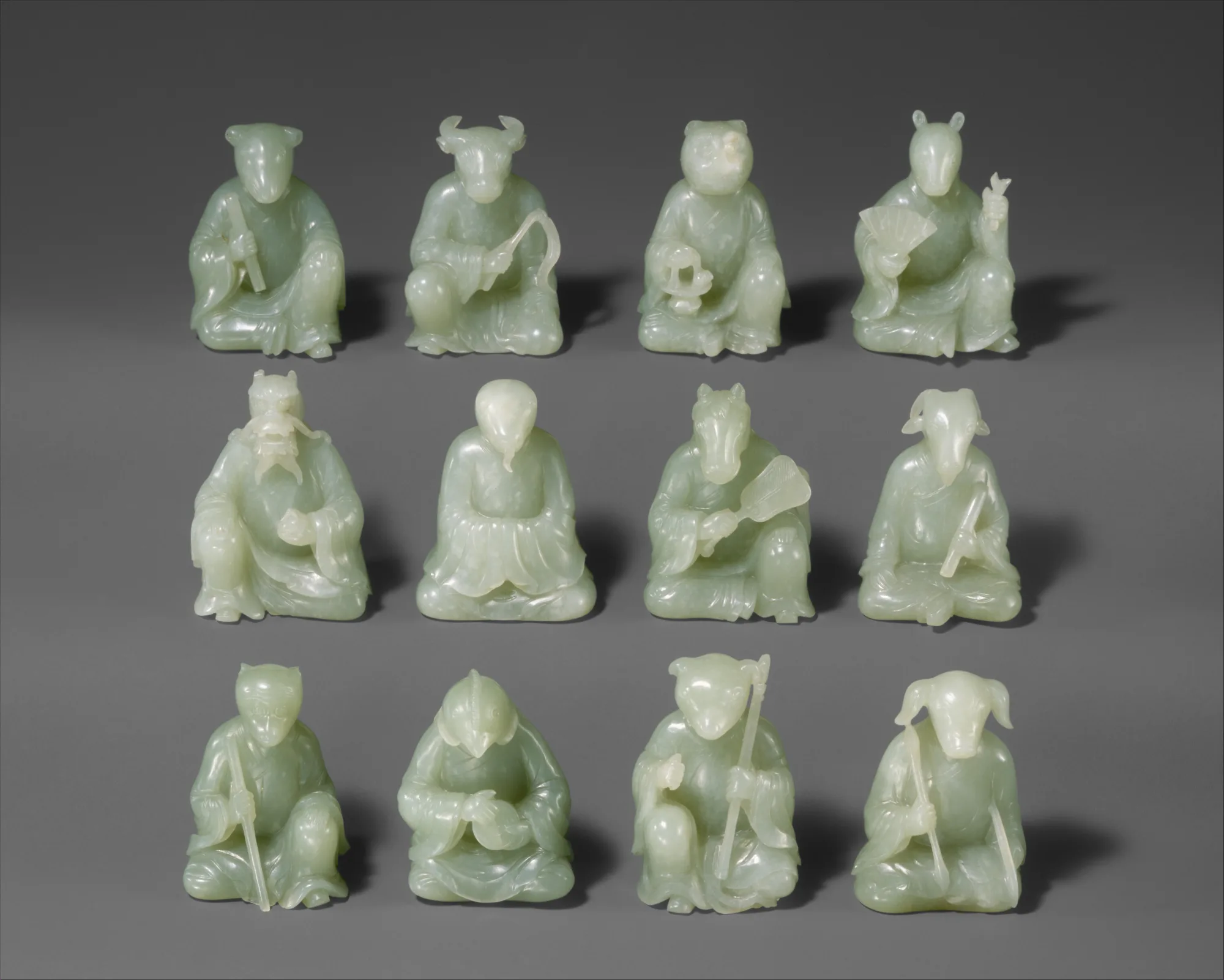
Enter your full birth date to find your Chinese zodiac animal, branch and element. This calculator correctly handles birthdays before Chinese New Year.
Read the deep guide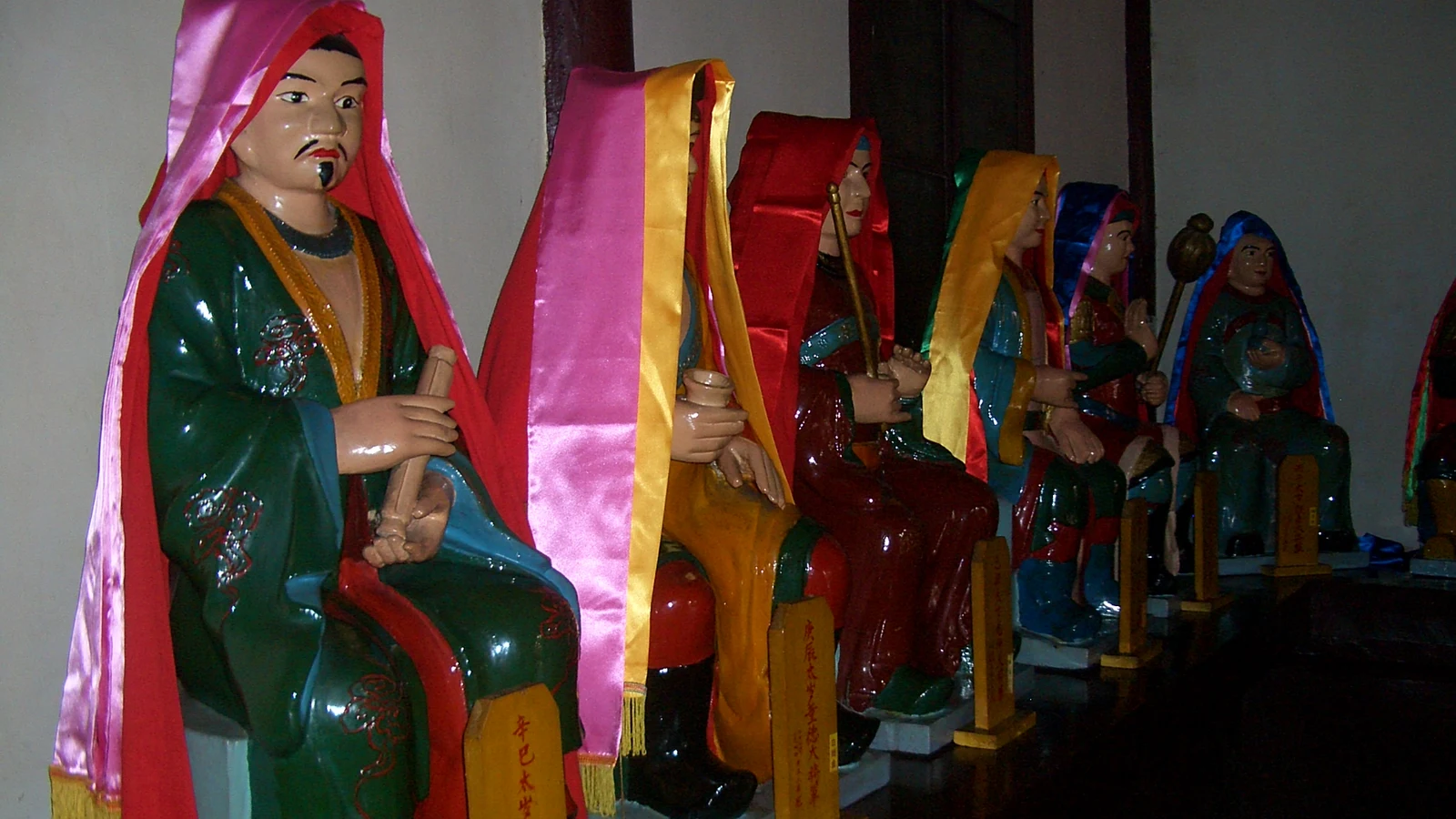
Find your Chinese zodiac element from the Heavenly Stem, understand yin and yang, and see why each animal can be Wood, Fire, Earth, Metal or Water.
Read the deep guide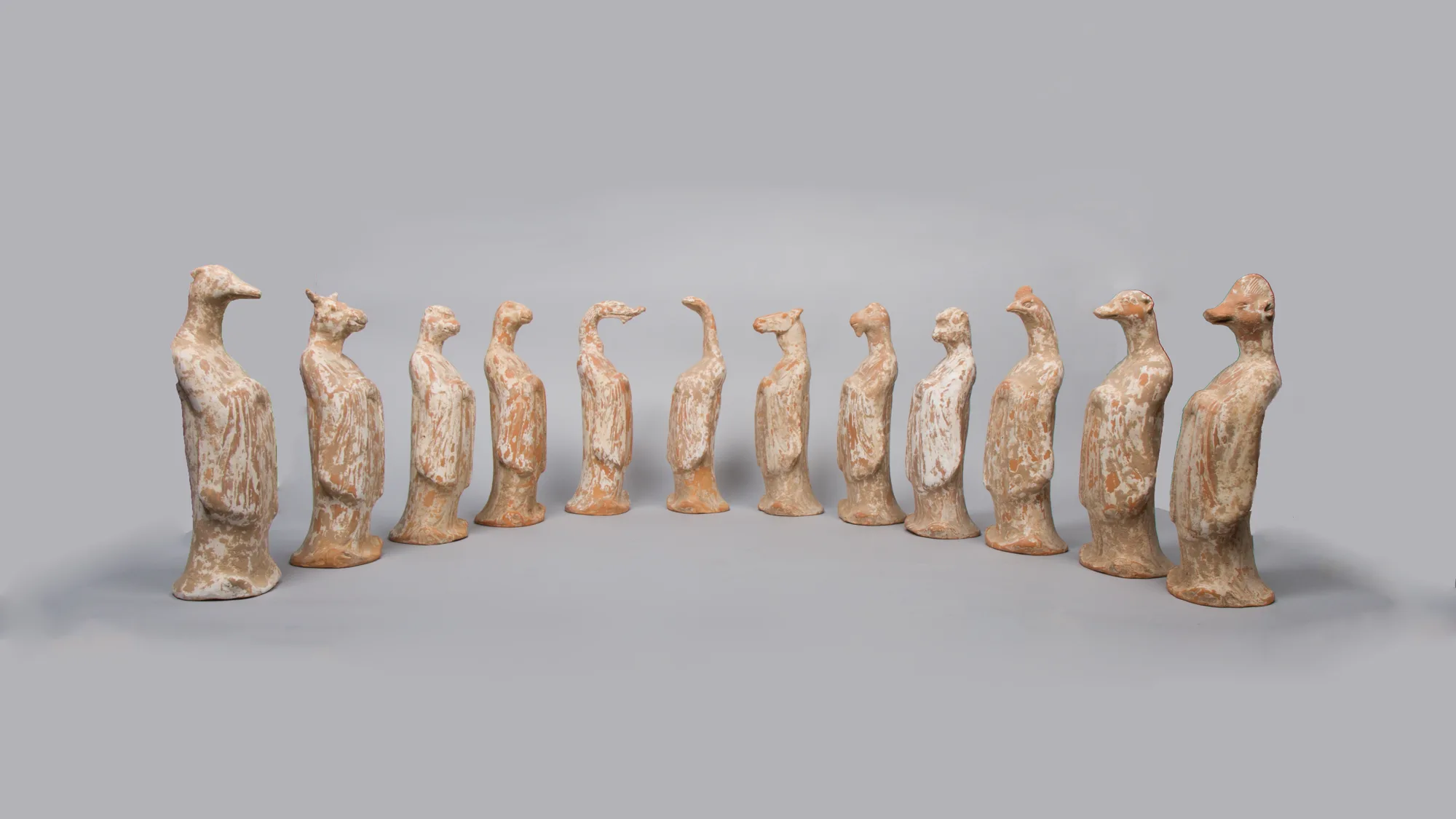
Check Chinese zodiac compatibility pairs, trines and opposites, then understand why these branch relationships are folklore rather than relationship science.
Read the deep guide6 published guides
Dragon, phoenix, lion, bat, crane and carp do not share one symbolic grammar. Follow posture, material, wordplay, paired motifs and use before deciding what any animal means.
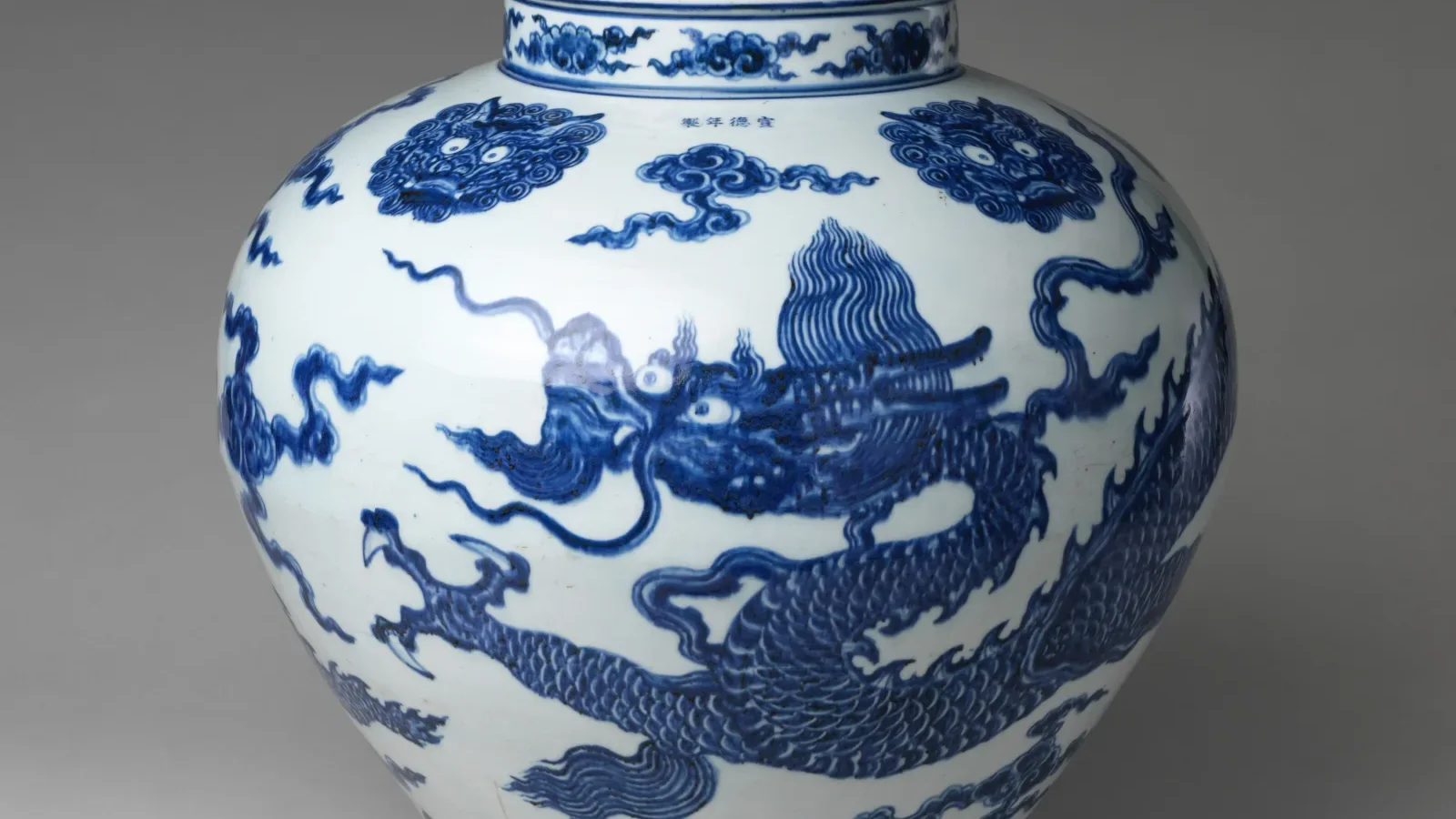
Understand dragons in Chinese culture through the actions they perform in water, court art, religious stories and dragon dance—not one generic meaning.
Read the deep guide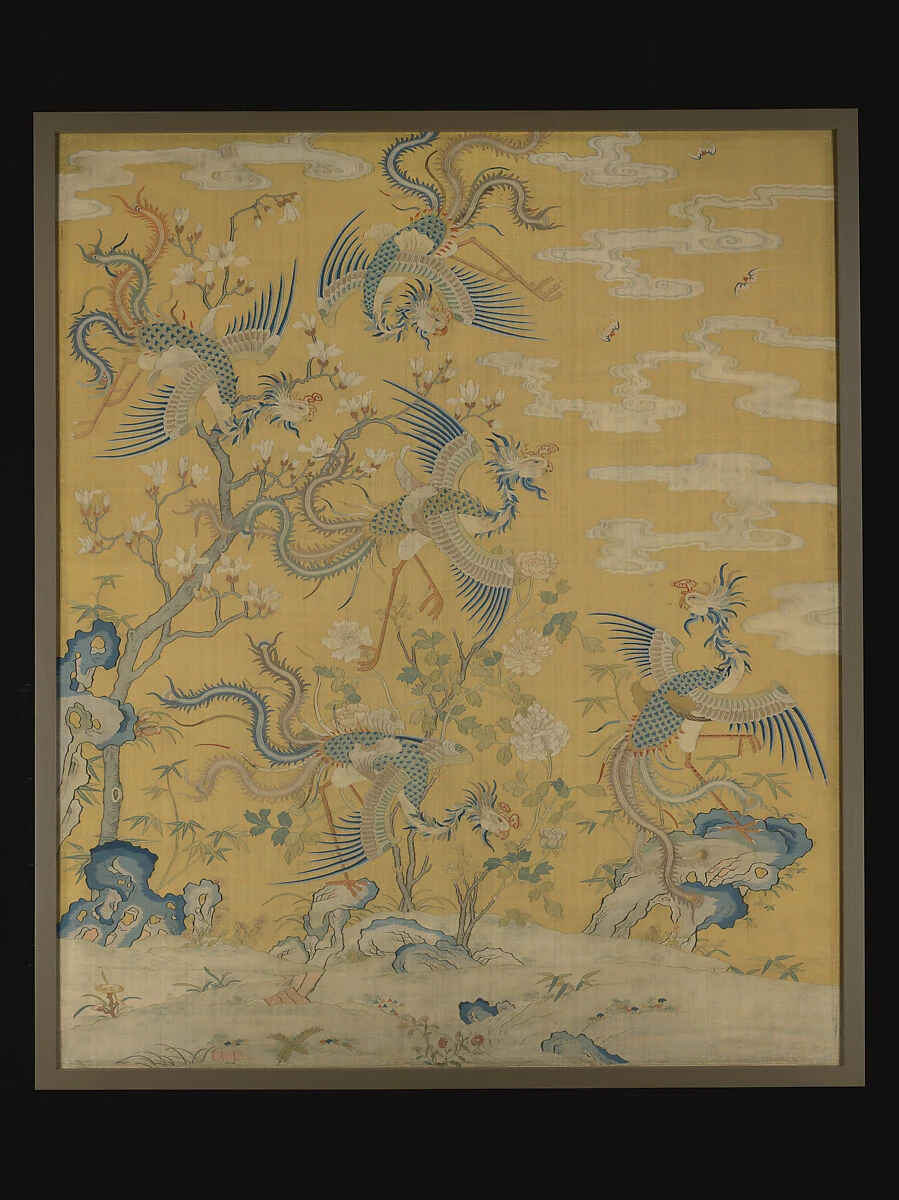
Understand Chinese phoenix symbolism through the fenghuang, dragon pairings, imperial robes, weddings, porcelain and tattoos, beyond generic rebirth claims.
Read the deep guide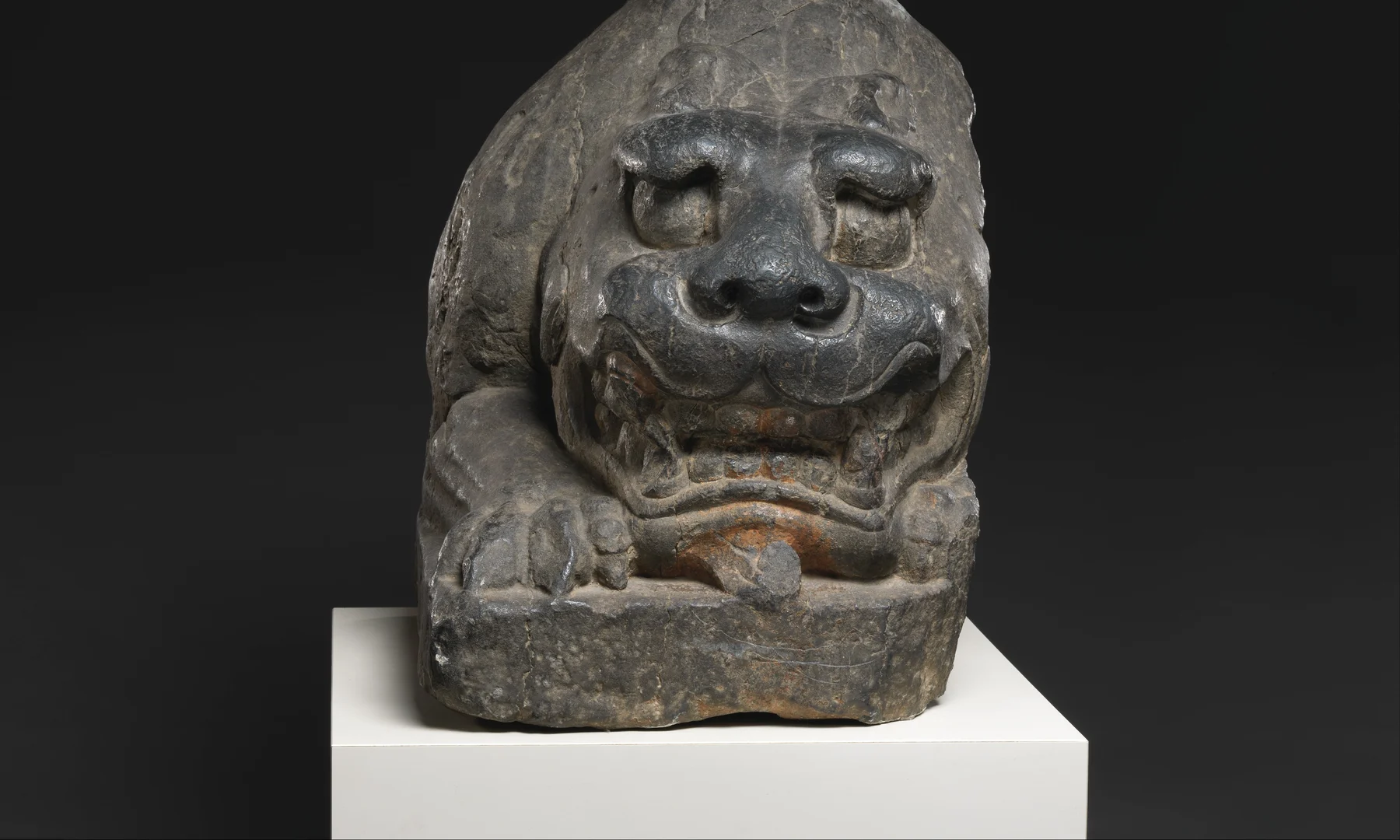
Understand foo dog meaning through real Chinese guardian lions: why they are lions, how pairs, ball and cub, doorways, history and architecture change the reading.
Read the deep guide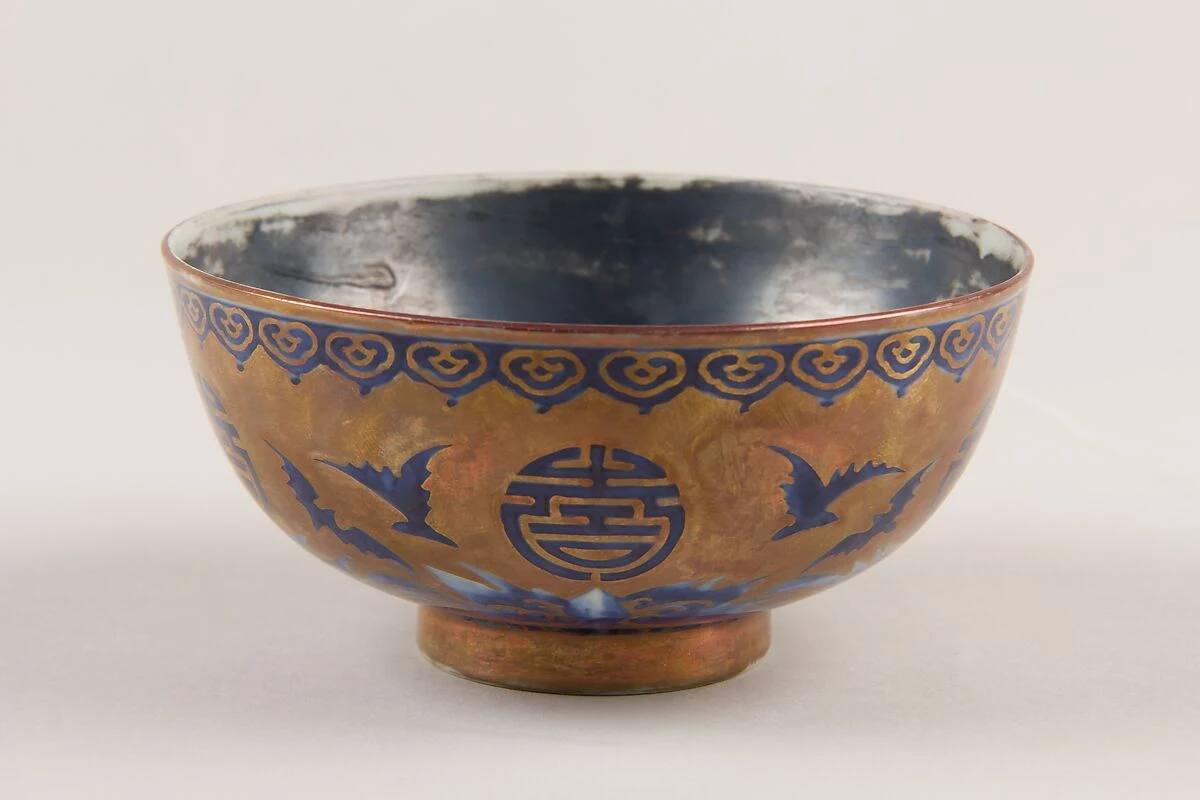
Understand bat symbolism through the Chinese fu homophone, Five Blessings, shou characters, peaches, red bats, porcelain, textiles and modern tattoos.
Read the deep guide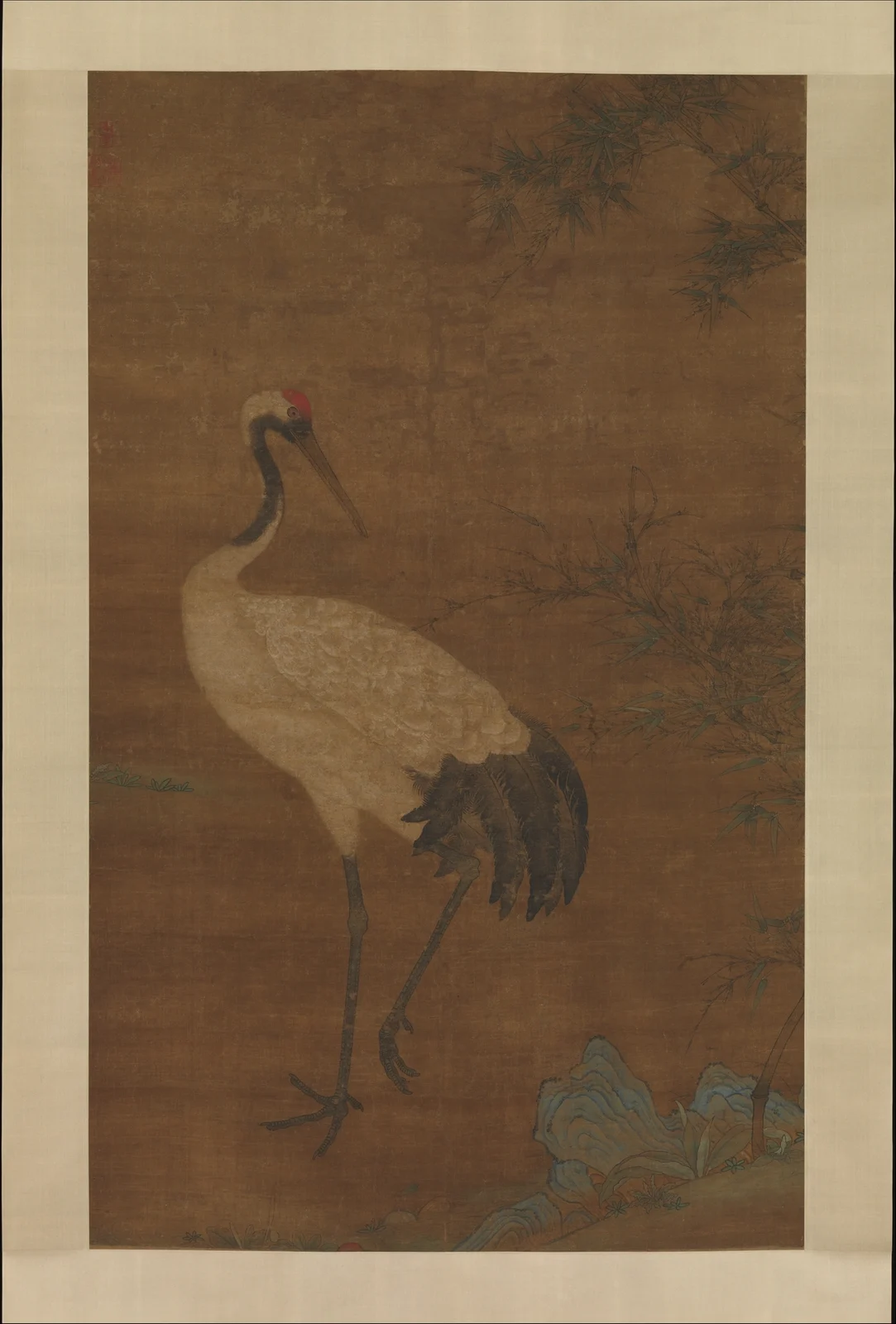
Understand crane symbolism through Chinese paintings, pine-and-crane longevity imagery, Daoist immortals, scholar gardens, rank badges and modern tattoos.
Read the deep guide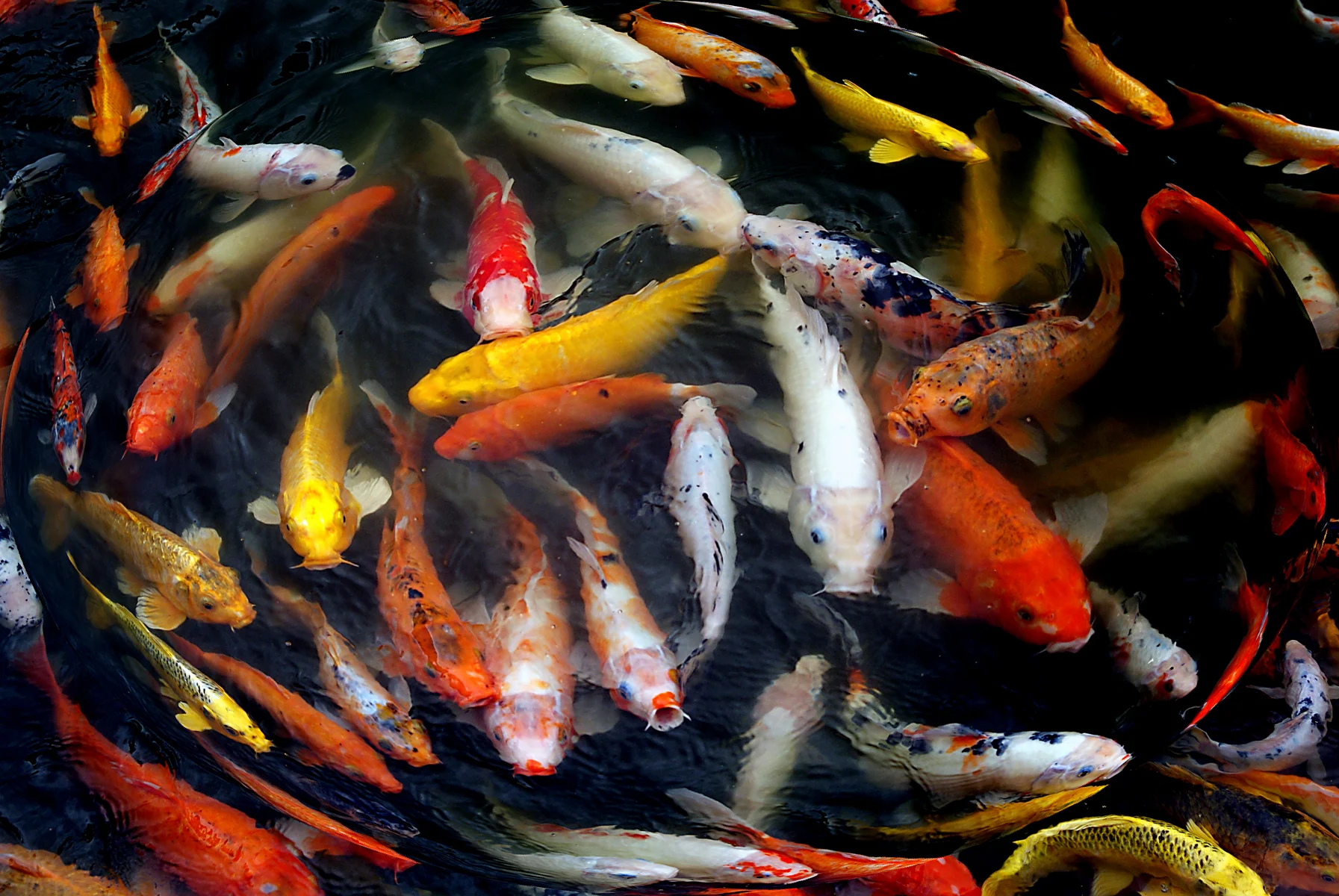
Understand koi fish meaning by separating Japanese nishikigoi from Chinese carp, Dragon Gate transformation, fish-abundance wordplay, paintings, porcelain and tattoos.
Read the deep guide2 published guides
Plum blossom and lotus are not interchangeable signs of beauty. Their seasons, physical habits, religious settings and literary companions create different emotional and ethical claims.
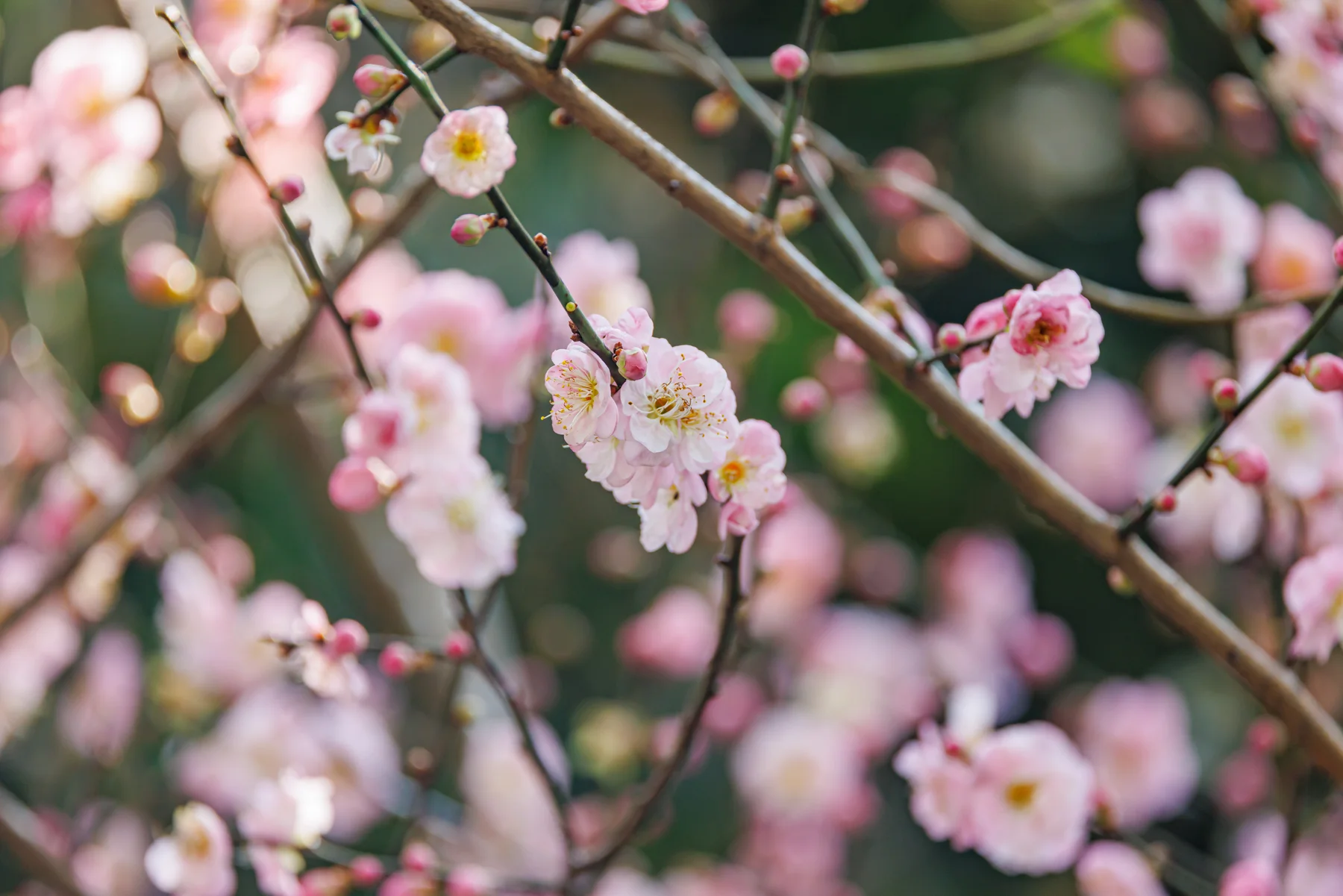
Understand plum blossom meaning through real flowers, Chinese poetry, scholar painting, the Three Friends of Winter and one crucial correction: mei is not wintersweet.
Read the deep guide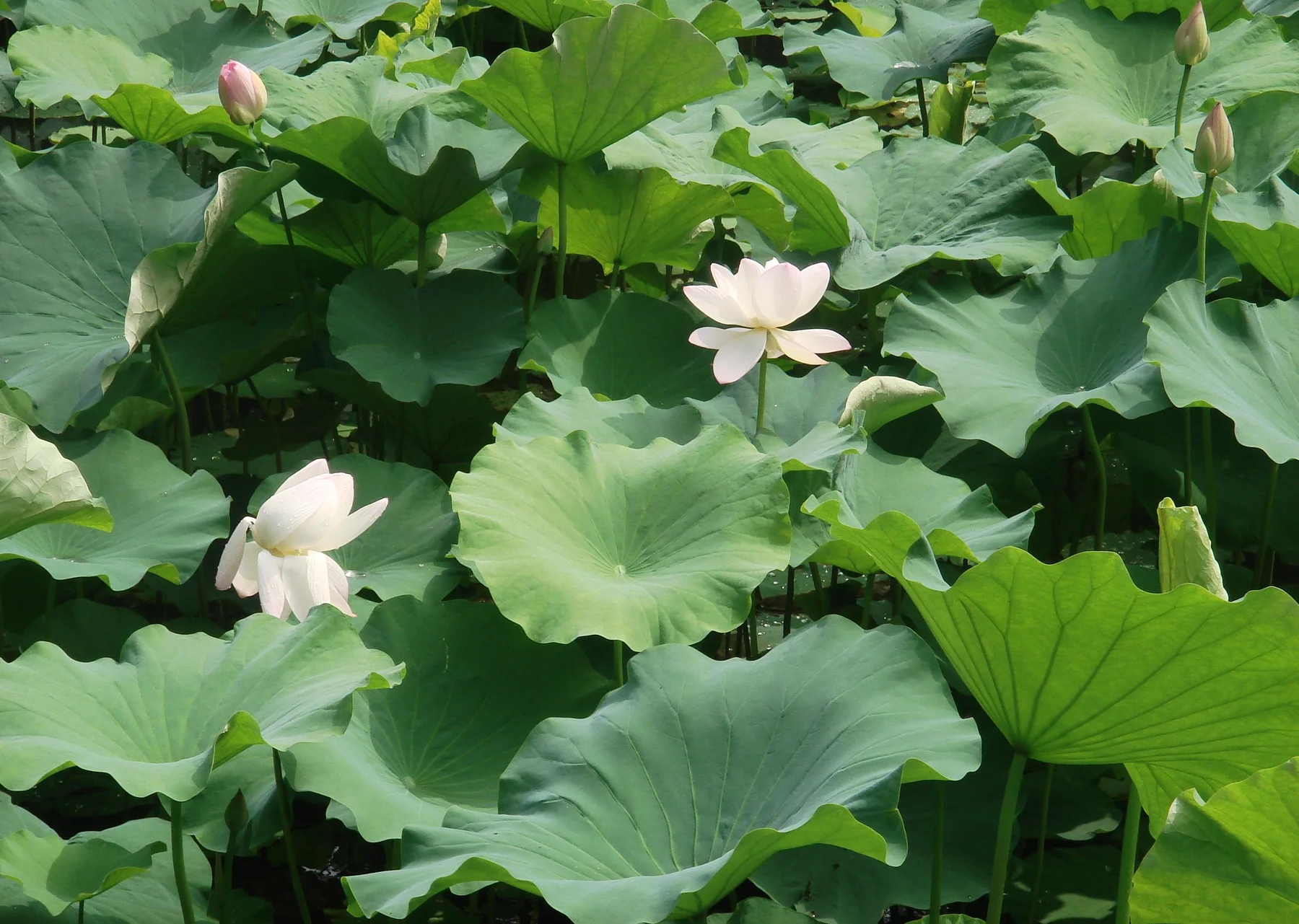
Understand lotus flower meaning through the living plant, Buddhist art, Zhou Dunyi, Chinese painting, porcelain, wordplay and one essential lotus-versus-water-lily check.
Read the deep guide3 published guides
A tied cord, a wedding graph and a field of clouds ask for different evidence. Follow structure, placement, material and neighboring motifs before reducing any of them to one auspicious word.
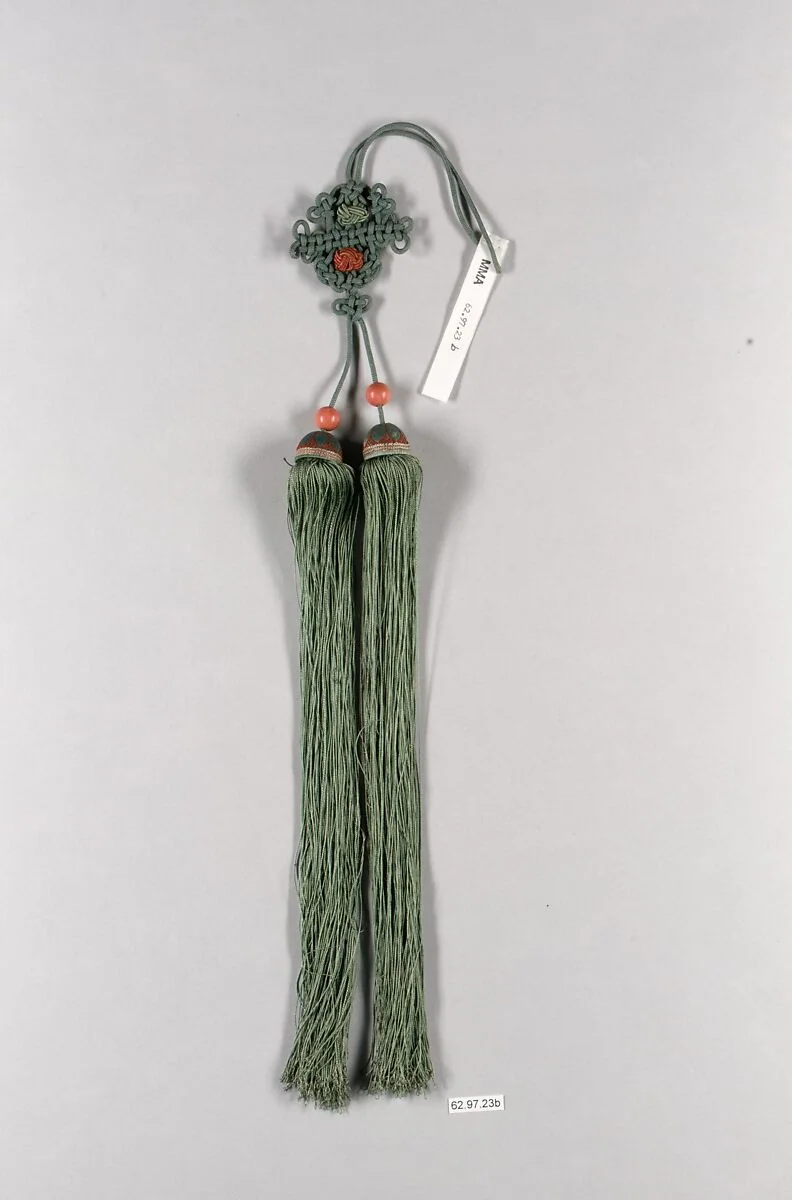
Understand Chinese knot meaning through cord structure, named form, attachment and occasion, and learn why not every red knot is an endless knot.
Read the deep guide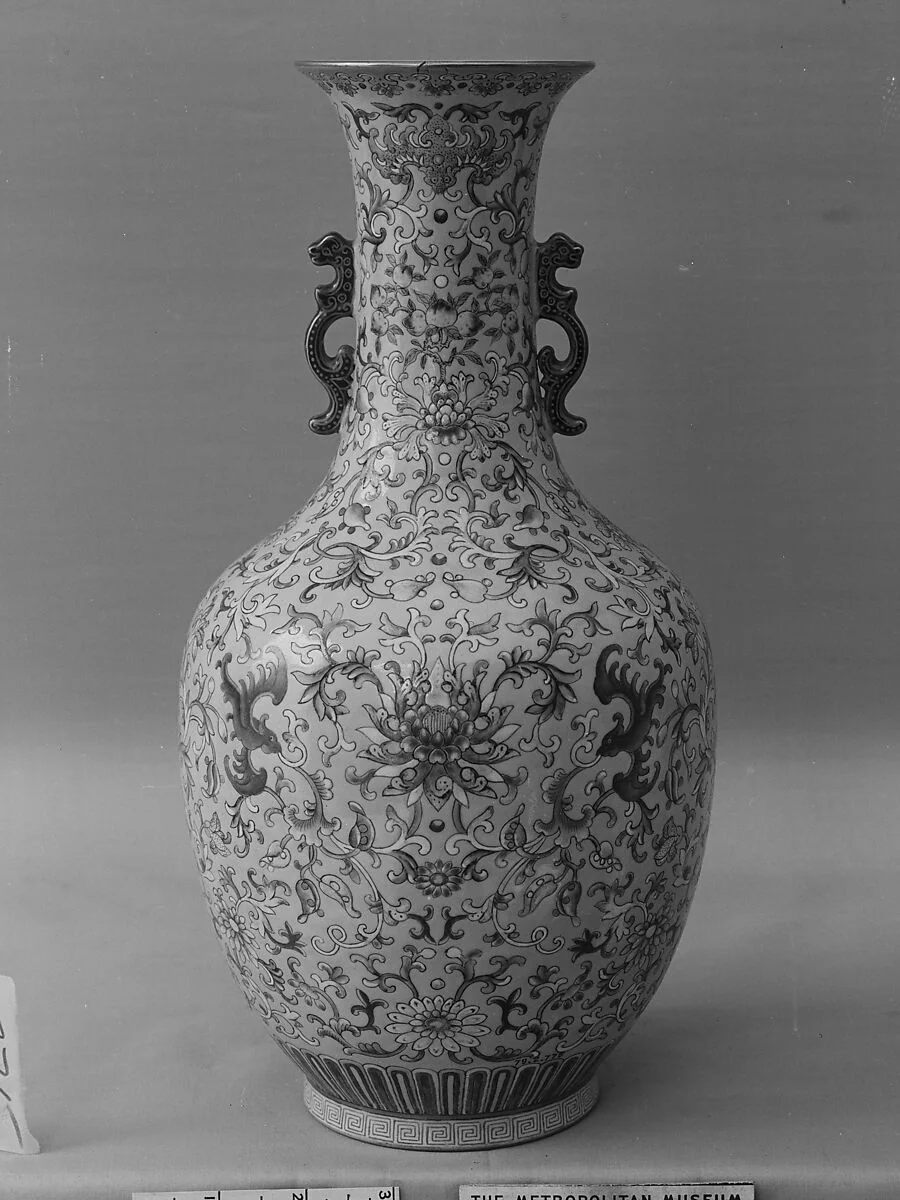
Learn what the double happiness symbol 囍 means, how it differs from 喜, and how wedding typography changes across doors, textiles, ceramics and gifts.
Read the deep guide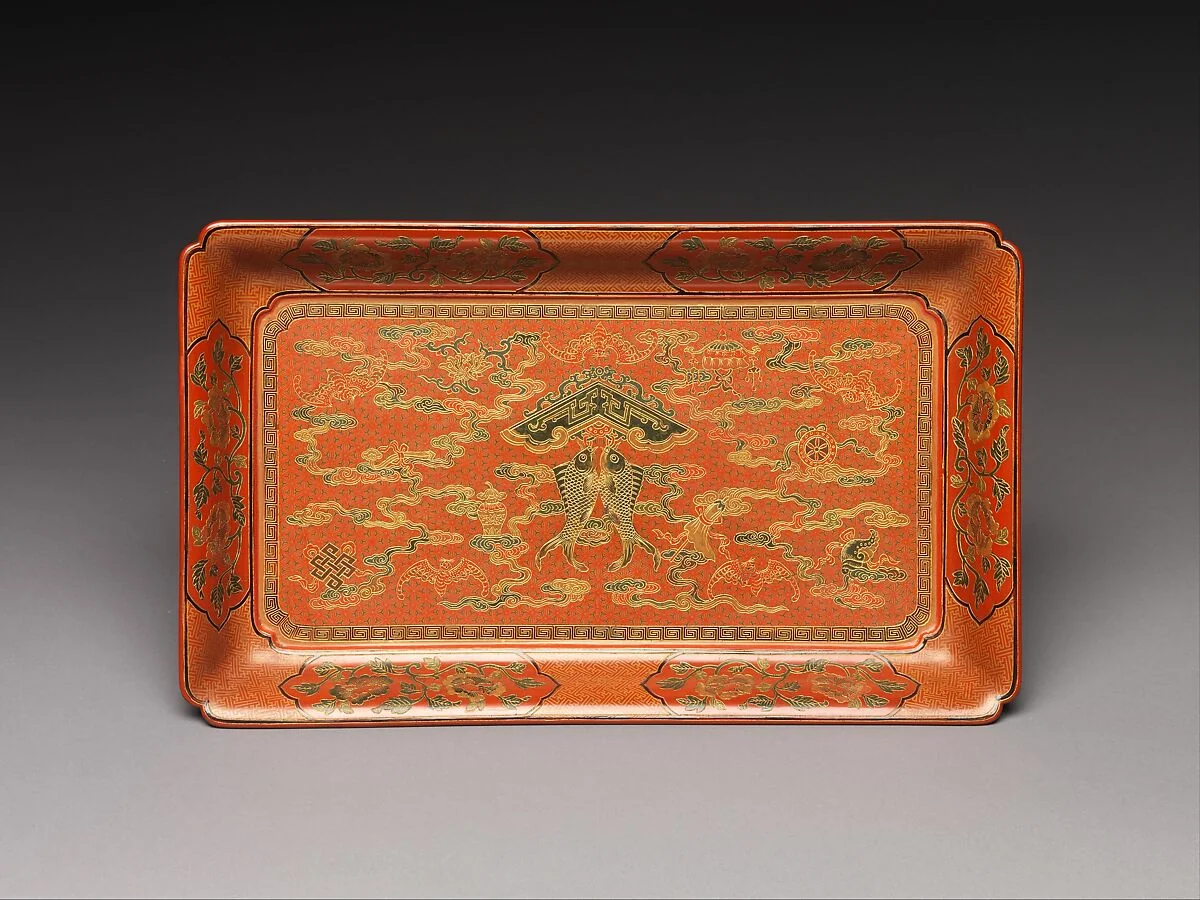
Learn to read the Chinese cloud motif across robes, textiles, lacquer and porcelain without calling every curl a timeless auspicious or ruyi cloud.
Read the deep guideUnderstand Chinese culture symbols through sound, season, placement and use, from red and dragons to lotus flowers, bats, fish and lucky numbers.
Chinese culture symbols are images, colors, numbers, plants, animals and written forms that gather meaning through language, history and repeated use. No secret code gives them one permanent answer. A fish on a New Year print, a fish on a scholar's painting and a fish on a restaurant sign may share an echo while speaking to different occasions.
In China, a symbol rarely sits alone and waits to be translated. It appears on a wedding invitation, under the glaze of a bowl, above a doorway, in a child's name, on an elderly person's birthday cake or in the awkwardly cheerful decoration of a shopping mall preparing three weeks early for a festival.
Context supplies the grammar.
The Metropolitan Museum of Art's Chinese auspicious-symbol collection search demonstrates the scale of the problem: similar animals, flowers, characters and colors migrate across vessels, robes, paintings and ritual objects. A motif list cannot tell you what the object was asked to do.
This is what quick online lists often miss. They tell us that the lotus means purity, the peony means prosperity and the dragon means power. These summaries are not necessarily wrong. They are simply unfinished. We still need to ask: used by whom, in which period, on what object and for what occasion?
After four decades of seeing symbols move between homes, restaurants, temples, packaging and public celebrations, I have become suspicious of any explanation that fits too neatly in one sentence. Symbols endure because they can carry old associations into new rooms.
I believe a symbol guide must be willing to leave a meaning unfinished. If the object, occasion or pairing is missing, certainty is not helpful; it is decoration pretending to be knowledge. I would rather tell a reader exactly what the evidence cannot settle than sell one lucky adjective as an ancient universal rule.
Several systems often work at the same time.
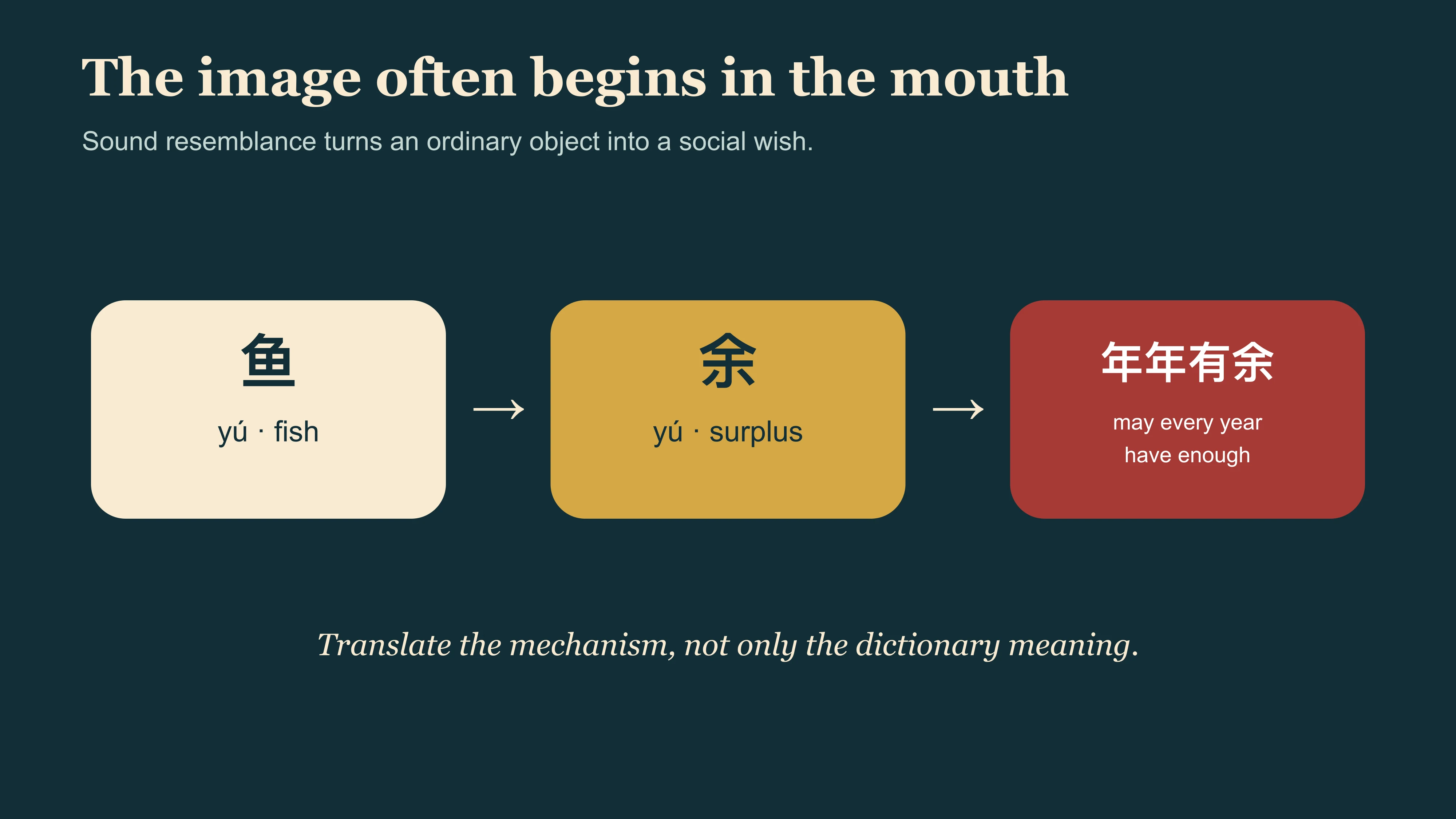
Chinese languages make rich use of homophones and near-homophones. A bat can suggest good fortune because bat and fortune are both pronounced fu in Mandarin, though written with different characters. Fish, yu, can evoke surplus, also pronounced yu with a different tone and character. The connection is linguistic, but repetition makes it visual: a painted fish no longer needs a caption to enter a New Year wish.
This wordplay is clever without being frivolous. It lets a gift or object speak politely. Instead of announcing, “I wish you prosperity and abundance,” someone can choose a motif that allows the wish to arrive more gracefully.
Plants and animals carry qualities people have observed, admired or imagined. Plum blossoms open in cold weather and therefore suggest endurance. Bamboo bends without easily breaking. Lotus flowers rise clean above muddy water. Cranes and peaches became associated with longevity through literature, religion and visual tradition.
The observation may be botanical, poetic or legendary. Usually it is a mixture. Culture is rarely courteous enough to keep those drawers separate.
Some symbols accumulated meanings through political or religious institutions. Dragons appeared in many forms long before they became tightly associated with imperial authority. Court regulations, rank systems and workshop traditions could make the number of claws, the placement of a motif or the color of a robe matter.
Later, the same image might become national, commercial or personal. The dragon now appears in community parades, sports identities, fashion and diaspora celebrations. Its imperial past remains relevant, but it no longer owns the whole creature.
Chinese decorative art frequently combines motifs. Five bats can represent the Five Blessings. A magpie with plum blossoms may form a rebus of joyful news. Fish paired with lotus can build a wish through sound and image. The object is not a sticker album; the relationship between its parts matters.
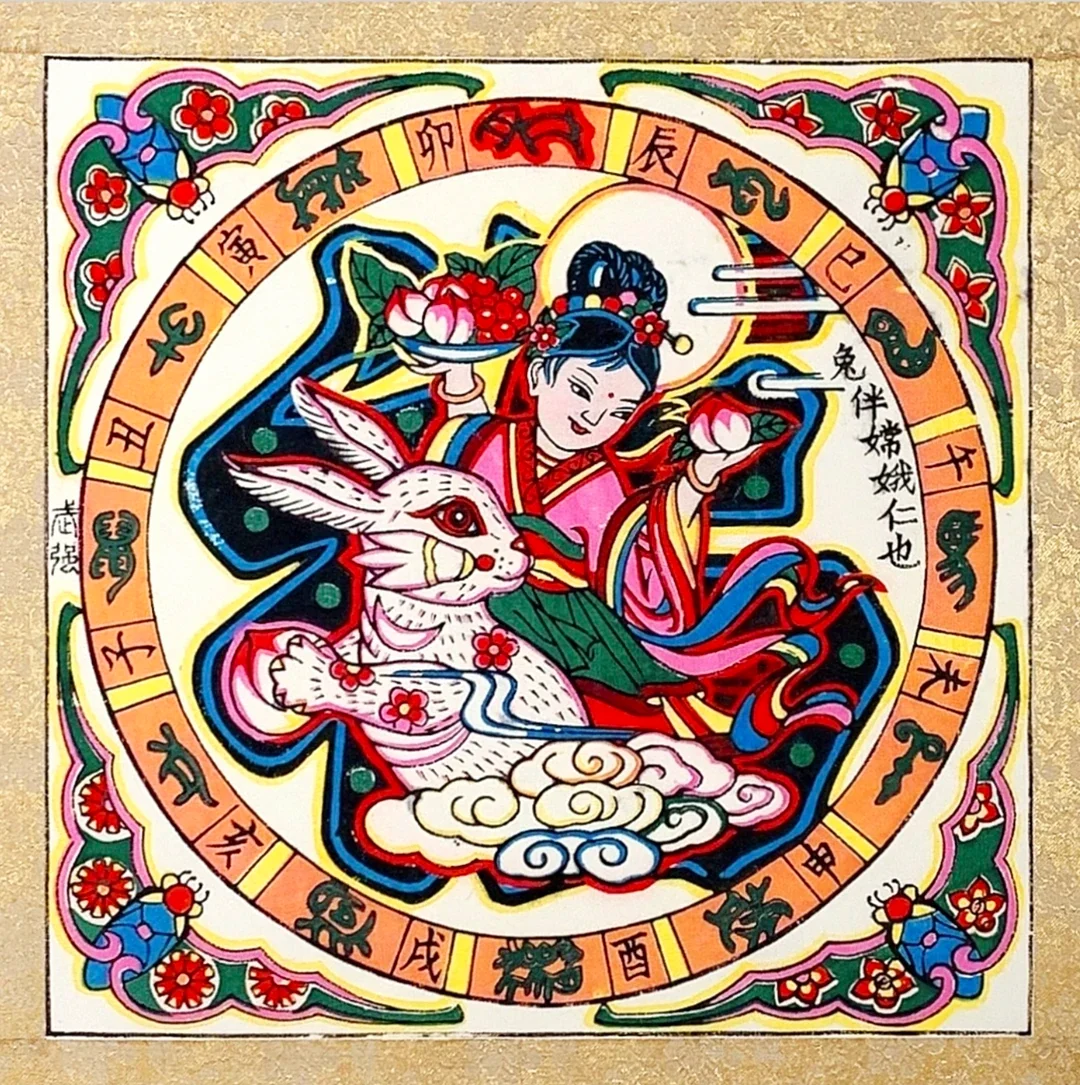
This rabbit print refuses to behave like a one-word dictionary entry. Rabbit, moon, peaches, flowers, clouds, the human figure and the surrounding zodiac ring occupy one crowded sentence. Pull the rabbit out and label it “luck” and almost everything visible has been discarded. The image proves the compositional fact: popular symbolism is built through pairing, scale and placement. It cannot date the print, establish a universal regional meaning or tell us how its maker explained every motif.
The Met cup is useful because it forces the eye to move around a group. Recognizing “an immortal” is not enough; attributes, companions, material and the cup's carved surface organize the reading. Symbolic literacy is often the patience to keep looking after the first familiar figure appears.
| Symbol | Common associations | Where it may appear | What the short definition misses |
|---|---|---|---|
| Red | Celebration, vitality, protection, good fortune | New Year, weddings, envelopes, doors | Red is not appropriate for every ritual or message |
| Dragon | Water, rain, transformation, authority, identity | Art, architecture, festivals, clothing | Meanings changed across periods and communities |
| Phoenix | Virtue, renewal, harmony, feminine or imperial associations | Textiles, wedding objects, court art | It is not simply the Western phoenix in Chinese dress |
| Lotus | Purity, integrity, Buddhist meanings, continuity | Painting, ceramics, temples, gardens | Botanical, literary and religious readings overlap |
| Peony | Wealth, honor, beauty, flourishing | Painting, textiles, domestic decoration | Its prestige also reflects historical taste and cultivation |
| Bat | Good fortune through the sound fu | Ceramics, furniture, textiles, architecture | The auspicious meaning depends on Chinese wordplay |
| Fish | Surplus, abundance, fertility, freedom | New Year images, food, painting, jade | A living carp, cooked fish and painted fish work differently |
| Chinese knot | Connection, continuity, blessing | Gifts, interiors, festivals, accessories | Cord path, attachment, giver and occasion shape the message |
| Eight | Prosperity and favorable association | Dates, addresses, business choices | Number symbolism varies and should not be treated as law |
Animals become especially misleading when a one-word caption replaces the object. Our dedicated readings of bat symbolism, crane symbolism, fish and koi meaning and Chinese guardian lions begin with the visible species, material, companion motifs, setting and use. That evidence can support a cultural reading; it can also tell us when the honest answer is still uncertain. | Four | Often avoided because it resembles the sound of death | Buildings, gifts, numbering | Avoidance differs by region, language and personal belief |
Paper makes that discipline physical. In Chinese paper cutting, the first question is not what a red motif means but which uncut bridge keeps it attached and what window, door or family occasion gave it work. Structure and placement stop symbolism from floating free.
Red may be the most internationally recognized of all Chinese culture symbols. Its strength comes not from an abstract dictionary meaning but from what people do with it. Red envelopes move money through relationships. Red paper changes a doorway before New Year. Red clothing can mark joy at a wedding. The color becomes auspicious because it participates in auspicious action.
This also explains why “red means lucky” is too blunt. A color has temperature, timing and etiquette. The same bright red that enlivens a festival may feel inappropriate in a quieter context. Meaning is not mixed at the paint factory; people make it together.
Material can make the context visible before language does. A Chinese knot asks the eye to follow crossings, working ends and attachment; a Chinese cloud motif may carry, frame or connect the other images across an object. Neither becomes legible through color alone.
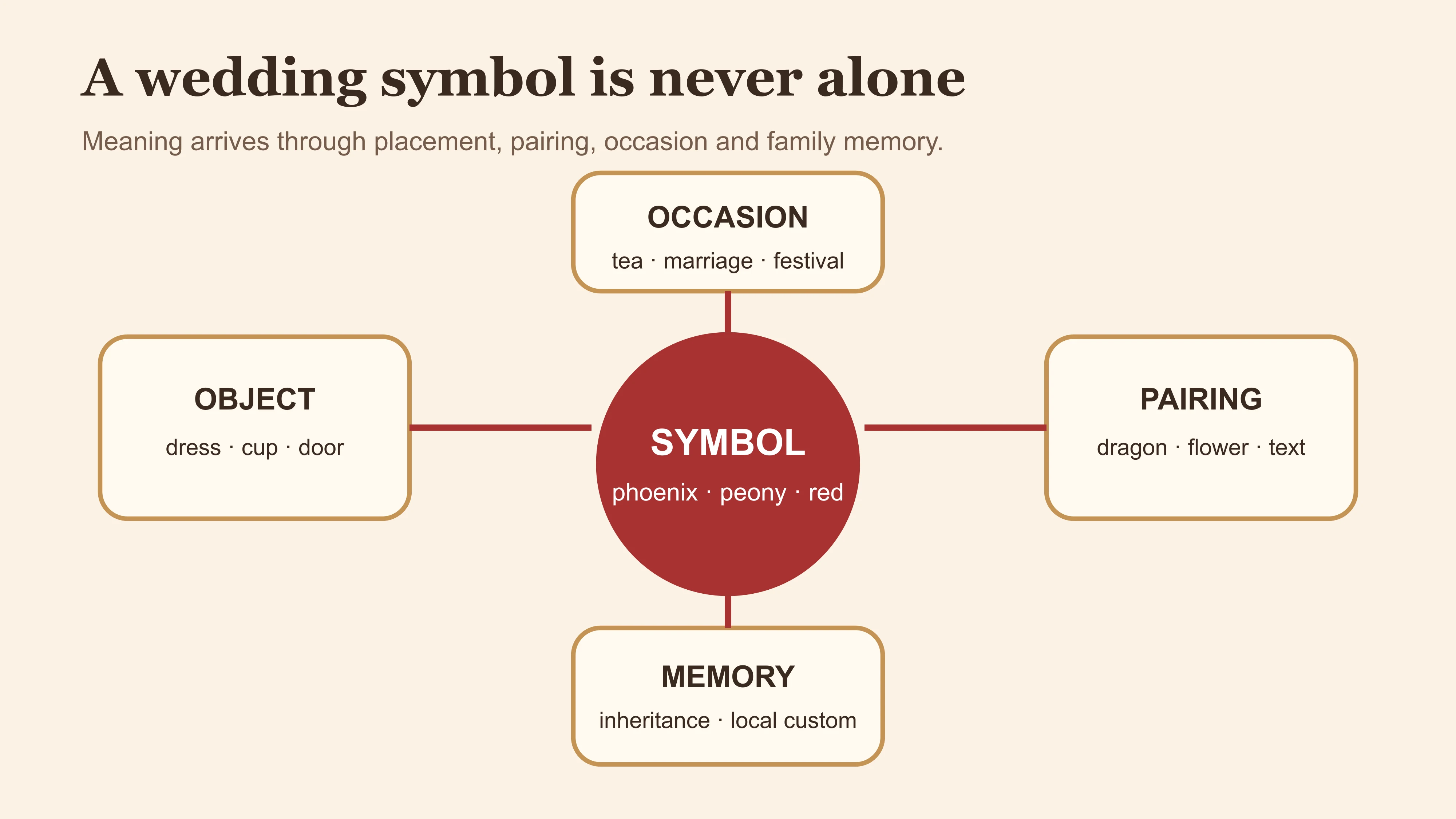
The diagram makes the missing grammar visible. Red, phoenix or peony is only the motif layer. The object carrying it, the wedding action, the neighboring symbols and the family's use decide which association becomes active. “Red means luck” describes a color and abandons the relationship doing the real cultural work.
The dragon and phoenix are often introduced as a male-female pair, especially in wedding decoration. That pairing exists, but neither creature has one fixed gender or role across Chinese history.
The dragon has been connected with water, weather, directional systems, imperial power and cultural identity. The phoenix-like fenghuang has carried associations of virtue, cosmic order, courtly authority and harmonious rule. In some historical settings, both could be linked to rulers. In modern wedding imagery, their pairing may emphasize balance and partnership. Their supernatural lives become clearer in the wider Chinese mythology guide, while the dedicated dragon and phoenix pages keep either creature from becoming a fixed gender label. When the question moves from a motif on an object to named gods, creatures and legends, XianLore's visual mythology guide is the useful sister-site route; this East Moment page stays with how symbols work in lived objects and occasions.
The useful question is not “What does the dragon always mean?” It is “What work is the dragon doing here?”
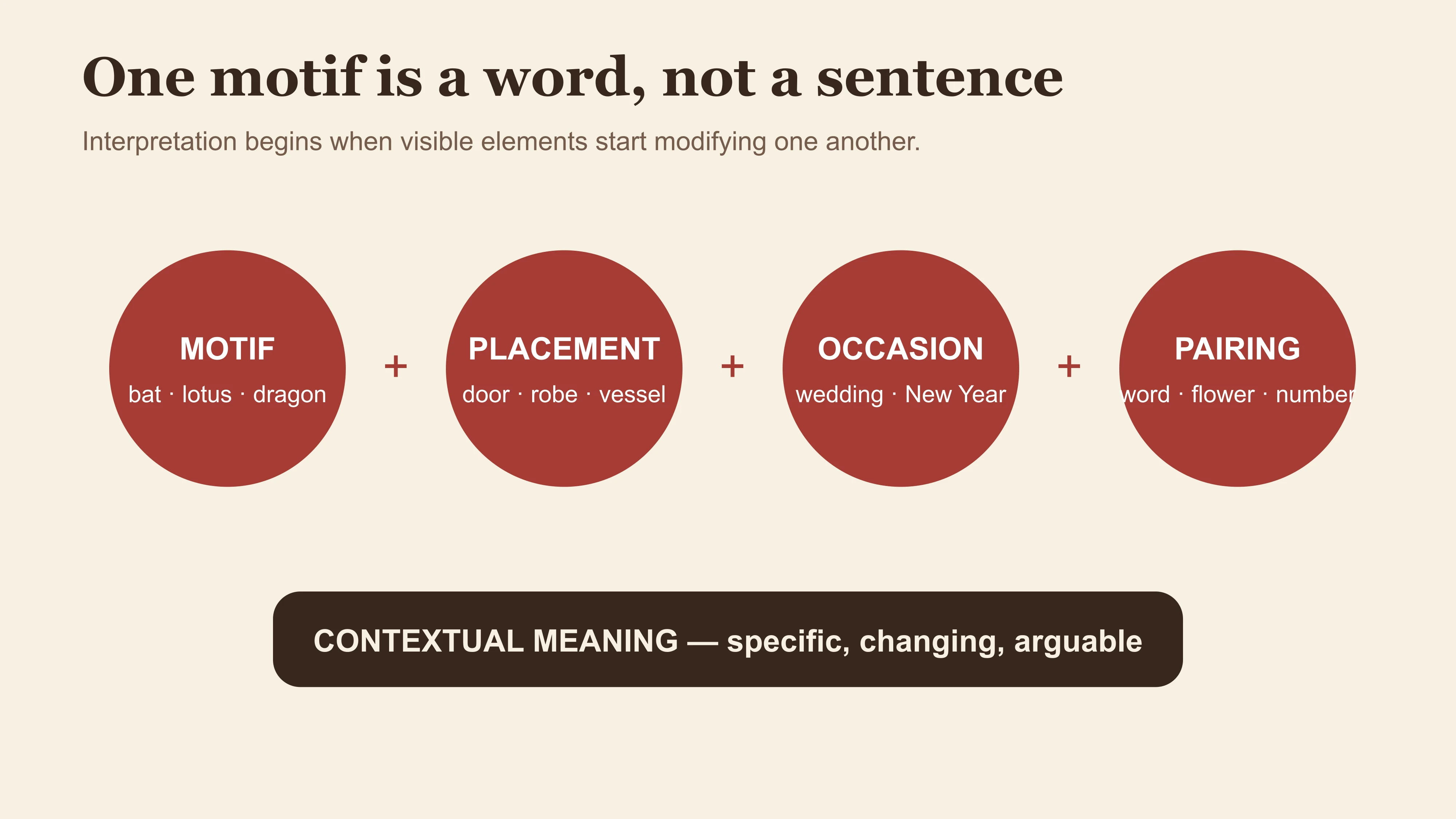
The sentence builder is intentionally abstract because the method must travel. Motif, placement, occasion and pairing are four pieces of one claim. Remove any piece and interpretation becomes louder but weaker. A dragon on a wedding panel, temple beam, porcelain bowl and parade body is not repeating the same sentence.
Chinese flower symbolism often begins with season. Plum blossom belongs to late winter and early spring. Peony carries the fullness of cultivated beauty. Chrysanthemum arrives with autumn and the long literary shadow of withdrawal, integrity and age. Orchid may suggest refinement; lotus may connect moral purity with Buddhist thought.
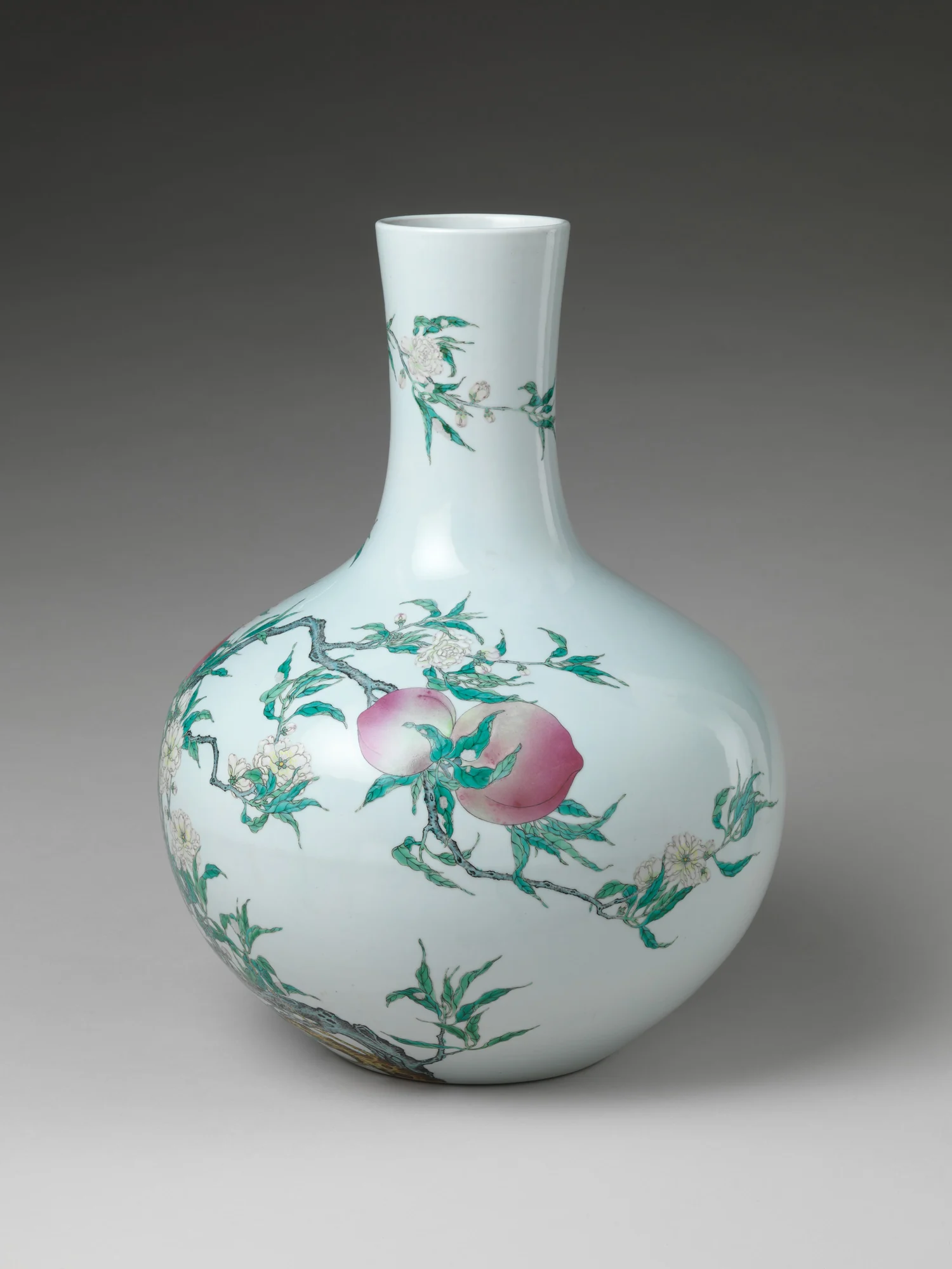
The Met calls this object a Vase with Nine Peaches. That title matters because it names what the camera can actually support: a Jingdezhen porcelain vessel, peach branches, blossoms and a counted group of fruit. Longevity is a strong cultural reading for peaches, yet the object is more disciplined than the word “longevity.” Nine, branch, blossom, ripeness, porcelain body and viewing angle all participate. The photograph can verify material, form and visible motif; it cannot recover every historical viewer's interpretation or prove that nine means exactly the same thing on another object.
Flowers allow time to become visible indoors. A painting can hold spring through winter. A textile can place blossoms from different seasons together and turn the year into a field of wishes. No real garden needs to obey.
A “four seasons” vase does not document one garden at one moment. It assembles time on one surface. That freedom is the point: painted flowers can make several seasonal associations coexist where botany would keep them apart.
The carp-and-lotus jar is equally resistant to single-word decoding. Fish, lotus, pond setting, vessel use and sixteenth-century porcelain production all matter. “Fish equals abundance” is an entrance; the object still has rooms behind it.
Characters such as fu for good fortune, shou for longevity and the double happiness symbol 囍 are recognizable visual symbols. Yet they remain language. Their calligraphic style, placement and occasion affect how they are read. Double happiness is especially revealing because it becomes wedding typography across thresholds, textiles, ceramics and gifts rather than merely repeating the English idea of being twice as happy.
The familiar practice of displaying fu upside down near New Year plays with another verbal association: “fortune upside down” sounds like “fortune has arrived” in Mandarin. It is a joke that became ritual, which may be the most honest summary of human civilization.
The celadon vase shown above was made in the shape of a much older jade cong. Its square body and circular opening recall Neolithic forms whose original meanings cannot be recovered with complete certainty. Centuries later, potters translated that ancient shape into ceramic.
This is symbolic life at its most interesting. The later object transforms the earlier one, turning antiquity into a material presence: green glaze over clay, memory remade through a different craft. Chinese culture often carries the past as a form available for another generation to think with.
Begin with five questions:
This method is slower than searching “Chinese symbol meaning” and faster than spending a lifetime becoming an art historian. It also leaves room for the person who owns the object to know something the internet does not.
My standard is deliberately unfriendly to souvenir-shop certainty. If an explanation cannot name the object, occasion or language mechanism, it has not interpreted a symbol; it has attached an adjective. “Lucky,” “prosperous” and “powerful” are conclusions that must earn their way back to visible evidence.
Use four lines for a field note: motif—what can you actually see or read; placement—what object, body or space carries it; action—what is happening around it; boundary—what remains unknown about date, region, maker or intention. That small discipline turns a decorative answer into a cultural observation. It also leaves room for someone with local language or family knowledge to correct you without throwing away the whole reading.
In diaspora communities, symbols often become more publicly visible. A dragon dance can announce a community's presence to a city. Red lanterns can mark a restaurant as Chinese to customers who cannot read its menu. A family may display objects abroad that seemed too ordinary to notice at home.
Travel can also detach a symbol from its original context. Commercial design favors images that are instantly legible, so dragons, red, gold and calligraphy are asked to represent an enormous culture by themselves. East Moment's Chinese culture guides take the opposite approach: keep the recognizable doorway, then open the rooms behind it.
Chinese symbols do not float above daily life. They are chosen, inherited, sold, joked about, argued over and sometimes quietly ignored. Their meanings endure not because everyone agrees, but because people continue to find occasions for them.
That is why I reject the idea that respectful interpretation means freezing every motif. Living use is allowed to be playful, commercial, regional and new. The responsibility is to state which layer you are reading. A bat may activate a sound association; a koi or carp may enter a transformation story; a family ornament may matter because one grandmother used it every year. These meanings can coexist without becoming one universal code.
The most respectful way to read a symbol is to resist the pleasure of solving it too quickly. Let the dragon keep some weather in its body. Let the flower remember its season. Let the object tell you where it has been.
In the comments, name a symbol you have seen translated too quickly and tell me which missing context changed it. Then publish a four-line field note in East Moment's community: motif, placement, action and boundary. Return when readers add dialect, region, object history or family use that makes the first reading more precise.
Continue to dragons in Chinese culture for one creature across four social jobs, phoenix symbolism for the danger of fixed gender formulas, or Chinese festivals when symbols become part of repeated public action.
One useful question
Which symbol have you seen translated too quickly, and what changed when you added its object, occasion, pairing or spoken sound?
Loading the conversation…
Reader-built field guide
Share one authorized object or scene, name the motif, placement, occasion and pairing, then state what remains uncertain.
What this builds: Return as readers add dialect, region, object history and family use that change an earlier interpretation.
These sources verify institutional records, protected traditions and claims that benefit from direct evidence. They support the story; they do not replace Lijun's judgment.