Phoenix symbolism in China begins with the fenghuang (鳳凰), not with a bird burning itself into ash. The fenghuang can signal peace, excellent rule, noble presence, courtly rank, an empress, marital harmony or a leader among birds—but none of those meanings is automatic. Its partner, action, material, wearer and historical setting decide which meaning becomes active.
Phoenix symbolism begins with a translation mistake
Search for “phoenix symbolism” and the answer arrives before the bird does: fire, death, ashes, rebirth. That cycle belongs to the phoenix familiar from classical and later Western tradition. Encyclopaedia Britannica's account of the phoenix describes a unique, long-lived bird whose death and renewal are bound to fire and a new life emerging from the remains.
The Chinese fenghuang is not that bird wearing an East Asian costume.
English calls both of them “phoenix,” so a translation bridge becomes a false family tree. The Chinese bird does not need to die, burn or rise again to become powerful. In surviving artworks it often appears inside an already ordered world: among flowers, above waves, beside a dragon, surrounded by smaller birds, woven into an imperial textile or circling a vessel. Its drama is social. It changes the rank and relationship of everything around it.
That difference is not a minor footnote. It overturns most generic symbolism pages.
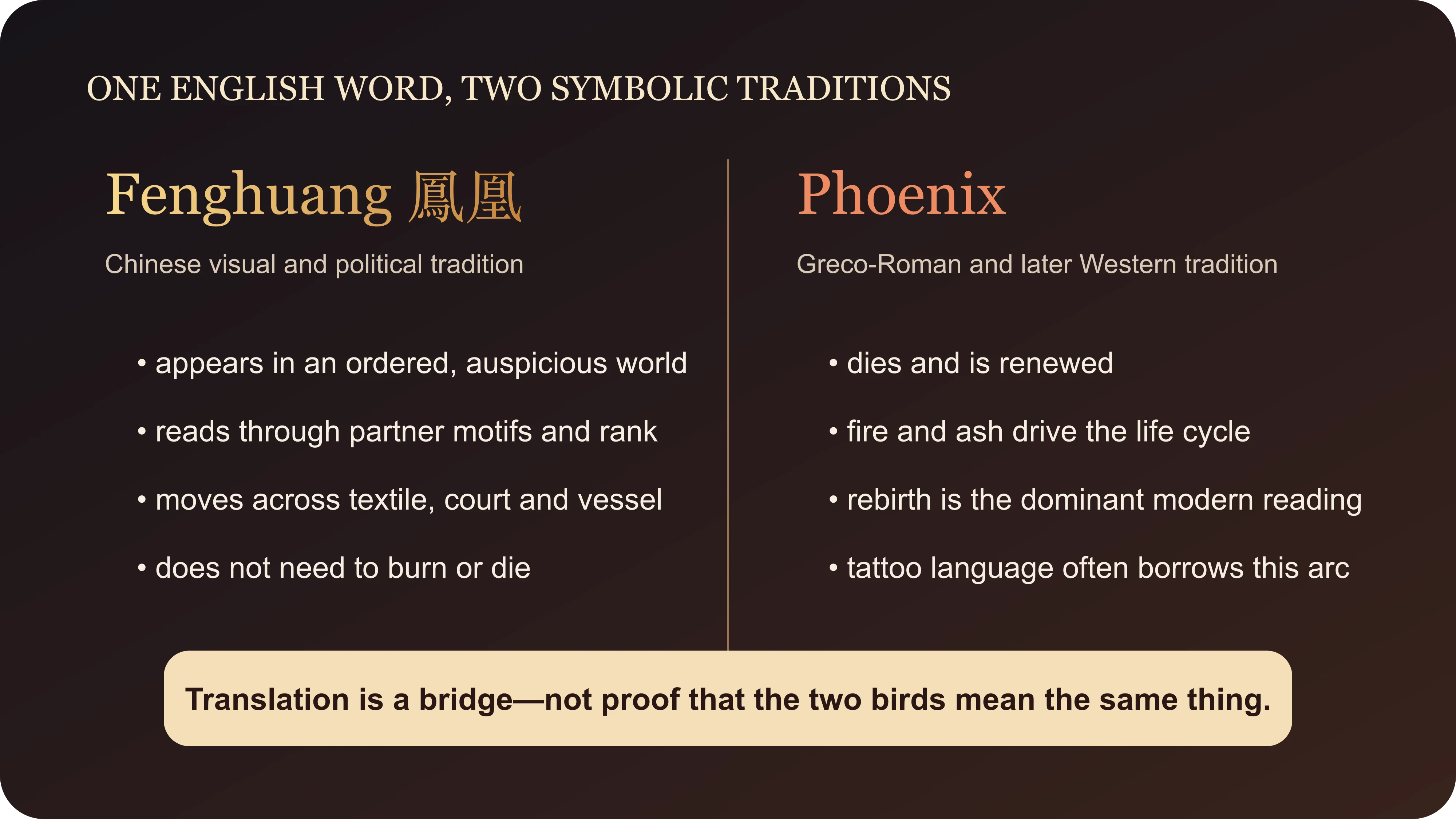
If a modern tattoo shows a bird exploding from flame and the wearer calls it a fenghuang, the image can be an honest contemporary hybrid. Cultures meet; artists invent. What it cannot honestly prove is that fire-rebirth was always the central Chinese meaning.
My rule is simple: translation can help us find the bird, but the object must tell us what the bird is doing.
The fenghuang appears when the world is worthy of it
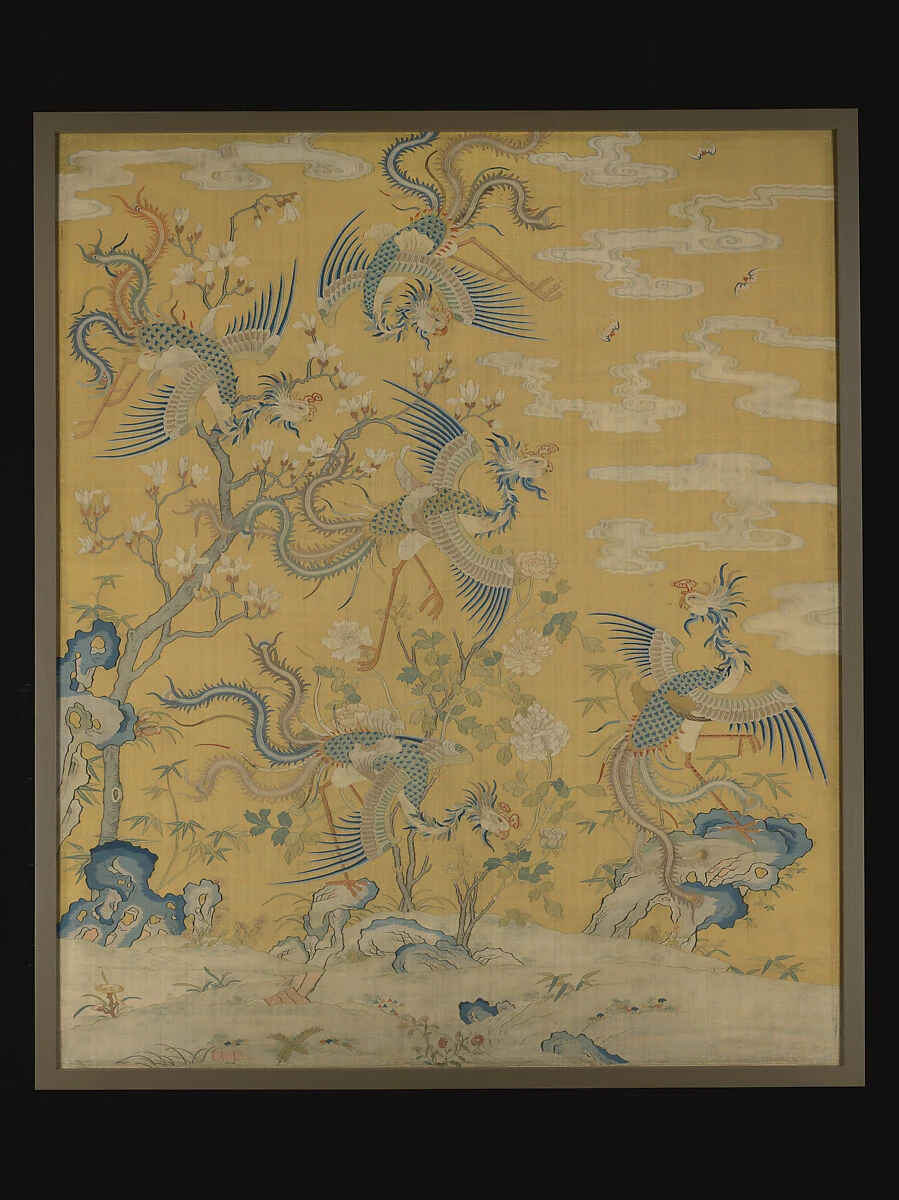
This Qing-dynasty kesi panel is not evidence of a bird surviving fire. Its yellow ground, imperial workshop context, garden and multiple phoenixes place the image inside ideas of courtly order, peace and prosperity.
The Metropolitan Museum of Art identifies this tapestry as an eighteenth-century panel with five phoenixes in a garden. The museum makes two points that matter more than any online color chart. First, fenghuang is only usually translated as phoenix; it is a distinct mythical species with different associations. Second, the bird was said to appear in times of peace and prosperity, which made it useful to imperial patrons.
Look at the yellow field. The birds do not escape a disaster. They inhabit abundance so complete that even the background carries rank. Their bodies are elaborate, their tails take up space, and each turn is answered by flowers and foliage. This is not survival after collapse. It is the visual claim that order has become beautiful enough for the rarest bird to arrive.
That claim contains flattery. When a ruler surrounds himself with fenghuang imagery, the bird does not independently certify that he is virtuous. The court is presenting the world it wants viewers to believe exists. Art can express an ideal and perform power at the same time.
I find that tension more interesting than “phoenix means good luck.” The fenghuang is not a lucky sticker. It is an impossible witness: if the bird appears, someone is claiming that the age deserves it.
A body made from many animals is a theory of harmony
Descriptions of the fenghuang vary across texts, periods and later retellings. Its body may be compared with features of several birds or animals; its plumage is frequently imagined as richly colored. The exact checklist is less reliable than the larger idea: this creature is assembled, not observed from one biological species.
That composite body matters. A real pheasant, peacock or crane can inspire the artist, but the finished fenghuang exceeds zoology. Its crest, beak, wings and long tail are coordinated differences. The bird becomes a visible argument that unlike parts can produce an ordered whole.
This is why I refuse the popular identification game that circles one feather and announces, “That proves it is a phoenix.” Identification comes from the complete design:
- the crested head and fantastic tail;
- the bird's scale relative to companions;
- whether smaller birds orient toward it;
- whether the title or object record names fenghuang;
- the court, ritual or decorative setting;
- associated motifs such as peony, paulownia, dragon, clouds or waves.
A long tail alone can belong to a peacock or stylized bird. A flaming halo alone can come from modern fantasy art. The Chinese phoenix is not a species test; it is a relationship test.
“Hundred birds face the phoenix” is leadership made spatial

The Met's Panel with a Phoenix and Birds in a Rock Garden dates to the late sixteenth or early seventeenth century. Its museum record interprets the central phoenix and smaller birds as a virtuous monarch or leader welcomed by followers. The panel once occupied a wall, so its meaning was also architectural: power entered the room at human scale.
The common phrase 百鸟朝凤—a hundred birds paying court to the phoenix—often gets flattened into “respect” or “good fortune.” The composition is sharper than that. The smaller birds make the phoenix large. Direction creates hierarchy. Attention becomes a political resource.
I can feel the attraction and the danger in the same image. A worthy leader should gather people without chasing them; excellence should create its own gravity. But a court object can also make obedience look natural, as if every smaller bird freely chose the same center. The textile turns a political arrangement into a garden.
That is an East Moment reading because it keeps beauty and power in the same frame. The phoenix is magnificent. The flock is not neutral.
For a modern company logo or personal emblem, this composition can express leadership, aspiration or responsibility. It should also provoke a harder question: do others gather because the center is worthy, or because the picture leaves them nowhere else to fly?
Phoenix gender changes when another symbol enters the room
People often ask, “Is the Chinese phoenix male or female?” The tempting answer is a clean rule: dragon equals male, phoenix equals female. That rule works in some later court and wedding settings. It does not explain the entire history of fenghuang.
The written compound itself preserves a more complicated memory. Feng and huang have been explained as paired male and female terms in parts of the tradition; combined as fenghuang, the creature can stand as one sovereign bird. The Met's historical study Chinese Textiles explicitly warns that the familiar emperor-dragon and empress-phoenix rule is not the whole story because feng and huang can form a dual creature. Later, when paired against the dragon in court imagery, the phoenix is pushed toward the feminine position and becomes associated with the empress or high-ranking women.
Here is the insight I keep returning to: beside huang, feng can be read as male; beside the dragon, the fenghuang is read as female. Gender is not sitting permanently inside one feather. It is being produced by the partner and the institution around the bird.
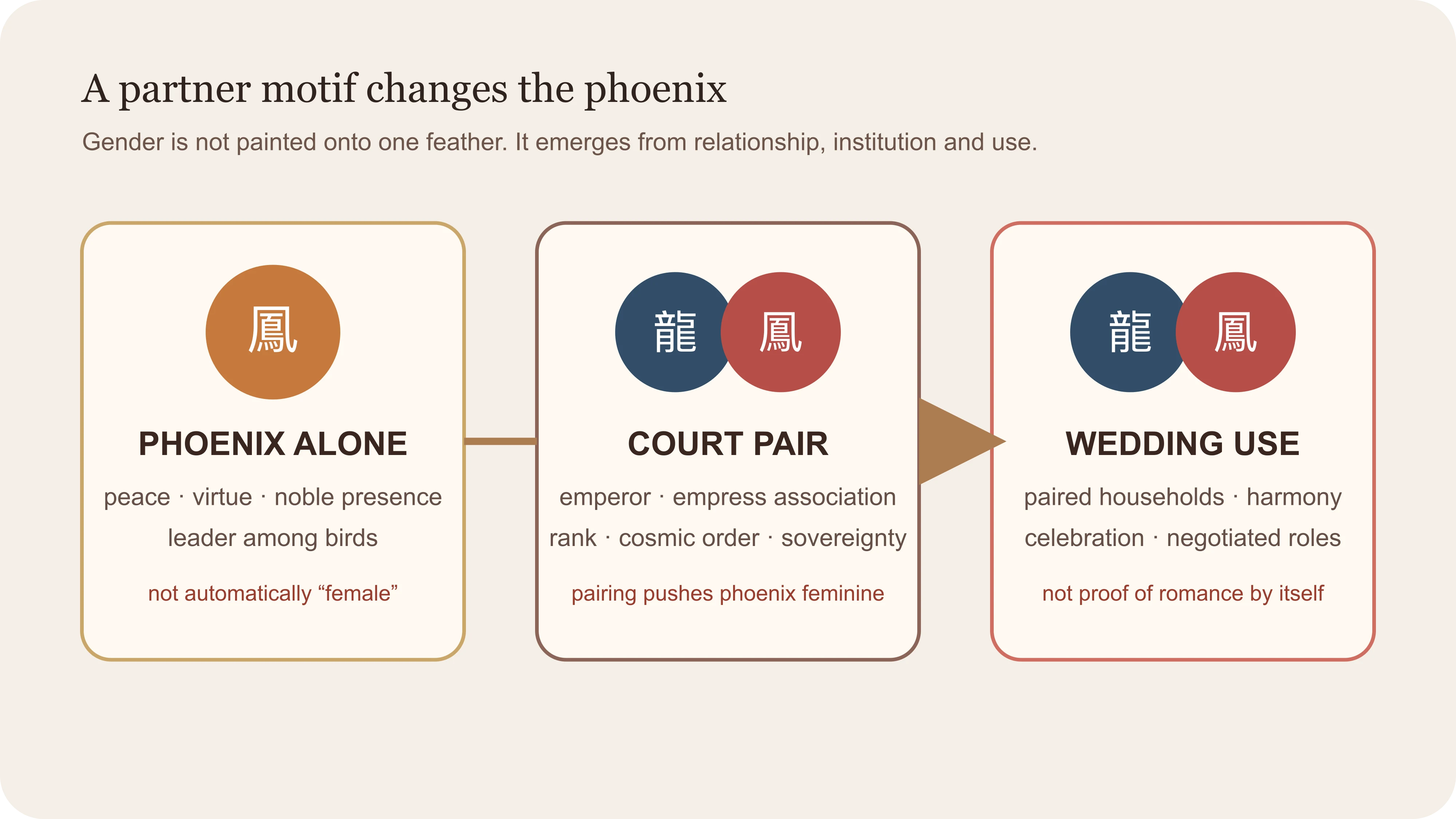
This is why a phoenix tattoo on a woman's shoulder can represent feminine authority without proving that all historical phoenixes were female. It is also why a man can choose a fenghuang without “wearing the wrong gender.” The image's action, partner and personal statement decide the modern meaning.
The useful question is not “What sex is a phoenix forever?” It is “Who or what is the phoenix being asked to stand beside here?”
Dragon and phoenix meaning began with power before it became wedding romance

The Met describes this sixteenth-century kesi panel as a dragon rising through clouds over mountains and waves while a phoenix flies over peonies, a garden rock and lingzhi. The museum reads the combined scene as an age of peace and prosperity.
Notice the geography. The two creatures do not embrace like a modern wedding couple. The dragon occupies cloud, mountain and water. The phoenix occupies flower and garden. Their pairing makes a complete ordered world.
That is why dragon and phoenix meaning cannot begin and end with “perfect couple.” In imperial and courtly contexts, the pair could stage complementary authority, sovereignty, hierarchy and cosmic balance. A five-clawed dragon might be linked with the emperor; the phoenix could be associated with the empress. The pair was political before a wedding shop printed it on invitations.

The Met's Wanli-period dish is unusually explicit: its five-clawed dragon symbolizes the emperor and the phoenix is associated with the empress. The porcelain makes the pairing repeatable and portable, but not casual. Rank is fired into the surface.
Our guide to the Chinese dragon explains why claws, waves, clouds and context matter. Put that creature beside the phoenix and both symbols narrow. The dragon is no longer every dragon; the phoenix is no longer every noble bird. The pair begins to perform a relationship between positions.
Wedding imagery borrows court order—and makes it intimate
Dragon-phoenix imagery later became one of the most recognizable visual languages of Chinese weddings. It can express paired households, harmony, prosperity and the hope that two strong lives will create an ordered future. Red cloth, gold thread and ceremonial display intensify celebration.
But I do not call every dragon and phoenix a romantic couple. The image may come from court dress, theater, architecture, porcelain, a business sign or a modern decorative print. Wedding meaning becomes persuasive when the object gives us wedding evidence: a bridal garment, marriage date, dowry context, ceremony photograph, invitation, bedding or reliable family record.
The V&A's record of imperial Chinese robes includes an 1889 wedding robe with red dragon and phoenix worn for Yehe Nara Jingfen's marriage to the Guangxu emperor. That specific garment joins court hierarchy and marriage. The two meanings do not cancel each other; they occupy the same silk.
This is exactly why our Chinese wedding clothing guide treats a garment as a social object, not a costume board. The wearer, household, region, date and ceremony are part of what the embroidery means. The wedding tea ceremony guide continues the same principle: marriage becomes real through relationships and actions, not through motifs alone.
My personal reading of the wedding pair is not “the man is a dragon and the woman is a phoenix.” That sentence traps two people inside inherited roles. I see two creatures powerful enough to keep their shapes while agreeing to share one composition. Harmony is not disappearance. It is negotiated space.
A court phoenix is feminine because the role makes it feminine

The Met identifies this nineteenth-century theatrical robe as clothing for an actor portraying a princess or palace concubine. Its phoenixes signified the empress and other women at court; ribbons would have moved as the performer walked or danced.
This robe makes symbolism physical. The phoenix is not merely seen. It is activated by a body, role and stage. Sleeves extend gesture. Ribbons delay movement. Embroidery catches light. A performer enters as one person and becomes legible as a court woman before speaking.
The object also warns us against treating museum labels as universal dictionaries. Here the phoenix supports a female court role. That fact is strong because the garment's function is documented. It does not prove that every earlier phoenix, every regional folk image or every contemporary tattoo must be female.
The role makes the reading precise. Precision is not limitation; it is evidence.
Two phoenixes do not need a dragon to become a pair

This mid-eighteenth-century double-phoenix box gives us a useful alternative. The Met notes that double-phoenix designs were popular across Qing imperial porcelain, jade, glass, metalwork and other media. There is no dragon required to complete the design.
The pair can produce symmetry, circulation and multiplication. Two long bodies answer each other across the lid; clouds keep them in one atmosphere. The box turns the motif into touch: open, close, contain, protect.
Could two phoenixes symbolize a couple? On a documented wedding object, yes. Could they suggest doubled auspicious force, formal balance or an imperial pattern? Also yes. The box itself prevents us from choosing romance automatically.
This is where generic pages fail. They make “two phoenixes” equal “eternal love” before checking what the object was, who used it or whether marriage was involved. Counting is evidence. It is not the entire argument.
Porcelain forces the phoenix to move around a body

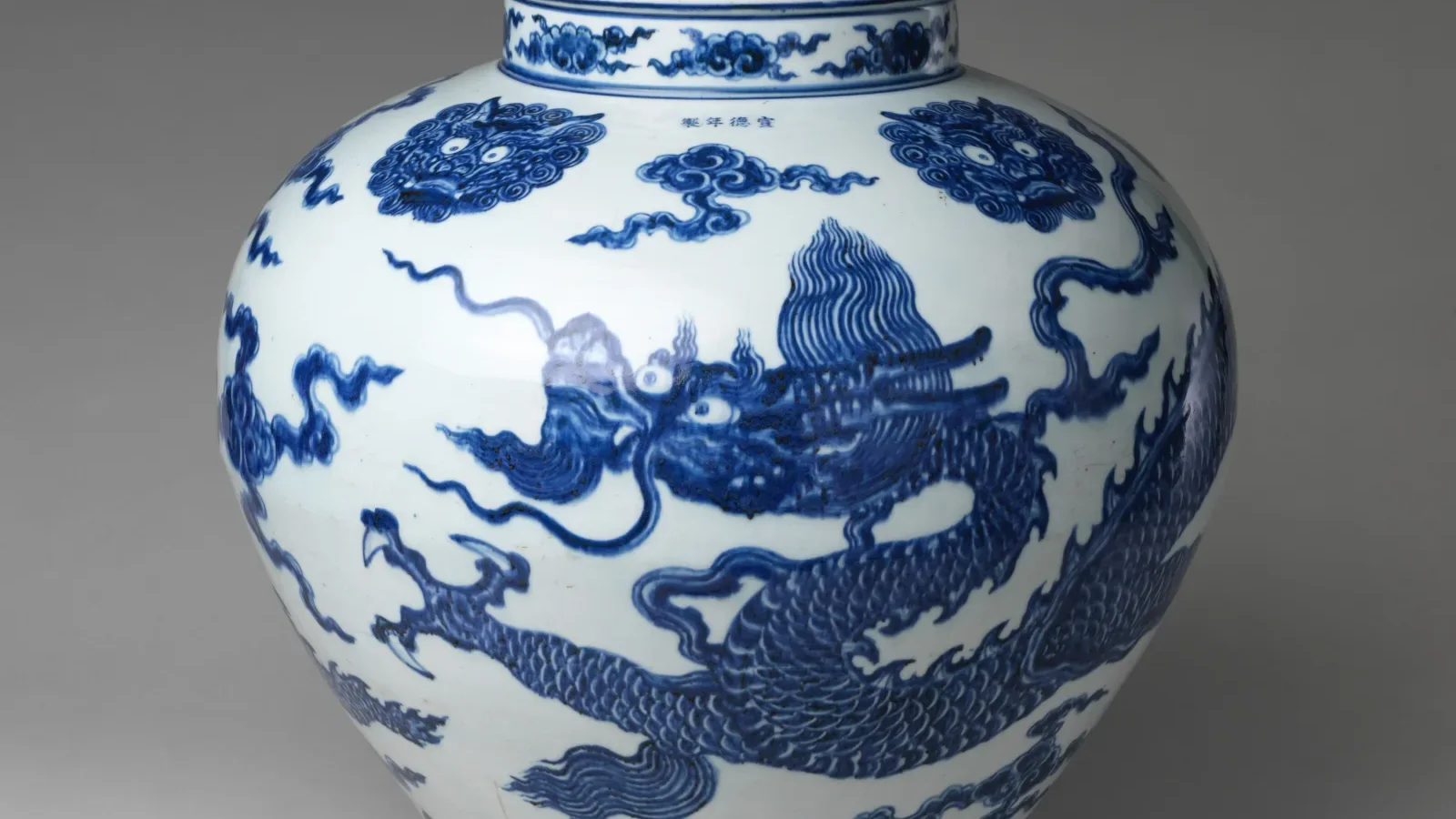
A phoenix on a vessel does not behave like a phoenix on a flat screen. The Met's late Ming meiping vase wraps bird, cloud and open ground around a narrowing shoulder and swelling body. Part of the creature is always moving away from the viewer.
That curvature changes meaning. The phoenix becomes return, rhythm and controlled concealment. You must walk around the vase or turn it to recover the whole bird. The object teaches that a symbol can be continuous without being visible all at once.
This is why the Chinese porcelain patterns guide asks what a motif does across a vessel. On blue-and-white porcelain, cobalt line, reserve, firing and curvature matter as much as the named creature. A poor reproduction can preserve the phoenix label while destroying the brush rhythm that made it fly.
I would rather see one sharp photograph of the object turning than five decorative phoenix icons. A real image carries evidence: scale, wear, material, edge, negative space and the limits of the camera.
Fenghuang and Zhuque are not interchangeable birds
Another common shortcut equates the fenghuang with Zhuque (朱雀), the Vermilion Bird. Both are extraordinary birds. Both can be rendered red. That resemblance is not identity.
Zhuque belongs to a directional-cosmological system: one of the Four Symbols, associated with the south and a larger mapped order of directions and constellations. Fenghuang belongs to a different web of legendary, political and decorative meanings. Later art, popular culture and fantasy can blend their appearances, but a red bird facing south is not enough to make every phoenix Zhuque—or every Zhuque fenghuang.
The distinction changes how we read games and animation. A fire-aligned southern guardian may draw on Zhuque. A sovereign bird among other birds may draw more strongly on fenghuang. A creator may deliberately fuse both with the Western rebirth phoenix. The honest answer can be “hybrid,” provided we name the ingredients.
I do not want cultural purity tests. I want better captions.
Phoenix tattoo meaning must choose its tradition before its color
People searching this keyword are often deciding what to place on their body. They need a usable answer.
A phoenix tattoo can mean rebirth after trauma, feminine authority, beauty, leadership, a marriage, a family name or a personal refusal to disappear. Every one of those meanings can be sincere. The design becomes culturally clearer when its visual grammar agrees with the statement.
Ask these questions before choosing color:
- Which bird tradition do you want? A Western phoenix rising through fire, a Chinese fenghuang in an auspicious world, Zhuque as a southern guardian, or a named hybrid?
- What is the bird doing? Burning, arriving, flying, facing a dragon, receiving homage, resting in a tree or turning around the body?
- Who shares the composition? Dragon, second phoenix, peony, paulownia, clouds, smaller birds, waves or no partner at all?
- What relationship do you want to make visible? Survival, sovereignty, marriage, community, beauty, responsibility or peace?
- What part is personal? A date, scar, family story, place or promise can make the tattoo yours without pretending to be ancient doctrine.
A fire-bird tattoo should not be described as “traditional Chinese phoenix rebirth” unless the artist can show the Chinese tradition being used. A fenghuang-and-peony design does not need flames added to become powerful. A dragon-and-phoenix tattoo does not need to reproduce old gender roles if the wearers define their partnership differently.
Tattoo health, pigments, placement and aftercare require a qualified professional. This page can clarify visual culture; it cannot make a medical decision.
What phoenix symbolism does not prove
Phoenix imagery can be politically, emotionally and visually dense. It cannot prove every claim projected onto it.
A phoenix image does not prove:
- that the bird belongs to the Western death-and-rebirth cycle;
- that it is a fenghuang rather than Zhuque, a peacock or an invented fantasy bird;
- that every phoenix is female;
- that every dragon-and-phoenix pair represents lovers;
- that a court association applies unchanged to ordinary domestic life;
- that red means one emotion or gold guarantees wealth;
- that an auspicious design confirms a ruler was actually virtuous;
- that a tattoo wearer accepts the historical role attached to a borrowed motif;
- that an object is authentic, old or valuable because it displays a phoenix.
These boundaries do not make the symbol weaker. They stop the same five words from being pasted under every image.
Use five questions to read any phoenix image
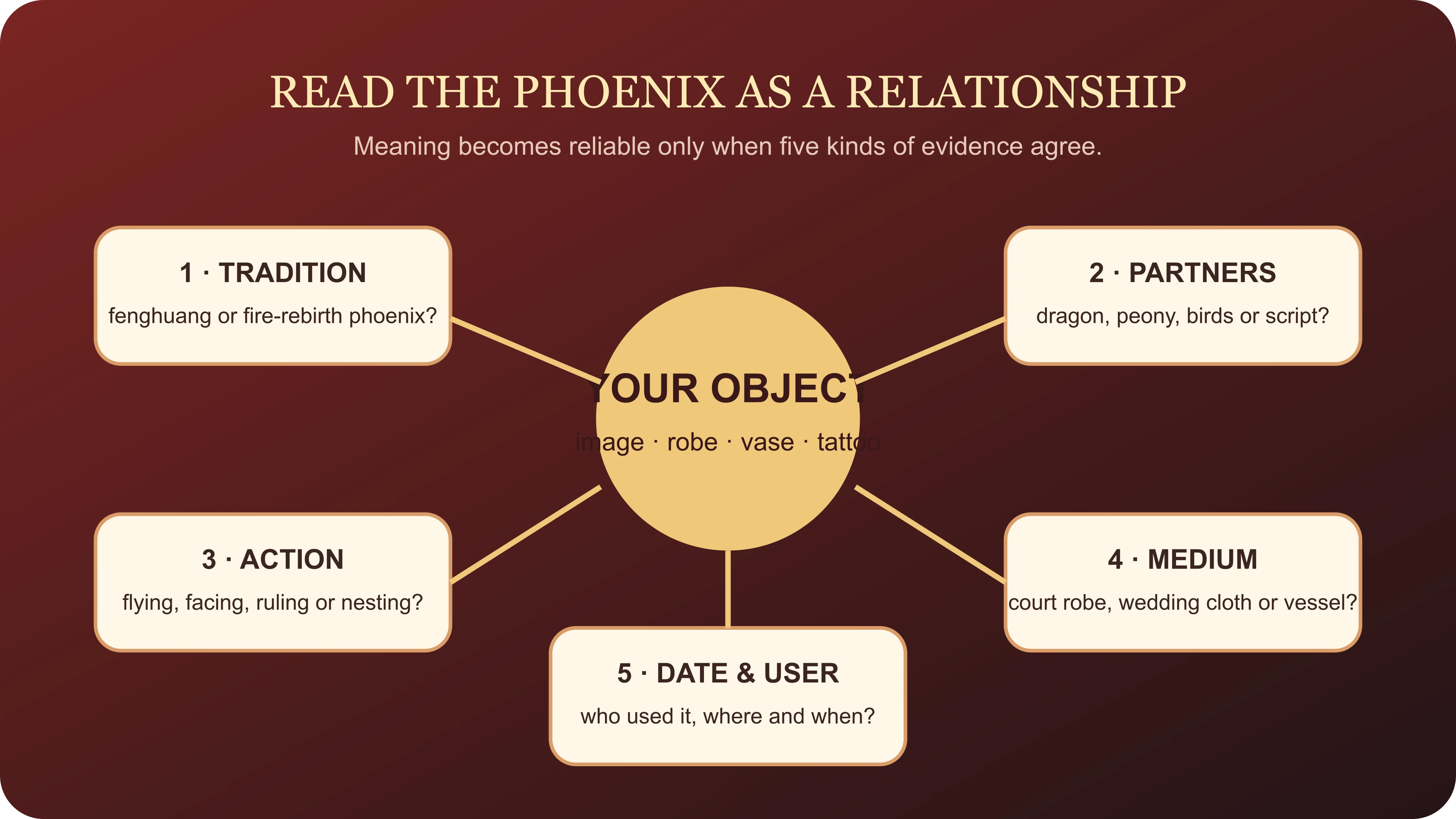
When someone sends me a phoenix and asks what it means, I use this order:
- Tradition: Is the source naming fenghuang, phoenix, Zhuque or only a fantastic bird?
- Partners: Is there a dragon, second phoenix, peony, tree, flock, cloud, wave or inscription?
- Action: Is the bird arriving, receiving homage, circling, facing, burning, nesting or simply filling a pattern?
- Medium and user: Is it on an emperor's dish, a woman's robe, a wedding textile, theater costume, porcelain vase, logo or tattoo?
- Date and record: What does a reliable institutional record, family history or artist statement allow us to say?
That order is more demanding than a symbolism chart, but it is faster than correcting a false answer later. It also preserves uncertainty. If the source says only “bird,” we can admire the form without forcing a famous name onto it.
The wider Chinese symbols collection uses the same method across flowers, animals, colors and objects. Continue to plum blossom meaning to see how season, branch structure and actual weather change a flower's reading. Symbols become alive when they stop behaving like vocabulary cards.
My verdict: the fenghuang does not rise from ashes—it changes the room
The Western phoenix is powerful because destruction does not finish it. The Chinese fenghuang is powerful for another reason: its arrival reorganizes the world around it.
Smaller birds turn toward it. A ruler borrows its virtue. A court assigns it gender beside the dragon. A wedding pulls public hierarchy into private hope. A vase makes it circle. A performer makes its ribbons move. A tattoo can reclaim all of those histories—or refuse them and declare a new one.
That is why I will not reduce the fenghuang to “rebirth.” Rebirth is one compelling modern choice. It is not the bird's entire Chinese life.
My phoenix is not most interesting when it burns. It is most interesting when it enters a crowded image and every relationship changes.
If you have a phoenix object, tattoo or family textile, bring the complete image to Moments. Do not ask the group for one lucky word. Put one popular caption on trial: name the bird tradition, partner, material and date, then show what the image can prove—and what it refuses to become.