Chinese porcelain patterns are not a dictionary printed on clay. They are arrangements made for curved, handled, lidded or open forms. A flower may become a continuous scroll, an isolated spray, a framed panel or one small border element. Before asking what a motif “means,” ask where it sits, what it repeats, what it leaves empty and how it changes when the vessel turns.
Chinese porcelain patterns begin with placement, not meaning
Most guides to Chinese porcelain patterns begin with nouns: dragon, phoenix, lotus, peony, bat, fish. I begin with verbs. Does the decoration wrap, frame, divide, climb, anchor, interrupt or leave breathing room? Those actions reveal how a painter, modeller or designer understood the object as a three-dimensional surface.
This changes the quality of the question. “What does the peony symbolize?” invites a one-line answer that can be pasted beneath almost any picture. “Why does this peony scroll widen over the shoulder, tighten at the neck and disappear behind the bottle?” forces us to look at the exact piece.
The distinction matters because one subject can perform several jobs:
| Placement | What the motif does visually | What you still need before interpreting it |
|---|---|---|
| Continuous scroll | Carries the eye around a body and makes rotation part of viewing | Full rotation, date, technique and where the scroll begins or joins |
| Isolated spray | Creates a focal pause and lets undecorated porcelain remain active | Front and reverse views; whether another spray balances it |
| Reserve or panel | Frames one scene against a contrasting ground | The ground, border, other panels and their sequence |
| Medallion | Compresses attention into a round or shaped unit | The object form, neighboring motifs and repeated sides |
| Border band | Marks rim, shoulder, foot or a transition between zones | Whether it repeats, drifts, closes cleanly or hides a repair |
| All-over ground | Turns the surface into atmosphere rather than a single picture | Density, scale, interruptions, reserved spaces and handling wear |
Meaning does matter. A museum record may identify a longevity character, lotus pond, historical figure or auspicious combination. But identification is only the first layer. Date, audience, intended use, combination and placement decide how securely we can move from “this is a bat” to “this object was made to communicate this particular wish.” A symbol list without those layers makes cultural knowledge look precise while quietly removing the object that gave it context.
First separate pattern from glaze, texture, damage and marks

Blue patches spread over a brown, rounded surface in this Jun Ceramic Culture Park photograph. Follow their irregular edges: they do not form the repeating stems or framed scenes shown on the porcelain below.
The surface above is visually eventful, but visible variation is not automatically a pattern. A deliberately repeated band, painted branch or moulded diaper ground has an organizing rule. A flowing glaze may produce streaks, pools, color breaks and transitions whose exact distribution emerged through application, gravity and firing. Both can be beautiful; calling both “pattern” makes it harder to describe what we actually see.
I separate five surface events before naming a motif:
- Designed pattern: repeated, framed or intentionally placed painted, incised, carved, moulded, pierced or applied decoration.
- Glaze behavior: pooling, thinning, mottling, crackle, streaking or color change across the fired surface.
- Body and tool texture: ridges, joins, faceting, throwing lines or modelled relief that may organize light without forming an iconographic pattern.
- Condition: abrasion, staining, restoration, kiln grit, chips or later paint that interrupts the original surface.
- Marks and labels: information on a base or body that belongs to documentation, not necessarily to the decorative composition. The Chinese ceramic marks guide explains why a mark is evidence to investigate rather than a date certificate.
Photographs collapse these layers. A glossy restoration can imitate glaze. Reflections can look like pale painted lines. Compression can turn fine crackle into dirt. Begin with neutral diffuse light, then add an angled view that reveals relief and surface gloss. If the color is consequential, include a neutral gray reference. Description should become more exact before attribution becomes more confident.
Read the vessel as a map with a rim, shoulder, body and foot

The Met records this early fifteenth-century bowl as Jingdezhen porcelain painted in underglaze cobalt blue, with pomegranates, lotus scrolls and chrysanthemum petals. It stands 21 centimetres high. The useful lesson is not merely that three motifs appear. Each motif occupies a different structural zone.
A vessel offers a map:
- The rim can close the composition, protect a visual edge or announce the transition into an interior.
- The neck often needs a smaller rhythm because its circumference is narrow and its vertical direction is strong.
- The shoulder turns sharply away from the viewer, so bands and lappets can manage that change.
- The body offers the broadest field for scrolls, scenes, medallions or open space.
- The lower body and foot visually carry the object; a border here can anchor dense decoration above.
- The interior, lid, handles and base create additional surfaces that may repeat, answer or contradict the outside.
On a plate or bowl, that map changes. The well behaves like a centre; the cavetto slopes outward; the rim forms a boundary. The Chinese porcelain plates guide reads those zones together with profile, depth, foot and reverse. A design that works as a circular medallion on a dish would behave very differently stretched around a tall Chinese porcelain vase. The same is true of a covered porcelain jar, where decoration must negotiate both body and lid.
This is why I never trust a pattern identification based on a cropped square. The crop may remove the border that identifies the design system, the rim that shows orientation or the lower band that reveals how the composition closes.
A scroll makes the viewer walk around the object

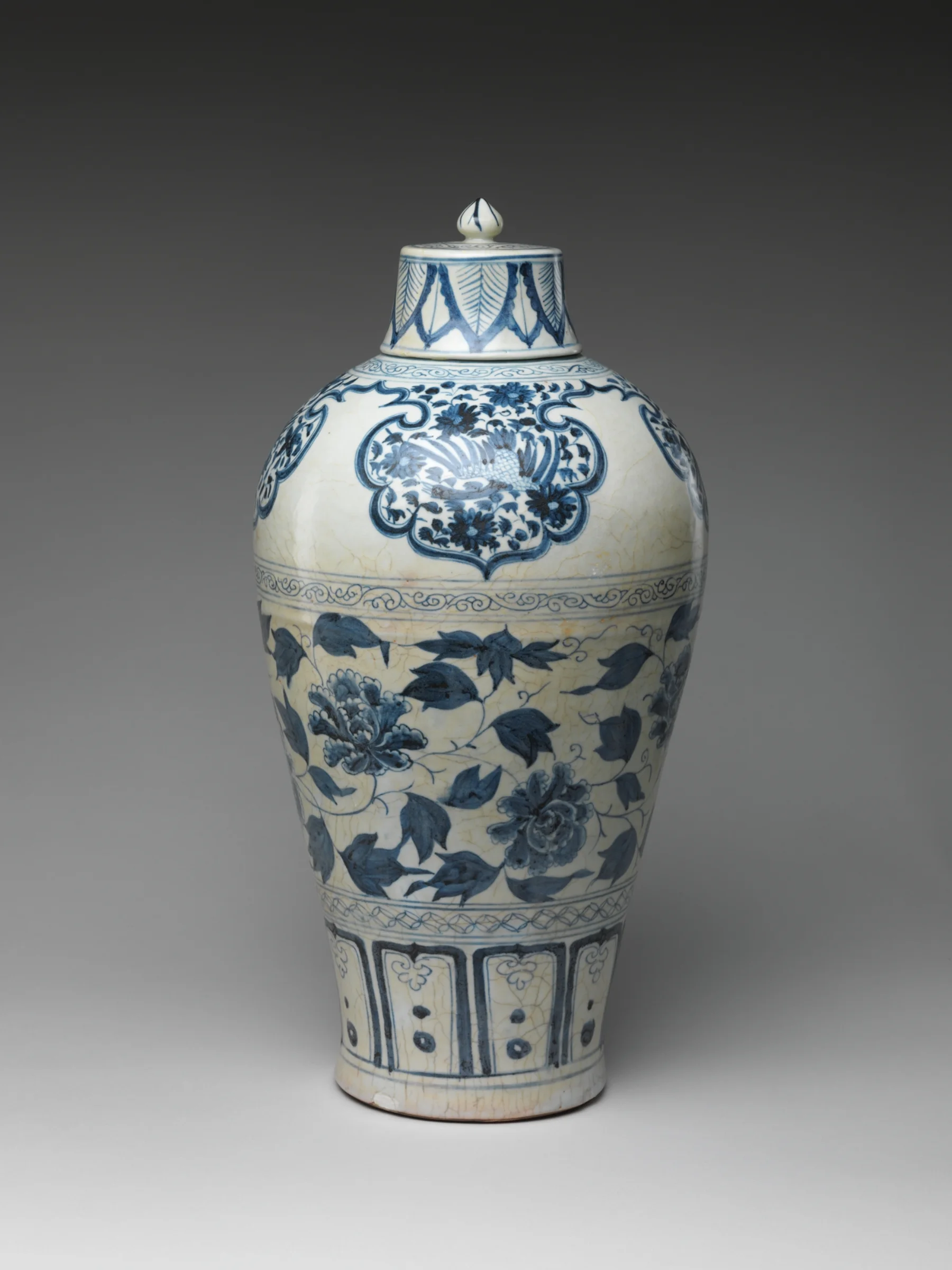
The Met's Bottle with Peony Scroll, dated to the mid-fourteenth century, makes the grammar visible. The museum records it as Jingdezhen porcelain painted with cobalt blue under a transparent glaze and gives its height as 44.5 centimetres.
“Peony scroll” names both subject and movement. Stems link leaves and blossoms into a route rather than a group of separate botanical specimens. The bottle's body gives that route a horizon. From one frontal image, we see only a temporary arrangement produced by the camera angle. The composition continues beyond both edges.
This is where a scroll earns its name. It asks the eye to anticipate what has just disappeared. A strong continuous design does not simply repeat wallpaper around a cylinder. It expands over the belly, compresses near the neck, negotiates seams between decorative zones and allows important blossoms to remain legible on a curved field.
When evaluating a scroll pattern, I look for:
- the main stem's direction and whether it remains coherent through a full rotation;
- changes in motif scale as the vessel narrows or widens;
- where the pattern joins, overlaps or deliberately breaks;
- whether border bands support the movement or imprison it;
- whether abrasion follows handling zones rather than the design;
- whether the reverse is equally resolved or treated as secondary.
Hand-painted asymmetry is not a defect by default. Mechanical perfection is not proof of quality. The more useful question is whether variation keeps the rhythm alive or makes the design collapse.
A continuous scene turns time into circumference

The Met dates this jar with carp in a lotus pond to the mid-sixteenth century and records underglaze cobalt blue with overglaze polychrome enamels on Jingdezhen porcelain. At 23.2 centimetres high, it carries a world larger than its physical scale.
A pond scene differs from a scroll even when lotus stems create continuity. Fish establish direction, depth and moments of encounter. Leaves can hide part of a body; blossoms punctuate the water; empty intervals stop the scene becoming a botanical wall. Rotation becomes a kind of editing. One fish leaves the frame while another enters.
That experience cannot be reconstructed from the “best side” alone. A seller may select the face where one carp is complete and omit the point where the scene joins. A museum photograph may serve identification while still leaving the reverse unseen. For any narrative vessel, I want a slow 360-degree video or at least four evenly lit quarter views.
The sequence also changes interpretation. Two motifs that appear adjacent in a flat composite may occupy opposite sides in reality. A figure facing a pavilion, an animal approaching a plant or a poem placed after a painted scene can create relationships that vanish when images are shuffled. On a vessel, order is spatial.
A reserve is a window cut into another surface
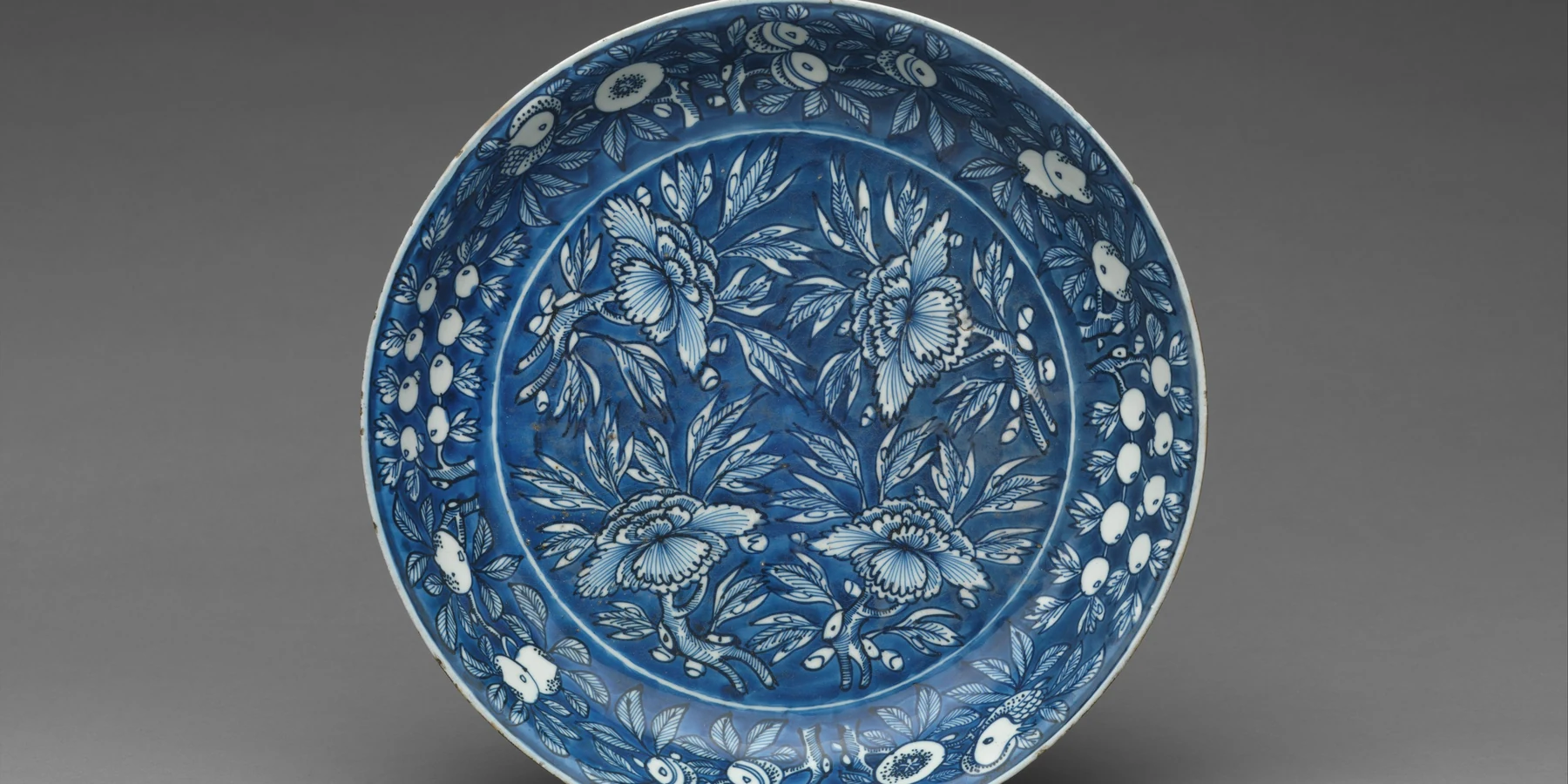
The Met's Dish with Flowering Branches is dated to the late sixteenth or early seventeenth century. Its record describes porcelain with reserve on a cobalt-blue ground under a transparent glaze. The dish is 31.8 centimetres in diameter.
“Reserve” is one of the most useful pattern words because it describes a relationship. One area is held back or made to read as an opening against a contrasting ground. The flower does not merely sit on blue. The blue makes the pale area behave like a window, silhouette or interruption.
Look at three boundaries:
- The outer contour of the reserve. Is it geometric, lobed, cloud-shaped, leaf-like or absorbed into the motif?
- The transition between reserve and ground. Is it a painted edge, relief, glaze contrast or another technical relationship?
- The space inside. Does it contain one branch, a landscape, calligraphy, a figure scene or deliberately quiet porcelain?
On vases and jars, several reserves can create a gallery around the body. Their order matters. Their sizes may respond to handles, shoulder changes or a preferred frontal axis. On a dish, the reserve may lock attention into the centre while the rim acts as a second frame.
Do not infer technique from a distant image. White-on-blue appearance can arise through more than one process, and restoration can repaint a boundary. The museum's medium field supports the named object. A visually similar listing still needs close views and exact-object examination.
Medallions compress a world into repeated punctuation

The Met records this early nineteenth-century bowl as Jingdezhen porcelain with underglaze cobalt blue and overglaze enamels. Floral medallions divide its surface into discrete units.
A medallion is not simply a round picture. On a curved body it creates punctuation. The eye reads one unit, crosses the ground and arrives at another. Repetition can make the object feel orderly; changes inside repeated frames can prevent that order from becoming static.
Count before interpreting. How many medallions are there? Are they the same size? Do they alternate subjects? Does one face act as the front? Is there a matching unit on the reverse? Does a border line pass behind them or stop at each frame? Those plain questions often reveal more than a confident symbolic label.
Medallions also expose photography's bias. A frontal image can make one unit look like the entire design. A three-quarter view shows the next one arriving and explains the interval between them. When an online listing says “pair,” compare the sequence on both objects; matching fronts can hide different reverse medallions or later replacements.
A floral spray needs empty porcelain around it

The Met identifies this bowl with floral sprays as Jingdezhen porcelain with overglaze enamels, Qianlong mark and period, 1736–95. Its height is 6 centimetres and diameter 11.1 centimetres. The object has a period attribution even though there is no separate calendar-year date. The stand beneath it is visually distinct from the bowl's small foot; do not include that support when comparing the vessel's silhouette.
In this monochrome photograph, compare spacing rather than reconstructing enamel colors. A spray is self-contained: stem, leaves and flower belong to a localized cluster. The blank ground around it is not unfinished space; it gives the cluster edges, scale and pause. My eye enjoys the interval as much as the flower. Filling every gap would make this small bowl less interesting, not more accomplished.
Negative space is especially vulnerable in online shopping. Bright white backgrounds can erase the vessel's boundary. Cropping can make an isolated spray look like part of a larger repeat. Excess contrast can turn pale decoration into sharp graphics and remove the softness that allows undecorated porcelain to remain active.
To compare sprays, record their number, orientation and distance apart. A branch that points upward on one face may angle downward on another to follow the body. A small interior motif may answer a larger exterior spray. These relationships belong to the whole object, not to the motif extracted as clip art.
Why the dragon-equals-power shortcut is not enough
Readers often arrive through a symbol question, and the Chinese symbols guide is useful for building vocabulary. The danger begins when vocabulary is mistaken for a verdict.
A dragon can appear as a principal imperial image, a lively creature in a popular design, part of an archaistic scheme, an export decoration or a modern pastiche. Its claws, posture, companions, surrounding clouds or waves, inscription, date and object type all matter. A peony beside a bird does not necessarily communicate exactly what a peony scroll around a bottle does. A lotus in a pond scene is not spatially equivalent to a lotus-petal border at the foot. The same discipline applies to crane symbolism: pine, peaches, clouds, an official badge or an immortal realm give the bird different work, so “longevity” cannot finish the reading by itself.
Here is a more useful example than a loose list of symbols. In its catalogue entry for a dish decorated with fish, the British Museum explains the shared sound of 鱼, yu, fish, and 余, yu, surplus. The image can carry a wish for abundance through a spoken association. An English translation that stops at “fish decoration” loses that extra layer.
I find this kind of wordplay warmer than the grand label “auspicious symbolism.” The wish is understandable: enough left over, not merely enough to scrape through. It brings ornament close to ordinary hopes. That is my reading of its appeal, not proof of the circumstances in which every fish-decorated vessel was made.
Return to the carp jar above. You can now hold two ideas together: the fish organize a lively scene around a curved body, and fish can participate in a Chinese verbal wish for abundance. Neither cancels the other. What we still cannot invent is a particular wedding commission, recipient or household ritual for that jar. The visual arrangement is visible; the linguistic association is documented; an individual owner's intention needs its own evidence.
I use four levels of confidence:
- Visible identification: “The record identifies carp and lotus.”
- Compositional observation: “The fish and plants create a scene that continues around the jar.”
- Contextual interpretation: “In this documented period and combination, scholarship connects the motifs to a particular cultural reading.”
- Exact-object claim: “This individual piece was commissioned, owned or used for that purpose.”
Each level needs more evidence than the one before it. The first may be supported by a museum title and clear image. The last may require inscriptions, archival documents, provenance and specialist scholarship. Moving carefully between them does not drain art of feeling. It keeps our feelings attached to something real.
Blue-and-white is a technique history, not the name of every pattern
Several objects on this page use cobalt beneath a transparent glaze because blue-and-white porcelain offers especially legible examples of scrolls, bands, reserves and continuous scenes. But “blue and white” names a material and firing relationship, not one pattern grammar.
The dedicated Chinese blue-and-white porcelain guide owns that technology, history and identification problem. This page asks a different question: how does any decoration occupy an object? Incised lotus under celadon, overglaze enamel sprays, moulded petals and reserved white ornament can all be read through zones, rhythm, frame and negative space.
The same separation applies to Chinese ceramic glazes. Glaze can be the dominant visual event. Pattern can sit under it, over it, within relief or in the absence of color. Naming the layers separately creates a more useful record than calling the whole surface “a traditional pattern.”
How to inspect Chinese porcelain patterns before buying
A pattern guide should end at the object, not at a mood board. Before buying a decorated porcelain piece, ask for evidence that lets you reconstruct its surface.
Request the visual set:
- full front and reverse at the same scale;
- left and right profiles or a slow full rotation;
- rim, interior, foot and base;
- close views of every panel, medallion or scene join;
- raking light for relief, repainting and gloss changes;
- measurements and one honest scale reference;
- condition views before any filters or background removal.
Then separate the decisions:
- Do I like the composition? Follow the design around the actual form. A beautiful isolated motif cannot rescue an unresolved reverse.
- Can I describe the technique? Say what is visible, then ask what documentation or examination supports underglaze, overglaze, transfer, hand painting, incision, moulding or relief.
- What is the condition? Look for abrasion across raised lines, restoration around rims and handles, repainted reserves, drilled bases and mismatched lids.
- What attribution is being sold? “Chinese style,” “made in China,” “Jingdezhen,” a dynasty date and an imperial reign attribution are not interchangeable claims.
- What documentation survives? Keep invoices, old labels, collection history, specialist reports and high-resolution photographs together. The wider history of Chinese porcelain becomes useful only when broad chronology meets exact-object evidence.
No photograph can authenticate a consequential purchase by itself. For significant money, obtain an independent condition assessment and attribution from an appropriate ceramics specialist. The purpose of visual literacy is not to make everyone an instant expert. It is to make weak claims harder to hide.
The pattern becomes alive when the object turns
The most memorable Chinese porcelain decoration does more than fill a surface. It understands the vessel beneath it. A scroll makes circumference felt. A panel creates a window. A medallion punctuates a curved field. A spray makes empty porcelain meaningful. A border tells the eye where one zone ends and another begins.
That is the order I now use: object, placement, technique, motif, context, meaning. Reversing the sequence produces a symbol dictionary. Following it produces a conversation with a particular work.
Continue through the Chinese porcelain overview or return to the Chinese Art collection to compare vessels, glazes, marks and making. For a conversation in Moments, start smaller than the buying checklist: show the front and one other side, then name what changed. Did the branch stop? Did a second medallion arrive? Was the back left almost empty? Come back with another angle if it overturns your first reading. A familiar flower becomes interesting again when someone shows the part we missed.