Leave the flowers out for a moment. A Chinese porcelain vase should be worth looking at empty: meiping gathers its weight in the shoulder, yuhuchun carries a continuous pear-shaped curve, and a double gourd interrupts that curve with a tight waist. I choose the shape first. A bouquet cannot rescue a silhouette I do not like.
A Chinese porcelain vase is a shape before it is a story
The quickest useful answer is this: read a vase from the outside inward. First trace its outline. Then identify the transitions between mouth, neck, shoulder, body and foot. Look at how decoration responds to those zones. Turn it over only after the upright object has given you a question to ask. A base mark can support an identification, but it cannot authenticate a vase by itself.
That sequence matters because “vase” is an English umbrella. It gathers together flower vessels, bottles, storage forms, display objects, shapes adapted from metal or jade, and modern decorative ceramics. Museum catalogues may use terms such as meiping, yuhuchun ping, double-gourd vase or cong-form vase. Marketplace listings may call all of them “Chinese vases,” then add “antique,” “vintage” or a dynasty name before the physical evidence has earned it.
For a first vase, I would spend more attention on the mouth than the mark. A narrow opening suits a restrained arrangement; a broad opening gives stems more room to spread but also demands more control. Neither makes the other inferior. The mistake is buying a flower vessel without thinking about the flowers—or filling a display vessel simply because English calls it a vase.
| Start with | Record what is visible | Do not conclude yet |
|---|---|---|
| Silhouette | Tall or squat; round, pear-shaped, squared or lobed | Dynasty, kiln or value |
| Mouth and neck | Flaring, straight, waisted, short, long or cut down | Original function from shape alone |
| Shoulder and body | Broad shoulder, continuous curve, compressed belly, handles | That a market name is historically precise |
| Surface | Painted, incised, moulded, monochrome, crackled or repaired | Porcelain, age or authenticity from color |
| Foot and base | Foot ring, glaze stop, exposed body, mark, labels, wear | That a reign mark is the manufacturing date |
| Documentation | Dimensions, condition, invoices, old labels, collection history | That a family story is formal provenance |

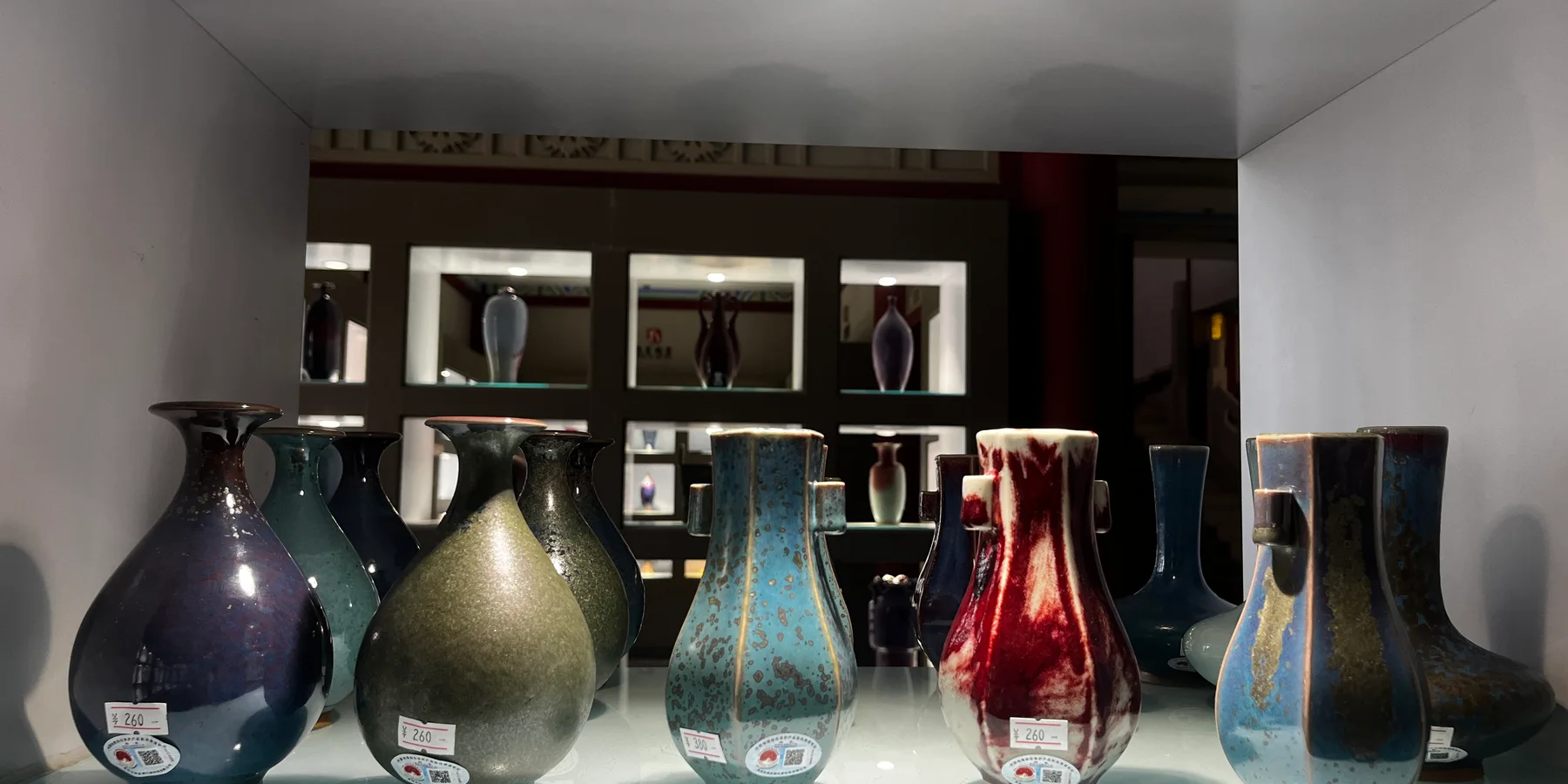
Contemporary glazed ceramics at the culture park: compare the outward reach of the handles with the tighter bodies beneath them. Those projections need space even when the vessel is empty.
The silhouette is a piece of cultural memory
Chinese vessel forms do not sit in a straight timeline where one dynasty invents a shape and the next replaces it. Forms move between materials, return in revivals, change scale and acquire new uses. A ceramic vase can echo an earlier bronze or jade object; a bottle associated with drink can later be filled with flowers; a historical silhouette can become the starting point for a contemporary studio work.
This is why form names are useful but should not become handcuffs. They give us a shared comparison language. They do not promise that every vessel will match a diagram perfectly.
Four families are especially helpful for a first reading:
- Meiping usually has a small mouth and short neck, full rounded shoulders and a body that narrows toward the foot. The English nickname “plum vase” encourages people to imagine a branch of blossom, but historical use was not limited to flowers.
- Yuhuchun ping is usually pear-shaped, with a swelling lower body, a narrower waist and neck, and an outward-flaring mouth. Its profile feels like one continuous rising curve rather than a broad shoulder abruptly turning downward.
- Double-gourd vase builds its silhouette from two joined lobes. The narrow transition between them is structural and visual; decoration and glaze have to negotiate both volumes.
- Cong-form vase translates the logic of an ancient jade form into ceramics: a square or faceted exterior organizes itself around a hollow interior. It is a reminder that a “vase” may be carrying an argument about antiquity as well as flowers.
Those names solve a vocabulary problem. They do not solve the object.
Meiping concentrates attention in the shoulder

The meiping is a useful training object because its drama does not depend on ornament. The Met’s nineteenth-century porcelain meiping is only 12.7 centimetres high, yet its short neck and broad upper body make it feel substantial. The iron-red glaze strengthens the silhouette, but the form would remain legible in white.
Compare that with the British Museum’s Yuan-period qingbai meiping. Its record describes a short neck, thickened rim, sloping shoulders and sides tapering toward a small base. It also notes that the body was joined in sections and carries incised decoration. Form, construction, surface and institutional history work together; no single clue does all the dating.
What I look for is the energy of the shoulder. Does it rise confidently from the foot and turn toward the neck, or does it feel like a jar with a small tube added on top? That is an aesthetic judgment, not an authentication test, but it is an honest one. It teaches the eye to notice proportion before a copied mark or a seller’s dynasty claim takes control.
The meiping also exposes a translation trap. “Plum vase” sounds like an original, fixed function. The Met's Northern Song Cizhou meiping, a stoneware rather than porcelain example, is associated with wine and other beverages as well as blossoms. Form travels across both material and use. Learning the name should open that history, not reduce every meiping to a flower holder.
Yuhuchun is a continuous curve, not simply a long-necked vase
The yuhuchun profile is often described as pear-shaped, but a pear is only the beginning. The mouth tends to flare, the neck narrows, the lower body swells and the foot spreads enough to settle the curve. When the proportions work, the eye can travel from lip to foot without being stopped by a heavy shoulder.
The British Museum’s Hongwu-period yuhuchun bottle is recorded as a heavily potted porcelain vessel made at Jingdezhen, with a pear-shaped body and spreading foot ring. Its neck was cut down, which is exactly the kind of condition fact a simplified silhouette chart would miss. The museum does not hide the alteration so that the object can fit an ideal type; the alteration becomes part of the record.
That is the better habit for a vintage Chinese porcelain vase too. If a neck appears shortened, a rim ground down or a mouth mounted in metal, describe the present object before imagining the original. Repair and alteration are not moral failures. Concealing them in a sale is the problem.
Three neck rings change the pace

The Kangxi-period peach-bloom vase above takes a different approach from yuhuchun. At 19.7 centimetres high, it puts three fine rings at the base of a long neck. Follow the outline: the neck delays the swelling body, then those rings interrupt the descent. This is the detail I would lose by looking only for a pleasing pink.
The Met relates this form to sets of writing-table objects and possible court gifts. It is a useful reminder that a small vase can belong to a group of carefully differentiated shapes. Its appeal need not depend on a large floral arrangement. Put an oversized bouquet in front of that neck and the most interesting part of the design disappears.
Double-gourd form makes empty space part of the vessel

The Met’s early eighteenth-century double-gourd vase stands 18.1 centimetres high. Its crackled green glaze attracts attention, but the decisive event is the waist between the larger lower bulb and smaller upper one. That tightening creates two bodies and one vessel.
In a photograph, this shape is often flattened into a symbol. In space, the upper lobe affects balance, the waist catches shadow and the base determines whether the stacked volumes feel poised or top-heavy. A useful listing should therefore include a straight frontal view and a profile, not one dramatic three-quarter image.
The gourd association may invite symbolic interpretation, but I would not treat every gourd-shaped vase as proof of one fixed wish, ritual or owner intention. Shape can carry cultural associations while an exact object still needs its own context. Meaning becomes stronger when the decoration, inscription, documented commission or use supports it.
Handles, squared bodies and bright glaze can distract from the real form

On these contemporary vessels, handles extend sideways while other forms concentrate on a long neck. Compare the width each object occupies, not just the height of its body.
When several vessels stand together, the brightest glaze usually wins the first second. I try to give that second back. Cover the color mentally and ask what remains. One vessel may depend on a square body and tube handles. Another may be all neck. Another may use an animal-shaped handle to pull the eye sideways.
This is where contemporary ceramics are valuable to historical looking. They show that old visual vocabulary is still being selected, stretched and combined. They also warn against the lazy conclusion “traditional shape equals old object.” A new work can quote an old silhouette with intelligence; an old work can be poorly understood by a new label.
The page on Jun ware makes a related distinction between historical Jun objects, later Jun-type glazes and contemporary works using the language of kiln transformation. A purple-blue surface is not a passport. Neither is a pair of tube handles.
Porcelain is a material claim, not a style adjective
The internet often uses “porcelain vase” to mean any glossy Chinese-looking ceramic vessel. That is too loose. Porcelain, stoneware and earthenware are material categories shaped by body composition and firing, not by whether the glaze is blue, white or crackled. A photograph may show an exposed foot or chip that helps a specialist, but a polished exterior alone is not enough.
The Chinese porcelain guide explains the material system in more depth, while how Chinese porcelain is made follows clay preparation, forming, decoration, glazing and firing. For this page, one boundary matters most: do not call an object porcelain because the seller does, and do not reject it because its glaze looks heavy or opaque. Record the claim, then look for documentation and appropriate examination.
When talking to a contemporary maker, ask what body they use, how the surface is produced and whether the piece was designed for flowers or dry display. Those answers are more useful than a grand dynasty adjective. A vessel can be excellent stoneware and a poor purchase for someone specifically seeking translucent porcelain. Disliking a misleading label does not require disliking the object.
Decoration should obey the body—or deliberately resist it
A vase is not a flat canvas rolled into a tube. A painter has to decide what happens at the shoulder, what disappears around the back, how a band closes around the neck and where a scene meets the foot. Incised or moulded decoration also changes as light crosses the curve.
On a blue-and-white meiping, a broad narrative register may occupy the body while narrower bands organize neck and foot. On a monochrome vase, glaze thickness and pooling may make the same transitions visible without painted borders. On an export form, a Chinese workshop may answer a foreign metal shape with local brushwork and kiln practice. The dedicated guides to Chinese blue-and-white porcelain, Chinese ceramic glazes and Chinese export porcelain separate those larger stories so this page can stay focused on the object’s architecture.
My test is not “Is the pattern beautiful?” It is “What does the pattern know about the shape?” A dragon that tightens around a shoulder, a lotus band that stabilizes a foot or a monochrome glaze that reveals a subtle ridge is in conversation with the vessel. Decoration that ignores every transition may still be intentional, but it asks a different question.
Read a vintage Chinese porcelain vase in five passes
“Vintage” is useful as a shopping signal and weak as a date. It may mean twentieth century, merely pre-owned or simply styled to look old. “Antique” has legal and marketplace meanings that vary by context. Neither word should replace a date range supported by evidence.
I would use five passes before asking for a price opinion:
- Whole form. Photograph the vase straight on, from the side and beside a scale. Record height, maximum width, mouth diameter and foot diameter.
- Construction and surface. Note seams, throwing lines, moulding, carved detail, brush variation, glaze pooling and anything that looks added later. These observations are leads, not instant dates.
- Condition. Photograph the rim, handles, neck, shoulder, foot and interior. Name chips, hairlines, drilled holes, mounts and restoration without theatrical language.
- Base and marks. Include the entire foot and glaze boundary before taking a close-up of characters. The Chinese ceramic marks guide explains why a reign mark can be genuine to an object, copied in a later revival or used deceptively.
- Ownership record. Keep invoices, old labels, collection notes, shipping documents, previous catalogues and correspondence together. Provenance is not “my relative said it was old”; it is a chain that another person can inspect.
That record will not authenticate a vase, but it converts a vague question into a useful one. A specialist can compare proportion, material, technique, condition and documentation rather than guessing from a cropped mark.
Give the flowers a job, not just a container
For modern ware explicitly made to hold flowers, start with what the mouth permits. A single branch and a dense bunch are different assignments. A narrow neck can gather stems closely; a broad mouth lets them fall apart unless their arrangement supplies structure. The outside diameter of the vase tells you almost nothing about that opening.
I prefer a branch that leaves the shoulder visible. That is a preference, not an ancient Chinese law. If a meiping's appeal is its broad upper curve, burying that curve under a heavy skirt of leaves defeats the reason I chose it. With a double-gourd shape, I would keep the waist readable instead of wrapping foliage around it. On a vessel covered in narrative painting, an empty mouth can be the best arrangement of all.
Try one change at a time: fewer stems, a shorter branch, a different angle. Look from the seat where the vase will actually be seen. A composition photographed standing above a table can block the face of the person sitting opposite. No fixed flower-to-vase ratio solves that problem. The room and the sightline are part of the arrangement.
There is a limit to my preference for simplicity: a wide, low modern vessel chosen for an abundant bunch should not be forced into single-branch minimalism. Match the vessel to the job. Restraint becomes another costume when it ignores what you enjoy.
Buying and living with a vase are different decisions
A collector may prioritize documented attribution, rarity and condition. A person furnishing a home may care more about silhouette, scale, stability and whether the object can safely hold water. Those are not inferior questions; they are different uses.
Keep an undocumented vintage vessel dry until its suitability has been assessed; adding a liner is not a universal solution to old repairs or moisture. The Canadian Conservation Institute explains that water can damage repair materials, including plaster and adhesives. Use documented modern flower ware for the arrangement exercise. Keep heavy pieces away from shelf edges and unstable plinths. If a stand is included, photograph it separately and confirm whether it is original, later or simply a display support.
Scale deserves more respect than online shopping gives it. A 12.7-centimetre meiping and a 60-centimetre floor vase may share a keyword but not a room. Ask for dimensions, a side view and one image beside a familiar object. A listing that supplies only a close crop is selling atmosphere before proportion.
I would rather choose a contemporary vase whose maker, dimensions and intended use are documented than buy a vague “Ming-style antique” because its mark makes a thrilling promise. Age can deepen an object’s history. It cannot repair a dishonest description.
The most Chinese thing about the vase may be its argument with the past
A Chinese porcelain vase is not a checklist of dragons, cobalt and red seals. It is a body shaped by material, labor, use and memory. One form may remember wine before flowers. Another may translate a jade geometry into ceramic space. A contemporary culture-park display may place old silhouettes beside experimental handles and saturated glazes, showing tradition as an active choice rather than a frozen costume. If the opening, shoulder and cover seem to organize the object around access rather than the neck, compare it with the Chinese porcelain jars guide before choosing a category.
That is why I start with the outline. The silhouette is where an object tells the truth most quietly. It does not name a dynasty or promise a price. It simply asks the eye to follow how a mouth becomes a neck, how a shoulder gathers volume and how the foot persuades the whole thing to stand.
Continue through the Chinese art guide for the larger material map. For a practical conversation, show East Moment's community your modern flower vase empty and with one branch. Tell us which version you prefer and what remains visible. Come back after a few days with the change that lasted. I want to see the vase you enjoy living with, not the most impressive dynasty name you can attach to it.