Jun ware is a high-fired Chinese ceramic tradition associated especially with Henan, recognized for cloudy blue glazes and, on some objects, copper-red or purple splashes. I care more about where those colors meet than how bright the purple gets. Read the form and the glaze together, and distinguish historical bowls, later numbered flower vessels and contemporary Jun-style work before assigning a date.
Jun ware rewards the eye that follows a transition
Jun ware is a high-fired Chinese ceramic tradition associated especially with kiln production in present-day Henan. It is known for thick, opalescent glazes that often appear blue, blue-gray, lavender or turquoise, sometimes interrupted by purple or red splashes.
Jun is included among the Five Great Kilns of Song China, and important Jun-related production belongs to the Northern Song and Jin periods. The label also covers later production, revivals and a famous group of large flower vessels whose traditional Northern Song dating has been challenged.
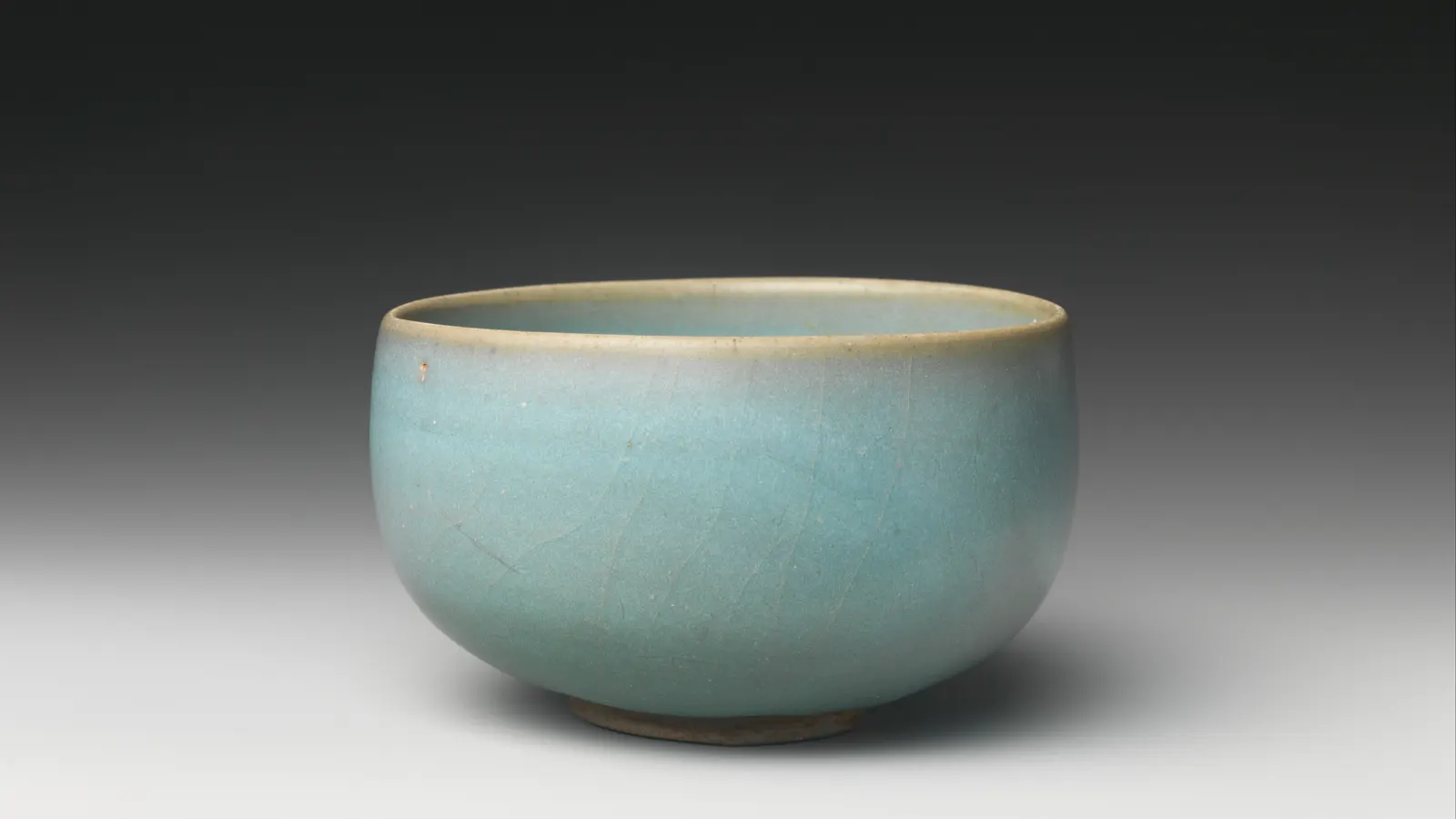
The small bowl in the opening image makes a better introduction than a spectacular red vase. The blue holds together across its curved wall, while the warmer rim gives the eye a stopping point. I like that pause. A surface does not need a dramatic splash to carry a room—or to earn another look.
Put that bowl in conversation with the contemporary Yuzhou display farther down this page. Suddenly the question is not whether old or new Jun is superior. It is whether the color helps the shape. Some modern pieces answer with exuberance; others bury a convincing profile under too many competing effects. I want to be able to enjoy the first and reject the second without pretending either reaction dates the object.
Jun ware in one useful comparison
| Surface effect | Material explanation | Viewing caution |
|---|---|---|
| Opalescent blue | Glaze microstructure, phase separation, bubbles and light scattering contribute alongside composition | Screen color is highly sensitive to lighting and white balance |
| Lavender or gray shifts | Thickness, body, atmosphere and optical mixing change the perceived color | One vessel can look different across its own surface |
| Purple-red splash | Copper-bearing areas can develop red or purple effects under suitable firing conditions | A splash is not proof of date or kiln |
| Pooling and runs | Thick fluid glaze moves with gravity and form during firing | Irregularity can be intentional, accidental or recreated |
| Darker rim or foot | Glaze thickness changes and body may become more visible | Edge color is part of a system, not a single identification mark |
The surface is evidence of process, but it is not a self-authenticating certificate.
Blue is a glaze problem, not a cobalt brushstroke
Jun blue should not be explained as a coat of blue paint, but the opposite claim—pure optical blue with no contribution from coloring elements—is too neat as well. Glaze composition and microstructure work together. Iron affects color; small regions formed when the glaze separates into different glassy phases can scatter light and alter its cloudy, opalescent appearance.
A study of iron oxide and phase separation in Jun-type blue glazes distinguishes the iron-related base color of its tested samples from the changes in shade and opalescence produced by scattering. That finding is a useful brake on the familiar sky analogy. It is not permission to assign one measured recipe to every historical Jun vessel. The important reader distinction is between color developed throughout a glaze system and a cobalt-painted design under a transparent coating.
Glaze thickness matters. Pooling can deepen or cloud a tone. A rim may thin. Bubbles and phase-separated droplets affect opacity. The clay body beneath changes the final appearance. Firing atmosphere and cooling influence which structures and colors develop.
On the bowl, follow the rim toward the fuller blue wall. On the jar below, follow the edge of the splash rather than staring only into its darkest center. Those are visible comparisons. A digital eyedropper can record a pixel; it cannot tell you which chemical and structural contributions produced the surface. The glaze guide takes that distinction further without turning a photograph into a laboratory result.
Copper interrupts the blue field
Purple and red splashes are among Jun’s most recognizable effects. Copper can produce red coloration in a reducing atmosphere, but the result is famously sensitive. Temperature, oxygen availability, glaze composition, thickness and cooling all matter.
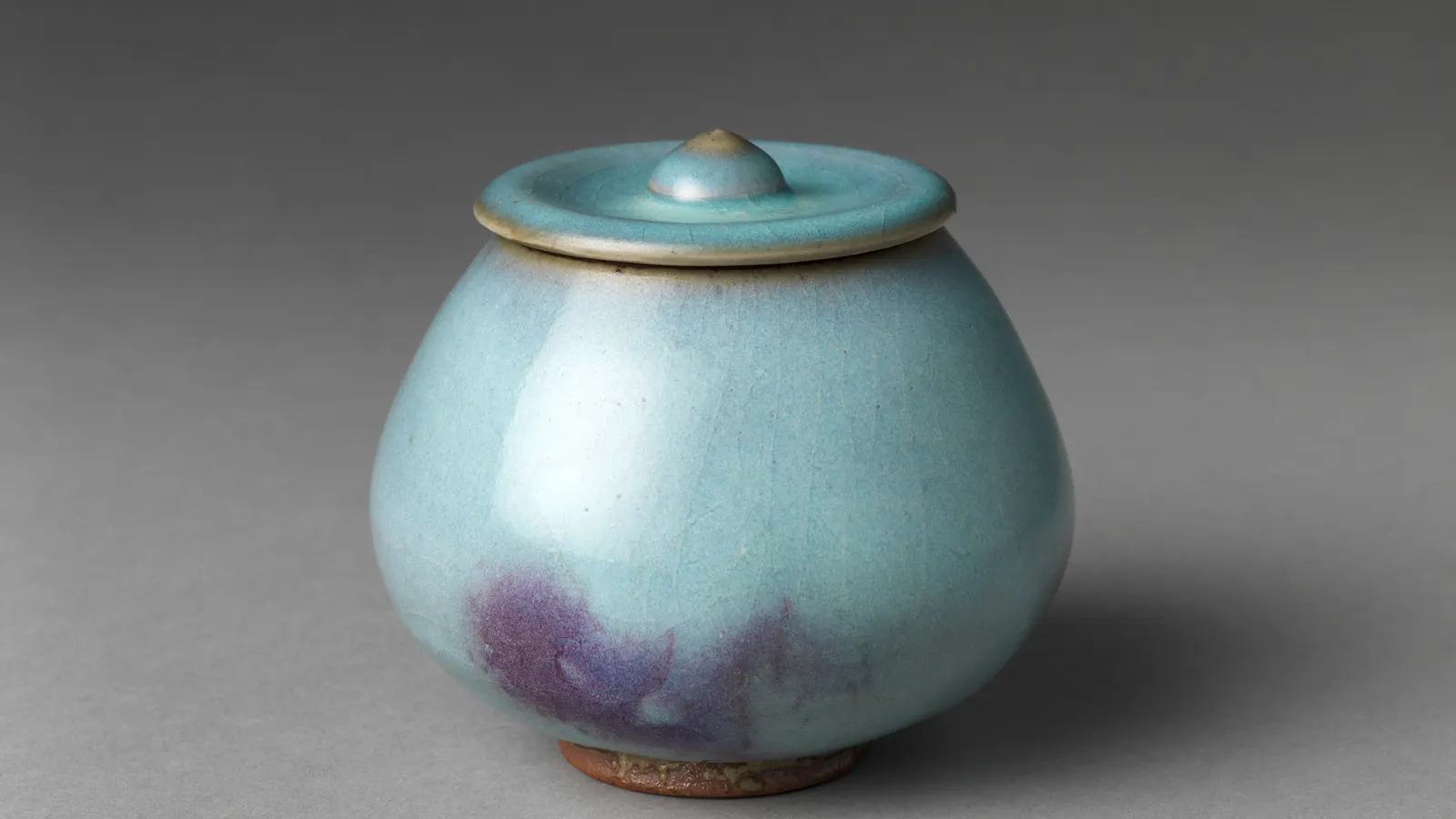
Northern Song Jun ware splashed-glaze jar, The Metropolitan Museum of Art, Open Access. Image record.
On the vessel, copper color interacts optically with the blue ground. Edges may dissolve, darken or turn lavender. The splash can pool or trail with gravity. It feels spontaneous, but spontaneity was held inside a tightly managed firing process.
The most interesting pieces do not look like someone placed a decorative sticker at the center. The color event follows glaze movement and the curve of the object.
Controlled accident is an incomplete description
Jun ware is often praised through the phrase “kiln transformation,” suggesting fire created effects beyond exact prediction. That is true up to a point. Potters could not draw every microscopic structure or guarantee every copper patch.
But “happy accident” can erase expertise. Makers selected materials, prepared glaze, chose thickness, formed the body, placed the vessel and managed firing. They learned which conditions made a range of results possible. Sorting after firing was also part of quality control.
The kiln had agency, but it was not working alone.
The Chinese term yaobian (窑变), kiln transformation, describes the attraction better than “random colors.” The pleasure is seeing variation that belongs to the vessel: a run pulled toward the foot, a patch thinning along a projection, blue collecting where the profile turns. When every irregularity is praised as magic, the maker's decisions disappear. I would rather notice which decisions survived the firing.
Contemporary Jun proves why color names are not enough
The photographs below come from the project's contemporary display material from the Jun Ceramic Culture Park in Yuzhou. Here Jun is not only a museum classification. It is a local craft identity encountered through shelves, ambitious forms, prices and the awkward decision of what deserves space at home.
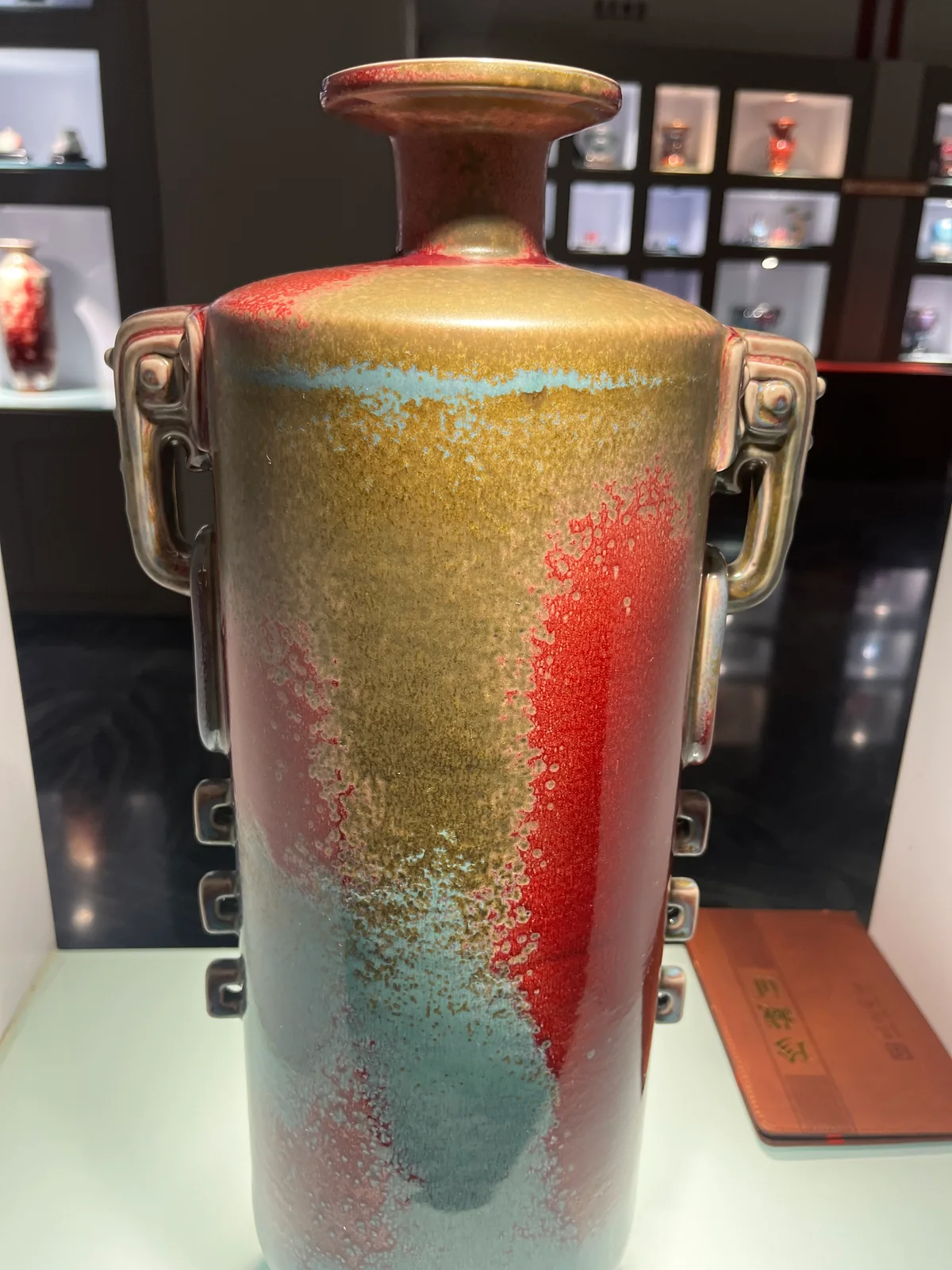
The handled cylinder makes form useful. A museum bowl can encourage us to think of Jun only as an optical surface. Here a tall shoulder, flared mouth and repeated angular handles force the glaze to negotiate projections and hard edges. Red pushes vertically through ochre while a thin blue-green band cuts across the shoulder. The handle leaves a darker recess next to the bright face. That difference rewards looking around an object instead of choosing one saturated patch from a catalogue.
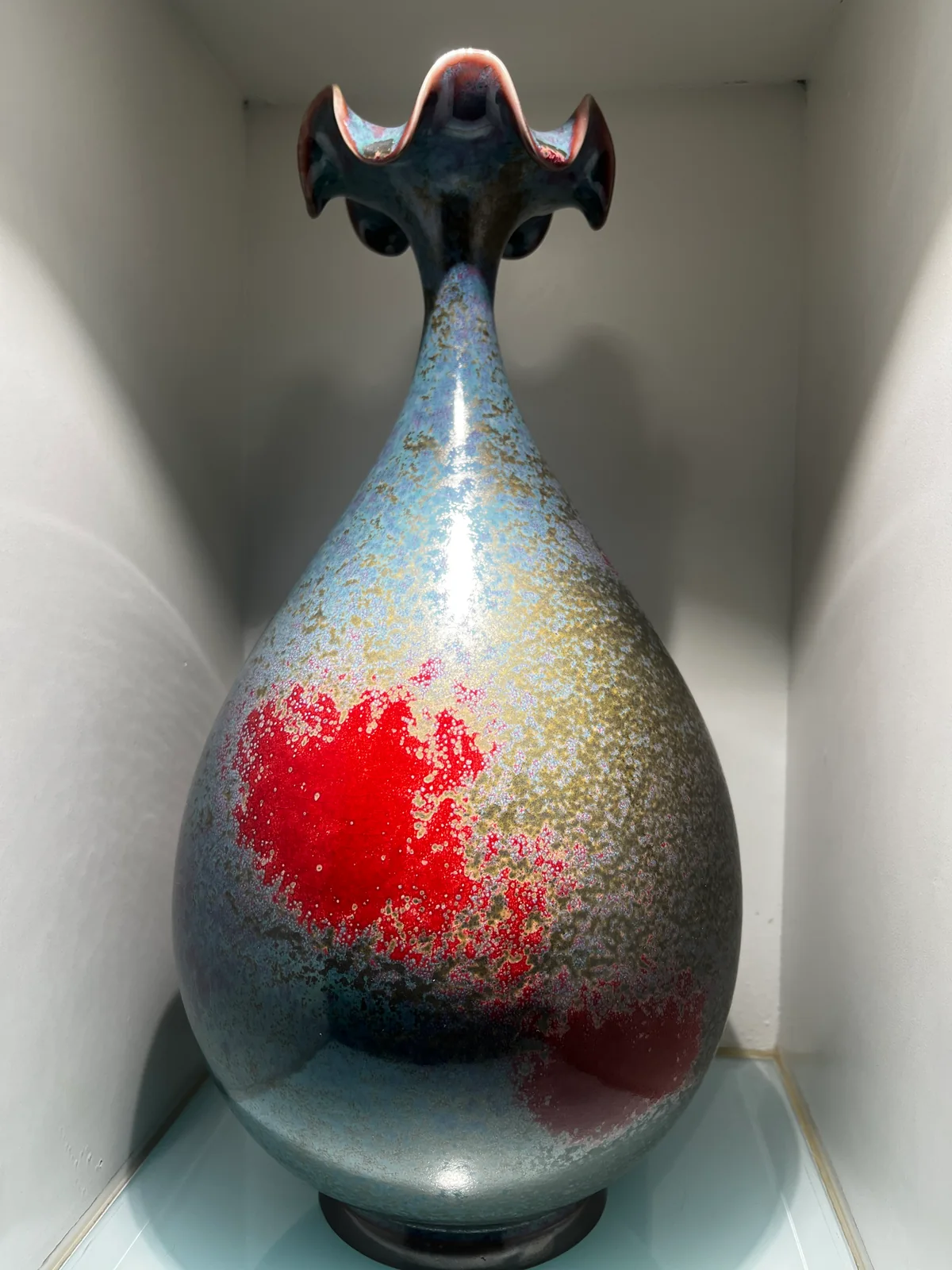
The tall vase is more confrontational. Its red is not a polite accent. It spreads across the belly, breaks into small islands and then loses authority as the glaze rises toward the neck. This is why I reject glaze-shopping language that treats names such as “sky blue,” “rose purple” or “flame red” as if they were Pantone codes. The compelling part is the transition. A name freezes the surface exactly where the object is trying to move.
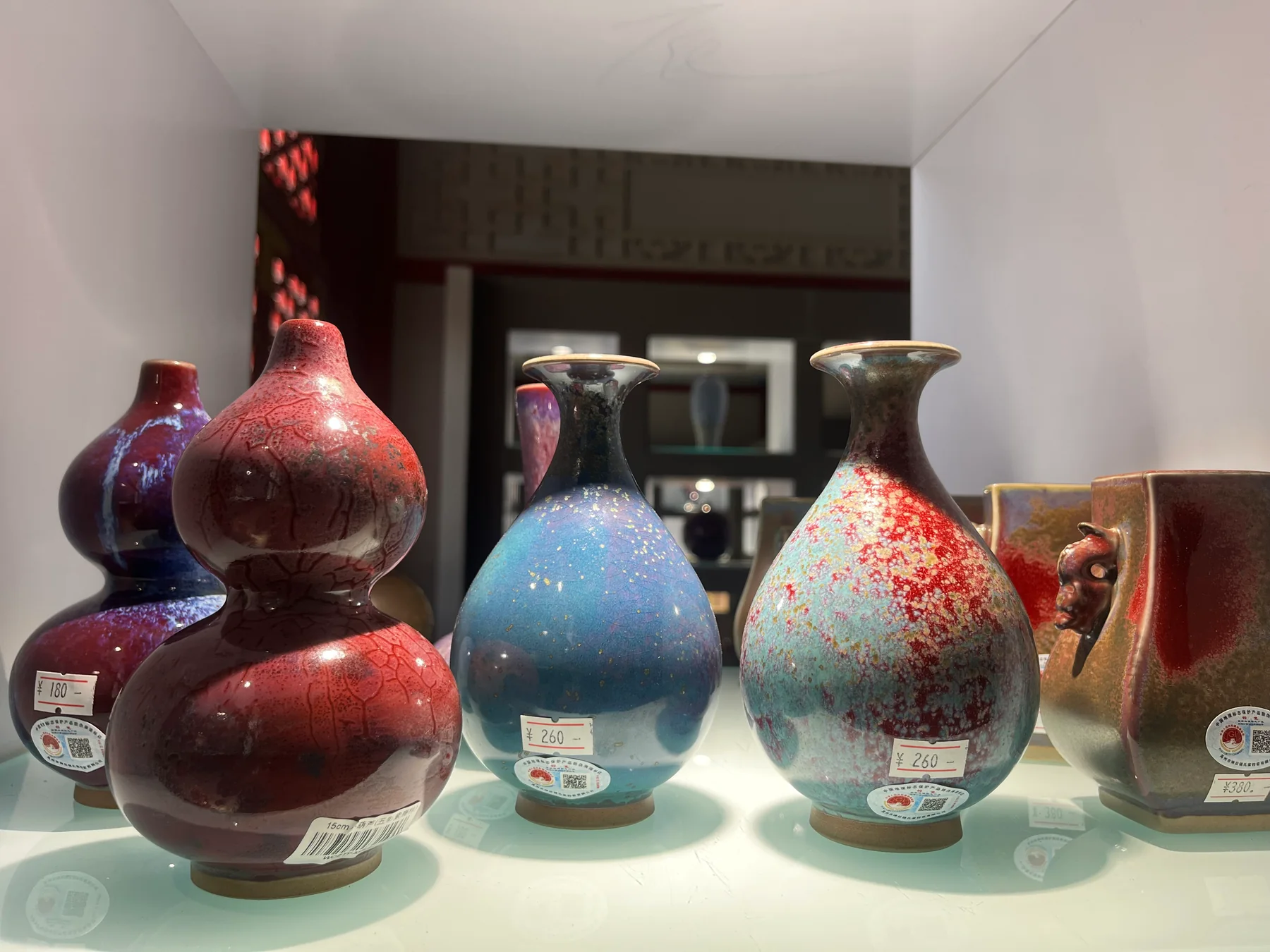
The shelf view is even more honest. Repeated bottle and gourd-like forms turn color variation into a retail field, complete with price labels and certification stickers. That is living material culture, not an embarrassment to hide. Jun now exists simultaneously as excavated history, museum category, regional craft identity, technical glaze vocabulary and purchasable contemporary style. Trouble begins only when those layers are collapsed and the glamour of one is used to certify another.
One ornate handled vessel in the same display takes the argument to its limit. Dragons, a flared mouth and a red-blue-gold surface compete for attention at once.
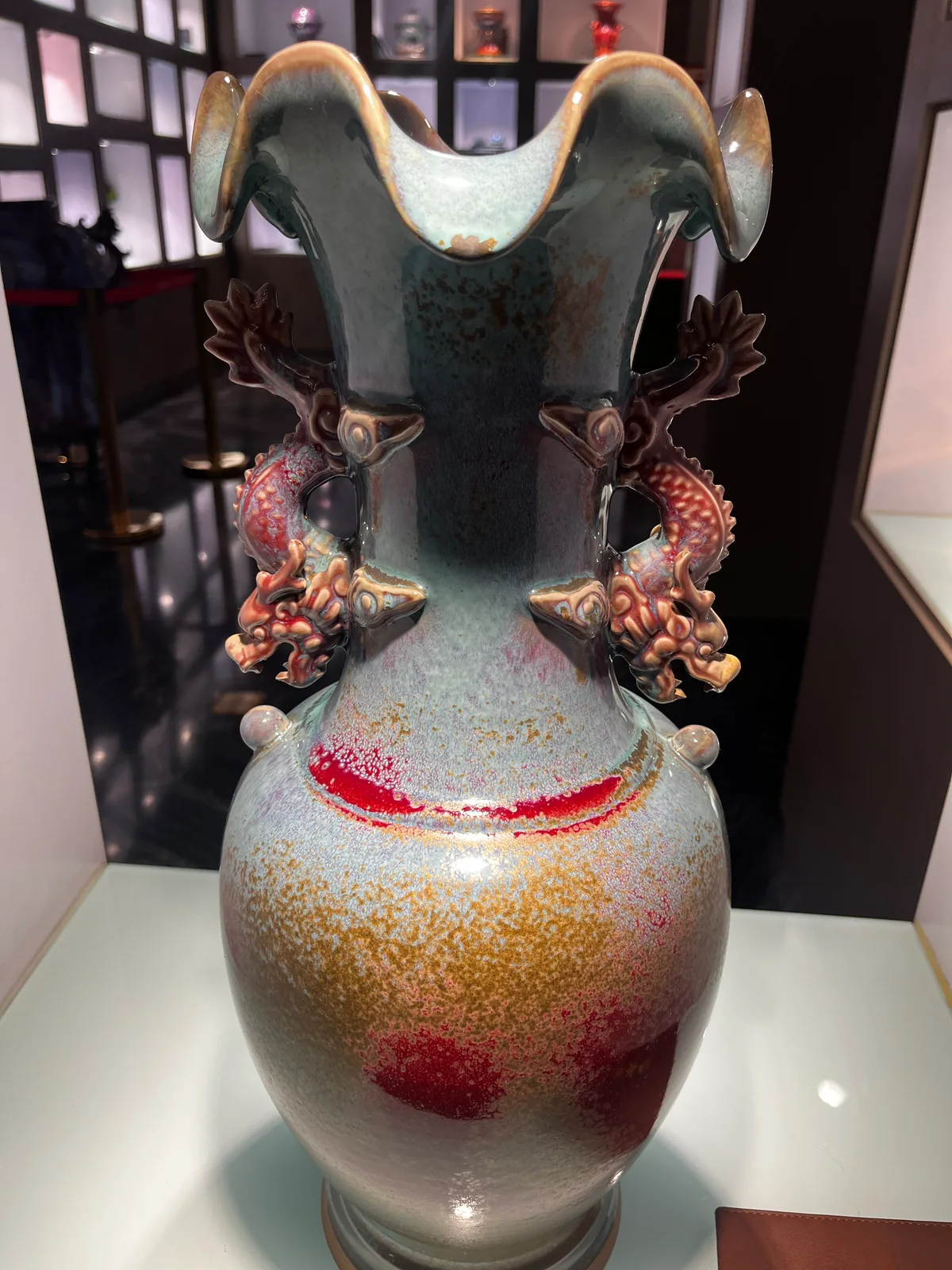
I do not think more transformation automatically means better Jun. When applied ornament, metallic sparkle, saturated red and dramatic form all shout, the glaze loses the quiet depth that made the historical bowl so difficult to stop looking at. That is a judgment, not an authenticity test. Contemporary makers are free to be theatrical; viewers are free to prefer restraint. The point is to name the choice rather than praise every irregular surface as “kiln magic.”
The bowl and the flowerpot do not carry the same historical problem
The Met dates the blue bowl and splashed jar above to the Northern Song. Its numbered Jun flowerpot, shown below, is catalogued to the late fourteenth or early fifteenth century—the beginning of the Ming dynasty. Those are different historical claims inside one broad ceramic name.
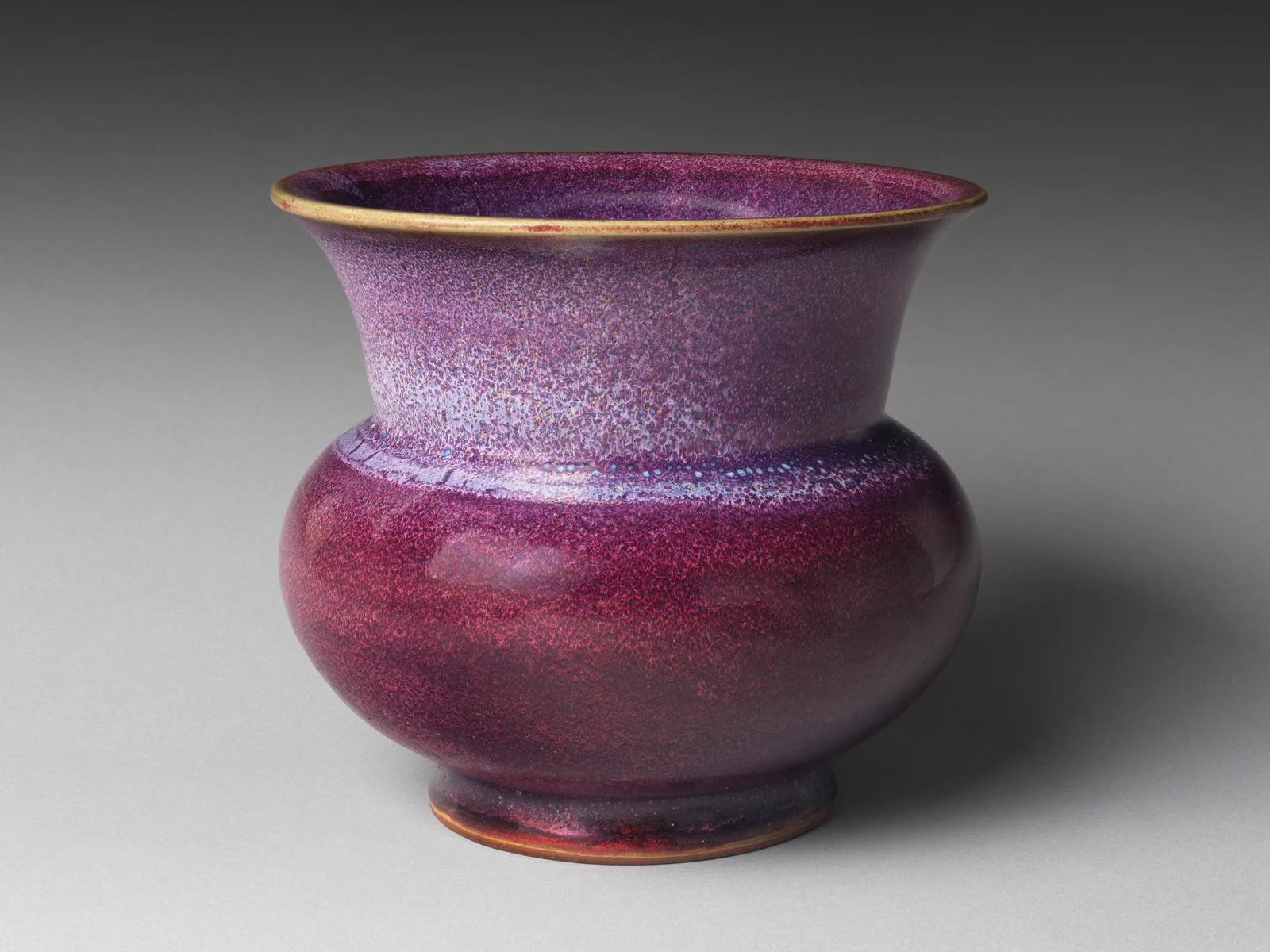
Flowerpot, late 14th–early 15th century, The Metropolitan Museum of Art, 50.145.306. Public Domain.
The pot has a broad open mouth, a constricted neck and a rounded lower body. A purple band gathers around the shoulder, while smaller pale interruptions break up the upper surface. It carries the number six on its base according to the museum record; the frontal photograph does not show that numeral.
This group was once assigned to Emperor Huizong's Northern Song gardens. The Met now explains its early Ming attribution through archaeological discoveries and research. A changed museum date is not an embarrassing detail to conceal. It is precisely why the object is worth discussing: the imperial collection that preserved something and the workshop that originally made it need not belong to the same moment.
Do not turn “some dates have changed” into “nothing is knowable.” Name the particular vessel and the current attribution. Equally, do not borrow the bowl's Northern Song date to make the flowerpot older. The relationship among their glazes remains fascinating without collapsing centuries.
Numbers on the base are not reign marks
Large Jun flower vessels can bear numbers, traditionally understood as relating to size or matching within sets. They are not straightforward imperial reign marks.
The numbers became part of the objects’ mystery because they suggest classification and court organization. Yet a number can tell us about sorting or intended arrangement without independently proving date.
Whenever a base mark appears, ask three questions: when was the mark applied, what function did it serve, and how is that interpretation supported? Marks are evidence only after context catches up with them.
Jun and Ru make blue do opposite jobs
Ru ware and Jun ware can both be described as blue or blue-green, but their surfaces create different experiences.
Ru often holds color in a narrow, calm register. Glaze supports proportion and restraint. Jun lets color become atmospheric, thick, variable and sometimes explosive. Ru asks how little difference is enough. Jun asks how much variation a single glaze system can sustain.
Neither description is a universal rule. It is a useful comparison between securely catalogued examples. The goal is to move beyond hue names toward behavior.
Jun and Ding reveal two production intelligences
Ding ware organizes pale surfaces through carving, incision, molding and efficient rim firing. Jun often moves visual energy into glaze chemistry and kiln transformation.
Ding’s pattern can be designed before glazing. Jun’s final optical depth emerges more strongly during firing. Both require repeatable knowledge. One makes the tool path visible; the other lets the kiln’s internal conditions take the lead.
Placed side by side, they dismantle the idea that Song ceramic refinement had one quiet celadon look.
How to look closely at Jun ware
Start with the form before the color. Is the bowl wall thick or thin? Does the jar feel compressed or upright? Would the silhouette remain convincing under a plain glaze?
Then look for depth. Does blue seem embedded in a cloudy layer? Where does glaze pool? Are there small pinholes, bubbles, streaks or areas where the surface turns more transparent?
Study any purple splash at its edge. Does it blend into lavender, sit sharply, trail downward or collect in a depression? The transition can reveal more about the glaze than the center of the color patch.
Inspect the rim and foot for thinning glaze, exposed body and firing support. Finally, read the date and attribution language. “Jun ware,” “Jun-type,” “Song,” “Jin,” “Yuan” and “Ming” are not decorative captions.
What is commonly misidentified as Jun ware?
Jun-inspired glazes have been made in China and internationally for centuries. Modern studio potters can produce spectacular blue and copper-red effects. Contemporary work deserves to be judged as contemporary work, not forced into an antique claim.
Common errors include:
- identifying Jun from blue-purple color alone;
- calling every dramatic glaze accident Song dynasty;
- treating a base number as an imperial reign mark;
- applying the date of one bowl to all large flower vessels;
- assuming surface irregularity proves age.
Photography creates another problem. Saturation, contrast and color temperature can turn gray-blue into electric turquoise or muted copper into bright magenta. Always compare institutional records and, where possible, the object itself.
Authentication needs material evidence
Specialist study may examine body composition, glaze layers, copper distribution, bubbles, phase-separated structures, firing traces, provenance and restoration. Comparison with excavated reference material is particularly important. Start with a securely catalogued object such as The Met's Northern Song bowl with blue glaze, because an institutional record establishes what object is actually being discussed even when it cannot settle every broader Jun chronology.
A genuine old ceramic can also carry later repairs, staining or altered mounts. A technically impressive glaze can be modern. Beauty, age and attribution are separate questions.
This guide cannot authenticate or value an object from images. A consequential claim needs direct examination and a transparent evidence chain.
White porcelain offers a useful disagreement
Move from these shifting surfaces to Dehua white porcelain and the source of movement changes. On a white robe, a fold must be modeled into the body; the glaze lets light reveal it. On Jun, a changing color field can animate a comparatively simple wall. Neither effect excuses a weak silhouette, but the eye is following a different kind of work.
For a home display, that gives you a practical choice. If you want the object to change as you move around a patch of color, Jun is an exciting starting point. If you are drawn to a sleeve, a hand or a line of drapery, begin with sculpture. I would choose the question I actually enjoy looking at before choosing a famous kiln name.
The kiln becomes part of the image
In painted porcelain, the hand can leave a visible stroke. In Jun ware, the image is often a field built inside the glaze. Fire, cooling and microstructure finish what the hand prepared.
Once you understand that, blue and purple stop being labels. They become evidence of a process still unfolding in the eye.
I love Jun most when the glaze refuses to pose as a finished color chart. The surface should make my eye travel, hesitate and return to the form. If one purple patch gives away everything at first glance, spectacle has defeated the vessel.
Explore the complete Five Great Kilns guide, compare Jun with Ru ware, or return to the material foundations of Chinese ceramics. If you can photograph one Jun-style object from the side, rim and foot, bring the sequence to Moments and mark the exact place where the glaze changes. Return when another reader adds the same form under different light: that comparison is far more revealing than another isolated color name.