Ding ware rewards the person who looks twice. An ivory bowl can appear almost empty until light catches the flowers cut into it. I value that delayed reveal more than a bright painted surface that explains itself immediately. But the narrow, unglazed rim is just as important: it tells you how the workshop fitted more bowls into the fire.
What is Ding ware?
Ding ware is a major northern Chinese ceramic tradition centered around Quyang in present-day Hebei. It is best known for fine white porcelain with a warm ivory-toned glaze, produced across the late Tang, Five Dynasties, Northern Song and Jin periods in changing forms and qualities.
The most admired Ding pieces often combine thin, light bodies with decoration cut, incised, impressed or molded into the surface before glazing. Bowls, dishes and basins turn floral and animal motifs into designs that move with the vessel rather than sitting on it like flat prints.
Ding belongs to the Five Great Kilns of Song China, but it disrupts a common myth about the group. It was not simply one small “imperial kiln.” Ding was a substantial commercial production system. Fine wares reached court and elite users, while broader output circulated through larger markets.
Start with the bowl, not the price tag
| Feature | What to notice | The larger production idea |
|---|---|---|
| Body and glaze | Pale body under a clear-to-ivory glaze | White can carry light, shadow and carved depth without painted color |
| Incised or carved decoration | Lines vary in pressure and depth as they follow the form | Fast handwork can remain controlled and specific |
| Molded decoration | Repeated, densely organized patterns | Standardization can expand output without eliminating design |
| Rim | Some vessels have an unglazed edge, sometimes metal-bound | Upside-down rim firing increased kiln capacity |
| Forms | Bowls, dishes, basins, boxes, bottles and other useful shapes | Everyday vessel types could become technically and visually ambitious |
The visual features overlap with later imitations and other northern white wares. Use them to look, not to authenticate.
White is an active surface
White porcelain is often treated as the neutral stage before blue-and-white painting arrives. Ding ware shows why that story fails.
An ivory glaze changes through thickness. It can pool warmer in a cut line, soften the edge of a carved petal and catch a small shadow along a molded ridge. The design may seem almost absent under frontal light, then become vivid when the dish tilts.
That delayed visibility is part of the pleasure. Ding does not always deliver its image in the first second. Follow a petal toward the wall: its shallow cut alternates between a bright edge and a narrow shadow. Looking from one fixed angle misses half the design. Through museum glass, change your own position; the object does not need to move.
This is also why overexposed photography damages understanding. If the glaze is rendered as pure digital white, the warm tone, carving and surface variation disappear.
The decoration follows the physics of a vessel
A ceramic plate is not a rectangle. Its center, well, wall and rim occupy different angles. A good Ding design anticipates that geometry.
Lotus petals may radiate from the center. A flower scroll bends around the curve. A bird or fish is compressed into a circular field without feeling trapped. Lines can direct the eye outward while the rim pulls it back.
The strongest designs do not simply fit inside the dish. They explain the dish. You can often sense where the vessel deepens by watching how leaves stretch or fold.
Carving, incision and molding create different energy
Hand-incised decoration can be quick and calligraphic. A tool enters the leather-hard clay, changes pressure and leaves a line with visible direction. Carving removes more material and can create stronger relief. Combed details add rhythm within larger forms.
Molded decoration behaves differently. Clay is pressed into or formed against a prepared pattern, allowing designs to be repeated with high consistency. By the Northern Song and Jin periods, molded Ding decoration could become highly complex.
It is tempting to rank hand-carved work above molded work because modern culture romanticizes the singular artist. That hierarchy misses the design challenge. A mold has to anticipate shrinkage, release, glaze softening and repeated use. It can organize dense detail at scale.
Industrial thinking did not begin with electricity. Ding ware shows premodern workshops solving problems of throughput, quality and visual identity through tools and process design.
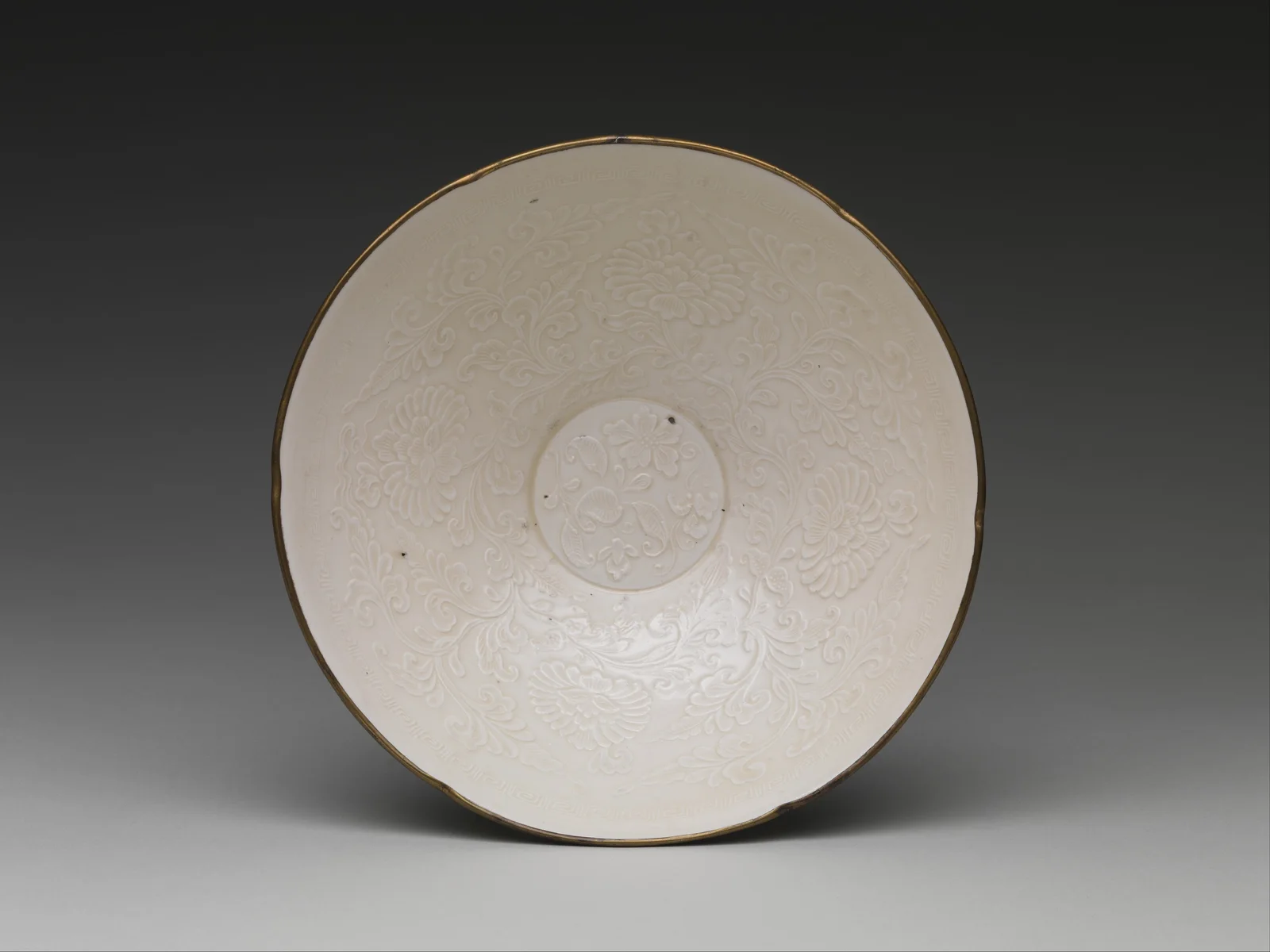
Ding ware bowl with peonies, twelfth–thirteenth century. The Metropolitan Museum of Art, Open Access. The repeated design is not mechanically dead: petals tighten toward the center while the bowl wall controls the rhythm.
This bowl is where I reject the easy worship of “handmade irregularity.” Repetition can be intelligent. The flower heads occupy the bowl without becoming a heap; their surrounding leaves preserve intervals of pale glaze. A mold concentrates those decisions before the next bowl is formed. Judge whether the relief remains readable after glazing, whether crowded leaves separate, and whether the pattern fits the wall. Uneven work is not automatically expressive; repeatable work is not automatically lifeless.
Rim firing connects elegance with kiln economics
Some Ding bowls and dishes were fired upside down, resting on their rims in stepped supports. This method allowed more vessels to be stacked within the kiln, increasing capacity. The tradeoff was an unglazed rim.
That bare edge could be left visible or covered with a metal binding. Copper, silver or gold-toned rims now attract attention in museums, where they may appear to be pure luxury. Their origin is also practical: a production decision created a finishing problem, and another material solved it.
The Chinese term is fùshāo (覆烧): inverted firing. A glaze-bearing surface cannot simply rest against a support during firing: the molten glaze can bond them. Supporting the bowl at a wiped-clean rim moves the contact point away from its glazed interior. A stack of compatible supports uses the kiln's vertical space while keeping bowls separated. That is why the missing glaze belongs at a particular edge rather than being random wear.
This does not mean every Ding vessel was inverted, or that every bare rim elsewhere identifies Ding. It explains a production choice. For the rest of the forming and firing sequence, follow how Chinese porcelain is made.
Do not assume every metal binding was applied immediately after manufacture. Mounts can be added, replaced or altered over an object’s long collecting life. Nor does a metal rim automatically prove imperial ownership.
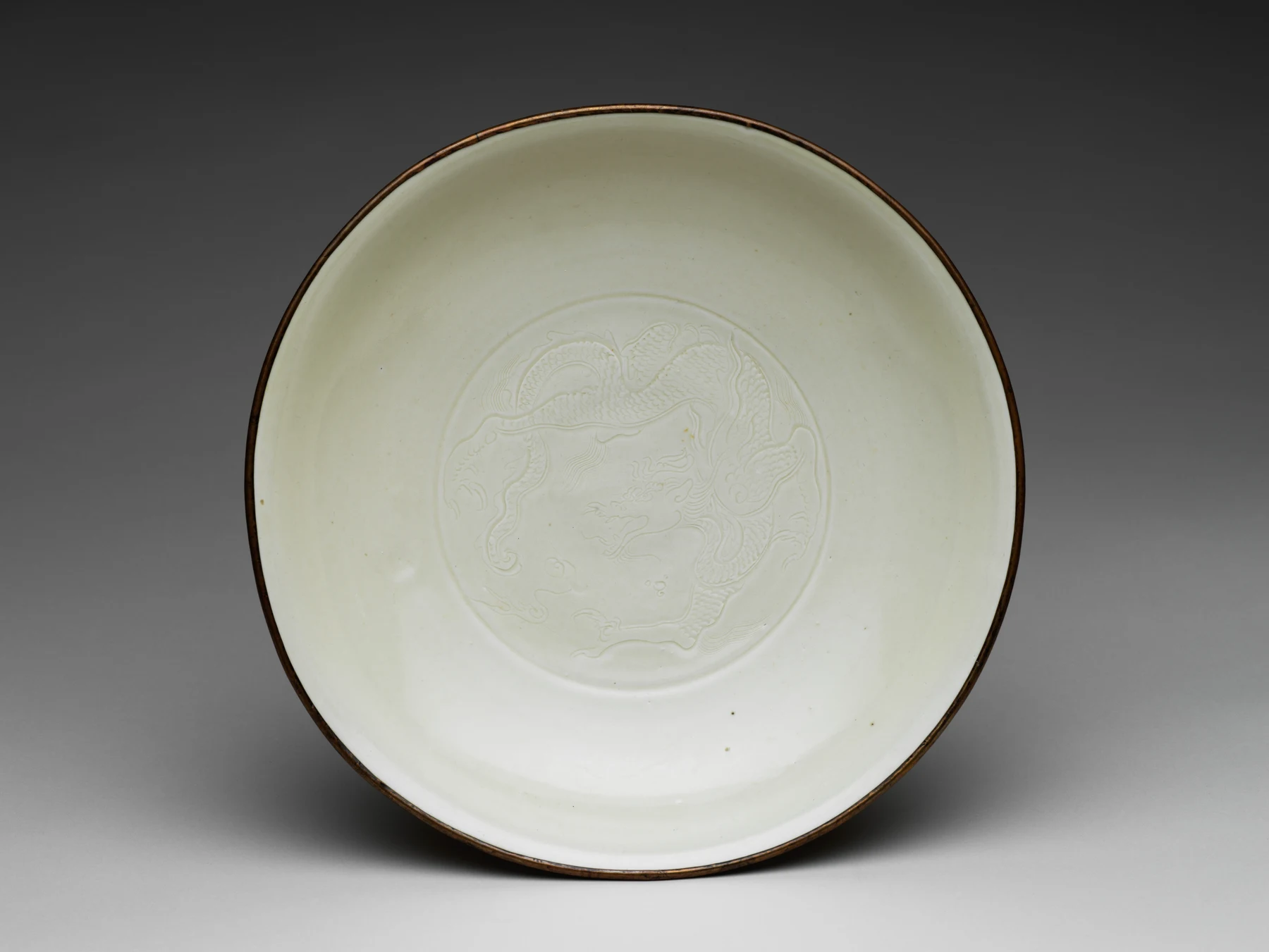
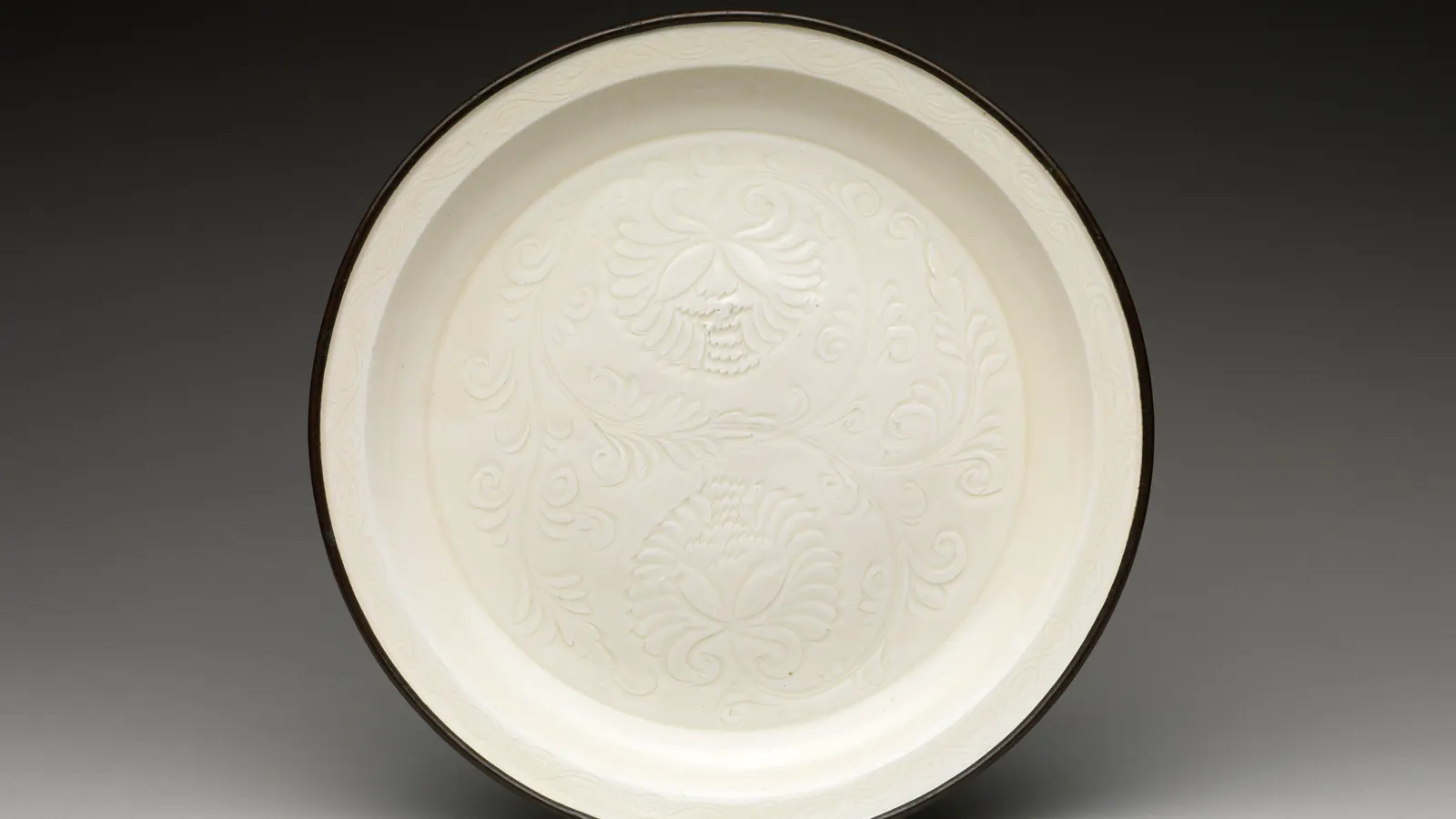
Ding ware dish with dragon, eleventh–twelfth century. The Metropolitan Museum of Art, Open Access. The metal rim is visually loud, but the real design intelligence is the dragon compressed into a shallow circular field.
The binding frames the image so decisively that it can steal the whole story. Resist it. Read the dragon’s turn, the varying line depth and the way glaze gathers inside the incision. The metal edge is one chapter in the object’s biography; it cannot tell us by itself when, for whom or why the dish was finished that way.
The dragon-head bottle breaks the story of quiet bowls
The dragon appears before the flowers do. It projects from the shoulder of a tall white bottle, its jaw opening beside a much longer neck. Look down and the decoration changes direction: overlapping lotus petals descend from the shoulder, a scrolling band turns around the belly, and long pointed petals rise from the base. The maker has not filled a blank space. The cuts explain the different parts of the vessel.
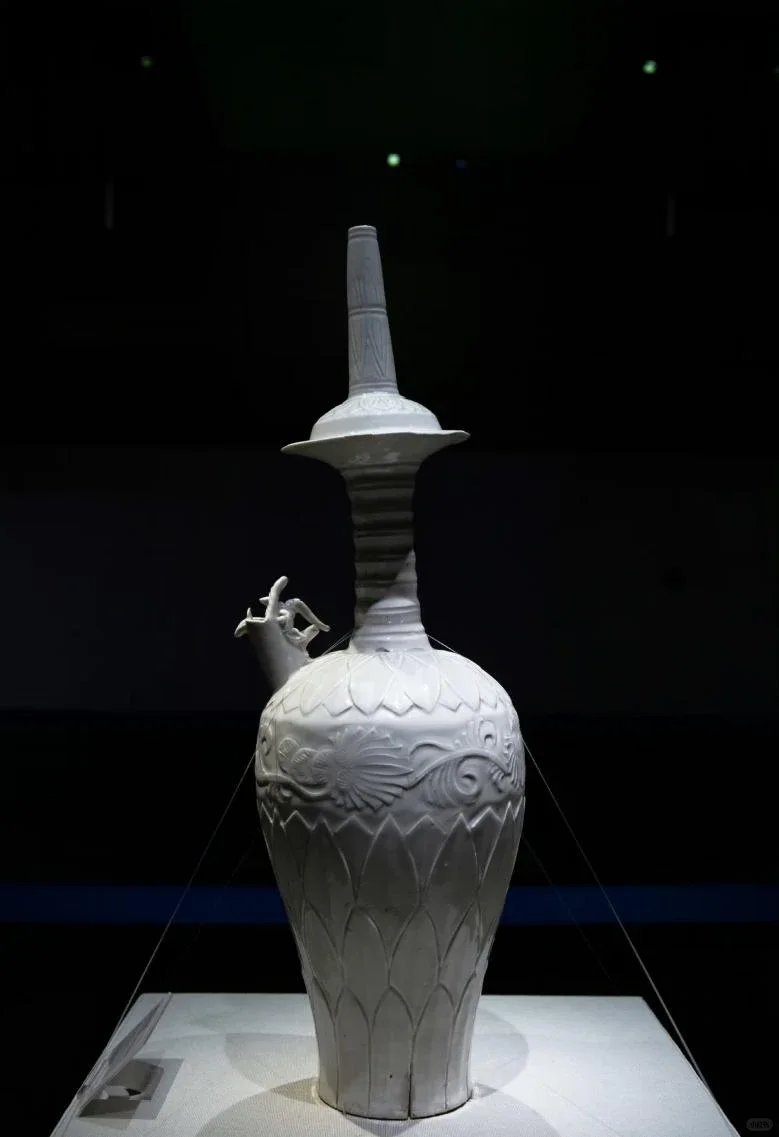
This Northern Song purification bottle belongs to Dingzhou Museum. Hebei's cultural heritage bureau describes the museum's excavated Ding collection, including this dragon-head vessel. Its Buddhist setting matters: Ding ceramics served more than the dinner table and the palace. Religious patronage gave potters other shapes, other scales and other expectations to answer.
I prefer this object to the claim that Song taste was universally minimalist. There is nothing timid about that projecting dragon or the long, articulated neck. Yet the white glaze holds the crowded carving together. Color restraint and decorative restraint are different decisions, and this bottle makes the difference impossible to miss.
The photograph also changes how to read lotus imagery. On a shallow dish, petals can radiate outward; here, upright petals lengthen the lower body while downward ones close over the shoulder. The same flower solves two different spatial problems. That is more interesting than assigning one symbolic meaning and moving on. The Chinese symbols guide supplies wider associations; this bottle supplies the reason to look at their placement.
Ding ware was commercial without being culturally secondary
The word “commercial” is often used as if it lowers artistic status. Ding production shows the opposite. Large markets can encourage specialization, efficient firing, repeatable forms, design libraries and multiple grades of output.
Court use remains important, but it should not swallow the entire kiln system. A ware can serve elite taste and wider consumption at the same time. Different objects may vary in body refinement, decoration, size and finish.
This is a useful correction to palace-centered ceramic history. If every excellent object must be explained by an emperor, workshop intelligence and consumer culture disappear.
Ding versus Ru: two kinds of restraint
Ru ware and Ding ware can both feel restrained beside brightly painted later porcelain. Their restraint works differently.
Ru often concentrates attention in glaze depth, proportion and subtle color. Ding uses a pale surface to carry incision, carving and molded rhythm. Ru editing tends to reduce visible signals. Ding editing organizes many lines so they remain coherent.
One is not calmer and the other louder in any absolute sense. Compare how quickly each piece reveals itself. Ru may hold the eye through atmosphere. Ding may reward movement as relief enters and leaves the light.
Ding versus later white porcelain
Chinese white ceramics include many traditions: earlier northern white wares, Ding, Dehua, Jingdezhen bodies and later revivals. “White porcelain” is a technical and visual family, not a kiln name.
Ding often carries a warm ivory tone rather than the cold bright white produced by some later porcelains. Iron and other material factors affect the body and glaze. Photographs may neutralize that warmth.
Decoration technique also matters. A molded Ding flower beneath glaze differs from painted overglaze enamels or underglaze blue. The image belongs to the body’s relief, not a separate color layer.
The broader Chinese porcelain guide follows these body, glaze and decoration differences across periods.
How to look closely at Ding ware
First change the angle. If you only look straight down at a pale dish, shallow decoration may disappear. Move until side light reveals the cut lines and glaze pooling.
Trace the design mentally. Does a stem continue naturally? Where did the tool accelerate or deepen? Molded designs may show more regular repetition, but inspect how the pattern was fitted to the vessel.
Look at the rim. Is it glazed or bare? Does a metal binding conceal the edge? If the underside is visible, study foot shape, exposed body and firing traces.
Finally, separate date from style. Later kilns made Ding-inspired white wares. A successful revival may reproduce the visual language without belonging to the original production period.
What gets misidentified as Ding ware?
Many northern kilns made pale or white ceramics. Later workshops copied Ding forms and designs. Modern reproductions can imitate ivory glaze, molded flowers and unglazed rims.
Common mistakes include:
- treating every ivory bowl as Ding;
- assuming carved lotus decoration identifies one kiln;
- reading an unglazed rim as proof of Song date;
- calling all molded work low quality or all free carving high quality;
- assuming a metal rim proves court ownership.
Attribution needs a complete material and historical argument, not one familiar feature.
What a useful object record must tell you
Body composition, glaze chemistry, forming technique, tool marks, kiln supports, condition, provenance and comparison with excavated material can all matter. Restoration may conceal breaks or alter rims. Artificial wear and burial effects can be added.
Before treating a listing as historical Ding, ask for the full interior, profile, rim and underside; the claimed date and attribution; condition and restoration information; and the documentary basis. A price and a glowing front photograph answer none of those questions. A photograph can help you decide what needs examination, not replace direct specialist study.
For a contemporary white bowl, the decision is different. Do not reward a maker for manufacturing dirt or antique-looking damage. Ask how the bowl feels at the lip, whether its foot sits steadily, and whether the relief still reads under ordinary room light. If it is sold for food use, ask for the maker's intended use and applicable safety documentation rather than inferring suitability from its historical style. A new bowl does not need to pretend it survived nine centuries to be worth living with.
Ding ware makes production intelligence visible
Ding ware is not important because white porcelain eventually became famous elsewhere. It had already solved its own visual and manufacturing problems with remarkable confidence.
Carved light, repeatable molds, dense kiln stacking and metal-finished rims belong to one connected system. The object is elegant because the production thinking is elegant.
Explore all Five Great Kilns, compare Ding’s pale body with the opalescent glaze of Jun ware, or enter the larger material world of Chinese ceramics.
For Moments, post two angles of one pale ceramic and mark where moving light reveals carving, molding or an unglazed firing edge. Return when other readers test the same object under different light; Ding ware should become clearer through movement, not brighter through overexposure.