Ru ware is a Northern Song ceramic tradition associated with the court and the Qingliangsi kilns in Henan, admired for blue-green glaze and carefully resolved forms. Modern Ru-style cups carry that admiration into daily life, but they are a different category. My objection is to making dark crackle a scorecard: the cup should give you pleasure before it gives you lines.
Ru ware is more than the crackle you hope to grow
Ru ware is a rare high-fired ceramic tradition produced during the Northern Song period and closely associated with court patronage. Archaeological work has connected important production to the Qingliangsi kiln area in Baofeng County, Henan. Surviving court-quality pieces are celebrated for controlled forms and muted celadon glazes often described through blue, blue-green, gray-green or “sky” tones.
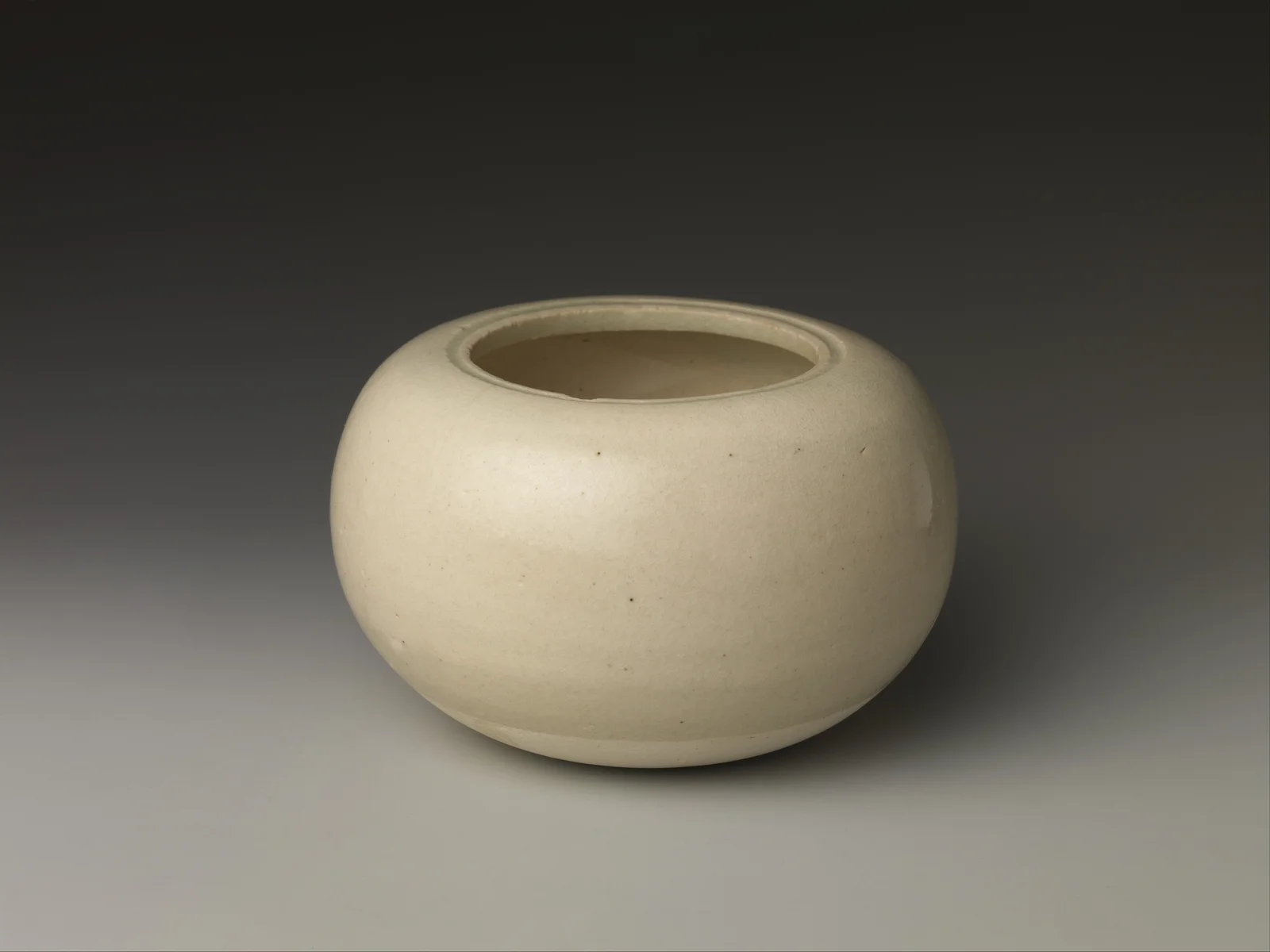
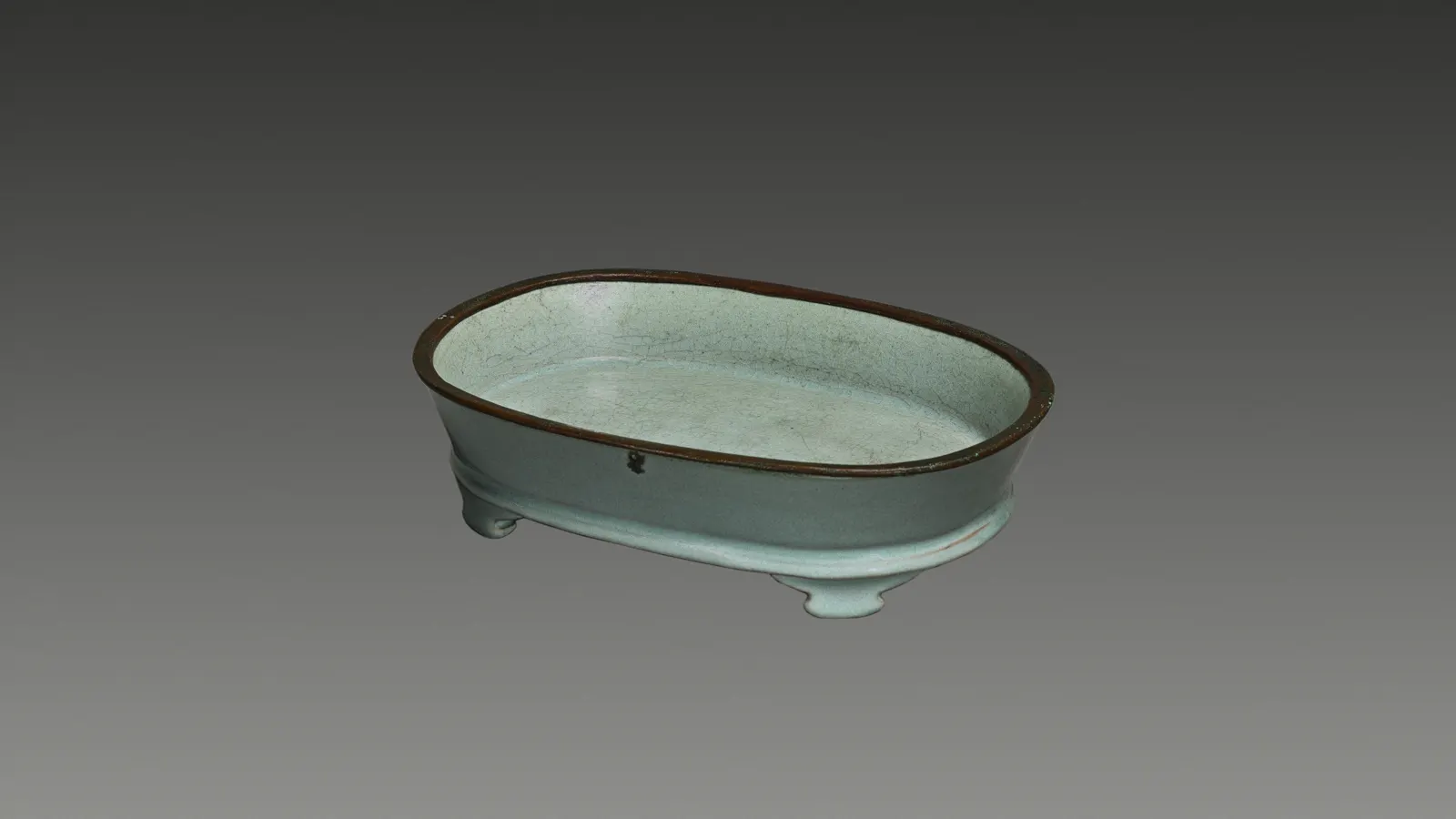
The Cleveland Museum of Art's brush washer is attributed to Qingliangsi and dated to the late eleventh century–1127. Its recorded ownership history is not a documented excavation account. That distinction matters: a museum's place attribution and a find recorded at a kiln are different kinds of evidence.
The direct answer is simple. The category is not. Excavated kiln material, court-linked surviving objects, later imitations and shifting museum attributions do not all belong to one identical group. Any exact internet claim that “only X pieces exist” depends on what the writer counts and which attributions they accept.
I refuse to introduce Ru as an auction trophy and leave ordinary readers outside the conversation. You can look seriously at a basin without owning one. You can also enjoy a plainly labeled modern celadon cup without pretending its tea stains bring it closer to the Northern Song court. What deserves attention is the relationship between the lip, wall, glaze and hand—or, in a museum, the way those parts meet the eye.
The modern cup makes the argument personal
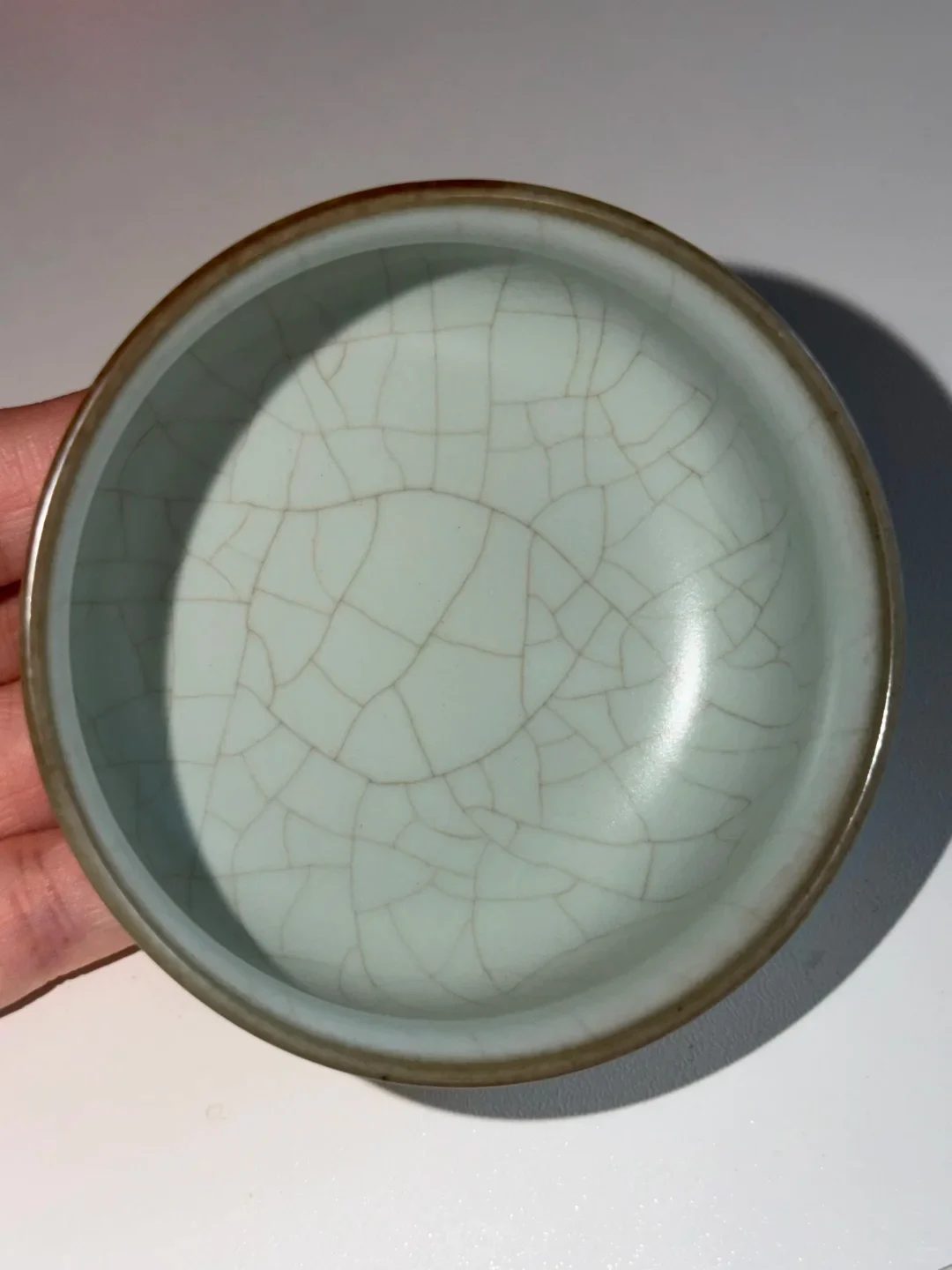
In this contemporary cup, thin brown lines cross a pale interior, and the warmer rim draws a separate circle around them. The hand makes the scale legible. This is the intimate appeal behind yang (养), the language of tending a tea vessel: an ordinary object begins to look like something that has kept you company.
I understand that attachment. What I dislike is the obligation to produce a dramatic result. Once a cup becomes a before-and-after competition, the drink, the comfortable rim and the afternoon itself can become supporting props for the photograph. The pattern is allowed to be attractive. It is not allowed to become the only reason the cup matters.
Kaipian (开片) names crackle in the glaze. In modern tea-ware conversation, “raising the lines” often means making that network more visible through use. The photograph establishes an appearance, not the manufacturer's glaze composition, the time needed to obtain it, or a safe method for reproducing it. Buy contemporary drinkware for its declared use and follow its maker's care guidance. Do not try to force an antique or an undocumented vessel into this practice.
Here is the counterexample that makes the discussion worth having: the National Palace Museum's Ru narcissus basin without crackle is admired precisely for its smooth, unbroken glaze. It is a different basin from the Osaka example at the top of this page. The existence of a celebrated uncrackled Ru surface is enough to defeat the claim that more visible lines automatically mean more successful Ru beauty.
If a cup is unattractive to you on the day you buy it, do not ask future staining to rescue the purchase. Pick a profile and surface you already want to live with. That is a much more generous relationship with an object than demanding it perform age.
The glaze does not sit on the object; it changes the air around it
Celadon color emerges from glaze composition, iron content, firing atmosphere, thickness and light. Ru glaze can feel milky or softly luminous because the eye is reading more than a flat hue. Tiny bubbles, suspended particles and the depth of the glassy layer change how light returns.
This is why color names can become a trap. “Sky blue after rain” is beautiful language, not a Pantone code. Museum lighting, camera white balance, screen calibration, glaze weathering and restoration all shift what you see. Two photographs of the same basin can look like two different objects.
Look instead at how color behaves across the form. Does the glaze deepen near a junction? Does it soften a sharp transition? Does the rim appear slightly thinner in color? Is the surface glassy, cloudy, dry or softly reflective? Ru becomes much more interesting once “What blue is it?” becomes “What is the glaze doing with light?”
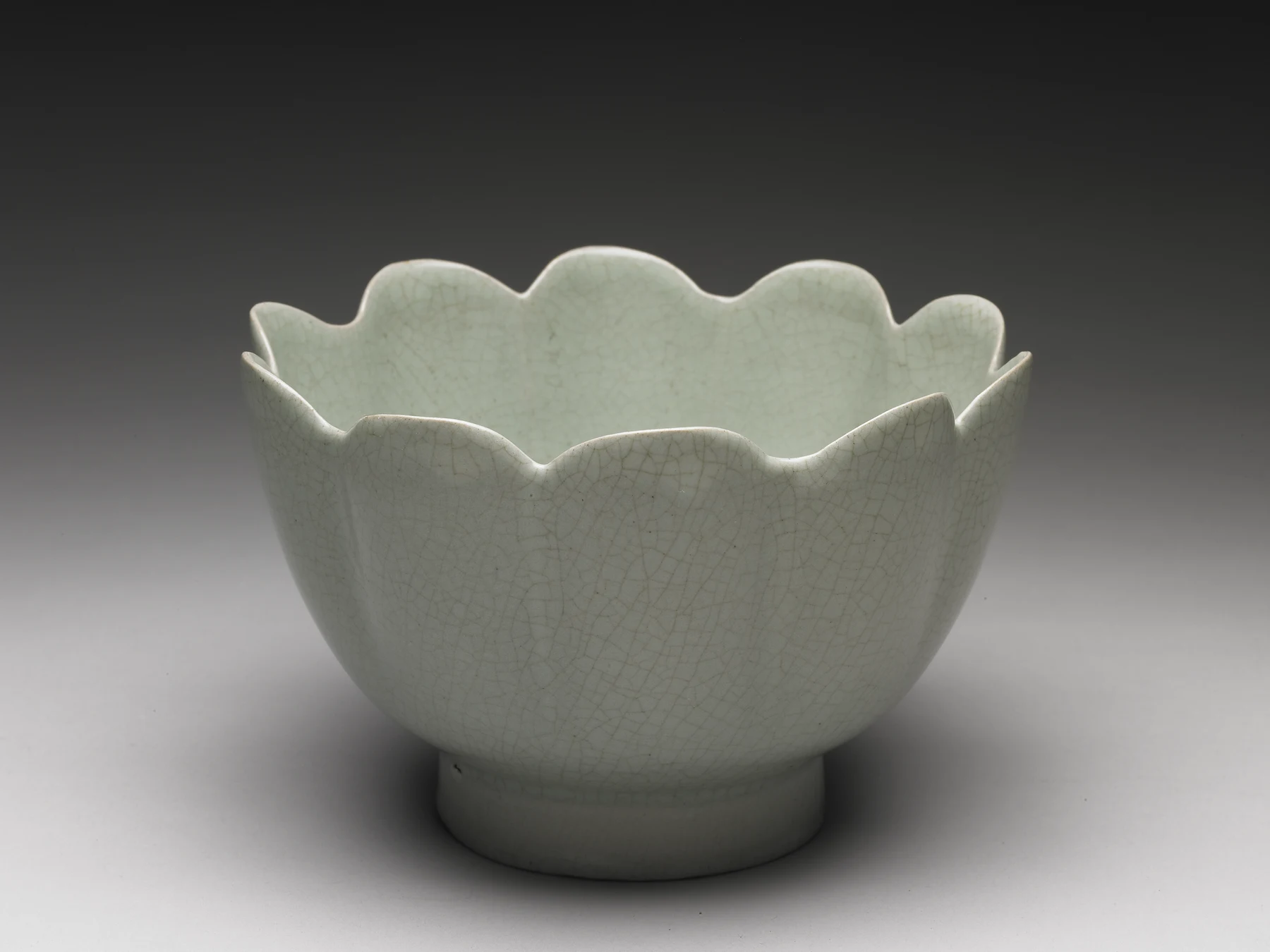
Northern Song Ru ware lotus-shaped warming bowl, National Palace Museum, CC BY 4.0. The lobed wall prevents the glaze from becoming a flat color sample: every petal changes the angle of reflected light.
The bowl is also a useful rebuke to the phrase “Ru ware is plain.” Nothing has been painted onto it, yet the silhouette keeps opening and closing like a flower. This is controlled ornament created by form itself. I prefer this kind of evidence to a romantic color name because the vessel gives the claim somewhere physical to stand.
Court taste was a relationship, not a magic label
Ru ware’s connection with the Northern Song court is central to its status. Yet “made for the court” should not erase the system that made production possible: clay extraction, glaze preparation, forming, finishing, kiln loading, firing, sorting and transport. Court taste could define standards and select objects; hands at the kiln had to solve the material problem.
The period of court-linked Ru production appears to have been limited. Archaeological discoveries at Qingliangsi transformed modern understanding by bringing kiln waste, fragments and firing evidence into a field once dominated by a tiny number of treasured complete objects.
That change matters. A flawless museum piece tells us what was preserved and valued. A discarded shard can tell us what was attempted, rejected and repeatedly made. Ceramic knowledge advances when the masterpiece and the waste pile are allowed to speak to each other.
Form is where the restraint becomes visible
Ru vessels are often admired for simplicity, but “simple” can be a lazy compliment. Look closely and the forms are highly controlled. A basin must decide how quickly its wall rises. A bottle must balance neck and body. A dish must make its rim feel finished without relying on painted decoration.
The absence of a bold image exposes every proportion. There is nowhere for a weak shoulder or uncertain foot to hide. Glaze may soften the geometry, but it cannot invent balance after firing.
This is one reason Ru ware feels surprisingly contemporary to design-minded viewers. The object is not minimal because it contains less labor. It is minimal because labor has been edited out of the visual noise.
Bowstring lines show that quiet does not mean blank
Some Ru forms carry raised horizontal bands often translated as bowstring patterns. The lines refer to the ridged organization of earlier bronze vessel forms while letting glaze gather and shift around the relief.
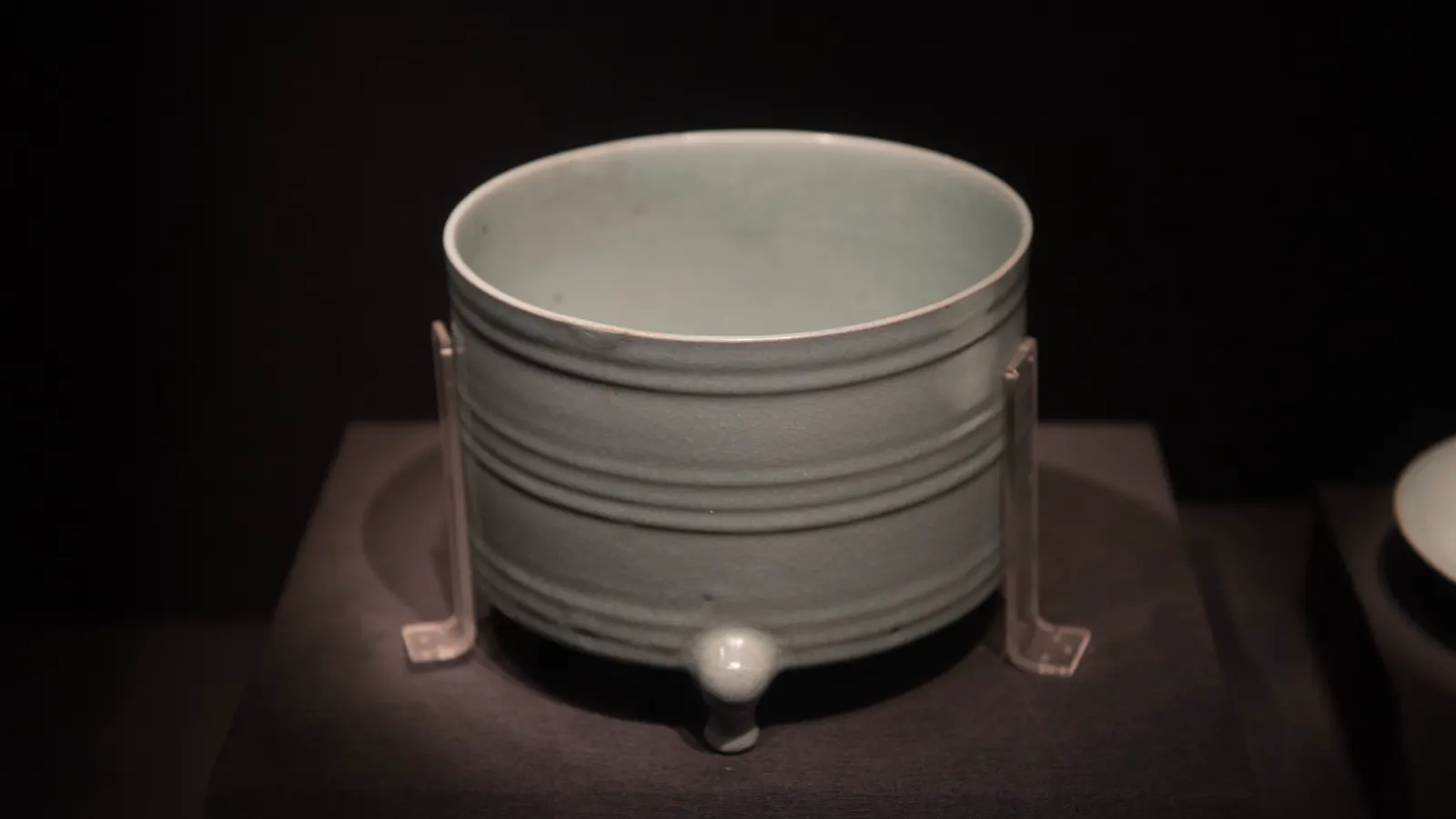
Ru ware bowstring vessel in the Palace Museum collection. Image record.
This is decoration behaving structurally. The band is not a picture placed on the surface. It changes profile, glaze thickness, shadow and the rhythm of the whole vessel. Ru’s visual language can therefore be restrained without being empty.
The archaic reference also complicates the idea that Song taste was purely modern or naturalistic. Ceramic makers and court users looked backward, translating prestigious bronze forms into a different material. Revival was already part of innovation.
The underside is part of the design system
Some Ru objects were supported in the kiln on small spurs, allowing glaze to cover most of the base and leaving tiny contact marks. Those marks have become famous because they seem to offer a hidden signature.
They are better understood as evidence of a firing decision. Glazing the base creates a more continuous surface but makes it impossible to place the vessel directly on a kiln support without sticking. Small contact points solve one problem while leaving another trace.
That trace is meaningful, but it is not a password. Reproductions can imitate support marks. A genuine object may not present the textbook arrangement you expected. Authentication cannot be reduced to counting tiny dots.
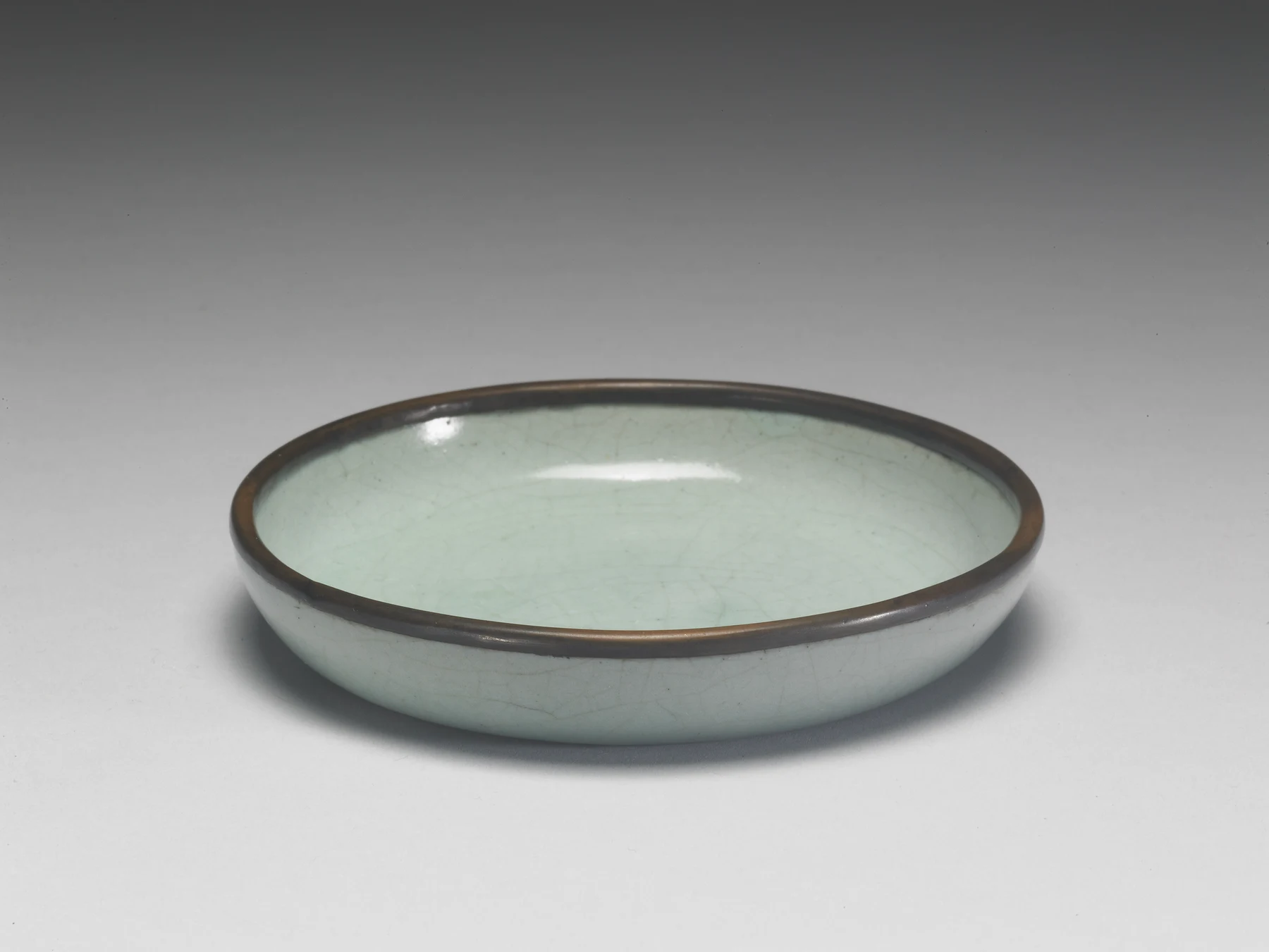
Washer with celadon glaze and fenghua mark, Ru ware. National Palace Museum, Taipei, CC BY 4.0. The inscription is on the underside, not visible in this front view.
The museum's object record places three small firing-support marks and the incised characters Fenghua on the base. It also follows the washer through Qing palace records: a recorded piece in 1729, an ivory label ordered in 1741 and replacement packaging after insect damage in 1751. Those dates concern custody and treatment long after the potter's work.
That sequence gives an overseas reader something more revealing than “imperial porcelain.” A tiny dish lived through storage, naming and the maintenance of its box. Collectors and emperors did not simply receive its meaning intact; they kept adding to it. Qianlong associated the inscription with a Southern Song consort, but his interpretation is part of the collecting history, not a signature left by a Northern Song kiln worker. I distrust a sales story that compresses all those moments into one magical mark.
Ru, Guan and Jun are not interchangeable blue wares
Ru, Guan and Jun can all appear in search results as bluish monochrome ceramics. Their visual and historical logics are different.
Ru is usually read through controlled form, a relatively quiet blue-green celadon surface and its Northern Song court relationship. Guan is strongly associated with Southern Song official production, thicker crackled celadon glazes and the relocation of court culture to the south. Jun often uses more opalescent, flowing blue surfaces and can include purple-red splashes driven partly by copper and kiln chemistry.
Color alone collapses those differences. Compare rim, glaze depth, body, crackle, foot and production history.
What gets misidentified as Ru ware?
Later Chinese potters repeatedly revived admired Ru glazes, especially under imperial patronage in later dynasties. Modern studios and factories also produce objects inspired by Ru aesthetics. Some are thoughtful contemporary ceramics. Some are replicas. Some are marketed with historical ambiguity.
Common shortcuts include:
- treating any pale blue-green crackled vessel as Song Ru;
- reading a poetic glaze name as a technical guarantee;
- assuming tiny base marks must be authentic firing spurs;
- using a modern seal or inscription as proof of ancient manufacture;
- believing an apparently imperfect surface must be old and handmade.
A clearly labeled modern Ru-style cup can be beautiful and useful. The problem begins when admiration is converted into a false date or provenance.
How to look closely in a museum
Start farther back than feels necessary. Read the silhouette before the glaze. Is the form broad or vertical? Does it feel tense or settled? How does the foot visually carry the body?
Move closer and watch the surface across changing angles. Look for pooling, fine bubbles, crackle and color shifts. Inspect the rim, where glaze may thin. If the base is visible, notice support traces and exposed body without turning any single detail into a verdict.
Then read the label carefully. Does it say “Ru ware,” “Ru-type,” “style of Ru,” “attributed to,” or “Northern Song”? Those phrases are not interchangeable. Museum language often encodes the level of confidence.
Finally, compare the piece with something louder. A Ding ware dish may use carving or molding to move the eye; a Jun bowl may let glaze pool and shift. Ru’s control becomes clearer through contrast.
Authentication has a hard boundary
No article can authenticate Ru ware from photographs. Serious attribution can require provenance, direct comparison with securely excavated material, microscopy, body and glaze analysis, firing evidence, condition study and specialist judgment.
Thermoluminescence is sometimes discussed around ceramics, but it is not a universal answer for every high-fired glazed object, and test interpretation has limits. A laboratory result cannot repair weak provenance or automatically identify a specific kiln.
If an object is being sold as Northern Song Ru, the burden of proof should rise with the claim and the price. Romance is not documentation.
A pale cup and a white figure ask different things of light
Put Ru beside Dehua porcelain rather than sorting both into a folder called “minimal Chinese ceramics.” A Dehua sculptor can make light describe a robe, a sleeve or an openwork wall. On a low Ru washer, a small change in wall angle must carry much more of the experience. The first invites the eye to follow modeled movement; the second can make you notice a curve you initially overlooked.
That is why I will not praise Ru by saying it has “no decoration.” A petal-shaped bowl and a bowstring vessel make choices just as deliberate as a painted flower. Their ornament sits in profile and relief rather than in a colored scene. If you only compare glaze colors, you miss where much of the work happened.
A small object can survive a large reputation
Ru ware sits comfortably in contemporary image culture because the forms photograph as clean and the palette feels calm. That visibility creates a paradox: one of the rarest historical ceramic traditions has become one of the easiest aesthetics to imitate.
The copies do not erase the original achievement. They reveal it. Reproducing “a pale blue cup” is straightforward. Reproducing the exact relationship among body, glaze depth, firing atmosphere, proportion, rim and foot is not.
Ru ware’s real modern lesson is not minimalism. It is calibration. Every decision is quiet enough that a small failure becomes audible.
Rarity made Ru famous; attention explains why it stayed famous
The market loves a low survival count because scarcity is easy to communicate. A surface is harder. It asks the viewer to slow down, distrust the screen and notice how glaze, proportion and firing traces cooperate.
That is the better route into Ru ware. Begin with the object, not the auction headline. Once the eye adjusts, quiet stops looking empty.
Explore the full Five Great Kilns of Song China comparison, then move outward into Chinese ceramics and the wider history of Chinese porcelain.
For Moments, show a modern cup you already use and the one detail you would keep even if it never developed dark lines. Return after ordinary use with the same angle and tell us whether that detail still matters. A conversation about what makes an object yours is more interesting than another contest to make it look older.