Chinese Dehua porcelain comes from a ceramic-making region in Fujian and is especially known internationally as Blanc de Chine, or “white from China.” I find it most convincing when hard porcelain makes a sleeve feel soft or a figure seem about to move. Follow the modeling, the light and the place behind it—not whiteness alone. Guanyin figures are an important entrance, but vessels, scholar's objects and contemporary sculpture belong in the picture too.
Chinese Dehua porcelain makes a hard material look impossibly soft
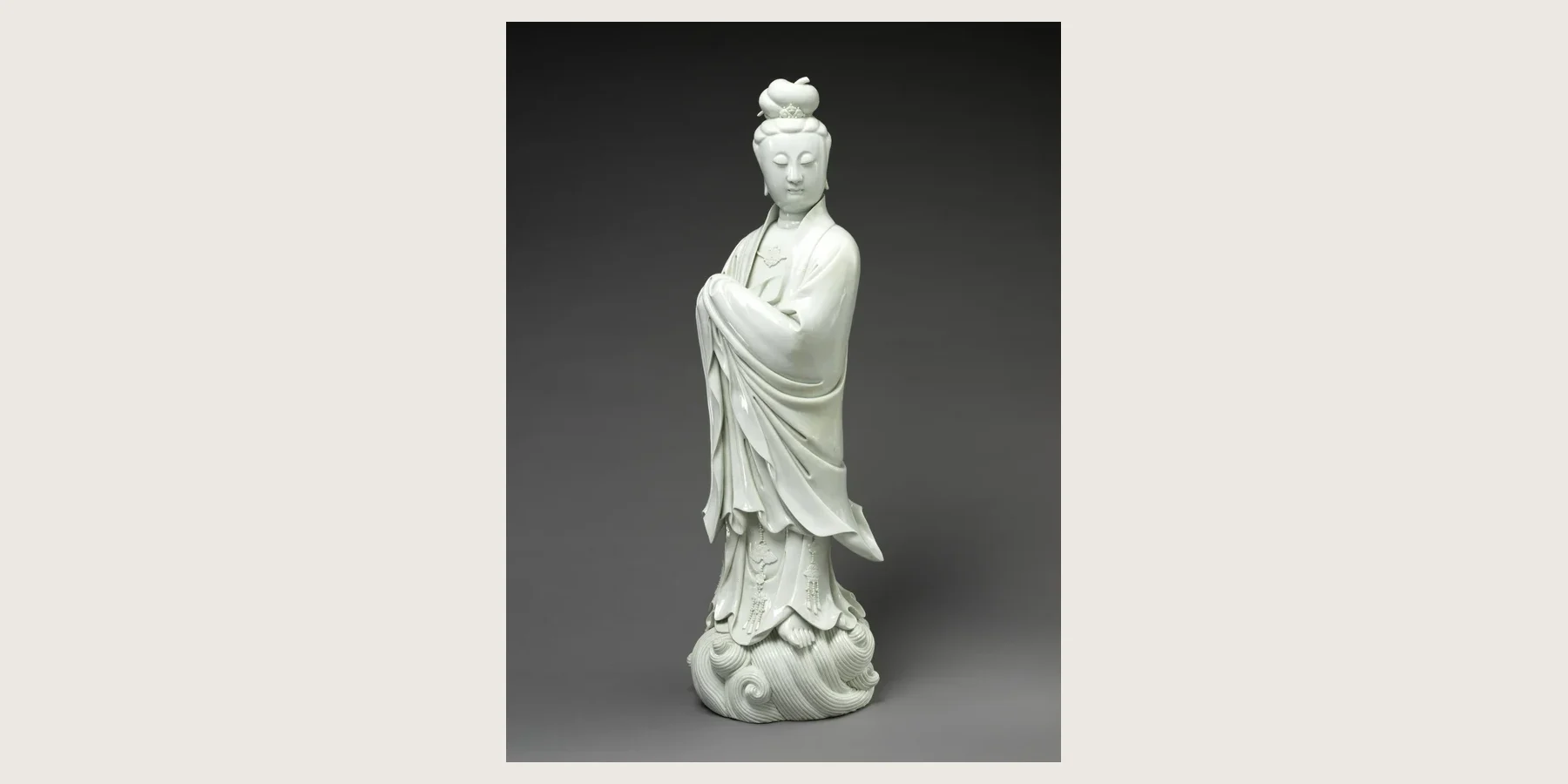
Look at the figure's hanging sleeves and the fine vertical lines down her dress. From a distance, you can read cloth before you register a rigid object. Moving closer reverses the impression: what appeared to flutter is held still in porcelain. That moment interests me far more than another claim that the white is especially pure.
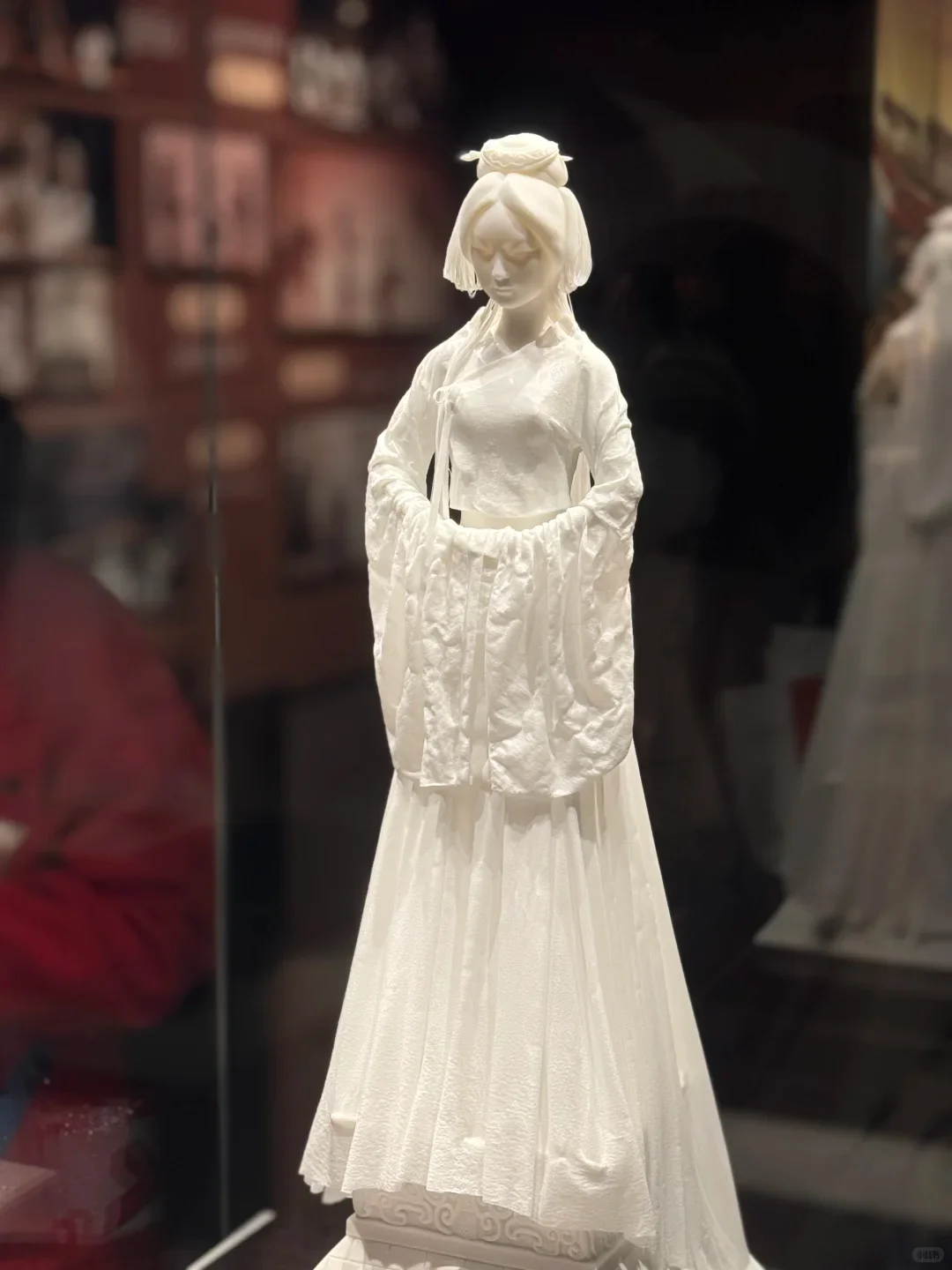
The contemporary work is presented as Princess Yushu (玉漱公主). A Fujian provincial record of the Min-Taiyuan Museum's ceramics exchange identifies a work of that title by Lian Deli (连德理). The human attraction is immediate: a living-looking body and costume, not a lesson in how to admire antiques. Contemporary Dehua can reach a viewer through this kind of character before that viewer knows a single kiln term.
I like the tension between stillness and implied movement. I am less impressed by thinness when it becomes a demonstration with nothing to say. Here the sleeve and the fall of the dress give the delicate surface a job: they make the stance readable. That is the difference between a technical stunt and sculpture.
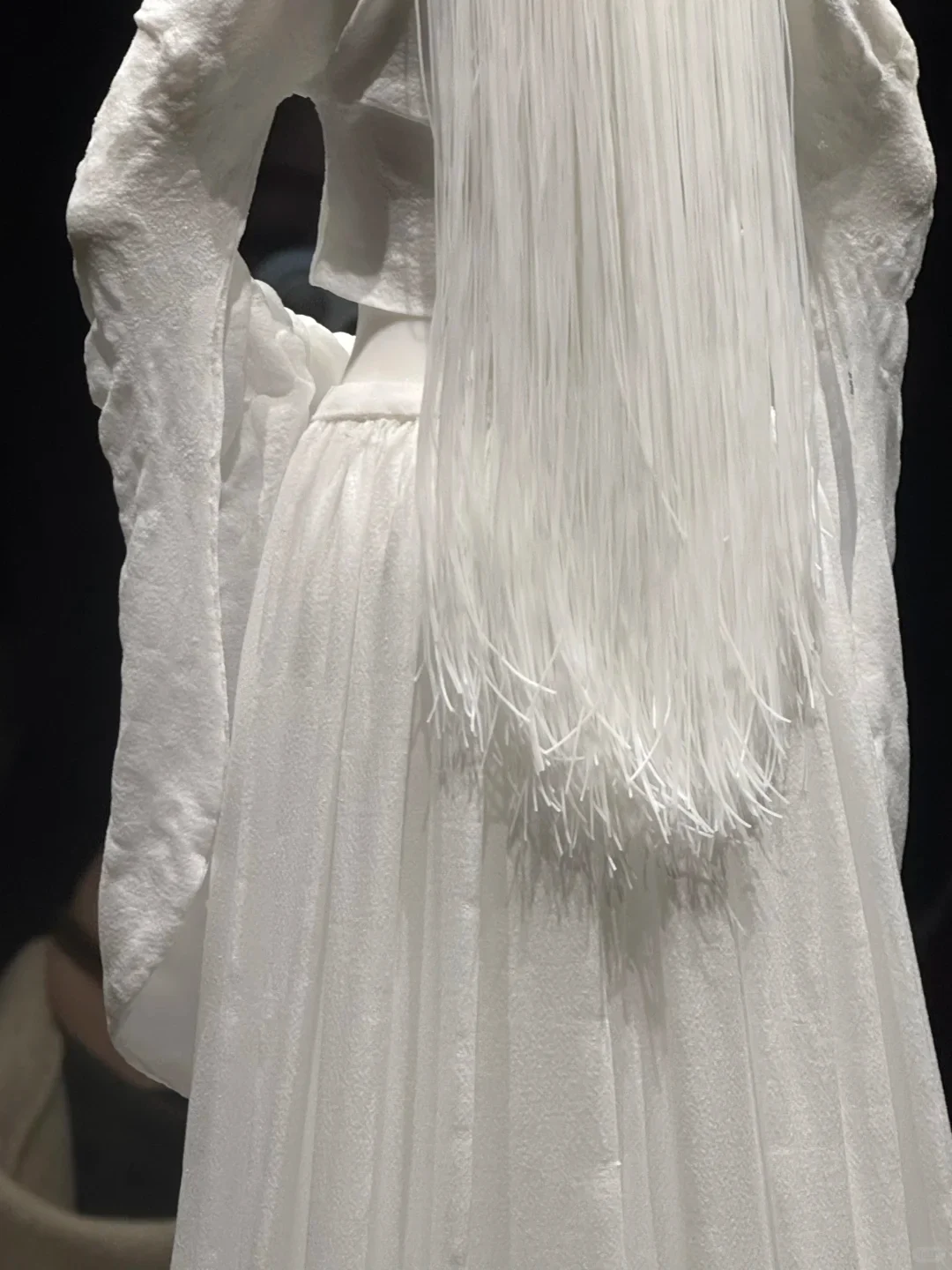
The close view exposes why white is demanding. A painted pattern could distract from an awkward join. Here the line has to hold its rhythm across the sleeve, skirt and intervening space. Small shadows separate one narrow ridge from the next. The photograph does not measure wall thickness or prove translucency; it lets you inspect the modeled folds. Those are already worth your attention.
Keep the place in the definition: Dehua is in Fujian, not a synonym for any pale ceramic figure. Museum catalogues use Dehua ware as an attribution; sellers sometimes use Blanc de Chine much more loosely. The name should lead to a maker, a kiln tradition or a documented historical object. It should not do all the work of describing what the sculpture achieves.
Blanc de Chine is what happened when Dehua travelled
The British Museum notes that plain white porcelains from Dehua became known in the West through the nineteenth-century French connoisseurial term Blanc de Chine. The phrase helped European collectors name a Chinese material they admired. It also narrowed a diverse place into one export-facing color.
That double effect is important. The name preserves global desire, but it can hide Chinese geography, domestic use and object variety. Dehua workshops made religious figures, scholar's objects, cups, dishes, seals, censers, bottles and vases. Some works reached European collections and influenced local porcelain production. Others served Chinese religious and domestic settings. A foreign name describes a route of reception, not the total life of the kilns.
The Met's account of an early Meissen Guanyin explains how Chinese Dehua figures in European royal collections became direct models for German experiments in red stoneware and hard-paste porcelain. Copying did not begin with today's online replicas. Dehua forms were already moving between materials, courts and systems of taste in the early eighteenth century.
The most interesting point is not that “China inspired Europe,” a sentence too large to teach much. It is that one object can change identity while keeping its posture: Chinese porcelain Guanyin, German red-stoneware copy, European porcelain version. Material technology, scale and religious reading shift around a recognizable body. In the broader Chinese art collection, that is a useful way to follow influence: trace an actual form moving between materials instead of announcing that two civilizations met.
Before the foreign name came a route out of the mountains
The polished statue can hide the less glamorous work that made Dehua a trading center. The official account of Dehua's kiln sites describes production in Quanzhou's mountainous hinterland and a route south by land to Yongchun, then toward the port by the East Creek, a tributary of the Jinjiang River. The kilns were not simply sitting beside an ocean waiting for European collectors.
That geography changes how I read a small vessel. Clay preparation, firing and packing had to connect to inland transport before maritime trade could begin. Song–Yuan production included practical bowls, plates, bottles and other utensils, with white and greenish-white wares. The long history cannot be squeezed into a row of later Guanyin figures, however striking they are.
There are two different timelines to hold onto: the earlier kiln-and-trade system and the later international fame of white sculpture. They connect, but they are not interchangeable. Following that distinction into Chinese export porcelain gives “export” a material meaning—objects moved along specific routes and were used differently at the far end.
Guanyin made white porcelain behave like light
The Met's eighteenth-century White-Robed Guanyin is 83.8 centimetres high. Its record identifies porcelain with white glaze from the Dehua kilns and describes a scale suited to a wealthy residence. The figure is not compelling because white automatically means purity. It is compelling because white refuses to rescue weak modeling.
Without painted brocade, the robe has to live through folds. Without a colored landscape, the cloud base has to turn shadow into movement. The face must remain calm without becoming blank. Sleeves overlap, beads interrupt smooth planes, and the glaze gathers differently along edges and recesses.
This is where a screen fails us. A white object photographed against white can lose every transition. Aggressive contrast can make shallow details look carved more deeply. Warm lighting can produce “ivory,” while cool LEDs push the same surface toward blue. A useful record therefore needs neutral light, angled light and a view that lets the figure cast its own shadows.
The British Museum's late Ming Guanyin, dated circa 1600–44, provides a different kind of evidence. Its record notes the figure's deep robe carving, pale yellow-tinged transparent glaze, missing hands and 46.3-centimetre height. Condition is not removed to preserve an ideal image. The missing hands are part of what the object is now.
My attention goes first to the hands for exactly that reason. Fingers, attributes, beads and thin projecting cloth are vulnerable. A face can look untouched in a frontal photograph while the sides, back and attachments carry the real history of handling and repair.
The back also deserves time. A face is designed to catch you; a shoulder turning into a sleeve tells you whether the figure remains convincing when that first attraction disappears. Hollowing, joins, tooling, glaze coverage and repairs may be easier to see away from the front. None independently authenticates a piece, but together they stop looking from becoming a contest between flattering portraits.
Dehua was never only Guanyin

The Met records this Bodhidharma in meditation as seventeenth-century Dehua ware: white porcelain with transparent glaze, 29.8 centimetres high. The broad body, gathered robe and concentrated face produce a weight entirely different from the tall White-Robed Guanyin.
The comparison corrects another shortcut. Dehua sculpture does not have one serene female face repeated across centuries. Buddhist and Daoist figures, historical or popular deities, attendants and other subjects required different bodies, gestures and emotional pressure.
More importantly, sculpture is only part of the field:
| Documented Met object | Date in the museum record | What it changes |
|---|---|---|
| Bottle with coiling dragon | Late 16th century | White glaze can carry applied sculptural movement around a vessel |
| Bodhidharma in meditation | 17th century | Dehua figure-making includes bodily weight and character, not only Guanyin elegance |
| Brushpot with floral pattern | 18th century | Openwork turns the white body into a screen for light |
| Covered incense burner | Early 18th century | Function depends on lid, openings, feet and heat path, not color alone |
| Vase | Late 16th–early 17th century | A long silhouette can let restrained glaze and proportion lead |
| Cup with poem | Late 17th–early 18th century | Text, scale and handling connect Dehua to a scholar's table and daily use |
This range is why I resist reducing a kiln tradition to a souvenir category. A Guanyin may be the doorway for an international reader. It should not become the entire room.
A dragon bottle makes white feel kinetic

The Met's Bottle with Coiling Dragon is dated to the late sixteenth century and stands 21 centimetres high. Its transparent glaze covers a dragon that wraps around the porcelain body. The creature is not a picture placed on a neutral bottle. It changes the bottle's outline and controls how a hand or eye moves around it.
White does something precise here: it unifies bottle and dragon while shadow keeps them separate. A painted dragon announces itself from one preferred face. An applied dragon makes the viewer rotate the vessel, following relief as it disappears and returns.
That movement offers a practical test for photographs. One frontal view cannot show whether the relief continues coherently, where an attachment meets the body, or whether a repair interrupts the line. Ask for rotation. If the seller's most important claim wraps around the object, the evidence must wrap around it too.
The bottle also belongs beside the Chinese porcelain vase guide. Form vocabulary matters: mouth, neck, shoulder, belly and foot remain readable beneath applied decoration. The dragon succeeds when it works with those transitions rather than disguising them.
Openwork turns emptiness into decoration

The Met identifies this eighteenth-century brushpot as Dehua porcelain with reticulated decoration beneath a clear glaze. It is 14 centimetres high. The openings are not missing material. They are the design.
Light passes through the wall and draws a second pattern on the interior. The negative spaces make wall thickness, edge finishing and structural continuity visible. In use, the object would organize brushes; in display, it asks the room behind it to participate.
This is where high-resolution side views earn their file size. A white-background catalogue image establishes the silhouette. A darker side light reveals which floral parts are pierced, which are relief and how the glaze rounds the edges. An interior view shows whether openings are clean, blocked, repaired or sharply abraded.
The broader porcelain-making guide explains why a finished object should return our attention to material sequence. Openwork is not an afterthought applied by a photographer. The object had to survive forming, drying, glazing and firing with those voids in place.
A Dehua incense burner is a function before it is a mood

The Met's early eighteenth-century covered incense burner is 11.4 centimetres high and 14.6 centimetres wide and deep. The clear-glazed porcelain object has a lid, openings, body and feet that create a functional architecture.
I would not recommend burning incense in an antique or undocumented ceramic object from photographs. Heat history, restoration, cracks, glaze condition and intended use need exact-object assessment. “Incense burner” in a museum record explains the historical object. It does not certify a similar-looking purchase for modern heat exposure.
Still, the form teaches us what to inspect. Where can smoke leave? How is the hot interior separated from the supporting surface? Can the lid be lifted without touching a hot finial? Does residue survive inside? Are feet stable? A contemporary incense object should answer those questions before it offers atmosphere.
This is one of East Moment's strongest rules for cultural objects: function must survive the poetry. A white censer photographed with smoke can look contemplative while hiding an unsafe setup. Beauty is not a substitute for a heat path.
White changes with the room
Museum catalogues describe Dehua examples with white glaze, ivory glaze, clear glaze and transparent glaze. The words reflect exact records and visible effects; they should not be flattened into a single digital color standard.
On a real object, perceived white changes with body, glaze thickness, pooling, firing, age, restoration, dirt and light. In a photograph it changes again with white balance, display glass, phone processing, background and screen. A warm ivory cast can be genuine, environmental or edited. A cool white can come from an LED rather than a kiln.
The Chinese ceramic glazes guide helps describe translucency, gloss, pooling and crackle without pretending a photograph can identify chemistry. For Dehua research, I would record:
- overall color in neutral diffuse light;
- glaze behavior on a broad flat plane;
- pooling in folds, recesses and around applied details;
- exposed body at the base or damaged areas, only if already visible;
- differences between restored and unrestored surfaces;
- the same views with a neutral gray reference when color is consequential.
Even “all white” has to be described object by object. The British Museum's Ming Dehua vase is a useful warning: its record identifies Dehua porcelain with overglaze red, green, turquoise and black enamels. Dehua is not invalidated when color appears. The Western nickname made whiteness famous; it did not erase everything the kilns produced.
Vessels reveal the discipline behind the glaze

The Met records this vase as Dehua porcelain with white glaze, dated to the late sixteenth or early seventeenth century. It stands 41.9 centimetres high. With no painted scene to distribute attention, proportion has nowhere to hide.
The flaring mouth, long neck, compressed shoulder and narrow body create a vertical rhythm. Applied or incised details would change that rhythm; here the first task is simply to let the silhouette remain whole. A cropped detail of luminous glaze cannot replace the full form.
This is the same discipline the previous pages established for Chinese porcelain jars and vases, but Dehua adds a different pressure. White surfaces make tiny profile changes prominent. A neck that thickens too abruptly, a foot that feels visually weak or a repair that breaks reflected light can alter the entire object.
For a modern Dehua-inspired vessel, I care less about whether it copies an antique perfectly than whether the maker understands why the profile works. Revival becomes interesting when proportion, surface and use have been reconsidered. It becomes costume when a historical name is doing all the aesthetic labor.
How to inspect a Dehua or Blanc de Chine listing
Begin by deciding what the seller is actually claiming. “Dehua-style” is an aesthetic description. “Made in Dehua” is a production-place claim. “Ming Dehua” is a consequential date and attribution. “Blanc de Chine” may be used loosely as a market category. Those statements require different evidence.
Then request a complete record:
- full silhouette, profiles and back;
- underside, interior and openings;
- neutral-light and angled-light photographs;
- dimensions and weight;
- close details of face, fingers, attributes, applied decoration and thin edges;
- all seals, inscriptions, labels and mounts in context;
- written condition, including missing parts, fills, overpainting, cracks and drilled holes;
- documented ownership or maker information;
- the exact museum or publication comparisons used for attribution.
A seal matters, but the Chinese ceramic marks guide explains why a seal cannot authenticate itself. Named Dehua makers and workshops produced marks that later makers could repeat. A convincing front view plus a clear seal is still only part of the object.
Do not ask an online photograph for a price verdict it cannot give. Authentication and valuation may require physical inspection, provenance research and specialist comparison. The goal of this page is to make a better evidence request, not to turn resemblance into certainty.
A robe, a quiet basin or a copper cloud?
If Dehua leaves you cold at first, compare what your eye is being asked to follow. In Ru ware, the interval between a muted glaze and a controlled profile can be the whole attraction. In Jun ware, a patch of copper red and its dissolving edge can pull you around a vessel. Dehua sculpture makes that movement more literal: the sleeve bends, the dragon circles, the light enters a pierced wall.
My preference here is for a figure that becomes more interesting from the side. A spectacular face with lifeless drapery is not enough. Nor does a famous maker's name redeem a bottle whose applied dragon looks stuck on. You are allowed to make those judgments without claiming to authenticate a Ming work. Taste and attribution are separate responsibilities.
Dehua is strongest when white stops being empty
The ordinary description says Dehua is famous white porcelain from Fujian, especially Guanyin figures. It is correct and insufficient.
What makes Dehua worth sustained attention is how apparently restrained surfaces carry difficult work. A robe fold becomes structure. A dragon makes a bottle rotate. Openwork lets the room enter a brushpot. A censer organizes lid, air, heat and support. A vase survives on proportion. Overseas, the same bodies entered new collections, translations and manufacturing experiments.
That is why I would never begin with “How white is it?” I would begin with “What is the white being asked to do?” Then I would return to place, construction, documentation and condition.
Continue through the wider Chinese porcelain guide and Chinese export porcelain to follow the material and its routes. In East Moment's community, bring one fold, opening or attachment that changed when you saw the object from another angle. Keep the title and known collection with the picture. Come back with the second view: the point is to show another reader where your first impression became more interesting.