A lid gives a jar a finish—and gives its owner another object to lift, store and protect. Chinese porcelain jars range from compact covered forms to large sculptural vessels; “ginger jar” names only part of that territory. I would choose the opening and the closed silhouette together. A beautiful jar that cannot be opened comfortably in its chosen spot is a bad fit for that spot.
Chinese porcelain jars are built around access, not a romantic name
The fastest useful way to read Chinese porcelain jars is to imagine the hand that would approach them. Is the mouth wide enough to reach through? Does the shoulder expand sharply below it? Is there a lid, and does that lid seat into a designed rim? Is the vessel stable when opened? These questions distinguish a jar's physical logic from the narrower mouth and display-oriented profile we commonly associate with a vase.
That does not create one perfect jar shape. Historical Chinese jars can be tall or compressed, round or faceted, monochrome or densely decorated, covered or now missing a cover. Some were connected to storage, transport, burial, ritual or display. Others were made for overseas buyers whose orders changed shape, decoration and metal mounting. Modern sellers then inherited this enormous field and compressed it into a few familiar phrases.
“Ginger jar” is the most seductive of those phrases. It sounds specific enough to be historical proof. It is not. Museums do use the term for particular objects, including the British Museum's documented blue-and-white export ginger jar recovered from the Diana shipwreck. But the same label now appears on new home accessories, lamps, urns, vases and almost any rounded covered vessel. The term can identify a useful visual family; it cannot establish what an individual jar stored, when it was made or whether its cover belongs to it.
This is why a label is a starting point, not my decision. For someone choosing a new jar for a room, mouth width, cover height and body depth matter immediately. For someone examining an inherited jar, the same features organize a useful description before a specialist assesses its history.
Opening a jar also changes the pace of looking. Closed, it offers a completed silhouette. Open, it asks you to notice its interior, rim and thickness. I find that second view especially revealing because decoration can no longer carry the entire impression. The mouth has to make sense as a worked edge.
Jar or vase? Look at what the opening asks the body to do

The culture-park vessel has a tall body but a short neck and broad opening. Height alone does not distinguish jar from vase; follow the mouth into the shoulder.
The object above could be listed casually as a jar, vase or urn. Color does not settle the question. Neither does height. I look at the transition from opening to body. A storage-oriented jar usually makes access and capacity legible: the mouth leads into a shoulder and an enclosed volume. A Chinese porcelain vase often gives more visual authority to the neck and the continuous profile rising from the foot.
The boundary remains porous because objects change use. A jar can hold flowers. A vase can lose its neck and be relabelled. A covered jar can become a lamp after drilling and mounting. A missing lid can make a jar look vase-like in an online photograph. That is why the safest first description is formal rather than functional: “globular body, short neck, wide mouth, recessed cover seat,” for example.
This language feels less glamorous than “imperial ginger jar.” It is far more valuable. It creates a record another person can check.
Three comparisons help:
- A covered jar is the broadest useful term when the body and lid are designed as a pair but the exact historical use is not established.
- A ginger jar is a familiar English-language market and museum term for certain rounded covered forms, but it should not be treated as proof that a specific object carried ginger.
- A baluster jar describes a swelling body with a narrower lower section and often a domed lid. It is a shape description, not a date.
“Temple jar” deserves even more caution. In today's interiors market it often means a tall covered jar with a prominent finial. The phrase can help someone find the look they want; it should not be converted automatically into a documented temple origin or ritual history.
A lid changes the whole object

The lid is not a hat placed on a finished shape. It creates another rim, another silhouette and another point of handling. On the Met's nineteenth-century Jingdezhen jar with lid, the cover continues an angular, almost architectural body. The porcelain is painted in overglaze polychrome enamels. Its height with lid is 30.8 centimetres, but its width is 12.1 and depth 10.2 centimetres. Calling it a “30-centimetre jar” loses the slenderness that makes the photograph interesting.
Look at the corners. The body asks the painter to handle faces and turns rather than one continuous cylinder. Above it, the lid repeats that angular character. Remove the lid visually and the top becomes an opening; restore it and the upward sequence closes. That change is more important to my enjoyment than whether a catalogue uses the same everyday jar name I would use.
When inspecting a covered jar, I want five views of the lid:
- The jar closed from the front.
- The jar closed in profile.
- The underside of the lid.
- The mouth and cover seat with the lid removed.
- The lid resting beside the jar at the same scale.
Those photographs reveal overhang, seating height, decoration and visible wear. They cannot establish whether the lid rocks: that requires a careful handling observation, not a guess from a still image. A lid can be old and still be a later marriage. Conversely, a color difference is not enough to convict it; body and cover may differ for several reasons. Ask for the fit and condition to be described separately from the proposed date.
Do not force a tight lid. Do not lift a heavy jar by its finial. A restored knob or hairline crack around the cover is not automatically disqualifying, but it belongs in the condition record and in the price discussion.
Shape controls where decoration can breathe

The Met's early seventeenth-century covered jar is only 20.3 centimetres high. Its painted decoration has to negotiate a compact body, narrow base and lid. The shoulder is not leftover space between picture and mouth; it is where the design turns away from the viewer.
This is the part online listings routinely flatten. A frontal photograph shows the principal motif and hides how it ends. Ask for a full rotation or at least four quarter views. Look for borders that drift, motifs that collide at the back, abrasion concentrated on one side, or a restoration that changes the surface gloss. Hand decoration is not expected to behave like a printed wrap, but awkward joins still tell us how the object was planned and how it has been treated.
The jar also clarifies the relationship between blue-and-white porcelain and later color. “Blue and white” refers to cobalt decoration beneath a transparent glaze, not every jar that happens to include blue. Overglaze enamels create another firing and surface relationship. If both appear on one object, name both rather than collapsing the palette into a style label.
Decoration should therefore be read in zones:
- Lid and finial: repeated motif, separate emblem, floral cap or later replacement.
- Neck: banding, scrollwork, inscription or quiet transition.
- Shoulder: border, lappets, floral collar or the beginning of the main scene.
- Body: narrative, animals, flowers, calligraphy, monochrome glaze or relief.
- Lower body and foot: border closure, wear, glaze pooling and the visual weight that anchors the jar.
Once you notice those zones, a jar stops being a flat pattern sample. It becomes a three-dimensional editing problem solved in clay and fire.
The biggest jar is not simply a small jar enlarged

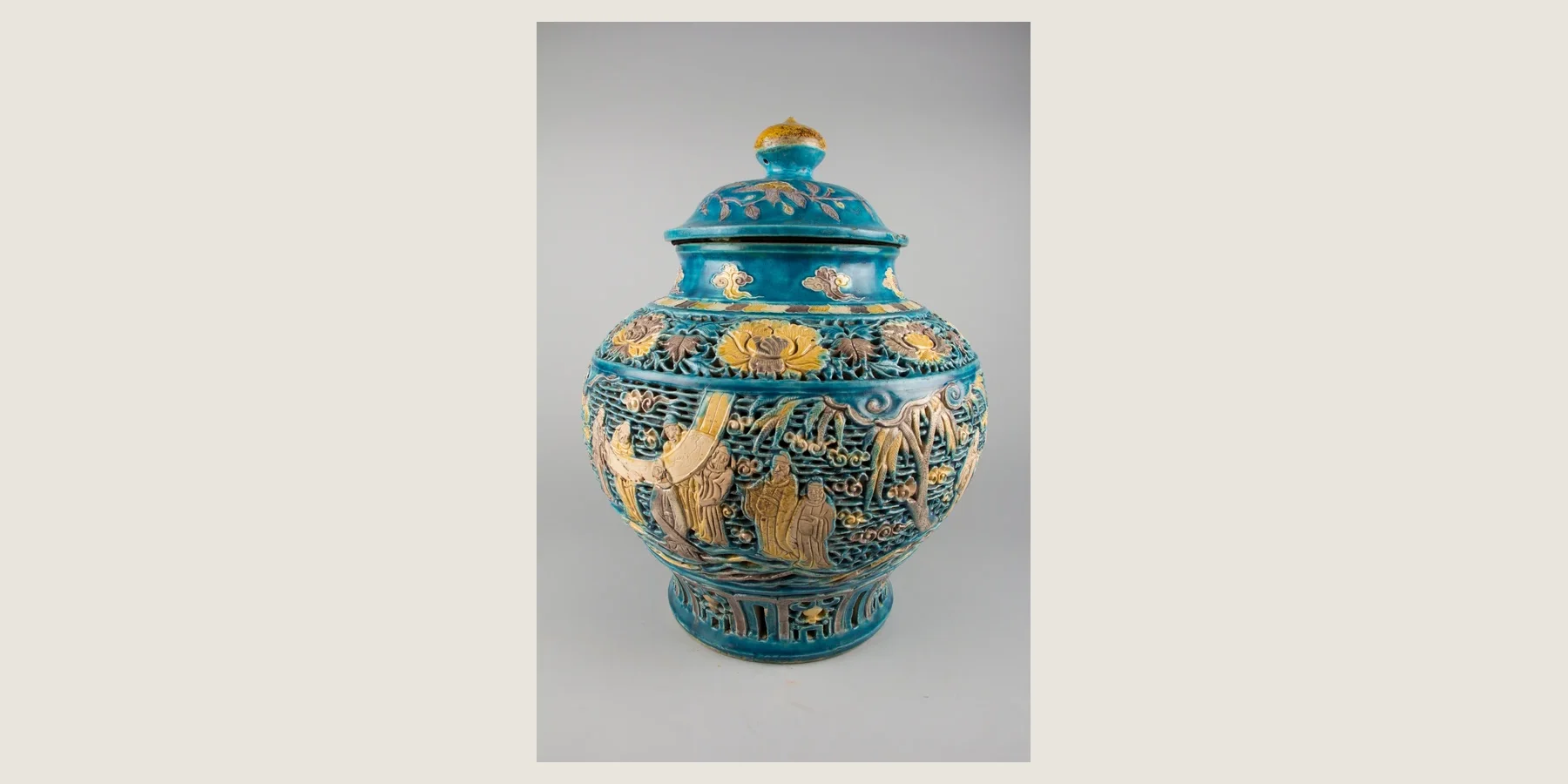
The same fahua object shown in the hero, now without its cover: the open neck and shadow inside the pierced decoration become visible. Removing the top changes both the outline and the way the surface is read.
The Met's sixteenth-century fahua covered jar stands 46.5 centimetres high and reaches 38.1 centimetres in diameter. Its porcelain body carries carved, pierced and relief decoration under colored glazes. This is not a little ginger-jar silhouette magnified for a console table. Scale changes the physical and visual problem.
The lid must remain stable across a wide opening. The shoulder has to manage weight. Relief catches light and makes the vessel read differently as you walk around it. Pierced areas introduce literal depth and shadow. Even the plinth-like foot participates in the architecture.
I find this object useful because it destroys the lazy idea that Chinese porcelain refinement always means thin white walls and delicate painting. Porcelain can be sculptural, weighty, textured and unapologetically complex. The wider history of Chinese porcelain makes more sense when quiet monochrome bodies and assertive architectural jars are allowed to coexist.
Scale also changes buying decisions. Before placing a large jar, record:
- total height with the lid and finial;
- widest diameter, not only base width;
- empty weight and whether two hands can safely reach around it;
- shelf, console or floor load capacity;
- clearance from doors, sleeves, children, pets and cleaning equipment;
- whether the lid needs a separate safe place during dusting or moving.
A room photograph without measurements makes a jar look whatever size the seller wants. Dimensions return it to reality.
Red glaze gives the body the leading role

The Met records this Kangxi-period covered jar as Jingdezhen porcelain with copper-red glaze, dated to the late seventeenth or early eighteenth century. It is 42.5 centimetres high including the lid. Without a painted scene, the viewer reads color movement, silhouette and surface interruption more intensely.
That intensity creates traps. A brighter patch can be glaze behavior, reflected light, overpainting or a repaired area. Fine lines can be crackle, scratches, hairlines or marks in the photograph. A halo near the foot can come from pooling, dirt or restoration. The Chinese ceramic glazes guide provides vocabulary, but no vocabulary can replace angled light and close inspection.
Ask for the same area photographed in diffuse daylight and raking side light. Ask whether the image has been sharpened, color-corrected or shot through glass. Compare the lid and body, but do not demand machine-perfect identity. The goal is not to punish variation. It is to separate visible variation from confident stories about why it exists.
Compare it with the turquoise fahua jar above. The red jar carries your eye along broad curves; the fahua surface repeatedly stops it at projecting detail. I would not place them against the same busy background and expect them to work equally well. The red silhouette can compete with a patterned room; the pierced body asks for enough quiet around it to show its shadows. That is a display judgment, not a hierarchy of craftsmanship.
For an old jar, keep the cover in the condition story
Turn the jar over only when it can be done safely. Photograph the entire base square to the camera, then add close views of the foot ring, exposed body, glaze edge, marks, labels, residue and repairs. A cropped mark floating on a white background removes precisely the evidence needed to interpret it.
The Chinese ceramic marks guide explains the central limit: a reign mark can be copied, revived, honored or added to an object made later. A blue circle, double ring, seal script or six-character formula is evidence to read, not a verdict. Wear is equally easy to perform or misinterpret. Dirt can be added; genuine old surfaces can be cleaned; a foot can be ground after damage.
For an antique purchase, request a written condition account covering both parts. “Good condition” for the body says nothing about a restored knob or a replaced cover. Keep that account with the dimensions, complete photographs and any ownership documentation; obtain an independent specialist examination when attribution or value is consequential. You do not need to turn every new decorative jar into a research project. You do need to know which kind of purchase you are making.
A jar needs more space than its footprint
Here is a practical planning example, not a measurement of one of the museum objects. A contemporary jar is 32 centimetres high with its lid and fits below a shelf 35 centimetres above the surface. It fits while closed. That three-centimetre gap does not automatically give your fingers room to lift the cover or somewhere safe to put it. The mistake appears only when you try to use the object.
Before buying, mark the maximum body width on the intended surface with paper, then check the full height and the cover's removal path. Do this with measurements or a light mock-up, not by repeatedly manoeuvring a heavy historical jar. A broad shoulder can overhang a narrow base by a surprising amount. Base diameter alone is not shelf depth.
For a modern jar used to hold small dry items, the opening matters as much as capacity. Can you retrieve the largest intended item without scraping it against the rim? Is the jar so deep that everything disappears below your reach? A narrow mouth can be visually elegant and frustrating for daily access. If the object is purely decorative, accept that and choose it for its closed form. Calling an awkward container “storage” does not make it useful.
I also refuse the automatic matched-pair rule. A pair can frame a console beautifully, but it can turn a small shelf into a symmetrical obstacle course. One jar beside something lower gives its shoulder and finial room to register. Two jars are worth choosing when their relationship adds something—not because an interiors photograph supplied two empty corners.
Decide what life you actually want the jar to have
Many searches for Chinese porcelain jars are really interior-design searches. That is legitimate. A contemporary covered jar can be chosen for scale, color and form without pretending it is an antique. A documented historical object can be displayed with the restraint its condition demands. Trouble begins when decorative use overwrites physical limits.
Do not assume an old or undocumented jar is food-safe, watertight or suitable for fresh flowers. Do not add water before checking the body, repairs and surface. Do not convert a jar into a lamp without understanding that drilling permanently changes it and that modern electrical components need professional installation. If a jar has already been mounted, ask to see the base and understand what the mount conceals.
For a shelf, one jar needs breathing room around its silhouette. For a pair, measure both rather than trusting “matched”: height, shoulder width, lid profile, glaze tone and decoration may differ. Difference is not always a defect, but the relationship should be visible and intentional.
The porcelain-making guide helps explain why form, surface and firing cannot be separated. The Chinese export porcelain guide shows why foreign demand and movement also belong to an object's story. Neither page will tell you what an undocumented jar is worth. Together they make the right questions harder to avoid.
Choose the jar you can make room for
Chinese porcelain jars deserve more than the role of blue-and-white punctuation on a shelf. A compact painted body, an angular jar and a monumental pierced vessel offer different ways to enclose space. Their covers finish that thought differently. That is what I want to notice before asking whether the object makes a room look expensive.
For a historical jar, protect the object and investigate its documentation. For a new one, choose deliberately between display and use, measure the clearance, and decide whether the cover improves the silhouette you will see every day. Those decisions give you a reason to like this jar instead of every jar with the same market label.
Explore the Chinese art collection or the broader Chinese porcelain guide. To compare forms organized around the neck rather than access, continue to porcelain vases. In East Moment's community, show one safely handled contemporary jar with its lid on and resting beside it. Which version belongs in your room? Return with the position you kept; a solved clearance problem is more useful to another reader than another unmeasured styling photo.