How Chinese porcelain is made cannot be reduced to “shape clay, paint it, fire it.” Porcelain is a chain of decisions in which every stage hands limits to the next. Fire delivers the final image, but it cannot rescue badly prepared clay, rushed drying, weak joins or careless kiln loading.
How Chinese porcelain is made, in one direct answer
Chinese porcelain is made by preparing a suitable mineral body, forming it, allowing it to dry under control, refining and decorating the surface, applying glaze, loading it into a kiln, firing it at high temperature and sorting the results after cooling.
I do not trust a porcelain-making video that jumps from spinning wet clay to a flawless vase. That edit removes drying, rejects, kiln risk and almost everyone except the most photogenic pair of hands. It sells magic. The real craft is more impressive because failure remains possible at every handoff.
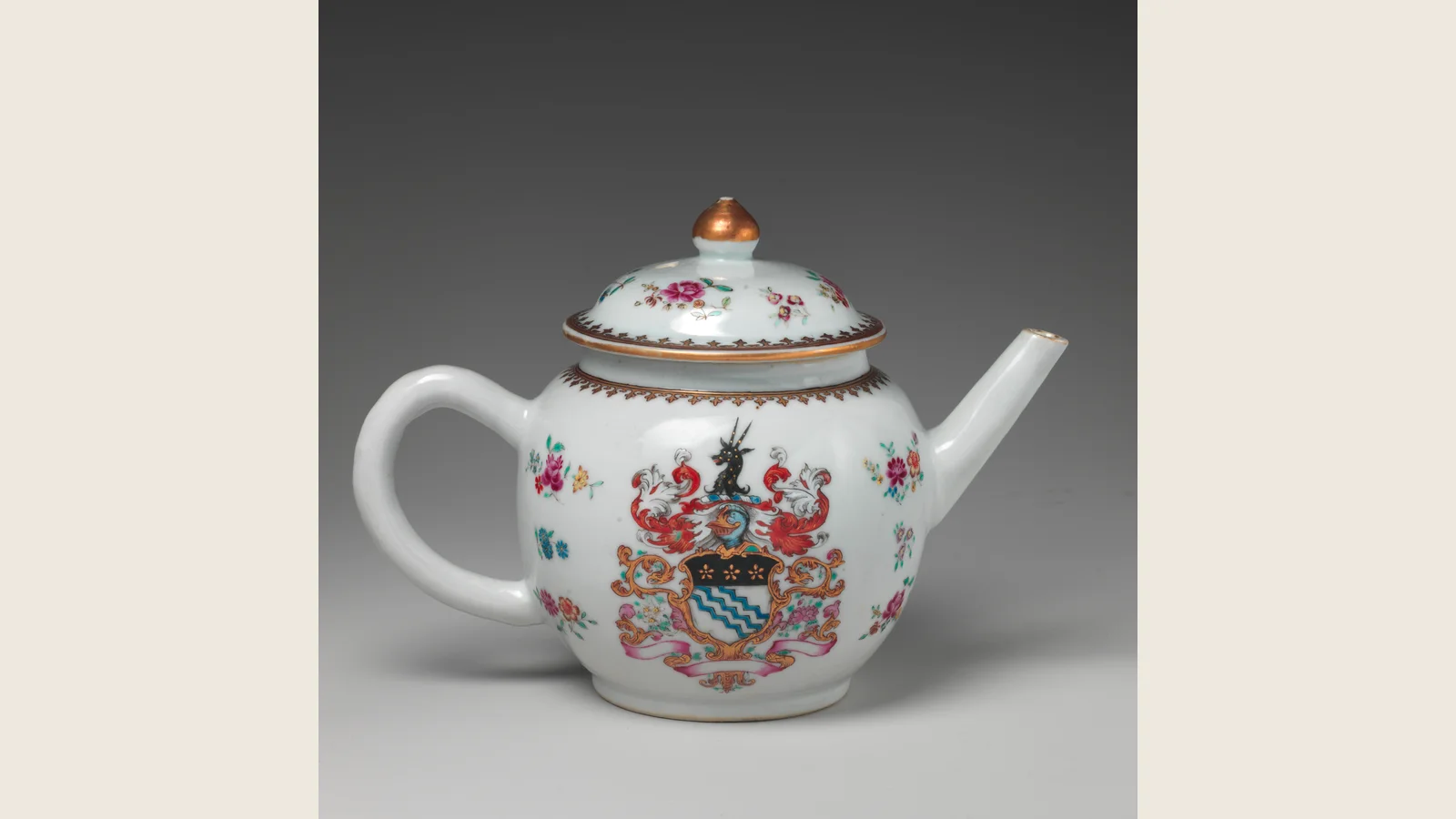
That is the direct answer. The deeper answer is that there has never been one Chinese porcelain recipe or one universal workshop sequence. Materials changed across regions and periods. A small thrown cup, a molded dish, a large assembled vase and an imperial enamelled object do not travel through identical production lines. Some objects require one firing; others require several.
Historic centers such as Jingdezhen became powerful because they coordinated materials, specialist labor, kiln knowledge, quality grades, court commissions and commercial orders at scale. The famous white surface hides a city-sized system.
The porcelain-making process at a glance
| Stage | What happens | What can go wrong | What remains visible later |
|---|---|---|---|
| Material selection | Porcelain stone, kaolin-rich clay and other minerals are selected and combined according to local practice | Wrong plasticity, impurities or inconsistent batch behavior | Body color, texture, density and firing response |
| Clay preparation | Material is crushed, washed, mixed, aged, de-aired or wedged as required | Air pockets, uneven moisture and hard particles | Cracks, weak spots and inconsistent walls |
| Forming | The body is thrown, molded, pressed, cast, carved or assembled | Collapse, uneven thickness, distorted joins | Silhouette, weight, seams and tool movement |
| Controlled drying | Moisture leaves until the body can be refined and eventually fired | Cracking, warping and failed joins | Subtle distortion and stress lines |
| Trimming and carving | Excess clay is removed; feet, edges and relief are clarified | Walls become too thin or proportions lose balance | Foot shape, turning lines and carved depth |
| Decoration | Cobalt, iron, carving, molding, slip, enamel or other systems add imagery | Bleeding, weak brushwork, poor placement or incompatible materials | Line quality, relief, color and composition |
| Glazing | A formulated glass-forming coating is applied | Drips, crawling, pinholes, uneven thickness or poor glaze fit | Gloss, opacity, pooling, crackle and edge color |
| Kiln loading and firing | Objects are supported, protected and fired through a controlled heat cycle | Sticking, slumping, contamination, color failure or cracking | Support marks, atmosphere effects and kiln variation |
| Cooling and sorting | The kiln cools before pieces are inspected, graded, repaired or rejected | Thermal shock and hidden flaws | Quality grade, wear path and later restoration |
Videos love the wheel because moving clay is instantly satisfying. The invisible stages—material washing, drying, kiln cooling and rejection—often decide whether that beautiful thirty-second sequence becomes usable porcelain.
Porcelain begins before the clay reaches a hand
The word “clay” makes the raw material sound ready. It is not. Ceramic bodies are engineered mixtures whose particle size, mineral content, plasticity and firing behavior need to work together.
Jingdezhen production is often explained through porcelain stone and kaolin. Porcelain stone can contribute feldspathic and clay-forming components; kaolin-rich material can improve refractoriness and structural strength at high temperature. Recipes changed over time, and proportions varied with object, workshop and available deposits.
Other Chinese centers worked with different local bodies. This is why “real Chinese porcelain contains exactly these two ingredients” is too rigid. The fired result depends on materials, refinement, forming, glaze and heat acting as one system.
Raw materials may be crushed, washed and settled to remove unwanted particles and create a more consistent batch. Water and time help separate usable material from grit. These stages are visually less dramatic than a brush touching a vase, but they set the ceiling for everything that follows.
This is also why a block of beautiful white clay tells you so little about the finished ware. Whiteness before firing cannot establish the recipe or predict translucency. The material has to be tested through the intended firing, not judged by how clean it looks on a workbench.
Clay preparation is quality control you can feel
Prepared clay still needs consistent moisture and working character. Wedging or kneading helps redistribute water and reduce pockets of trapped air. Industrial systems may mix, filter and de-air material mechanically, while studio workshops use hand preparation at different scales.
Clay remembers careless preparation. A hard inclusion can interrupt trimming. Uneven moisture can make one side shrink faster. An air pocket may open during forming or contribute to later failure.
The point is not that every trapped bubble causes an explosion—the popular version is oversimplified. The larger risk is inconsistency. Porcelain asks a thin wall to survive drying, handling and high heat. Small differences become expensive later.
Forming is not the same as throwing
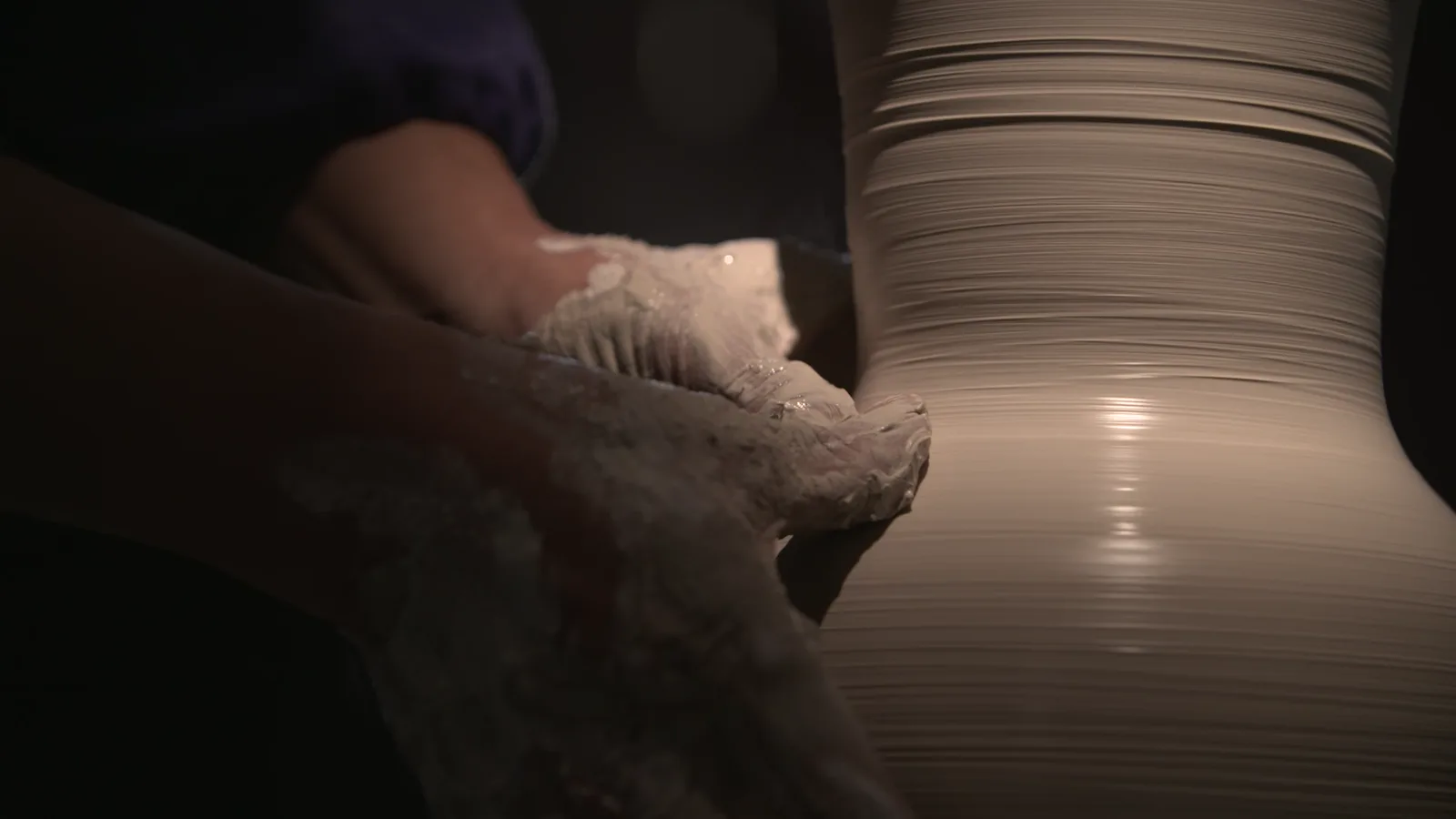
Wheel throwing is one of the most recognizable ceramic skills. The maker centers a rotating mass, opens it and pulls the wall upward through coordinated pressure. One hand supports what the other changes.
The clean silhouette can make the process look effortless. In reality, the wall is negotiating gravity, centrifugal force, lubrication and the clay’s limited willingness to stretch. Too much water weakens it. Too little friction control drags the surface. Pressure applied a moment too late can leave a wobble that trimming cannot fully erase.
But not all porcelain is wheel-thrown. Chinese workshops have used molds, pressing, casting and assembly from separately formed parts. Handles, spouts, necks and sculptural details may be attached later. Large vessels can be built in sections because one wet body would not support the full height.
This is where the fantasy of the solitary master begins to break. A form may pass through several hands before it is ready to dry.
Drying is an active stage, not a pause button
Freshly formed clay contains a great deal of water. As that water leaves, the body shrinks. If one area dries faster than another, stress develops. Thick bases, thin rims, attached handles and enclosed forms all create different drying problems.
Workshops manage airflow, humidity, timing and object placement. A vessel may become leather-hard: firm enough to handle and trim, but still capable of receiving carving or attached elements. Wait too long and the tool responds differently. Move too early and the wall can deform under its own weight.
Video editing usually cuts directly from wet wheel work to a clean finished foot. The missing hours or days are not empty. Drying is where the object quietly decides whether it will cooperate.
Take a handled cup. The handle and body are separate forms with separate moisture histories. Joining them is not like fastening a metal handle to an already finished pot: both clay parts still have to shrink. A convincing join must survive that movement, not merely look smooth while wet. That is why the small contact point deserves as much attention as the broad painted surface.
There is no honest universal production time. A quick wheel demonstration measures forming, not the completed cup. Drying, decoration, a place in the firing schedule, cooling and inspection can carry the work across days or weeks. A second decorative firing adds another cycle. Ask which stages a quoted lead time includes before comparing two workshops.
Trimming turns a rough body into a balanced object
Once the vessel has firmed, it can return to the wheel for trimming. A tool removes excess clay, clarifies the foot and adjusts the relationship between wall, base and weight.
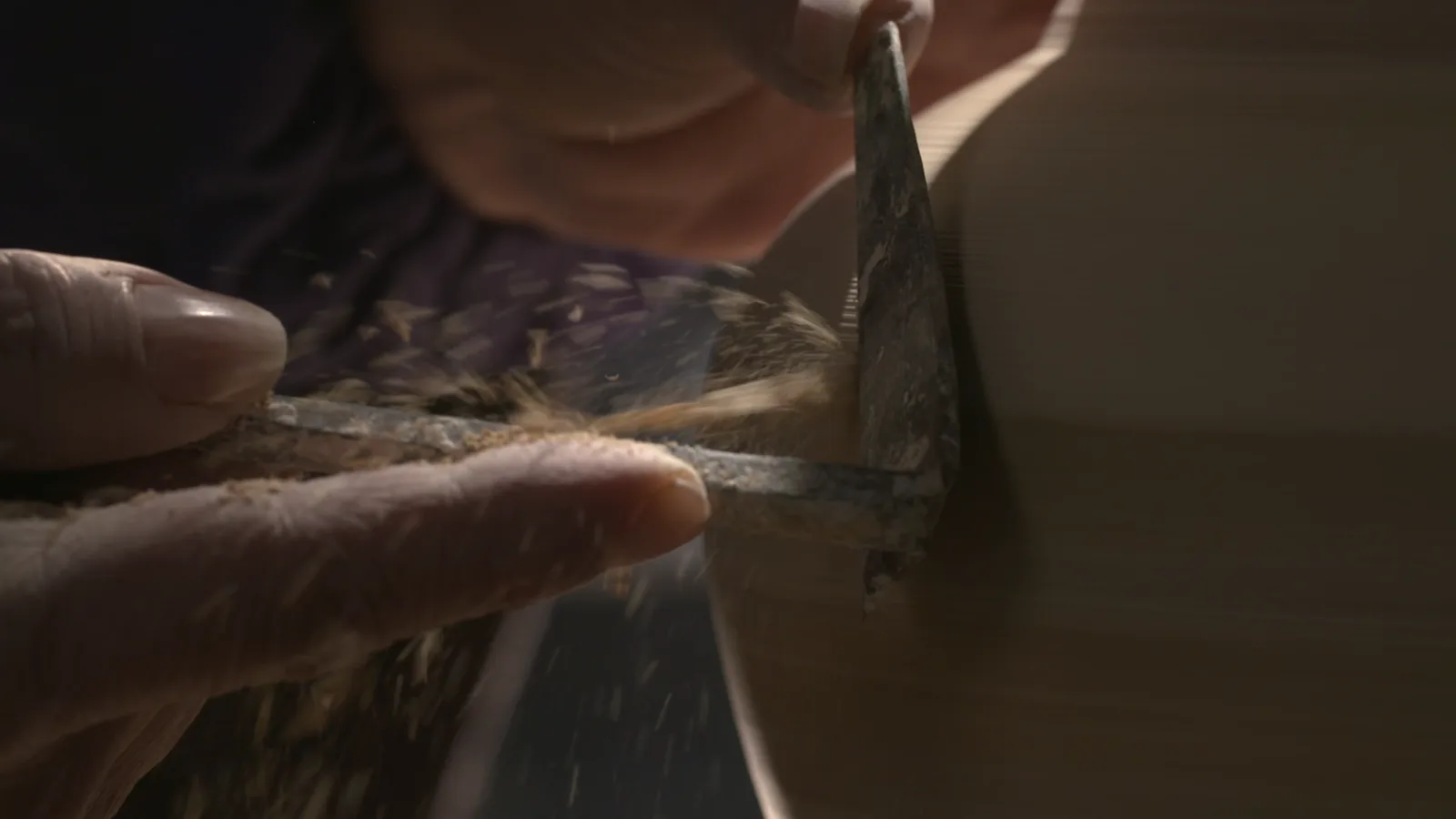
Refining the form changes weight and balance while leaving tool evidence on the underside.
The foot is not a decorative afterthought. It determines how the object meets the table, how it can be glazed and supported in the kiln, and how stable it feels in use. A heavy base can make a small cup feel dead. An over-thinned foot may fail during firing or handling.
Historic production often divided throwing and trimming between specialists. That division does not reduce authorship; it distributes it. The person correcting thickness may save the work of the person who formed the first body.
Look at the underside of finished porcelain and the production sequence starts reappearing: turning lines, glaze boundaries, support marks, exposed body and later wear.
Carving makes the surface structural
Decoration can begin before any pigment appears. At the leather-hard stage, makers may incise lines, carve away clay, impress patterns or add relief. The depth must anticipate glaze, which can soften a shallow cut or pool in a deeper channel.
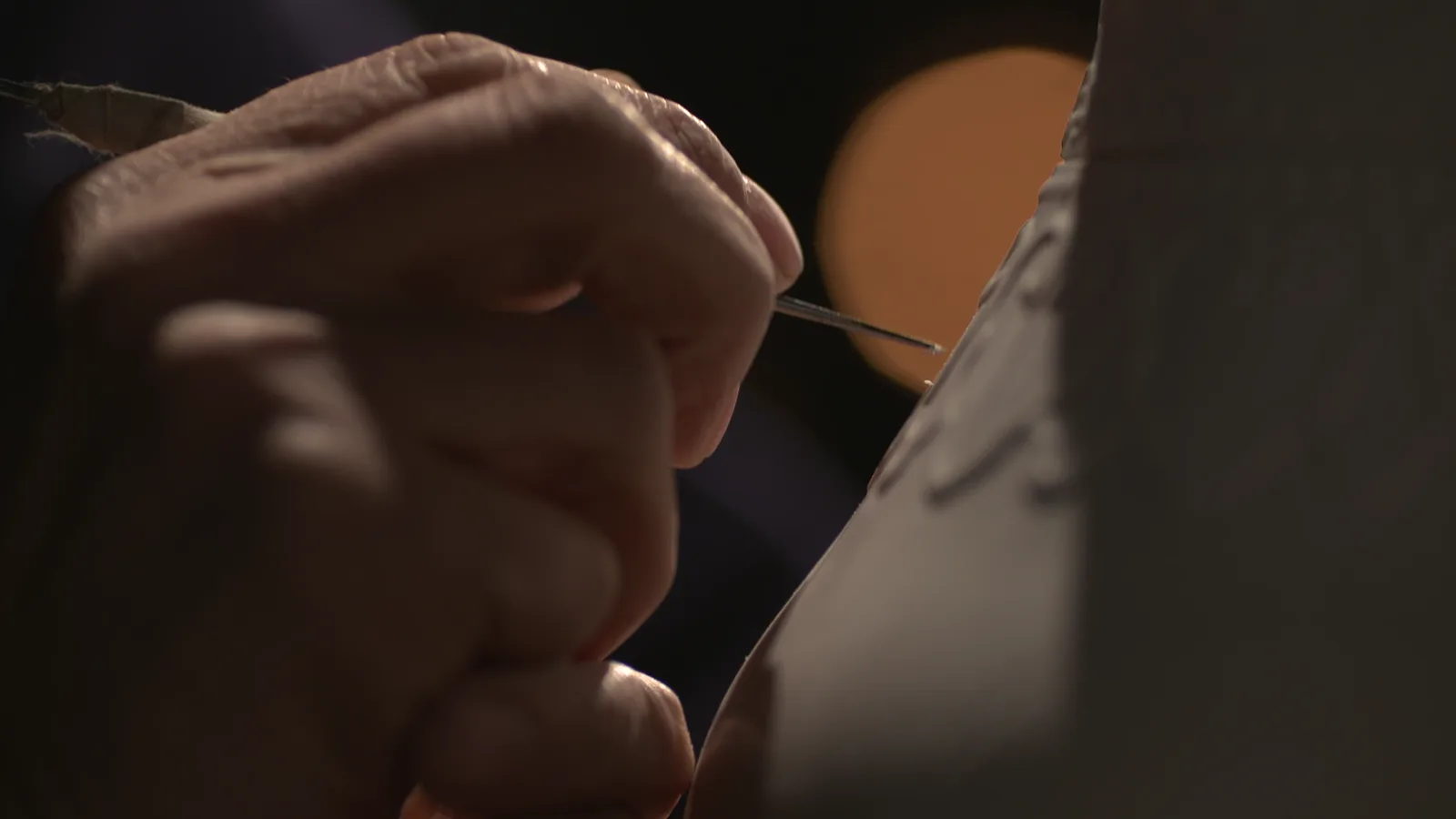
Carving changes the object itself; the pattern is not a flat layer sitting above the form.
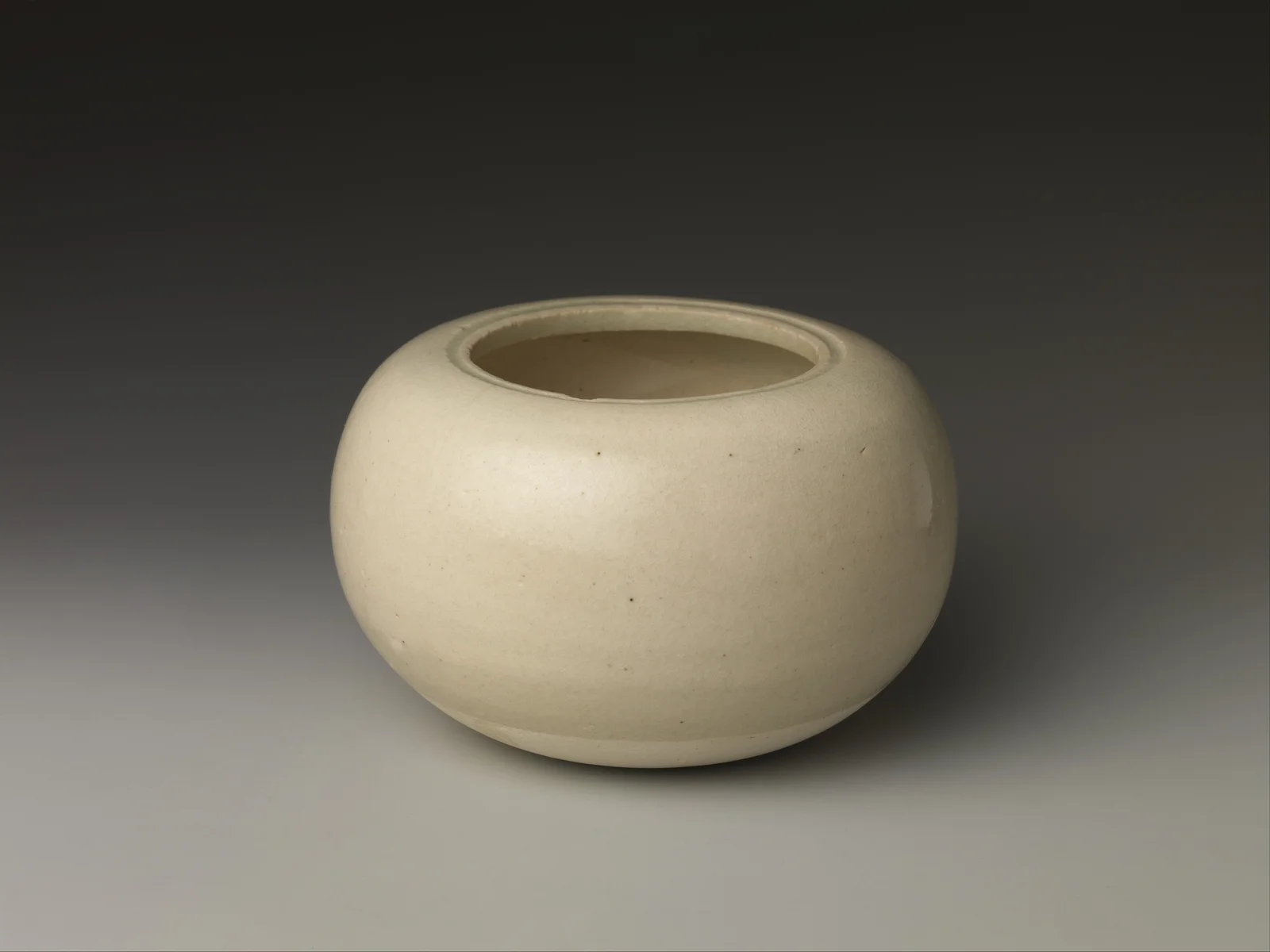
Ding ware is a powerful example. Carved, incised and molded decoration uses an ivory-white surface to make light do the work normally assigned to color. The design appears and disappears as the viewing angle changes.
Carving also reveals why sequence matters. Cut too early and the soft body drags. Cut too late and the clay resists or chips. Apply a glaze that is too opaque and the work disappears. The decorator is designing for an object that does not yet exist in its final material state.
Painting a curved surface requires prediction
Blue-and-white porcelain commonly uses cobalt-bearing decoration beneath a transparent glaze. Other traditions use iron, copper, slips, overglaze enamels and many additional systems. The order of painting, glazing and firing changes the result.
The dedicated Chinese blue-and-white porcelain guide follows what happens after that technical sentence: how a painter organizes borders, roundels, motifs and white space across a curved vessel, and why cobalt connected Jingdezhen to a global design market.
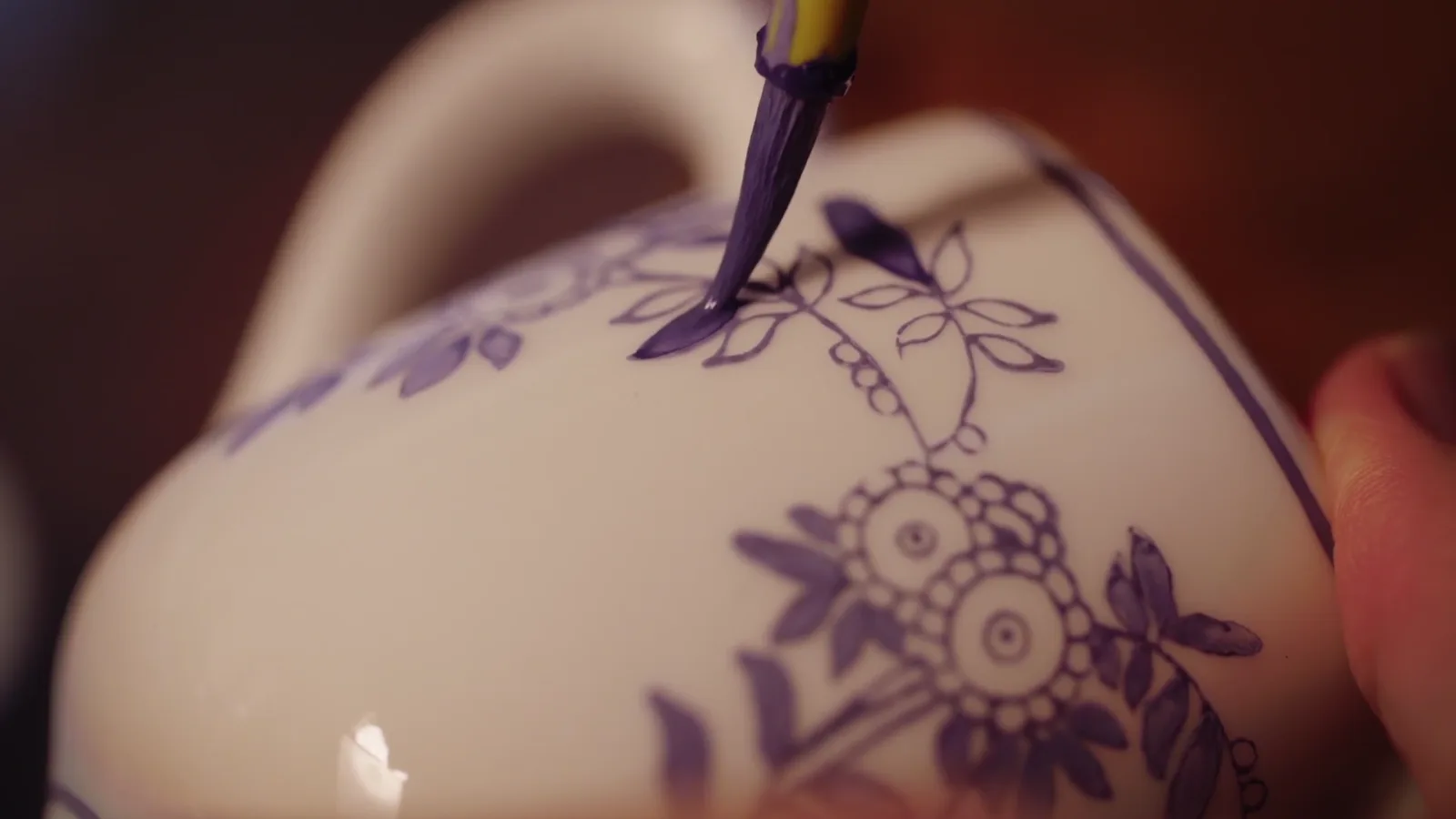
Look at the contact between brush and curved wall. The photograph shows controlled painting; the pigment recipe and firing sequence require the maker's explanation.
Painting a vase is not the same as painting paper. The surface curves away. A band has to meet itself. A flower must remain balanced when viewed from several angles. Absorbency changes how the brush releases liquid, and the color before firing may not resemble the final color.
Cobalt can bleed or soften beneath glaze. Brush loading changes tone. A fast line may remain energetic; a corrected line can become heavy. Repeated workshop motifs still carry tiny differences in pressure and timing.
Large production systems used templates, division marks, molds and specialist painters. That does not make every object mechanically identical. Standardization and hand variation often occupied the same vessel.
Glaze is a material layer, not transparent polish
Glaze is a formulated coating that melts during firing into a glassy surface. It can protect the body, change color, intensify decoration and create optical depth. It may be dipped, poured, sprayed, brushed or applied through other workshop methods depending on period and production system.
Thickness matters. Glaze can gather in carved lines, thin at rims, crawl away from contamination, trap bubbles or run downward under gravity. Its thermal expansion must also relate to the body. A mismatch can produce crackle—celebrated in Guan and Ge ware under some historical conditions, rejected as a defect in others.
The easiest place to read glaze thickness on a finished vessel is often a transition: the lip, a carved recess or the edge above an exposed foot. Look for where the coating thins, pools or stops. Do not confuse that observation with a diagnosis. A dark recess can involve pigment, shadow and glaze depth together; a photograph alone cannot separate the ingredients.
Kiln loading is a form of design
A kiln is not an empty hot room. Objects need supports, spacing and sometimes protective containers. Placement affects heat, airflow, ash exposure and atmosphere. One piece can influence the space around another.
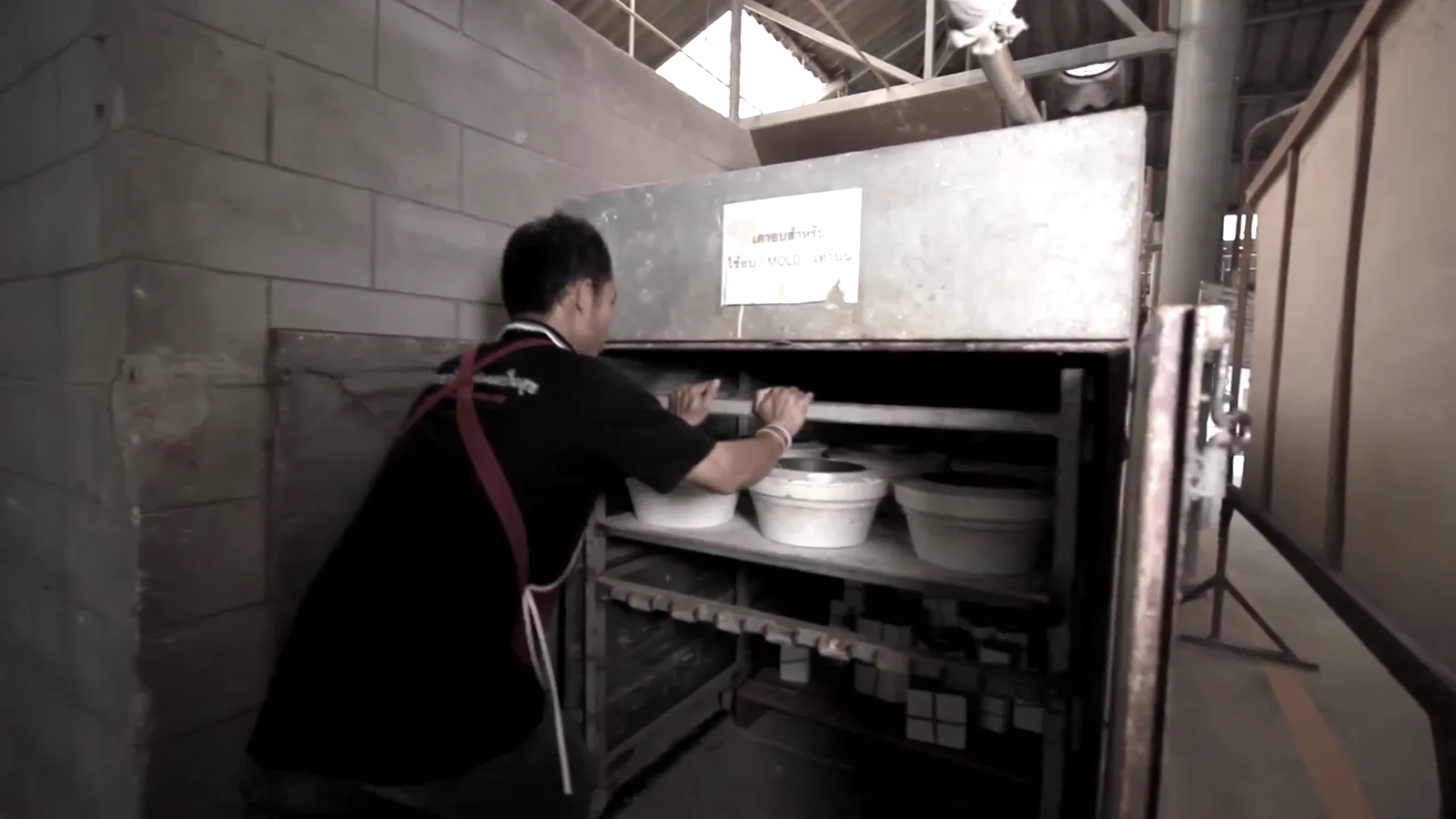
Kiln loading determines support, spacing and how each vessel meets the firing environment.
Historic makers used kiln furniture, rings, setters, spurs and saggars to stack wares and reduce contamination. Ding ware workshops fired some vessels upside down on their rims to increase capacity. Some Ru ware objects were supported on small spurs so glaze could cover most of the base.
Those traces remain visible after firing. What collectors call a “mark” may originally have been a solution to kiln logistics.
Loading also reveals production economics. More objects per firing can lower fuel cost, but dense stacking raises technical risk. Quality is partly the art of deciding how much efficiency the kiln can tolerate.
Fire vitrifies the body—and exposes every earlier shortcut
Porcelain is fired at high temperature, often broadly around 1,200–1,400°C depending on body, glaze, kiln and desired result. Heat drives chemical and structural changes. The body densifies and vitrifies; glaze melts and bonds to the surface.
Temperature is only one variable. Heating rate, peak time, atmosphere, fuel or energy source, kiln design and cooling all matter. Reduction and oxidation can change color-producing elements. A glaze may become clear, cloudy, red, green, blue or unexpectedly dull depending on the full firing history.
Jun ware makes this especially visible. Its opalescent blue is not simply blue paint. Glaze structure, tiny bubbles, phase separation, thickness and light scattering work together, while copper-bearing areas can develop purple-red effects under suitable conditions.
The kiln does not forgive weak preparation. Uneven walls can slump. A poorly joined handle can separate. Trapped moisture can create failure. A glaze can fuse the vessel to its support. Fire is transformative, but it is not generous.
Cooling and sorting are part of making
The kiln must cool before unloading. Opening too early risks thermal shock and damaged ware. When objects finally emerge, workers inspect form, glaze, color, decoration and soundness.
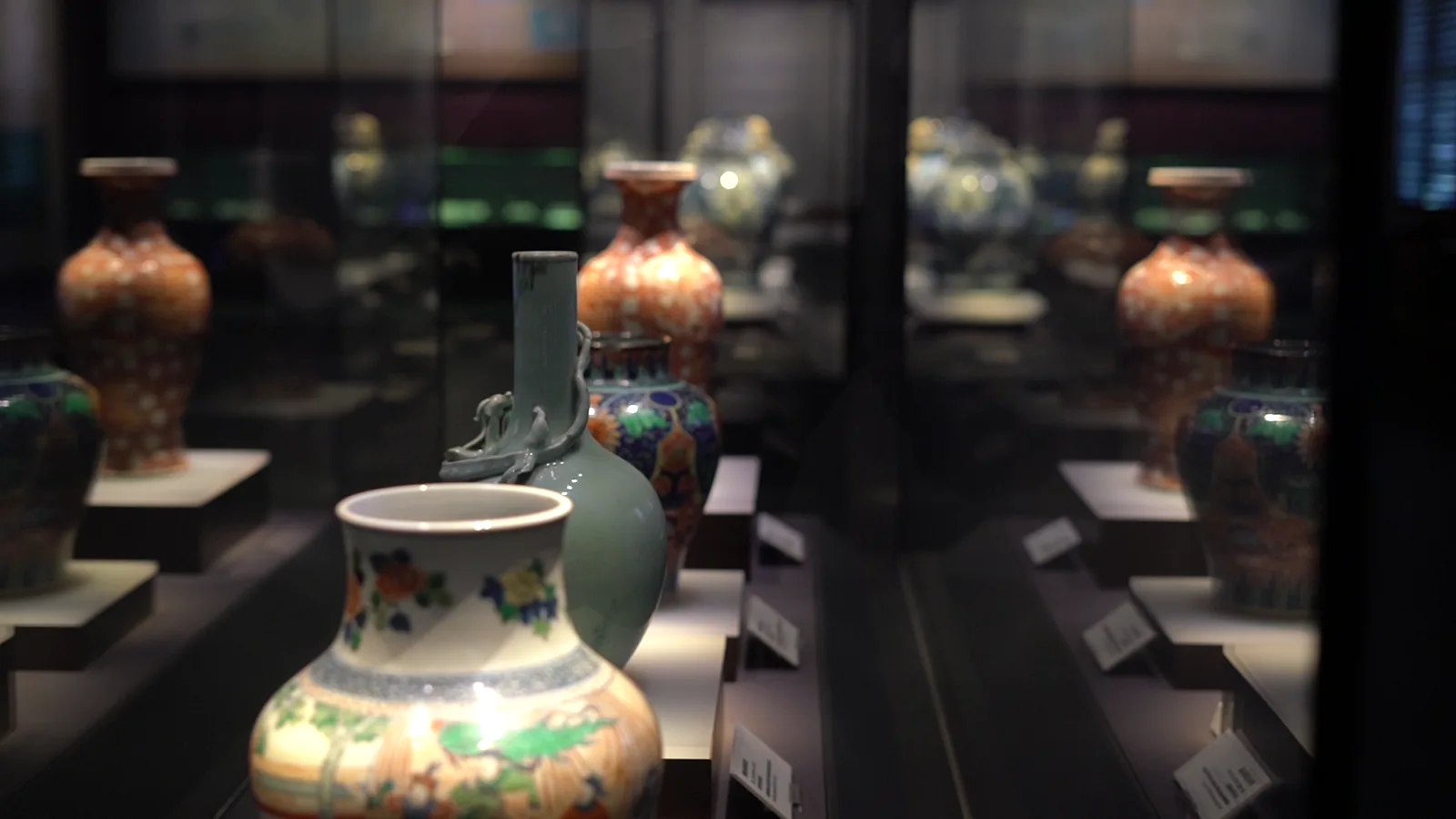
Museum display shows the survivors. Kiln waste and rejected pieces reveal the production risks hidden behind them.
Not every fired object becomes a masterpiece. Pieces may be graded for different markets, repaired, sold as seconds, reused as workshop reference or discarded. Archaeological kiln waste is valuable precisely because it preserves failures, tests and ordinary output that collectors did not protect.
A museum case edits out the rejection rate. The smooth row of finished vases can make production look inevitable. It was never inevitable.
Jingdezhen turned a city into a production instrument
The Jingdezhen porcelain city guide follows the workshops, suppliers and shared services behind that famous place name. UNESCO's record for the Jingdezhen Handicraft Porcelain Industry Sites recognizes the connected mining, making and transport infrastructure. Here the important consequence is practical: the person who changes a body at one stage changes what the next specialist receives.
One worker might prepare clay, another throw, another trim, another draw outlines, another fill color, and another manage the kiln. The finished object compresses this network into one surface so effectively that modern viewers often imagine a lone artist completing every stage.
Division of labor supported consistency and scale, but it also made ceramic knowledge social. Skill lived between workshops and generations. A production center was not just a place with kilns; it was a memory system made of people. The Metropolitan Museum's Chinese ceramics chronology helps place changing bodies, glazes and kiln traditions in time; it also makes clear why “Chinese porcelain” cannot be reduced to one permanent recipe.
That history feels unexpectedly contemporary. Material supply, modular production, quality control, visual branding and global logistics were already connected. The technology changed. The systems problem did not.
Modern porcelain making changes the tools, not the material stakes
Contemporary porcelain may be slip-cast in molds, pressure-cast, machine-formed, digitally decorated or fired in precisely controlled electric and gas kilns. Studio makers may use 3D printing or computer-guided mold production alongside wheel work and hand finishing.
Automation can improve repeatability, but porcelain still shrinks, warps, cracks and reacts. A digital model must anticipate physical transformation. A temperature program cannot compensate for the wrong body or an unstable form.
This is why “handmade versus machine-made” is too blunt. I reject that binary because it flatters the buyer while hiding the actual work. The better questions are: which decisions were automated, where did skilled judgment remain, what level of variation was intended, and what does the object claim to be?
What a process video usually hides
The most shareable ceramic footage shows wet clay rising, cobalt flowers appearing and a kiln door opening. The least visible work often carries the most risk.
My test is severe: if the camera never shows a foot, a drying rack, kiln supports or a rejected piece, it has not explained the process. It has advertised the surface. I insist on seeing failure because a collapsed wall or a fused foot teaches more about porcelain than another flawless vase rotating under soft light.
Watch for what has been cut out:
- raw material testing and purification;
- failed centering and collapsed forms;
- hours or days of controlled drying;
- glaze formulation and test tiles;
- kiln monitoring and cooling time;
- rejects, seconds and quality grading;
- cleaning, packing and transport;
- the number of different workers behind one object.
Follow one piece across the cuts. Does the vessel keep the same foot, handle and decoration, or has the edit silently switched to another object? A sequence assembled from different pieces can explain separate techniques, but it cannot establish the complete making history of the finished vase. That distinction matters more than the video's length.
How the process helps you look at finished porcelain
Start with the silhouette: forming and trimming created it. Look at wall thickness and balance. A very regular form may come from a mold, a wheel, mechanical assistance or a highly practiced hand; regularity alone does not identify the method.
Move to the foot. It may reveal body color, trimming lines, glaze boundaries and firing support. Then inspect decoration. Hand-painted lines change with speed and pressure, but historical workshops also used repeatable systems and modern makers still paint by hand.
Study glaze where it pools or thins. Notice bubbles, pinholes, crackle, runs and color shifts. These may be accepted characteristics, later damage or production flaws depending on the ware.
Finally, remember sorting. The object in front of you is a selected result. Its apparent perfection may represent the best of a much larger batch.
For age, attribution or value, process clues need provenance, archaeological comparison and technical examination. A ring when tapped, a reign mark or a “handmade irregularity” is never enough by itself. The broader Chinese porcelain guide explains those authentication boundaries.
Porcelain becomes complete in use
Production does not end culturally when the kiln cools. A cup has to meet a hand. A bowl changes how food or tea looks, cools and moves.
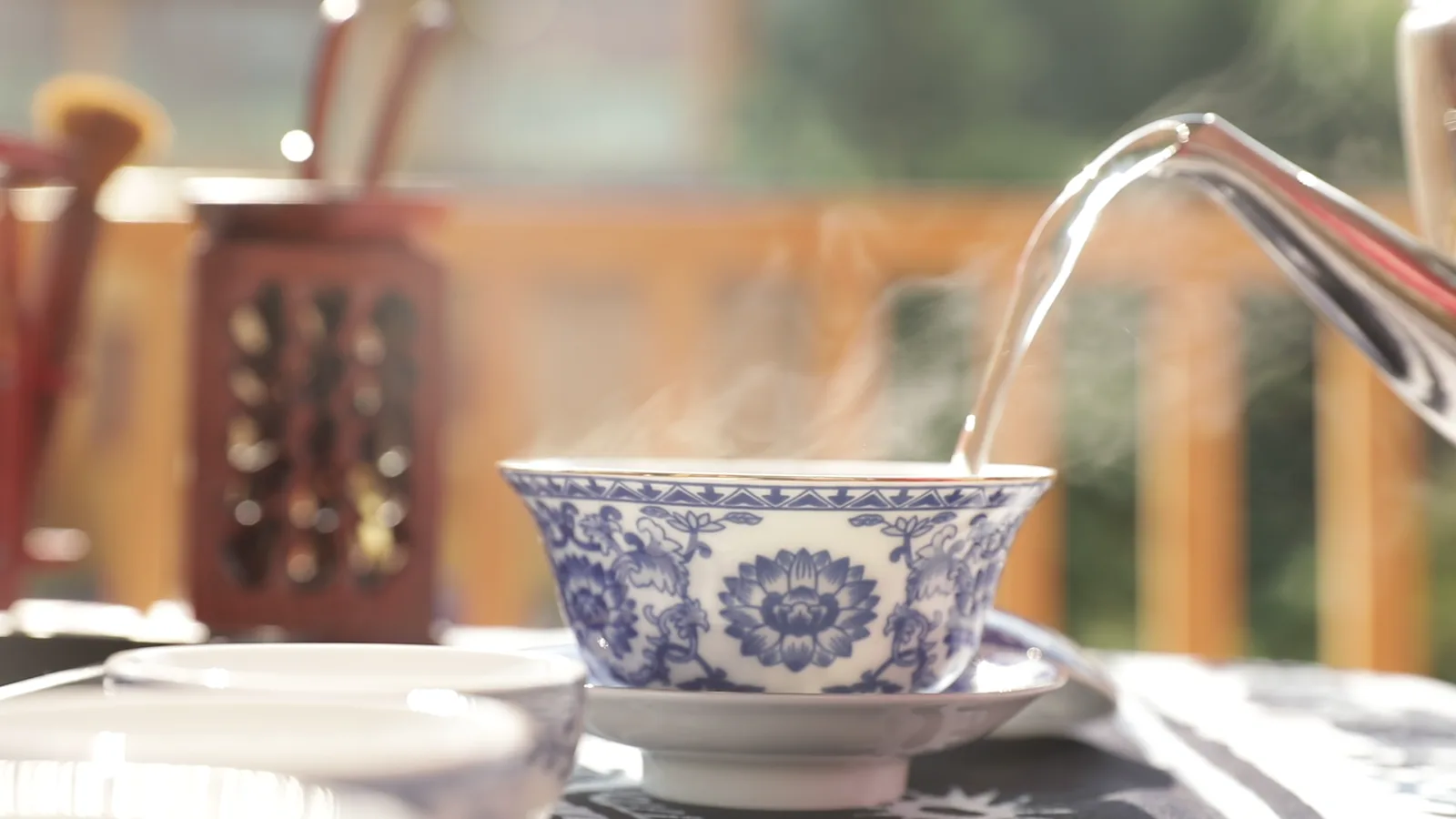
The production system ends at the table, where weight, rim, glaze and balance become physical experience.
A thin pale bowl makes tea color visible. A smooth glaze changes how the lip meets the rim. A well-cut foot stabilizes the object. Decoration rotates as the user turns it.
The Chinese tea set guide follows that relationship between vessel and use. Porcelain was never made only to sit under museum light.
The shine is the last frame, not the whole story
Finished porcelain can look untouched by effort. That is the trick. Mineral extraction, water, pressure, drying time, tool marks, brush rhythm, glaze chemistry, kiln placement and sorting disappear into a surface that seems calm.
Look longer and the chain returns. A slight turn in the wall remembers the wheel. A pooled blue line remembers the brush and glaze. A support mark remembers the kiln. A comfortable rim remembers somebody testing the relationship between material and mouth.
That is how Chinese porcelain is made: not through one magical recipe, but through coordinated decisions that survive fire together.
Continue with Chinese ceramics for the wider material field, Chinese porcelain for the material and historical overview, and Chinese export porcelain to see how an overseas table changed the form a workshop had to build.
Then take one object to Moments: photograph its underside, describe a trimming line, glaze edge or support trace, and put your proposed explanation beside the observation. If the maker answers, add that reply in your own words and say what you learned. The satisfying part is returning to the same cup and noticing something you missed—not winning a diagnosis from a photograph.