A Chinese tea set is complete when its volumes work together and every vessel has a necessary job. For most beginners, that means one brewing vessel and one comfortable cup; add a fairness pitcher when you serve several cups or need to stop extraction cleanly. Measure working capacity and test the pour before buying anything else.
I have no patience for a “complete” set that hides bad proportions behind twelve matching pieces. I test the brewer full of hot water, I watch where the lid sends the stream, and I keep only the object that solves a real service problem. The best tea set is usually smaller than the sales photograph. Every vessel must earn the space it occupies on the table.
The minimum useful Chinese tea set

The strongest beginner demand we found was not for elaborate matching ware. It was for a short answer to a practical question: what are the fewest pieces that still make good tea? That is the right question because a large boxed set can conceal a poor central vessel.
| Situation | Minimum setup | Add only when needed |
|---|---|---|
| One person | Gaiwan or small glazed pot + one cup | Pitcher if direct pouring is awkward or you want to stop extraction before drinking |
| Two to four people | Brewing vessel + pitcher + one cup per person | Tray if spills or rinse water cannot be managed on the table |
| Family-style service | Glazed pot + comfortable cups | Pitcher when the pot cannot divide one infusion evenly |
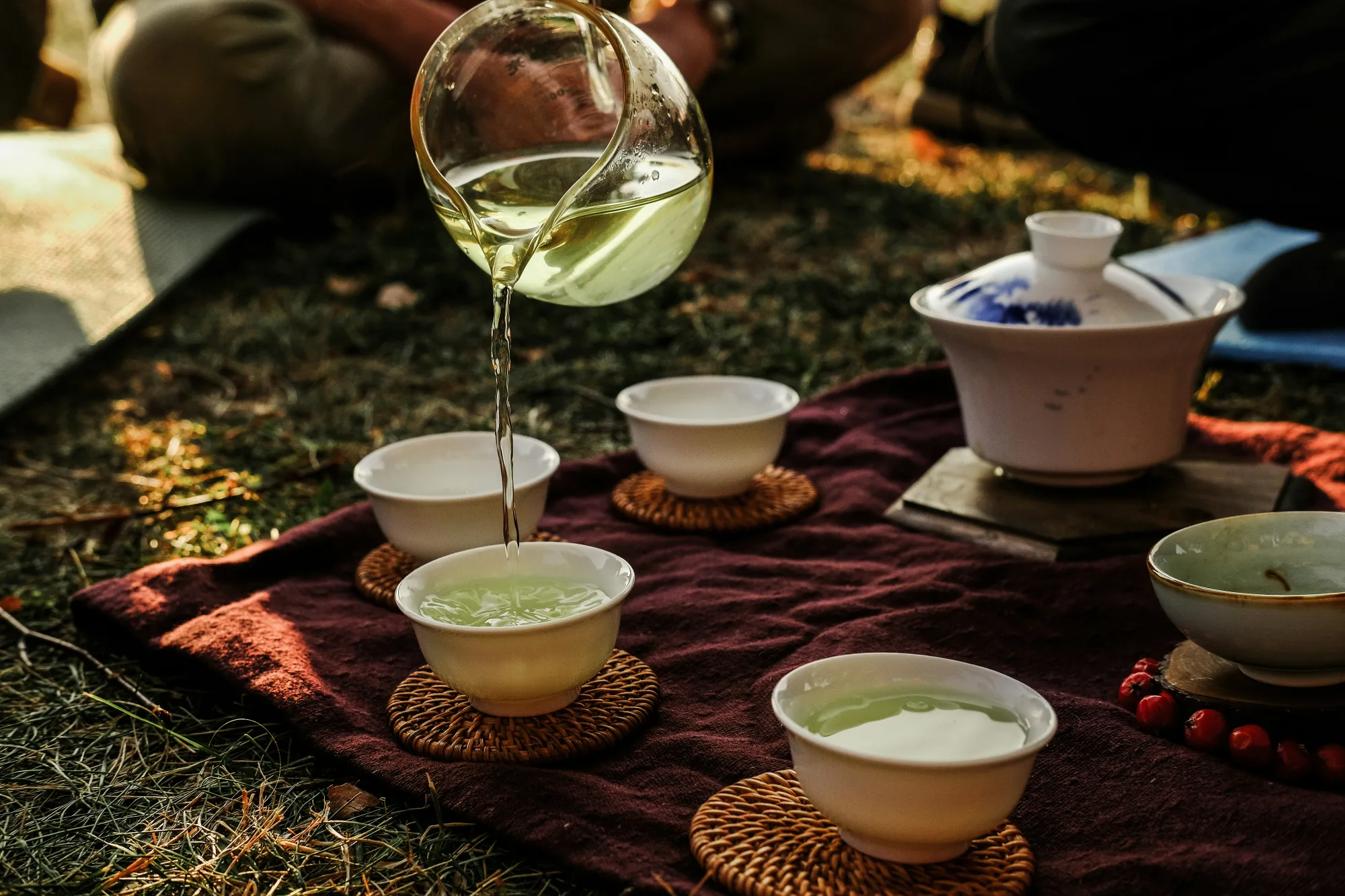
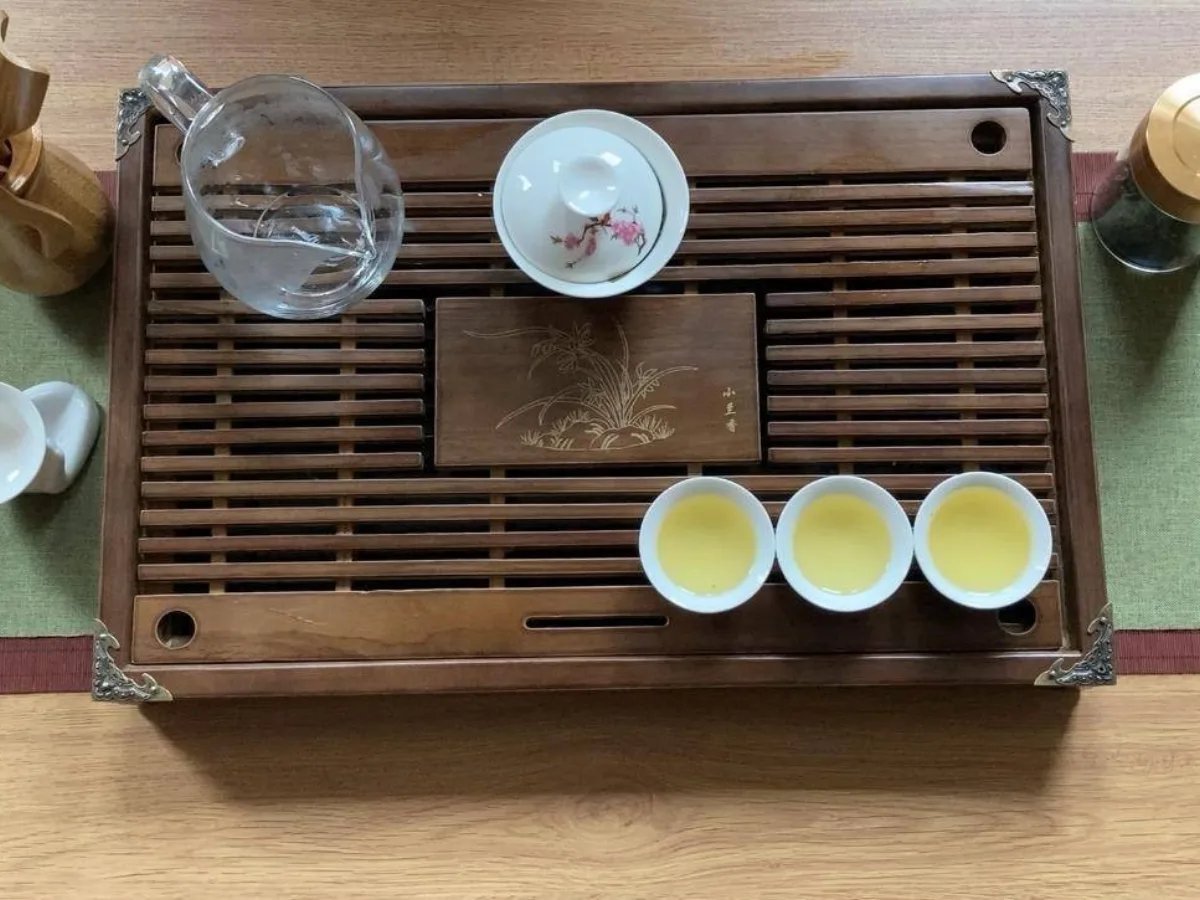
This real setup makes the division of jobs visible: the gaiwan brews, the pitcher stops extraction and the cups receive one shared infusion. It does not prove that every table needs this many cups or that the photographed tea requires this equipment.
The kettle and a way to discard spent leaf are part of the working environment, but they are not reasons to buy a ceremonial box. A scoop, tongs, brush, display stand or tea pet may be useful later. None is a prerequisite for learning what your tea tastes like.
A complete set is a capacity system
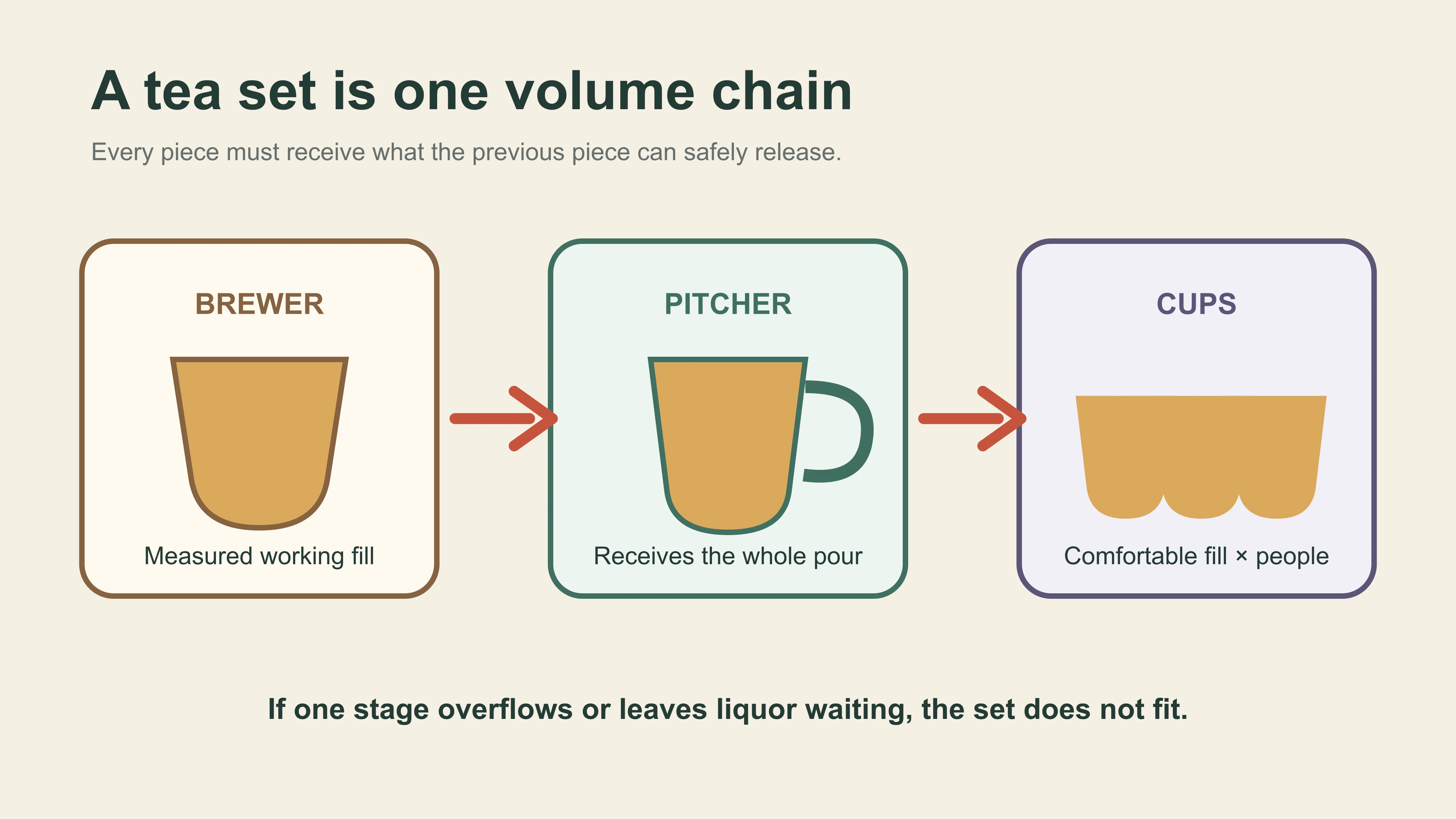
The pieces should be sized as a chain:
brewing-vessel working capacity -> pitcher working capacity -> planned volume across the cups
Working capacity means the amount you can brew and pour safely, not the number obtained by filling a vessel to the brim. Leaves occupy space; some liquor remains among them; and a safe fill line leaves room below the rim or lid.
Our reviewed measurement record contains two real gaiwan samples. Water was added to a tared setup, so the displayed water mass can be treated as an approximate household volume comparison.
| Tested sample | Displayed water mass | Practical reading | What it proves |
|---|---|---|---|
| White porcelain sample | 111.3 g | about 111 ml | This specific vessel holds roughly 111 ml at the demonstrated fill |
| Smaller sample | 79.4 g | about 79 ml | This specific vessel holds roughly 79 ml at the demonstrated fill |
These are two samples, not universal specifications. They do show why visual labels such as “small” and “standard” are inadequate. A difference of about 32 ml is large enough to change leaf use, cup count and handling.
Measure your own vessel in three minutes
- Put the empty, dry vessel on a digital scale and tare it.
- Add cool water only to the line you would actually use for brewing.
- Read the added mass in grams as an approximate volume in milliliters for this household comparison.
- Pour that water into the intended pitcher, then divide it among the cups.
- Reject the combination if the pitcher is near overflowing or the cups cannot receive the planned serving without being filled uncomfortably high.
For example, a measured 111 ml brewing vessel can pair with a pitcher whose comfortable working capacity is at least that amount. Three intended 30 ml servings require 90 ml across the cups, leaving some system headroom. Do not assume the finished yield will equal 111 ml exactly: leaf displacement and retained liquid reduce it.
The smaller 79 ml sample can suit one drinker or a low-volume comparison session. The larger sample provides more flexibility for several small cups. Hand size and safe grip still matter; capacity alone does not choose the vessel.
Test pour speed instead of believing the product page
Pour speed affects extraction because the leaves continue contacting liquor while the vessel empties. But a universal “good pot empties in X seconds” rule is unreliable: volume, spout, leaf shape, lid gap and pour angle all change the result.
Use a controlled comparison instead:
- Fill each candidate with the same measured volume of cool water.
- Start a phone timer when the vessel begins to tilt.
- Stop when the continuous stream ends, not when the final isolated drip falls.
- Repeat three times and compare the median result.
- Record drips, lid movement, hand strain and water left inside, not just seconds.
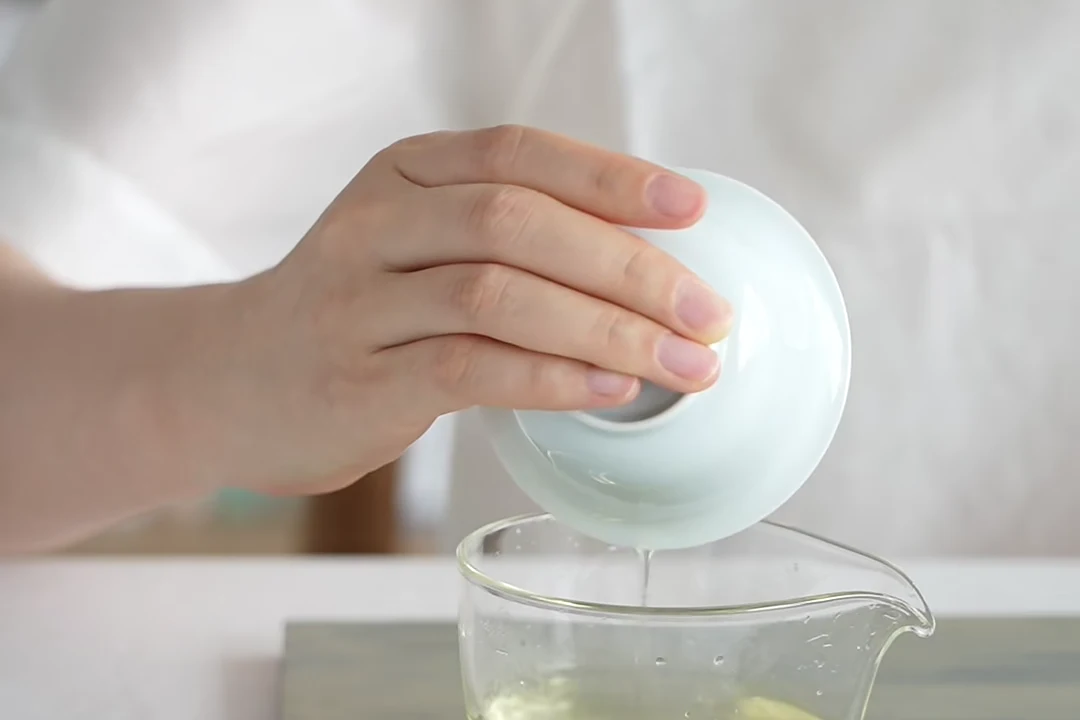
The hero visibly documents a complete gaiwan-to-pitcher decant. We do not publish a pour-time number from that record because its fill volume was not measured and it was not a repeated stopwatch test.
The faster vessel is not automatically better. It is better only when you can control it. Reject a candidate if the lid threatens to fall, the handle twists the wrist, the stream runs down the body, the spout retains a large amount or your fingers must enter a hot zone.
Every piece must earn its place
| Piece | Necessary job | Keep it when | Remove it when |
|---|---|---|---|
| Gaiwan or teapot | Controls leaf-water contact and releases the infusion | You can fill, hold and empty it safely | Its size, lid, handle or pour defeats control |
| Fairness pitcher, gongdao bei | Stops extraction and combines one infusion before division | Several cups need equal liquor or the vessel should empty fully at once | One person drinks directly and no liquor waits on the leaves |
| Cups | Define serving size and drinking comfort | Rim, volume and heat suit the drinker | Matching appearance is their only advantage |
| Tray | Organizes movement or captures water | Your method produces drips or rinse water | It adds bulk without solving a mess |
| Tongs and scoop | Keep fingers away from hot or shared surfaces | Grip, hygiene or narrow openings require them | Hands can perform the task safely and cleanly |
Cup volume is not an afterthought. A pitcher sized for 100 ml and four tiny cups may work; the same pitcher and one small cup may force liquor to wait and continue cooling. Test the whole chain, not each object in isolation. The Chinese tea cups guide explains rim, wall and serving-volume choices in more detail.
Run the redundancy test before buying more
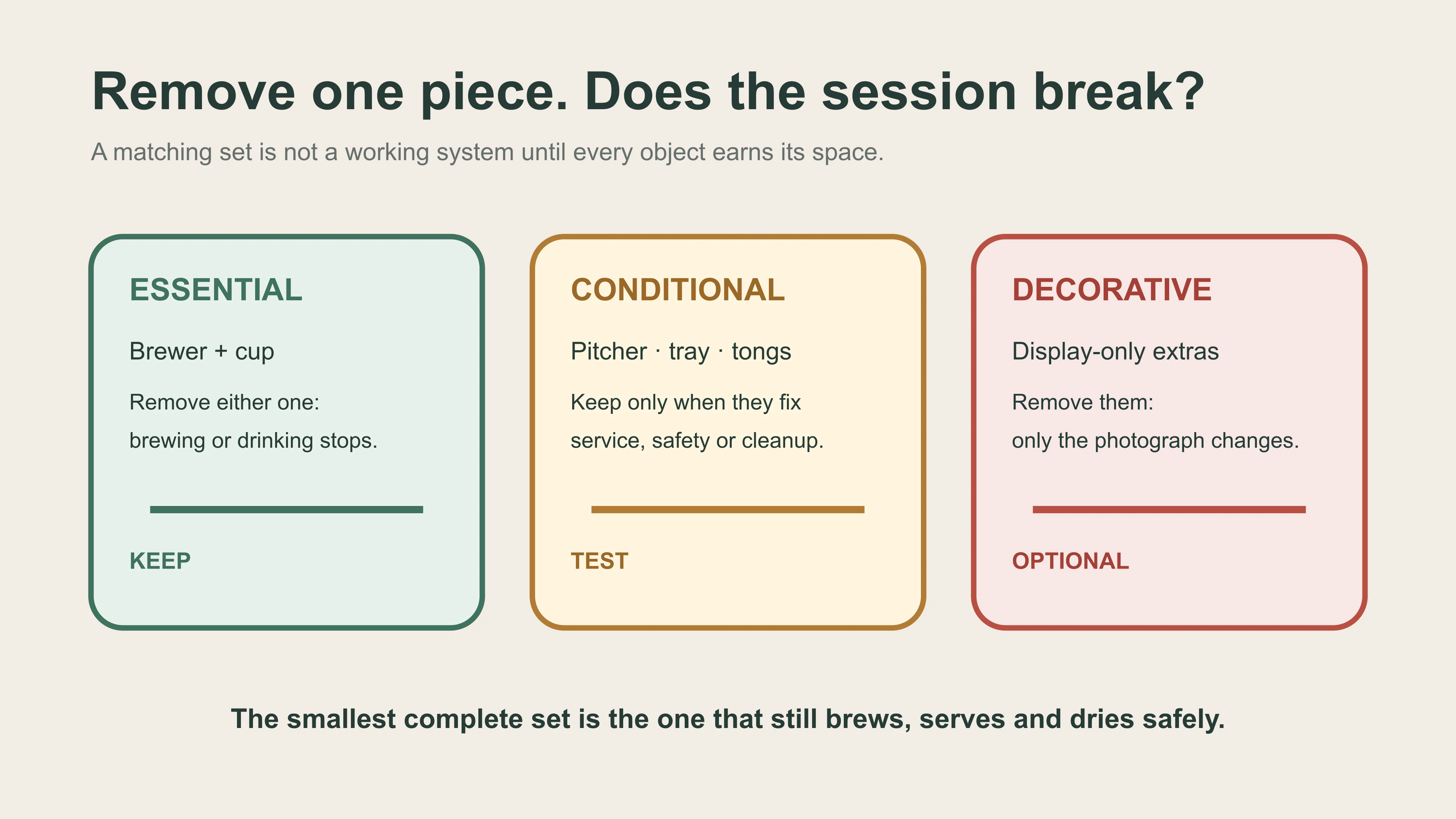
Set up one full session, then remove one object at a time.
- Remove the pitcher. Can you still stop extraction and divide liquor fairly?
- Remove the tray. Can a cloth or dry-pour method manage the table safely?
- Remove the tongs. Can hot cups be handled without touching drinking rims?
- Remove the scoop. Can leaf enter the vessel without waste or hand contact that matters to you?
- Remove decorative pieces. Does brewing, serving or cleanup become worse?
If removing an item changes only the photograph, it is optional. If removing it breaks safety, even serving, controlled extraction or practical cleanup, it has earned a place.
This is also the best way to assess a traditional Chinese tea set sold as “complete.” Complete for what practice, how many drinkers and what table? The word is meaningless until the seller answers those questions.
The full setup-to-storage sequence
The set should work through the whole session, not only at the moment tea is poured.
| Stage | Action | Failure to watch for |
|---|---|---|
| 1. Set up | Put the kettle outside guest reach; place vessel, pitcher and cups in one unobstructed movement path | Cord, flame or hot body crosses reaching hands |
| 2. Measure | Confirm the working fill and that the pitcher can receive it | Brim capacity is mistaken for safe brewing capacity |
| 3. Rehearse | Fill with cool water; lift, decant and serve once | Lid slips, grip pinches, stream dribbles or cups overfill |
| 4. Brew | Add leaf and water using a repeatable starting ratio | Too much leaf expands into the lid or blocks the outlet |
| 5. Decant | Empty the brewing vessel completely when the infusion is ready | Liquor remains on the leaf and continues extracting |
| 6. Serve | Divide from the pitcher or pot at a comfortable cup level | First and last cups differ greatly or guests cannot hold them |
| 7. Clear leaf | Let the vessel cool; remove spent leaf without forcing tools into a fragile spout | Hot surfaces, scratched glaze or compacted leaf remains |
| 8. Rinse and dry | Rinse appropriate surfaces, drain them open and allow every part to dry fully | Detergent aroma in porous clay or a closed damp pot |
| 9. Store | Keep lids ventilated and prevent hard surfaces from striking in a drawer or case | Trapped moisture, odor or rim-to-rim impact |
Storage is part of design. A lid that fits perfectly during use can chip when packed tightly against the bowl. A large tray may organize a permanent tea table but fail in a small kitchen. The travel tea set guide applies the same test to packed dimensions, breakage and wet storage.
Gaiwan or teapot: choose by failure mode
| Vessel | Choose it when | Test before buying | Main failure mode |
|---|---|---|---|
| Porcelain gaiwan | You compare many teas and want to inspect leaf and liquor | Working capacity, rim flare, lid clearance and cool-water pour | Hot fingers, unstable lid or hesitant decant |
| Glazed teapot | A handle makes daily or family service easier | Filled balance, handle clearance, stream and complete emptying | Slow pour, wrist torque or lid movement |
| Unglazed clay pot | You already know the tea and accept specialized care | Provenance evidence, odor, interior, pour and condition | Marketing claims replace functional proof |
| Glass vessel | Visibility matters for green tea or flower infusions | Thermal comfort, handle, fragility and cleaning | Heat loss, breakage or uncomfortable grip |
Porcelain is the clearest first purchase because it is relatively neutral and easy to inspect. If a gaiwan feels unsafe after a cool-water rehearsal, a simple glazed teapot is the better beginner vessel. There is no prize for forcing your hand to suit an object.
The detailed gaiwan guide compares measured capacity, shape and grip. The Chinese teapots guide covers lid, spout and handle decisions.
Material matters after fit and volume
Porcelain and glazed stoneware are usually the simplest multi-tea choices because the interior is easy to inspect and clean. A pale interior also makes liquor and residue visible. Glass reveals leaf movement but can lose heat quickly and requires careful handling.
If porcelain is already your material choice, continue with the dedicated porcelain tea set guide. It checks the brewer, pitcher and cups as one capacity system, then separates visible glaze beauty from pour performance and food-use evidence.
Unglazed clay deserves more caution, not more mystique. Material, firing, form, use and condition all affect the experience. “Purple clay,” “seasoned” or “improves flavor” is not enough evidence to identify origin, age or performance. Learn with a neutral vessel before buying a pot that asks for a specialized routine. When a seller claims Yixing origin or automatic flavor improvement, use the measured Yixing teapot guide to check working capacity, pour time, retained liquor, lid fit and the evidence behind the clay name.
No material rescues poor geometry. A prestigious clay pot that drips, twists the wrist or traps liquor is a poor tool for that user.
Historical Chinese tea sets were not fixed packages
Museum objects make the variation visible. The Metropolitan Museum of Art holds an 11th–12th-century Jian ware tea bowl and a peach-shaped porcelain wine pot or tea pot dated to around 1644–83. They differ in period, material, form and likely practice. Neither establishes one timeless checklist for a modern set.
UNESCO's record of traditional tea processing techniques and associated social practices in China reinforces the same boundary: tea practice is carried by regional skills and social situations, not by one universal boxed inventory.
Modern matching sets are not therefore false. They are contemporary products shaped partly by manufacturing, photography, packaging and retail. The responsible question is not “Does it look traditional?” but “Which place, period or practice does this claim describe, and what evidence supports it?”
Reject claims that cannot survive five questions
| Seller claim | Ask for |
|---|---|
| “Complete traditional set” | Intended brewing method, number of drinkers and working volumes |
| “Authentic Yixing” | Maker, place, claimed material and accompanying evidence |
| “Handmade” | Which stages were formed or finished by hand and whether process records exist |
| “Antique” or “vintage Chinese tea set” | Measurements, condition, documented ownership and specialist assessment |
| “Seasoned for one tea” | Use history, cleaning, storage, odor, residue and damage |
A reign mark or aged surface does not establish date. Old glaze, cracks and repairs also raise use questions that appearance cannot answer. An uncertain antique can remain an object of study rather than a vessel for hot liquid.
Final buying rule
Buy in this order: brewing vessel, cup, pitcher if the service requires it, then only the pieces that solve a recorded problem.
Before paying, verify five things:
- The working capacity suits the real number of drinkers.
- The pitcher and cups can receive that volume without operating at their brims.
- Three cool-water pours are repeatable, controlled and comfortable.
- Every included object has a job in setup, brewing, serving or cleanup.
- Materials, age and origin are described with evidence rather than prestige words.
A good Chinese tea set becomes quiet during use. The leaf, the people and the conversation remain visible because the equipment no longer asks to be managed.
Continue through the Chinese teaware topic center, compare tea vessels and sets or return to Chinese tea culture.