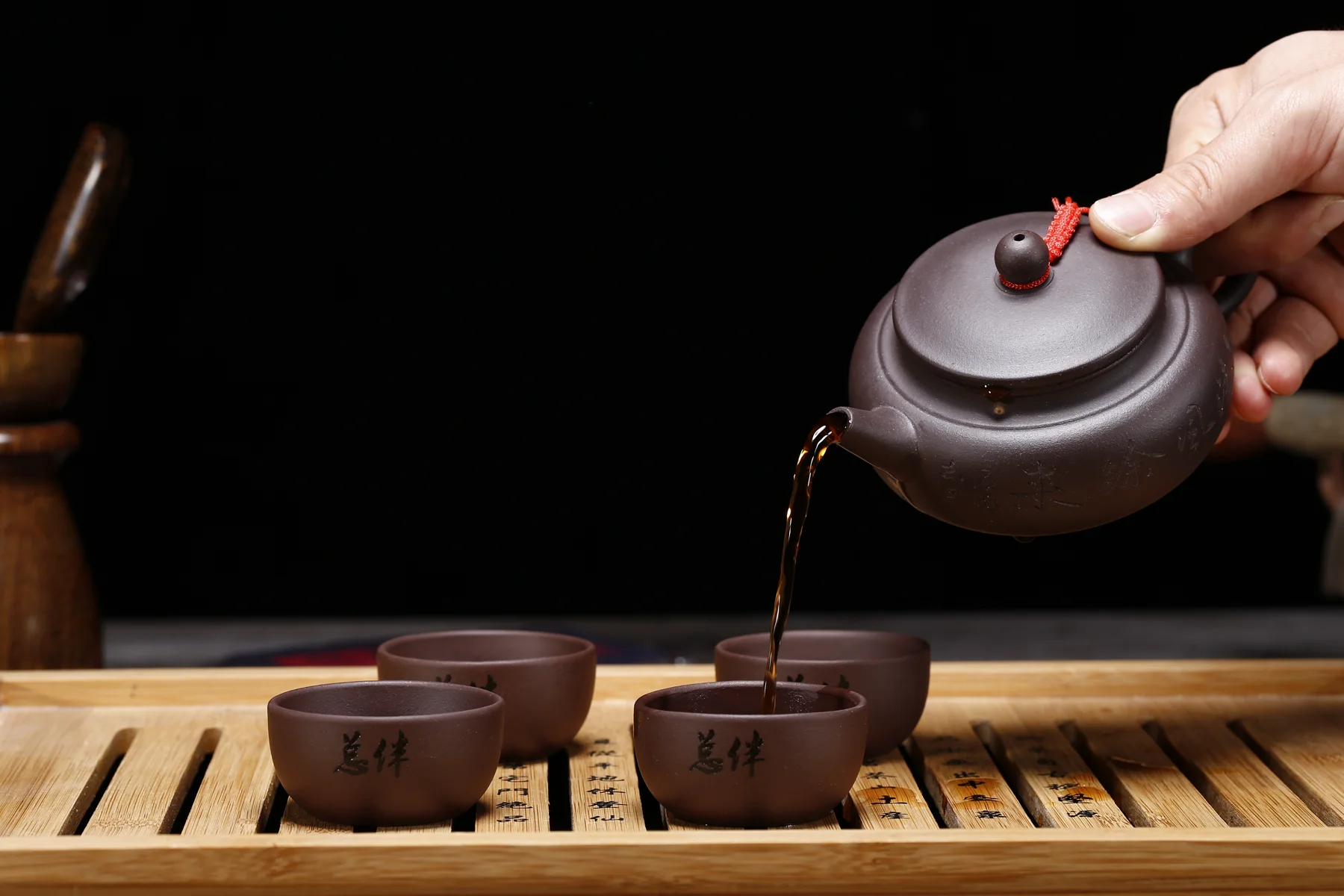
For a first Chinese teapot, buy the smallest neutral glazed pot that fills the cups used in one round, empties completely and remains controllable when full. Calculate capacity from your cups, then test the actual pot three times. Material prestige, decorative form and clay stories come only after working volume, pour consistency, retained liquor, grip and clean drying.
That conclusion rejects two common mistakes: choosing capacity from a one-person/two-person slogan, and buying an unglazed clay pot before knowing what problem it is meant to solve. A plain porcelain or glazed stoneware pot that passes the tests below is a better first purchase than an expensive pot with an untestable story.
First decide whether you need a Chinese teapot
A Chinese teapot is a vessel in which leaf and water infuse before the liquor is poured out. It is not the kettle used to boil water. Product pages often mix the two because both may be called a tea pot in casual English.
Choose by the interruption you need to control:
The tea-vessels collection compares the broader choices. This page begins only after a handled pot has a real job that a gaiwan, glass or basket infuser does not do better.
| Vessel | Best reason to choose it | Main limitation |
|---|---|---|
| Handled teapot | Stable one-handed serving rhythm; lid stays on the vessel | Interior and leaf may be harder to inspect or clean |
| Porcelain gaiwan | Fast decanting, visible leaf and easy comparison across teas | Hot rim or poor grip can punish bad technique |
| Basket infuser | Work may interrupt the session; basket can leave the water completely | Less suited to repeated small-cup service |
| Glass brewing pot | Liquor and leaf need to remain visible | Fragility and heat loss vary with construction |
Do not buy a teapot merely because it appears to be the advanced stage of tea drinking. If a gaiwan already gives you faster, cleaner control, the pot must earn its place through a better serving rhythm.
I reject the idea that owning a clay pot graduates someone into “serious” Chinese tea. That hierarchy sells identity before it solves brewing. I insist on the opposite order: the vessel must first fit the cups, empty on time, stay steady in the hand and dry without hidden residue. If a plain glazed pot does those jobs while a prestigious pot fights the wrist and traps liquor, the plain pot is the better Chinese teapot. Beauty can deepen use; it cannot excuse bad use.
Calculate working capacity from the cups
Ignore the seller's person-count first. Measure one cup to the level you actually serve, multiply by the number of cups filled in one round, then add only a small allowance for transfer loss.
target working volume = actual cup fill x cups per round x 1.05 to 1.10
If two cups each hold 45 ml at their normal serving line, the round needs 90 ml. With a 10% allowance, the target is about 99 ml. A pot with a measured working volume around 100-120 ml is therefore more rational than choosing a 180 ml pot because a listing labels it for two people.
| Your measured service | Cup calculation | Sensible target to test |
|---|---|---|
| One 65 ml cup | 65 ml x 1 | About 70-80 ml |
| Two 45 ml cups | 45 ml x 2 | About 95-100 ml |
| Three 40 ml cups | 40 ml x 3 | About 125-135 ml |
| Four 50 ml cups | 50 ml x 4 | About 210-220 ml |
These are arithmetic examples, not universal quality grades. If you pour through a fairness pitcher, measure the cups and pitcher together as a complete service. The Chinese tea cups guide explains why stated cup capacity and comfortable drinking volume are rarely identical.
Brim capacity is not working capacity
A pot advertised as 150 ml may hold 150 ml only when filled to the brim with no leaf and no lid. Its usable fill might be 120 ml. Dose tea for the 120 ml you actually use, not for the catalog number.
To measure it, place the dry pot on a kitchen scale, tare to zero, add room-temperature water to the normal leaf-and-lid fill line, and read the water mass. For this kitchen check, one gram of water is close enough to one millilitre.
Choose material by neutrality, heat and intended use
Material names do not override wall thickness, geometry, surface, firing and pour speed. Two porcelain pots can handle heat differently; two unglazed pots can interact with aroma differently. Buy the category for a reason, then test the individual vessel.
| Material | Choose it when | Do not assume |
|---|---|---|
| Porcelain | You want a neutral first pot, easy cleaning and one vessel across tea families | Every porcelain pot is thin, fast or durable |
| Glazed stoneware | You want a substantial body while keeping liquor off the underlying clay | Stoneware alone predicts heat retention or pour quality |
| Unglazed clay or stoneware | You already know the tea, heat behavior and sensory tradeoff the pot should serve | Clay always improves tea or can be authenticated by color |
| Glass | You need to see leaf opening and liquor level | Transparency guarantees a good filter, handle or thermal design |
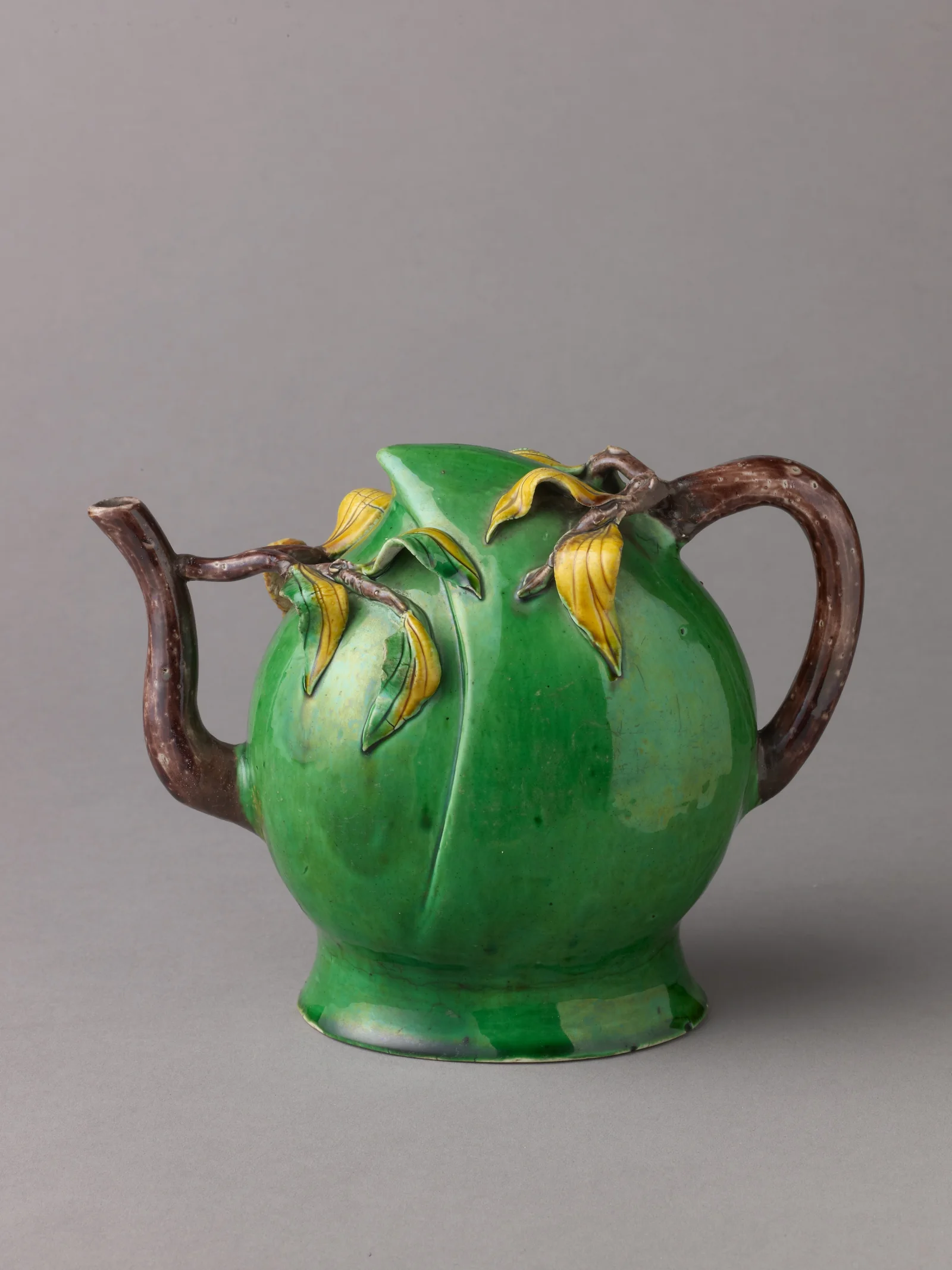
The Metropolitan Museum records this green peach-shaped object as a porcelain wine pot or tea pot, about 1644-83, with a height of 12.7 cm. The dual-purpose catalog title is important: historical form does not always map neatly to a modern retail category. Its measured exterior height also tells us nothing about working capacity or pour quality.
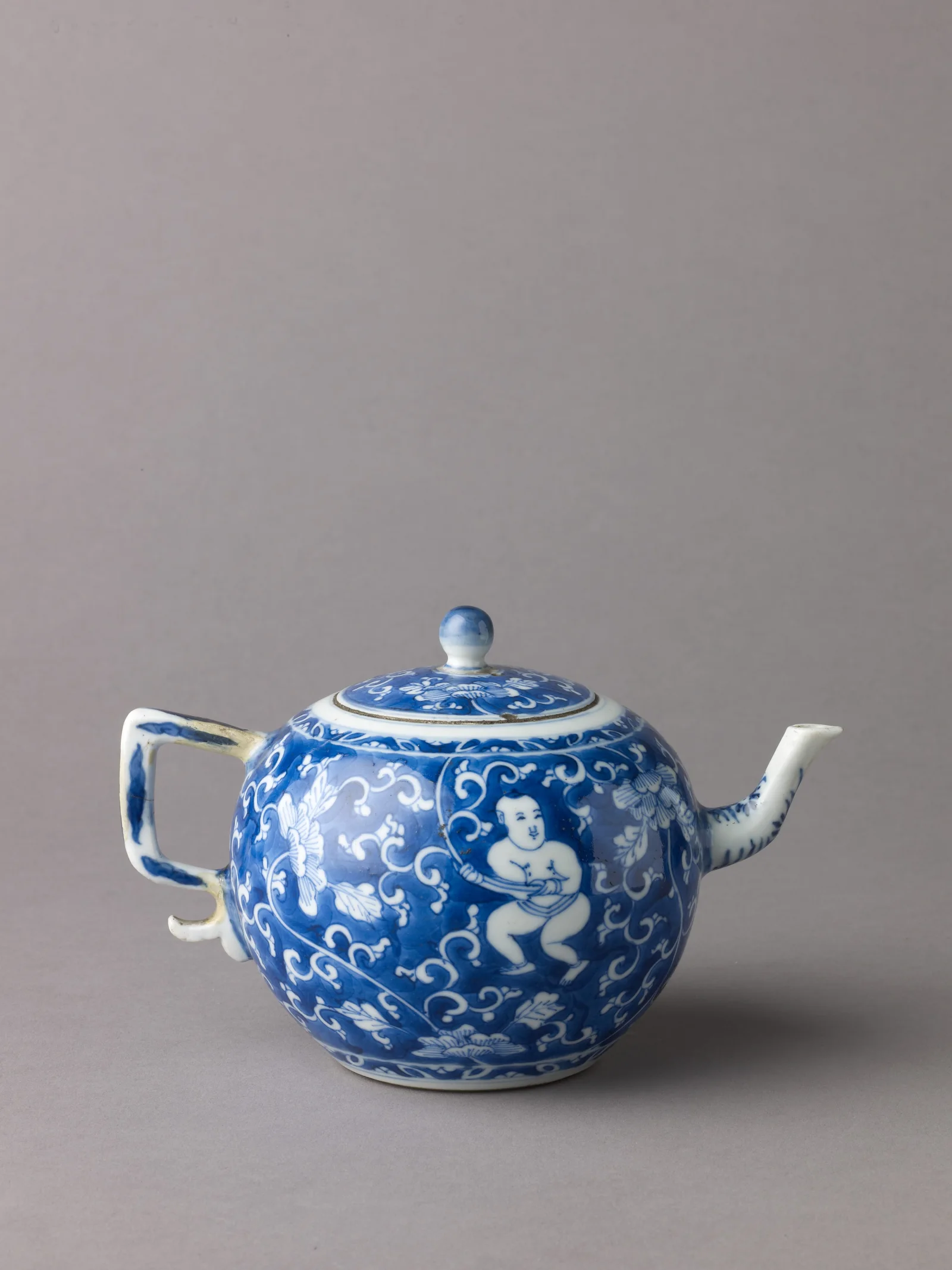
A second Met object, dated 1662-1722, is porcelain painted in underglaze blue and recorded at 10.2 cm high with its lid. Together the objects disprove the idea that a traditional Chinese teapot must be a small plain brown clay pot. They do not tell you which modern pot will brew better.
Run this 15-minute function test
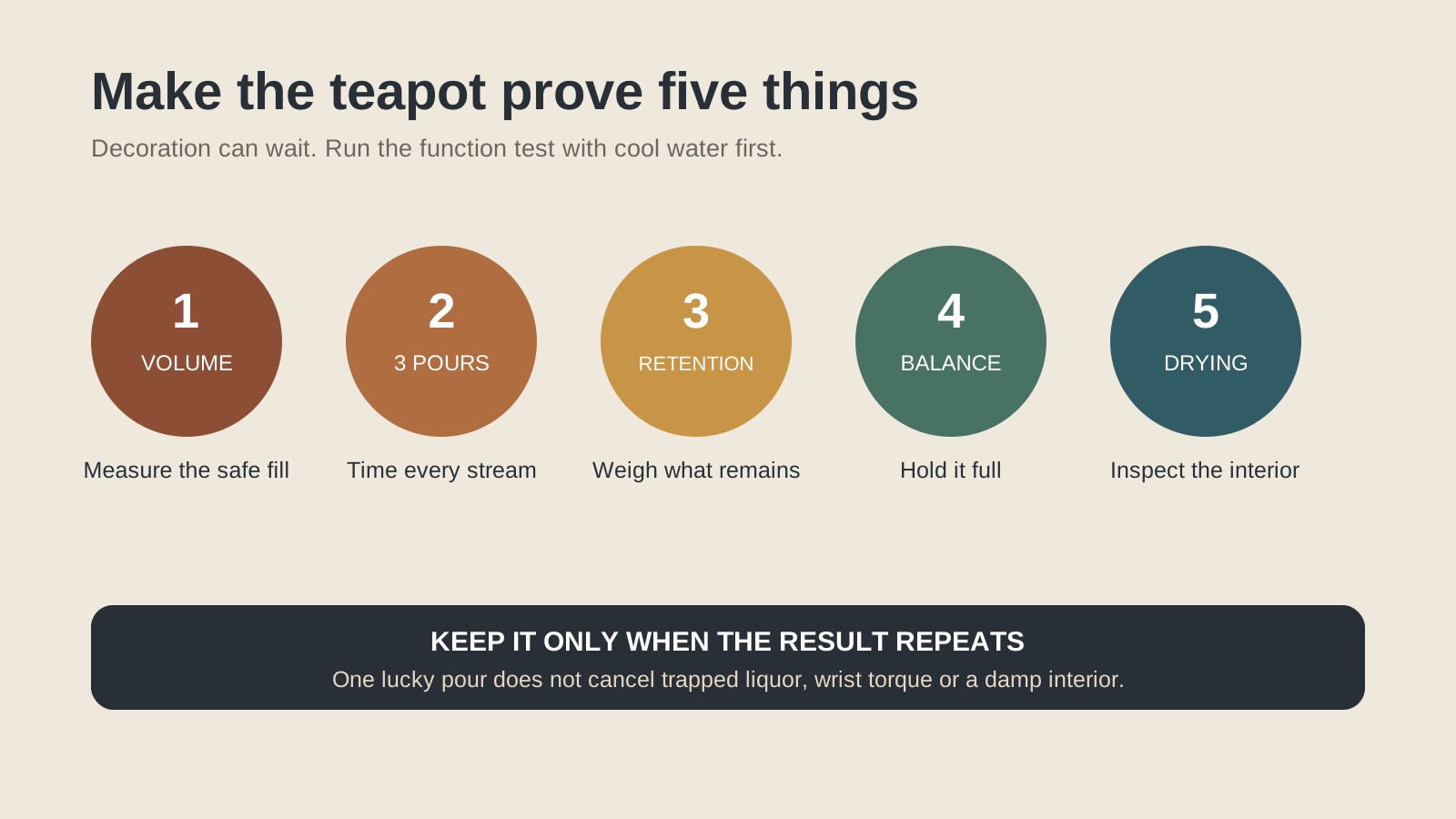
Use cool or comfortably warm water for the measurements. Move to hot water only after the pot has passed visual inspection and no crack, adhesive or unstable repair is suspected.
1. Record empty weight and working volume
Weigh the dry assembled pot. Then measure working volume at the fill line you will use with leaf. Empty weight matters because a pot can look compact yet become front-heavy when full.
Record both numbers. A capacity claim without a fill method is incomplete; a weight claim without the lid is not comparable.
2. Time three complete pours
Fill to the measured working level. Keep the same receiving vessel, grip and pouring angle. Start timing when the continuous stream begins and stop when it ends. Repeat three times.
| Record | Run 1 | Run 2 | Run 3 | Decision |
|---|---|---|---|---|
| Complete-pour time | ___ s | ___ s | ___ s | Large variation means unstable airflow, technique or blockage must be investigated |
| Stream | coherent / spray | coherent / spray | coherent / spray | Persistent spray or a side jet is a serving failure |
| Stop | clean / dribble | clean / dribble | clean / dribble | A long trail after returning upright is a reject signal |
There is no universal seven-second rule. A 90 ml single-hole pot and a 200 ml multi-hole pot should not be judged by one number. The useful result is a repeatable pour that is fast enough for your recipe. If the first liquid leaves eight seconds before the last, that difference is already part of the infusion time.
3. Measure retained liquor
After a normal pour, hold the final angle for five seconds, return the pot upright, then drain the remaining water into a tared cup and weigh it.
retained percentage = retained water mass / working water mass x 100
For example, 3 g retained from a 112 g working fill is 2.7%. This is a worked calculation, not a score for a reviewed product. Compare candidate pots under the same method. More retained liquor means more extraction continues between rounds and less control remains with the brewer.
4. Test the full-pot center of gravity
Hold the filled pot at serving height for 30 seconds, then pour normally. Reject a handle that twists the wrist forward, traps fingers against the hot body or requires squeezing the lid to feel secure. An empty shelf test misses the water weight that creates the real problem.
Do not invert a full pot or block the air hole to perform a lid trick. Suction proves one fluid-sealing condition, not clay, craftsmanship or safety.
5. Check opening, filter and complete drying
Put a spoonful of wet leaves into the cool pot, then remove them without tools. Inspect whether leaf catches behind the filter, whether the spout flushes clear and whether fingers or a soft cloth can reach the interior when needed. Rinse and leave the lid off until dry.
A pot that smells of perfume, detergent, mildew, adhesive or an unexplained coating after rinsing fails. Seasoning cannot turn unknown residue into a safe material.
Spout and filter design: judge the result, not the label
Single-hole outlets, flat perforated screens, multi-hole screens and raised ball filters all involve tradeoffs.
- A broad outlet can empty quickly but pass small fragments.
- Fine holes can restrain broken leaf but clog and slow the final third of the pour.
- A raised ball filter increases surface area but occupies interior space and can trap leaf.
- A good air hole stabilizes flow; poor venting can produce chugging even when the spout looks elegant.
Count holes only to predict what to test. More holes are not automatically more advanced, and a separate strainer can solve leaf fragments more cheaply than a complicated pot.
Shape matters through space, heat and cleaning
A wide opening makes large wet leaves easier to remove. A broad chamber may give rolled oolong room to open. A tall chamber may accept long twisted leaf with less bending. Thick walls and a compact body may lose heat more slowly than a thin, open form, but material labels alone cannot quantify the effect.
Do not buy from a rigid chart that assigns one named tea to one named pot shape. Shape changes leaf space, surface area, heat path, pour angle and cleaning access together. Test those variables instead of memorizing auspicious names.
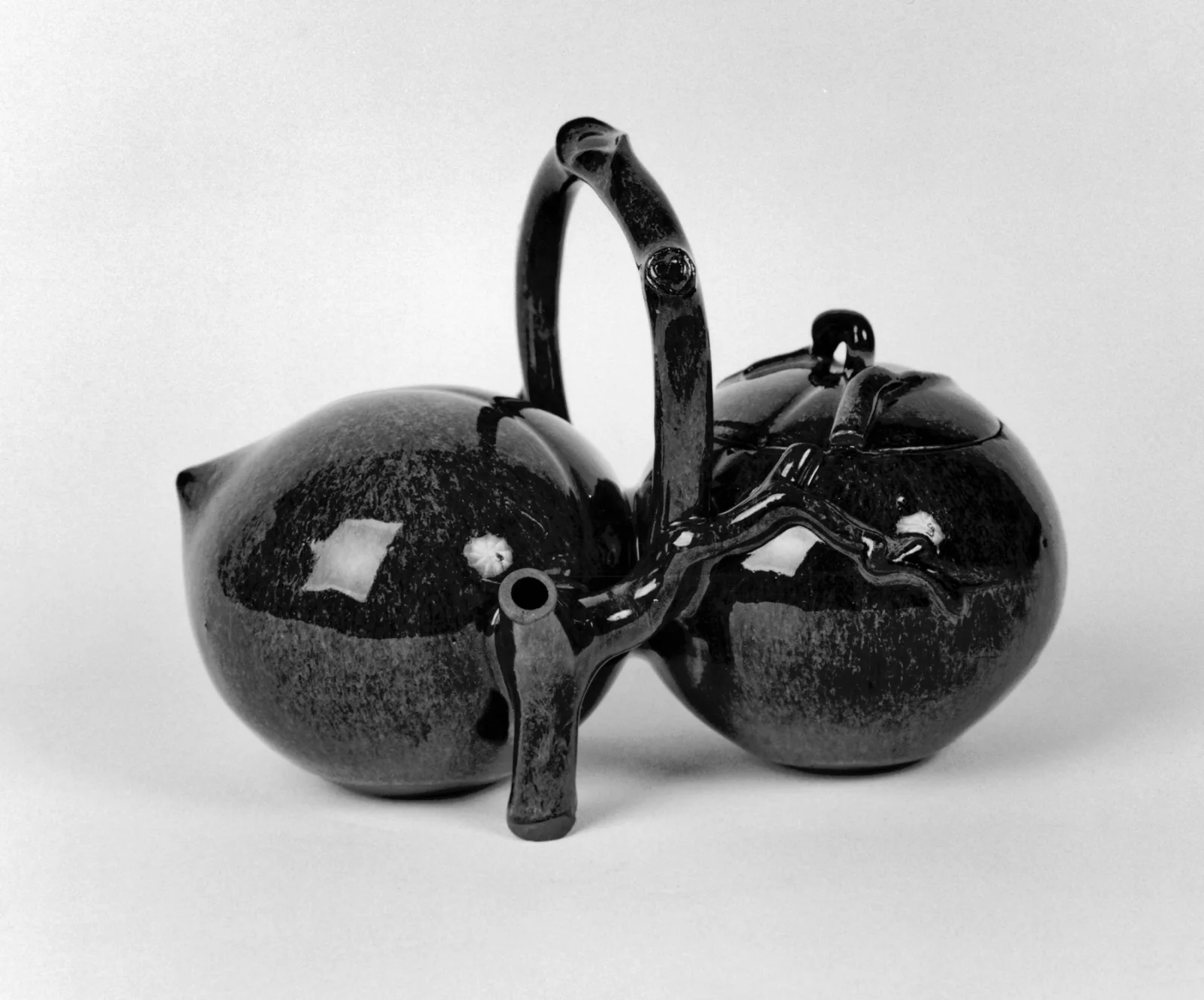
The Walters Art Museum records this 18th-century double-peach vessel as Yixing ware with a blue-brown transmutation glaze. It is neither plain nor the standard round brown form promoted in many buying guides. The object establishes the documented range of Yixing form and finish; resemblance to it cannot authenticate another pot. For clay, provenance and maker claims, use the dedicated Yixing teapot guide.
Compare the pot with a white porcelain gaiwan
When a seller or owner claims that a pot makes tea smoother, sweeter or more aromatic, compare it with a neutral white porcelain gaiwan. The comparison is useful only when extraction is controlled.
- Use one tea lot and one water source.
- Weigh equal leaf for equal measured working volumes.
- Use the same water temperature.
- Include the entire pour in total leaf-water contact time.
- Alternate which vessel is served first.
- Taste both cups hot, warm and near cool.
- Repeat on at least three sessions.
Record aroma clarity, bitterness, astringency, body, finish and foreign odor. If the teapot takes 12 seconds to empty and the gaiwan takes 6, the test already contains a six-second extraction difference. Match contact time before crediting the material.
The result may be a tradeoff rather than a winner. A pot that softens roughness may also mute high aroma. Better is not a complete conclusion until it names the tea, the controlled variables and what was gained or lost.
New, used and antique pots require different evidence
| Purchase | Minimum useful evidence | Walk away when |
|---|---|---|
| New daily pot | Maker or workshop, material disclosure, working capacity, empty weight, pour video and return terms | Basic measurements or a continuous pour cannot be supplied |
| Used pot | All new-pot evidence plus odor, residue, cracks, repairs and prior-use history | Perfume, mildew, adhesive or damage is minimized as seasoning |
| Claimed antique | Specialist attribution, provenance, condition report and conservation advice | Price depends on a seal, story, color or seller-issued certificate alone |
A historic object does not need to brew tea to retain cultural value. When material, repair or condition is uncertain, preserve and study it instead of forcing it into hot-water service.
Photographs can document visible form and condition. They cannot establish clay composition, firing atmosphere, food-contact safety, maker, date or geographic origin by themselves. A seal is a claim to investigate, not a certificate that verifies itself.
Reject a teapot for these functional reasons
Return or refuse a daily-use pot when any of the following remains after one careful retest:
- measured working volume does not fill the intended cups;
- three pour times vary enough to disrupt the recipe;
- flow repeatedly chugs, sprays sideways or runs down the body;
- substantial liquor remains trapped after a normal complete pour;
- the filled pot pulls the wrist forward or forces fingers against hot ceramic;
- the lid must be clamped or held acrobatically;
- wet leaves cannot be removed and the interior cannot dry cleanly;
- odor, unknown coating, crack or repair remains unexplained;
- the seller substitutes cultural language for measurements and return terms.
Decoration, history and skilled making may justify pleasure and price after these questions are answered. They cannot cancel a failed daily function test.
The buying order that prevents regret
- Choose the brewing vessel, not a water kettle.
- Measure the cups used in one round.
- Calculate target working volume from those cups.
- Prefer neutral porcelain or glazed stoneware for a first general-use pot.
- Record empty weight, working volume and three complete pours.
- Measure retention and test the full-pot grip.
- Inspect opening, filter, odor and drying.
- Verify material, maker and age claims separately from usability.
The best Chinese teapot is not the one with the most cultural vocabulary. It is the smallest pot that serves the intended cups, gives repeatable extraction, empties cleanly and asks nothing unsafe from the hand. Build the wider service around that vessel with the Chinese tea set guide, then use measured volume in the Chinese tea brewing guide.