Buy a Yixing teapot only when provenance and measured function agree. Color, grain, a seal, a ringing sound, quick water absorption and an unusually tight lid cannot authenticate clay, maker, age or origin. For a daily pot, working volume, emptying time, stream control, retained liquor, handle comfort and clean drying matter before prestige.
This guide separates three questions that sellers often collapse into one: Is the Yixing claim credible? Does the pot actually work? Is the evidence strong enough to justify a premium? A pot can brew well without being collectible, and a documented historical object need not match modern ideas of the perfect brewing tool.
I insist on keeping those questions separate. A pleasant pour does not authenticate an origin, and a prestigious provenance does not guarantee that a pot suits your hand, tea or serving rhythm. The seller benefits when admiration, function and identity blur together; the buyer benefits when they do not.
The 30-second Yixing teapot decision
Choose a Yixing teapot only if all three columns survive inspection.
| Decision | Evidence that matters | What does not settle it |
|---|---|---|
| Is the claim credible? | Identified maker or workshop, invoice, consistent provenance, material disclosure, independent examination when stakes are high | Brown or red color, visible specks, stamp, certificate supplied by the seller |
| Is it a good brewing tool? | Measured working volume, timed emptying, clean stream and stop, low retained liquor, safe grip, accessible interior | Price, title, fame, dramatic lid tricks |
| Is the premium justified? | Evidence appropriate to a daily pot, named contemporary work or historical object | Investment language, old clay, rare ore, master handmade without traceable records |
If the seller will not provide the basic evidence and a return route, stop. The correct first Yixing purchase is not the most romantic pot; it is the least ambiguous one that fits your tea and hands.
Yixing, zisha and clay names do not mean the same thing
Yixing is a place in Jiangsu. Zisha names a family of ceramic materials and wares associated with the region; it is not one uniform purple recipe. Retail terms such as zini, zhuni and duanni may describe a claimed material family, but an English listing that says purple clay, red clay or green clay is still only a claim until its source and preparation are documented.
Raw material selection, refinement, blending, aging, forming and firing all affect the finished body. Lighting, editing, surface treatment and years of use further change what a photograph shows. Therefore:
- color cannot identify a clay deposit;
- visible particles cannot prove
original ore; - a fast-darkening water patch cannot prove purity or quality;
- a photograph cannot establish food-contact safety;
- a seal cannot prove who made the pot.
Laboratory analysis may answer some composition questions. Maker records, workshop documentation and provenance answer authorship and origin questions. Neither can be replaced by a viral home test.
Identified objects show why appearance is not authentication
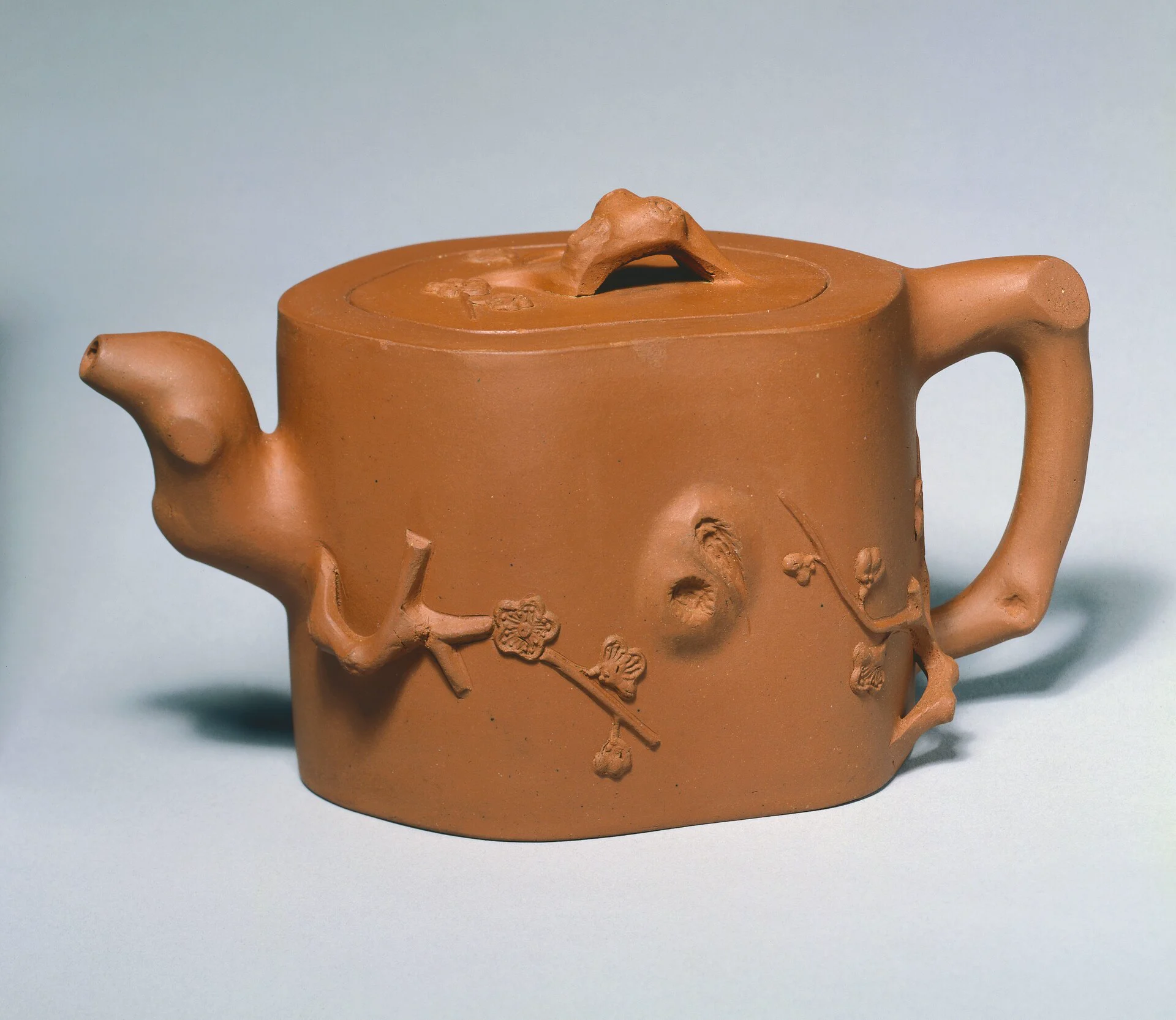
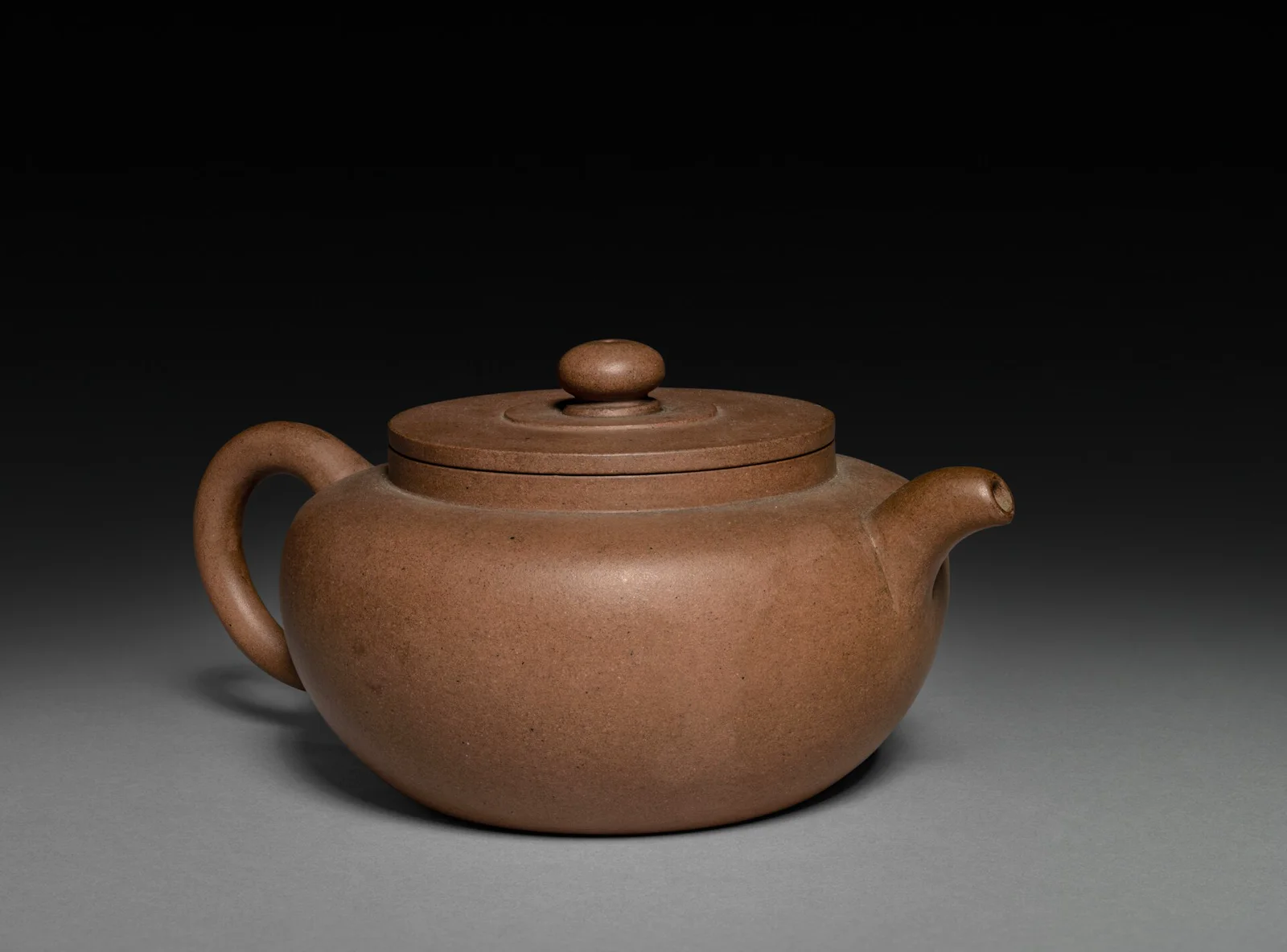
The Cleveland Museum of Art records object 1995.12 as an 1800s Qing dynasty Yixing stoneware teapot, 18 cm in diameter and 10 cm high. That conclusion belongs to the cataloged object and its record, not to every pot with warm brown clay and applied decoration.
A second Cleveland object, 1955.299, is cataloged as Qing dynasty Yixing ware, 12.8 cm in diameter and 8.6 cm high. Its proportions and surface differ from 1995.12, yet both are documented as Yixing. Similarity to either object would still prove nothing about a modern listing.
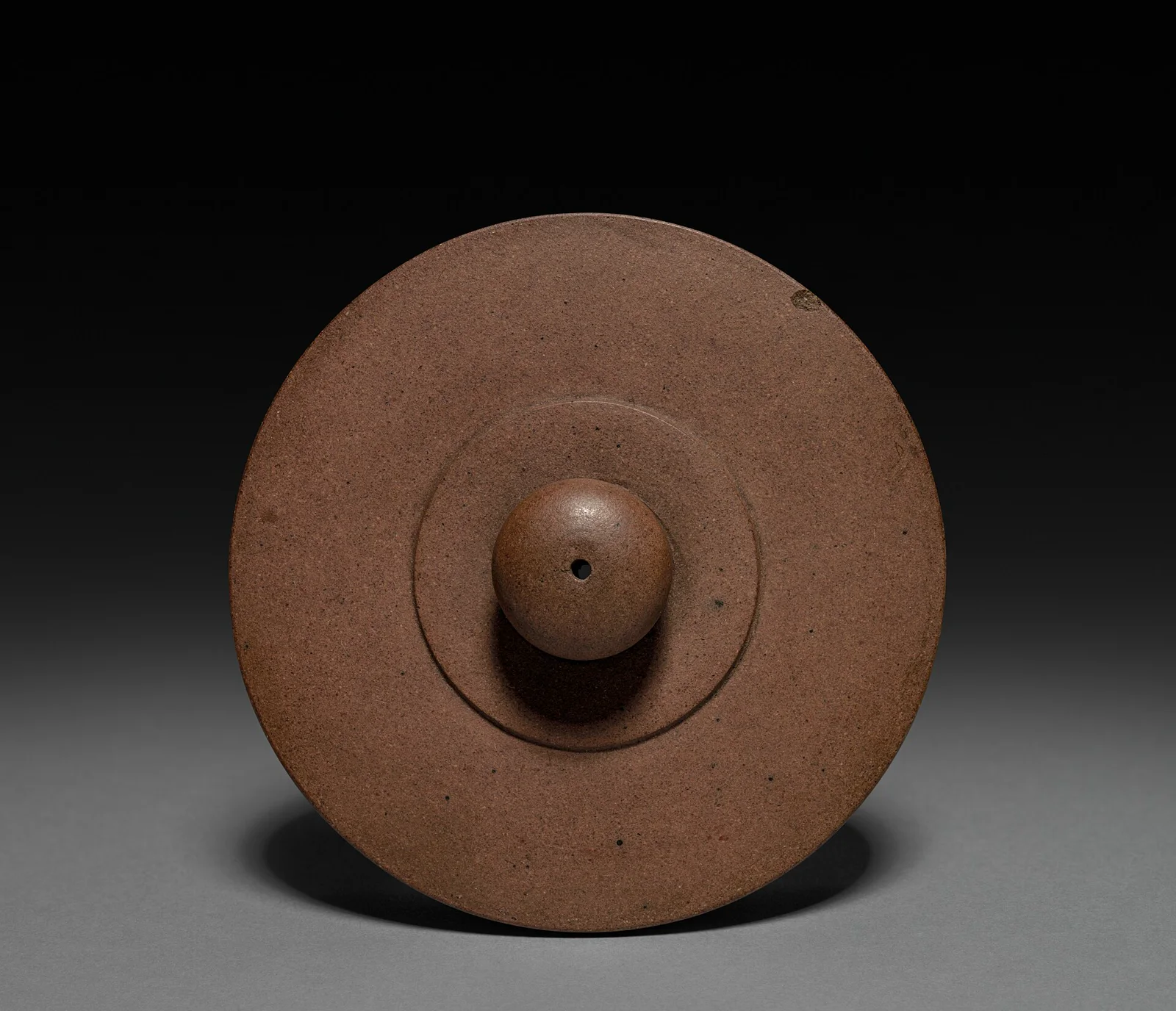
The separate lid record is useful because buyers often overvalue lid fit. A lid should remain controllable during a normal pour, but a narrow gap, suction effect or upside-down stunt cannot establish material, maker or age. Fit is one functional observation, not an identity test.
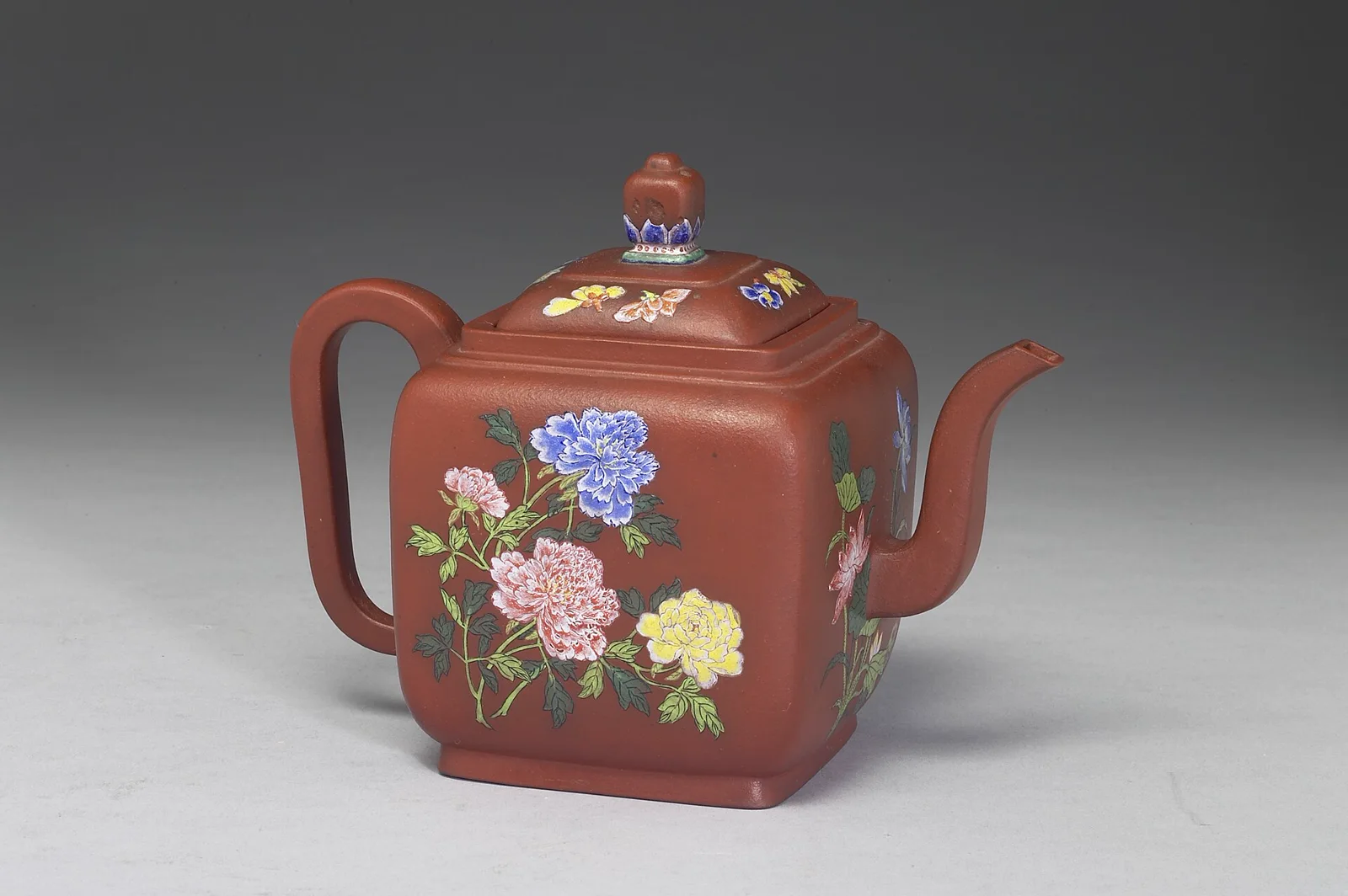
The National Palace Museum's cataloged Kangxi-period square Yixing teapot is enamel painted. It decisively rejects the idea that all legitimate Yixing objects must be plain, round and visibly purple-brown. It does not authorize a buyer to identify a similar modern pot by appearance.
Separate the three markets before comparing prices
| Market | What you are buying | Evidence priority | Sensible walk-away point |
|---|---|---|---|
| Daily brewing pot | A functional vessel with a stated maker or workshop | Measurements, material disclosure, process description, pour video, return policy | Basic function or seller answers fail |
| Named contemporary work | Function plus authorship and artistic record | Direct provenance, workshop confirmation, comparison with documented output | Name and certificate cannot be independently connected to this pot |
| Historical object | Period attribution, rarity, provenance and condition | Specialist examination, collection history, condition report and technical study | Price depends on an oral story or a seal alone |
Do not use the price of an anonymous daily pot to dismiss documented contemporary work. Do not use an auction result to justify an anonymous online pot. They are different markets with different evidence burdens.
Full handmade also needs a precise answer. Traditional Yixing production is associated with building and refining forms from prepared clay sections. Modern handmade language may mean full hand building, mold-assisted forming, hand finishing or only a broad craft claim. Mold assistance does not make a pot unusable; it changes the claim and the premium that can be defended. Ask which stages were done by whom and whether the process record belongs to the pot being sold.
Ask for these eight views before paying
For an online purchase, request one continuous, well-lit set rather than unrelated promotional photographs:
- left profile with the lid on;
- right profile with the lid on;
- top view showing the opening, lid and knob;
- base and every mark in focus;
- interior wall and floor under neutral light;
- inside of the lid and lid flange;
- spout holes and air hole;
- one uncut video filling, lifting, pouring and stopping.
Also request empty weight, brim capacity, claimed working capacity and a ruler in at least one frame. These views expose contradictions and allow basic fit assessment. They still do not authenticate clay or authorship remotely.
Run this 15-minute function test
Use cool or comfortably warm water for the first measurements. Record the results; do not rely on how premium the pot feels.
1. Measure empty weight and working volume
Dry the pot, assemble it and weigh it. Then place the empty pot on a scale, tare to zero and add water to the level you would actually use with leaves. One gram of room-temperature water is close enough to one millilitre for a kitchen check.
Working volume = water mass in grams ≈ millilitres
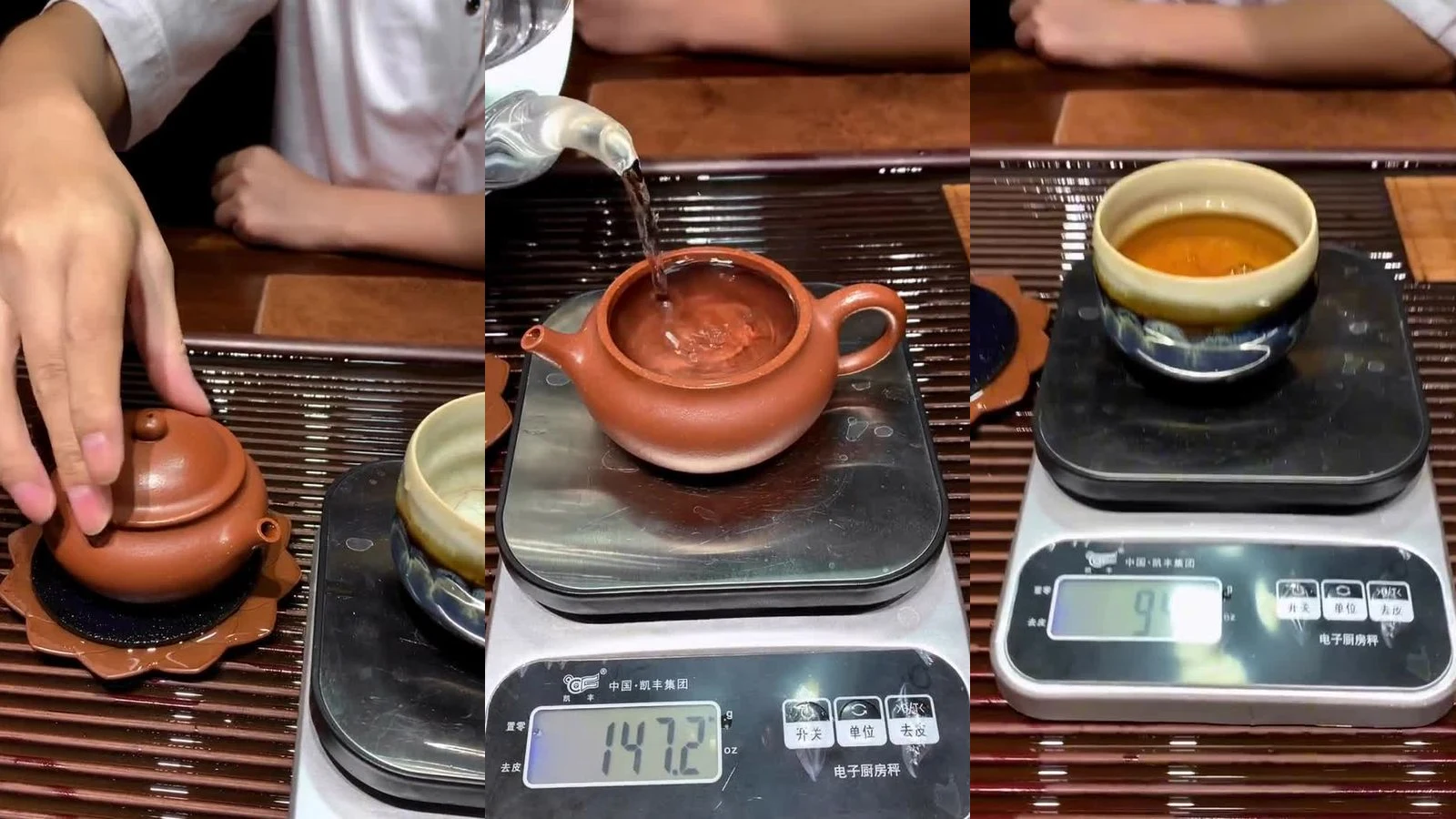
This sequence is useful because it drags a vague capacity claim onto a kitchen scale. The pot is first placed, then filled while the display is visible, and the receiving cup is weighed afterward. It is not a laboratory test and it does not authenticate the clay. It shows the habit that matters: separate the stated 160 cc label from the water the vessel actually accepts and the liquid that actually leaves it.
Do not copy the displayed numbers as specifications for your pot. The frames come from one authorized demonstration of one modern vessel; the cup reading is not automatically retained liquor because the clip does not document every tare, fill line and transfer condition needed for that calculation. Reproduce the method with your own scale, write down your own working volume and keep all three pour repetitions. That turns the image into a test you can challenge, not an influencer claim you are expected to believe.
Brim capacity is not working capacity. If the seller advertises 150 ml but a usable fill is 118 ml, dose tea for 118 ml. For one person using small cups, roughly 80-120 ml is often easier to control; 120-180 ml suits two or three small cups. These are service ranges, not quality grades.
2. Time the complete pour
Fill to the measured working level, uncover the spout hole and pour at a normal angle into a vessel large enough to catch everything. Start timing when the stream begins and stop when the continuous stream ends. Repeat three times and record all results.
| Observation | Pass for daily use | Investigate or reject |
|---|---|---|
| Emptying time | Repeatable and fast enough for the tea you brew | Large variation, severe slowing or a pour so long that it changes infusion time |
| Stream | Coherent and aimable | Persistent spray, side jet or liquid running down the body |
| Stop | Clean enough to serve without a trail | Long dribble after returning upright |
| Airflow | Flow remains stable | Chugging that improves only when the lid is moved |
There is no universal seven-second rule. A 90 ml pot and a 180 ml pot, or a fine multi-hole filter and a single-hole spout, cannot be judged by one time. Repeatability and suitability for your leaf matter.
3. Measure retained liquor
After the normal pour, hold the pot at the same final angle for five seconds. Return it upright, then drain the remaining liquid into a tared cup and weigh it. Record retained millilitres and calculate:
retained percentage = retained ml ÷ working volume ml × 100
Lower retention gives you better control over repeated infusions. A pot that leaves 8 ml behind from a 100 ml working volume retains 8% of the brew and keeps extracting the leaves between rounds. That is a functional cost, whatever the maker's reputation.
4. Test lid, grip and heat with a normal pour
Fill with hot water only after the pot has passed visual inspection and has no known crack or repair. Hold it exactly as you would during tea service. The lid should remain controllable without an acrobatic grip; the handle should not force fingers against the hot body; the knob and air hole should not make the pour unsafe.
Do not invert a full pot to prove quality. Do not block the air hole and treat suction as authentication. Those demonstrations test a narrow fluid-sealing condition and can end with a broken lid.
5. Check cleaning and complete drying
Confirm that expanded leaves can be removed through the opening and that the spout/filter can be flushed. After rinsing, leave the pot open in moving air and inspect it when fully dry. Persistent perfume, detergent, mildew, chemical odor, sticky coating or unexplained residue is a stop signal, not something to season away.
Compare the pot with a white porcelain gaiwan
Claims that Yixing automatically improves tea are too broad to be useful. Vessel geometry, heat retention, emptying speed, retained liquor, surface and prior use can all change the cup. Test the actual pot against a neutral white porcelain gaiwan.
- Use one tea lot and one water source.
- Weigh equal leaf doses for equal working volumes.
- Use the same water temperature.
- Match total leaf-water contact time, including the entire pour.
- Alternate which vessel is served first.
- Taste each pair hot, warm and near cool.
- Repeat on at least three sessions before assigning a pattern.
Record aroma clarity, bitterness, astringency, body, aftertaste and any foreign odor. If the Yixing pot takes 12 seconds to empty and the gaiwan takes 6, a six-second extraction difference is already present. Do not credit that difference to clay.
The right conclusion may be tea-specific: one pot can soften a harsh stored Pu-erh yet mute the high aroma of a floral oolong. Better must name the tea and the sensory tradeoff.
Reject the five popular authentication shortcuts
| Shortcut | What it may reveal | What it cannot prove |
|---|---|---|
| Tap it and listen for a ring | Possible cracks, shape and thickness effects | Yixing origin, clay family, age, maker or quality |
| Drip water and watch absorption | Surface condition, temperature, cleanliness and use-history effects | Original ore, purity or safety |
| Read the color and visible grains | Visible firing and surface characteristics | Deposit, recipe, additives or place |
| Read the seal or certificate | The identity being claimed | Who made the pot or whether the issuer is independent |
| Test an airtight lid | One aspect of fit and fluid behavior | Material, authorship, age or overall brewing performance |
The stronger the claim, the stronger the evidence must become. Rare old ore, a famous maker, full hand building and a historical date all demand more than the evidence required for an honest, inexpensive daily pot.
Seasoning should be boring
For a sound modern pot, rinse with warm water, inspect it, brew a familiar tea and let the pot dry completely. Repeat through normal use. That is enough.
Boiling a pot with tea leaves, tofu, sugar or other ingredients is unnecessary. It can create residue, odor or thermal stress. Never boil a valuable, repaired or historical pot as an internet ritual. Follow a trustworthy maker's care instructions when they are specific to the actual body and firing.
Dedication is optional. If aroma transfer becomes noticeable, group compatible profiles rather than buying one pot for every tea name. Do not dedicate a pot before it passes the water, odor, function and comparison tests.
Seven questions the seller must answer
- Who made this exact pot, in which workshop and when?
- What precisely is the claimed material, and where did that information come from?
- Which forming stages were full hand work, mold assisted or machine assisted?
- What are empty weight, brim capacity and measured working capacity?
- Can you provide the eight views and one uncut pour video?
- Who issued the certificate, and can the record be verified independently?
- What is the return process if capacity, odor, damage or description is wrong?
Walk away when the story changes, basic measurements are withheld, a famous name has no provenance, the certificate exists only inside the seller's ecosystem, or urgency and guaranteed appreciation replace evidence.
Keep an evidence packet
Save the full listing, invoice, seller identity, measurements, photographs, video, certificate, correspondence and return terms. Label which claim came from the maker, dealer, previous owner, museum catalog or independent specialist; they are not interchangeable.
The broader teaware-vessels route places Yixing beside other brewing tools before prestige narrows the decision. The Chinese teapot guide compares porcelain, glass, stoneware and other vessel choices, while the Chinese tea set guide helps size the complete service. This page adds the burden specific to Yixing: a generic clay pot may be useful, but it has not earned a Yixing identity or premium until the evidence supports it.
If you already own one, bring a measured 15-minute pot test to East Moment's community: usable water mass, three pour times, retained liquid and the first problem your hand or cleaning routine exposed. Return after three real tea sessions and say whether the cool-water result predicted actual brewing control.