Chinese oolong tea is not one flavor and not a fixed point between green and black tea. Choose it in this order: leaf form, named regional style, roast and storage, then price. For a first purchase, three traceable 20-30 g samples teach more than one prestigious tin because rolled Tieguanyin, Wuyi rock tea and Phoenix Dancong reveal three different ways that Chinese makers control leaf movement, heat and aroma.
Chinese oolong tea: buy a comparison, not an oxidation percentage
Oolong labels often lead with a percentage: 20% oxidized, 40% oxidized, 70% oxidized. The number looks precise, but it rarely tells a buyer how the figure was measured. Even when oxidation direction is broadly accurate, it cannot explain leaf shape, roast, cultivar, breakage, storage or the speed at which the tea opens in water.
Use this decision order instead:
| Decision | What to ask | Why it matters more than color |
|---|---|---|
| 1 | Is the dry leaf compactly rolled, loosely rolled, long and twisted, or broken? | Form changes expansion, circulation and extraction speed |
| 2 | Is the seller naming Anxi Tieguanyin, Wuyi rock tea, Phoenix Dancong or only “oolong”? | A regional system gives useful process and identity questions |
| 3 | Is the tea light, medium or deeply roasted, and when was the final roast? | Roast changes heat demand, aroma and resting needs |
| 4 | What are the production year, packing date and storage conditions? | Fragrance and roast clarity can be lost before the packet is opened |
| 5 | Can you buy a small sample from the same batch? | The cup tests whether the story and material agree |
My firm recommendation is to start with one rolled Tieguanyin, one Wuyi Shuixian or transparent Da Hong Pao blend, and one named-aroma Dancong. Keep the samples modest. Contrast builds judgment faster than prestige.
I reject the idea that a beginner needs one expensive “best oolong.” I believe three honest small samples teach more than a cabinet of famous names, because the leaf must prove its story after the first aroma has faded. I insist on comparing the fourth infusion: Tieguanyin should still offer structure after its floral opening, Wuyi tea should let roast reveal rather than smother the leaf, and Dancong should carry fragrance into liquor without making bitterness its entire personality. The mistake is to reward whichever cup shouts first. I want the tea that still gives me a reason to pour again.
What makes a tea oolong
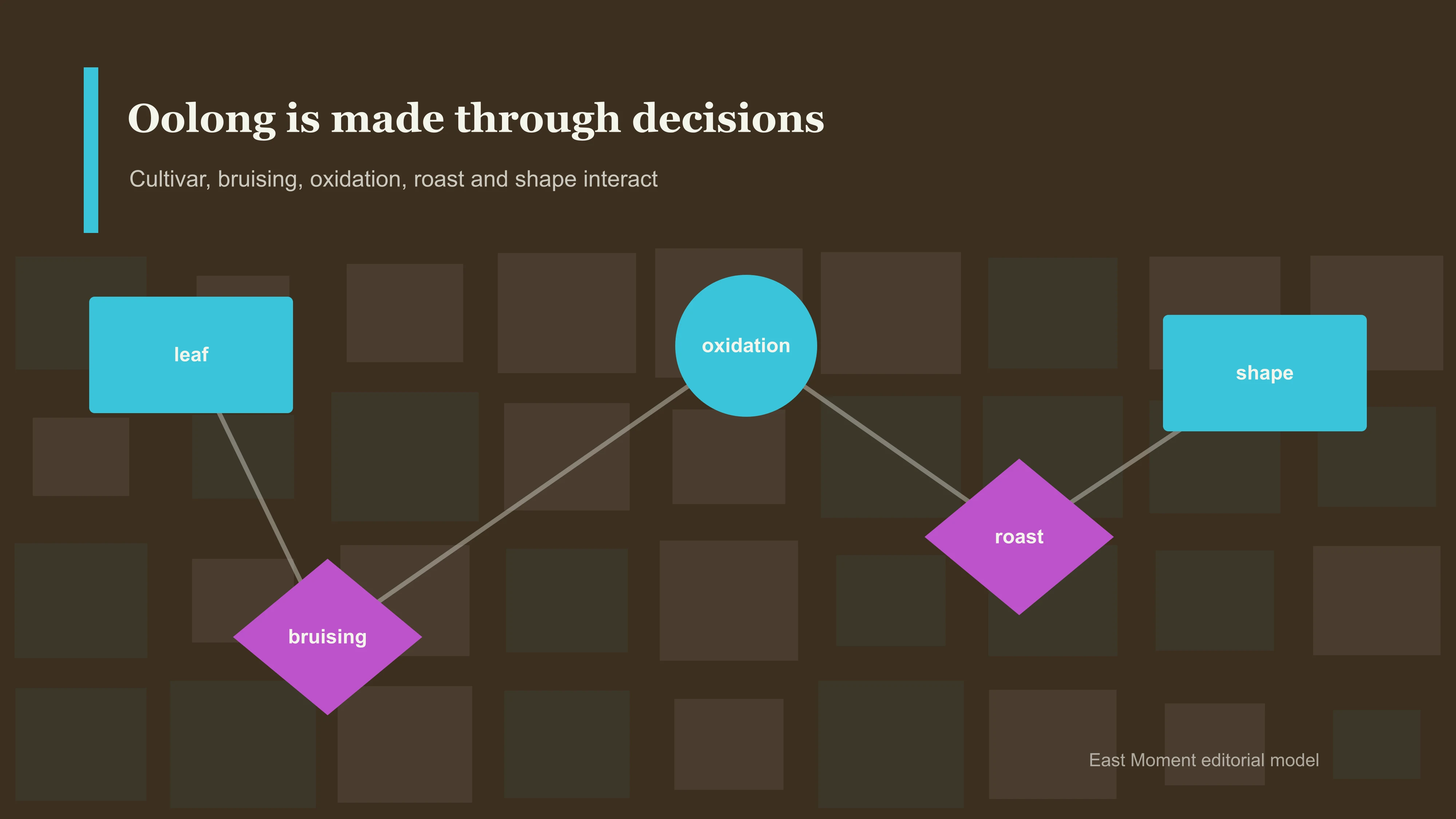
China's official GB/T 30357.1 basic-requirements record treats oolong as a defined tea category, while UNESCO places Chinese tea processing inside a much larger body of knowledge, skill and social practice. A useful family-level sequence is withering, repeated leaf movement and rest, heat fixing, shaping and drying; roasting may follow according to the style.
| Stage | Maker's decision | What may change in the cup | What a buyer cannot infer from one photo |
|---|---|---|---|
| Withering | Sun, shade or indoor conditions; time and airflow | Leaf flexibility and aroma direction | Exact duration or finished quality |
| Movement and rest | Frequency, force, temperature and recovery time | Uneven oxidation and floral or fruit development | A universal oxidation percentage |
| Fixing | When heat stops substantial enzyme activity | The chosen transformation is arrested | Whether later roast is light or deep |
| Shaping | Roll into compact forms or twist into strips | Expansion, packing and extraction behavior | Cultivar or protected origin |
| Drying and roast | Moisture reduction, fire level and rest | Stability, warmth, grain, fruit, wood or spice | That darker leaf is automatically older or better |
Peer-reviewed work on bruising and withering shows that these stages change volatile formation; metabolomics research also separates oolong manufacture into enzyme-active and later heat-driven phases. The practical conclusion is narrower than the chemistry: oolong is made through a sequence of controlled transformations, not by choosing one number on a green-to-black scale.
See rolled and twisted leaf as different physical systems

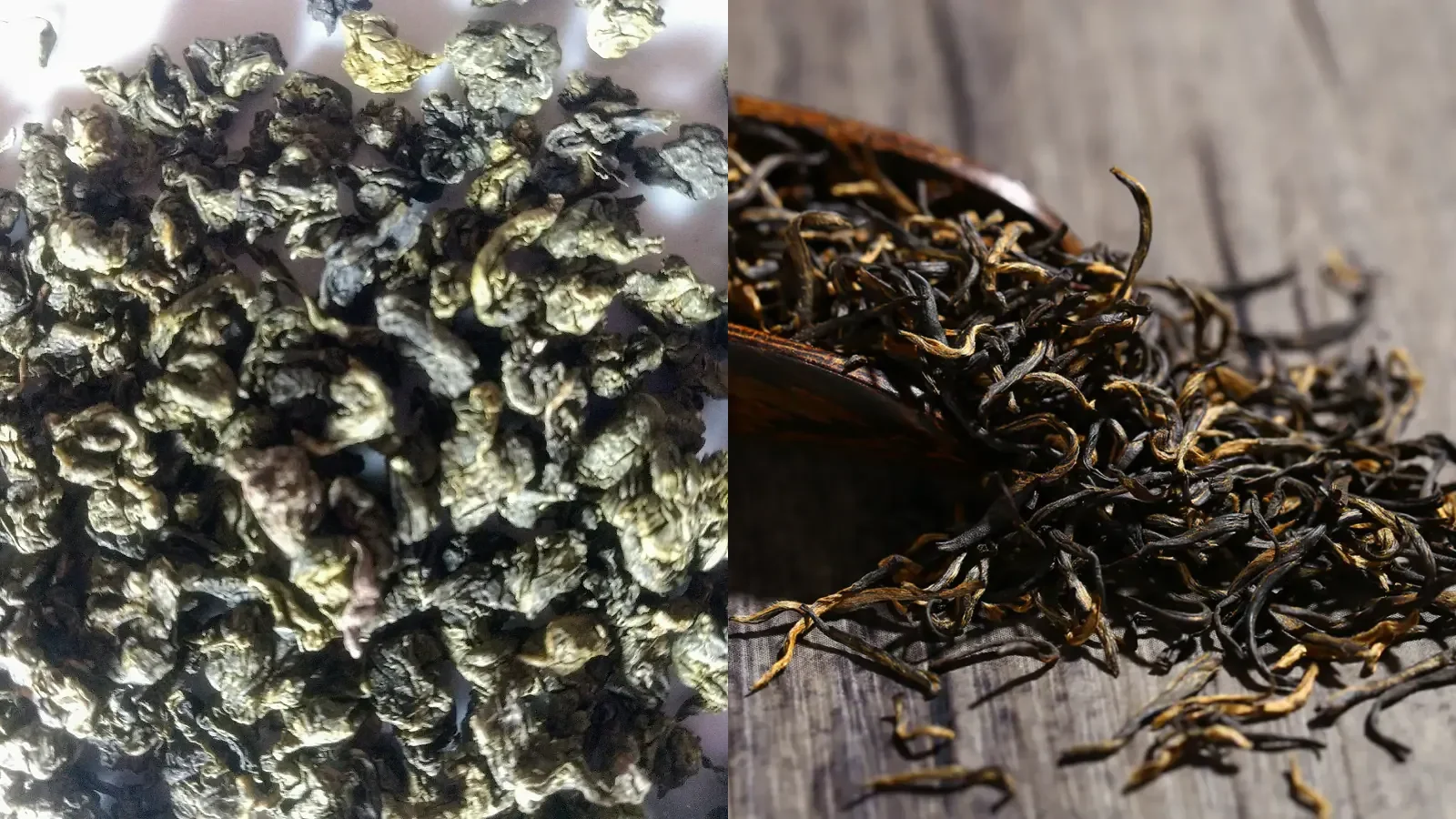
In the hero comparison, the left side is a compact rolled-form reference and the right side is a long twisted-form reference. Neither photograph proves cultivar, mountain, grade or production date. They answer one legitimate question: how will this leaf occupy the vessel?
| Visible form | Vessel consequence | First brewing risk | What to inspect after opening |
|---|---|---|---|
| Tight pellets or compact rolls | Dry leaf occupies little space but can expand dramatically | A quiet first infusion encourages an unnecessary dose increase | Whether full leaves open cleanly or the vessel becomes crowded |
| Loose rolls | Water reaches more surface earlier | Timing copied from a tighter tea may overextract | Breakage, stem proportion and evenness |
| Long intact twists | Leaf needs a reasonably wide opening and fast outlet | Slow pouring extends contact after the timer stops | Whether the strip opens with resilience rather than disintegrating |
| Many broken tips or dust | Small particles extract quickly and may block the lid gap | Bitterness is blamed on the whole regional style | Whether damage is throughout the sample or concentrated at the packet bottom |
This is why “use boiling water for all oolong” and “use cooler water for green-looking oolong” are incomplete rules. Shape, breakage, roast, vessel and pour time work together.
Three regional systems, three different buying questions
Anxi Tieguanyin: separate cultivar, category and protected origin
Tieguanyin can name a cultivar and an oolong product style. Anxi Tieguanyin is a narrower geographical claim governed by its own quality requirements. A packet saying “Iron Goddess” does not by itself establish Anxi origin.
Modern examples may be light, green-looking and floral; more traditional or roasted styles may move toward baked grain, nuts and warmth. Color is not a quality ladder. A vivid green roll can be clear and durable or loud and short-lived. A darker tea can be carefully roasted or simply covered by fire.
Ask:
- Does the seller mean the Tieguanyin cultivar, a Tieguanyin-style product or protected Anxi Tieguanyin?
- What is the roast direction and final roast date?
- Does the rolled leaf have enough room to open in the recommended vessel?
- Does the tea remain coherent after its first aromatic infusion?
Wuyi rock tea: origin and roast must be explained separately
Wuyi rock tea is a protected geographical product under GB/T 18745-2006. A replacement standard was published in 2026 but does not take effect until April 1, 2027, so this guide does not silently treat a future requirement as current law.
Da Hong Pao, Rougui and Shuixian are not interchangeable words. “Da Hong Pao” on a retail packet may describe a commercial blend or product tradition; it does not mean material from the famous mother trees. “Zhengyan,” named cliff locations and old-bush claims require traceability beyond dark leaf and mineral-sounding prose.
The Chinese tasting expression yan yun, often translated as “rock rhyme,” describes a valued sensory resonance. It is not a laboratory certificate for minerals and cannot authenticate a garden. Ask the seller to separate place, cultivar or blend, roast and batch instead of merging them into one romantic adjective.
Phoenix Dancong: aroma names organize expectation, not ingredients
Phoenix Dancong belongs to the Chaozhou tea world of Guangdong. Aroma-family names such as honey-orchid or gardenia organize sensory expectations and production lineages; they do not automatically mean flowers or flavoring were added.
Guangdong's DB44/T 2816-2026 series now provides dedicated terminology, appearance, liquor-color, quality and sensory-review frameworks for strip-form Dancong tea. That is useful evidence that appearance and liquor are assessed systematically. It still does not authorize a shopper to identify cultivar or mountain from a social-media photograph.
Dancong is often the least forgiving of the three entry routes. High fragrance can arrive with drying bitterness when dose, broken leaf or pour time is ignored. Start with a named style from a seller who can explain the batch, then use a porcelain vessel so a strongly seasoned clay pot does not become another hidden variable.
The comparison that matters
| Route | Typical form | Useful first expectation | Heat direction | Main buying rejection |
|---|---|---|---|---|
| Tieguanyin | Compact or looser rolled leaf | Floral lift, green or baked notes, later leaf expansion | 90-95°C for a very light example; hotter for roasted styles | “Iron Goddess” used as proof of Anxi origin |
| Wuyi rock tea | Long twisted strips | Roast, fruit, wood, spice and returning finish | Usually 95-100°C with a complete preheat | Mother-tree, cliff or “mineral” claims without traceability |
| Phoenix Dancong | Long twisted strips | High aroma joined to bitterness-sweetness tension | Usually 95-100°C with a fast complete pour | Aroma name treated as guaranteed cultivar, place or added flower |
These are starting directions, not regional laws. The dedicated oolong brewing guide owns the detailed timing and correction system. This page owns the earlier decision: what style to buy and what evidence to demand.

Cup color becomes useful only under comparable water, dose, vessel, time, temperature and lighting. It can help record change across infusions. It cannot establish Wuyi origin, roast date or cultivar.
Use the vessel's measured capacity, not its advertised name
East Moment previously measured two porcelain gaiwans with water at their repeatable working fill: 79.4 g and 111.3 g. Treating room-temperature water mass as an approximate milliliter value gives a more useful brewing denominator than a seller's nominal “100 ml” label. This is a household capacity check, not laboratory calibration.
At a comparison dose of 5.5 g per 100 ml, the calculation is:
| Measured working water | Calculation | Practical weighed dose |
|---|---|---|
| 79.4 ml | 79.4 × 5.5 / 100 = 4.367 g | 4.4 g |
| 111.3 ml | 111.3 × 5.5 / 100 = 6.1215 g | 6.1 g |
That 1.7 g difference is large enough to change the cup. “One scoop in a gaiwan” is not a reproducible recipe when the vessels hold different amounts of water.
The best starting tool is glazed porcelain because it makes cross-sample comparison easier. The gaiwan guide shows how to measure working capacity rather than filling to the brim.
Run a four-infusion, three-style comparison
This protocol is designed to teach category differences. It does not reproduce a laboratory panel and it does not rank regions.
Hold these variables constant
- Use the same measured vessel, water source and kettle.
- Weigh each sample at 5.5 g per 100 ml of working water.
- Use 95°C water as the shared comparison temperature.
- Start the timer when water first touches the leaf.
- Begin decanting at 15 seconds and record the pour duration separately.
- Empty the vessel completely and taste after similar cooling.
Record four rounds

| Round | Main question | Rolled tea observation | Wuyi observation | Dancong observation |
|---|---|---|---|---|
| 1 | What appears before the leaf fully opens? | |||
| 2 | How do aroma and texture change? | |||
| 3 | Does roast, bitterness or sweetness become clearer? | |||
| 4 | Is there a new reason to continue, or only weaker repetition? |
Do not declare a winner from the first fragrant lid. Compact leaf may still be opening. Surface aroma may flatter a weak tea. A good comparison follows the arc: opening, development, structure and finish.
A peer-reviewed Tieguanyin study varied ratio, temperature and time and found that the preferred conditions differed across consumer drinking habits. It does not validate the short timings above. It supports the disciplined principle behind the protocol: ratio, heat and time materially change the result, so comparisons are meaningless when every variable moves at once.
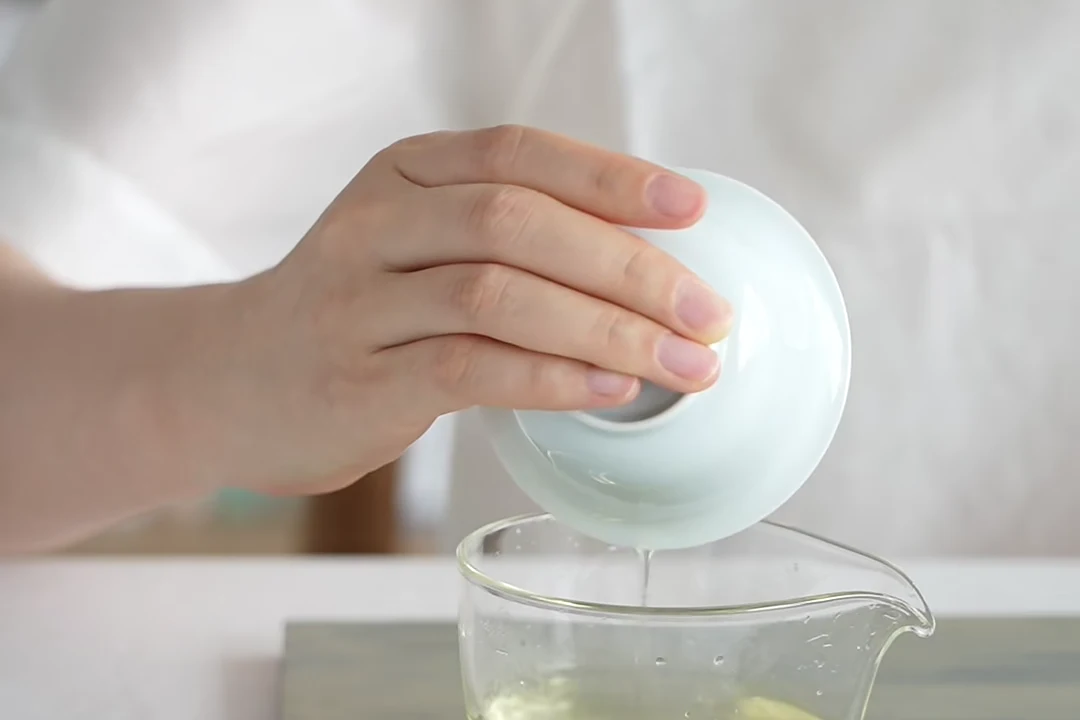
In every round, the complete transfer into cups matters more than a photogenic pouring pose. Timing the infusion but leaving liquor around the leaf turns a recorded 15-second contact into an unknown extraction.
Diagnose the cup before blaming the region
| Result | First checks | Change one thing next |
|---|---|---|
| Rolled tea is thin in round one but improves later | Leaf still opening; water too cool | Keep dose; raise heat slightly or extend only the first contact |
| Twisted tea becomes bitter before aroma reaches the cup | Broken leaf, crowded outlet, slow pour | Shorten contact or improve decant speed |
| Roast dominates every infusion | Recent or heavy roast; excessive contact; weak underlying leaf | Shorten time first; then ask for roast date and rest history |
| Dry leaf smells strong but liquor is hollow | Packet aroma, stale leaf or unsuitable water | Repeat once with neutral water before replacing the tea |
| Fragrance is loud only in the first infusion | Surface aroma without durable structure | Judge texture and rounds two to four before paying a premium |
| Opened leaf is shredded | Rough handling, breakage or a packet-bottom sample | Compare a representative portion from the same batch |
One variable at a time is not fussy tea theater. It is the shortest path from a bad cup to a useful conclusion.
A photograph is evidence, but only for what it shows
Chinese social discussions repeatedly ask whether a rolled leaf, red edge or glossy opened leaf proves that Tieguanyin is “authentic.” The correct answer is no. A real photograph improves transparency, but its authority has a boundary.
| A clear photograph can show | It cannot prove by itself |
|---|---|
| Compact or twisted form, visible breakage and approximate uniformity | Cultivar, protected origin or harvest date |
| Whether leaf expanded and whether the vessel became crowded | Oxidation percentage or processing skill |
| Liquor clarity and color under that lighting | Flavor, aroma, roast date or absence of additives |
| A named garden, workshop or maker when provenance is documented | That the retail packet in your hand came from that scene |
Reject the packet when the story outruns the evidence
Before paying a premium, ask seven questions:
- What exact tea is this: cultivar, blend or commercial style?
- What is the production area, and is a protected geographical name being claimed?
- What are the harvest or production year and packing date?
- What is the roast direction, final roast date and rest period?
- How was the tea stored after production and after opening?
- Can the seller provide a small sample from the same batch?
- What specific fact justifies the price beyond aroma adjectives and packaging?
Reject “mother tree,” “ancient bush,” “core cliff,” “competition grade” or “master made” when the seller cannot explain the batch and evidence. Reject a large tin when a small sample is unavailable. Reject the idea that a greener pellet, darker strip or louder perfume is a self-authenticating quality grade.
The best first Chinese oolong purchase is still three transparent samples. Brew them in the same measured porcelain vessel. By the fourth round, the category stops being a diagram and becomes a set of decisions you can defend.
Continue through the tea table
Use the types of Chinese tea guide to compare oolong with the other five processing families, or return to the oolong-tea collection for the full route. Then go deeper with Tieguanyin tea, Da Hong Pao or Phoenix Dancong. For ratios, timing and symptom correction, continue to how to brew oolong tea.