To brew oolong tea well, classify the leaf before choosing the recipe, then let the first cup decide one change. For short infusions, begin around 5-7 g per 100 ml: use roughly 90-95°C and 15-25 seconds for a light rolled oolong, or roughly 95-100°C and 5-15 seconds for an intact twisted Wuyi or Phoenix-style leaf. Start timing when water touches leaf, record the pour separately and empty the vessel completely. These are East Moment test ranges, not regional laws.
I reject any oolong recipe that never asks what shape the leaf is. I believe the best first infusion is not the most fragrant one; it is the one that gives the second infusion room to answer. The mistake is to chase a quiet rolled tea with extra leaf while its center is still opening. I insist that a brewer must change time before changing the entire system, and I would rather pour one clean, slightly thin cup than use a slow decant to turn Dancong or Wuyi leaf into punishment.
How to brew oolong tea without forcing one universal recipe
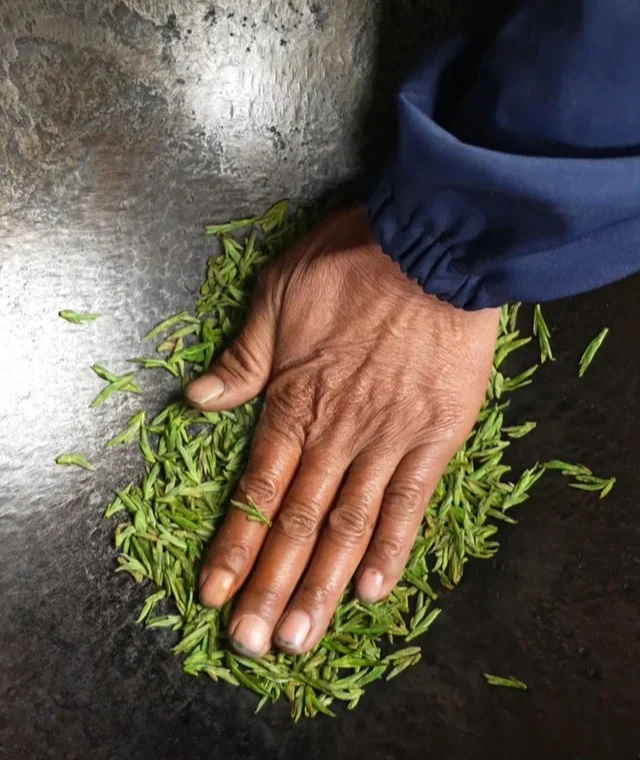
A pale, tightly rolled oolong and a dark twisted Wuyi tea can both be oolong while behaving very differently in water. Rolled leaf needs physical room and changes as it unfolds. Long twisted leaf exposes a different surface area. Broken tips extract quickly. Roast alters what heat reveals, but dark color does not by itself prove a heavy roast or a named origin.
UNESCO's record of Chinese tea processing and social practice includes Tieguanyin, Wuyi rock tea and Chaozhou gongfu tea within a much broader living system. It supports the existence of distinct regional knowledge; it does not turn one household timing table into a national rule.
Read five clues before heating water:
| Clue | What you can observe | Why it changes the baseline |
|---|---|---|
| Shape | Tight pellets, loose rolls or long twists | Controls expansion, packing and exposed surface |
| Breakage | Intact leaf, small fragments or dust | Smaller pieces usually extract faster |
| Roast evidence | Warm toast, charcoal, wood or darker leaf description | Often benefits from heat, but excess time can make roast coarse |
| Compression in the vessel | Leaf has room or is already crowded | Crowding blocks circulation and may slow decanting |
| Documented style | Tieguanyin, Wuyi rock tea, Phoenix Dancong or another named type | Gives a starting route, not automatic proof of identity |
The packet supplies a hypothesis. The cup decides whether the hypothesis survives.
See rolled and twisted leaf as different engineering problems
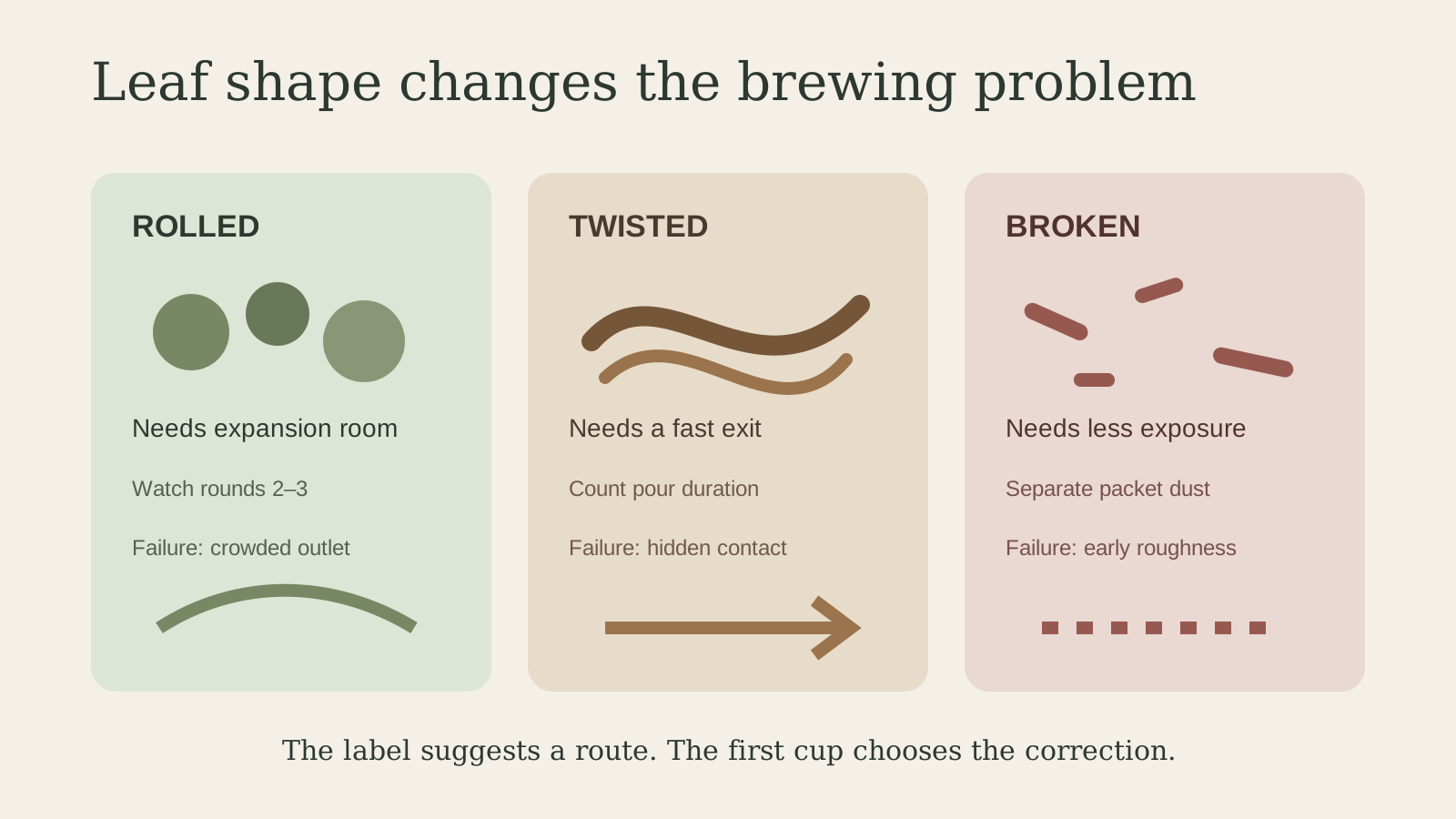
Rolled leaf is compact, so a small dry volume can become a much larger wet volume. Twisted leaf occupies the vessel unevenly, while broken tips expose more surface and often release roughness early. These are physical starting clues, not proof of cultivar, origin or processing quality.
| Physical form | Vessel decision | First timing decision | Failure to watch |
|---|---|---|---|
| Tight rolled leaf | Leave headroom for expansion | Do not assume the quiet first round means low dose | Later rounds crowd the lid and outlet |
| Long intact twists | Use a wide enough opening; avoid crushing into a basket | Begin with a fast complete decant | Fragrance becomes drying during a slow pour |
| Many broken pieces | Reduce dose or shorten the first contact | Treat the bottom of the packet separately if needed | Early bitterness blamed on the whole style |
| Dark roasted twists | Preheat and keep heat high enough to reveal the leaf | Shorten time before dropping temperature | Roast dominates because contact continued too long |
Use one measured starting table
| Oolong route | Leaf per 100 ml | Water | Begin decanting | First question |
|---|---|---|---|---|
| Light tightly rolled oolong | 5-6 g | 90-95°C | 15-25 sec | Does the cup retain freshness without raw sharpness? |
| Traditional roasted rolled oolong | 5-7 g | 95-100°C | 10-20 sec | Does roast frame the liquor rather than cover it? |
| Intact Wuyi-style twisted leaf | 5-7 g | 95-100°C | 8-15 sec | Does heat reveal body before dryness arrives? |
| Intact Phoenix-style twisted leaf | 5-6 g | 95-100°C | 5-10 sec | Does fragrance reach the cup before bitterness dominates? |
| Broken or dusty oolong | 4-5 g | 90-98°C | 5-10 sec | Can a lower dose and fast pour control roughness? |
For a larger mug or pot, begin near 3 g per 250 ml, use roughly 90-98°C water and taste at two minutes. Remove the leaf or decant the whole vessel. Extend only when the first result is clean but thin.
The numbers create a repeatable first attempt. They do not certify the tea, and they are not a promise that every seller's "Tieguanyin" or "Dancong" will respond identically.
Evidence supports testing ratios, not worshipping one optimum
A 2022 peer-reviewed study in npj Science of Food varied water-to-tea ratio, brewing temperature and time for specific Tieguanyin samples. Under its response-surface design, ratio affected all measured quality variables most strongly. The optimized conditions also differed among consumers who drank tea hardly, occasionally or almost daily.
That study used ratios and extraction times designed for its own experiment, including 80-127-second brews. It does not validate the short-infusion table above. It supports two narrower conclusions:
- Dose relative to water can change concentration and sensory acceptance substantially.
- One mathematically optimized cup is not automatically the preferred cup for every drinker.
This is why dose should be measured, preference should be recorded, and a result from one person or protocol should not become a universal oolong law.
Build the first infusion as a controlled baseline
1. Measure working volume and leaf
A seller's vessel capacity may describe brim fill rather than a safe working level. Measure the vessel with cool water, then calculate grams per actual working volume. Weigh the leaf; a teaspoon of pellets and a teaspoon of long strips are not comparable doses.
2. Preheat, then empty completely
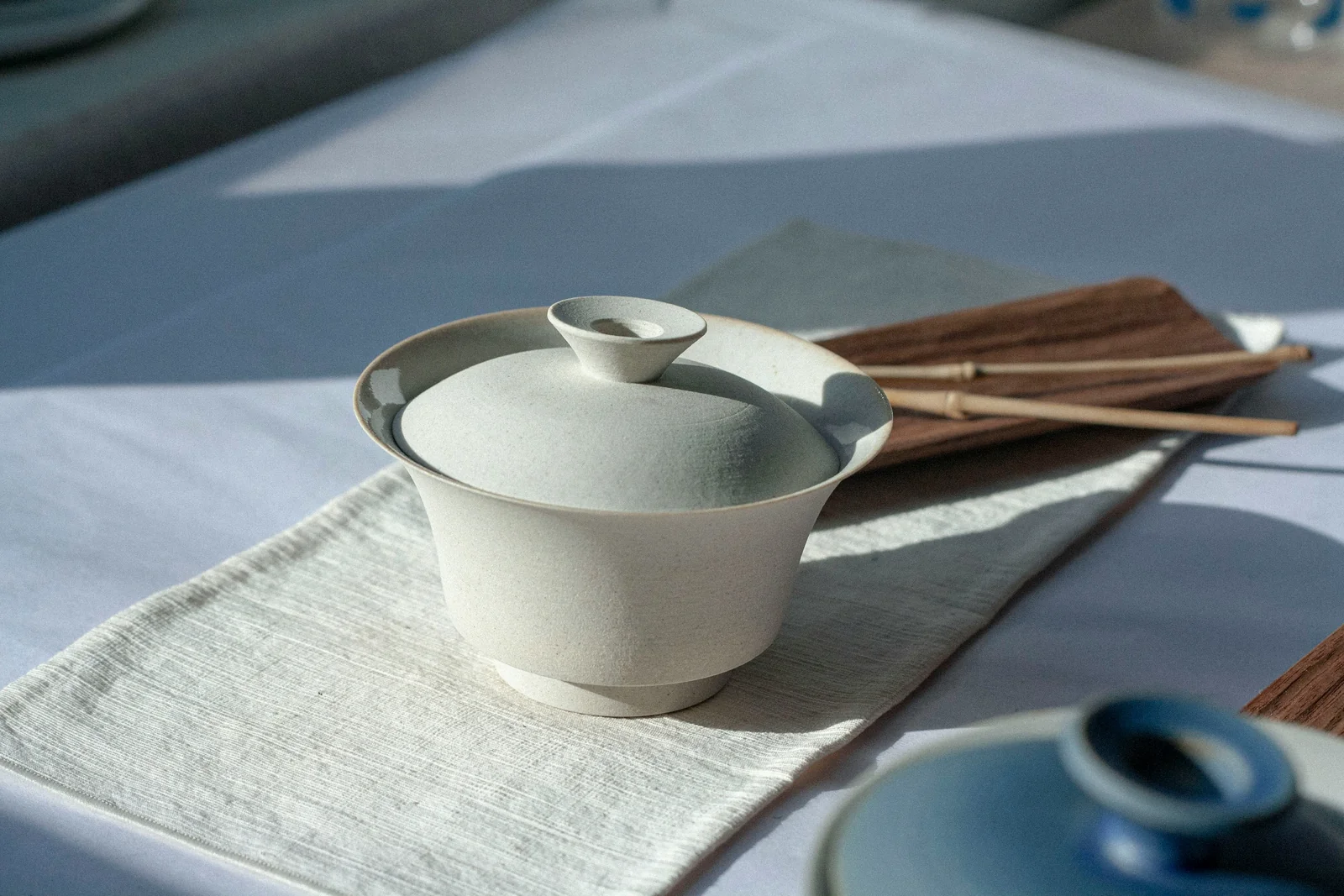
Warm porcelain or glass reduces avoidable heat loss, especially for aromatic or roasted oolong. Discard the preheat water safely before adding leaf. Preheating is a thermal decision, not proof of ceremony.
3. Add water consistently
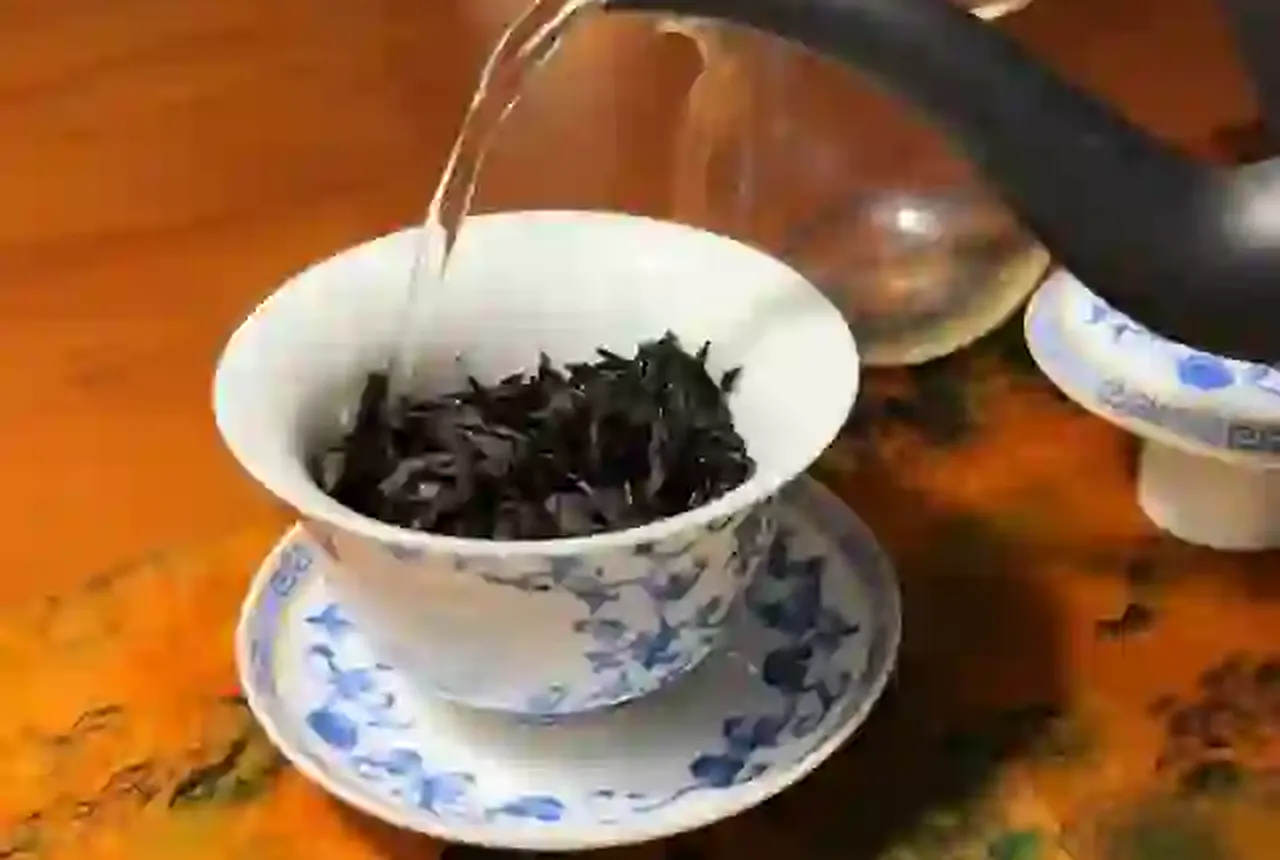
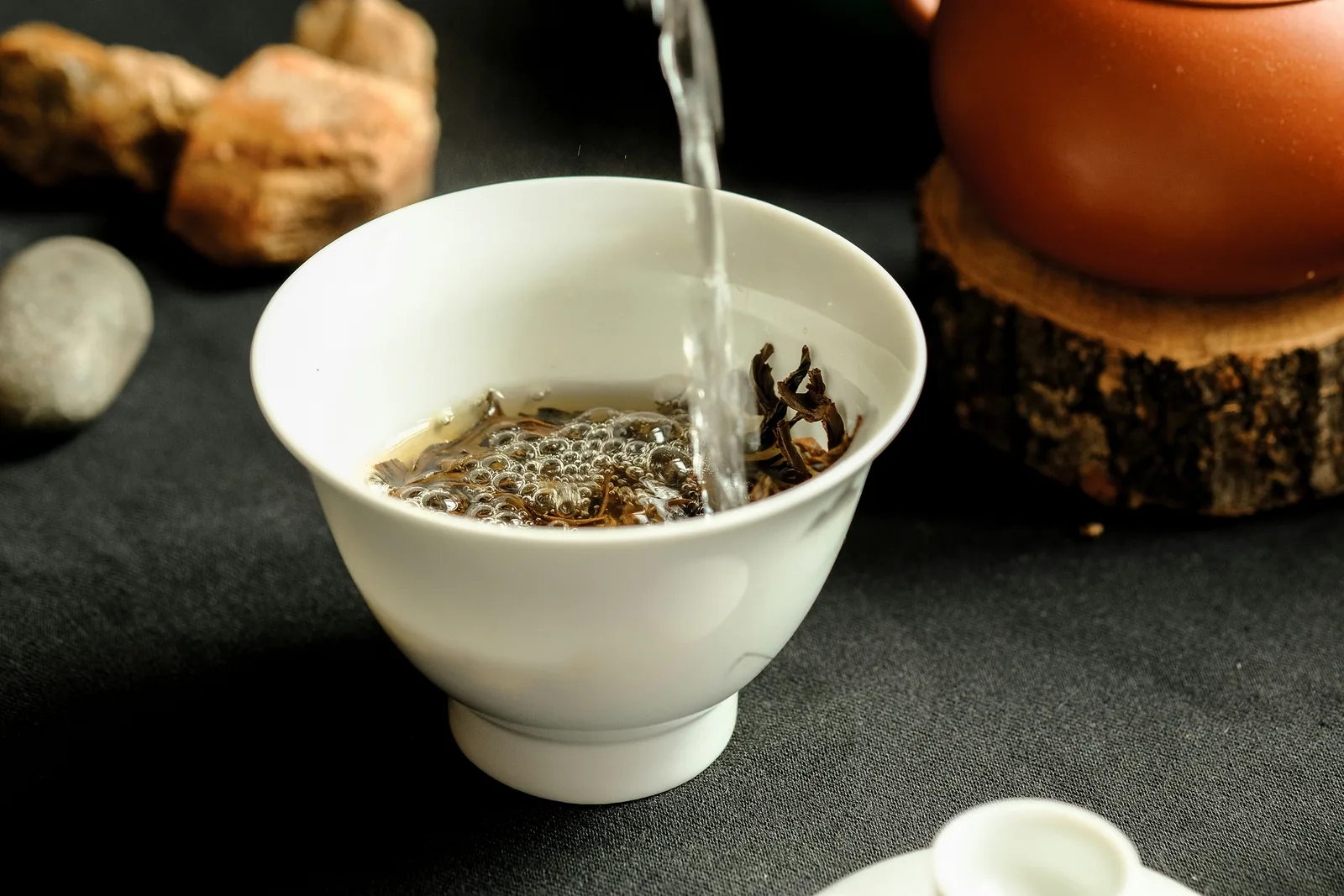
Pour close enough to control splashing and wet the leaf consistently. A dramatic high stream is not automatically better. The image shows water contact with twisted leaf; it cannot identify cultivar or origin.
4. Define timing and decant fully
- Start the clock when water first touches leaf.
- Begin decanting at the recorded target.
- Record pour duration separately.
- End extraction when the continuous stream finishes.
The required physical endpoint is a complete decant: when the continuous stream finishes, record the pour duration separately from the planned steep. Do not claim a universal pour time without a measured fill and repeated stopwatch trials.
5. Taste after slight cooling
Write one line about aroma, texture, bitterness or dryness, roast, sweetness and finish. A hot lid aroma can be spectacular while the liquor remains thin. The cup, not the lid, determines the next brewing decision.
Correct time now; correct dose in the next session
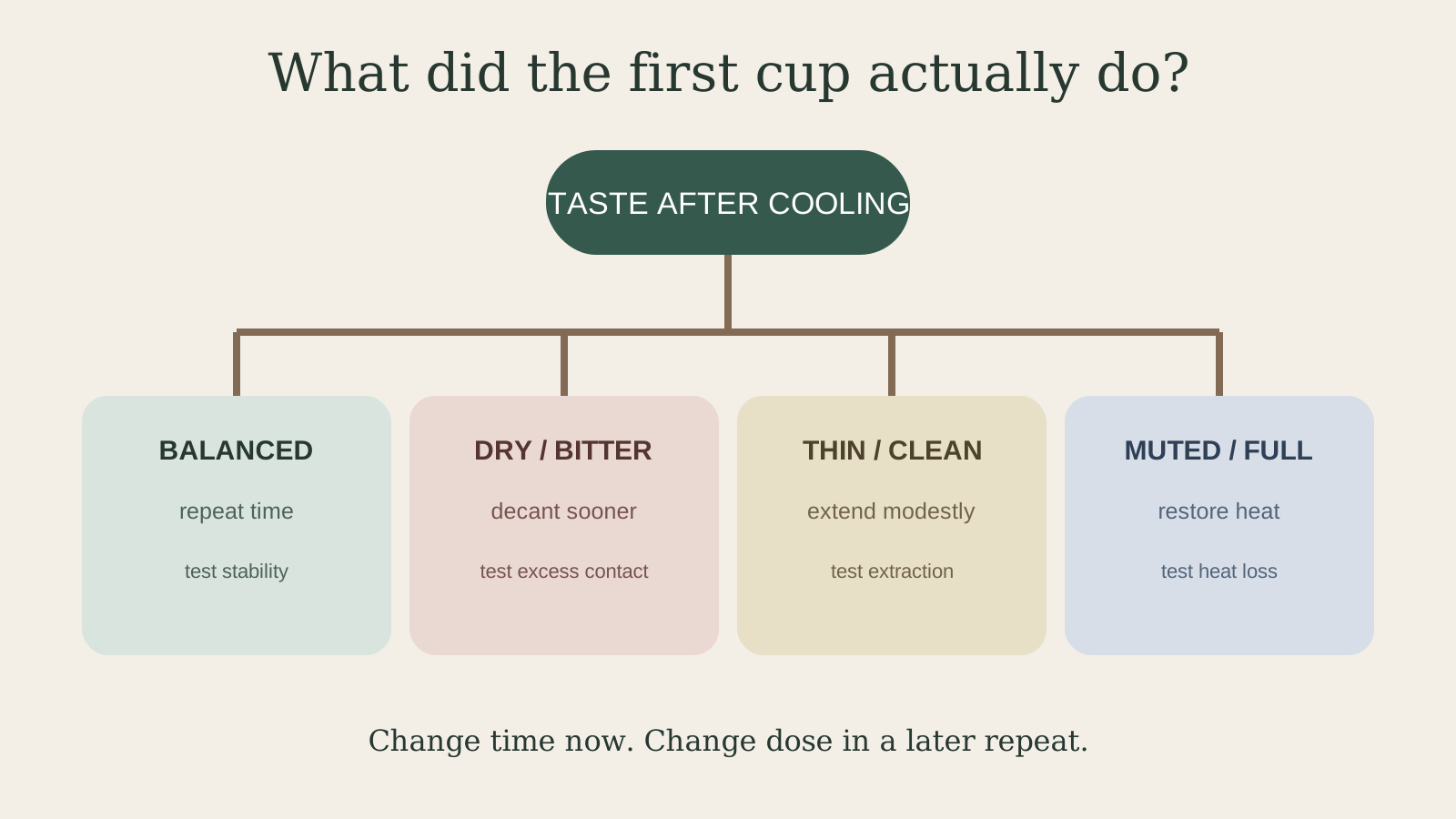
Within one session, keep leaf, water, vessel and temperature stable. Use time to test the diagnosis.
| First result | Next infusion | What it tests |
|---|---|---|
| Balanced and clear | Repeat the same target | Whether the result is stable as leaf opens |
| Bitter or drying before sweetness | Begin decanting about 25-30% sooner | Whether excess contact drove roughness |
| Thin but aromatic and clean | Add about 25-50% more contact time | Whether more extraction builds body |
| Muted with adequate body | Reheat water and vessel, then repeat | Whether heat loss hid aroma |
| Roast dominates but the liquor has structure | Shorten the next early round | Whether leaf character appears under less extraction |
| Outlet slows as leaf expands | Open the lid gap safely or use less leaf next session | Whether physical crowding is extending contact |
Do not remove leaf midway through a gongfu session and pretend the ratio stayed controlled. Record the problem, then run a later session with dose changed by a small measured increment, such as 0.5 g per 100 ml, while returning time to the original baseline.
| Later-session question | Session A | Session B |
|---|---|---|
| Is the tea thin because dose is low? | Original dose and best known time | Add 0.5 g / 100 ml; keep everything else fixed |
| Is the tea harsh because dose is high? | Original dose and best known time | Remove 0.5 g / 100 ml; keep everything else fixed |
This separates a time problem from a concentration problem. If both dose tests remain flat, inspect water, storage and the tea itself before adding more leaf.
Rolled oolong changes as it opens
The first contact hydrates a tight rolled leaf; later rounds expose more surface. Do not automatically lengthen every infusion just because the first cup was quiet.
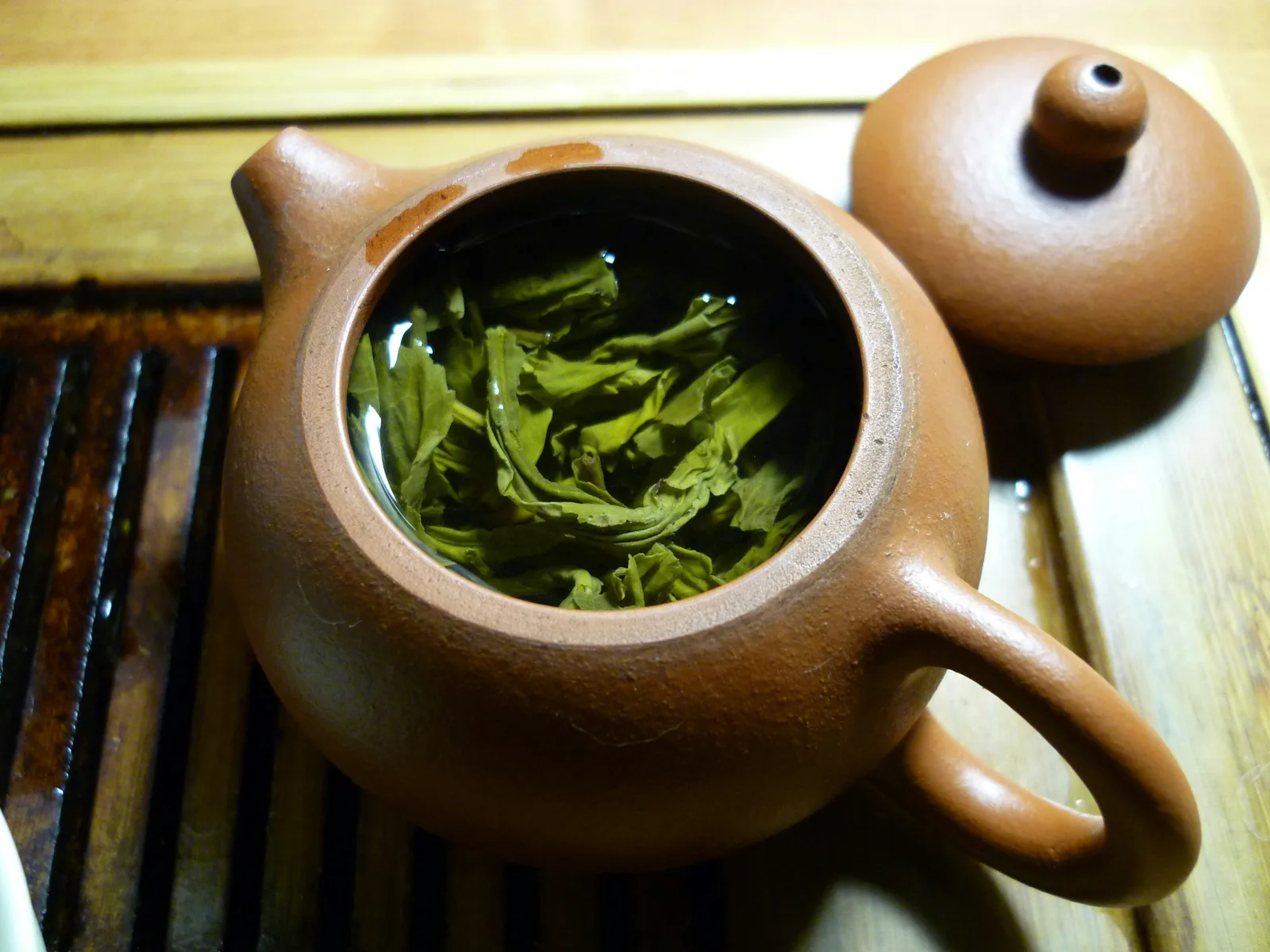
Compare the vessel before brewing and after the third round. The open leaf can reveal crowding, breakage and uneven wetting. It cannot prove Tieguanyin identity or origin.
For a light rolled oolong that becomes aggressively green, shorten time before lowering temperature. If very low heat leaves only perfume and no texture, restore heat and reconsider the tea. A Tieguanyin guide can help separate modern green and roasted style expectations.
Wuyi-style tea needs heat without unnecessary waiting
Most intact Wuyi-style twisted leaf benefits from a fully preheated neutral vessel and near-boiling water. The practical error is often not "too hot" but "hot and left too long."
If the first cup tastes only of charcoal, shorten time first. A coherent roast should eventually leave room for fruit, wood, spice, texture or a clearer leaf finish. Brewing cannot manufacture complexity that is absent.
The phrase yan yun, often translated as rock rhyme, belongs to Wuyi tasting culture. A lingering sensation may be meaningful to a drinker, but it cannot certify a cliff garden. Keep sensory response separate from provenance. The Da Hong Pao guide handles the product and origin questions.
Phoenix-style leaf requires an honest fast pour
Phoenix Dancong can be intensely aromatic and structurally bitter. Use an intact sample, a known vessel and a fast first decant. Do not chase the loudest lid aroma at the cost of a punishing cup.
Use the leaf form to understand why intact strips and broken tips can extract at different rates, not to authenticate a sample. A Phoenix label still requires its own production-area, aroma-name and batch evidence.
If fragrance is clear but the liquor is thin, extend time before adding leaf. If bitterness arrives before fragrance reaches the cup, shorten time and inspect the vessel's emptying speed. The Phoenix Dancong guide covers cultivar, aroma-name and origin boundaries.
Rinse only when the rinse has a job
A brief rinse can warm tightly rolled or roasted leaf, remove loose fragments or begin opening the material. It can also discard a fragrant first infusion. A rinse does not reliably remove caffeine, repair poor storage or make questionable tea safe.
For a controlled comparison, either skip the rinse or give both sessions the same measured rinse. Record it as contact with water. Do not silently rinse one batch and compare it with an unrinsed batch.
Stop when the cup stops giving useful information
The right number of infusions is the number still worth drinking. Five coherent cups are better evidence than ten pale cups made to satisfy a seller's endurance claim.
| Stage | Useful question |
|---|---|
| Opening rounds | Is the leaf hydrating evenly, and did roast or fragrance dominate too early? |
| Middle rounds | Do aroma, texture and sweetness become more integrated? |
| Later rounds | Does a clean finish remain after obvious intensity fades? |
| Stop point | Is the cup now mainly hot water plus memory? |
The best oolong method leaves you able to explain the next decision. Measure the system, classify the leaf, use enough heat, decant completely and change one variable. That is more demanding, and more useful, than copying a ceremonial-looking recipe.
Compare the wider Chinese oolong tea family, return to the tea-practice center, apply the broader Chinese tea brewing method, learn the measured gaiwan or practice the six-infusion gongfu tea protocol.