To brew Chinese tea well, make the first cup a measured baseline and the second cup a controlled correction. Identify the tea family, measure leaf and working water volume, choose either immersion or complete decanting, then change only one variable after tasting. There is no universal Chinese temperature or steep time because tender green tea, twisted oolong, bud-heavy white tea and compressed Pu-erh do not extract in the same way.
How to brew Chinese tea: treat the recipe as a starting hypothesis
The most common brewing mistake is not using the "wrong" number. It is changing dose, temperature and time together, then having no idea which decision made the tea better or worse.
I reject the fantasy that Chinese tea has one secret correct temperature guarded by experts. I believe the best recipe is the one a reader can repeat, criticize and improve with the leaf already on the table. The mistake is to copy a beautiful sequence while leaving dose, working volume and pour duration invisible. I insist that one variable must earn the next change; otherwise a sweeter second cup teaches nothing about why it improved.
Chinese tea practice includes leaves kept in an office glass, a family teapot refilled through a meal and concentrated gongfu tea in a small vessel. The tea-practice collection separates these jobs before the detailed recipes begin. UNESCO's record of traditional tea processing and associated social practices supports this diversity. It does not define one national brewing formula or require a ceremonial table.
A useful recipe must answer six questions:
- What tea family and visible leaf condition am I brewing?
- How many grams of leaf and how much working water are actually present?
- Will the leaf remain immersed, or will I separate all liquor from it?
- When does timing start, and when does extraction truly end?
- What did the first cup taste and feel like after cooling slightly?
- What single change will test the diagnosis in the second cup?
If those answers are missing, a precise number copied from a package is only false precision.
Choose the brewing mode before choosing the time
| Mode | Useful for | Starting structure | Main control problem |
|---|---|---|---|
| Cup or glass immersion | Green tea, casual drinking, office refills | Less leaf, more water, leaf remains in the vessel | Extraction continues while you drink |
| Larger teapot or mug | Family service and one longer infusion | About 3 g per 250 ml, usually 2-4 minutes | Slow pouring and liquor left on the leaf |
| Small vessel with full decant | Oolong, black, dark tea and comparison sessions | About 4-6 g per 100 ml, repeated short infusions | Heat, timing and complete emptying |
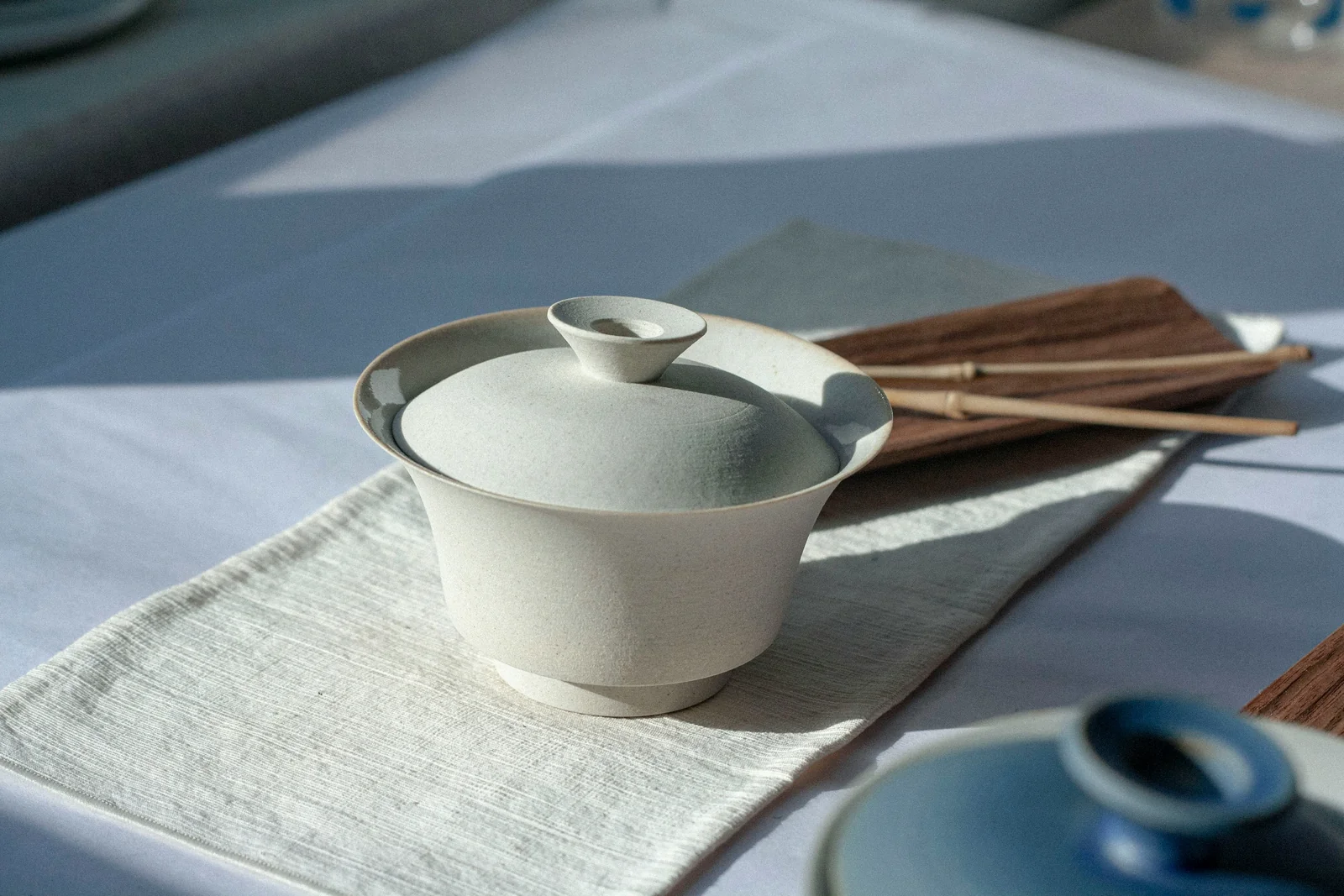
These modes are not beginner, intermediate and expert levels. They solve different jobs. A glass is often the more intelligent choice when the goal is a relaxed green tea. A small gaiwan is more informative when the goal is to compare short infusions.
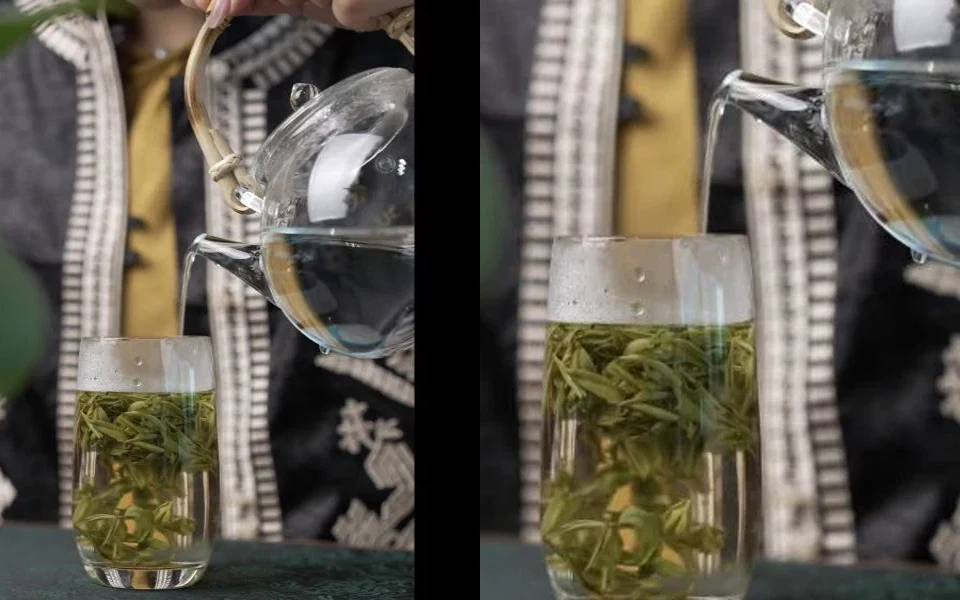
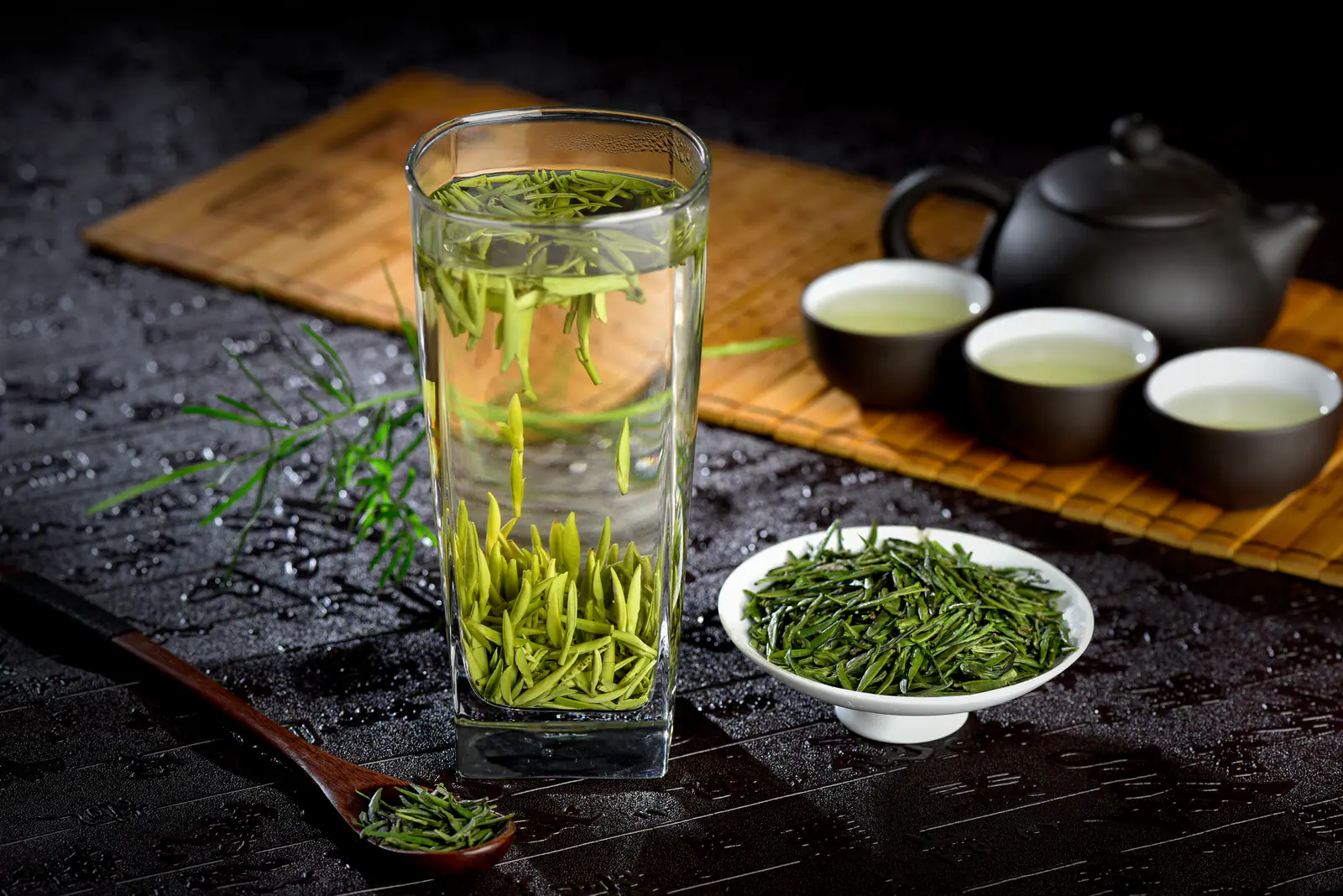
The glass sequence makes the key difference visible: the leaf remains in contact with water after the pour. Time does not stop when the kettle leaves the frame. Drink when comfortable and refill before the remaining liquor becomes overly concentrated; many drinkers refill while roughly one-third remains. That is practical extraction control, not ceremony.
Measure the system, not only the leaf
A digital scale solves two separate uncertainties:
- Weigh dry leaf because fluffy white tea, rolled oolong and dense broken leaf occupy very different spoon volumes.
- Measure the vessel's working water volume because seller labels and visual size do not reveal the amount you actually use below the rim.
Our reviewed real-vessel record shows a white porcelain gaiwan holding 111.3 g of water after taring at the demonstrated fill, approximately 111 ml for this household test. A second smaller sample held 79.4 g. These are two samples, not standard gaiwan specifications.
To measure your vessel, tare the empty bowl, add cool water only to the fill line you can safely use, and treat the added water mass as an approximate milliliter comparison. Then empty that volume into the intended pitcher and cups. Leaf displacement and retained liquor mean the finished yield will be lower than the water-only measurement.
Record dose as grams per measured working volume, not "one scoop per pot." A 6 g recipe means something different in 79 ml and 111 ml vessels.
Use family-specific starting points
| Tea family | Water starting range | Small-vessel starting point | What should change your decision |
|---|---|---|---|
| Green tea | 75-85°C | 2-3 g / 100 ml, 30-90 seconds | Tenderness, broken leaf and continuing immersion |
| White tea | 85-100°C | 4-5 g / 100 ml, 15-40 seconds | Bud-heavy versus mature leaf, age and compression |
| Yellow tea | 80-90°C | 2-4 g / 100 ml, 30-90 seconds | Tenderness and whether low heat makes the cup merely thin |
| Oolong | 90-100°C | 5-7 g / 100 ml, 5-20 seconds | Rolled or twisted form, roast, breakage and pour speed |
| Chinese black tea | 90-100°C | 4-5 g / 100 ml, 10-30 seconds | Whole versus broken leaf and early dryness |
| Dark tea and Pu-erh | 95-100°C | 5-7 g / 100 ml, 10-30 seconds | Compression, storage condition and how quickly leaf opens; use the Pu-erh brewing guide for raw, ripe and compressed-leaf diagnosis |
These are East Moment diagnostic ranges synthesized for first tests, not historical rules or producer guarantees. The wider a tea family is, the less useful one exact recipe becomes. A broken black tea can extract faster than a whole-leaf one; a tightly compressed tea may open slowly; a tender green tea can become coarse under heat that suits a roasted oolong.
Use the family pages when the material needs a narrower route. The oolong brewing guide separates rolled, twisted and roasted styles rather than forcing them into one recipe.
Build the first cup as a baseline
1. Inspect and weigh the leaf
Record whether the material is intact, broken, rolled, twisted, fluffy or compressed. Appearance cannot authenticate origin or quality, but it predicts how quickly water can reach more surface area.
2. Heat water and wet the leaf consistently
Pour with enough control to wet the leaf consistently. A dramatic high stream is not automatically better. The image documents water meeting twisted leaf in a gaiwan; it does not identify the cultivar, mountain or producer.
3. Define the clock
For a fully decanted vessel:
- Start timing when water first contacts leaf.
- Begin pouring at the recorded target time.
- Record the pour duration separately.
- Treat extraction as finished when the continuous stream ends.
If a recipe says 10 seconds and the pot takes another 12 seconds to empty, the leaf did not experience only 10 seconds of contact. A slow vessel changes the recipe.
4. Empty the vessel completely
The hero photograph documents a real gaiwan-to-pitcher decant. It does not support a universal pour-speed number because the fill volume and repeated time were not measured for that shot. Its practical lesson is simpler: liquor left among the leaves continues extracting.
5. Taste after the cup cools slightly
Record five short observations: aroma, texture, bitterness or dryness, sweetness, and finish. "Good" is not enough to guide the next cup. "Aromatic but thin, clean finish" suggests a different action from "full but drying after swallowing."
Make the second cup a controlled correction
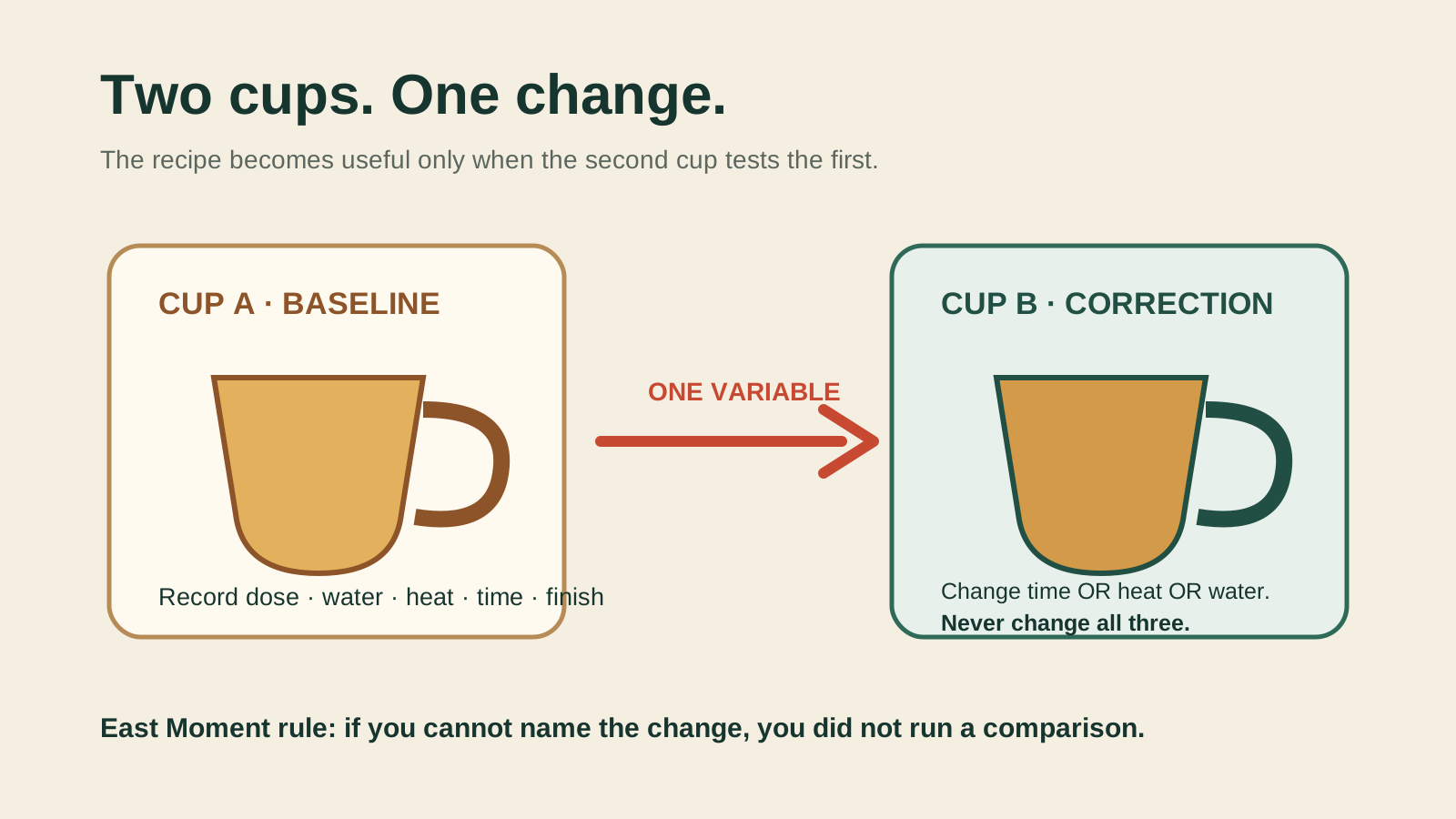
Use the same tea, water source, vessel, dose and temperature. Change only contact time first.
| First-cup result | Second-cup change | What the comparison can show |
|---|---|---|
| Balanced and clear | Repeat the same time | Whether the baseline is reproducible |
| Harsh, bitter or drying | Begin decanting sooner | Whether excess contact drove the roughness |
| Thin but aromatic | Add 25-50% more time | Whether added extraction builds body and finish |
| Muted but not harsh | Check water and vessel heat, then repeat | Whether heat loss, not dose, hid aroma |
| Uneven strength among cups | Combine in a pitcher or improve distribution | Whether the problem was service rather than tea |
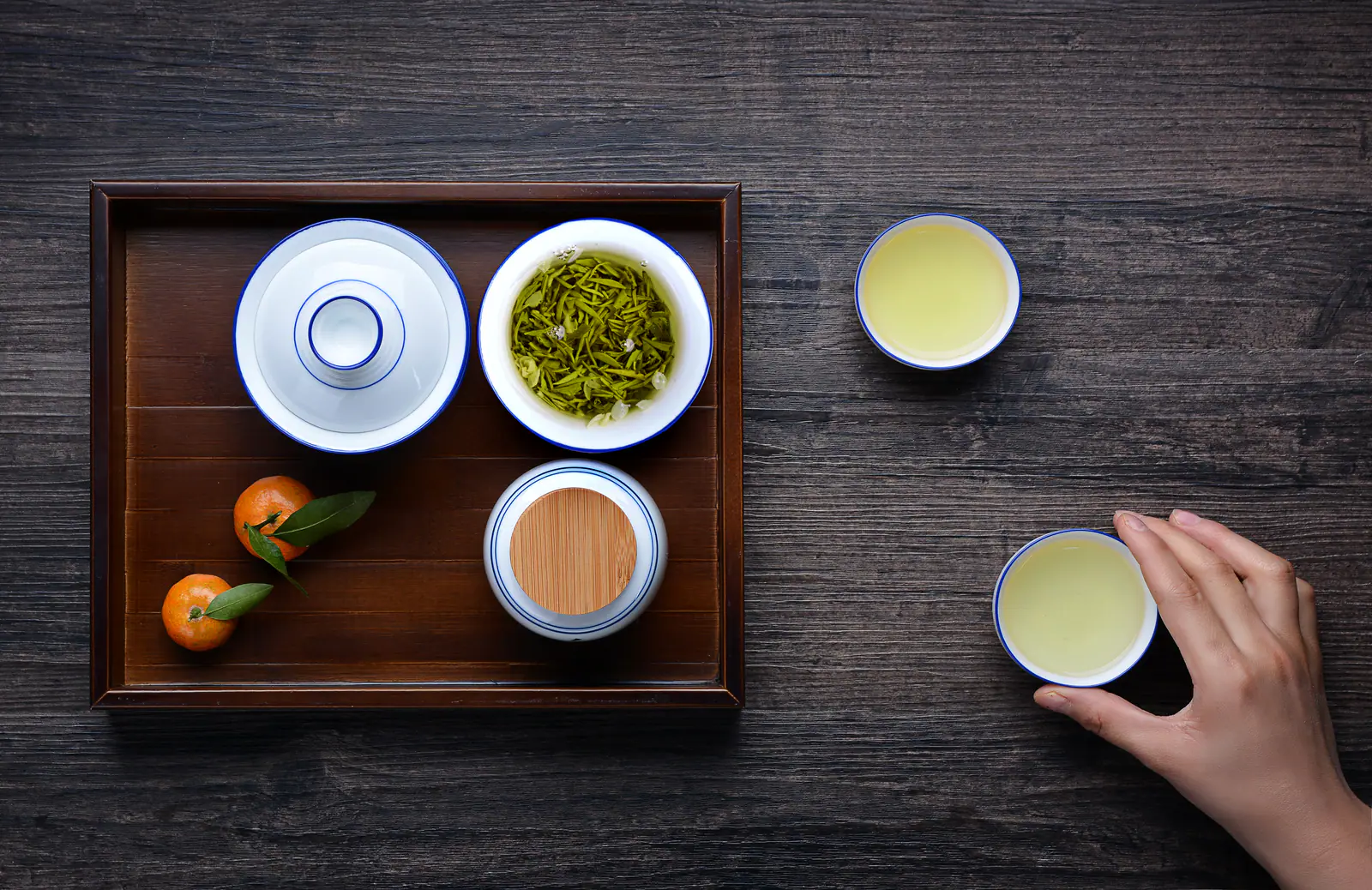
The photograph shows a real two-cup service setup; it does not prove that the visible cups were brewed under a laboratory protocol. Use the arrangement to run your own A/B comparison:
| Field | Cup A: baseline | Cup B: one change |
|---|---|---|
| Tea and batch | Same | Same |
| Water source | Same | Same |
| Vessel and working volume | Same | Same |
| Dose | Same | Same |
| Temperature | Same | Same |
| Contact time | Record | Change only this |
| Result after cooling | Record five observations | Compare the same five observations |
Do not search for the least bitter cup by default. The better cup is the one where aroma, texture and finish hold together. Some Dancong and young raw Pu-erh use bitterness as structure; the relevant failure is roughness that dominates and does not resolve.
Temperature becomes testable when everything else stays fixed
Once time is under control, temperature can be the next-session variable. A 2025 Food Chemistry: X study compared specific premium and standard Longjing samples at 70, 80, 90 and 100°C using four-minute infusions and a trained nine-person panel. Under that protocol, 70-80°C favored umami or mellow perception and reduced bitterness and astringency.
That result does not prove all Chinese green tea should be brewed at 70°C. It proves something more useful: temperature effects can be compared when sample, dose, water, vessel and time are held stable. The Longjing guide translates that bounded evidence into a 70/80/90°C reader test.
For other tea families, test two temperatures in separate sessions after establishing a repeatable time. Do not compare a cooler long infusion against a hotter short one and claim temperature caused the difference.
Water deserves one controlled comparison, not luxury claims
Strong chlorine odor can flatten aroma. Very hard water may make a subtle tea feel heavy or muted; very low-mineral water can feel thin. Filtered tap water or a moderate bottled water is a practical baseline.
Compare two accessible waters with the same tea, dose, vessel, temperature and time. Choose the water that gives the clearer total cup, not the more prestigious label. Clean visible kettle scale. Reheating once is not a cultural error, but repeated unattended boiling can concentrate minerals as water evaporates.
Do not change water in the middle of a time test. Water deserves its own A/B session.
Read leaf and liquor together
Spent leaf can reveal heavy breakage, uneven wetting or a compressed center that has not opened. It cannot authenticate a cultivar, village or grade from appearance. Taste the liquor first, then use the leaf to test a diagnosis.
| Symptom | First action | What not to assume |
|---|---|---|
| Bitter and drying | Shorten time | That the whole tea family requires cooler water |
| Thin but fragrant | Extend time; add leaf only in a later session | That pale color means low quality |
| Flat aroma | Check fresh heat, water and storage | That more leaf restores aroma lost in storage |
| Strong first cup, dead second | Shorten the first cup | That the advertised infusion count is guaranteed |
| Sour, damp or moldy | Stop drinking and review storage | That rinsing repairs contamination |
| Every round tastes identically perfumed | Let liquor cool and inspect the changing leaf aroma | That persistent perfume proves natural quality |
Rinse only when it solves a named problem
A quick rinse can loosen compressed tea, warm leaf or discard a first contact when storage and practice justify it. It does not reliably remove caffeine, purify questionable tea or improve every leaf.
If you rinse during a comparison, record the rinse as a separate contact with water. Do not rinse one cup and not the other while claiming time is the only changed variable. Tender green tea and aromatic black tea may lose a useful first infusion when rinsing becomes automatic.
Service is part of the brewing result
For several drinkers, a fairness pitcher combines one infusion before division. Direct pouring can also be even when the brewer alternates among cups. The photograph demonstrates shared service, not tea identity or origin.
Keep the kettle, cord and waste water outside reaching paths. Ask before refilling; repeated small cups still add to total caffeine. All true tea from Camellia sinensis contains caffeine, and a quick rinse does not make it caffeine-free.
The shortest complete learning route
Use one tea for three sessions:
- Session one: measure the system and create a baseline.
- Session two: repeat, changing only time based on the first result.
- Session three: keep the better time and compare either temperature or water.
Write only dose, working water volume, temperature, timing convention and one sentence about the finish. At the end, you should be able to explain which change improved the cup and why. That is more valuable than memorizing a ceremonial sequence or collecting recipes that cannot be reproduced.
Choose the right family through types of Chinese tea, learn the measured gaiwan method, practice concentrated gongfu tea, build a functional Chinese tea set or simplify the system for a travel tea set.