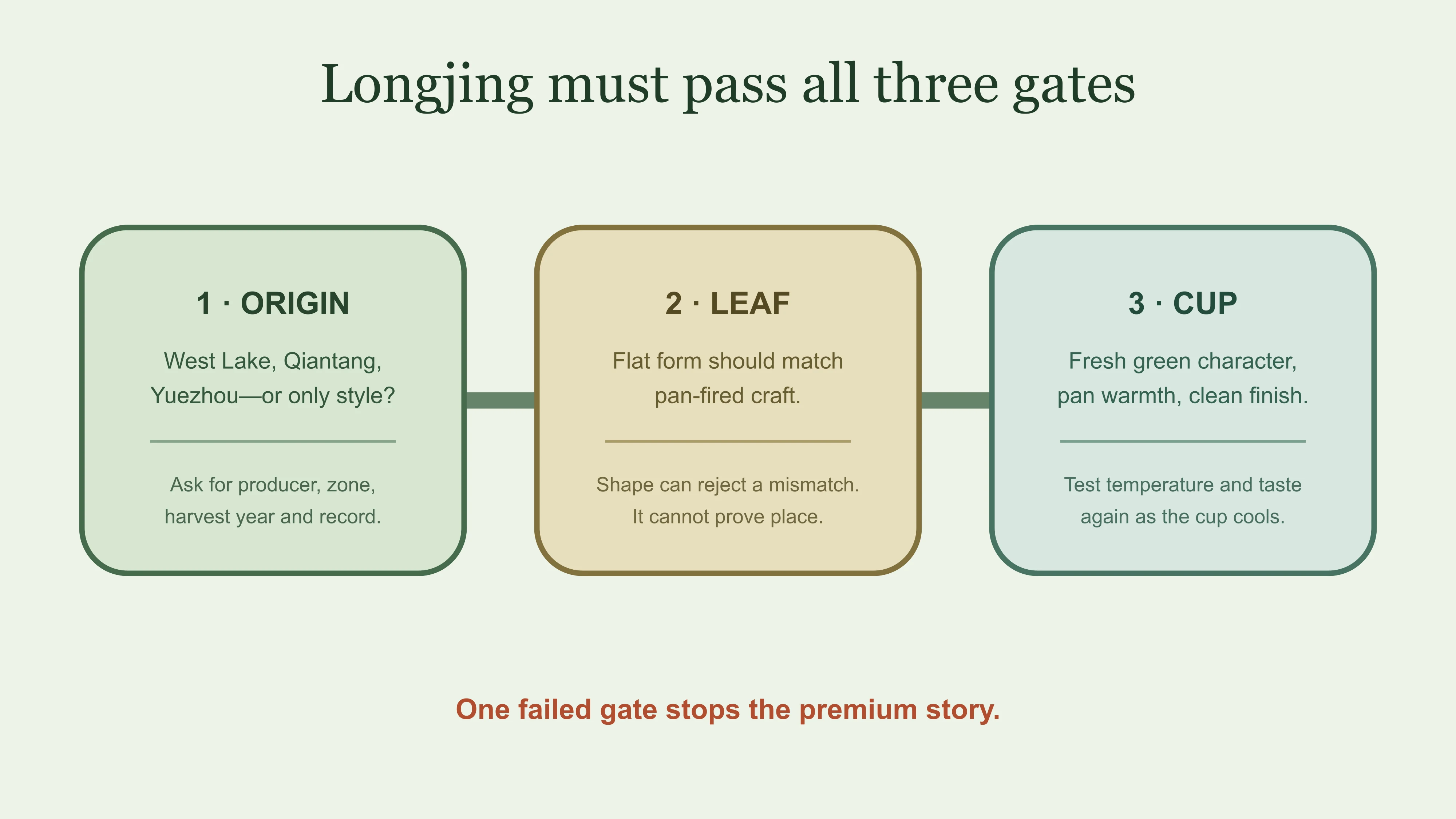
Longjing tea, or Dragon Well tea, is a pan-fired Chinese green tea from protected production areas in Zhejiang. Its leaves are pressed and guided into a flat form during firing. But flat leaves do not authenticate Longjing, and the word “Hangzhou” does not authenticate West Lake Longjing. A worthwhile tea must align three things: credible origin language, clean flat-leaf craft and freshness that survives the cup.
Longjing tea verdict: make origin, craft and freshness agree
Use this order when judging a tea. It prevents the most common mistake: allowing one attractive clue to carry an entire sales story.
- Read the claimed place. Is the seller saying Longjing, West Lake Longjing or only “Dragon Well style”? These are not interchangeable claims.
- Inspect the material. The dry leaf should make sense for a flat-fired green tea, but shape can only exclude obvious mismatches; it cannot certify origin.
- Test the cup. Fresh aroma, integrated pan warmth and a clean finish matter more than an immaculate green tin or a famous calendar date.
My conclusion is deliberately stricter than most buying guides: origin, craft and freshness must agree; none can substitute for the other two. A beautifully flat tea can come from the wrong place. A protected place name can still contain tired tea. An early harvest can still be poorly made.
Start with the Chinese green tea collection when you need category context. Stay here when the decision is narrower: whether a specific Longjing claim survives the label, leaf and cup.
Longjing, West Lake Longjing and flat green tea are different claims
The official Chinese standards record for GB/T 18650-2008, Product of Geographical Indication—Longjing Tea identifies Longjing as a geographical-indication product. Within the recognized Zhejiang framework, West Lake is the narrowest and most prestigious name; Qiantang and Yuezhou are also Longjing production areas. An English package that says only “Dragon Well” may hide which claim it is actually making.
| Label you see | What it should mean | What you still need |
|---|---|---|
| West Lake Longjing | A Longjing product claiming the protected West Lake production area | Traceable producer or cooperative, harvest year and evidence supporting the narrow place name |
| Longjing tea | A Longjing product from a recognized Zhejiang production area | The specific zone, harvest information and producer record |
| Longjing-style / flat green tea | Tea made to resemble the flat-fired style without claiming protected origin | Honest origin and processing description; judge it on quality rather than borrowed prestige |
| Dragon Well with no Chinese name or zone | Ambiguous retail language | Ask which of the three claims above the seller actually means |
This is the Chinese context an overseas buyer is most likely to miss: 龙井茶 is not simply a leaf shape translated into English. A protected place name carries local labor, reputation and market value. Calling every flat green tea “Longjing” converts regional knowledge into a decorative style.
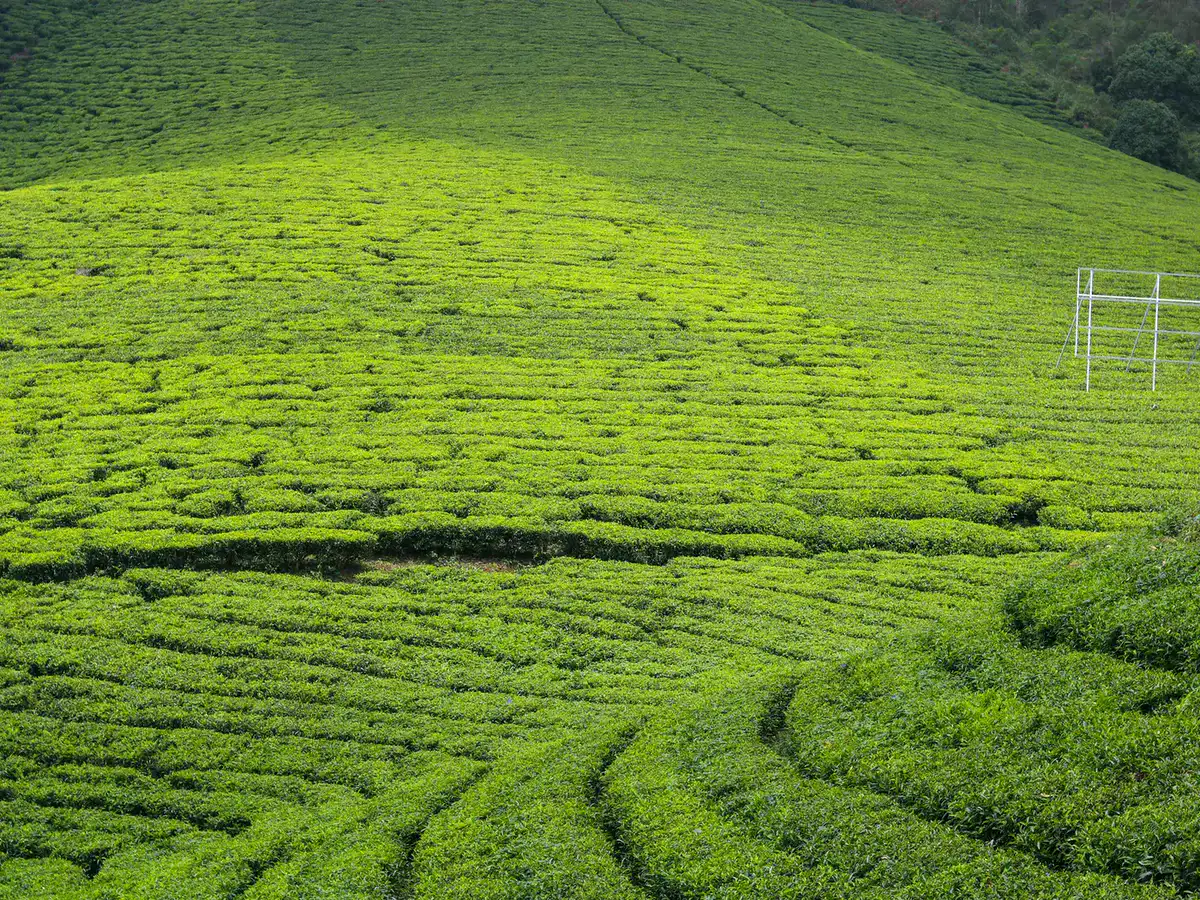
A tea-garden photograph cannot close that evidence gap. Our image above visibly documents cultivated tea bushes; it does not identify a village, cultivar, harvest date or protected zone. Sellers should meet the same standard. Scenic West Lake copy is atmosphere, not traceability.
Why Longjing is flat: contact, heat and pressure
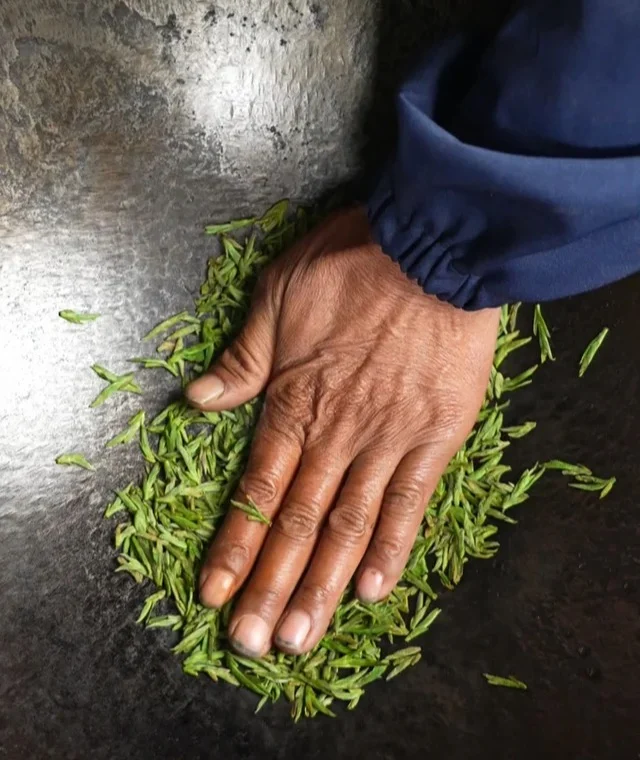
Longjing leaves do not grow as finished flat blades. After plucking and spreading, heat limits enzymatic oxidation; during firing and shaping, the maker repeatedly moves, presses and guides the leaf against a heated surface. Moisture, leaf tenderness, pan temperature and force all change while the leaf becomes flatter and drier.
This real pan-firing image shows the physical relationship that generic descriptions usually omit: broad hand contact distributes pressure while the leaf moves across the pan. It supports the explanation of hand shaping, not the identity of every leaf in the finished market.
| Stage | What changes | What failure may taste or look like |
|---|---|---|
| Plucking | Tender shoots are selected to a picking standard | Mixed maturity can produce uneven appearance and extraction |
| Spreading | Fresh leaf loses some moisture and becomes workable | Poor control can flatten aroma before firing begins |
| Fixing and shaping | Heat slows oxidation while contact and movement build the flat form | Excess heat or stalled movement can produce scorch, harshness or broken leaf |
| Final drying | Moisture is reduced for stability | Under-drying weakens storage; over-drying can leave a thin or baked impression |
UNESCO's 2022 inscription of China's traditional tea-processing techniques and associated social practices places Longjing within a living system of cultivation, making, drinking and social practice. That recognition should not be reduced to the word “handmade.” Machines assist much modern production. Hand work is not automatically excellent, and machine-assisted work is not automatically poor. “Handmade” is a process claim that needs a record, not a quality grade.
Flat shape is an exclusion clue, not a certificate
The best use of leaf shape is negative. A curled spiral does not match Biluochun's role and a fine needle does not match Longjing's broad flat form. But once a tea looks plausibly flat, appearance has reached its limit.
Compare three famous green teas without turning the comparison into an authentication shortcut:
| Tea | Typical dry-leaf direction | Main shaping difference | Common cup direction |
|---|---|---|---|
| Longjing tea | Flat, pressed leaf pieces | Pan contact and pressure emphasize a broad flat form | Tender greens with bean, warm grain or restrained toasted notes |
| Biluochun | Fine curled spirals, often visibly downy | Rolling and curling retain a spiral form | Floral, tender green or lightly fruity impressions |
| Huangshan Maofeng | Slender buds and leaves, often downy | Gentler shaping leaves a more natural slender form | Soft green, floral and light sweet impressions |
Color is equally limited. A yellow-green Longjing is not automatically old, and a vivid green one is not automatically fresh. Cultivar, firing and grade affect appearance. An implausibly neon, perfectly uniform sample deserves questions, but no shade proves a protected origin.
Mingqian, Yuqian and grades: timing is not a quality certificate
Mingqian means picked before Qingming; Yuqian refers to the period before Guyu. These terms describe harvest timing, not geographical identity. “Pre-Qingming West Lake Longjing” therefore stacks at least two claims: a narrow origin and a picking period. Evidence for one does not prove the other.
Earlier leaf is often tender, scarce and expensive. It is not automatically the best drink. A slightly later harvest can have more body and tolerate brewing better; a poorly fired early tea can be less complete than a well-made later one. I would buy a traceable, fresh Yuqian tea before a vague “imperial Mingqian” tin every time.
Words such as “imperial,” “supreme” and “competition grade” also need context. Ask which grading system or producer specification they refer to. If the answer is only another adjective, the word is packaging.
How to buy Longjing tea when the origin names overlap
A first-time buyer does not need to memorize every village, but should know what each name is doing in the sentence. West Lake narrows the geographical claim. Longjing names the wider protected product family. Hangzhou may describe the city, a retail address or a broad regional association. Dragon Well style may describe a processing shape without claiming protected origin.
Ask the seller to rewrite the listing as a complete sentence: “This is [product family], made in [specific area], from [material or blend], harvested [date or season], processed [method], packed [date].” If the seller can fill only the first and last blanks, the tea may still be enjoyable, but the price should reflect uncertainty.
For a practical two-sample comparison, buy one traceable Longjing from a named Zhejiang production area and one honestly labeled flat green tea from outside the narrow West Lake claim. Brew both at 70°C, 80°C and 90°C with the same dose. This does not prove which origin is “better.” It reveals whether the premium story produces a difference you can actually taste and whether the seller's description survives a controlled cup.
That is a more useful learning route than buying the most expensive tin first. It separates origin value, craft value and drinking value so a buyer can decide which one they are paying for.
Read Longjing in three states
Do not decide from the dry packet alone. Use dry leaf, liquor and spent leaf as three separate evidence windows.
| State | What to inspect | How to read the result |
|---|---|---|
| Dry leaf | Form, breakage and aroma | Plausible flat form and clean, lively aroma are useful; stale oil, mustiness, perfume, heavy dust or unrelated form require investigation |
| Liquor | Clarity, texture and finish | Freshness joined to bean, grain or restrained toast is promising; flat aroma, sour storage character or harshness that never opens is not |
| Spent leaf | Picking consistency, tenderness and cooled aroma | Leaf should reasonably match the stated picking standard; coarse mature leaf, burnt aroma or sour mustiness can contradict the sales story |
The spent leaf is not a courtroom. It cannot identify a village or prove handwork. It can expose contradictions. If an “all-bud early spring” story ends as a bowl dominated by coarse mature leaves, the material and the marketing are not describing the same tea.
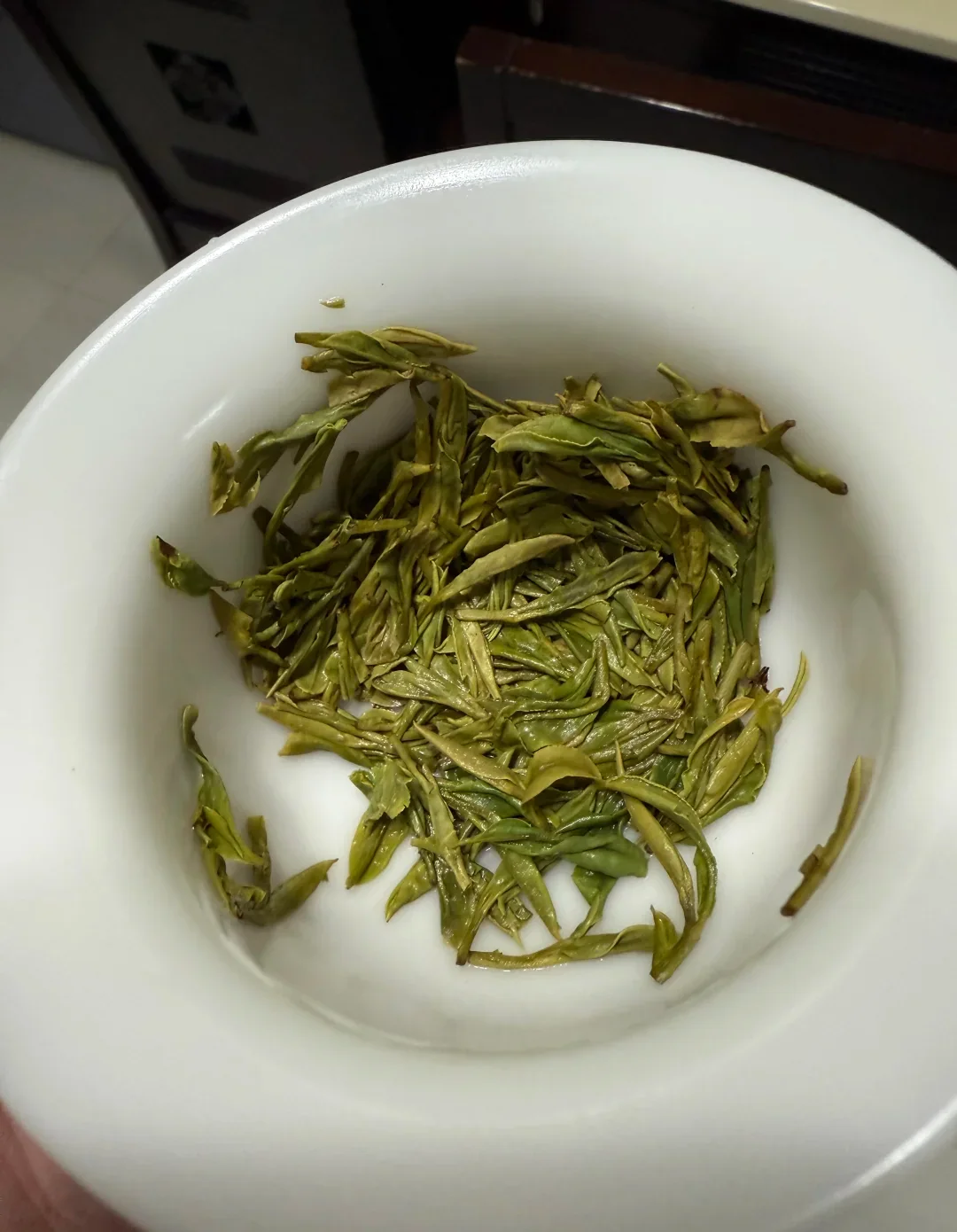
This is the kind of ordinary bowl I trust more than a seller's arranged handful. The opened material lets me inspect leaf size, breakage and how consistently the pieces have unfurled. It still cannot authenticate West Lake origin, a 2025 harvest, Lion Peak, hand-firing or grade. Its value is narrower and more honest: it shows exactly where a buyer should look when the leaf finally stops posing for the packet.
What Longjing tea should taste like
Well-kept Longjing often moves between tender bean, cut green, warm grain and a restrained roasted-nut or chestnut-like impression. The important quality is not whether you say “bean” or “chestnut.” It is whether fresh green character and pan warmth feel integrated rather than raw on one side and scorched on the other.
Use this diagnostic sequence:
- Fresh but aggressively grassy: lower temperature first; if raw harshness remains across careful brews, the issue may be the tea rather than technique.
- Roasted aroma dominates, finish turns dry: shorten time; persistent char or burnt aroma points toward heavy firing or damage.
- Clean but nearly empty: increase leaf slightly only after checking water and freshness. More leaf cannot restore aroma lost in storage.
- Perfume leaps out but the liquor has no corresponding depth: investigate added flavoring or misleading scent claims.
- Gentle first sip, clean returning sweetness after swallowing: this matters more than a memorized tasting-note list.
How to brew Longjing tea: start at 80°C, then test it
For a new tea, use 2 grams per 100 milliliters, water around 80°C / 176°F and a 90-second first comparison infusion. This is a diagnostic starting point, not a universal ceremony. Softer water usually reveals a subtle green tea more clearly than very hard or strongly chlorinated water.
A 2025 Food Chemistry: X study compared premium and standard Longjing at 70, 80, 90 and 100°C using four-minute infusions and a nine-person trained panel. Under that protocol, 70-80°C favored umami or mellow perception and reduced bitterness and astringency, with 70°C performing best. That does not prove every retail Longjing must be brewed at 70°C. The study used specific samples and a much longer extraction than the practical test below.
The controlled 70/80/90°C three-cup test
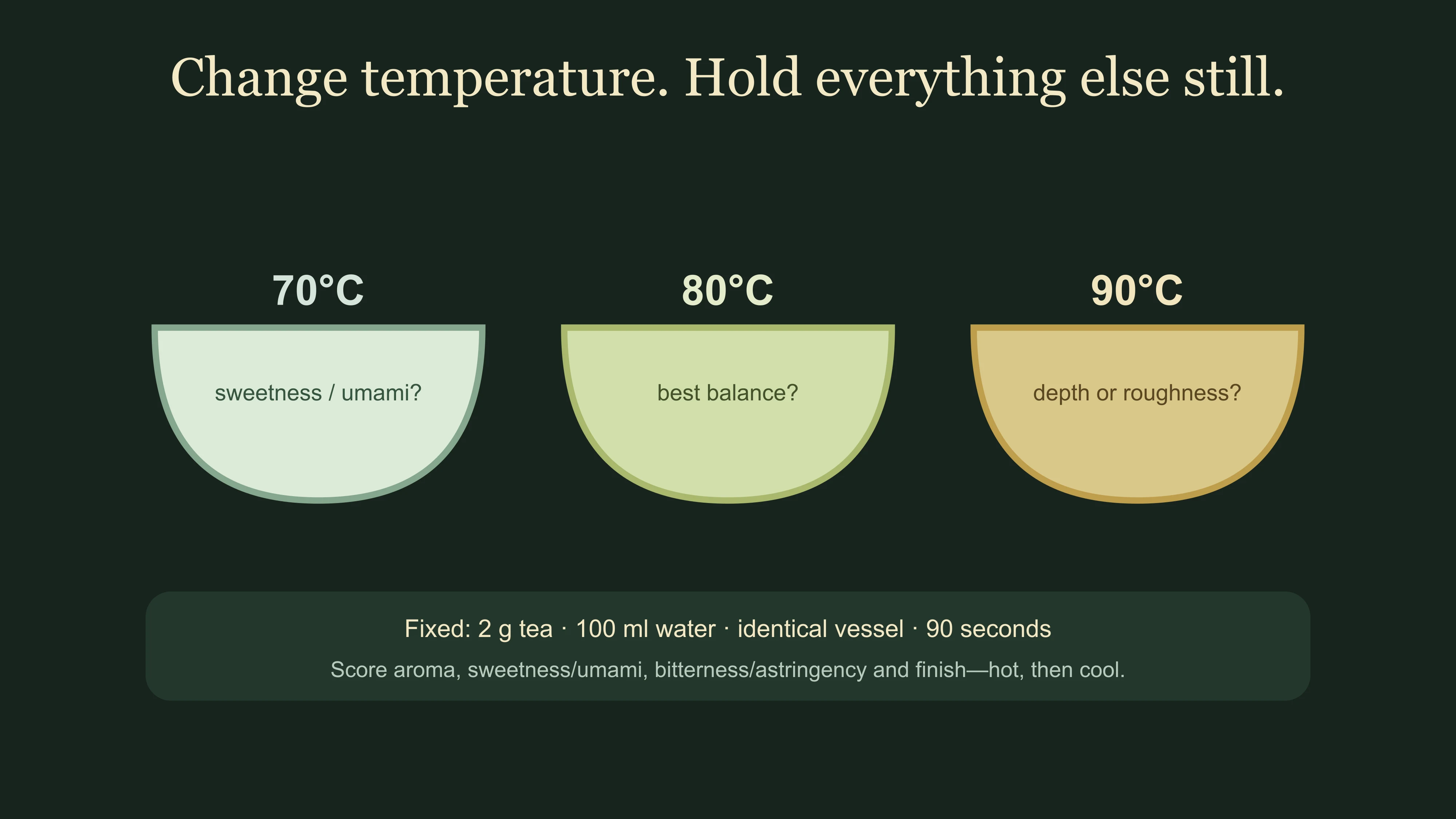
Use identical white porcelain cups or gaiwans. Keep the tea, water source, dose, vessel and time fixed. Change only temperature.
| Cup | Fixed setup | Question to record |
|---|---|---|
| 1 | 2 g / 100 ml, 70°C, 90 seconds | Does sweetness or umami emerge, or does the tea feel muted? |
| 2 | 2 g / 100 ml, 80°C, 90 seconds | Is this the best balance of aroma, texture and finish? |
| 3 | 2 g / 100 ml, 90°C, 90 seconds | Does higher heat reveal depth, or only bitterness and astringency? |
Smell each cup hot and again as it cools. Score four things from 1 to 5: aroma, sweetness/umami, bitterness/astringency and finish. The winning cup is not the least bitter by default. It is the cup in which aroma, texture and aftertaste form the most complete shape.
This corrects a common problem in Chinese tea discussions. Readers ask whether low or high temperature is correct and whether water or tea should enter first, but those questions have no universal answer. Temperature and pouring order are variables to test against the actual leaf.
Glass or gaiwan? Choose by task
| Your task | Better first choice | Why and tradeoff |
|---|---|---|
| Office or casual drinking | Tall heat-safe glass | Easy refills and visible leaves, but the tea continues extracting while you drink |
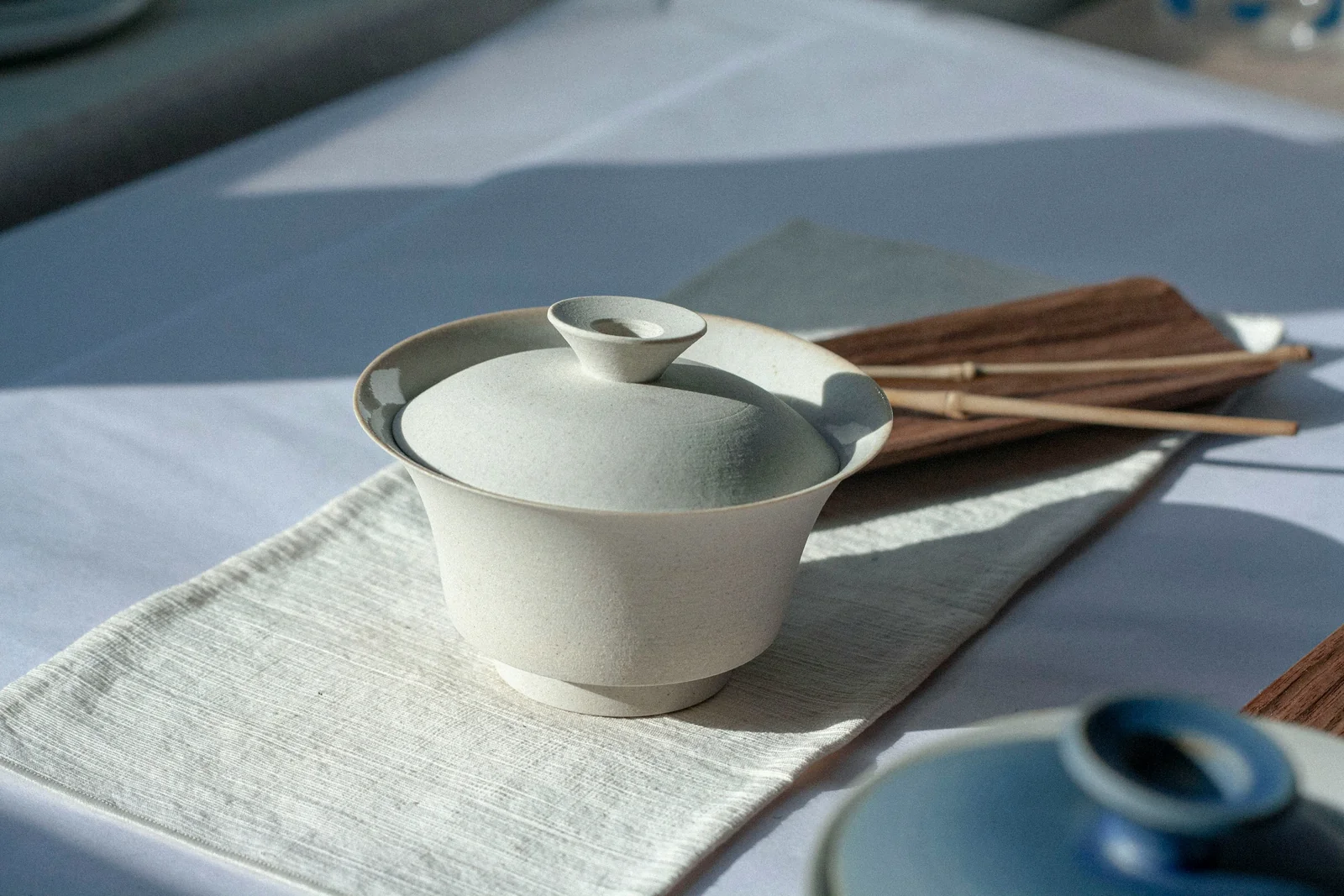
| Comparing temperatures or batches | Porcelain gaiwan | Repeatable dose, time and complete decant, provided the pour is quick enough |
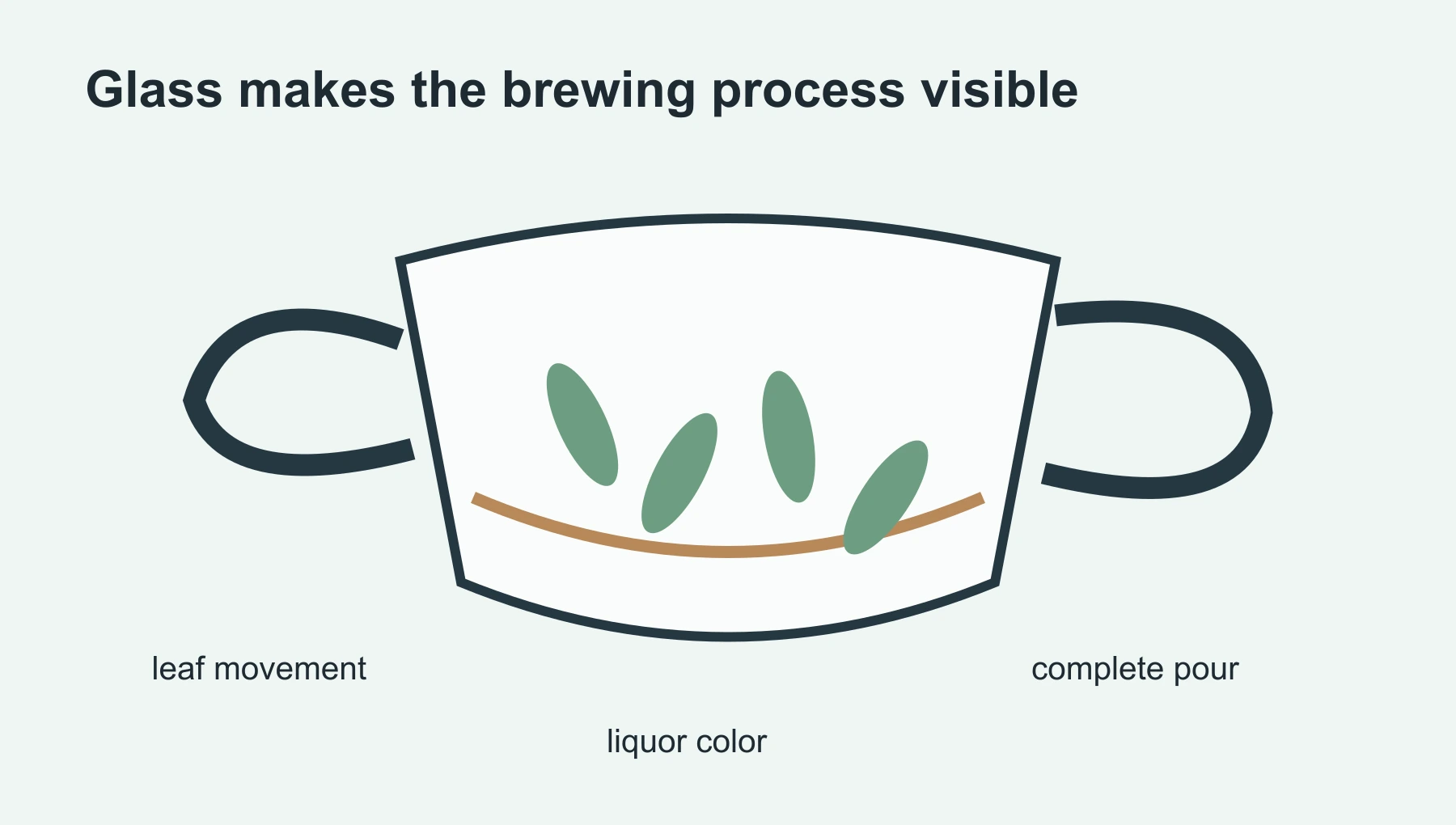
| Photographing leaf opening | Clear glass | Shows suspension and settling, although a beautiful view cannot rescue weak flavor |
| Keeping delicate aroma clear | Glass or porcelain | Neutral surfaces and moderate heat retention avoid the retained aroma and heat of an unglazed pot |
For a glass, start with 2 g per 100 ml and 75-85°C water. Add enough water to wet and open the leaf, then fill; or add part of the water before the leaf and complete the pour. Drink when comfortable and refill while roughly one-third remains. Do not let a “top, middle or bottom pour” label override the result in your glass.
The visible leaf remains immersed after the pour, so extraction continues while the glass sits. That is why “drink half, then refill” is practical control rather than ceremony: it dilutes the remaining liquor before heat and time make it coarse.
For a gaiwan, use the same ratio and begin around 80°C. Decant fully so one infusion does not silently become three minutes long. Adjust one variable at a time: lower temperature for aggressive bitterness, shorten time for drying astringency, or increase leaf slightly for a clean but thin cup.
The vessel distinction sounds small, but a practical guide loses authority when it quietly changes extraction conditions. A glass keeps the leaf immersed; a gaiwan can decant completely. Compare them as different tools, not competing signs of authenticity.
Freshness is a testable buying issue
Longjing's value is unusually dependent on fresh aroma. A storage study in Food Chemistry: X found that elevated-temperature storage and oxygen exposure contributed to Longjing aroma deterioration; oxygen-scavenger packaging mitigated deterioration in that experiment. The study does not mean every reader needs oxygen absorbers. It supports a simpler rule: buy manageable quantities, exclude air, heat, light and strong odors, and track when the pack was opened.
Run a realistic freshness comparison instead of intentionally ruining expensive tea:
- Label the opening date on every packet.
- When possible, compare two samples of the same tea with known but different opening dates, stored in their normal containers.
- Brew both at 2 g / 100 ml, 80°C and 90 seconds.
- Compare dry aroma, first-cup aroma, texture and finish after cooling.
- Record “different” before declaring “stale.” Batch and roast differences can imitate storage effects.
If refrigerating unopened or tightly sealed tea, let the sealed container reach room temperature before opening so humid air does not condense on cold leaf. Do not keep opening a large cold bag. Divide tea into small airtight portions and expose only the portion you are drinking.
Seven reasons to reject or pause a Longjing purchase
Walk away, or ask for evidence, when:
- The seller claims West Lake Longjing but cannot name a producer, cooperative or specific protected area.
- “Hangzhou” appears only as scenery while the actual production zone remains absent.
- The package omits the harvest year; green tea freshness cannot be judged from “spring” alone.
- Mingqian is presented as proof of origin or automatic superiority.
- Handmade appears with no maker, process record or explanation of machine assistance.
- A very low price is paired with a narrow protected-origin and ultra-early-harvest claim, but no traceability.
- The opened tea smells musty, sour, oily, perfumed or simply dead, and the seller responds with more legend instead of storage information.
Do not reject a tea merely because it is not West Lake Longjing. Honest Qiantang or Yuezhou Longjing, and honest Longjing-style flat green tea, may offer better drinking value than a vague premium claim. The goal is not to buy the most prestigious noun. It is to buy the tea whose name, material and cup agree.
The Longjing decision that matters
Longjing is often sold as a postcard: West Lake, imperial legends, early spring and a perfect green tin. Buy the evidence instead. First establish what origin the seller is claiming. Then check whether the flat-fired material plausibly matches the description. Finally, brew the tea under controlled conditions and ask whether freshness, pan warmth and finish remain alive.
Flat is not proof. Early is not proof. Expensive is not proof. The best Longjing purchase is the one with the fewest contradictions between place, process, date and cup.
If you run the 70/80/90°C test, share the tea, water and result in China Moments. A useful community tasting note does not need expert vocabulary; it needs a repeatable setup and an honest difference between cups.
Continue with the broader Chinese green tea guide, compare types of Chinese tea or learn why a gaiwan changes control rather than authenticity.