The six main types of Chinese tea are green, white, yellow, oolong, black and dark tea. The reliable way to tell them apart is the processing decision that changes the leaf's path: early heat, controlled withering, sealed yellowing, staged bruising and oxidation, substantial oxidation before drying, or later microbial transformation. Liquor color, price and caffeine do not classify tea.
Types of Chinese tea: follow the process, not the color
All six families can begin with leaves from Camellia sinensis. What separates them is not a different botanical definition but a different sequence of human decisions after harvest. UNESCO's record of traditional tea processing in China names these six categories, while individual Chinese standards document the boundaries of specific families and products.
This produces one practical rule:
Ask what happened to the leaf, and in what order. Do not ask which tea is “more fermented” and expect one scale to explain all six.
I insist on this sequence because a tea-family name must help the drinker predict a process and choose the next useful test. The mistake is treating six labels as shelf decoration: green means fresh, black means strong, white means gentle, and everything between them becomes marketing fog. If a classification cannot tell me which production decision to investigate, I do not trust it.
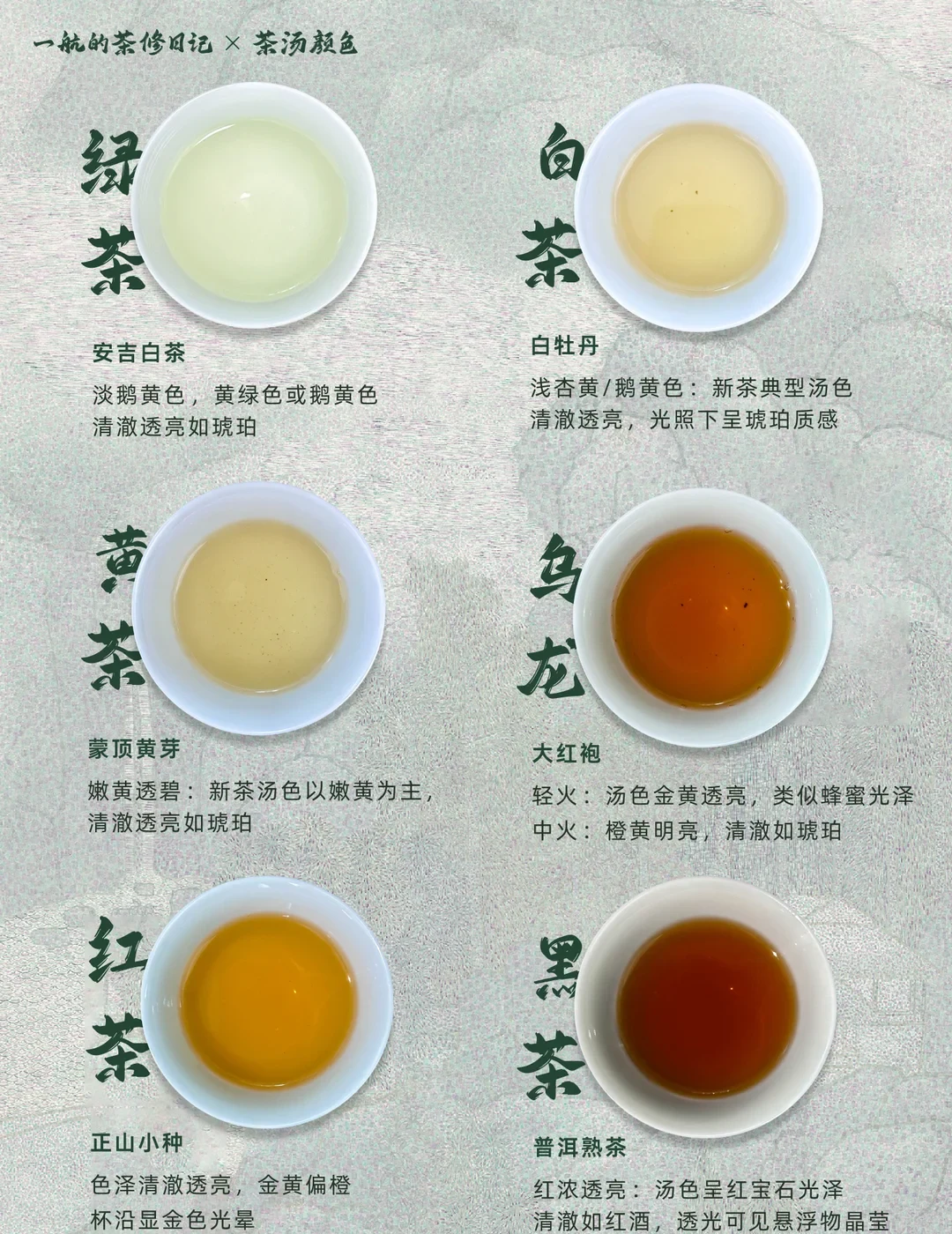
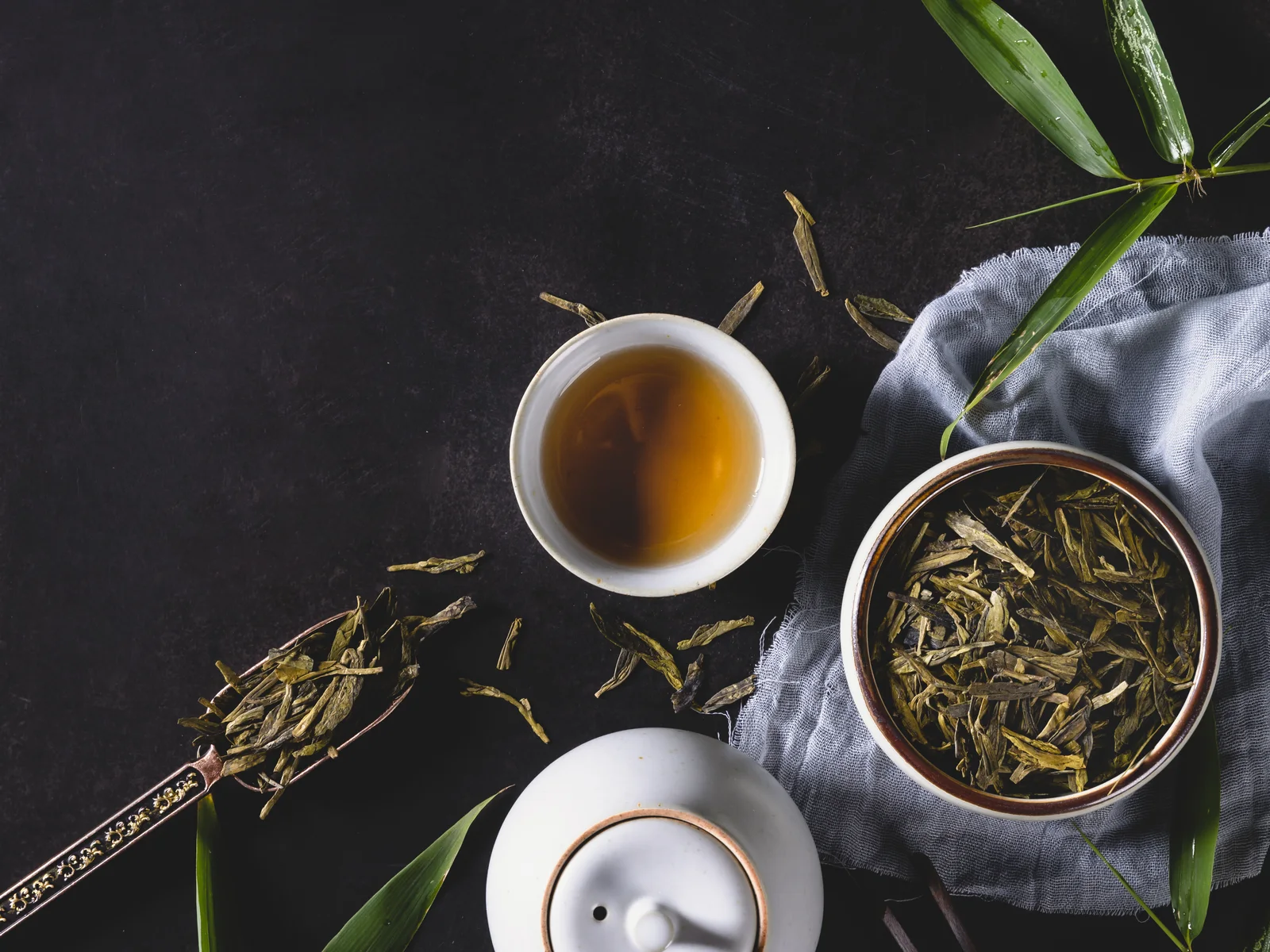
This six-bowl comparison explains why the color shortcut is so seductive: the progression looks orderly enough to memorize. I still reject it as a classification method. Each bowl records one tea, one dose, one water temperature and one moment in the infusion. Brew the same leaves longer and the row changes. Roast an oolong more heavily and the visual gap changes again. The photograph is valuable because it gives us six real cups to question; it is not a certificate for six processes.
The common color chart fails because several processes can darken a leaf or liquor. Roast can darken oolong. Oxidation can redden black tea. Aging can deepen white tea. Pile fermentation can transform ripe Pu-erh. Similar color is an outcome; it is not proof of a shared process.
The six-family decision map
| First decisive processing fork | Family | What the decision accomplishes | What does not prove the family | Representative teas |
|---|---|---|---|---|
| Heat the fresh leaf early | Green | Limits enzymatic oxidation, then shape and dry | Green liquor, grassy taste or a flat leaf alone | Longjing, Biluochun, Huangshan Maofeng |
| Wither and dry with controlled, relatively limited handling | White | Develops the leaf through managed water loss without a green-tea fixing sequence | Pale liquor, visible white hairs or “minimally processed” sales copy | Silver Needle, White Peony, Shou Mei |
| Fix early, then hold warm leaf through controlled yellowing | Yellow | Softens and transforms the fixed leaf through menhuang | Yellow liquor or yellowed old green tea | Junshan Yinzhen, Mengding Huangya, Huoshan Huangda Cha |
| Wither, repeatedly agitate or bruise, allow staged oxidation, then fix | Oolong | Builds uneven aromatic transformation before heat arrests the process | A claimed oxidation percentage, floral aroma or rolled shape | Tieguanyin, Wuyi rock tea, Phoenix Dancong |
| Wither and roll or otherwise disrupt, then allow substantial oxidation before drying | Black | Develops the warm aromatic and color profile called hong cha in Chinese | Dark dry leaf, red liquor or the English word “black” alone | Qimen, Dianhong, Jin Jun Mei, Zhengshan Xiaozhong |
| Continue transformation after initial tea making, often through managed heat, moisture and microorganisms | Dark | Creates a post-processed tea whose later transformation is central | Compression, age, earthy smell or a dark cup alone | Ripe Pu-erh, Liu Bao, Fu brick tea |
This is a decision map, not a hierarchy. Every family contains poor tea, competent tea and exceptional tea. Category tells you which questions to ask next; it cannot answer quality by itself.
Why the six families are not an oxidation ladder
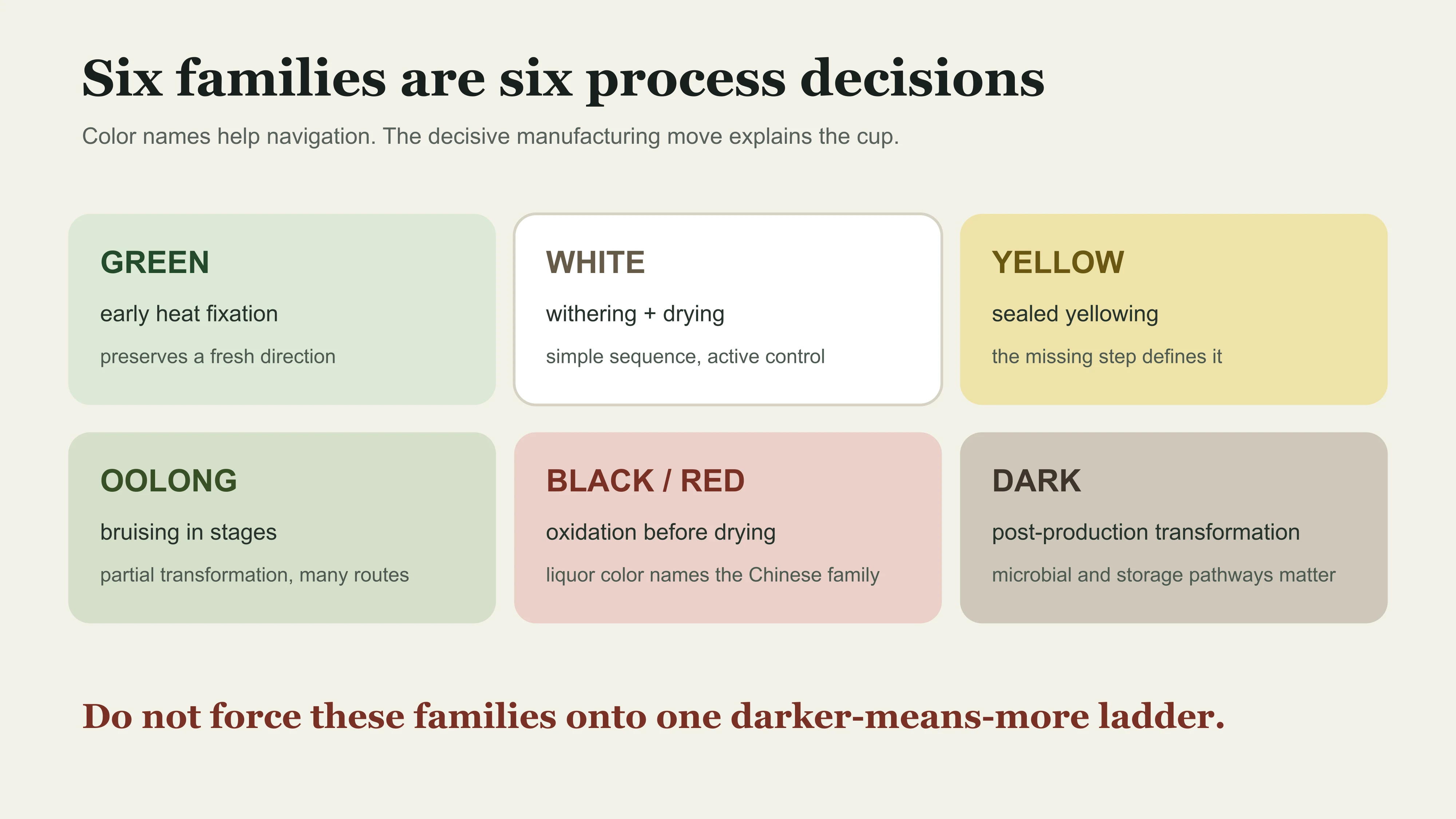
An oxidation ladder is tempting because green and black tea appear to sit at opposite ends. The model becomes misleading as soon as white, yellow, oolong and dark tea enter the picture.
- White tea is not unfinished green tea. Controlled withering is its central work; green tea uses early heat to interrupt the fresh leaf's enzymatic path.
- Yellow tea is not stale green tea. It begins with fixing, then adds deliberate warm, moist yellowing stages.
- Oolong is not simply half-black tea. Repeated agitation and resting create a staged, often uneven transformation before fixation. Leaf edges and interior do not behave as one uniform percentage.
- Dark tea is not “the most oxidized.” Later post-processing and microbial activity introduce a different mechanism from fresh-leaf enzymatic oxidation.
Oxidation remains important. It is simply one variable inside a branching production system. A classification guide that reduces every family to percentages creates false precision.
Green tea: early heat protects a fresh direction
Green tea reaches its defining fork early. Heat fixing reduces enzyme activity before extensive oxidation develops; makers then roll, press, curl or otherwise shape and dry the leaf. Pan firing is famous, but it is not the only method, and no single shape represents the family.
The photograph shows why dry shape is only the first clue. Flat leaves expand and reveal their picked material in water, but the image cannot prove West Lake origin, harvest date or quality. Use opened leaves to check whether the material is reasonably intact and consistent with the seller's description, not to authenticate a protected name.
Choose green tea when you want the clearest view of freshness, heat shaping and tender leaf texture. Reject it when the seller hides harvest timing, storage conditions or the exact tea name behind “premium green tea.”
White tea: withering is work, not neglect
White tea is often called the least processed family. That phrase is memorable and inadequate. The decisive work is controlled withering and drying: leaf thickness, airflow, humidity, temperature and timing determine whether moisture leaves cleanly or the tea becomes coarse and dull.
Bud and leaf composition matters. Silver Needle emphasizes buds; White Peony combines buds and leaves; Shou Mei generally uses more mature material. This is a material and style distinction, not a guaranteed pleasure ranking. A good Shou Mei can be more articulate than a badly made or badly stored bud tea.
Choose white tea when you want to study how material and withering create texture with relatively little shaping. Reject age claims that provide no harvest year, pressing year or storage history. Dark color alone does not prove valuable age.
Yellow tea: the missing step is the category
Yellow tea begins close to green tea and then takes a distinct turn. After fixing, warmed leaf is held under controlled moisture and heat in stages commonly called menhuang, translated as sealed, smothered or sweltered yellowing. China's GB/T 21726-2018 standard recognizes yellow tea as its own product category; scientific reviews describe family-specific yellowing processes rather than accidental discoloration.
A needle-like dry shape cannot tell you whether the tea is Junshan Yinzhen, Mengding Huangya or a different bud tea. A seller must supply the Chinese product name, production area and process account. “Rare yellow silver needle” is not enough.
Choose yellow tea when you want to compare the effect of controlled yellowing against green tea's clearer heat-shaped profile. Reject any listing that treats yellow liquor as proof of identity.
Oolong tea: transformation happens in stages
Oolong covers the widest obvious visual and aromatic range: green-looking rolled Tieguanyin, twisted Phoenix Dancong and roasted Wuyi rock tea can seem unrelated in the cup. Their shared logic is staged transformation. Withering and repeated agitation or bruising manage oxidation; fixation arrests it; rolling, drying and sometimes roasting build the finished style.
Opened leaf is especially useful here. It can reveal whether a tightly rolled tea expanded into substantial leaf, whether the batch is heavily broken and how evenly it appears to have been handled. It still cannot prove cultivar, mountain, village or oxidation percentage.
Choose oolong when repeated infusions and aromatic change matter more than a single stable flavor. Reject sellers who use “oolong” as if it were one taste, or who substitute an exact-sounding oxidation number for origin and process information.
Black tea: oxidation comes before drying
Chinese black tea is hong cha, “red tea,” named for the liquor rather than the English category's dark leaf. Withering and leaf disruption are followed by substantial enzymatic oxidation before drying. Qimen, Dianhong and Wuyi black teas remain different regional systems even when retail shelves place them together.
The photograph usefully pairs dry leaf with liquor, but neither proves that a tea is Qimen. Aroma names such as malt, honey, rose or cocoa are tasting directions, not identity certificates.
Choose black tea when you want a fuller cup that often works in both repeated short infusions and a larger pot. Reject a listing that borrows the prestige of Jin Jun Mei, Qimen or Dianhong while withholding origin and material.
Dark tea: later transformation is the point
Dark tea, hei cha, is defined by post-processing after the first stages of tea making. Depending on the product, heat, moisture, piling, compression, storage and microorganisms can matter. Ripe Pu-erh's pile fermentation is one documented microbial and chemical system; it should not be treated as the recipe for every dark tea.
Compression tells you that the leaf was pressed. Dark liquor tells you how that brew appears. Neither proves age, clean storage, microbial safety or value. Those require records, sensory inspection and trustworthy handling history.
Choose dark tea when you want to study post-processing and storage as part of the tea's identity. Reject moldy, sharply chemical or persistently dirty-smelling tea; rinsing does not repair unsafe or badly stored material.
Read dry leaf, liquor and opened leaf in that order
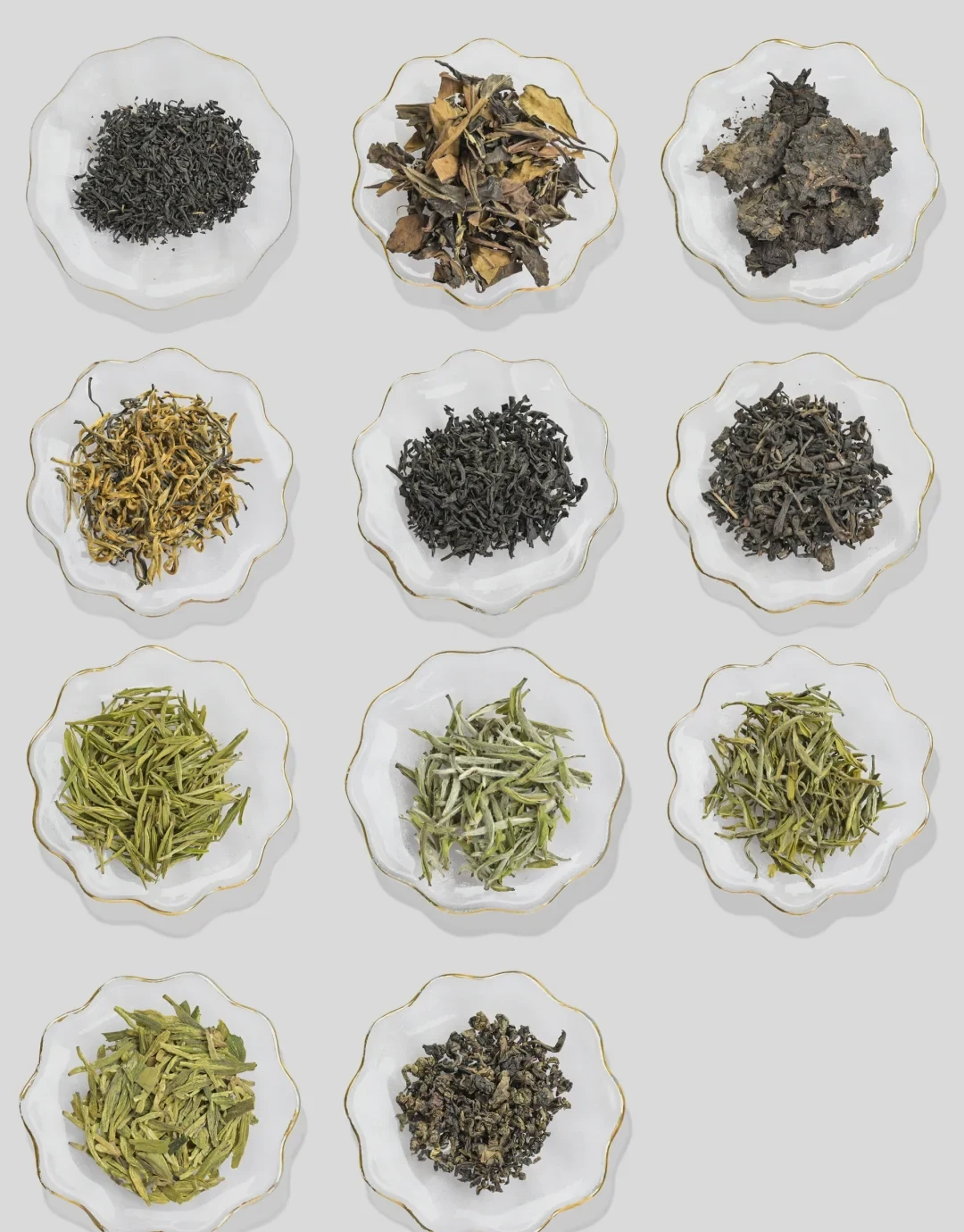
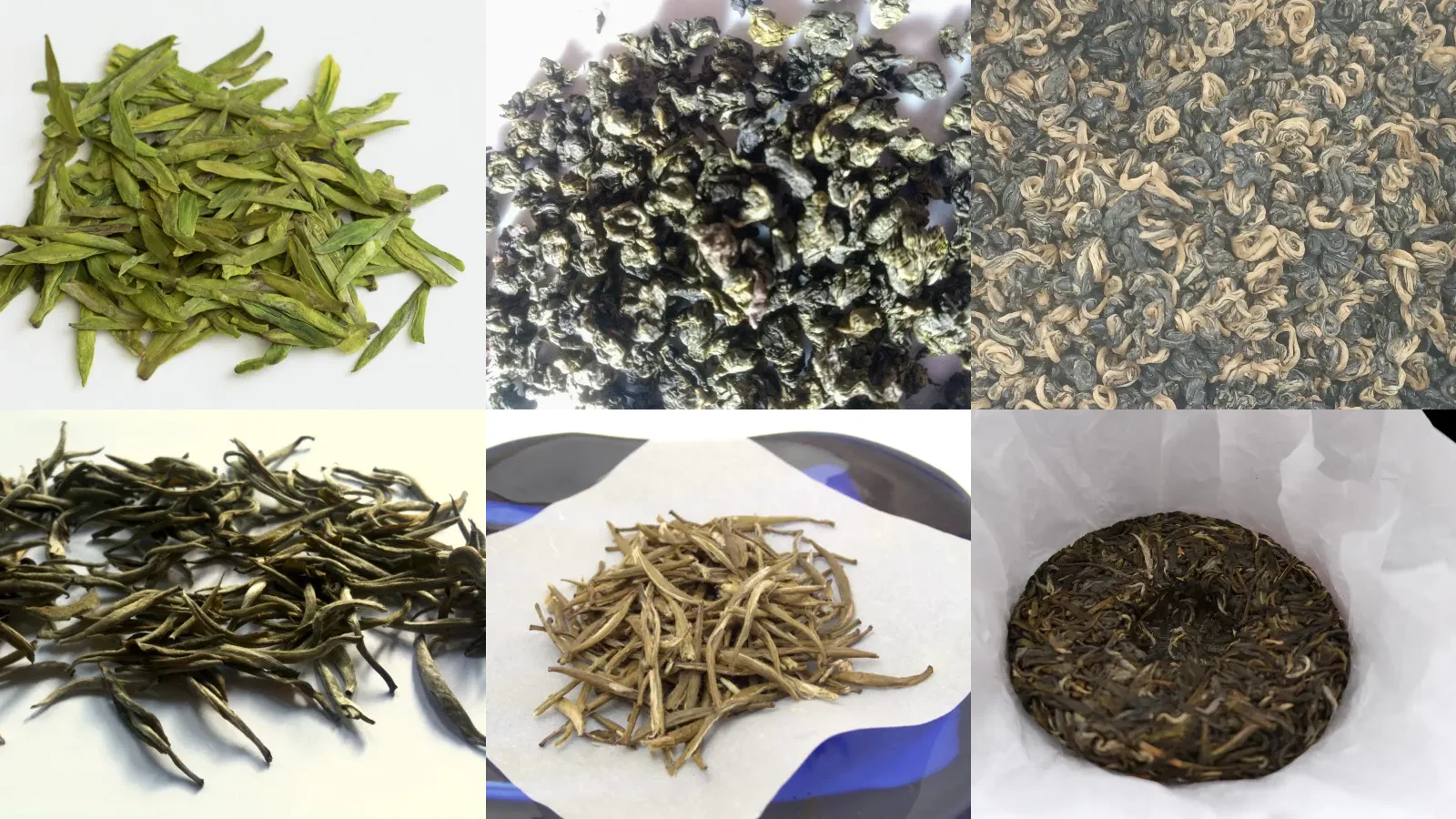
This training set is more useful than a beauty shot because identical dishes remove the packaging theatre. It includes three black teas, three green teas, two white teas, two dark teas and one oolong. Teas inside one family do not converge on one silhouette: Zhengshan Xiaozhong, Dianhong and Qimen black tea remain visibly different, while a dark Fu brick sample and ripe Pu-erh break apart in different ways. Conversely, leaves from different families can share color or twist. I use dry leaf to form a question—whole or broken, bud or mature leaf, loose or compressed—not to announce the answer.
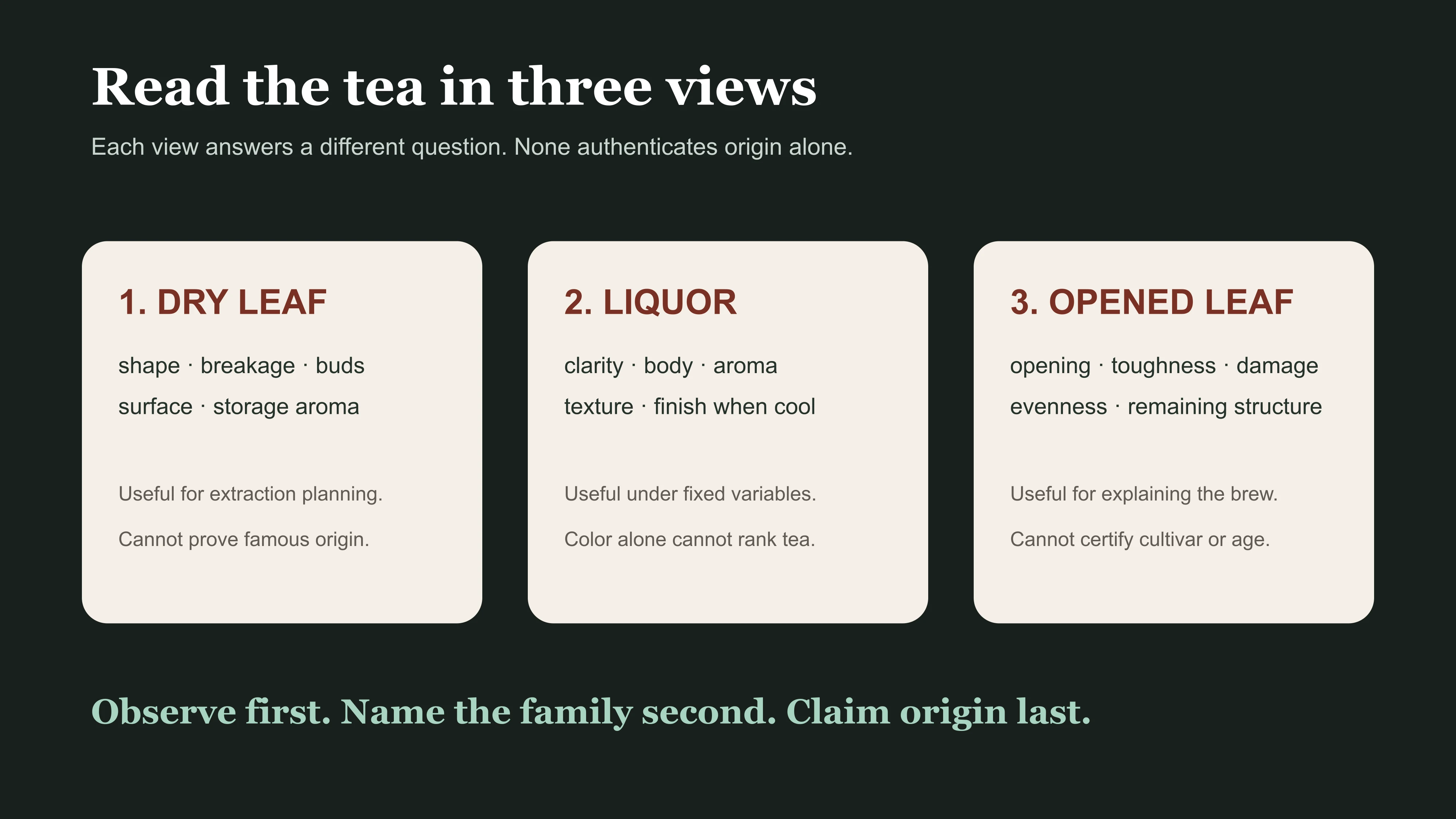
No single visual feature classifies all tea. A useful inspection has three passes, and each answers a different question.
| Family | Dry leaf: useful observation | Liquor: useful observation | Opened leaf: useful observation | What the three still cannot prove |
|---|---|---|---|---|
| Green | Shape, breakage, surface dullness, mixed material | Clarity and how quickly bitterness appears | Tenderness, intactness and picked material | Protected origin, exact harvest or freshness history |
| White | Bud/leaf ratio, mature leaves, compression, visible fuzz | Texture and whether sweetness survives cooling | Leaf maturity and consistency with the grade description | Age, clean storage or superior quality |
| Yellow | Bud or leaf scale and evidence of deliberate manufacture | Softness versus stale or flat character | Material consistency and degree of opening | That yellow color came from correct menhuang |
| Oolong | Rolled versus twisted form, roast aroma, broken fraction | Aromatic change across infusions | Expansion, intactness and visible handling pattern | Cultivar, mountain, village or oxidation percentage |
| Black | Twist, bud content, broken grade, smoke when relevant | Body, astringency and aroma after cooling | Uniformity and degree of breakage | Qimen, Dianhong or Wuyi identity from color alone |
| Dark | Loose or compressed form, surface condition, storage odor | Cleanliness, texture and persistence across steeps | Material integrity and whether compression opens evenly | Age, storage safety, provenance or investment value |
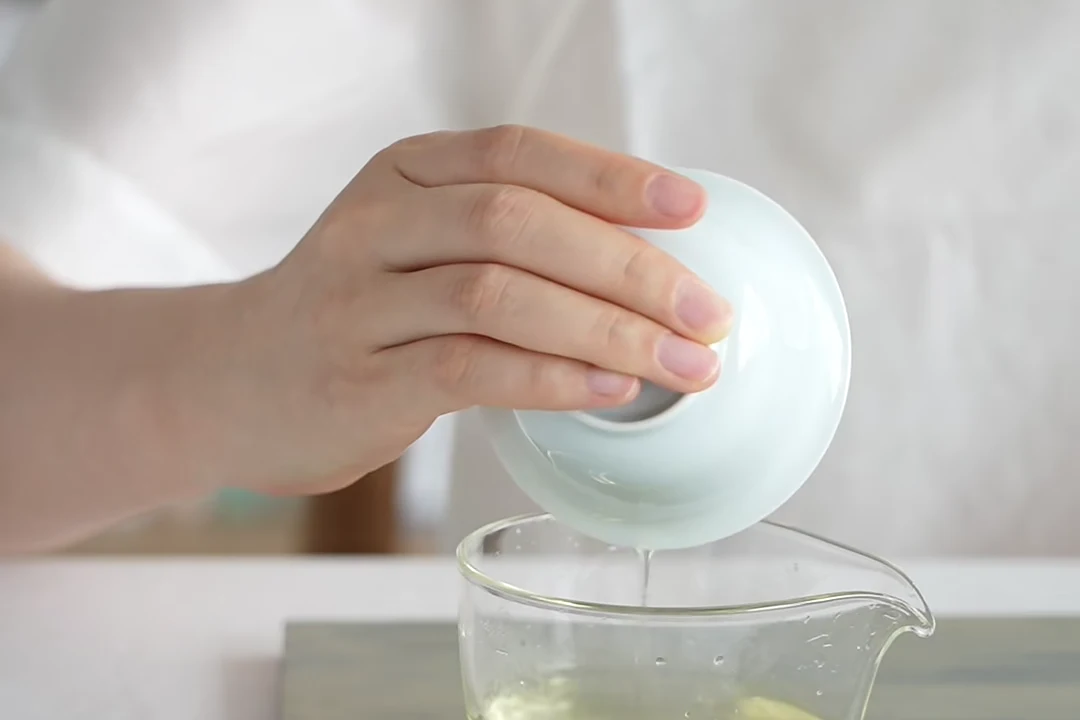
The most important opened-leaf test is consistency with the claim. If a seller promises whole-leaf oolong and the gaiwan fills with fragments, that is useful evidence. If a seller promises a famous mountain and the leaves look attractive, the photograph still cannot confirm geography.
Four popular shortcuts that fail
“Darker tea means more oxidized”
Roasting, aging, microbial transformation and storage can all darken tea. Compare process records before color.
“White and green tea always contain less caffeine”
Caffeine varies with plant material, growing conditions, processing, dose, water and extraction. Family name alone cannot predict what reaches one cup. Anyone controlling caffeine should manage leaf quantity and drinking context rather than trust a color category.
“A famous family is better”
Family is not a grade. A clean, well-made everyday black tea can outperform badly stored expensive white tea. Judge the exact product.
“Fermentation explains every category”
Retail English often uses fermentation loosely. Fresh-leaf enzymatic oxidation and microbial post-fermentation are not interchangeable. Name the mechanism when it matters.
Choose a family by the experience you want
Use this route when you do not yet know which Chinese tea variety to buy:
| You want to study | Start with | Why |
|---|---|---|
| Fresh leaf, early heat and shaping | Green tea | The processing fork is immediate and easy to compare with black tea |
| Bud/leaf material and controlled withering | White tea | Grade language becomes visible without becoming a quality ranking |
| The difference one concealed process stage can make | Yellow tea | Menhuang explains why classification cannot rely on color |
| Aroma changing through many infusions | Oolong tea | Staged handling produces the broadest practical comparison range |
| Body, oxidation and regional black-tea styles | Black tea | Qimen, Yunnan and Wuyi provide clear contrasts inside one family |
| Post-processing, compression and storage | Dark tea | Time and microbial transformation become explicit parts of the decision |
For a first purchase, choose a clearly named, modestly priced tea with origin, harvest or production date and storage information. Do not begin with the most expensive famous name. You are buying a legible example, not a trophy.
Run a six-tea comparison that produces usable evidence
The best way to understand the classification is to taste six clearly labeled examples under controlled but not identical conditions. Use one green, one white, one documented yellow, one oolong, one Chinese black tea and one dark tea.
Fix the variables that should stay fixed
- Use the same water source.
- Use the same neutral porcelain or glass vessel.
- Weigh leaf and record water volume.
- Use the same cup shape.
- Photograph each sample dry and after the final infusion from the same distance.
- Record water temperature and infusion time rather than relying on memory.
Let family-sensitive variables change
Do not force every tea into one temperature and steep time. That tests tolerance to one recipe, not each family's structure. Begin around 80°C for a tender green tea, move warmer for white and yellow tea, and use near-boiling water for many oolongs, black teas and dark teas when their material supports it. Adjust by taste and record the adjustment.
Use a four-line note, not a flavor encyclopedia
For each tea, write:
- Dry leaf: shape, material and dominant aroma.
- First useful infusion: texture before flavor labels.
- Change: what appears, disappears or becomes coarse in the next infusion.
- Opened leaf: what the expanded material confirms or contradicts.
Taste quieter teas before dominant ones: green, white, yellow, lighter oolong, black and dark tea is a workable first order. Move a heavily roasted oolong later. Take breaks; fatigue creates false certainty.
The goal is not to crown a winner. It is to connect an observable cup to a documented process. When you can explain why roasted oolong and black tea can both look dark yet reach that color differently, the classification has become useful.
Buying tests: reject the listing before judging the tea
Every seller should be able to answer five fields: exact tea name, production area, harvest or production year, processing style and storage. Family-specific red flags then narrow the decision.
| Family | Reject or pause when the seller says |
|---|---|
| Green | “Fresh” without a harvest season/year or storage account |
| White | “Ten-year aged” without separate harvest, pressing and storage information |
| Yellow | “Yellow tea” based only on leaf or liquor color |
| Oolong | A precise oxidation percentage but no origin, cultivar or roast description |
| Black | A famous regional name used as a flavor adjective with no production-area claim |
| Dark | “The older the better,” with no clean-storage history or condition disclosure |
Prestige words are not extra evidence. “Imperial,” “ancient,” “rare,” “master” and “competition grade” increase the burden of proof; they do not reduce it.
Edge cases reveal whether the map is working
Jasmine tea is usually a scented tea whose base may be green, white or another true tea. Scenting does not erase the base process; it adds a later layer.
Aged white tea remains white tea because it began through a white-tea processing route. Storage changes do not retroactively make it dark tea.
Raw Pu-erh is the most important warning against a simplistic map. It begins from sun-dried green tea material and transforms through storage, but it is not equivalent to ripe Pu-erh pile fermentation. Product definition, geography and production history matter more than forcing it into a one-line oxidation chart.
Herbal infusions such as chrysanthemum or rooibos are not Camellia sinensis, even when English calls them tea. Ingredient identity comes before the six-family system.
Smoked black tea remains black tea. Smoke may dominate its aroma, but flavoring or smoking does not replace the underlying processing family.
Milk oolong can refer to a cultivar association, a creamy sensory impression or added flavoring. Ask which meaning the seller intends.
Classification is successful when it tells you which uncertainty to investigate next. It should not make ambiguity disappear by renaming it.
Continue with the tea-types collection and the Chinese tea decision guide, then study Chinese green tea, Chinese white tea, yellow tea through Junshan Yinzhen, Chinese oolong tea, Chinese black tea or Pu-erh tea at family depth.