The best way to choose Chinese white tea is by harvested material and the cup you want, then by the tea's present storage condition. Silver Needle, White Peony and Shou Mei are not first, second and third place. A famous grade name, an old date, brown leaves or a high price cannot replace a clean sample and a traceable lot.
What makes a tea Chinese white tea?
Chinese white tea is made from Camellia sinensis shoots through a process centered on controlled withering and drying. It is not simply a leaf picked and left alone. The maker must move moisture out of buds, leaves and stems without trapping dampness or flattening the tea with excessive heat.
China's GB/T 22291-2017 White Tea standard defines the product category, while the official record for GB/T 32743-2016 provides a national processing framework. These standards define terms and requirements; they do not guarantee that an individual tea tastes good or was stored well.
One naming trap matters immediately: Anji white tea is a green tea, not a member of this white-tea processing family. Its name refers to pale young leaf from a particular cultivar, while its finished-tea process is green tea. Buy by process and documented identity, not by the English word white.
Start with the shoot, not a prestige ladder
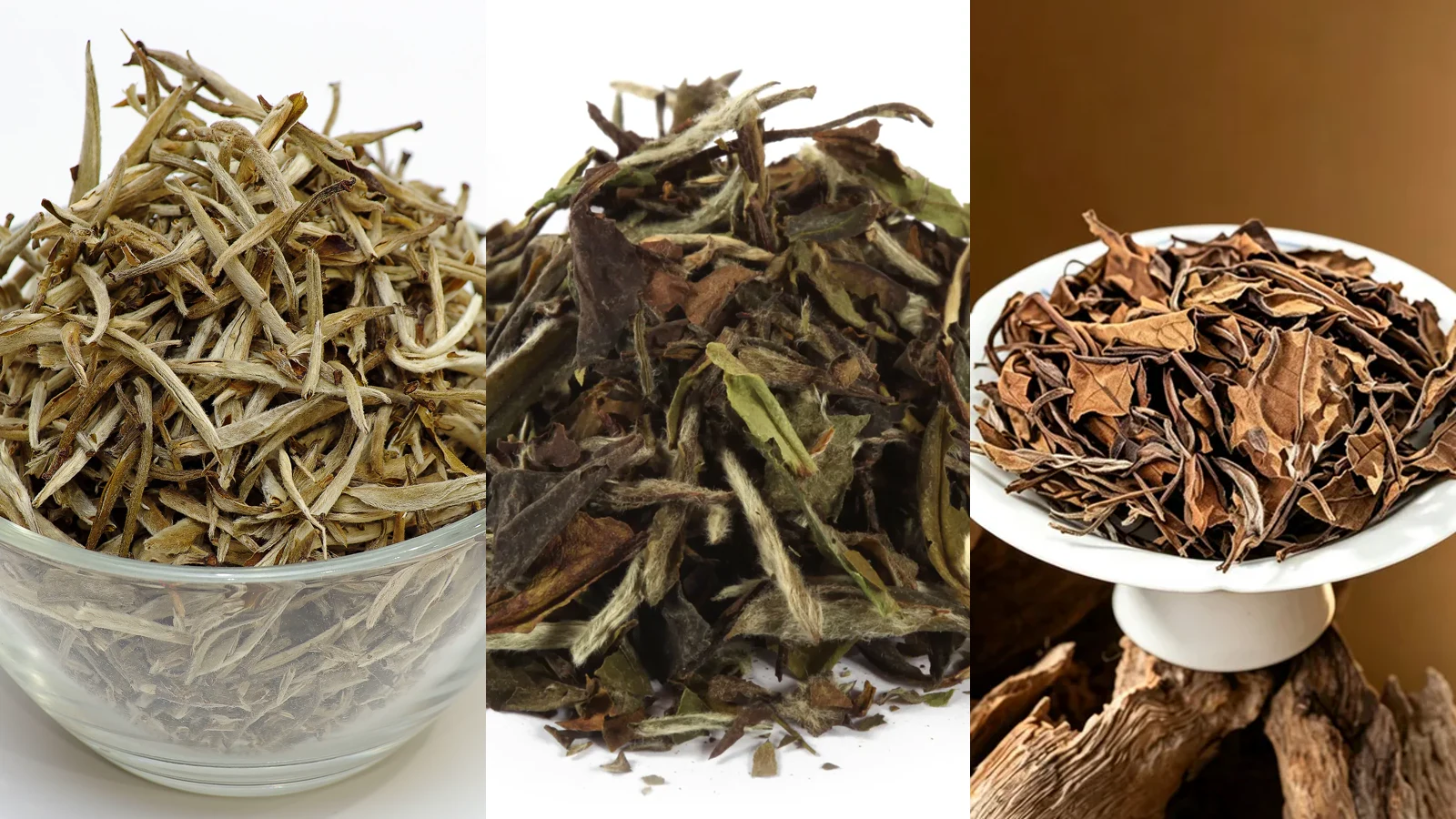
The three photographs in the hero are separate documentary records, assembled to make material differences easier to see. They are not the same batch, origin, harvest or lighting, so they should not be used as a controlled color comparison.
| Style | Material emphasis | Cup tendency | Best first choice when you want | What the name does not prove |
|---|---|---|---|---|
| Silver Needle | Intact buds or strongly bud-dominant material | Fine texture, downy sensation, restrained aroma and slower extraction | To study bud texture and patient brewing | Origin, freshness, age or superior quality |
| White Peony | Buds with young leaves | More immediate aroma and structure while retaining bud softness | The clearest bridge between bud and leaf | One universal bud-to-leaf ratio or grade |
| Shou Mei | More mature leaves and visible stems | Broader extraction, fuller body and easier flavor recognition | A forgiving daily tea or a stronger white-tea cup | Old age, low quality or inferior craft |
Gong Mei also appears in standards and trade. Its exact material and grading language must be read against the applicable standard and producer record. It should not be inserted into a universal four-rung quality chart.
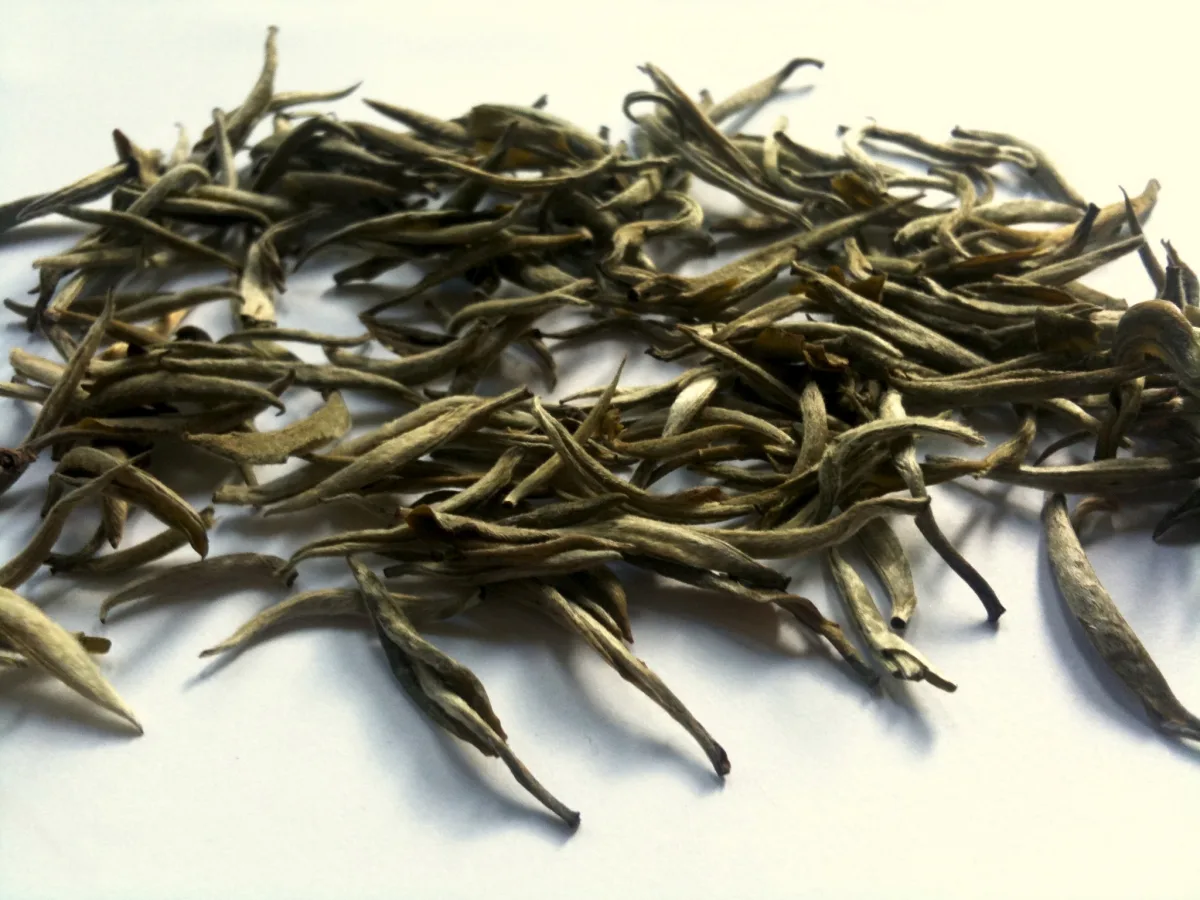
These images can help you recognize material emphasis. They cannot authenticate a seller's cultivar, protected origin, grade or year. A photograph of brown tea cannot prove age, and a photograph of pale buds cannot prove freshness.
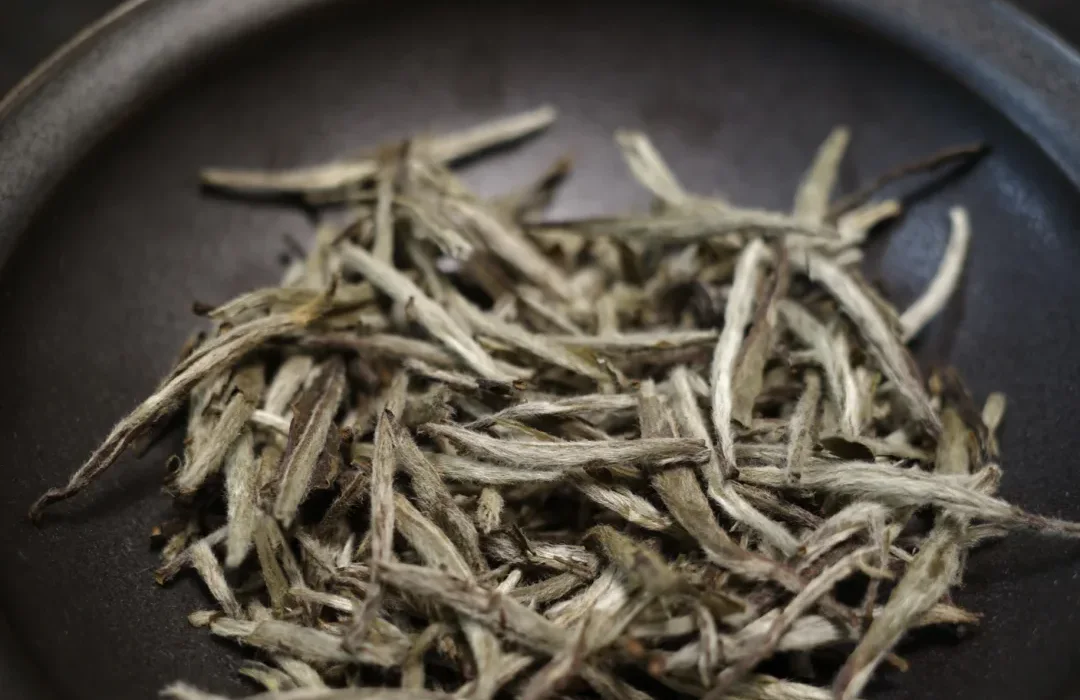
This authorized close-up is useful because the camera is near enough to show actual structure: slender shoots, pale down and a relatively bud-dominant sample. It supports a material observation, not a quality verdict. I can see why Silver Needle often costs more to pick and why it extracts differently; I still cannot infer harvest date, cultivar, mountain, storage or sweetness from the hairs alone. Any seller who points at a furry bud and jumps directly to “top grade” is skipping the part where the tea must survive water.
Withering is the decisive transformation
Fresh shoots do not lose water evenly. Down-covered buds, thin leaf edges, thick veins and stems respond differently to temperature, humidity, airflow, layer depth and time. The practical task is controlled moisture loss, not passive neglect.
A peer-reviewed comparison of indoor, withering-tank and sunlight treatments found different aroma profiles under the study's conditions. That establishes that withering conditions matter. It does not establish one method as universally superior, because cultivar, weather, material thickness and the maker's target also matter.
Drying stabilizes the result. A cup that smells sharply raw, sour, scorched or persistently dull may point to process or storage trouble, but taste alone does not identify the exact production error. Use those sensations to reject a weak purchase, not to issue a remote factory diagnosis.
Fresh versus aged: separate four dates
White tea does change during storage, but “old white tea” compresses several claims into one phrase. Ask for four records separately:
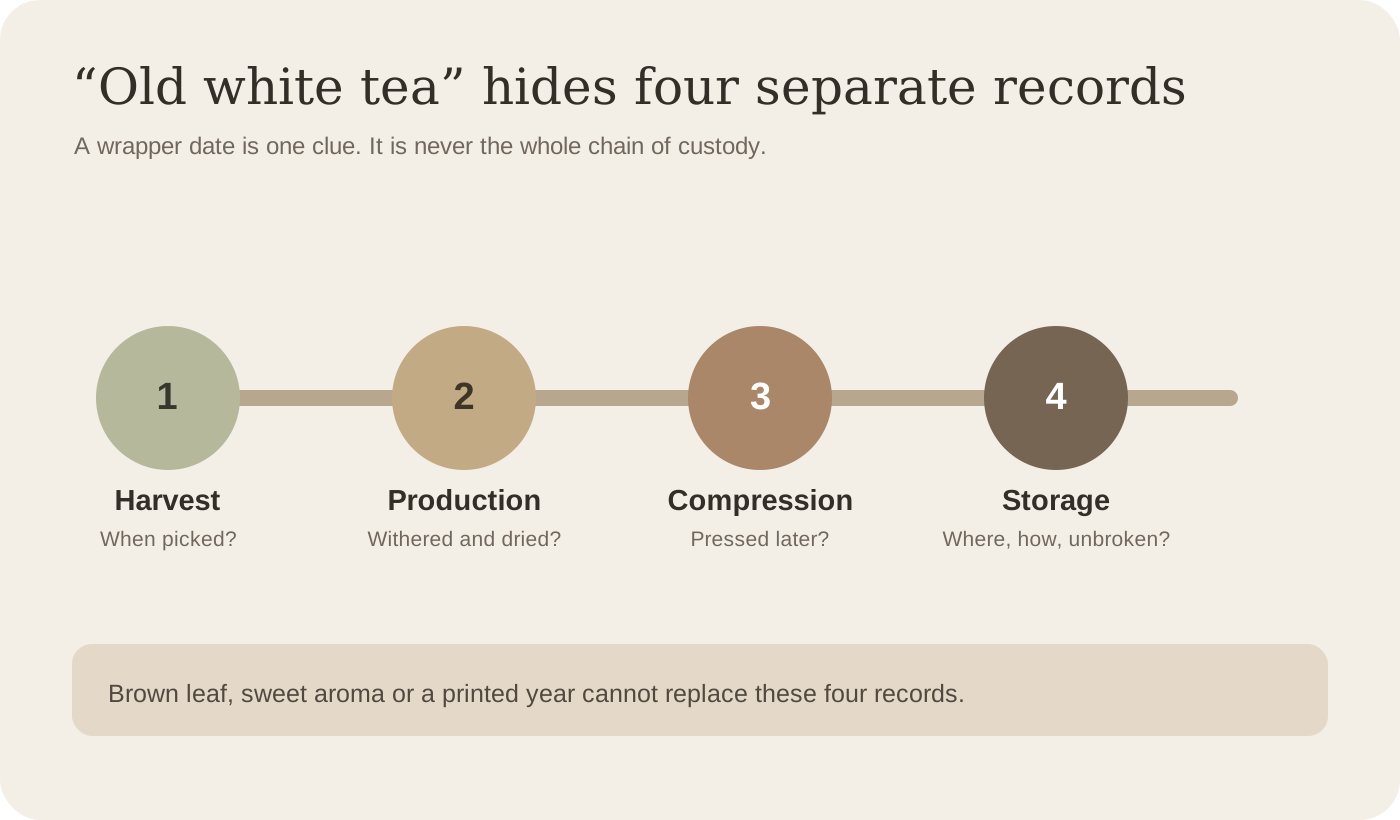
- Harvest year: when the leaf was picked.
- Initial production year: when withering and drying were completed.
- Compression year: when loose tea was pressed, if it became a cake.
- Storage history: where and how the tea was kept between those events and today.
A 2024 metabolomics study compared first-grade Bai Mudan samples from Zhenghe, Fuding and Jinggu across stated storage durations of 0, 1, 2, 3 and 15 years. Multiple compounds changed with storage, and producing area also mattered. This is good evidence that storage time can change tea chemistry. It is not a method for authenticating an unknown retail cake by color or smell, and it does not show that older tea is automatically better.
| Evidence offered | What you may conclude | What remains unproven |
|---|---|---|
| Dated wrapper only | A date was printed | Harvest date and uninterrupted clean storage |
| Brown dry leaves | The photographed leaf is brown | Natural age, clean storage or authenticity |
| Seller says “medicine aroma” | The seller uses that descriptor | Health effect, age or absence of damp damage |
| Batch record plus sample | The claim is testable against a specific lot | That every cake from the seller is identical |
Do not declare tea “artificially aged” from one photograph. Inconsistent surface color, flat sweetness or a dark liquor may justify more questions, but compression, material maturity, lighting, roast and storage all complicate visual judgment.
Read the photograph in three layers
I refuse both easy extremes: a photograph is not useless, and it is never a full certificate. Read it in three layers.
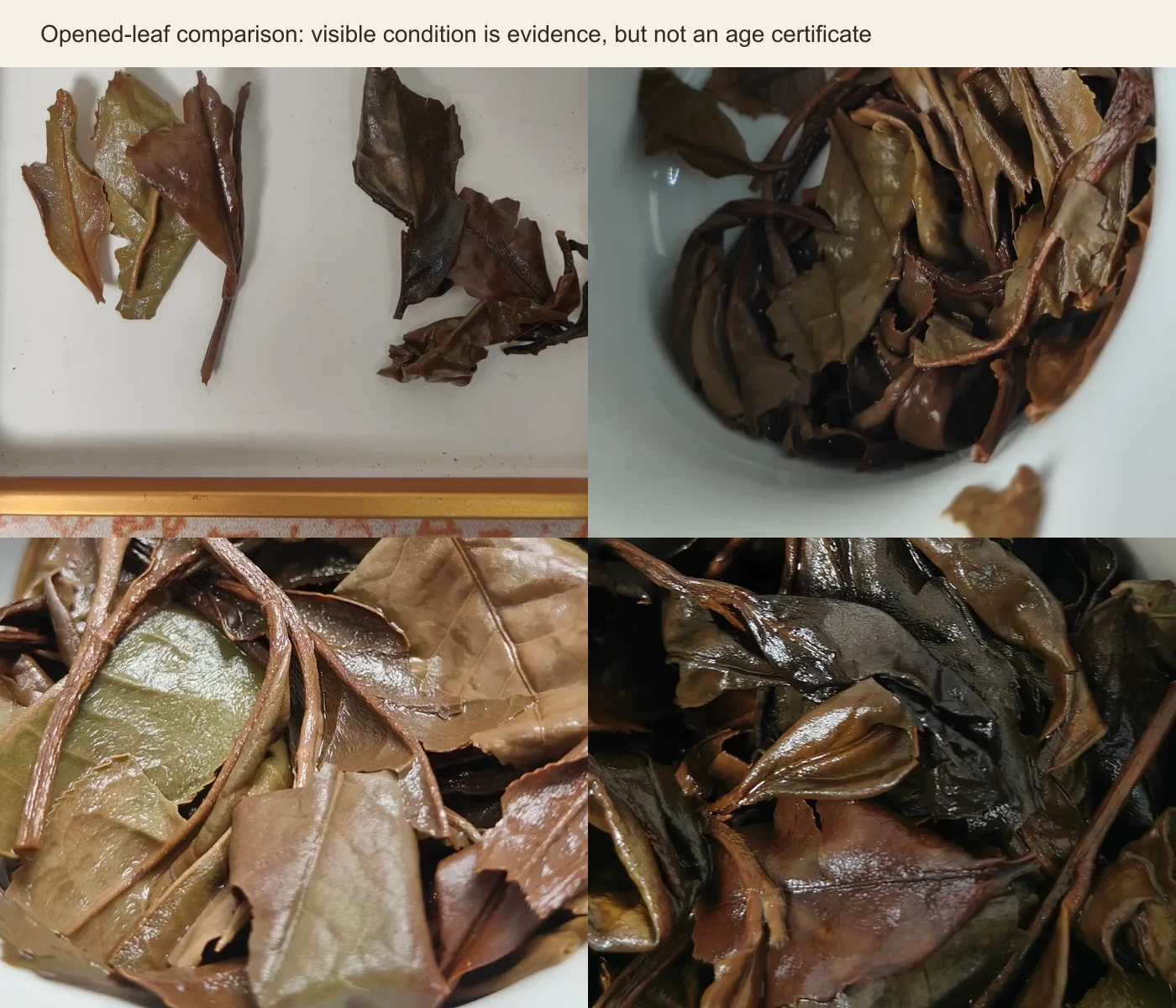
First, write down only the visible facts. Are the leaves broad or bud-heavy? Are they intact or shattered? Is the color mixed across veins, stems and leaf surfaces, or uniformly dark? Does the opened material look resilient, leathery, thin, mushy or charred? Those observations are legitimate because another reader can inspect the same pixels.
Second, identify every condition the image hides. White balance can warm pale leaf into brown. Wet leaf always looks darker than dry leaf. Compression can damage edges. Mature Shou Mei material naturally differs from Silver Needle. A seller who compares one dry sample with another wet sample has already broken the comparison before making an age claim.
Third, connect the photograph to the exact lot. Ask whether the dry leaf, liquor and opened leaf came from the packet being sold. A beautiful Fuding garden, a warehouse aisle or a dated wrapper cannot establish that chain. The strongest visual record keeps packet, weighed sample, liquor and opened leaf together under stable light, then pairs them with the four dates above.
This discipline is less dramatic than declaring “real” or “fake” from leaf color, but it is far more useful. It lets the image eliminate visible contradictions without asking it to invent a missing provenance record.
Run one fixed comparison before judging quality
Use a neutral glazed pot, gaiwan or heatproof cup. Compare one variable at a time. The following is an East Moment household protocol, not a national grading method or laboratory test.
Test A: compare harvested material
- Weigh 3.0 g each of Silver Needle, White Peony and Shou Mei.
- Use three identical 150 ml vessels, the same water and 90°C water.
- Infuse each for 3 minutes, then decant completely.
- Taste each cup hot, warm and nearly cool.
- Record aroma clarity, body, drying sensation, sweetness after swallowing and visible opened material.
This test will not crown a universal winner. It shows how material maturity changes extraction under equal household conditions. Silver Needle may remain quieter; White Peony may show balance; Shou Mei may release structure sooner. Those are comparison hypotheses, not guaranteed flavors.
Test B: compare fresh and aged tea responsibly
Use the same named category, equal dose, equal vessel, equal water and equal time. Do not compare a fresh Silver Needle with an aged Shou Mei and call the result an age test: material and age changed together. If producer and origin also differ, write that limitation beside the result.
Glassware makes leaf opening and liquor visible, but the photograph still does not prove the tea's batch, grade or age. In your own test, keep the dry leaf, liquor and fully opened leaf together until notes are complete.
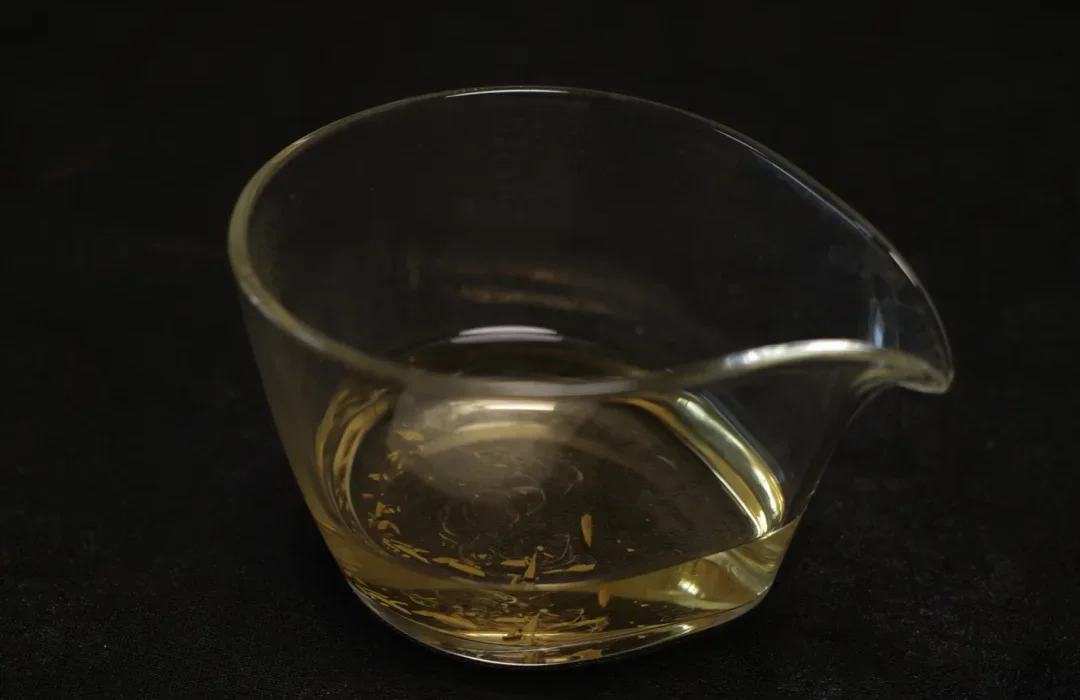
A pale liquor is visually attractive, but pale is not a synonym for weak and amber is not a certificate of age. What matters is whether the cup has clean aroma, texture through the middle of the sip and a finish that remains pleasant as it cools. I judge white tea in that cooling interval. Hot water can make almost any fragrant sample seem generous for thirty seconds; the honest cup appears when heat stops doing the perfume's work.
For a buying comparison, photograph the liquor against the same neutral background at the same infusion time. Then photograph the opened leaf, not merely the cake wrapper. That pair is far more useful than a lifestyle shot because it lets you compare extraction and material while keeping the claim modest.
Diagnose the cup before changing everything
| Result | Change first | What to check before blaming the tea |
|---|---|---|
| Thin but clean | Add 0.5-1.0 g leaf or extend time | Large intact buds may simply extract slowly |
| Raw, grassy or hollow | Raise water temperature once, then retest | Too-cool water can under-extract structure while leaving green aroma prominent |
| Rough and drying | Shorten contact time and decant fully | Hidden water beneath a gaiwan lid continues extraction |
| Sour or sharply stale | Retest with fresh water and a clean vessel | If it persists as the cup cools, reject the sample |
| Damp cardboard, cellar or visible mold | Stop drinking and reject it | More heat cannot repair contaminated storage |
| Flat baked aroma | Use slightly cooler water once | Persistent roast may be a processing or refresh-drying character, not “age fragrance” |
Change only one variable per round. If you change dose, temperature and time together, you learn nothing about the cause.
Seven questions to ask before buying
- Which category and grade term is being used, and under which standard?
- What is the harvest year, not merely the wrapper or pressing year?
- What producing area, producer and batch can the seller document?
- Was the tea sold loose first and pressed later?
- How was it stored, and is a sample available before buying a full cake?
- Can you see dry leaf, liquor and fully opened leaf from the same batch?
- Can the seller describe taste without relying on medicine, detox or guaranteed-age language?
Reject the purchase when the price depends on origin or age but the seller supplies only a wrapper, a story and a dark photograph. The strongest first purchase is usually a small, traceable comparison set, not an expensive old cake.
Fuding, Zhenghe and place-name limits
Fuding and Zhenghe are important white-tea producing traditions with their own applicable records and standards. A famous place name still needs product-level traceability. GB/T 22109-2008 addresses Zhenghe white tea; Fuding products have a separate local standard record. Neither record authenticates an unlabeled sample or a marketplace listing.
UNESCO's inscription of China's traditional tea processing techniques and associated social practices recognizes living knowledge across communities. It does not certify a retail product, prove uninterrupted antiquity for a seller's method or make every local practice identical.
Caffeine and health claims
White tea is tea and contains caffeine. Pale liquor is not proof of low caffeine, and a bud-heavy tea is not caffeine-free. Leaf material, dose, water temperature and contact time all affect the drink.
Age does not turn white tea into medicine. This page does not claim detoxification, disease prevention, weight loss or therapeutic effects. If a seller must make the tea sound medicinal to justify its price, that is a reason to slow down, not a reason to buy.
Final rule: choose the material that makes the cup you enjoy, demand evidence for origin and dates, and let present storage condition outrank the romance of age. Return to the white-tea collection, continue with Silver Needle, White Peony or Shou Mei, then use the Chinese tea brewing guide to refine your method.