Buy Silver Needle tea only when the seller can define the origin, bud standard, harvest year and storage—and the second infusion still has body. White down, pale buds, early-spring language and age cannot authenticate a batch or justify its premium. For most first-time white-tea buyers, a transparent, vivid White Peony is better value than a beautiful but exhausted Silver Needle.
Silver Needle tea: a translation, not a complete identity
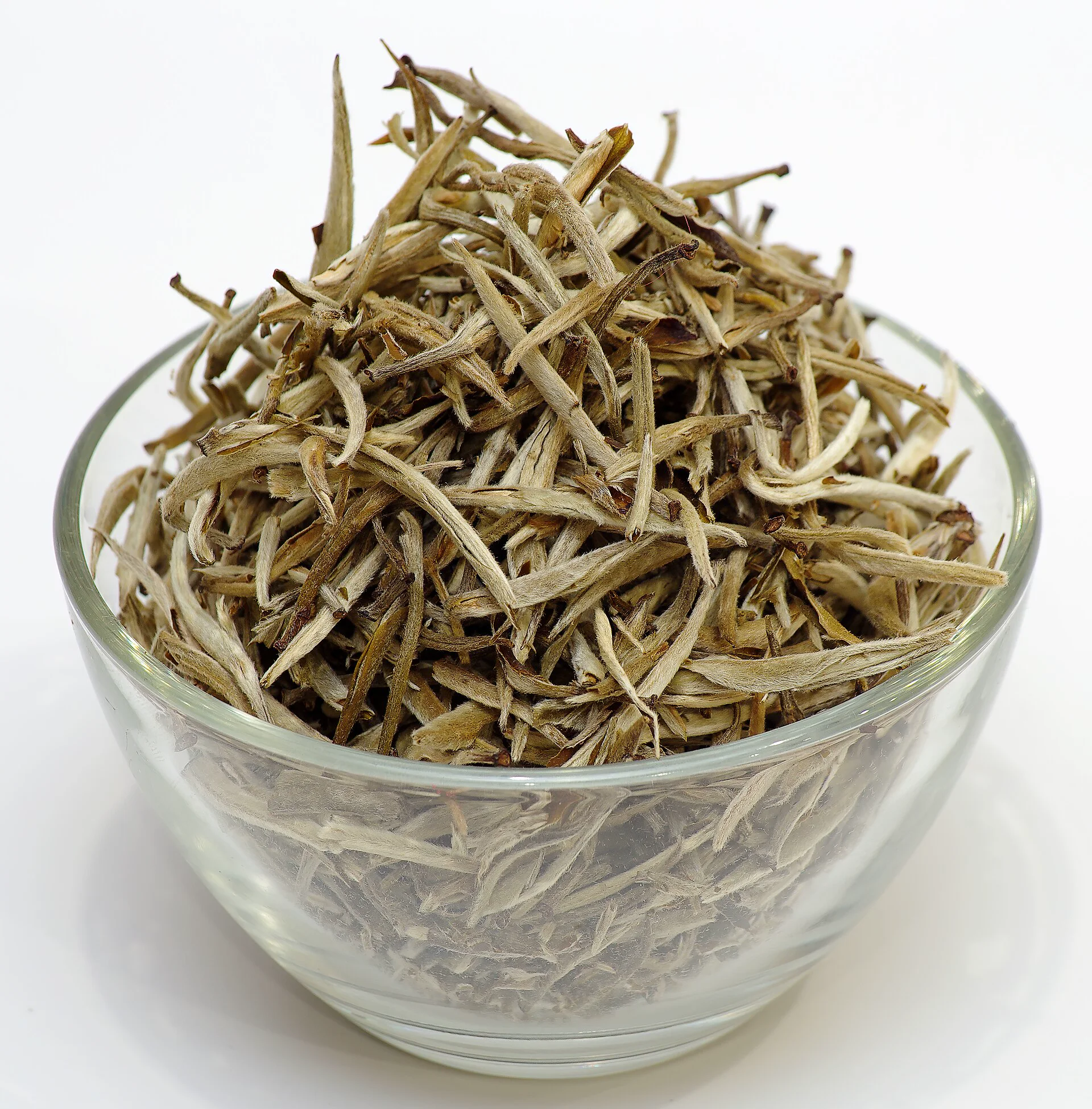
Silver Needle tea usually means Baihao Yinzhen (白毫银针), a bud-focused Chinese white tea. Baihao refers to the fine white down on tender material; Yinzhen means silver needle. The name tells you what the style looks like. It does not, by itself, tell you where the tea grew, which cultivar was used, when it was picked or how it was stored.
Ask the seller to resolve the name before discussing quality.
| Label | What it establishes | What is still missing |
|---|---|---|
Silver Needle |
A commercial English style name | Chinese name, tea family, origin and batch |
Baihao Yinzhen / 白毫银针 |
A bud-focused white-tea identity | Truth of the origin and grade claim |
Fuding Silver Needle |
A Fuding origin claim | Producer and evidence joining this packet to that origin |
Zhenghe Silver Needle |
A Zhenghe origin claim | Producer and evidence joining this packet to that origin |
Yunnan Silver Needle or another named origin |
A bud-style white tea from the stated place | Honest labeling, harvest and storage record |
Bud-only white teas from outside Fujian may be worthwhile teas. They should be sold under their real origin rather than borrowing a protected place name.
Standards create an evidence ladder, not a packet certificate
For Silver Needle, the standards are an evidence ladder rather than a decorative string of numbers. The official record for GB/T 22291-2017, White Tea establishes the national product category, and GB/T 32743-2016 records a white-tea processing framework. The Fuding geographical-indication standard DB35/T 1076-2010 and the nationally listed GB/T 22109-2008, Zhenghe White Tea concern protected production contexts. A seller still has to connect the actual bud lot to its claimed origin, harvest and producer; the existence of a standard cannot authenticate a packet by itself.
These records establish product categories, processing frameworks and protected-origin contexts. They do not authenticate an unknown online listing.
| Evidence level | Useful proof | What it cannot prove alone |
|---|---|---|
| Category | The product is identified as white tea and Baihao Yinzhen | Fuding or Zhenghe origin |
| Origin | Producer, production area, compliant label and traceable seller record | That the tea tastes good now |
| Batch | Harvest year, bud standard, packing and storage history | That the asking price is fair |
| Cup | Clean aroma, texture and persistence under fixed brewing | Legal origin without records |
A credible purchase needs all four levels to agree. A standards logo in a product photograph is not a substitute for a readable label, batch record and seller accountability.
A bud is not a purity symbol
The down is made of plant hairs called trichomes. It belongs to tender growth and can contribute to the visual haze in an infusion. More visible down does not prove origin, freshness, hand picking or higher quality. Lighting, camera sharpening, cultivar, handling and breakage all change what a photograph shows.
Inspect dry tea in neutral light over plain paper:
| Observation | What it can tell you | Stop before claiming |
|---|---|---|
| Mostly intact, narrow buds | Broad agreement with a bud-focused listing | Protected origin or harvest date |
| Small attached leaf or scale | Material is not visually identical to a bare needle | Fraud; the seller's declared standard must be checked first |
| Fine white down | Tender structures are visible | Quality, age or authenticity |
| Broken tips and loose dust | Handling or packing may have damaged the lot | Counterfeiting by itself |
| Pale green, straw or olive variation | The lot's visible condition and uniformity | Exact storage history |
| Must, damp cardboard or stale oil | A possible storage rejection signal | Exact cause without further evidence |
The correct question is not Are all the buds perfectly white? It is Does the material match the seller's specific bud-standard description, and does that standard produce a good cup?
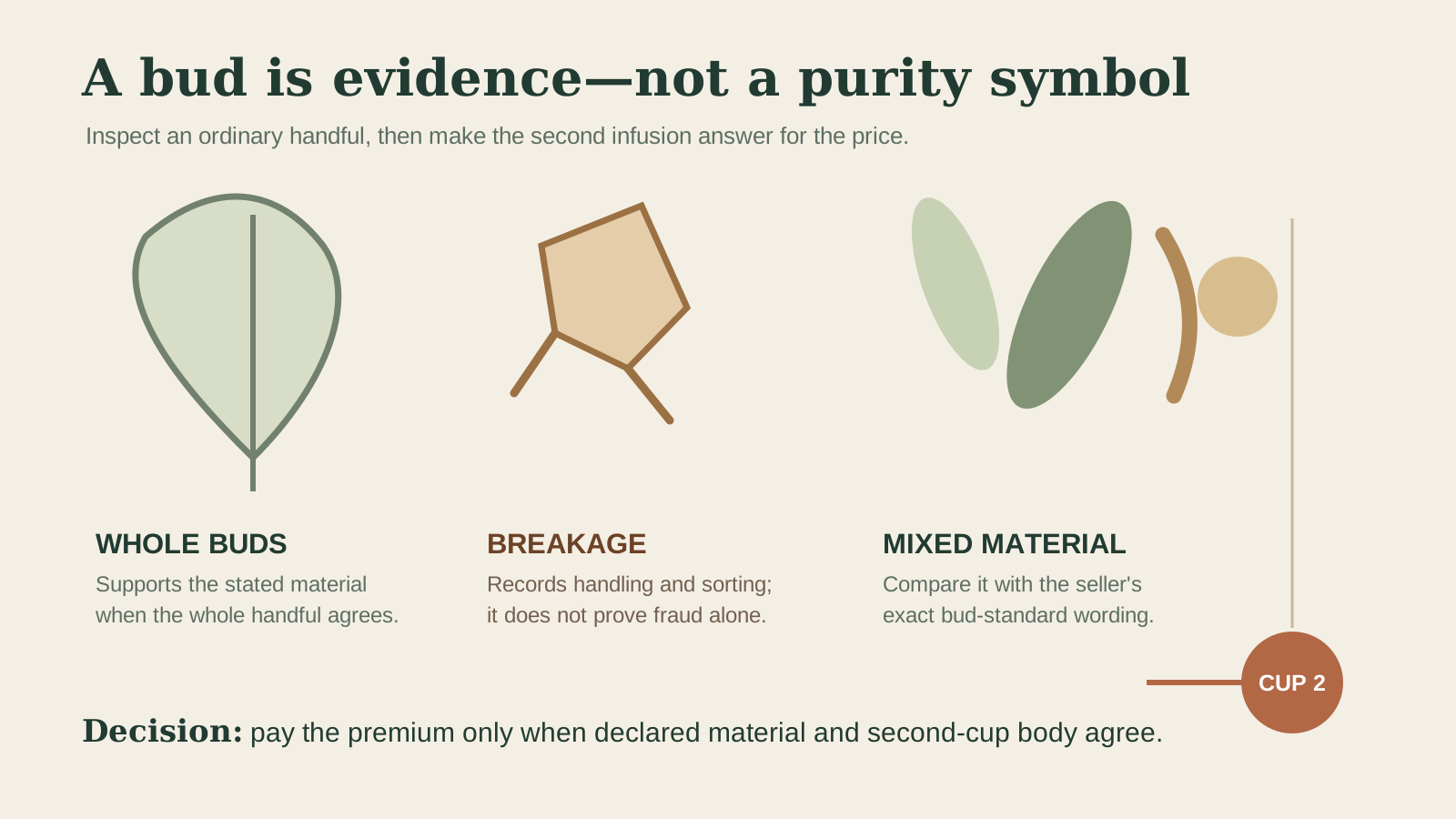
I use this as a two-part audit, not an online authenticity trick. First I photograph an ordinary handful and count what the seller actually supplied. Then I make cup two answer for the premium. Perfect-looking buds with no body are still poor value; modest handling damage in a vivid, traceable lot is not a reason to reject it.
The premium begins in a narrow harvest window
Selective plucking is slow, tender buds bruise easily, and their high surface moisture must be reduced without trapping heat or leaving unstable material. That difficulty helps explain cost, but difficulty does not guarantee success.
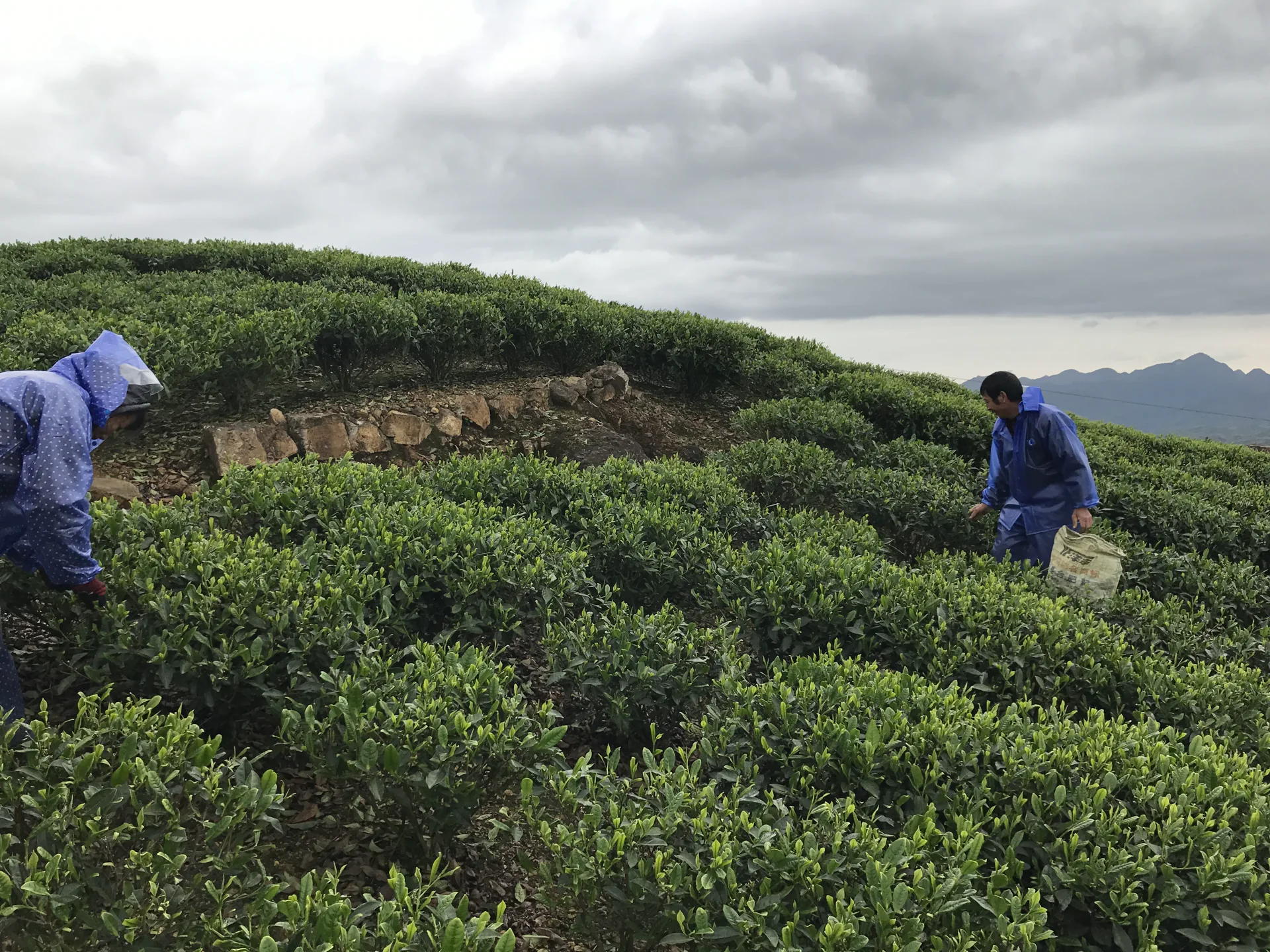
Hand-picking white-tea material. Photograph by KZZZ01, CC BY-SA 4.0, via Wikimedia Commons. The photograph documents white-tea picking, not every Silver Needle standard or the origin of a retail batch.
White tea is often reduced to withering and drying. In practice, the maker manages leaf depth, airflow, humidity, temperature, time and final moisture. A romantic phrase such as sun withered is not a quality grade; a controlled environment is not automatically industrial damage.
| Stage | Maker's decision | Failure direction in the cup |
|---|---|---|
| Plucking and transport | Select the intended material and prevent crushing or heat buildup | Mixed maturity, bruising or dull aroma |
| Spreading | Give fragile shoots enough space and air | Uneven change or trapped heat |
| Withering | Remove water while allowing a coherent aroma and texture to form | Raw greenness, sourness or emptiness |
| Drying | Stabilize the tea without erasing it | Scorch, flatness or residual-moisture risk |
| Sorting and packing | Protect brittle buds and exclude odors and humidity | Dust, breakage or rapid storage decline |
No photograph of trays can prove that these decisions were made well. The finished cup is where process claims meet consequences.
Run the same two-infusion test before judging value
The first infusion shows aroma; the second decides whether the premium has substance. Use one repeatable baseline when comparing sellers or comparing Silver Needle with White Peony.
This is an East Moment household comparison protocol, not a national standard or laboratory method. It provides fair conditions; it does not claim that every tea reaches its absolute best at these numbers.
- Measure 4.0 g of tea for 100 ml of working vessel volume.
- Use neutral porcelain and fully decant after every infusion.
- Start with 90 C / 194 F water.
- Infuse for 30 seconds, then 45 seconds, then 75 seconds if needed.
- Start timing when water first touches the tea and include pouring time.
- Taste each cup hot, warm and nearly cool.
- Keep water, vessel, dose and pour speed unchanged between samples.
| Checkpoint | A premium-supporting result | Warning sign |
|---|---|---|
| Infusion 1, hot | Clean steam and a recognizable fresh, floral, melon, hay or sweet-vegetal direction | Perfume that is strong only above the cup |
| Infusion 1, warm | Rounded texture rather than scented water | Pale, thin liquor sold as automatic refinement |
| Infusion 2, warm | Flavor family remains, with sweetness, body and a clean finish | Sudden collapse into warm water |
| Nearly cool | Clean return; no damp-paper or cellar odor | Sourness, must or stale oil becomes clearer |
| Opened material | Broad agreement with the stated bud standard | Unexplained mature leaves, stems, fragments or mixed material |
Research on infusions from different Fuding white-tea types supports the limited point that plucking material can produce compositional differences. It does not prove that one grade is universally superior, that Fuding always beats Zhenghe or that a photographed packet is genuine.
Diagnose a disappointing cup one variable at a time
Social discussions repeatedly ask why Silver Needle tastes like water, becomes bitter or smells green. The useful answer is controlled adjustment.
| Result at the baseline | First controlled change | Buying interpretation after the repeat |
|---|---|---|
| Thin but clean | Increase to 5.0 g, holding everything else constant | Improvement points to dose; no improvement weakens the premium case |
| Bitter or drying | Shorten both early infusions by 10 seconds | Improvement points to excessive contact time |
| Still rough | Lower water to 85 C / 185 F | Improvement shows the sample needs gentler heat in this setup |
| Very green or raw | Keep the baseline and taste warm, then cool | Persistent harsh greenness may reflect style, making or storage; it does not identify which |
| Flat, papery or old-hay-like | Repeat from a newly opened portion with known water | Persistence is a freshness and value warning |
| Sour, musty, damp or cellar-like | Repeat once in clean porcelain with known water | Persistence is a rejection signal; do not try to rinse it away |
| Strong aroma but hollow liquor | Compare infusion two at the same conditions | Surface perfume without body does not justify the premium |
Do not reduce leaf, temperature and time together. That may rescue one cup but destroys the diagnosis. Change one variable, record the result and then decide whether the tea is merely demanding or fundamentally poor value.
Wet leaf checks the listing, not the birthplace
After infusion two, spread the cooled material on a white plate. Separate ten representative pieces rather than selecting only the prettiest bud.
Record:
- how many pieces are intact buds, buds with an attached small leaf, larger leaves, stems or fragments;
- whether the pieces open at roughly similar rates or behave like a visibly mixed lot;
- whether the seller's
bud only,single budor other declared standard matches what is actually present; - whether sour, musty or perfumed odor remains as the leaf cools.
Wet leaf can expose a mismatch between uniform whole buds and a mixed or broken lot. It cannot prove Fuding, Zhenghe, cultivar, harvest year, artificial aging or added aroma. Those claims require records or appropriate testing, not confidence in a photograph.
Silver Needle versus White Peony is a value decision
Silver Needle is not automatically the best white tea. Bud material often gives a fine texture and slow-building sweetness; the open leaves in White Peony can deliver faster aroma, broader flavor and clearer structure at a lower price.
| Choose | When it earns the choice | Do not choose it because |
|---|---|---|
| Silver Needle | You specifically want a traceable bud style and infusion two retains texture and sweetness | It is pale, expensive or visually pure |
| White Peony | You want an expressive first white tea, stronger leaf structure or better value | It is assumed to be failed Silver Needle |
| Shou Mei | You want a mature-leaf style with fuller extraction or a different aging format | Darker leaf is assumed to mean poor quality |
For a fair purchase comparison, brew a transparent White Peony with the same 4.0 g / 100 ml / 90 C baseline. If the Silver Needle is less complete by infusion two and has weaker provenance, its grade name is not a reason to pay more.
New versus aged: storage is the product
Fresh Silver Needle may lean toward flowers, melon, cucumber, sweet corn, hay or soft herbs. With suitable storage, some teas may move toward honey, dried hay, herbs or softer fruit. Age is a transformation, not a quality guarantee.
An age claim is worth money only when the seller can identify:
- the original tea category and bud standard;
- the harvest and packing years;
- whether the tea remained loose or was later compressed;
- storage location and odor, heat and humidity controls;
- current batch photographs and a sample for brewing.
Brown buds, dark liquor or an old-looking wrapper cannot date tea. A photograph cannot distinguish natural storage from poor storage or deliberate treatment. Reject the older, the better when the seller cannot describe the storage chain.
For compressed Silver Needle, request an interior cross-section. A pale cake surface cannot establish what was pressed inside, and compression can increase breakage and change extraction.
Glass brewing is observation, not authentication
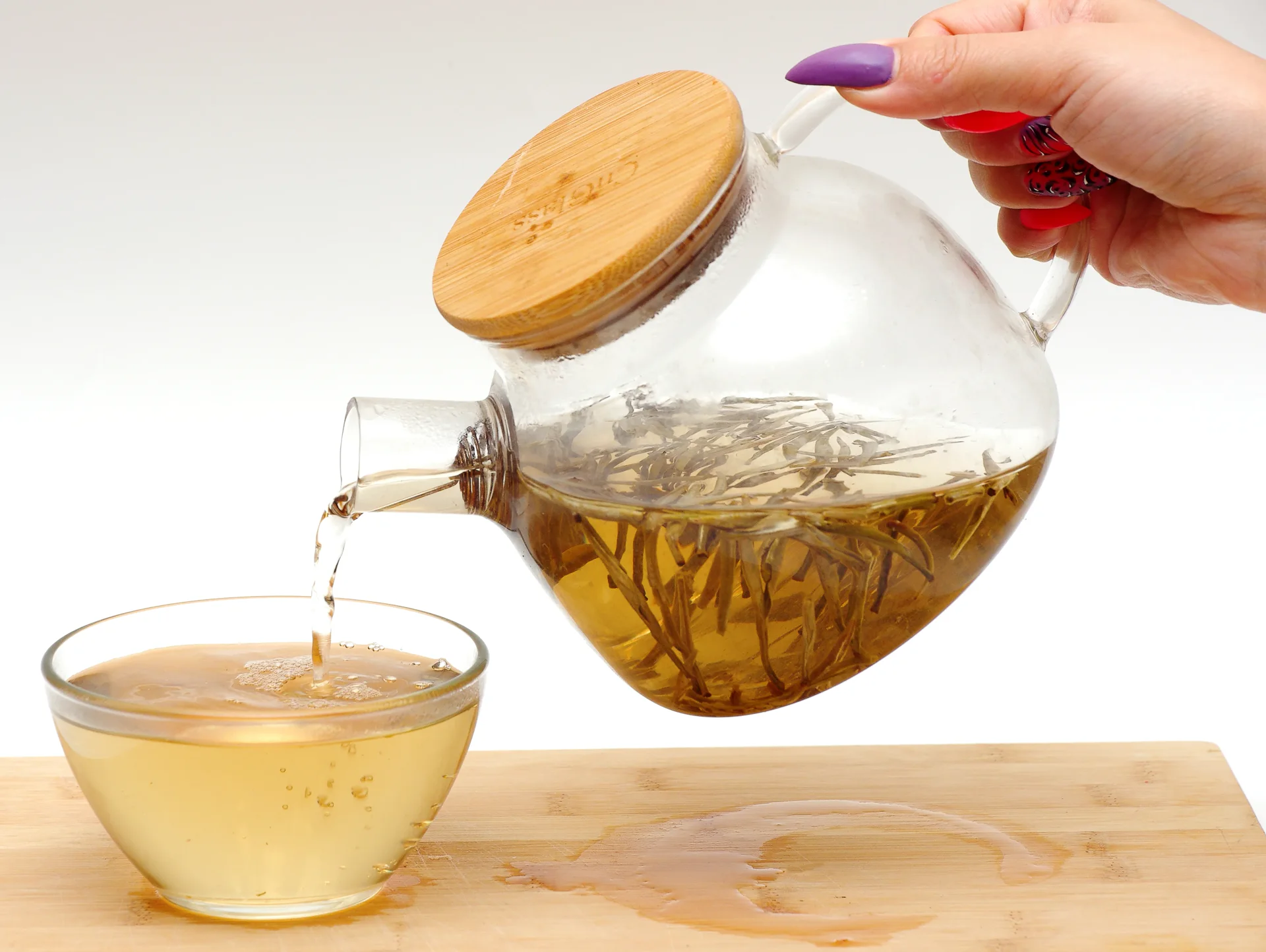
Baihao Yinzhen opening in a glass teapot. Photograph by Pannet, CC BY-SA 4.0, via Wikimedia Commons.
Some buds float, stand or sink as air escapes and water enters them. Pour direction, vessel shape, turbulence and individual bud structure change the display. Dancing needles can be pleasant to watch; it is not an authenticity test.
For one everyday glass, begin with 3.0 g per 250 ml at 85-90 C / 185-194 F. Taste at about 3 minutes instead of waiting for every bud to sink. If the cup is thin, raise temperature or dose before extending the steep dramatically.
An automatic rinse is unnecessary for a clean, traceable sample and removes the opening evidence in a comparison. A quick rinse cannot repair must, questionable hygiene or bad storage. If you choose to rinse, apply the same rinse to every comparison sample and record it.
Ask eight questions before paying the premium
- Is the product explicitly
白毫银针white tea, not onlySilver Needle? - What exact origin is claimed, and who produced and packed it?
- What bud standard does this batch use in the seller's own words?
- What are the harvest year and approximate picking period?
- Are the dry-leaf and opened-leaf images from this batch?
- How was the tea dried, packed and stored?
- If age is part of the price, what records connect the current tea to that year?
- Can you buy a sample large enough for two controlled sessions before committing?
Reject the premium when the answers return only to wild, ancient tree, imperial, first day, all buds, medicine aroma or aged treasure. Those may be marketing directions. None replaces origin, batch, storage and cup evidence.
The final buying rule
Buy when the product name is unambiguous, the origin and batch are traceable, the dry and wet material agree with the declared bud standard, the cooled cup is clean, and infusion two still has body. Pay more only for evidence and repeatable sensory value.
Do not buy when the seller asks white down, pale liquor, age, floating buds or a prestige story to carry the whole argument. If a well-documented White Peony performs better under the same conditions, buy the White Peony. That is not settling for a lower grade; it is choosing the better tea.
Silver Needle contains caffeine. Pale liquor and minimal processing do not make it caffeine-free, detoxifying or medically gentle. People who are pregnant, caffeine-sensitive or managing a health condition should consider dose and total intake and seek qualified guidance where appropriate.
Continue through the Chinese white tea collection, compare White Peony and Shou Mei, or use the broader Chinese tea brewing guide to calibrate vessel volume and pouring time.