White Peony tea is the best first Chinese white tea for most buyers. Its mix of buds and young leaves usually gives more immediate aroma, clearer structure and easier brewing than bud-only Silver Needle, without asking you to begin at the highest price. Buy a traceable batch whose declared leaf standard matches the dry and opened material and whose second infusion remains complete. Do not pay extra for
Peony King, perfect color or age language without that evidence.
White Peony tea: tea, not a peony infusion
White Peony tea, Bai Mudan (白牡丹) and Pai Mu Tan are names for the same broad Chinese white-tea style. It normally contains no peony petals and is not made by scenting tea with peony flowers. The floral name describes the tea's identity and visual imagination, not an ingredient list.
Resolve the listing before buying:
| Listing | What it establishes | What is still missing |
|---|---|---|
White Peony or Pai Mu Tan |
An English trade name | Chinese name, origin, producer and batch |
Bai Mudan / 白牡丹 |
A recognized bud-and-leaf white-tea identity | Truth of the origin and grade claim |
Fuding Bai Mudan |
A Fuding geographical claim | Evidence joining this packet to that production chain |
Zhenghe Bai Mudan |
A Zhenghe geographical claim | Evidence joining this packet to that production chain |
Peony King, imperial or wild |
Seller vocabulary | Applicable grade standard, material definition and value |
The name is meaningful, but it is not a certificate. A product can be genuine White Peony and still be stale, badly stored or poor value.
I reject the idea that a new white-tea buyer should pay first for the sparsest, palest leaf. I would rather have White Peony show me aroma, body and opened material in the same session. The best first tea is not the one that looks most expensive while dry; it is the one whose second infusion still explains the purchase. That matters because a beautiful bud photograph can sell silence as refinement.
Bud plus leaf is the advantage, not a defect
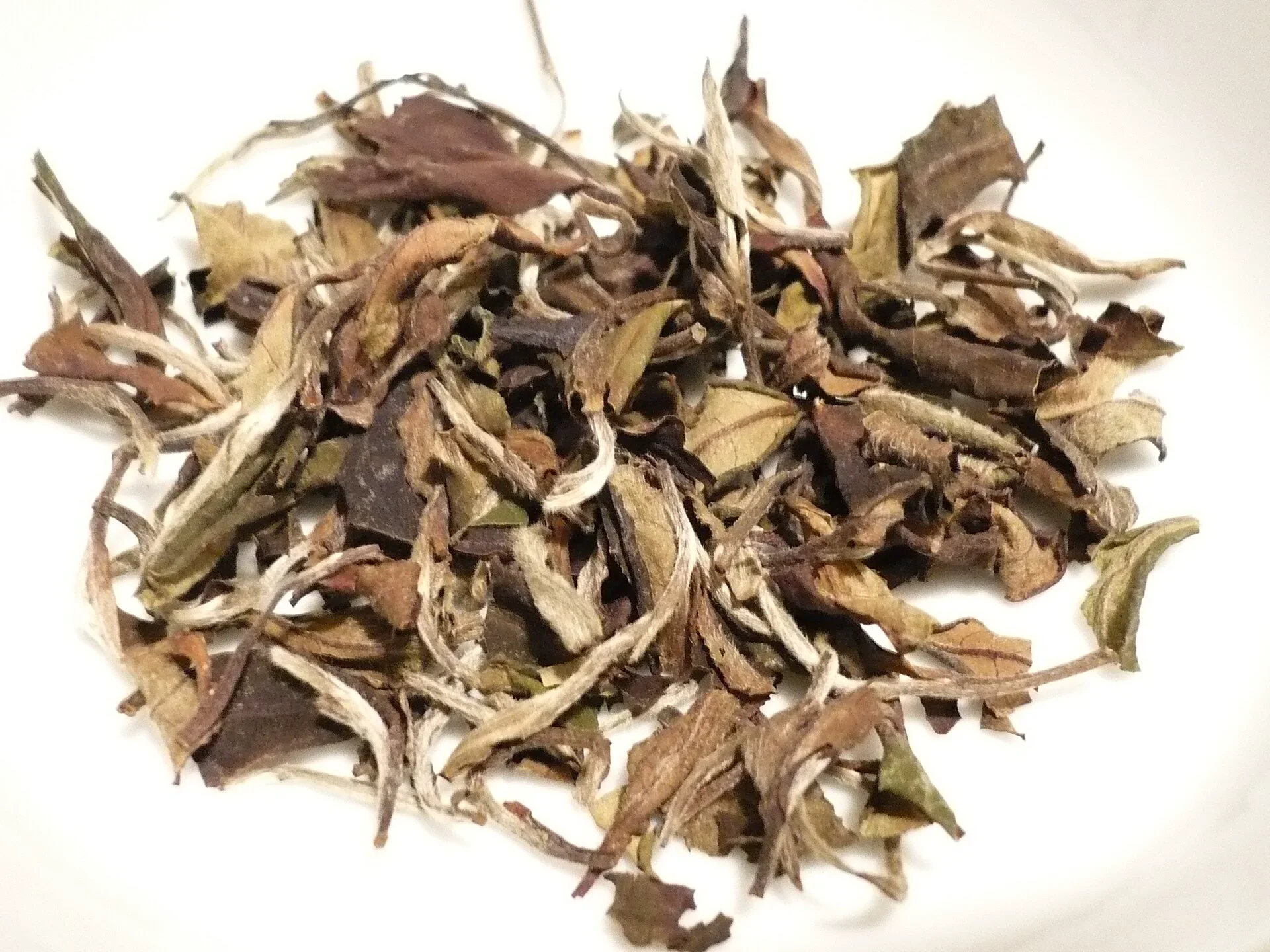
Bai Mudan purchased as Chinese organic tea and photographed in Ohio. Photograph by Badagnani, CC BY-SA 3.0, via Wikimedia Commons. The image documents the labeled retail tea, not a verified Fujian production lot.
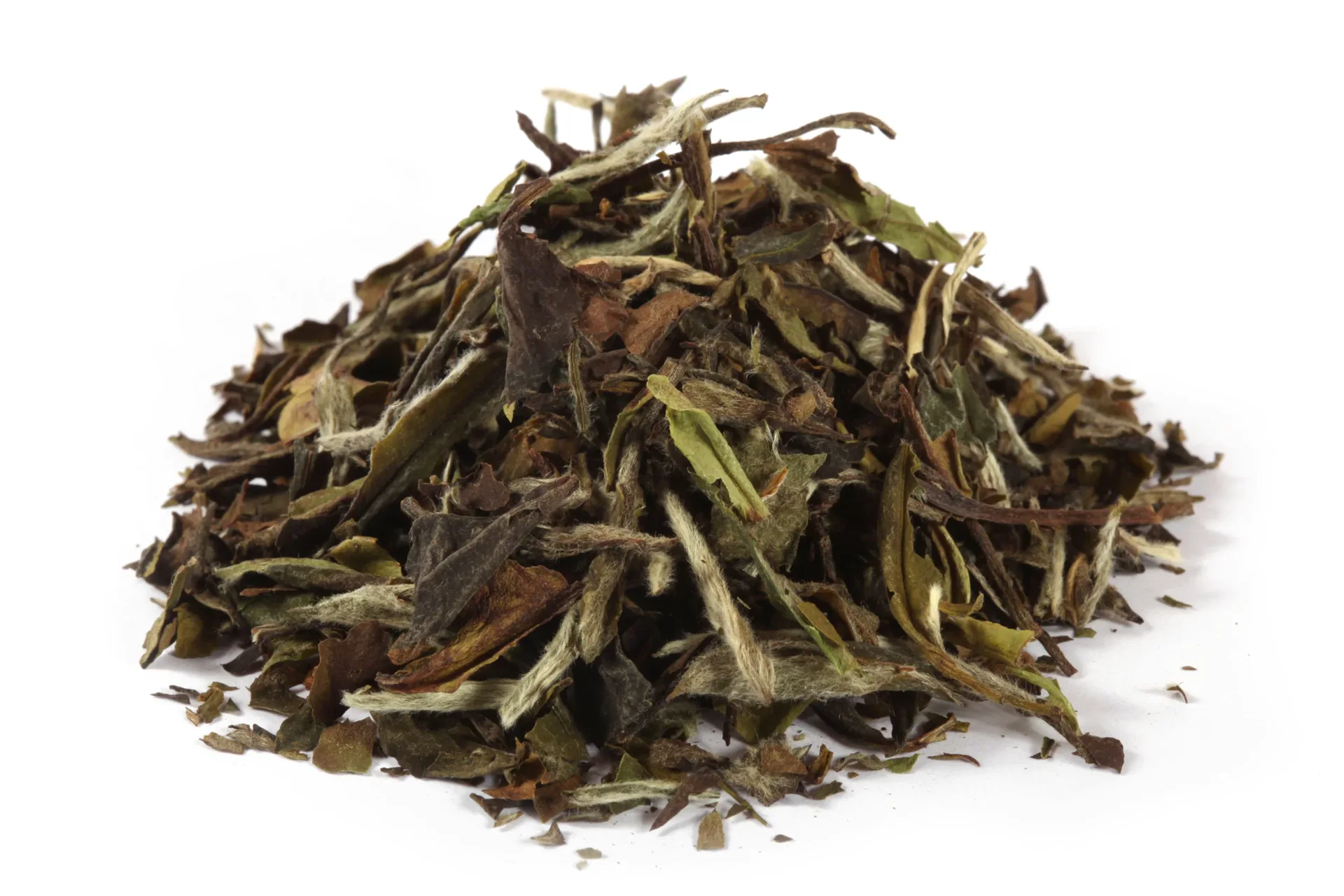
White Peony is generally built around downy buds with young leaves. Exact material and grade wording depends on the applicable standard and producer specification. That is why one bud and two leaves should be treated as a seller claim to inspect, not a diagram that every fragment must reproduce.
The bud can contribute fine texture and slow sweetness. The open leaf hydrates faster and can bring broader aroma, fruit, herbs and a firmer finish. White Peony is not failed Silver Needle. It is a different material composition, and that composition is precisely why it is such a useful first white tea.
| Dry-leaf observation | Useful conclusion | What it cannot prove |
|---|---|---|
| Buds and young leaves both visible | Broad agreement with a bud-and-leaf style | Fuding or Zhenghe origin |
| Mixed silver, green, olive and brown tones | Visible condition and lot variation | Age or grade from color alone |
| Some broken broad leaf | The fragile material experienced handling | Fraud by itself |
| Heavy dust and very uneven fragments | Possible rough handling, low sorting consistency or old bottom-of-bag material | The exact cause |
| Clean hay, floral, fruit or sweet-vegetal aroma | A plausible clean starting point | Absence of added aroma without testing |
| Must, damp paper, cellar or stale oil | A storage rejection signal if it persists | The exact production failure |
Bright green is not automatically fresh. Dark leaf is not automatically old. Photographs can reveal a mismatch with the listing; they cannot establish origin, cultivar, harvest year or storage history.

This is why I refuse to call White Peony a consolation prize. The bud supplies finesse; the open leaf makes the tea legible. When those two parts remain joined in the warm second infusion, White Peony can be more emotionally satisfying—and more useful to a new buyer—than a prettier Silver Needle that disappears after cup one.
Standards define claims, not the tea in your hand
The standards answer different questions, and White Peony buyers should not collapse them into one badge. The official record for GB/T 22291-2017, White Tea supplies the national product framework, while GB/T 32743-2016, Technical Specification for White Tea Processing addresses processing. The Fuding geographical-indication record DB35/T 1076-2010 and the nationally listed GB/T 22109-2008, Zhenghe White Tea identify protected regional contexts. None of those numbers proves that the leaf-and-bud ratio inside an anonymous packet matches its sales photograph.
Keep four evidence levels separate:
| Evidence level | What useful documentation can support | What remains unproven |
|---|---|---|
| Category | White tea and Bai Mudan identity | Protected origin |
| Origin | Production area, producer, compliant label and traceable seller | Present cup quality |
| Batch | Harvest year, material standard, packing and storage | Fair price |
| Cup | Clean aroma, body, persistence and opened-leaf agreement | Legal origin without records |
A premium claim needs all four levels to agree. A standards number in product copy does not authenticate a packet, and a beautiful packet cannot replace a batch record.
Withering is controlled work, not passive drying
White tea is often summarized as withering and drying. Those are the visible stages, not the complete judgment. Leaf depth, airflow, humidity, temperature, weather, time and final drying all affect the finished tea.

White tea withering on bamboo trays. Photograph by KZZZ01, CC BY-SA 4.0, via Wikimedia Commons. This real setup illustrates process context; it does not prove how the article's retail images were made.
| Stage | Maker's decision | Failure direction a drinker may notice |
|---|---|---|
| Plucking and transport | Select intended maturity and prevent crushing or heat buildup | Coarse, bruised or uneven material |
| Spreading | Release field heat and give shoots enough air | Heated piles or patchy change |
| Withering | Manage water loss and continuing biochemical change | Raw greenness, sourness or dullness |
| Drying | Stabilize the material without emptying it | Scorch, flatness or later storage decline |
| Sorting and packing | Protect broad fragile leaf from dust, odor and humidity | Breakage, foreign odor or inconsistency |
Sun withered is not automatically superior, and controlled indoor equipment is not automatically inferior. The useful question is whether the method suited the leaf and produced a clean, stable tea.
Run one fixed test before adjusting the recipe
White Peony's open leaves usually hydrate faster than intact Silver Needle buds. Excessive caution can still produce scented water; long standing contact can make the leaf dry and rough. A fixed comparison gives you evidence before preference.
Use this East Moment household baseline. It is not a national standard, laboratory method or claim that every White Peony reaches its best cup at these numbers.
- Measure 4.0 g for 100 ml of working vessel volume.
- Use neutral porcelain and fully decant after every infusion.
- Begin with 90 C / 194 F water.
- Infuse for 30 seconds, then 45 seconds, then 75 seconds.
- Start timing when water first touches the tea and include pouring time.
- Taste each cup hot, warm and nearly cool.
- Keep water, vessel, dose and pour speed unchanged between samples.
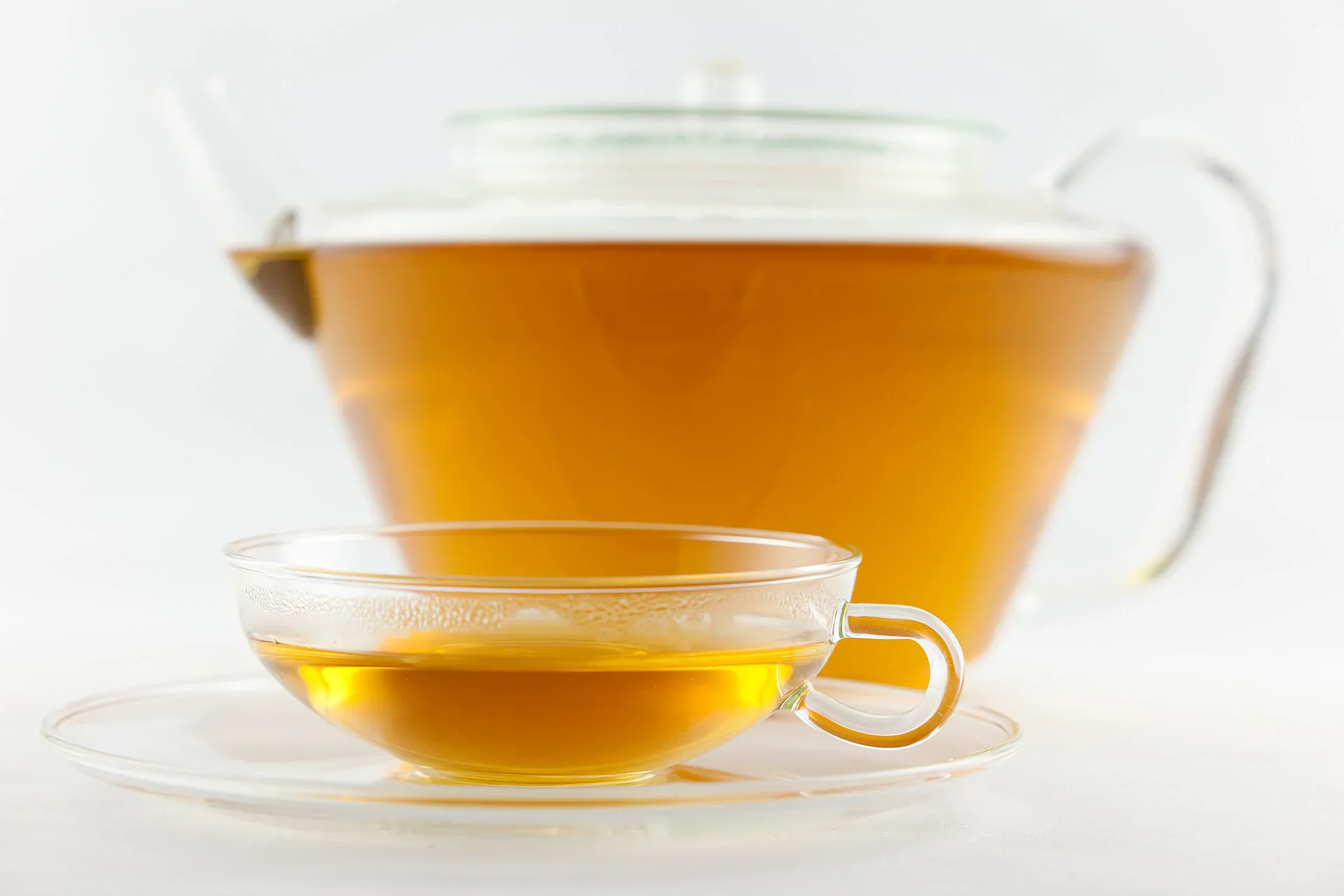
Freshly brewed Pai Mu Tan, another romanization of Bai Mudan. Photograph by Andre Helbig / soultea.de, CC BY-SA 3.0, via Wikimedia Commons. The documented liquor belongs to that source session; color is not a universal target.
| Checkpoint | A useful result | Warning sign |
|---|---|---|
| Infusion 1, hot | Clean floral, fruit, hay or sweet-vegetal direction | Strong perfume above the cup but little flavor in it |
| Infusion 1, warm | Noticeable body and a coherent finish | Thin scented water sold as delicacy |
| Infusion 2, warm | Aroma family remains and leaf structure adds depth | Abrupt collapse or harsh dryness |
| Infusion 3 | A weaker but still recognizable continuation | Only color remains |
| Nearly cool | Sweet or clean return without storage odor | Must, damp paper, cellar or sourness emerges |
| Opened material | Broad agreement with the stated bud-and-leaf standard | Unexplained mature leaf, stems, dust or mixed material |
Infusion two is the buying hinge. A vivid first aroma can come from the surface. The second cup shows whether the lot has enough substance and clean structure to justify repeat drinking.
Diagnose the cup one variable at a time
The recurring practical confusion is whether White Peony needs cooler water, a longer steep or the forceful treatment sometimes used for aged white tea. There is no useful answer without holding the other variables constant.
| Result at the baseline | First controlled change | Interpretation after repeating |
|---|---|---|
| Bitter or drying | Shorten each early infusion by 10 seconds | Improvement points to excessive contact time |
| Still rough | Lower water to 85 C / 185 F | Improvement shows the lot needs gentler heat in this setup |
| Thin but clean | Increase dose to 5.0 g | Improvement points to dose; no improvement weakens the value case |
| Floral aroma but empty liquor | Keep the baseline and compare infusion two | Surface aroma without body is not premium evidence |
| Very green and sharp | Taste warm, then nearly cool before changing heat | Persistent rawness may reflect style, process or storage; the cup cannot identify which |
| Flat or papery | Repeat from a newly opened portion with known water | Persistence is a freshness warning |
| Sour, musty or cellar-like | Repeat once in clean porcelain with known water | Persistence is a rejection signal; rinsing cannot repair it |
Change one variable per repeat. Lowering dose, heat and time together may create a softer drink, but it cannot tell you what failed.
For a 250 ml mug, begin with 3.0 g, 90 C / 194 F water and 3 minutes. Remove or strain the leaves. White Peony can tolerate casual brewing, but leaving a large dose in hot water indefinitely is a different extraction method, not proof that the tea is bad.
Compare three white teas under the same conditions
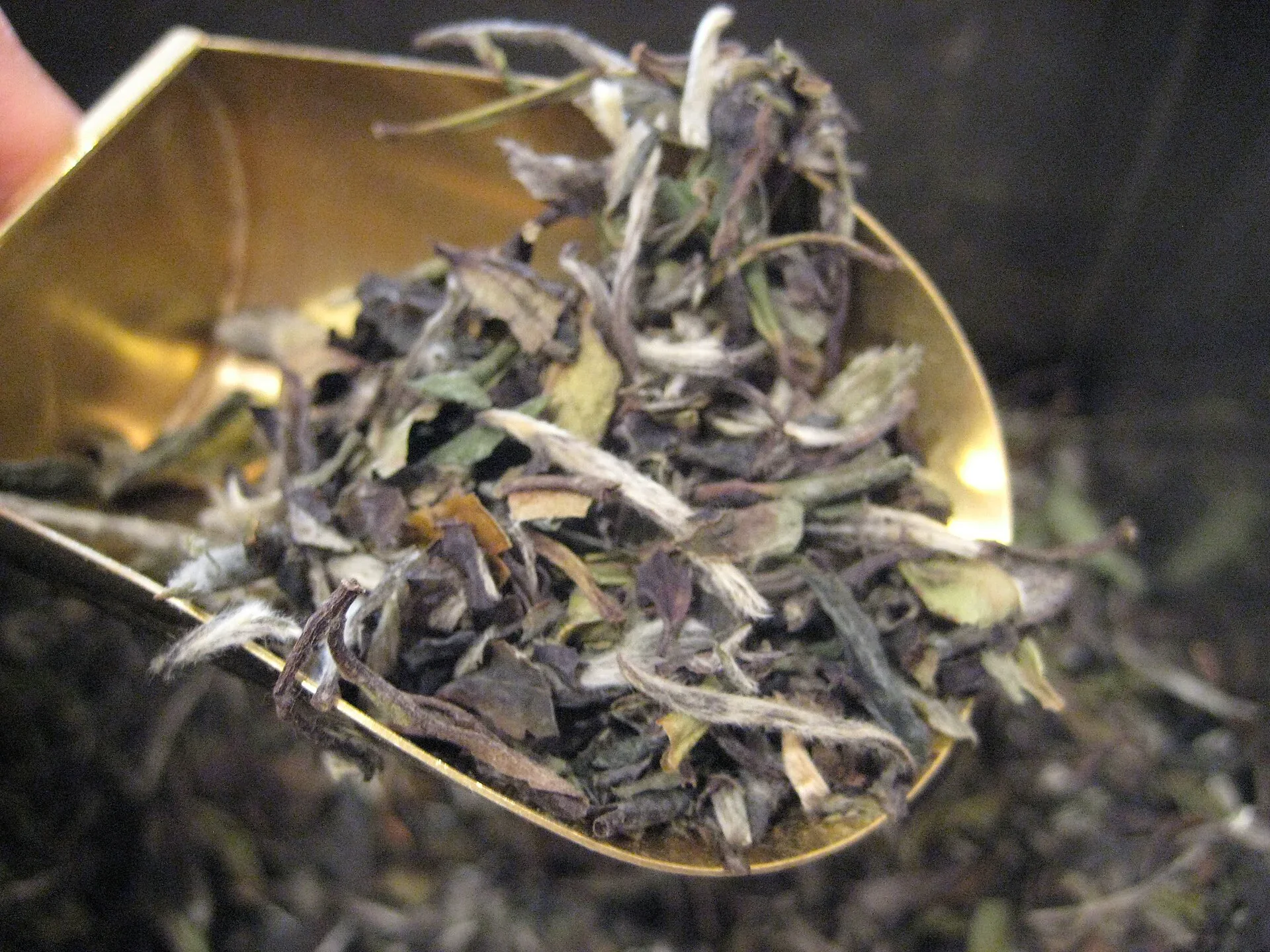
Loose White Peony tea in a scoop. Photograph by Selena N. B. H., CC BY 2.0, via Wikimedia Commons. The trade description does not establish a protected origin or grade.
Use the same 4.0 g / 100 ml / 90 C / 30 and 45 seconds baseline for one transparent sample of each style. This is a purchasing comparison, not a declaration of each tea's final ideal recipe.
| Tea | Material emphasis | What to watch in infusion two | Buy it when |
|---|---|---|---|
| Silver Needle | Bud-only or strongly bud-focused | Fine texture and sweetness survive slow hydration | You specifically want a traceable bud style and accept its premium |
| White Peony | Buds with young leaves | Aroma remains while leaf adds body and a clean finish | You want the clearest first lesson and strongest all-round value |
| Shou Mei | More mature leaf and fewer buds | Fuller extraction remains clean rather than coarse | You want mature-leaf character, easier strong brewing or another aging format |
If White Peony is more complete than the Silver Needle at the same price, buy White Peony. If a clean Shou Mei gives you the mature-leaf depth you prefer, buy Shou Mei. Grade names describe material; they do not rank your cup for you.
Opened leaf tests the seller's description
After infusion two, cool the material and spread it on a white plate. Select ten representative pieces rather than the ten prettiest.
Record:
- the number of intact buds, bud-plus-leaf units, separate young leaves, mature leaves, stems and fragments;
- whether the material broadly matches the seller's stated plucking and sorting standard;
- whether pieces open at similar rates or behave like a visibly mixed lot;
- whether sour, musty, perfumed or stale odor remains as the leaf cools.
Opened leaf can expose a mismatch between a declared bud-and-young-leaf lot and unexplained coarse or fragmented material. It cannot prove Fuding, Zhenghe, cultivar, year, artificial aging or added fragrance. Preserve the package, invoice and seller description with your photographs so the evidence retains context.
Grade words need definitions
Retailers use special grade, first grade, Peony King, imperial, wild and other terms. Some may refer to a real producer sorting system. Others are marketing. Ask which applicable standard or written producer specification defines the term for this batch.
Do not pay more merely because every leaf looks arranged for a photograph. White Peony is broad and fragile. A few broken leaves are normal; heavy dust, unexplained mature material, foreign odor and a cup that collapses are more useful warnings.
The strongest seller evidence is ordinary and specific:
- exact origin, producer and packer;
- harvest year and approximate picking period;
- the batch's declared bud-and-leaf standard;
- current dry and opened-leaf photographs from that lot;
- loose or compressed form, packing date and storage account;
- a sample large enough for two controlled sessions.
Fresh, aged and compressed are separate decisions
Fresh White Peony may emphasize flowers, pear, melon, green hay and cool herbs. With suitable storage, some lots may move toward honey, dried fruit, dry wood or herb-like directions. Age is not an upgrade. It is a storage-dependent transformation.
A 2024 metabolomics study compared first-grade Bai Mudan samples described as coming from Zhenghe, Fuding and Jinggu across stated storage durations. It supports the bounded conclusion that producing area and storage duration can affect measured chemistry. It cannot authenticate an unknown tea, prove that older is better or turn one region into a universal winner.
Require an age claim to identify the original category, harvest and packing years, loose or compressed history, storage location and odor, heat and humidity controls. Wrapper color, brown leaf and dark liquor cannot date tea.
China's official platform lists GB/T 31751-2015, Compressed White Tea, as current. That framework does not tell you what grade sits inside a particular cake. Request an interior cross-section and sample: the cake surface can be arranged more attractively than its center, and compression changes breakage and extraction.
Do not begin by boiling an unknown aged White Peony. First brew a measured portion conventionally and taste it cool. Boiling can be a later preparation choice for a clean tea; it is not a method for washing away doubtful storage.
Ask eight questions before buying
- Is this explicitly Bai Mudan white tea, and what origin is claimed?
- Who produced, packed and sold this batch?
- What exact bud-and-leaf or grade standard does the seller claim?
- What are the harvest year and approximate picking period?
- Are the dry and opened-leaf photographs from this lot?
- How was the tea dried, packed and stored?
- If age or compression raises the price, what records support that history?
- Can you buy a sample large enough for two controlled sessions?
Reject the premium when every answer returns to Peony King, imperial, wild mountain, medicine aroma, perfect color or old tea. Those terms can describe a seller's story. They do not join the tea to an origin, batch, storage chain or good second infusion.
The buying verdict
Choose White Peony as your first white tea when you want the category's bud softness and leaf expression in one readable cup. Buy when the origin and batch are traceable, the material matches its description, the cooled liquor is clean and infusion two retains aroma, body and finish.
Do not buy because White Peony is supposedly a cheaper Silver Needle, because the leaves look uniformly green, or because an old date promises medicine-like value. The correct premium is for evidence and repeatable drinking quality, not hierarchy.
The name “White Peony” describes a tea grade, not a flower infusion. Buds and leaves from Camellia sinensis still deliver caffeine, and a pale liquor does not make the cup medicinal, detoxifying or suitable for unlimited drinking. If caffeine affects sleep, pregnancy or a medical condition, reduce the variables you can control—leaf weight, contact time and repeated infusions—and use qualified guidance for the decision the cup cannot answer.
Continue through the Chinese white tea collection, compare Silver Needle and Shou Mei, or use the Chinese tea brewing guide to measure working vessel volume and pouring time.