The price looks small. How much are you agreeing to buy? At the Yiwu wholesale market in Zhejiang, that question comes before the bargain. This small-commodity trading network is useful for comparing gifts, accessories, household goods and other shop stock. A personal purchase, an evaluation sample and a wholesale order are different conversations. I want you to enjoy the displays without letting one attractive bag turn into a carton you never meant to own. Start with the product category, confirm the buying unit, then compare the offer.
Yiwu wholesale market is a discovery system, not one giant shop
The Yiwu government's specialized-market directory shows why the place cannot be treated as one undifferentiated hall: crafts, jewelry, toys, hardware, electronics, bags, stationery, cosmetics, eyewear, buttons and zippers occupy organized commercial zones. Start with what belongs on your shelf. A visitor looking for a single gift and a shop owner building a coordinated range can enjoy the same display and need entirely different offers.
Yiwu's international trade market is valuable because it compresses thousands of small-commodity categories into a navigable commercial geography. Buyers can compare colours, packaging, variations and minimums quickly. That speed is the product.
I like the small decisions this makes possible: a different handle, a quieter colour, a box that lets a modest object feel like a gift. Those details are the visit, not distractions from it. The discipline is to keep the exact version attached to its buying unit and reorder terms. Otherwise the display gives you a collection you love and an order you cannot reconstruct.
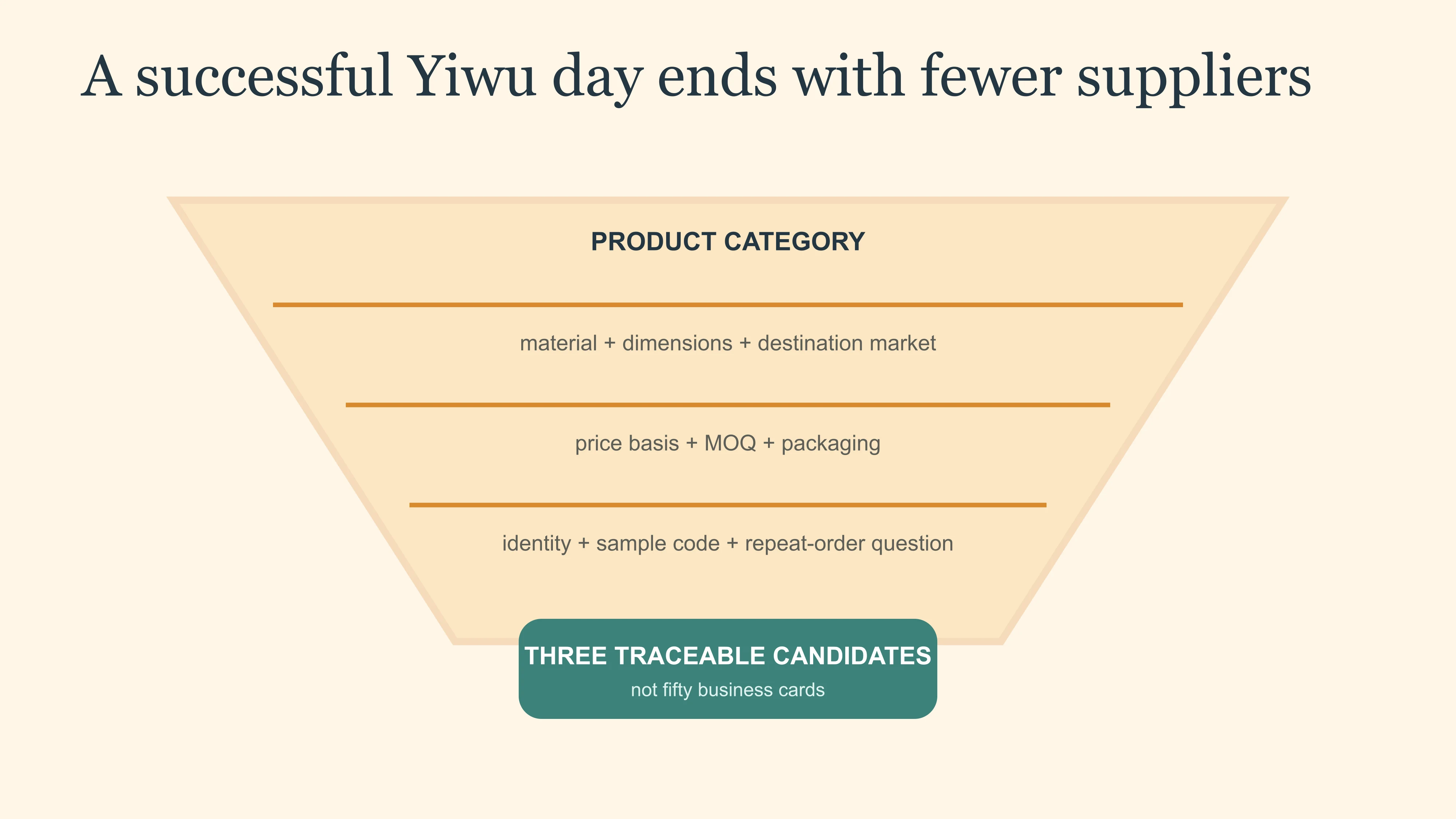
For a first sourcing visit, I would rather leave with three comparable candidates than fifty business cards. Three gives you a useful evening's work: match each sample to its material, packaging and repeat-order terms. Fifty unlabelled contacts leave you scrolling through a phone gallery, wondering which seller promised what. Choose a category before you enter; give yourself permission to walk past the rest.
Visiting for yourself is not the same as buying for a shop
You do not need to invent a business to be curious about Yiwu. But you do need to say what you want. A seller quoting a carton is not necessarily refusing to help; the conversation may simply be about a different unit from yours. Ask about a single-piece purchase before taking up time with colours and packaging. If it is unavailable, thank the seller and continue. A wholesale appointment is not an audition in which a tourist must pretend to be a future major customer.
Keep three requests separate: one item to use, one sample to evaluate, and stock to resell. A sample price and a repeat-order price can serve different purposes. Neither tells you that every neighbouring booth offers the same arrangement. A saved retail-store list is a starting lead, not a promise that the shop still occupies that booth or sells singles today.
For a leisure visit, choose one product category you genuinely enjoy and set a spending limit before entering. Look at how the same object changes across materials, finishes and packaging. That is more interesting than collecting shopping bags merely because the number on a calculator looks small. For a business visit, the satisfying moment comes later: when the sample, written offer and reorder conditions finally describe the same product.
Four questions worth keeping on your phone:
- 可以零售吗? (Kěyǐ língshòu ma?) — Do you sell individual items at retail?
- 可以买一个样品吗? (Kěyǐ mǎi yí ge yàngpǐn ma?) — Can I buy one sample?
- 起订量是多少? (Qǐdìngliàng shì duōshao?) — What is the minimum order quantity?
- 一箱多少个?可以混色吗? — How many pieces are in a carton? Can colours be mixed?
Have the answer written beside the product code. Pointing at a display and hearing a number is not yet an agreement about quantity. The Chinese business culture guide takes that conversation further: respect the person, then make the commercial details explicit.
What can you source in Yiwu?
The market is strongest for small commodities and product variations rather than every kind of industrial manufacturing.
| Category | Good first use | Checks that matter |
|---|---|---|
| Gifts and seasonal goods | Test a small collection quickly | Materials, packaging, seasonal lead time |
| Accessories and jewellery | Compare colour and form in person | Plating, nickel content, consistency |
| Home and kitchen items | Build a mixed catalogue | Food-contact safety, dimensions, cartons |
| Stationery and craft supplies | Small-batch retail tests | Printing, adhesives, licensing |
| Toys and novelty products | Trend and sample discovery | Age grading, testing, packaging and IP |
| Bags and travel accessories | Compare materials and hardware | Stitching, load tests, smell and finish |
For furniture, electronics or regulated products, the market can be a discovery or sourcing starting point, not the complete due-diligence route. Use the China manufacturing guide to decide when a specialist cluster is more appropriate.
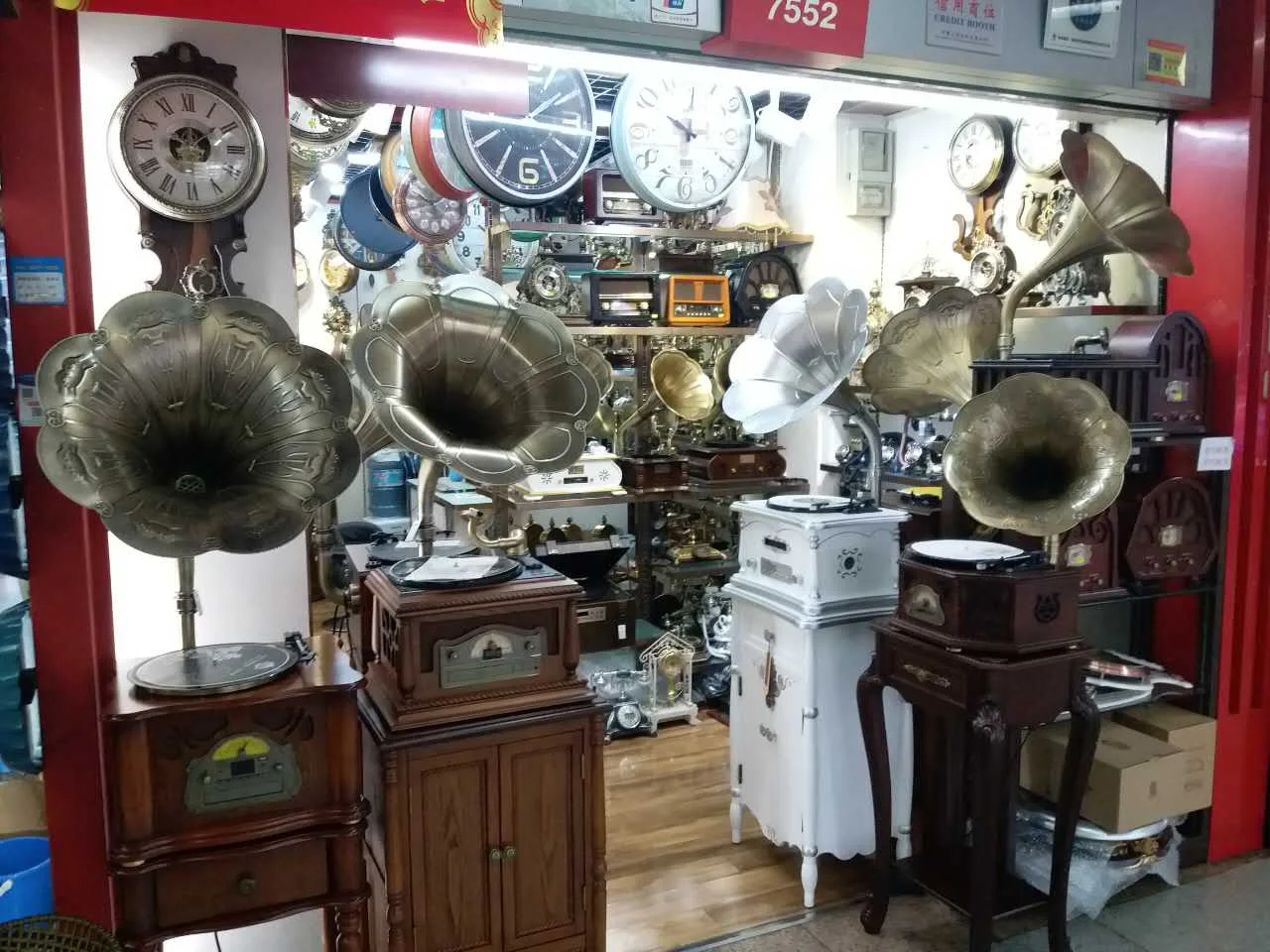
District 1, photographed in 2017 by Muzzleflash, CC0. Resized and converted to WebP.
Look past the big horns. The white cabinet, dark wooden-looking bases and different footprints turn one appealing product idea into several different buying decisions. I like this display because it makes comparison tangible: which finish suits your customer, how much shelf space will it occupy, and what must survive inside the carton? Point to the exact model before asking for a quote. For an audio product, ask for a working demonstration too; a nostalgic shape is not a listening test. This is a historical shop photograph, not a current stock recommendation.
Choose the district by product, then choose the aisle by decision
Do not plan a current visit from an old five-district graphic alone. The market operator's current directory lists Districts 1–6, alongside Huangyuan and the International Production Materials Market. “Yiwu market” on a screenshot is not a sufficiently precise destination. Save the Chinese market name, district, gate and booth location supplied by the business you intend to visit.
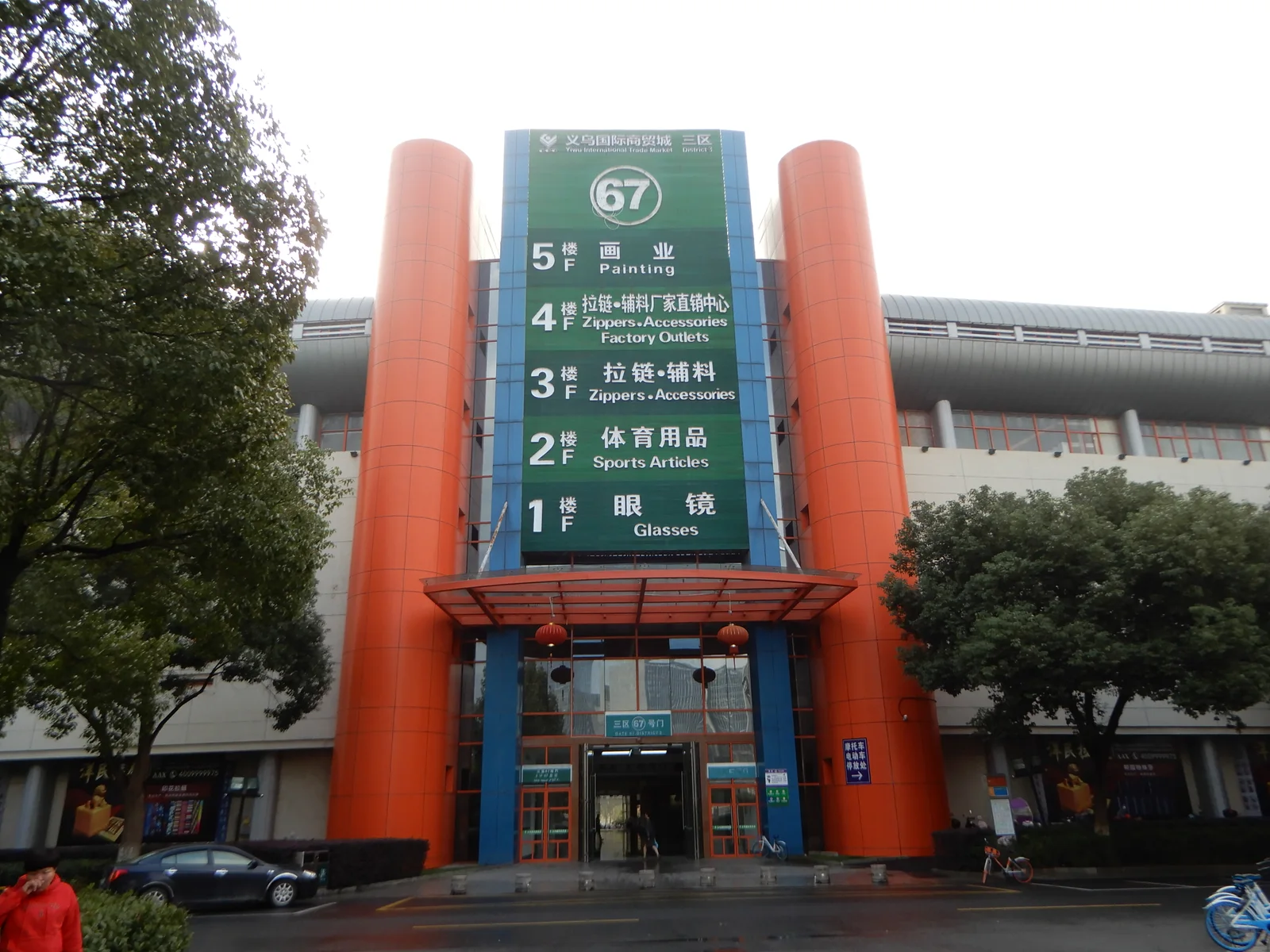
Photographed in 2018 by Whisper of the heart, CC BY-SA 4.0. Resized and converted to WebP under the same license.
The useful detail here is the enormous 67, followed by District 3 and the floor labels. Save that kind of entrance photograph when you arrive, then save the booth number separately. A product close-up will not help you find the right door again. The 2018 sign also explains why a floor directory belongs in your notes with a date: it is a record of that visit, not a permanent map for every future trip.
For one concrete route, the operator's District 2 profile places bags and umbrellas on the first floor, hardware and electrical products on the second, and categories including small household appliances and clocks on the third. That helps you begin a category search; it does not replace a current booth confirmation. The same page lists customer-service hours separately. Do not turn a service-desk schedule into a claim that every seller keeps identical opening hours, especially around holidays.
Do not begin the day by asking a taxi driver for “the market.” Begin with the product family and the decision you need to make. Official descriptions of the International Trade Mart show category concentration by district and floor; for example, the government's District 3 profile identifies stationery, sports products, cosmetics, eyewear, zippers, buttons and apparel accessories among its industries. That structure is the first filter.
The second filter is yours. Two buyers can walk the same aisle and need different evidence. A gift wholesaler may care first about assortment and seasonal packaging. A food-contact buyer must care about material and destination requirements before color. A jewelry buyer may begin with plating and allergen-related material declarations. A toy buyer cannot postpone age grading, small parts and licensing until after ordering.
Write the decision at the top of the brief: compare materials, find a stock package, test three price tiers, locate an export-capable coordinator, or identify a factory route. The market becomes navigable when each stop must answer that decision. Without it, abundance turns into sightseeing.
How to use the market without losing the day
I would divide a first sourcing day into three jobs rather than a race across districts: an initial comparison pass, appointments with the most relevant sellers, and time outside the aisles to reconcile notes. Keep the last part. It feels less productive than seeing another display, but it prevents an impulsive order made with a tired head. Before you travel, ask shortlisted sellers for their current location and availability; before you leave the district, decide which unanswered question deserves a return visit. This is a working route, not a promise that one day is enough for every category.
Go in with a product brief, not only curiosity. Record the stall number, supplier name, sample code, material, dimensions, packaging, quoted MOQ, lead time and whether the price is for an ex-works or delivered order. Photograph the product beside its handwritten details, not just the prettiest display wall.
The visual discipline matters because memory turns ten similar suppliers into one imaginary perfect supplier by the end of the afternoon.
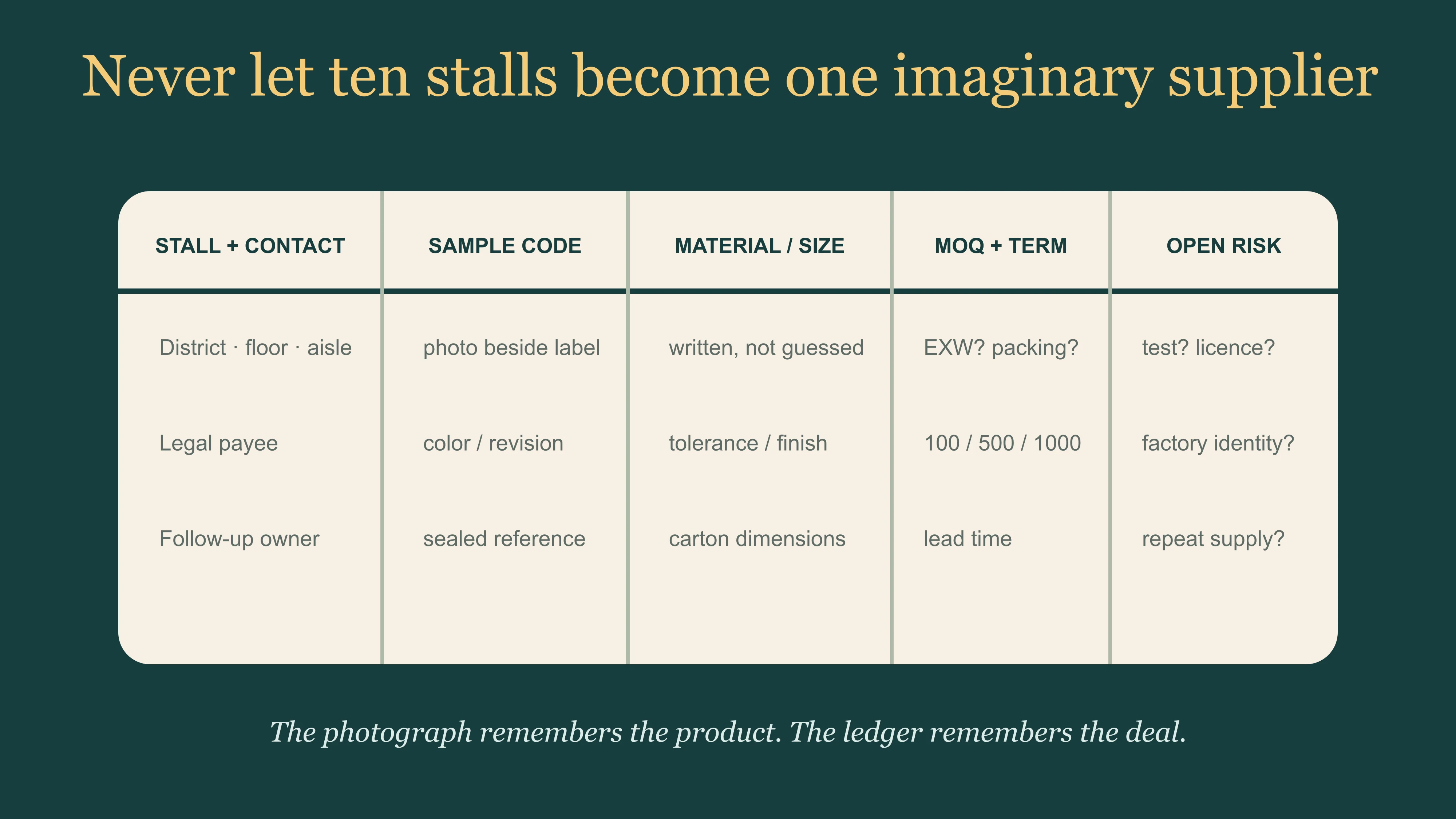
This is the mistake I dislike most: a buyer remembers the low price from one booth, the strong packaging from another and the friendly promise from a third, then mentally combines them into one supplier who never existed. The ledger prevents that fiction. Every photograph needs its stall, contact, sample code, material, quote basis and unanswered risk attached before the next aisle.
Use a fixed naming rule for photographs. District-floor-aisle, supplier code, product code and sequence number are enough. Record voice explanations as written follow-up questions, not as facts. By the time you return to the hotel, the sample must still belong to the correct quotation.
The five checks before a sample becomes an order
- Identity: Is the legal company name on the quotation the same entity receiving payment?
- Capability: Can the supplier show the production site, process or a documented manufacturing partner?
- Specification: Does the sample match a written material, size, colour and packaging specification?
- Compliance: Does the product need testing, labelling, age grading, food-contact or electrical documentation for your destination market?
- Logistics: Who handles inspection, consolidation, export documents, freight and damage claims?
These questions do not eliminate risk. They make risk visible before the order becomes expensive.
The legal name deserves special attention because payment, invoicing, export and production may involve different entities. Difference is not automatic fraud. Yiwu's strength includes coordinators who can combine many small suppliers. The arrangement becomes dangerous only when responsibility disappears between the names. Ask which entity receives payment, who owns the booth, who makes or sources the goods, who exports and who answers a claim after delivery.
MOQ, price and the seduction of the first quote
Yiwu is attractive to small brands because a buyer can often compare low minimums and mixed products. The first quote is still only one line in a cost model. Add packaging changes, labels, inspection, inland transport, consolidation, customs, freight, duties, platform fees, payment costs and defective units.
Ask whether the quote changes at 100, 500 and 1,000 units. Ask what happens when the colour is slightly different or the carton dimensions change. A low unit price can become a high landed cost when the product is fragile or the packaging is inefficient.
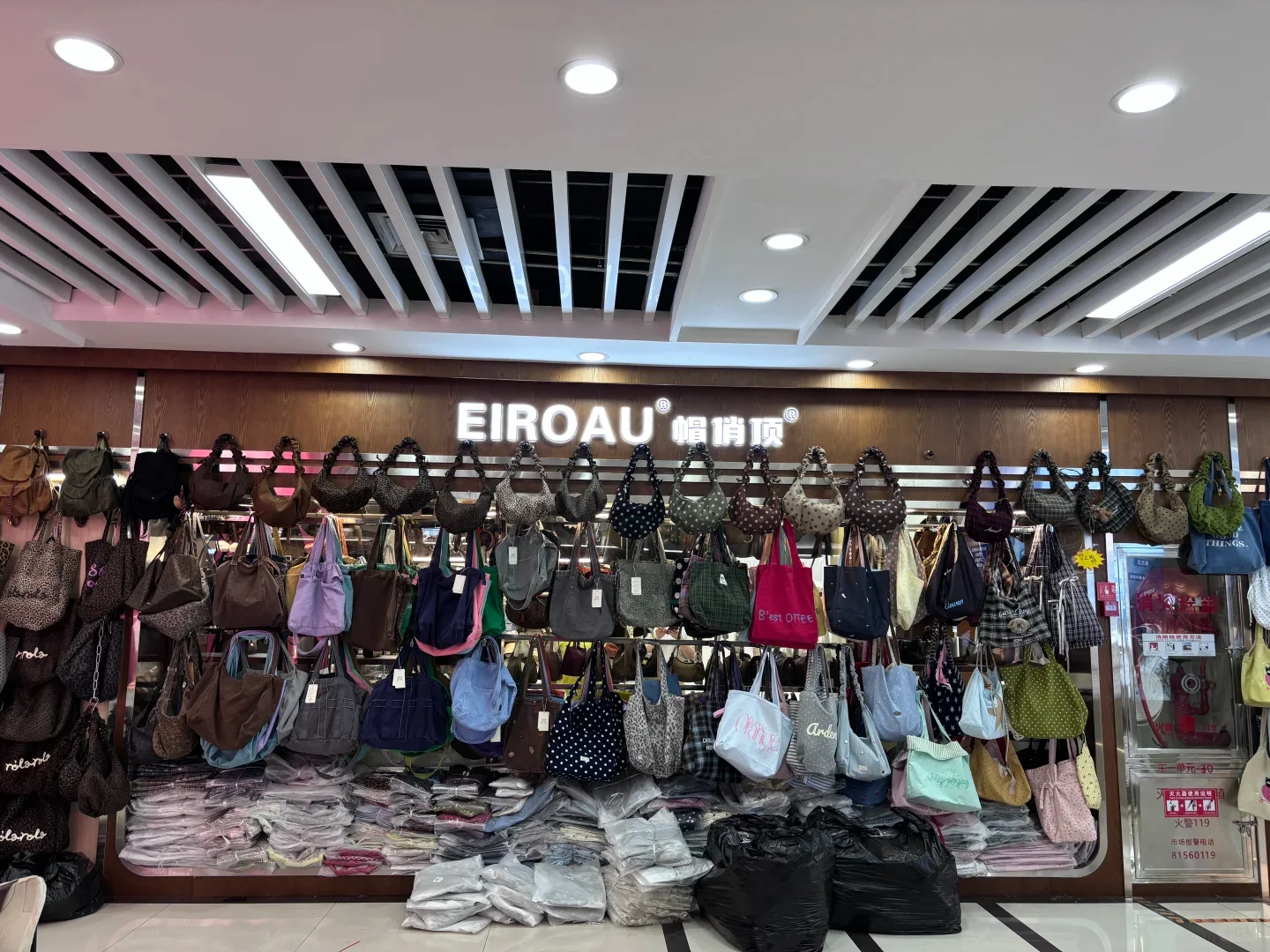
The hanging bags make colour and shape easy to compare; the wrapped goods below raise the next question. Can you choose across those displayed styles, or does each style have its own minimum? I want that answered before bargaining. A wall full of choice is not a promise of a mixed order.
MOQ in Yiwu can refer to several different constraints: one item, one color, one inner box, one carton, one logo print, one production run or the supplier's total order value. Do not celebrate a low number until the unit is clear. “One carton” can contain a manageable test or a warehouse problem depending on size and assortment.
Work out the colour minimum before multiplying the price
Here is an illustrative order, not a live quotation. You want 60 bags in three colours, 20 of each. “MOQ 60” could mean 60 pieces across the order, or 60 of each colour. The second interpretation commits you to 180 bags. A carton containing 12 pieces introduces another question: is 12 simply the packing unit, or must each colour be ordered in multiples of 12? Do not infer the answer from the display.
Write your intended assortment first: black 20, cream 20, green 20; total 60. Ask the seller to confirm it or return a revised breakdown. If the offer becomes 24 of each, compare the revised 72-piece commitment, not the original 60-piece budget. Then confirm whether mixed cartons are permitted and whether choosing the colours yourself changes the price.
The useful Chinese follow-up is 起订量是每款、每色,还是整单? — Is the minimum per style, per colour, or for the whole order? Follow with 装箱数和起订量一样吗? — Is the carton quantity the same as the minimum order? These questions turn a vague bargain into arithmetic you can check. They also let the seller explain a workable alternative without either side pretending that “60” was a complete specification.
Negotiate the constraint, not just the number. A supplier may reduce the color minimum if you accept stock shades, reduce the print minimum if you use a neutral package, or combine several ready-made variants into one order. Those concessions change the product. Record them. A cheaper MOQ achieved by removing the exact feature that made the item worth buying is not a win.
The first order should test information flow as much as demand. Can the supplier reproduce the approved color? Can the agent trace which booth supplied a carton? Does the packing list match the actual assortment? Can a damaged unit be tied to one batch? A small order that exposes these failures has done useful work. A huge “cheap” order can hide them until the destination warehouse.
I distrust the fantasy that margin is already earned when a low buying price appears on a calculator. Unsold stock still occupies space. A broken strap or crushed package still takes time to resolve. Before increasing quantity, decide how you will check the goods on arrival and what evidence you will retain if something is wrong. The market cannot supply customers for your unsold inventory. That uncomfortable distinction belongs in the buying decision, not in a motivational story about getting rich in Yiwu.
There is an awkward human part here: after a friendly negotiation, reporting a defect can feel like accusing someone. I reject that hesitation. A clear, prompt report is fairer than silent resentment or an angry message weeks later. Inspect the delivery before mixing it into saleable stock. Keep damaged units separate, record the carton and sample codes, and send photographs with a count and a specific question: replacement, credit or another agreed remedy? Agree the inspection and reporting window before payment. Do not let the first customer become your quality inspector.
For decorative goods, the buying test also needs time. A flower insert or transparent finish earns its place through how it looks after storage and handling, not only under the booth lights. Keep a dated reference sample and photograph it again under comparable lighting before a larger reorder. Look for colour change, surface marks, loose attachments and packaging damage. This is a practical appearance check, not a substitute for any required product testing. My dividing line is simple: if appearance is what you are selling, appearance must be part of the written acceptance criteria. “It looked lovely when I bought it” will not answer a disappointed customer.
Yiwu is not a guarantee against copying or IP risk
Small-commodity markets move quickly, which is both their advantage and their danger. A design that looks “generic” may still belong to a brand, artist or character licence. Do not order branded goods from a stall merely because the logo is visible and the price is attractive.
For toys, stationery, accessories and seasonal goods, keep a record of who supplied the sample and what rights they claim. If a product depends on a character, sports team or luxury mark, obtain permission or remove it from the order.
How the market connects to China's wider supply chain
Yiwu's value is often downstream: product discovery, small-commodity trade, packaging and export coordination. Other Chinese cities specialise in materials, moulds, electronics, furniture, ceramics or textiles. The Jingdezhen porcelain guide shows why a city-product cluster can carry more technical evidence than a generic market directory.
That is the larger lesson. “Made in China” is not one supply chain. It is a map of specialist places, trading networks, workshops, factories, ports and verification gaps.
Consolidation is where a mixed order becomes one risk
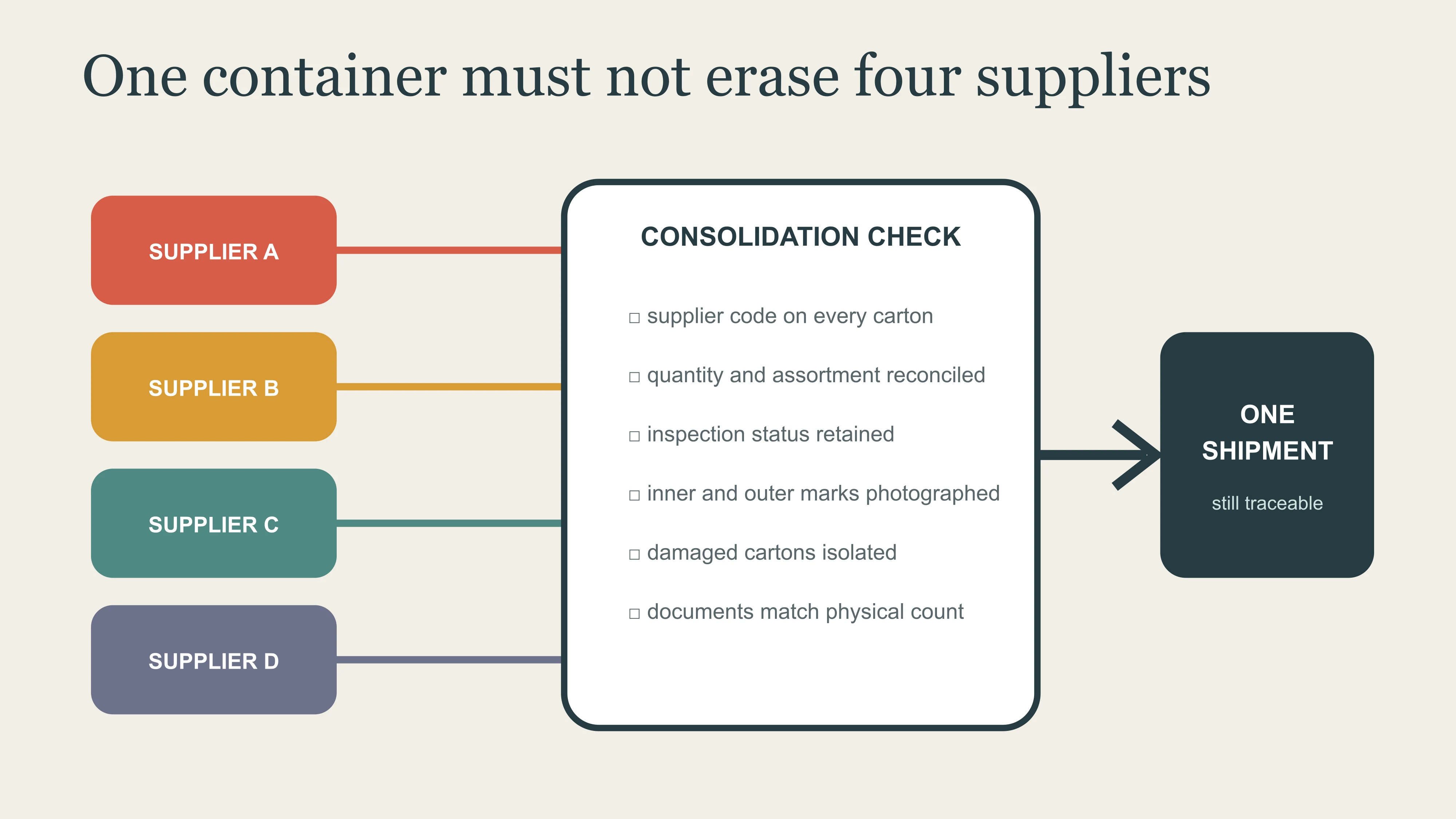
Yiwu makes it easy to imagine a mixed catalogue. Consolidation is where that imagination becomes cartons, dimensions, labels, customs codes and one shipping deadline. Goods from several suppliers can arrive with different packaging quality, document accuracy and interpretations of “ready.”
Give every order line its own receiving status before the goods share a booking: not received, received unchecked, accepted, or held for a problem. A supplier's message saying “sent” does not tell the consolidator what arrived. Ask who changes that status and which record supports it.
The colourful display is what you remember. The carton mark is what you need when the wrong colour arrives. This is why I insist on keeping the supplier code attached all the way through consolidation: a mixed shipment must still let you trace one disappointing item back to the order that specified it.
Use the Yiwu international-trade service platform to understand the city's formal market-procurement and trade-service environment, then confirm the exact route with the operator handling your goods. A city platform can explain the system; it cannot verify your carton count or classify your product for you.
For the bag example, the receiving line should still say how many black, cream and green bags were accepted. An overall count of 60 can conceal the wrong assortment. If a carton is short, damaged or held for checking, decide whether to wait, ship an agreed partial quantity or cancel that line before loading. Record the choice against that supplier's order. The shipment may become one booking, but it must not become one untraceable pile.
Who should use Yiwu—and who should go elsewhere?
Yiwu is especially useful for retailers, promotional-product buyers and small brands comparing many low-complexity categories. It is less suitable as the only research stop for products whose value depends on deep engineering, regulated materials, heavy tooling or a specialist industrial cluster.
If the product brief begins with colour, assortment, packaging and a manageable specification, Yiwu can be powerful. If it begins with tight tolerances, proprietary electronics or safety-critical performance, use the market for orientation and continue to the relevant production city. The Shenzhen electronics market guide shows why a component identity and test chain demand a different sourcing method.
Yiwu should turn abundance into a smaller, traceable decision
Visit or research the Yiwu wholesale market when you need to compare many small-product possibilities quickly. Do not confuse density with certainty. The market gives you options; your specification, sample approval, inspection and logistics plan decide whether those options become a reliable order.
The market's real output is not a bag of samples. It is a disciplined reduction from category to candidates, from candidates to written specifications, and from several suppliers to cartons that retain their identity inside one shipment.
Planning your first visit? In the comments, name the product and say whether you want a personal purchase, sample or shop stock. You do not need a buying success story to ask a useful quantity question. If you have already bought, bring one piece-versus-pack-versus-carton misunderstanding to East Moment's community, with the visit month and the question that resolved it. An owned packaging photograph can make the answer clearer; omit private contacts and confidential quotes. Come back after a repeat order and tell us whether the arrangement held.