Chinese business culture is not a collection of tricks for pleasing Chinese people. It is a way of reducing uncertainty between people who may not yet share language, assumptions, authority or risk. Guanxi can open a conversation; only delivery keeps it open. My firmest rule after years around export business is this: trust is built by what happens next.
Chinese business culture turns small promises into a trust ledger
The internet likes theatrical rules: hand over a business card with two hands, never give a clock, let the senior person enter first, prepare for a banquet. Some rules can help a visitor avoid needless awkwardness. None of them will rescue a late sample, a hidden subcontractor, a specification nobody understood or a problem reported after the shipping deadline.
When I look at Chinese business culture, I do not begin with chopsticks or seating charts. I begin with promises.
You said the updated drawing would arrive on Friday. Did it arrive—or did you warn everyone on Wednesday that it would not? You said production would match the approved sample. Can the factory show the control points? You said a defect was solved. Who owns the corrective action, what changed, and what evidence closes the issue?
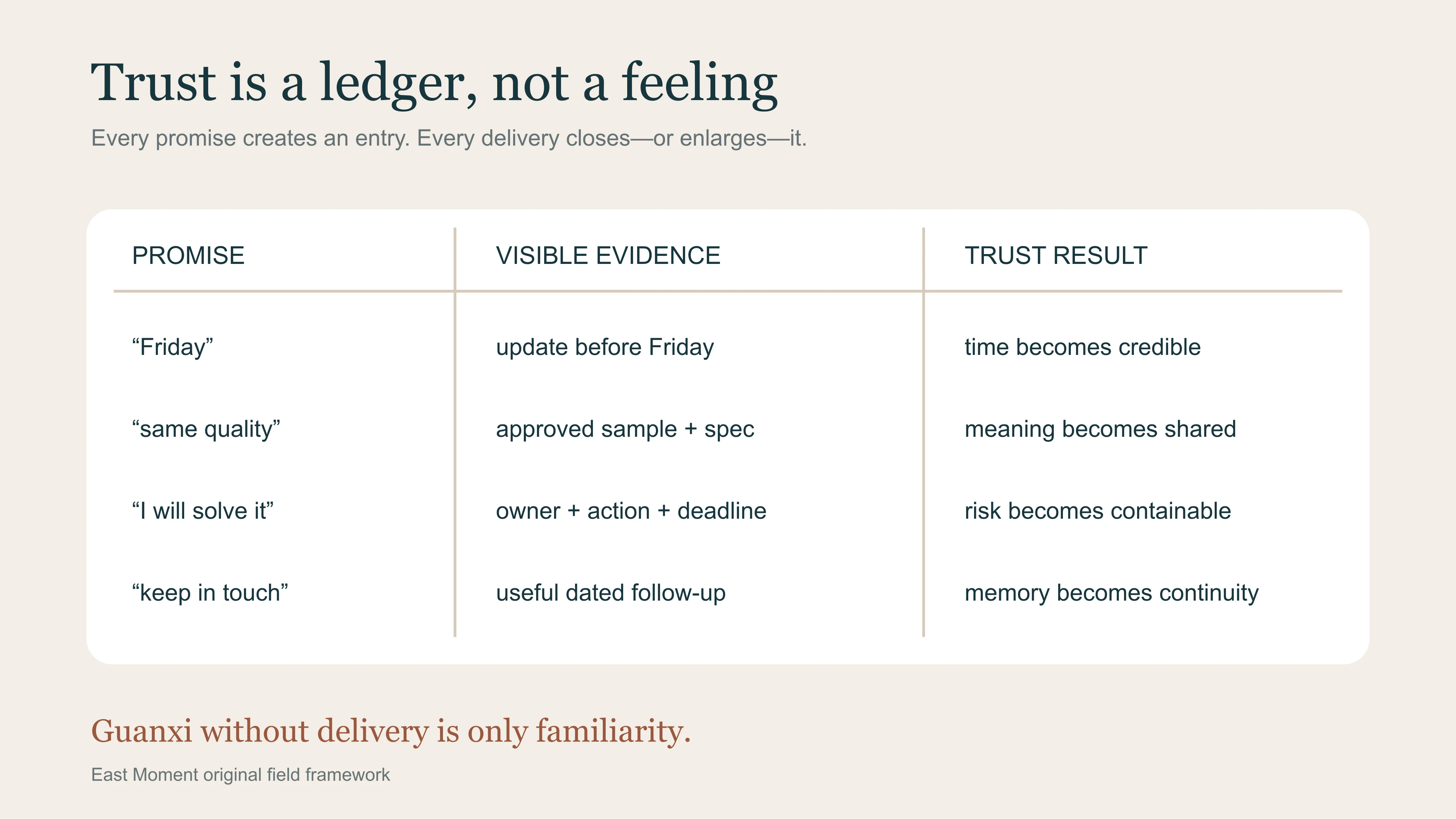
I think of every commercial relationship as a quiet ledger. Each small promise creates an entry. A useful update closes it. Silence enlarges it. One late reply is rarely fatal; a pattern of unowned promises becomes the company’s real identity.
This is where the Chinese word guanxi (关系) is most often misunderstood. It literally refers to relationships or connections, but in business it should not be reduced to “knowing the right people.” The U.S. Department of Commerce’s current China business guidance describes guanxi through personal trust, continuous communication, on-site visits and transparency over time. That is much closer to the reality I recognize. A connection creates access; repeated conduct creates confidence.
My definition is deliberately practical: guanxi is remembered reliability with a human face. If reliability disappears, the face cannot carry the deal forever.
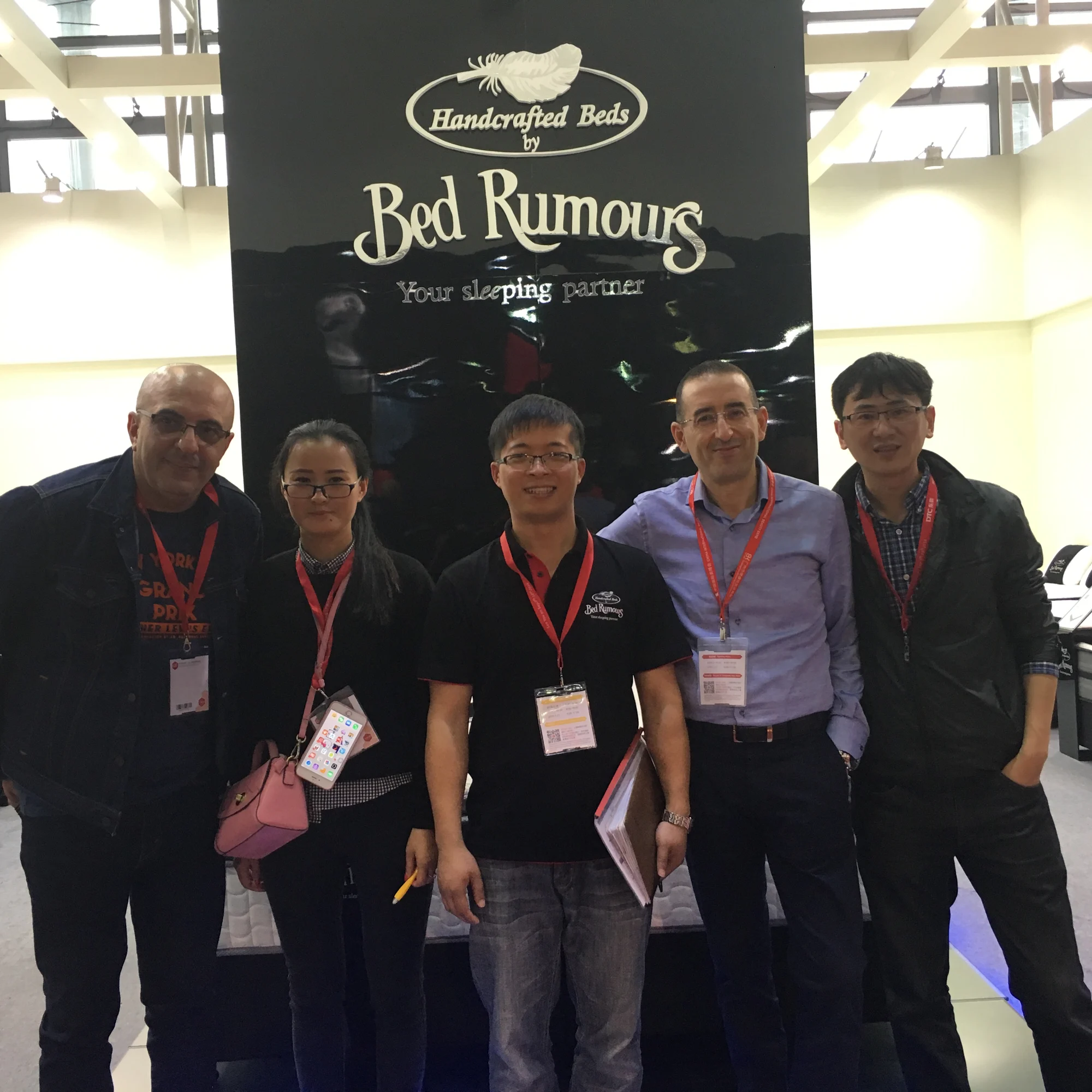
A trade-fair photograph captures the beginning—not the outcome
This 2016 first-party photograph records Lijun meeting international visitors at a furniture trade-fair booth. It proves a shared physical encounter in a real exhibition setting. It does not prove that everyone pictured placed an order, formed a partnership or remained a customer.

Pazhou makes the scale of Chinese exhibition business visible: connected halls, roads, hotels and river infrastructure occupy an entire district. The photograph cannot identify which fair was running or whether any exhibitor was reliable. It proves why a booth encounter is only the first filter—inside this scale, disciplined follow-up is what makes one conversation survive.
This photograph matters to me because it contains the moment online guides usually skip. People have walked through an enormous exhibition hall. Their feet hurt. Their bags are full of catalogues. Every booth says quality, innovation and partnership. Nobody needs another polished adjective.
What makes one conversation survive the hall?
Not the photograph. Not even the friendly exchange by itself. The encounter survives when somebody remembers the exact product, sends the promised file, answers the difficult question and continues at a pace that respects the other person’s decision process.
At a trade fair, friendliness is abundant and attention is scarce. A visitor may meet fifty suppliers. A supplier may scan hundreds of badges. The business card or WeChat contact is therefore not a relationship; it is a permission to follow up. Treating it as an order lead ready for daily promotion is the fastest way to waste that permission.
The official U.S. China business-travel guide still notes the importance of face-to-face connections, business cards and the growing use of WeChat, particularly among younger professionals. I agree with the direction, but the detail that matters is not whether paper or QR code wins. The real test is whether your next message proves you listened.
My follow-up after a booth conversation should contain four things:
- the object or problem we actually discussed;
- one useful file, photograph or answer—not a complete catalogue dump;
- the action I own;
- a real next date.
“Nice meeting you, please see our catalogue” is socially correct and commercially empty. “You asked whether the zipper survives repeated removal; I will send the component specification and our test method by Thursday” gives the conversation a spine.
Guanxi is not the opposite of contracts
One of the laziest comparisons says that Western business runs on contracts while Chinese business runs on relationships. Serious companies use both. The relationship helps people interpret ambiguity, solve friction and decide whether continued cooperation is worthwhile. The written agreement keeps price, scope, ownership, acceptance and responsibility from being reinvented by memory.
I have no patience for the romantic version of guanxi that asks a buyer to ignore due diligence because everyone had a warm dinner. A relationship that cannot survive clear specifications is not strong; it is untested.
The reverse is also true. A contract cannot anticipate every late truck, damaged carton, engineering change or market shock. When something unforeseen happens, people decide whether to hide, blame, negotiate or solve. That decision is cultural in the deepest sense: it reveals what the organization rewards when the script ends.
For sourcing, our China manufacturing guide takes this further. A factory’s city, website, trade-fair booth and personal introduction can narrow the search. They cannot prove process ownership, quality control or production capacity. The relationship should make verification easier—not replace it.
I use this boundary:
- Relationship answers: Will this person warn me early? Can we discuss bad news without performance? Do they remember what matters to my market?
- Documentation answers: What was approved? Which tolerance applies? Who pays for rework? When does ownership or risk transfer?
- Inspection answers: Does the actual batch match what both sides agreed?
- Payment controls answer: What happens before and after money moves?
Put all four together and cooperation becomes resilient. Remove any one and goodwill carries too much weight.
“Saving face” should mean correcting without public humiliation
The Chinese word mianzi (面子), usually translated as “face,” attracts more stereotypes than explanations. The bad version tells outsiders to avoid direct truth, never say no and let senior people remain unchallenged. That is not a workable business system.
My interpretation is sharper: do not turn a solvable work problem into a public attack on someone’s social standing. Correct the fact. Preserve a path for the person to act. Keep the evidence.
Suppose a technical manager approved the wrong colour code in a group chat. You can expose the mistake theatrically—“You approved this, look at the screenshot”—or you can move the work forward: “The approved code in the record is X, while the physical sample appears Y. Production is paused. Can you confirm the controlling standard by 3 p.m.?”
The second message is not weak. It states the conflict, consequence, owner and deadline. It also lets the other person correct the record without being reduced to the error.
Three rules keep “face” from becoming an excuse:
- correct sensitive errors privately first when possible;
- document the final decision in the shared working channel;
- escalate risk when necessary, but never use an audience as a weapon.
If somebody invokes face to suppress safety, legality, payment truth or quality evidence, the concept has been abused. Respect is not silence. Respect is directness without unnecessary humiliation.
Chinese business culture hierarchy is a map of functions, not chairs
Foreign visitors often enter a meeting trying to identify the most senior title. That can be useful, but it is insufficient. The most senior person may set direction and say little. A technical specialist may decide whether the product is viable. Finance or procurement may control vendor setup and payment. A junior coordinator may determine whether every daily task moves or stalls.
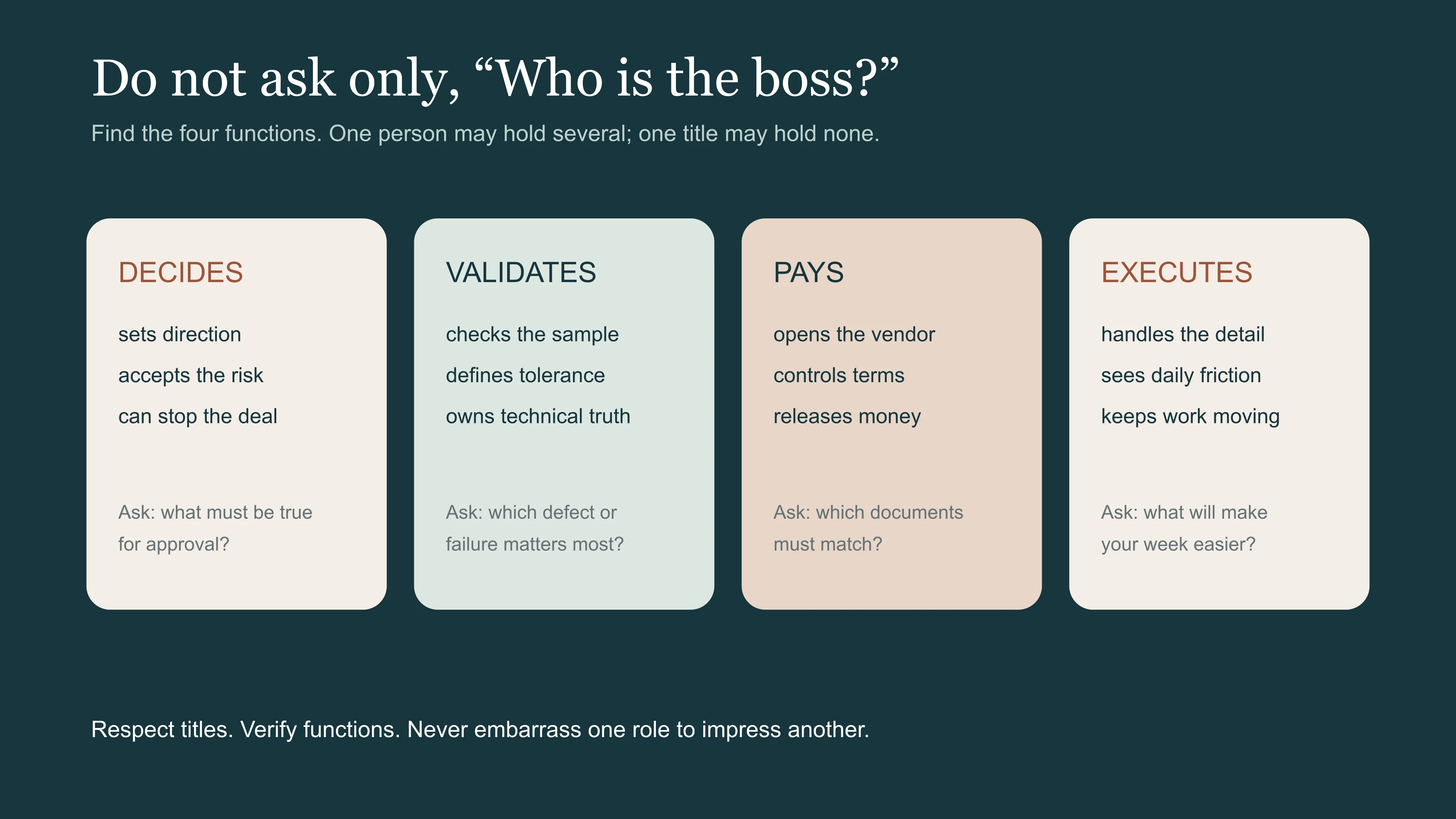
I map four functions:
Who decides? This person accepts the strategic or commercial risk and can stop the deal.
Who validates? This person owns the technical truth: sample, tolerance, material, test or user requirement.
Who pays? This function controls supplier onboarding, documents, terms and release of money.
Who executes? This person lives with the daily details and sees friction first.
One person may carry several roles. Titles vary by company, ownership, sector and generation. A founder-led workshop, a listed technology company, a state-owned enterprise and a young e-commerce brand do not share one hierarchy simply because all are Chinese.
The most expensive cultural mistake is performing respect upward while ignoring the person who owns execution. If the project coordinator has to chase you for the same packing list three times, a flawless greeting to the chairperson has achieved nothing.
Respect the formal host. Listen to the quiet technical voice. Learn who receives bad news, who signs the specification and who can change the schedule. Never embarrass one role to impress another.
Meetings need a decision record within 24 hours
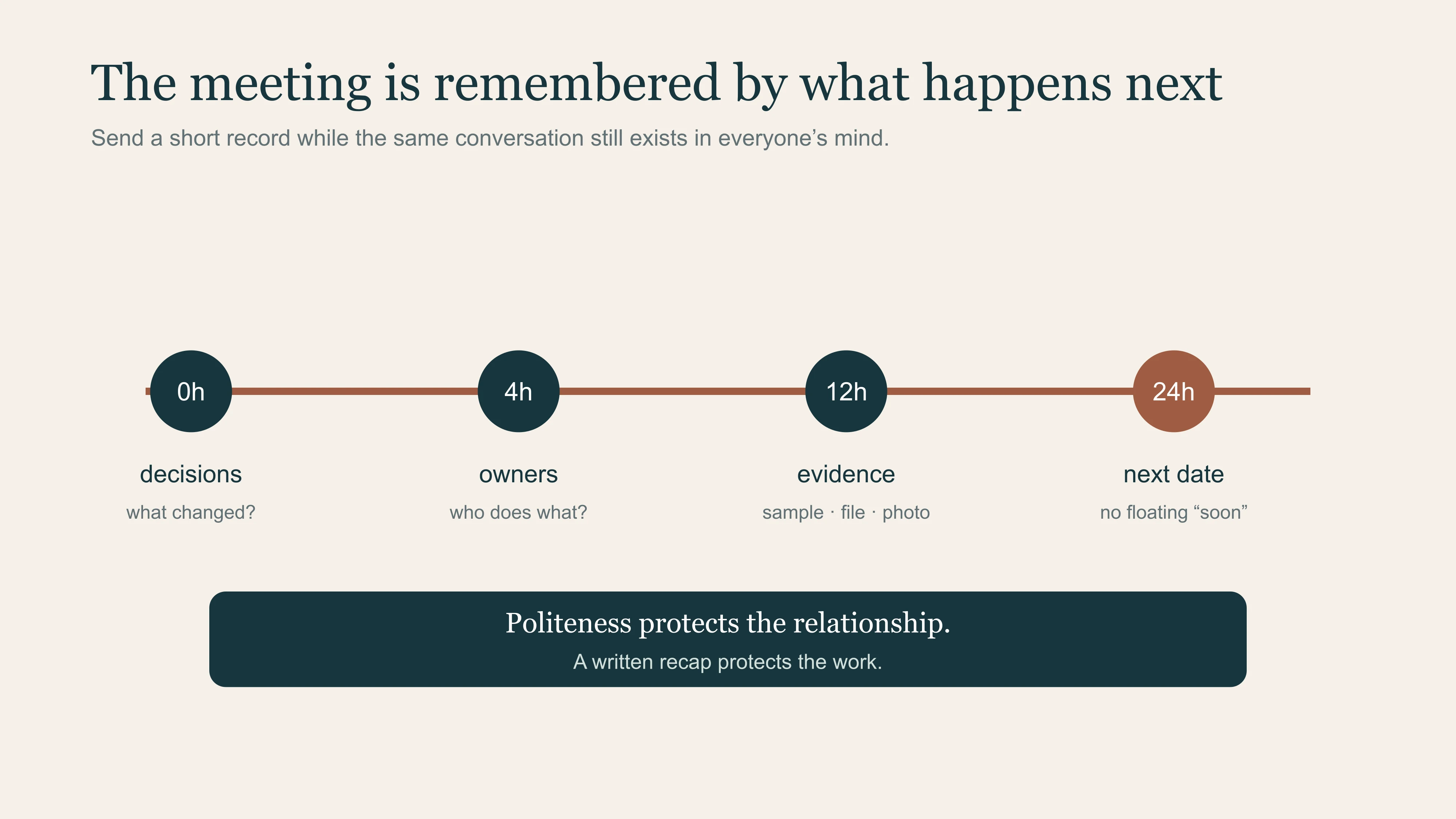
A productive meeting can feel clear while everyone is still in the room. Two days later, four people remember four versions.
I send a short bilingual or plain-English recap within 24 hours whenever the stakes justify it. Not a transcript. Not a legal ambush. A working record:
- decisions made;
- open questions;
- each action owner;
- evidence to be supplied;
- exact next date;
- conflicts with the earlier specification.
This habit solves several cross-cultural problems at once. It gives colleagues time to correct language misunderstandings. It reveals when “we can do it” meant technical possibility rather than an approved commercial commitment. It lets a senior participant redirect the team without publicly reopening the entire conversation. It also makes the next meeting shorter.
Do not confuse “yes” with one universal meaning. In any language, it can mean “I hear you,” “this seems possible,” “I agree in principle,” or “I authorize the exact scope.” Replace interpretation with a closing question: Which version is approved, by whom, and what happens next?
My preferred recap is almost boring. Boring is good. Commercial memory should not depend on charisma.
WeChat creates continuity—and dangerous informality
WeChat is often where Chinese business becomes fast and human. A voice note can resolve what ten emails could not. A factory can send a production photograph immediately. A buyer can share a marked screenshot while standing in a store. Groups connect sales, engineering, purchasing and management without waiting for another formal meeting.
That convenience creates a second problem: the working record fragments across voice notes, private chats, group threads, screenshots and disappearing context.
Use WeChat for speed, not for ambiguity. After an important decision:
- restate the decision in text;
- identify the controlled file or sample;
- move contractual or specification changes into the agreed formal system;
- never assume a thumbs-up emoji authorizes price, tooling, compliance or shipment;
- protect confidential information and follow your company’s data rules.
The platform does not create guanxi. It makes continuity easier. A person who sends ten promotional posters and ignores one technical question is not maintaining a relationship; they are occupying a notification screen.
Business meals reveal attention, not automatic agreement
A meal can make a relationship more human. People learn where someone grew up, why a product matters, what pressures they carry and how they behave when the agenda loosens. That knowledge can make later problem-solving faster and kinder.
But dinner is not due diligence. Alcohol is not consent. Hospitality is not purchase approval.
If you drink, choose your boundary before the table and state it calmly. Never pressure someone to drink in order to prove sincerity. Dietary, religious, medical and personal restrictions are not insults. A good host asks; a good guest answers early.
At a meal, watch less for theatrical etiquette and more for care:
- Did the host ask about dietary restrictions?
- Is the interpreter included in the human conversation rather than treated as equipment?
- Does the team speak respectfully to restaurant staff?
- Can the group disagree without punishing the dissenter?
- Does anyone turn hospitality into an unrecorded commercial obligation?
These observations do not certify a company. They do reveal habits. I remember how people handle small power because larger power rarely improves character.
Chinese business culture gift giving needs a compliance boundary
Gift advice is where cultural guides become dangerous. They debate colour, clocks, pears and wrapping while ignoring value, timing, policy, public officials and whether the gift is meant to influence a decision.
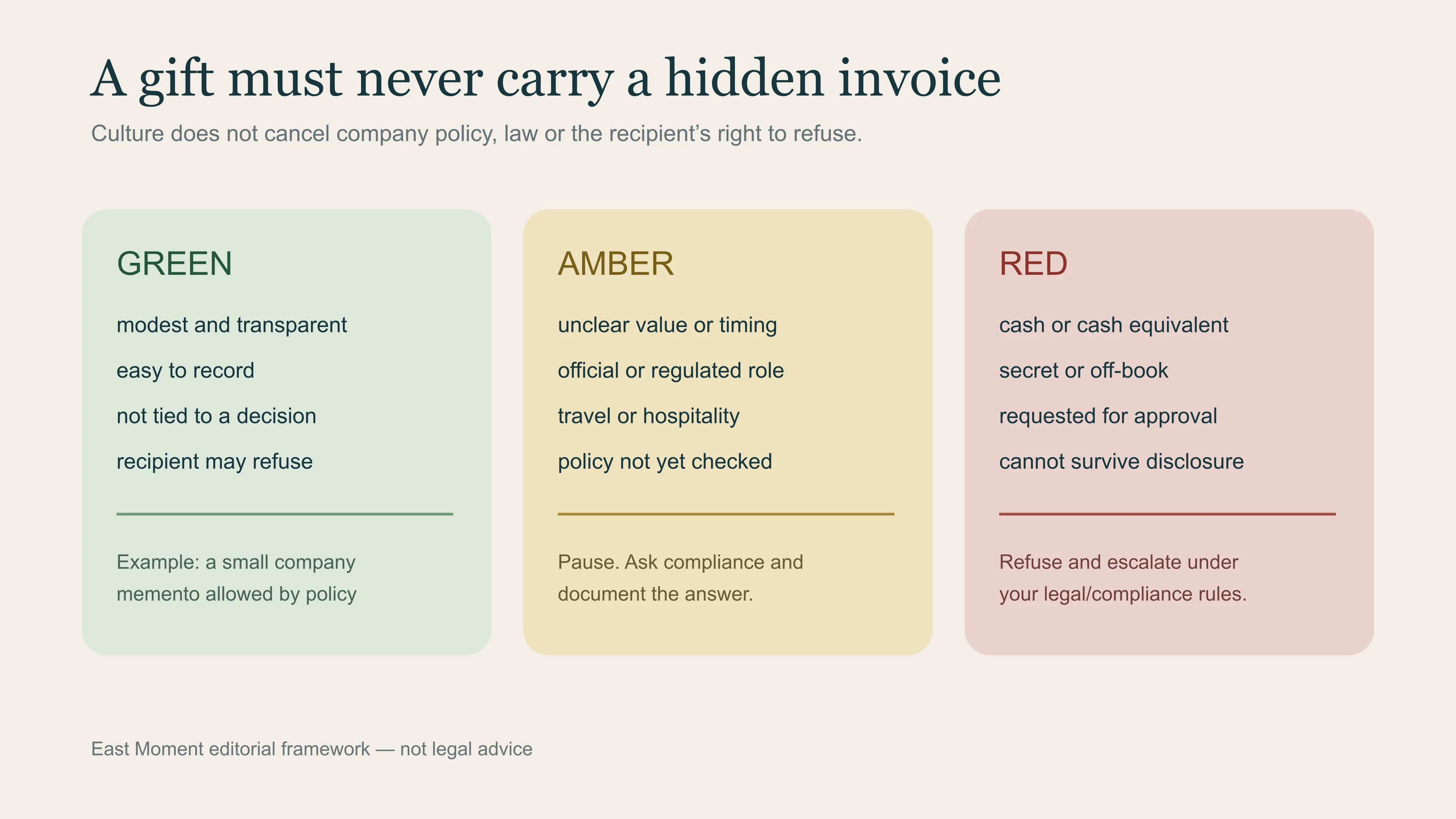
The U.S. Department of Commerce notes that modest, culturally appropriate gifts may reinforce relationships. That should never be read as blanket approval. The UK government’s official anti-bribery guidance explicitly treats gifts, entertainment and hospitality as possible items of value and flags disproportionate hospitality, missing paperwork and refusal of written agreements as warning signs.
My rule is stronger than any superstition list: a gift must never carry a hidden invoice.
Before giving anything, ask:
- Does the recipient’s organization permit it?
- Does my organization permit it?
- Is the value modest, transparent and easy to record?
- Is the recipient involved in a tender, inspection, approval or official decision?
- Would I be comfortable if the gift, timing and value appeared in an audit?
- Can the recipient refuse without losing face or access?
A small company memento after an open meeting may be acceptable under both policies. Cash, cash equivalents, secret hospitality or anything tied to approval belongs in the red zone. Ambiguity belongs in the pause zone: ask qualified legal or compliance staff before acting.
This is not legal advice, and “local culture” is never a defence for ignoring applicable law.
Chinese business culture vs American business culture is the wrong fight
Searchers often ask for Chinese business culture vs American business culture. A comparison can prepare the mind, but binary tables easily become theatre: Chinese people are indirect and relational; Americans are direct and contractual. Real companies immediately break those boxes.
A Shenzhen hardware startup may make decisions in a group chat faster than a century-old American corporation. A Chinese export manager may be more direct than the foreign buyer. A family company may centralize decisions in one founder; a multinational’s China office may require regional and global approval. Industry, ownership, age, language, incentive and individual personality all matter.
Our Chinese vs American culture guide treats comparison as a way to notice assumptions, not rank civilizations. In business, replace national predictions with testable questions:
| Weak cultural prediction | Better operational question |
|---|---|
| “Chinese teams avoid saying no.” | “What would prevent approval, and who owns that decision?” |
| “Americans want everything in contracts.” | “Which documents control scope, price and acceptance here?” |
| “Chinese hierarchy is strict.” | “Who decides, validates, pays and executes?” |
| “Relationships matter more in China.” | “Which repeated actions will make this partner trust us?” |
| “A banquet means the deal is close.” | “What written next step did both sides accept?” |
Culture should improve the question. It should never replace observation.
The real hierarchy is risk

A one-to-one photograph from the same 2016 trade fair. The folders, badges, booth and product display make the commercial setting visible. The image cannot prove what was discussed, whether a transaction followed or which person held decision authority.
When I return to this photograph, I do not remember business culture as a performance of national difference. I see two people carrying unequal information.
The visitor may not know the factory, production line, cost structure or supplier’s ability to repeat quality. The exhibitor may not know the buyer’s market, customer complaints, cash cycle or approval process. Both sides are deciding how much risk to reveal and how much risk to accept.
That is why the best cross-cultural skill is not memorizing a list of taboos. It is making risk speakable.
For a buyer visiting the Yiwu wholesale market, the risk may be confusing a stall with a factory or failing to control consolidation. In the Shenzhen electronics market, it may be component identity, substitution or testing. In the Foshan furniture market, it may be materials hidden under upholstery, finish consistency or packaging. Xuchang wigs test whether one approved sample can survive another material lot; Shantou toys require each revision to remain tied to its evidence; Guzhen lighting turns showroom attraction into mounting, component and service questions. The human relationship changes by product because the underlying uncertainty changes.
Ask the question that gives the other side permission to tell the truth:
- What goes wrong most often with this order?
- Which requirement is expensive or difficult?
- What would make you reject my timeline?
- Which evidence would let you approve the next step?
- If a problem appears, how early can we both see it?
These questions create more trust than “We hope to establish long-term cooperation.” A long relationship is not declared. It is accumulated.
My field rules for doing business in China
I would carry these twelve rules into any Chinese business meeting:
- Learn the product before performing the culture. Ignorance wrapped in perfect etiquette is still ignorance.
- Respect titles, then map actual functions. Find who decides, validates, pays and executes.
- Make one promise smaller and clearer. A precise Thursday beats an impressive “very soon.”
- Send the record within 24 hours. Decisions without owners and dates are atmosphere.
- Let WeChat accelerate work, not erase the record. Move controlling changes into the proper document.
- Correct privately; confirm publicly. Preserve dignity without sacrificing shared truth.
- Treat meals as human time, not hidden negotiation. Nobody owes consent because hospitality was generous.
- Give no gift you cannot disclose. Check policy, value, role and timing.
- Visit when the risk justifies it. Face-to-face attention can reveal people and process; it is not a certificate.
- Ask for bad news early. The first honest warning is a contribution, not a failure.
- Do not confuse warmth with capacity. Verify the factory, sample, documents and controls.
- Close every promise with evidence. This is the culture of trust I believe in.
China’s Ministry of Commerce publishes a current Foreign Investment Guide because doing business in China also involves law, market access, administration and formal procedures. Cultural fluency cannot replace professional legal, tax, compliance or investment advice. The warmest relationship still operates inside institutions.
Bring us one promise that is still floating
Do not post another generic “China business etiquette” list. Bring one anonymized real situation to Moments: a promise made in a meeting, message, factory visit or trade fair that still has no owner, evidence or date.
Write four lines:
- what was promised;
- who should own the next action;
- what evidence would close it;
- the next honest date.
Remove confidential names, prices, contracts and personal details. The East Moment community will help turn the floating promise into one clean trust-ledger entry. That is a more useful act of Chinese business culture than memorizing where to place a business card. Continue through our wider Chinese culture guide when you want to understand the family, language and social ideas surrounding the business table.