
Chinese culture vs American culture is a comparison between diverse societies, not a chart of fixed national traits. A family meal, a workplace meeting, a school event, or a festival can be shaped by relationship, language, region, migration, class and generation. The useful question is not which side is “more” one thing, but what a particular setting asks of the people in it.
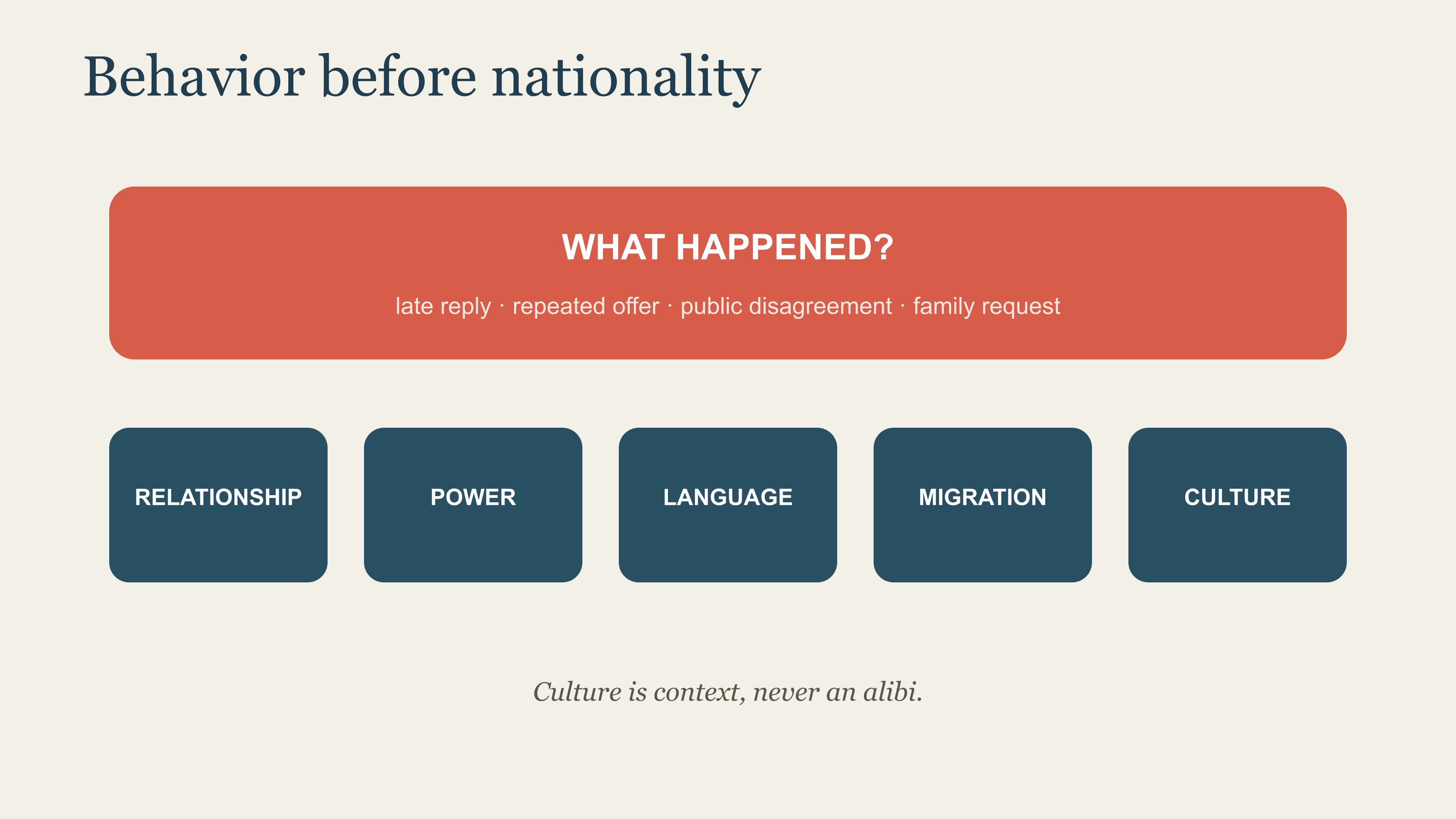
I reject the tidy comparison chart that turns two enormous societies into “collectivist Chinese” and “individualist Americans.” I do not want a stereotype made gentler; I want the behavior, relationship and power imbalance named. My rule is severe because the shortcut causes real damage: if a manager silences someone, if a family crosses a boundary or if a guest feels trapped, “culture” cannot be allowed to close the investigation.
I keep the comparison only when it helps the people in the room act more honestly.
The cover places one Chengdu metro platform beside New York's Fulton Center. It does not prove that Chinese people wait one way and Americans another. It proves that two named transit environments organize sightlines, movement, information and crowd density differently—the situation must be described before nationality is blamed.
Chinese culture vs American culture: what this comparison can actually tell us
The phrase “Chinese versus American culture” is often used as if it names two cleanly separated teams. It does not. China contains many regional, linguistic, ethnic, religious and class histories. The United States contains Indigenous nations, Black, immigrant, regional, religious and multilingual histories, alongside unequal power and different ideas of belonging. Chinese American communities are not a bridge with only two ends; they are communities made in particular cities, families, languages and migration histories.
That does not make comparison pointless. It makes the unit of comparison smaller and more honest. Instead of asking whether Chinese people are indirect or Americans are individualistic, ask what a junior employee can safely say to a manager in this organization, in this language, at this moment. Instead of treating a family dinner as proof of a national value, ask who planned it, who is expected to attend, who is absent, and what care or conflict is being negotiated there.
The broader Chinese culture guide provides historical and regional context. This page has a narrower job: to show how a China-US comparison can help a reader notice a situation without mistaking a tendency for a rule. For comparisons beyond the United States, start with Chinese cultural differences, which keeps the framework from making America the default measure of everyone else.
Historical connections matter before cultural differences
No present-day comparison starts from a blank page. Chinese migration to what is now the United States has long histories, and the legal conditions surrounding movement, work, family and citizenship shaped what communities could build. The 1882 Chinese Exclusion Act record at the U.S. National Archives is essential context because it makes one exclusionary federal policy visible as a primary document rather than a vague backdrop.
That history should not be used as a single origin story for every Chinese American person. People and families arrived through different periods and routes, including Guangdong-linked migration in the nineteenth century and later migration from many places and communities. The Library of Congress collection Chinese in California, 1850-1925 is a starting point for locating period documents and images. It is not a complete account of Chinese America, and an archive cannot speak for people who did not leave records within it.
The point is practical. A restaurant, association, language school, church, temple, family home or student apartment may carry a history of adaptation under conditions very different from those in contemporary China. Someone can be shaped by Cantonese kinship terms, English schooling, a local Chinatown, anti-Asian racism, a parent’s migration story, online Chinese-language media, and a personal refusal of inherited expectations all at once. “Chinese” and “American” may both be important without having the same meaning at every moment.
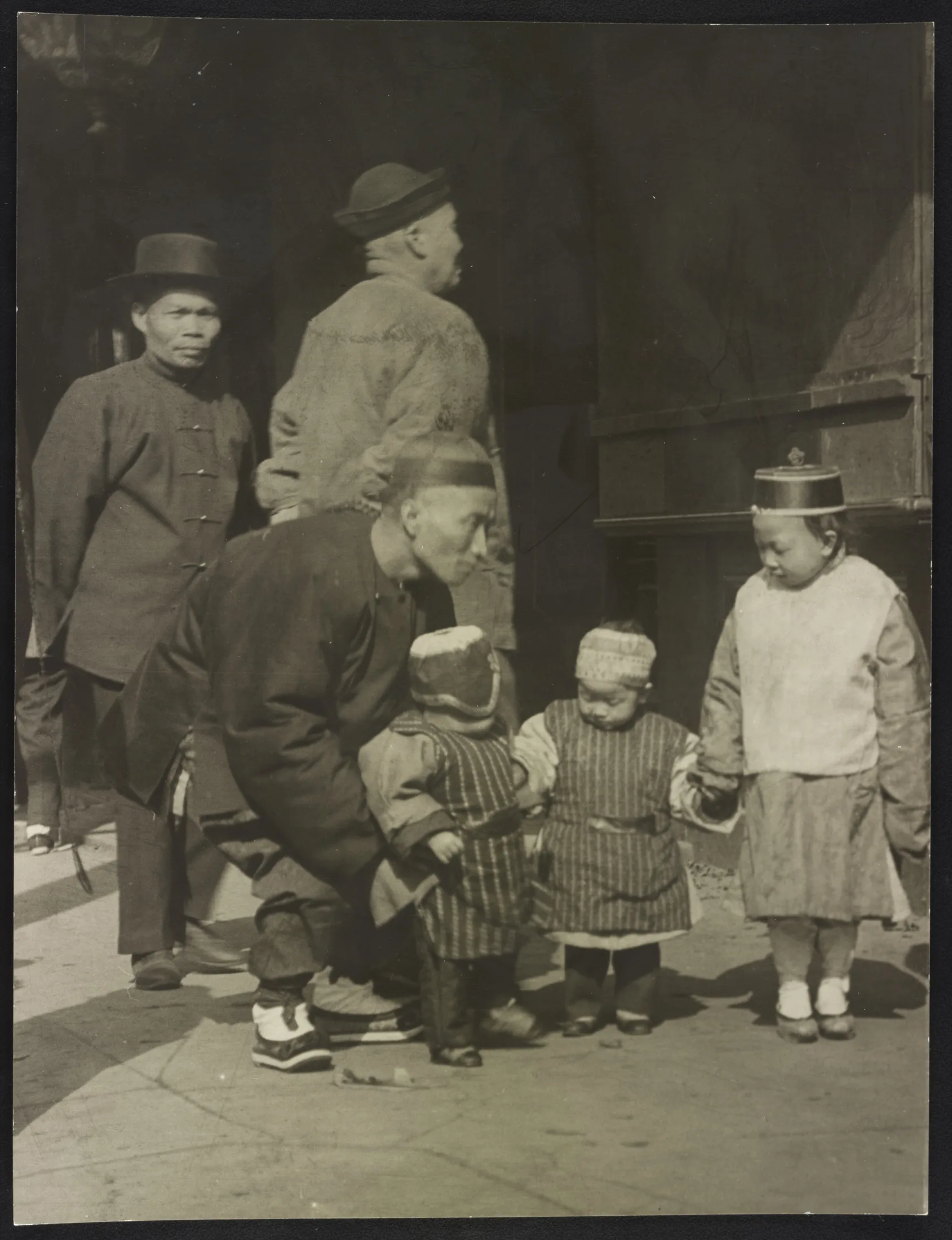
This Library of Congress photograph records Chinese American men and children sharing a San Francisco street between 1896 and 1911. Their clothes, ages and proximity make a community visible; the image cannot tell us their private beliefs, family relationships or whether they felt more “Chinese” or “American.” That silence is exactly why migration history must enter the comparison before personality labels do.
The archive also catalogues a color photochrom made between 1898 and 1905 under the title A Chinese family. The title sounds definitive; the photograph is not. It shows an adult and four children posed on steps in California, while the hand-applied color and formal arrangement show how a family was made legible to the image market of its time. We cannot safely infer their exact kinship, language, household rules or feelings from the pose. This is the comparison problem in miniature: a visible scene is evidence, but a label is only the beginning of interpretation.
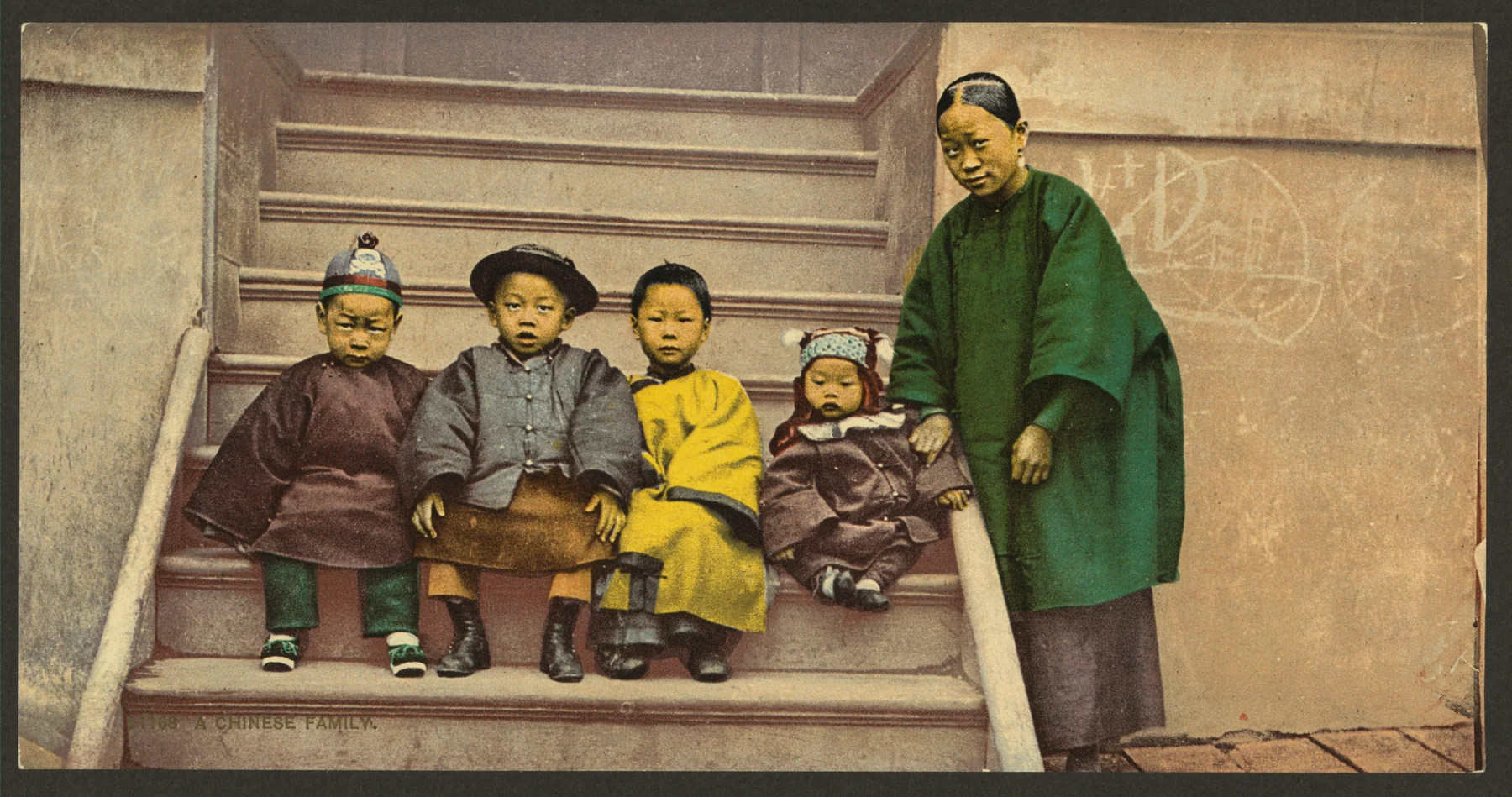
The image records a posed California setting, period dress and the way a publisher framed “a Chinese family” for viewers. It does not reveal the household’s private relationships or turn one family into a national personality.
Key differences at a glance, with the labels kept loose
The table offers questions to investigate, not diagnoses to apply. The left and middle columns describe possible emphases in some settings, never a default personality for a person from China or the United States. “American” here is particularly broad: a regional, racial, religious or immigrant community may produce expectations that differ sharply from a national stereotype.
| Dimension | A Chinese context may foreground | A U.S. context may foreground | Shared ground | Important caveat |
|---|---|---|---|---|
| Relationship and decision-making | Family role, seniority, reciprocal obligation, or the effect of a choice on the group | Individual preference, explicit consent, or the right to set a personal boundary | Families and teams everywhere negotiate care, duty and autonomy | Neither approach predicts what one family, workplace or person will choose |
| Communication | Reading the relationship, timing and likely social cost before saying something directly | Stating a preference, disagreement or request plainly so it can be answered | People in both settings adjust directness for power, intimacy and risk | “Indirect” and “direct” are strategies, not national character traits |
| Hospitality | Attending to a guest through food, repeated offers, seating or practical care | Respecting a guest’s stated preference, schedule or privacy | Welcome can be expressed through generosity, attention and choice | A host’s style reflects household, region, age, budget and personality |
| Education and achievement | Family sacrifice, examination history, social mobility, personal interest or status may all be present | Individual aspiration, institutional access, family expectation and economic security may all be present | Study can carry pride, pressure, curiosity and care at the same time | No culture owns either ambition or burnout |
| Identity after migration | Language maintenance, heritage practices, kin networks and a connection to ancestral places | Local civic identity, racialization, mixed households and new cultural forms | People make belonging through repeated relationships and places | Diaspora is not a diluted version of culture in China, and China is not culturally uniform |
The value of this framework lies in the caveat column. A young adult may prefer a family consultation in one decision and insist on privacy in another. A manager may use careful, indirect language because the team is under pressure, while an employee may state a disagreement plainly because the relationship is strong enough to bear it. A family can prize education while disagreeing fiercely about the school, field, cost or city that is right for one child.
Concepts sometimes associated with Chinese settings, including mianzi (often translated as “face”) and guanxi (relationship networks), can be useful only when they describe a real social setting. Mianzi is not a magic word for avoiding embarrassment, and guanxi is not a synonym for corruption or a claim that relationships do not matter in the United States. Define the people, stakes and institution before using either term.
Everyday life is where a comparison becomes testable
Take a dinner invitation. One host may keep offering food because care is expressed through abundance and attention; another may read a clear “no, thank you” as the most respectful response. Either guest can become uncomfortable if they assume their own rule is universal. The useful move is simple: notice the offer, answer with warmth, and clarify when needed. “I’m full, but I would love to take some later” can preserve both appetite and relationship better than a lecture about etiquette.
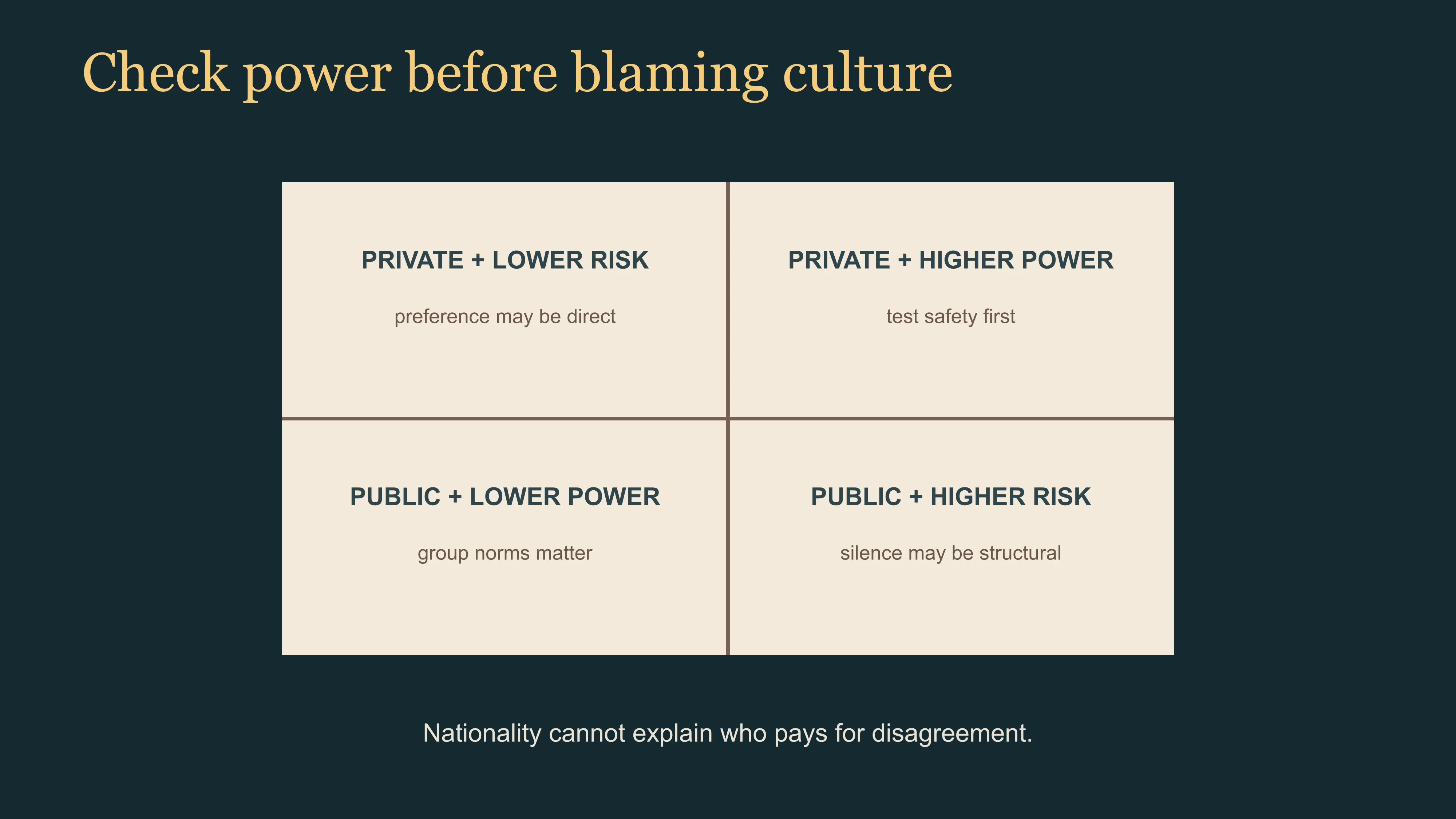
The same holds at work. A person accustomed to a strongly hierarchical setting may first test a disagreement privately, seek an intermediary, or frame a correction as a question. A person accustomed to a flatter meeting style may say the objection in the room. Neither pattern is inherently more honest. The consequential questions are whether someone can raise a concern safely, whether credit and blame are distributed fairly, and whether the organization makes room for disagreement without humiliation.
Family language can make the pattern more complex. An adult child may speak English at work, Mandarin with one parent, Cantonese with a grandparent and a mixture of languages with siblings. A word for “aunt,” “older brother,” “cousin,” or “respect” may carry a relationship that English does not specify in the same way. But language does not compel obedience. People translate, joke, set boundaries, forget terms, recover them and disagree across generations. The Chinese language guide can help readers see why translation involves relationships as well as vocabulary.
Food is another place where comparison goes wrong when it becomes a purity test. Chinese American restaurant food, home food and regional Chinese food in the United States are not failed copies of a menu in China. They are foodways made through migration, local ingredients, labor, customers, memory and invention. The Chinese American food guide follows that history without ranking cuisines by distance from an imagined original.
Lived experience and regional variation
I find these comparisons useful only when they return me to a concrete decision. Who is expected to call a parent? Who translates the document? Who can afford to move out? Who is permitted to disagree in front of older relatives? The Chinese traditions and customs guide and Chinese festivals guide provide context, but no national label can answer those questions for a particular household.
Regional variation matters inside China as much as it does across the Pacific. Food, accent, climate, religious practice, local history and migration change ordinary routines. So do urban housing, work schedules, education, disability, gender, wealth and intergenerational conflict. A comparison that says “Chinese people value family” and “Americans value independence” misses the actual drama: who is caring for an elder, who can afford to move, who translates a document, who cooks, who is expected to call, and who is allowed to say no.
Common stereotypes to leave behind
The first stereotype is that collectivism and individualism are opposite teams. People often want both belonging and room to decide. A person may make a career choice with family needs in mind and still want final authority over it. Another may speak the language of independence while depending on family money, childcare or emotional labor. Culture can make some arguments more legible; it does not eliminate contradiction.
The second is that politeness means silence. Restraint can be generous, strategic, fearful, tired, or simply a preference. Direct speech can be courageous, careless, playful, or a sign that the relationship is secure. It is better to ask how disagreement is handled in this group than to announce that one culture “does not say no.”
The third is that Chinese American identity is an in-between identity waiting to become whole. Diaspora communities create their own institutions, aesthetics, foods, languages and political commitments. A hybrid practice is not evidence of confusion. It may be a deliberate answer to a life lived across more than one inheritance.
Finally, do not treat classical ideas as a personality algorithm. Confucian traditions have shaped enduring conversations about learning, relationships and ritual, and they remain important context for many readers. They do not explain every Chinese person’s conduct or override other traditions, modern institutions and personal commitments. Read Confucianism and Chinese culture as history and debate, not as a shortcut for predicting a colleague.
How to engage respectfully across the difference
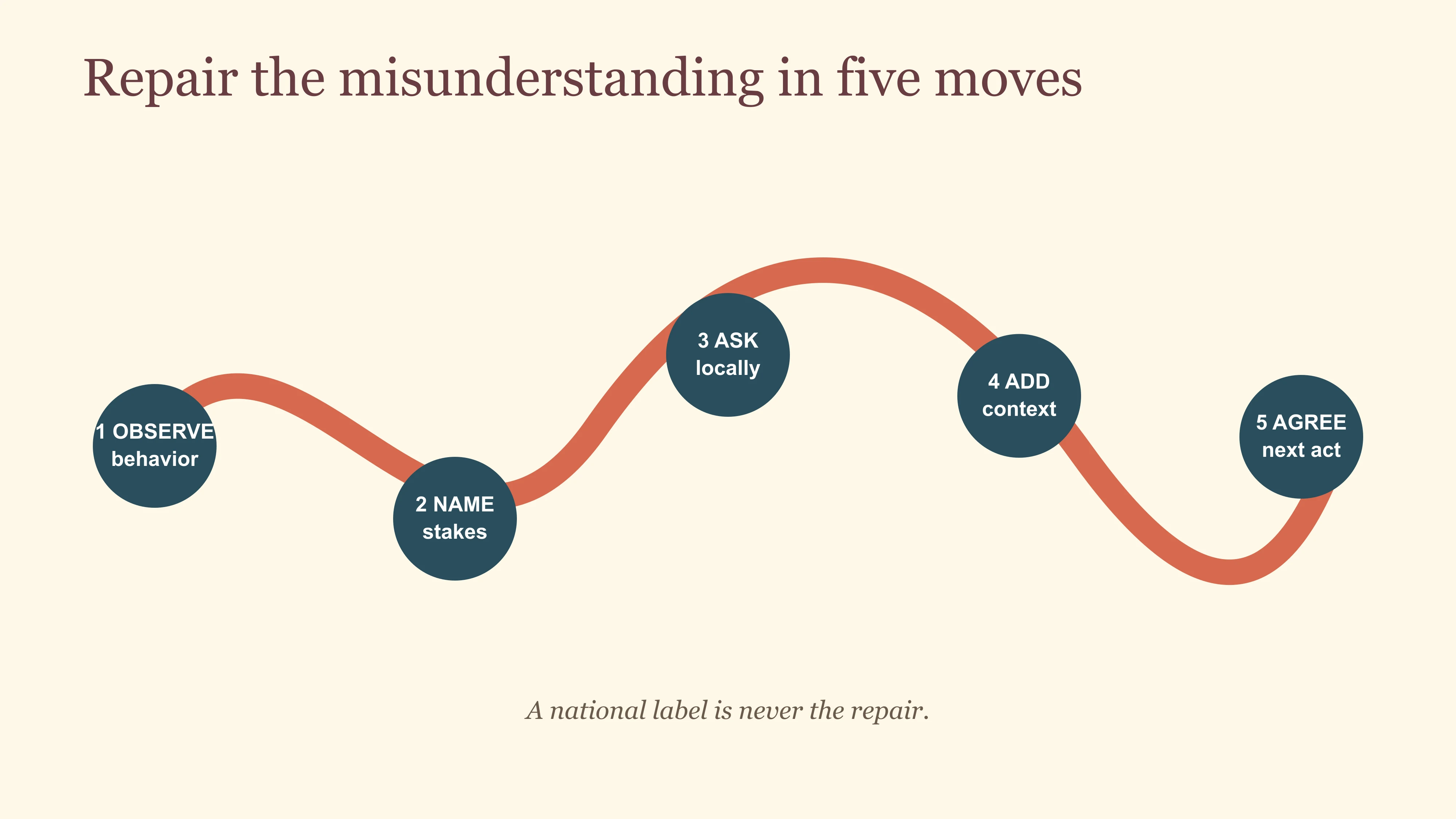
Start with an invitation, not a test. Ask what a host calls the meal, festival or family practice. Ask whether a photograph is welcome. Ask whether a person wants to explain a word rather than guessing from a translation app. Give people room to say that a custom is not part of their life. The goal is not to acquire “Chinese culture” as a social skill; it is to become more attentive to the relationships in front of you.
When a misunderstanding happens, name the practical issue first. Is the problem timing, translation, a different expectation of privacy, a hierarchy at work, a diet, money, or who has been included in a decision? Cultural vocabulary can help after that, but it should not become an excuse for ignoring power or a way to excuse someone from listening.
This approach also protects against the opposite mistake: treating every disagreement as a cultural clash. A roommate who leaves dishes in the sink, a parent who keeps calling, or a supervisor who edits a document harshly may be expressing a personal habit, a workload problem, a generational disagreement, or a power imbalance. National labels can make an ordinary problem sound exotic and therefore harder to solve. Start with the observable behavior, then ask whether language, migration history, family expectations, or institutional rules add useful context.
For readers planning travel, work or study, the Chinese culture hub is a better starting point than a rulebook. Learn a little language, observe before participating, and treat an explanation from one person as their explanation, not a password to a whole population. Curiosity becomes respectful when it is precise enough to be corrected.
Frequently asked questions
What does Chinese and American culture mean?
It is a comparison of contexts, not a claim that either country has one fixed personality. Region, language, race, migration, class, generation and the relationship at hand shape what a practice means.
Where and when did Chinese American cultural connections develop?
They developed through long histories of trade, migration, exclusion, community building, study, family life and cultural exchange. Different Chinese American communities have distinct regional and migration histories.
Does it vary by region or community?
Yes. A Guangdong-linked family in San Francisco, a Mandarin-speaking student in Boston, a multigenerational household in Los Angeles, and a family in Chengdu may have different languages, reference points and expectations.
Is it still practiced or used today?
Yes, but practices are continuously adapted. Food, language, celebrations, family roles and workplace habits change with migration, technology, local law and individual choice.
How can overseas readers engage respectfully?
Ask about the particular setting, avoid using nationality as a prediction, and let people define the traditions and identities that matter in their own lives.
What does Chinese and American culture mean?
It is a comparison of contexts, not a claim that either country has one fixed personality. Region, language, race, migration, class, generation and the relationship at hand shape what a practice means.
Where and when did Chinese American cultural connections develop?
They developed through long histories of trade, migration, exclusion, community building, study, family life and cultural exchange. Different Chinese American communities have distinct regional and migration histories.
Does it vary by region or community?
Yes. A Guangdong-linked family in San Francisco, a Mandarin-speaking student in Boston, a multigenerational household in Los Angeles, and a family in Chengdu may have different languages, reference points and expectations.
Is it still practiced or used today?
Yes, but practices are continuously adapted. Food, language, celebrations, family roles and workplace habits change with migration, technology, local law and individual choice.
How can overseas readers engage respectfully?
Ask about the particular setting, avoid using nationality as a prediction, and let people define the traditions and identities that matter in their own lives.