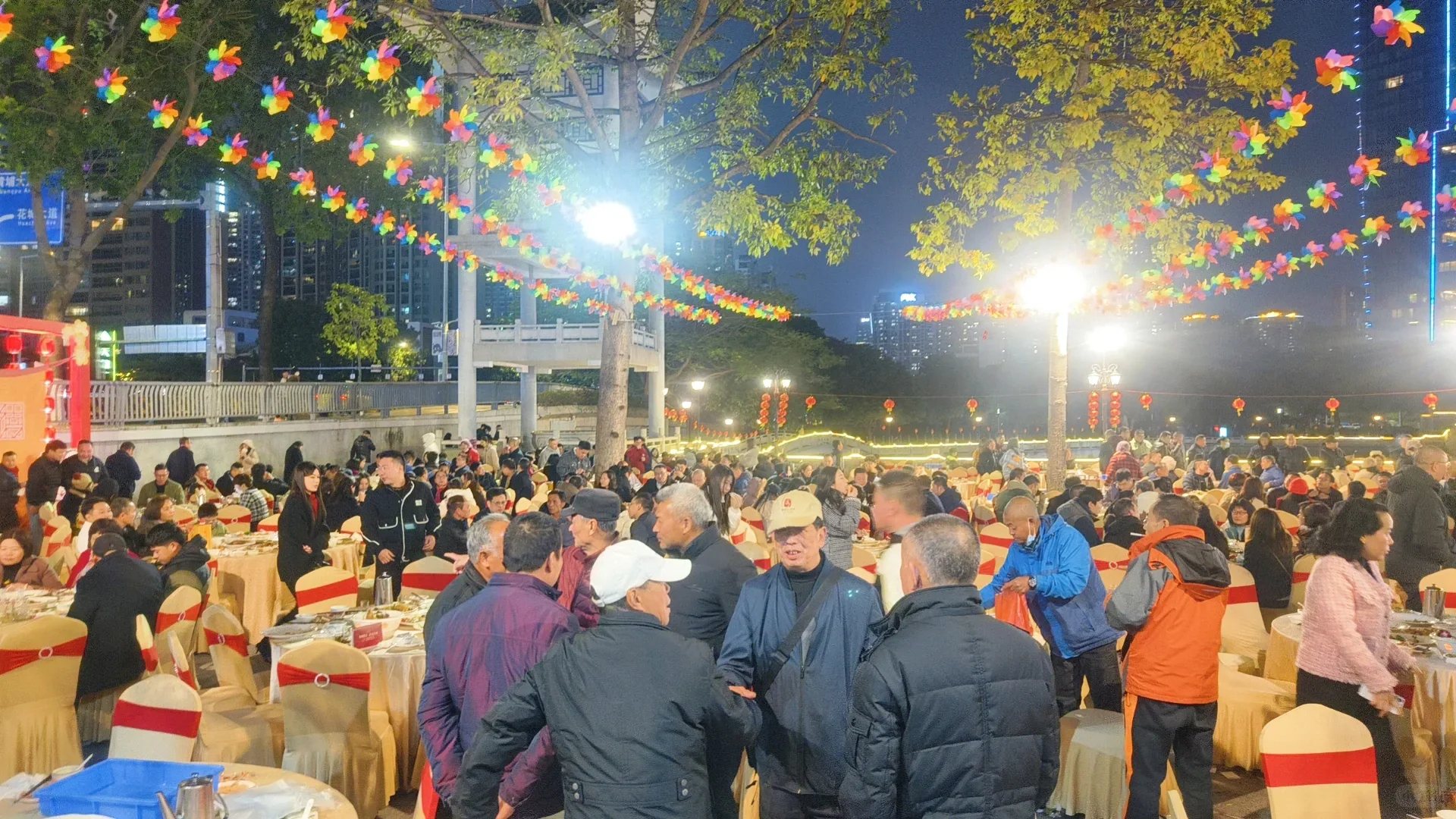
Confucianism in Chinese culture is an ethical tradition about becoming a better person in relation to other people. It asks how learning, ritual, family responsibility, moral courage and humane government can turn ordinary conduct into social order. It is less interested in giving the universe a tidy diagram than in asking what you will do when another person is standing in front of you.
The distance between two people is where Confucianism begins
A child pours tea for an older relative. A teacher corrects a student more carefully than the exam requires. A manager chooses whether to embarrass someone in public. None of these moments is automatically Confucian, and no society has a monopoly on courtesy. Yet Confucian thought pays unusual attention to the moral shape of such relationships.
Who owes what to whom? How can respect avoid becoming fear? When should loyalty yield to honesty? What makes ceremony sincere instead of theatrical?
These questions are why Confucianism has outlived the institutions that once taught it as official orthodoxy. The answers have changed, but the human situation stubbornly remains.
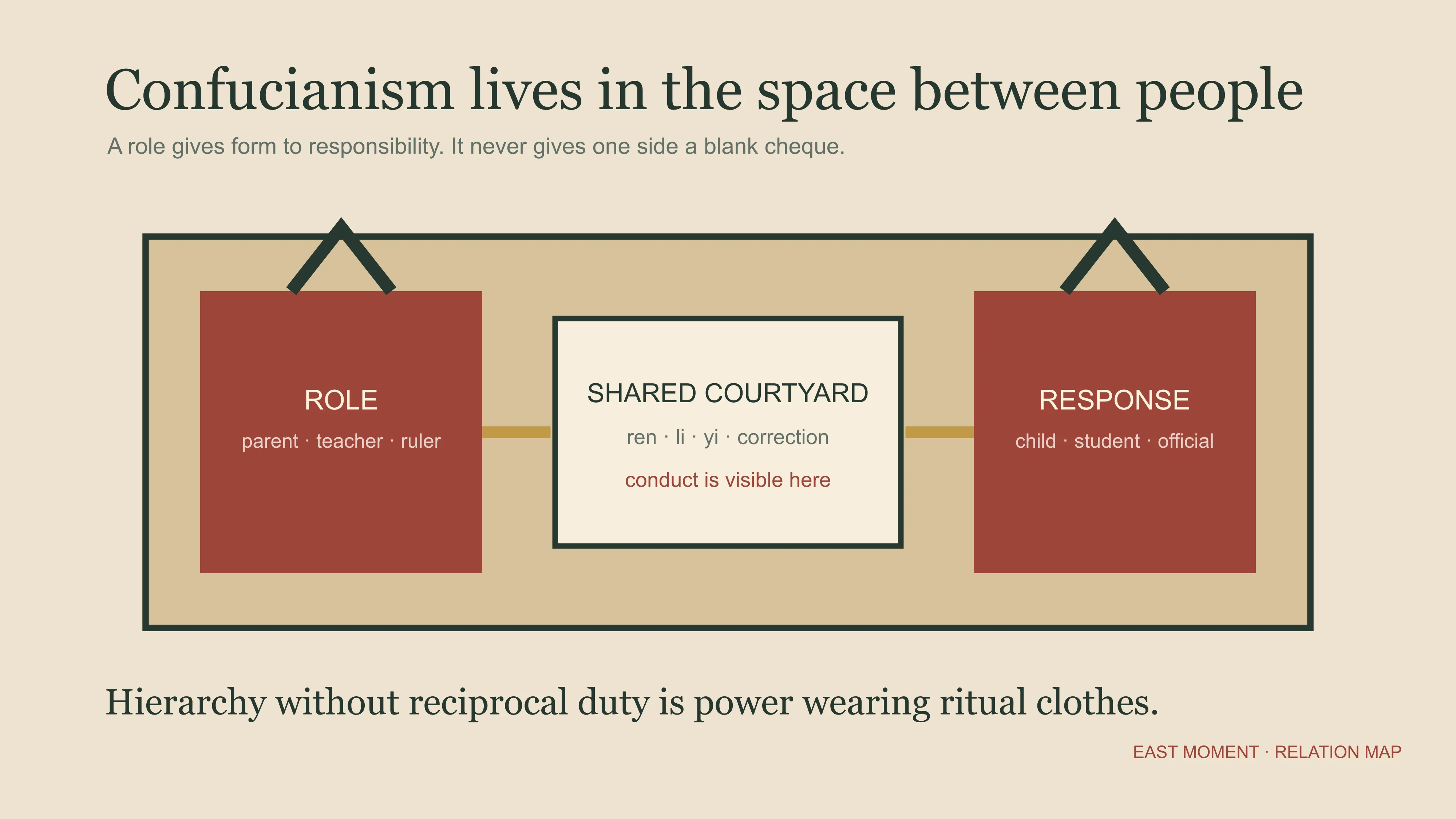
This editorial courtyard is a relationship model, not a historical temple plan. It keeps obligation, correction and dignity moving in more than one direction; it cannot prove that every Chinese relationship is Confucian or that hierarchy is automatically humane.
Who was Confucius?
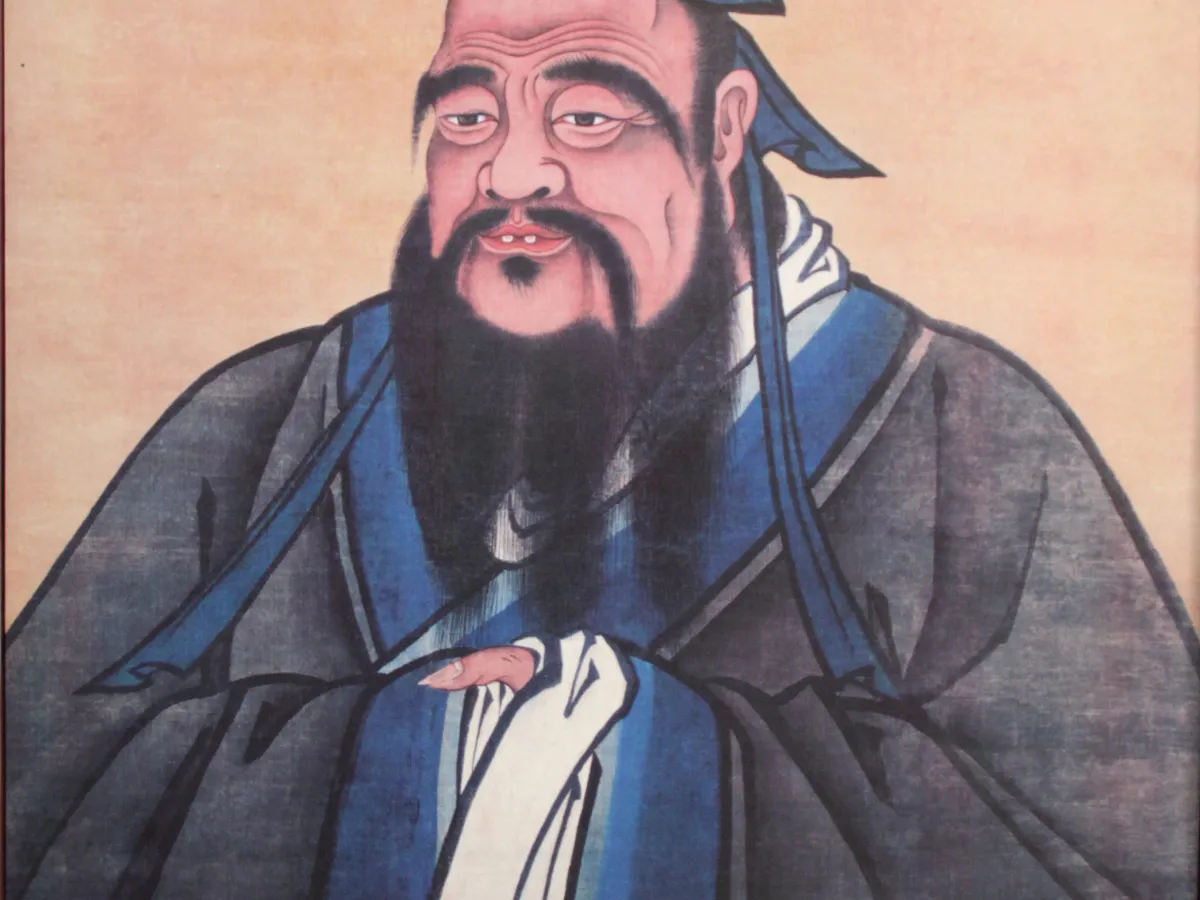
Confucius, known in Chinese as Kongzi or Master Kong, lived from 551 to 479 BCE during the late Spring and Autumn period. He was a teacher and thinker in a time of political fragmentation. Later generations made him a cultural sage, placed his teachings at the center of education and built institutions around his name.
UNESCO's record for the Temple and Cemetery of Confucius and the Kong Family Mansion in Qufu makes that later institutional scale visible; the buildings document centuries of commemoration, not a transcript of what Confucius personally taught.
The Analects is the best-known collection associated with him. It was compiled by followers across time rather than written by Confucius as a single finished book. Its short exchanges can feel surprisingly alive: a student asks a large question, and the answer turns toward behavior, character or the student's particular weakness.
This matters. Confucianism did not begin as a stone monument. It began as conversation. The Confucius profile keeps the failed political reformer and teacher visible, while the Analects reading guide shows why the surviving book cannot be reduced to a single-author manifesto.
Confucianism is not one fixed doctrine
Across more than two thousand years, thinkers interpreted, expanded and argued with the tradition. Mencius emphasized the human capacity for goodness. Xunzi gave greater weight to disciplined learning and ritual formation. Later scholars now grouped under “Neo-Confucianism” engaged deeply with Buddhist and Daoist questions while creating new metaphysical systems.
Imperial governments used Confucian texts in education and civil examinations. Families used ritual manuals and moral language. Reformers blamed Confucian hierarchy for social weakness. Modern governments alternately attacked, revived and repackaged Confucian heritage.
There is therefore no honest way to say “Confucianism teaches” without eventually asking: which text, thinker, institution and century?
That question is not academic housekeeping. It stops people from laundering any familiar hierarchy through the word “tradition.” The Stanford Encyclopedia of Philosophy maps a field of debates rather than one frozen doctrine. East Moment's conclusion is firmer: a modern claim made in Confucian language must still prove that responsibility moves both ways.
The central Confucian ideas
| Concept | Approximate meaning | What it asks in daily life | Common misunderstanding |
|---|---|---|---|
| Ren | Humaneness, benevolence, humane character | Can I treat another person as fully human? | It is not merely being pleasant |
| Li | Ritual, appropriate conduct, social form | What behavior fits this relationship and occasion? | It is more than formal ceremony or etiquette |
| Yi | Rightness, moral appropriateness | What should I do even when advantage points elsewhere? | It is not blind rule-following |
| Xiao | Filial responsibility | How do care, gratitude and duty move between generations? | It need not mean unconditional obedience |
| Xin | Trustworthiness | Do words and actions deserve another person's confidence? | Reputation alone is not moral character |
| Learning | Study joined with reflection and practice | How can I become corrigible rather than merely informed? | Examination success is not the whole purpose |
Translations are useful handrails, not perfect replacements. Ren is often translated as benevolence or humaneness, but its meaning grows through relationships and conduct. Li can mean ritual, propriety or appropriate form; none of those English words carries the whole history.
Ren: becoming human through humane conduct
Confucian ethics does not imagine character as a private jewel polished in isolation. A person becomes humane through repeated responses to others. Compassion, restraint, reciprocity and moral attention become habits.
This sounds gentle until it becomes inconvenient. It is easy to praise humaneness toward people who agree with us, arrive on time and remember our birthday. The real test appears when status gives us permission to be careless.
The Confucian “gentleman” or exemplary person, junzi, is not admirable because of birth alone. The ideal points toward cultivated character: someone whose behavior remains worthy when applause is absent.
Li: why form matters
Ritual can sound stiff to modern ears. We may imagine ceremonial robes, ancestral halls and a large instruction manual waiting to correct the angle of our elbows. Confucian li includes formal rites, but it also concerns the patterns that make social life intelligible.
Greetings, mourning practices, classroom conduct, table manners and public speech all give emotion a form. The form can protect people from chaos and humiliation. It can also become empty performance or a weapon of exclusion. Confucian thinkers themselves recognized that ritual without humane intention is hollow.
Good form is not the opposite of sincerity. Sometimes it is how sincerity learns not to spill all over the furniture.
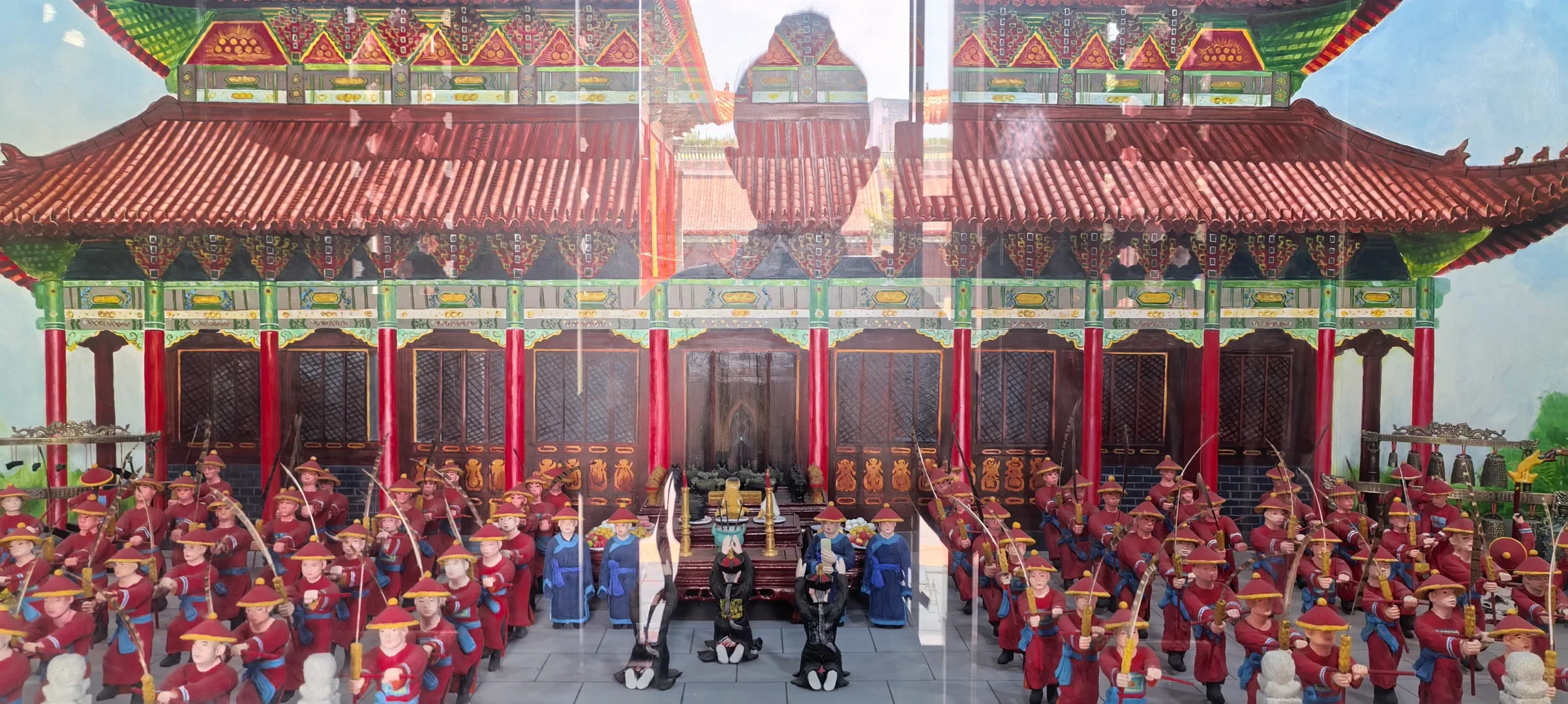
The opening photograph is useful because it is not timeless. It records a contemporary memorial performance: microphones, staging, reconstructed dress and an audience all occupy the same courtyard. I do not call that scene “ancient Confucianism.” I call it a modern argument about how inherited ritual should look. The distinction matters. A robe can reproduce a silhouette while the event around it still feels theatrical, moving or awkward. Visual age is never proof of ethical depth.
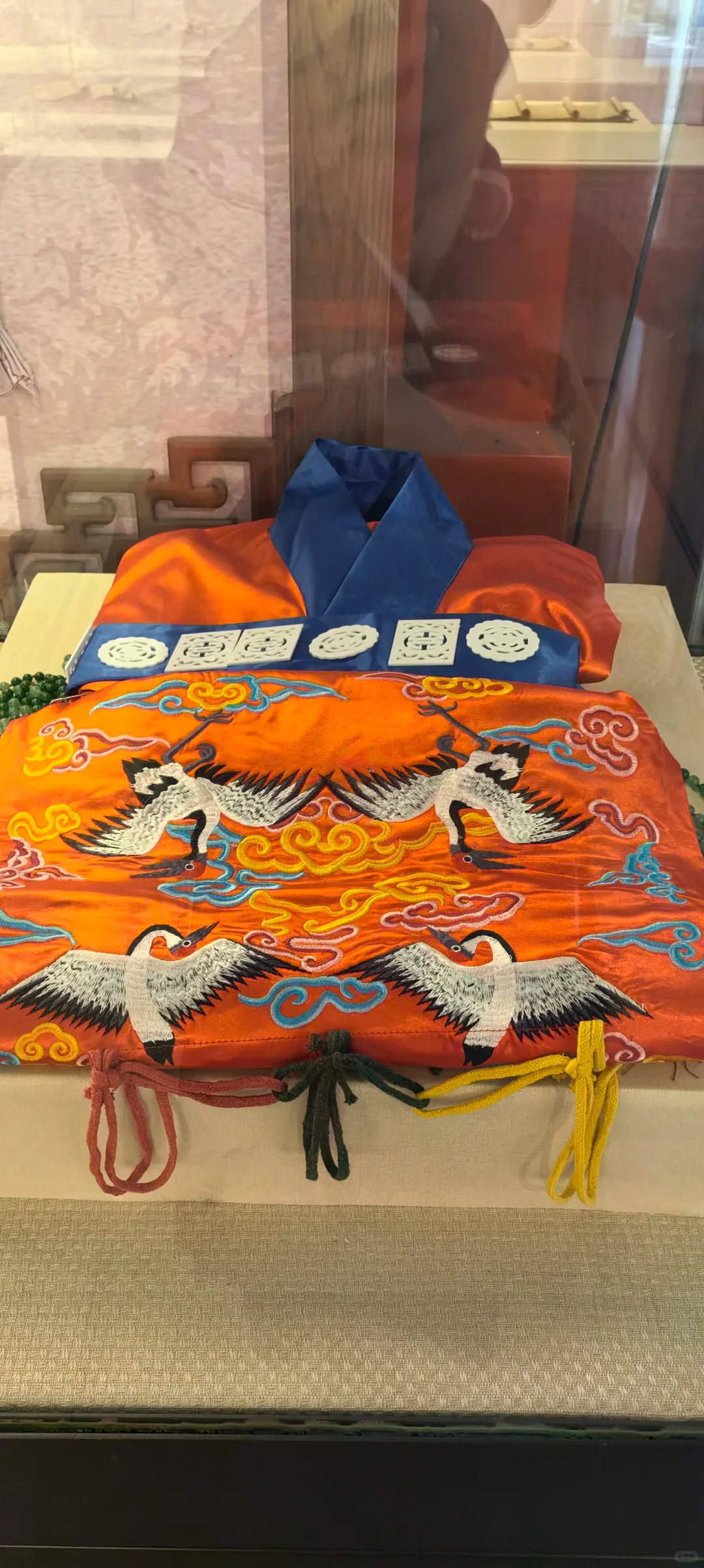
Displayed robes make ritual form visible, but fabric alone cannot prove sincerity or reciprocity. The moral test begins when people put the roles into practice. Authorized field photograph.
Filial responsibility is care, debt and debate
Filial piety is among the most discussed Confucian values and among the easiest to caricature. It concerns respect and responsibility toward parents and ancestors, but historical expressions ranged from daily care to elaborate ritual and extreme moral stories.
Modern families negotiate the idea under new conditions: migration, smaller households, women working outside the home, longer life expectancy and adult children living overseas. A weekly video call may carry a responsibility once expressed through physical proximity. Financial support may coexist with disagreement. Care can be loving and exhausting at the same time.
Confucian traditions also contain resources for remonstrance. A responsible child or official should not always remain silent when a parent or ruler is wrong. Loyalty without moral judgment becomes flattery, which is less noble and usually more comfortable.
Learning is a moral practice
Education became one of Confucianism's deepest influences on Chinese society. Imperial examination systems gave classical learning political consequence, even though access was limited by wealth, gender and circumstance. The prestige of study survived the end of those examinations.
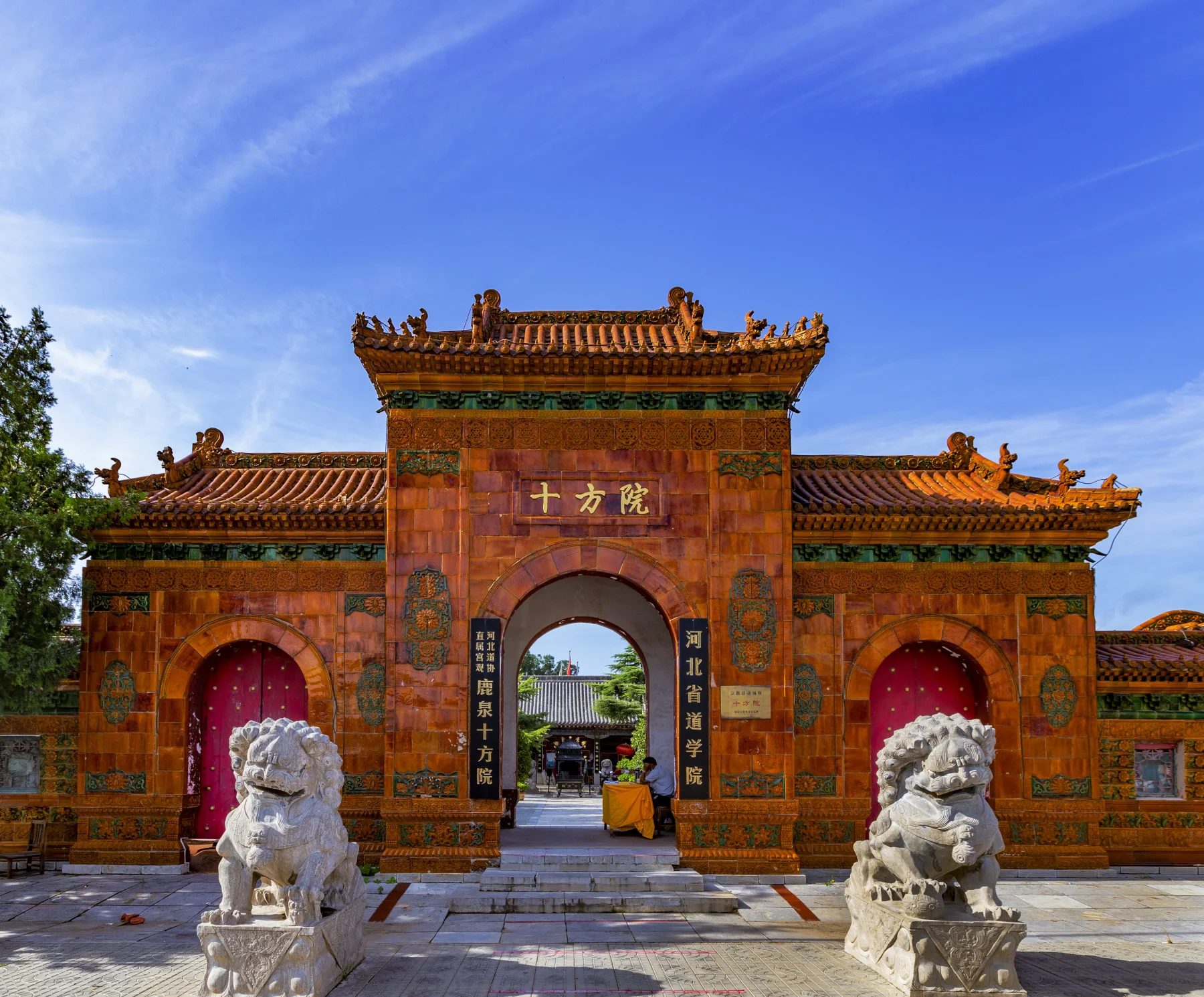
The Confucius temple guide shows how that prestige became a public route of gates, courtyards, inscriptions, ritual halls and school memory—and why the institution must be read through both aspiration and exclusion.
Yet Confucian learning is not identical with collecting scores. The Analects repeatedly joins study with reflection, practice and self-correction. Knowledge should alter conduct. A person who can quote every moral principle while making everyone nearby miserable has missed an important section of the syllabus.
Confucianism, Daoism and Buddhism compared
The three traditions are often displayed as separate columns. Chinese history is messier and more interesting.
| Tradition | Frequent emphasis | Characteristic question | Important caution |
|---|---|---|---|
| Confucianism | Ethical relationships, learning, ritual, humane order | How should I cultivate myself and fulfill responsibilities? | It includes diverse and competing schools |
| Daoism | Alignment with the Dao, naturalness, non-forcing, religious practice | Where am I forcing life out of balance? | Philosophical texts and organized religions are not identical |
| Buddhism | Suffering, impermanence, compassion, liberation | How does attachment shape suffering and awakening? | Chinese Buddhism contains many schools and local forms |
People did not always choose only one. A household might use Confucian language for family duty, Buddhist ritual for death and Daoist practices for protection or health. The boundaries mattered, and so did the crossings.
If the comparison you need is practical rather than taxonomic, the Taoism versus Confucianism guide puts both traditions under the same pressure: damaged relationships, over-control, unequal authority and the consequences of action. That is a harder test than choosing the column that sounds most like your personality.
Hierarchy is part of the history, not beyond criticism
Confucianism helped articulate reciprocal responsibilities between rulers and subjects, parents and children, husbands and wives, older and younger people, and friends. Reciprocity is important: authority was supposed to carry obligation. In practice, unequal systems often emphasized obedience more successfully than reciprocal care.
Women encountered educational and social restrictions justified through Confucian language, even as women also studied, wrote, taught children, managed households and interpreted moral life. Modern critics were right to challenge structures that converted role into destiny.
Respecting a tradition does not require protecting it from moral examination. A living tradition should survive questions. If it cannot, it has become branding.
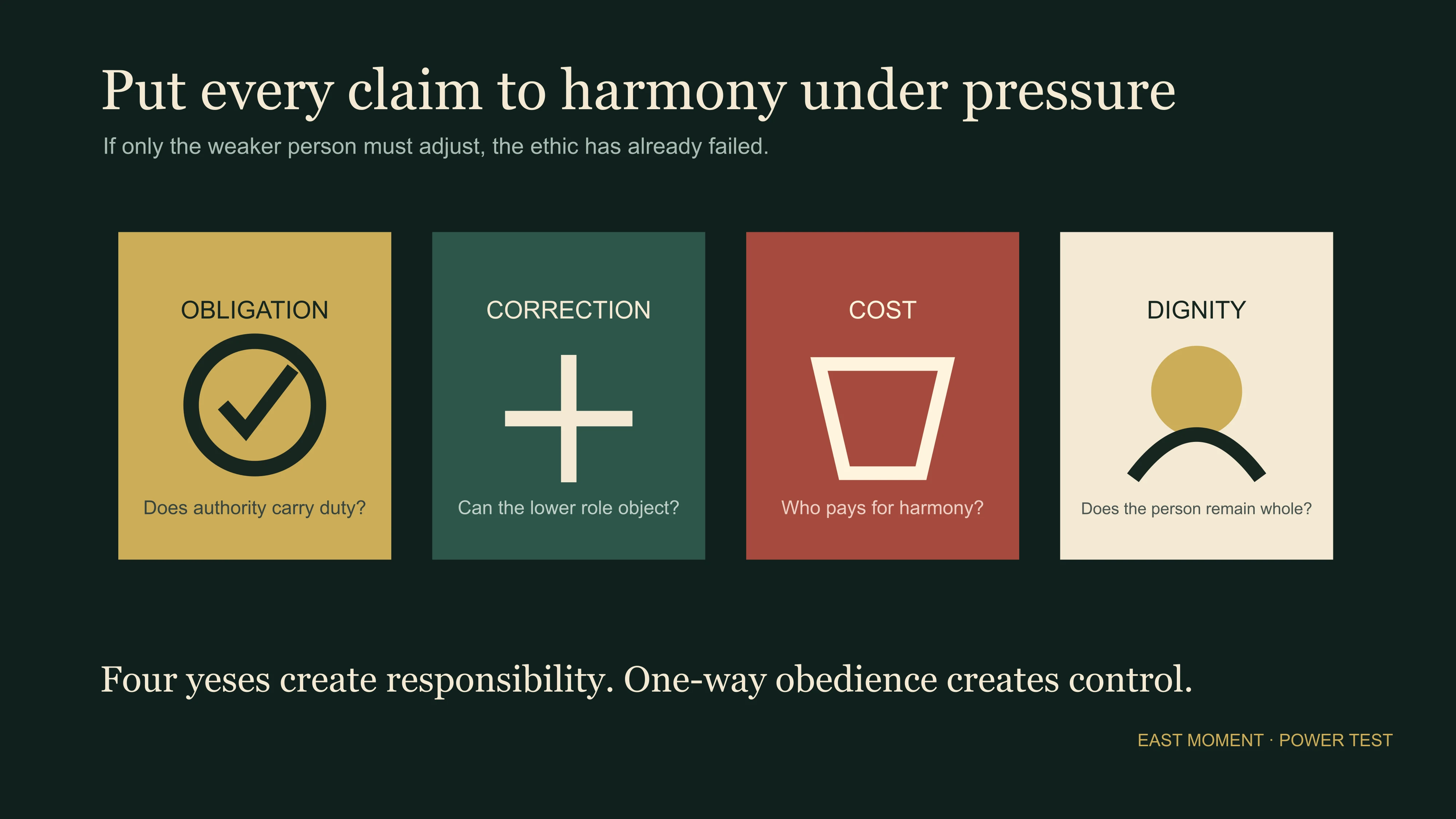
My four-part power test for Confucian language
Arguments about Confucianism often collapse into two loud camps. One calls it the source of every good Chinese habit; the other calls it a machine for manufacturing obedience. Both positions are too convenient. A tradition this long has produced humane discipline, elite institutions, moral resistance and real coercion. The useful question is not whether the label is good or evil. It is what a particular rule does to a particular relationship.
I use four tests. Obligation: does the person with greater authority carry a heavier duty, or only receive respect? Correction: can the person below disagree without being declared immoral? Cost: who supplies the time, money, silence or emotional labor required to preserve “harmony”? Dignity: does everyone remain a moral subject, or does one role swallow the person inside it?
If a family expectation, school rule, company culture or political slogan fails those tests, I do not care how classical its vocabulary sounds. It is control wearing ritual clothes. If it passes, Confucian language can still name something modern individualism sometimes forgets: freedom does not erase the people whose trust, work and care make a life possible.
That is my line. Confucianism deserves neither automatic obedience nor automatic contempt. It deserves pressure. A relationship ethic proves itself precisely where power is unequal.
Confucianism in modern Chinese life
Contemporary China is not a Confucian society in any simple sense. Marxism, market reform, global education, urbanization, family policy, digital life and many religious or secular worldviews all shape the present.
Confucian echoes remain audible in the prestige of education, concern for family obligation, respect for teachers, attention to public harmony and the moral language of self-improvement. But people use these ideas selectively. A young adult may value care for parents while rejecting control over marriage. A company may praise harmony while employees privately wish it would try paying overtime instead.
Continuity here is not obedience to an ancient blueprint. It is a vocabulary people inherit, revise and sometimes use against those who claim to defend it.
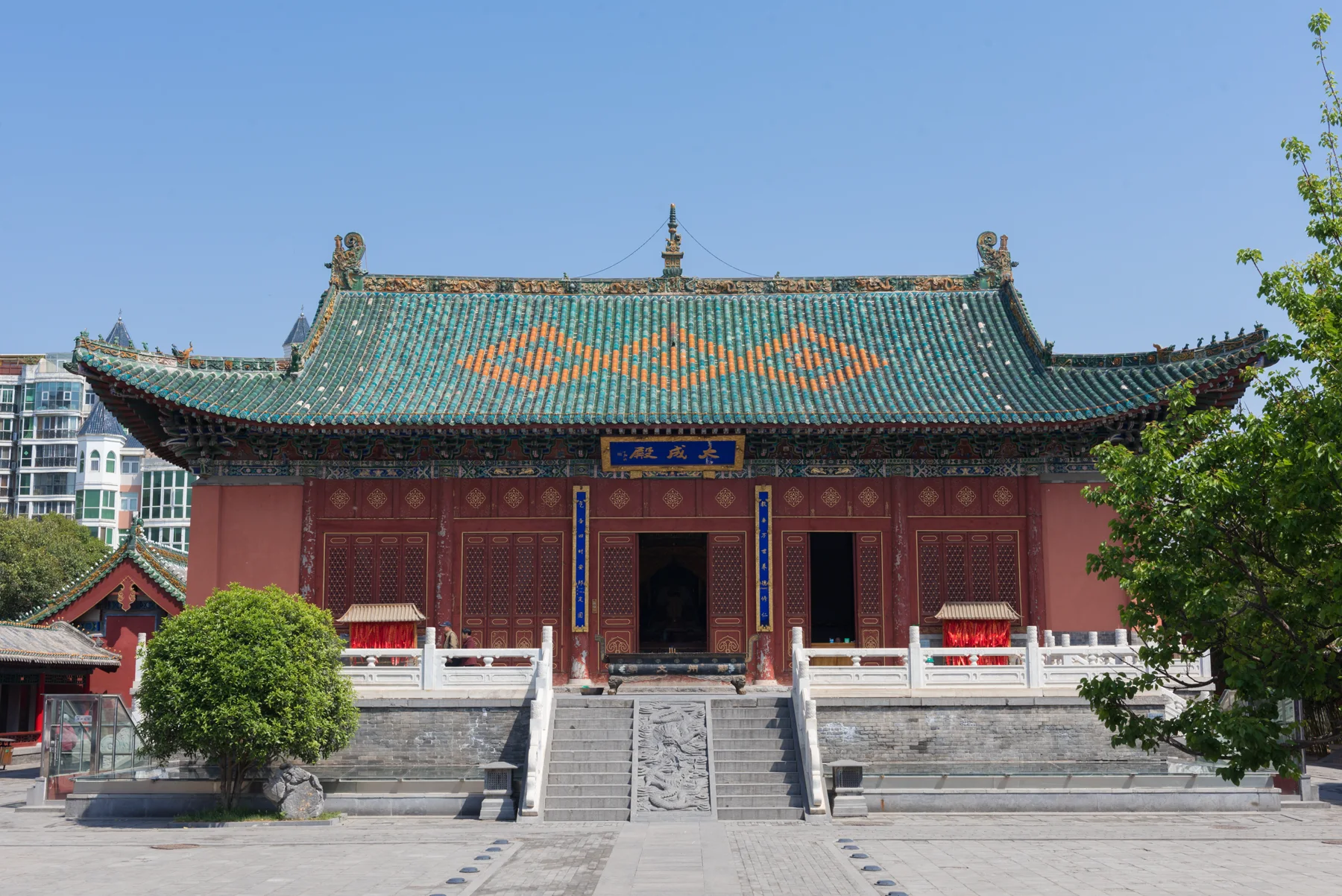
A Confucian temple turns ethical teaching into gates, courtyards and civic memory. The architecture matters because ideas gain authority by entering public space. East Moment media archive.
Confucianism after migration
In diaspora families, Confucian values can become more visible because they meet another social language. Expectations around education, elder care, family reputation or emotional restraint may be named “Chinese” only after children ask why their household works differently from their classmates' homes.
Generational conflict is not proof that culture has failed. It may be the place where culture becomes conscious. The important work is translation in both directions: elders explaining the history inside an expectation, younger people explaining the life that expectation now enters.
How to begin reading Confucian thought
Start with a good translation of the Analects, but read slowly. The text is brief enough to encourage overconfidence. Notice who is speaking, what question was asked and whether the answer seems tailored to a particular student. For the family argument where reciprocity is most easily replaced by control, continue to filial piety.
Then compare later thinkers rather than treating “Confucius” as a label pasted over two millennia. Read Mencius and Xunzi side by side. Learn how civil examinations, family ritual and modern reform changed the tradition's social life. Our Ideas and Beliefs hub will continue into Daoism, Buddhism and popular practice, while Language and Texts follows what translation reveals and loses.
Frequently asked questions about Confucianism and Chinese culture
What is Confucianism in simple terms?
Confucianism is an ethical and intellectual tradition centered on cultivating character, learning how to fulfill relationships well and building humane social order through responsible conduct.
Is Confucianism a religion or a philosophy?
It can be approached as philosophy, ethics, education, political thought and ritual tradition. Calling it only a religion or only a philosophy can hide important parts of its historical life.
What are the main Confucian values?
Important concepts include ren or humaneness, li or appropriate ritual conduct, yi or moral rightness, xiao or filial responsibility, learning and the cultivation of trustworthy character.
How did Confucianism influence Chinese culture?
It influenced education, family ethics, government, social roles, ritual, ideas of self-cultivation and the language people use to discuss responsibility. Its influence has never been uniform or uncontested.
Is Confucianism still relevant in China today?
Yes, although often indirectly and selectively. Ideas about education, family responsibility, respectful conduct and social harmony remain recognizable, while hierarchy and gender roles are also debated and revised.
The tradition lives in the quality of attention
Confucianism can look grand from a distance: temples, classics, examinations, emperors and moral systems. Up close, it returns to a smaller scale. How do you speak to someone with less power? What do you owe the people who raised you? Can you accept correction without turning shame into anger?
The tradition has supported hierarchy and inspired moral resistance. It has been official doctrine, family habit, educational ideal and target of revolution. Its value today lies neither in worshipping the past nor pretending we have escaped the need for character.
Between two people there is always a little space. Confucianism asks what kind of person you become while crossing it.