The Analects of Confucius is a twenty-book collection of short sayings, conversations and scenes associated with Confucius and his disciples. Confucius did not sit down and write it as a finished book. Its value comes from learning to hear a layered conversation: who asks, who answers, which terms recur and where one passage unsettles another.
That conclusion changes how you read. Do not approach the Analects as a modern self-help book with one argument per chapter. Do not mine it only for quote cards either. Read it as a record of teaching in motion.
What are the Analects of Confucius?
The Analects of Confucius is the conventional English name for Lunyu (论语 / 論語). Lun can involve ordering, discussing or selecting; yu refers to speech or sayings. “Analects,” from a Greek-rooted English word for selected literary passages, does not translate the title word for word.
The received text contains twenty books, traditionally named by words near their openings rather than by descriptive titles such as “Ethics” or “Government.” Book 1 is Xue Er (学而 / 學而), taken from its opening phrase about learning. Book 2 is Wei Zheng (为政 / 為政), beginning with governing. The names are handles, not tables of contents.
Most entries are brief. A disciple asks about ren; Confucius answers differently than he did elsewhere. Someone observes how he behaves at court or during ritual. A compact statement appears without a scene. Later disciples sometimes speak in their own voices. This is why a summary can tell you the topics but not replace the book's form.
Read it as a difficult classroom, not a dead monument
One of the most convincing Chinese reading instincts I found treats the book less like a cabinet of sacred sentences and more like a disorderly classroom inside a collapsing political world. That is exactly right. The disciples are not interchangeable note-taking machines. Zilu is forceful, Zigong is verbally agile, Yan Hui becomes an object of affection and grief, and Zai Yu can provoke open frustration. When those personalities disappear, the teacher's answers become falsely universal.
This is also why I reject the popular complaint that the Analects is “too shallow” because many passages are short. Brevity is not the same as thinness. The missing material is often supplied by sequence, speaker, repetition and contradiction. A line that looks obvious on a poster can become uncomfortable when you notice that it was aimed at a particular failure. The book is not withholding a secret metaphysical system. It is making you watch judgment happen between people.
The best modern analogy is not a motivational feed. It is a long-running class whose surviving notes were arranged by later hands. You enter halfway through, learn names, hear a familiar term used differently and slowly discover the teacher's method. That friction is the pleasure. If an edition makes every sentence sound instantly smooth, inspirational and context-free, I do not trust it.
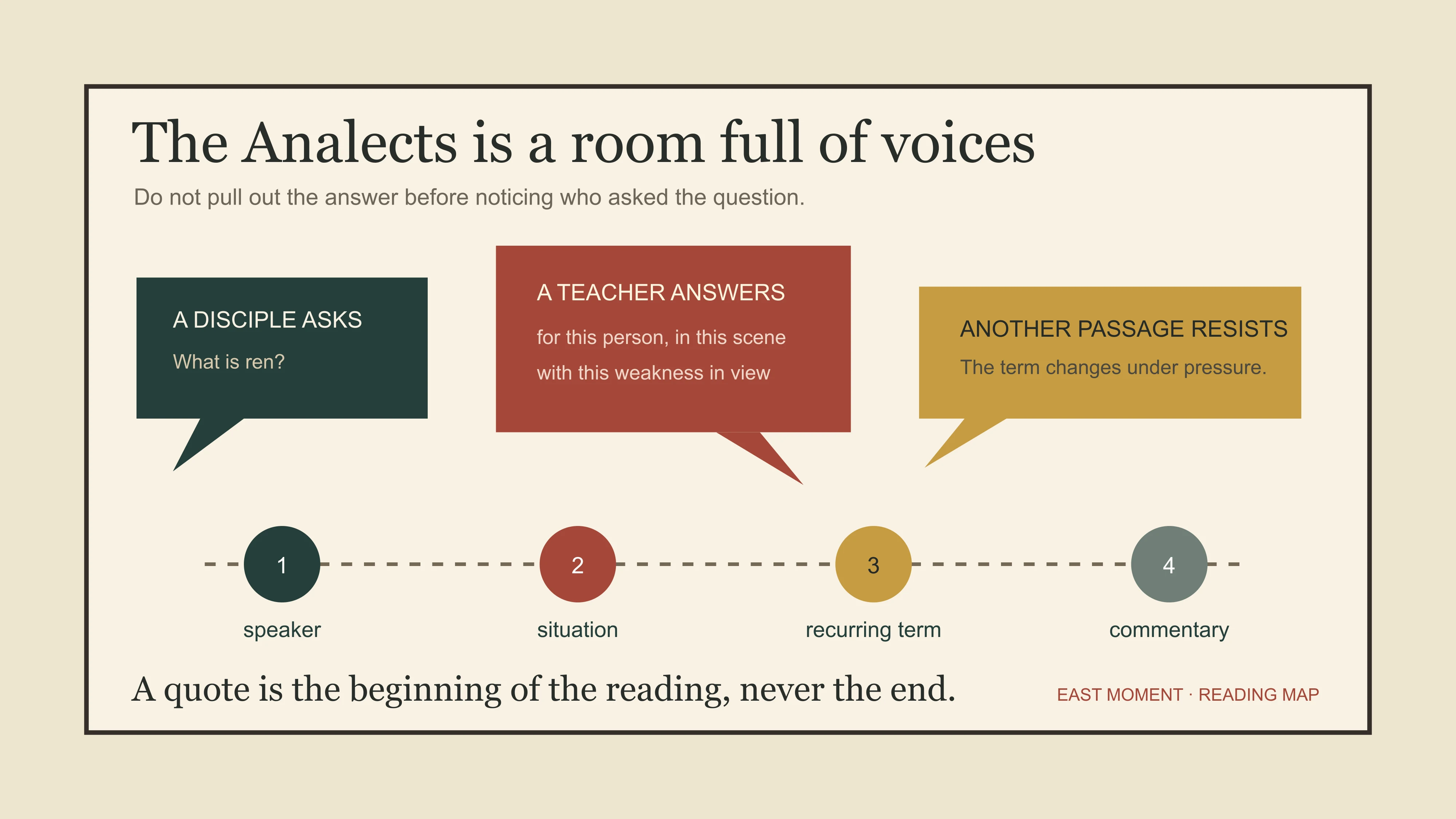
This is the reading discipline I use: restore the question before praising the answer, then look for the neighboring passage that refuses to let the slogan become universal. The map is not a reconstruction of an ancient classroom. It is a guardrail against turning a many-voiced book into one immaculate poster quote.
Who wrote the Analects?
The honest answer is we do not know a single author, because the text was not made like a modern single-author book.
A traditional account recorded in the Han dynasty describes first- and second-generation disciples compiling sayings and transmitting them. That account helped establish the received Analects as the most authoritative collection of Confucius's teachings. The Stanford Encyclopedia of Philosophy's Confucius entry lays out the biographical and textual difficulties without pretending that later transmission can be reduced to one certain editor. Later scholarship has questioned how early the compilation reached its present shape and how much authority should be given to one collection over other Confucius-related materials.
The safest conclusion is not “the book is fake.” It is more precise:
- sayings and dialogues associated with Confucius circulated in more than one collection;
- editors and transmitting communities selected and organized material;
- the received twenty-book text became a central, enormously influential form of that inheritance;
- exact layers and dates remain debated.
This is normal textual history, not a scandal. Ancient teaching often survives because communities repeat, select, comment and preserve it. The job of a serious reader is to notice that process rather than erase it.
The manuscript is evidence of transmission, not an original
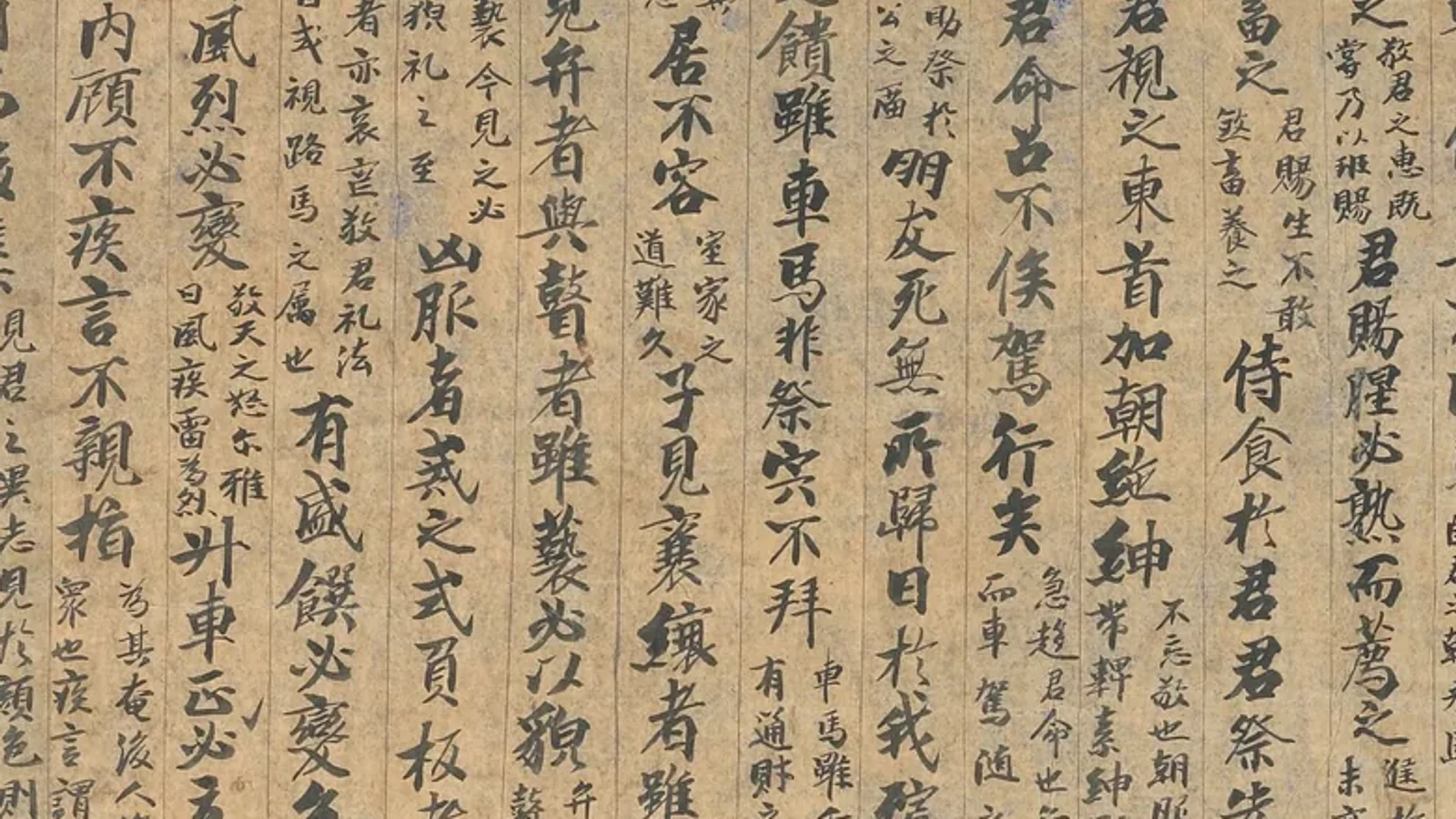
The surviving Dunhuang manuscript associated with the Lunyu makes at least two reading layers visible. Large characters carry the base text; smaller characters carry commentary. The object makes a crucial point: for much of its history, reading the Analects meant reading it with interpretation already on the page.
This is not Confucius's handwriting. It is not the first copy. The record dates the manuscript centuries after Confucius. Its value lies elsewhere: it shows a real stage in the book's material transmission and the intimacy between text and commentary.

The thin strip changes the scale of the argument. The Analects did not travel toward us as a clean modern paperback; words had to be written on separate pieces, ordered, tied, buried, damaged, identified and interpreted. I find that material fragility more convincing than reverence. It shows why chapter order, missing sections and variant wording are historical questions rather than attacks on the book.
Excavations changed the confidence of the old story
The transmitted text is not the only material witness. Excavated manuscript finds have revealed overlapping or variant Analects-related material, including a version from Dingzhou in Hebei and material from the tomb of the Marquis of Haihun in Jiangxi. Other early excavated texts preserve sayings associated with Confucius outside the received twenty books.
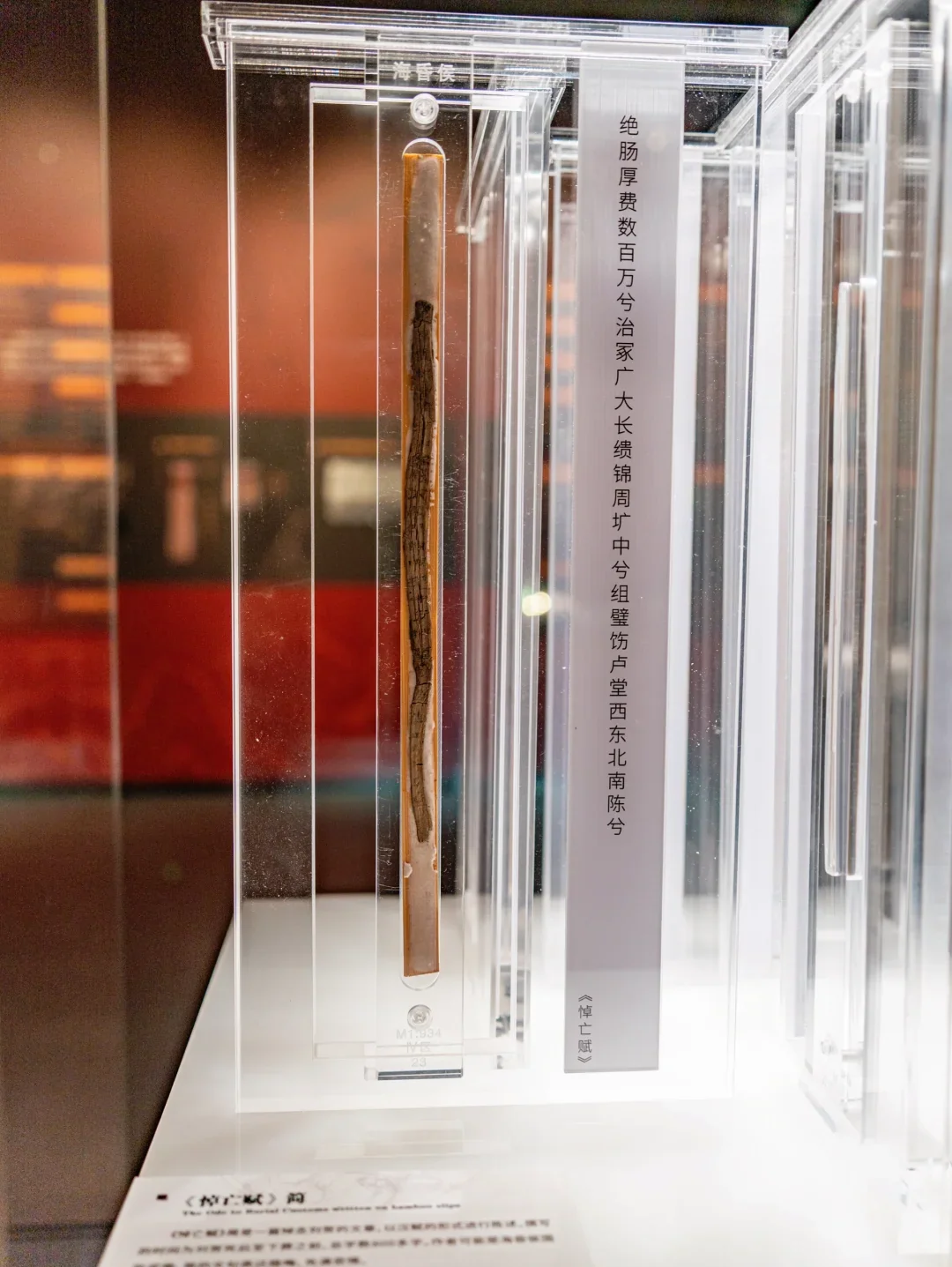
This exhibition view is evidence of the object and the museum encounter, not a shortcut to deciphering every character. A social post can bring us close enough to notice fibre, scale and conservation; the textual claim still has to rest on archaeological and scholarly publication. That division of labour matters. A beautiful photograph should sharpen a question, not silently promote itself into an authority.
According to the Stanford Encyclopedia of Philosophy, these discoveries support a picture of multiple Confucius dialogues and quotations circulating before the received text was fixed. They also show strong circulation of Analects material by the first century BCE.
What should an ordinary reader do with that complexity? Two things:
- Treat the received Analects as central and real, not as a stenographic transcript.
- Avoid sentences such as “Confucius wrote in his book…” when the evidence supports “The Analects records…”
That small change protects both accuracy and readability.
Why the book feels repetitive
Several major terms recur: ren (仁), li (礼 / 禮), yi (义 / 義), xiao (孝), junzi (君子), dao (道), learning, government, speech and friendship. Yet the Analects rarely stops to define them as a glossary would.
Instead, meaning accumulates through situations. Confucius tells one disciple that ren involves restraining oneself and returning to ritual; he tells another not to impose on others what one would reject for oneself. Different answers do not necessarily signal contradiction. A teacher may be responding to different temperaments, roles or practical failures.
The repetition is therefore the method. If you isolate one line, ren becomes “benevolence.” If you follow the term through conversations, it becomes a demanding field of humane relation, disciplined conduct, judgment and responsibility that no one English noun comfortably contains.
Our recommended first reading route

This route is designed for comprehension. It is not a theory of composition order.
1. Begin with Books 1, 2 and 4
These books quickly establish the text's core rhythm: learning, friendship, self-examination, government, ritual, ren and the contrast between the junzi and the petty person. Read slowly enough to mark recurring words.
2. Move to Books 7 and 11
Here the teacher and disciples become more distinct as people. You see learning habits, judgments, losses, affection and sharp corrections. Book 11 is especially useful for breaking the image of Confucius as a marble dispenser of universal maxims.
3. Read Books 12 and 15
These contain concentrated exchanges about ren, government, reciprocity, speech, correction and moral purpose. Compare answers instead of collapsing them into one slogan.
4. Return to Book 1, then read all twenty in order
The second encounter with the opening feels different because names and conceptual tensions are now familiar. Continue through the full text. Mark passages that echo, challenge or narrow earlier ones.
5. Compare a second translation
Do not switch translations every line during the first reading; that kills momentum. After finishing a book, compare three or four passages where the English sounds unusually smooth, moralizing or obscure. Those are often places where a translator has made a strong choice.
How to choose an English translation
There is no neutral translation, but there are useful matches between edition and reader.
| Reader need | Useful starting point | What to watch |
|---|---|---|
| Clear modern prose with substantial notes | Edward Slingerland | Helpful scholarly framing; still one interpretive vocabulary |
| Compact, widely available reading | D. C. Lau | Elegant and practical; notes are lighter than a study edition |
| Relational and role-centered interpretation | Roger Ames and Henry Rosemont Jr. | Philosophically rich; terminology is intentionally interpretive |
| Literary energy | Simon Leys | Strong voice; not the fullest apparatus for textual history |
| Free bilingual reference | James Legge through Chinese Text Project | Public domain and searchable; English is distinctly Victorian |
The best first translation is the one you will actually read and can check. A bilingual edition helps even if you do not know classical Chinese because repeated characters become visible. An edition with passage numbers lets you compare without hunting.
The page of a later printed tradition

Annotated page from a facsimile of an Analects edition printed in the Yuan dynasty after a Song edition; the original is recorded in the National Palace Museum, Taipei. Public domain image.
This page is cleaner and more regular than the Dunhuang manuscript, but it makes the same larger argument. The Analects reaching a reader is never only “what Confucius said.” It is also a history of scripts, editions, punctuation, commentary, classroom use and institutional authority.
During the Song dynasty, Zhu Xi placed the Analects within the Four Books curriculum alongside the Mencius, Great Learning and Doctrine of the Mean. That curricular afterlife shaped what educated readers across East Asia noticed in the text. It is part of the book's history, not proof that every interpretation was present at the beginning.
Five mistakes that flatten the Analects
1. Calling Confucius the author in the modern sense
Write “the Analects records” or “in Analects 4.17” unless discussing traditional attribution. This keeps the transmission history honest.
2. Reading only the inspirational lines
The book contains political hierarchy, ritual discipline, grief, social distinction and difficult judgments as well as humane reciprocity. A version with only comforting lines is not a summary. It is a mood board.
3. Translating every key term once and forever
Ren is not always exhausted by “benevolence”; li is not only “ritual”; junzi is not simply “gentleman.” Let context test the English word.
4. Assuming different answers must be contradictions
First ask who posed the question and what problem the answer addresses. The dialogical form matters.
5. Treating historical influence as timeless Chinese personality
The Analects profoundly influenced education, government and moral debate, but it never made every Chinese person Confucian in the same way. Influence is historically mediated, contested and combined with other traditions.
What the book is actually good for
The Analects does not hand you a complete moral system. It trains a habit of relational judgment: watch speech and action, examine models, correct faults, learn through practice, and ask what a role demands without reducing morality to rule compliance.
Its fragmentary form is an advantage here. A system can let you admire its architecture from a distance. A short exchange keeps asking what you would do with it.
For a passage-level entry, continue to ten traceable Confucius quotes. The Confucius guide separates the historical person from the later cultural symbol, while Confucianism explains how later thinkers and institutions built far beyond these twenty books.
The conclusion
The best way to read the Analects is neither worshipfully nor suspiciously. Treat it as a layered record whose brevity demands more attention, not less. Keep speaker, scene, Chinese term, translator and transmission history in view. Use the accountable bilingual text at the Chinese Text Project, then continue through the wider Chinese philosophy collection instead of mistaking one book for the whole tradition. The book will stop sounding like a wall of antique slogans and start behaving like a difficult, energetic classroom.