The most useful Confucius quotes are not the smoothest ones. They are the sayings you can trace to a passage, compare across translations and place back inside a conversation. Below are ten such passages from the transmitted Analects. The English wording is East Moment's close rendering of the Chinese, not an attempt to hide interpretation behind quotation marks.
Confucius quotes need the source attached

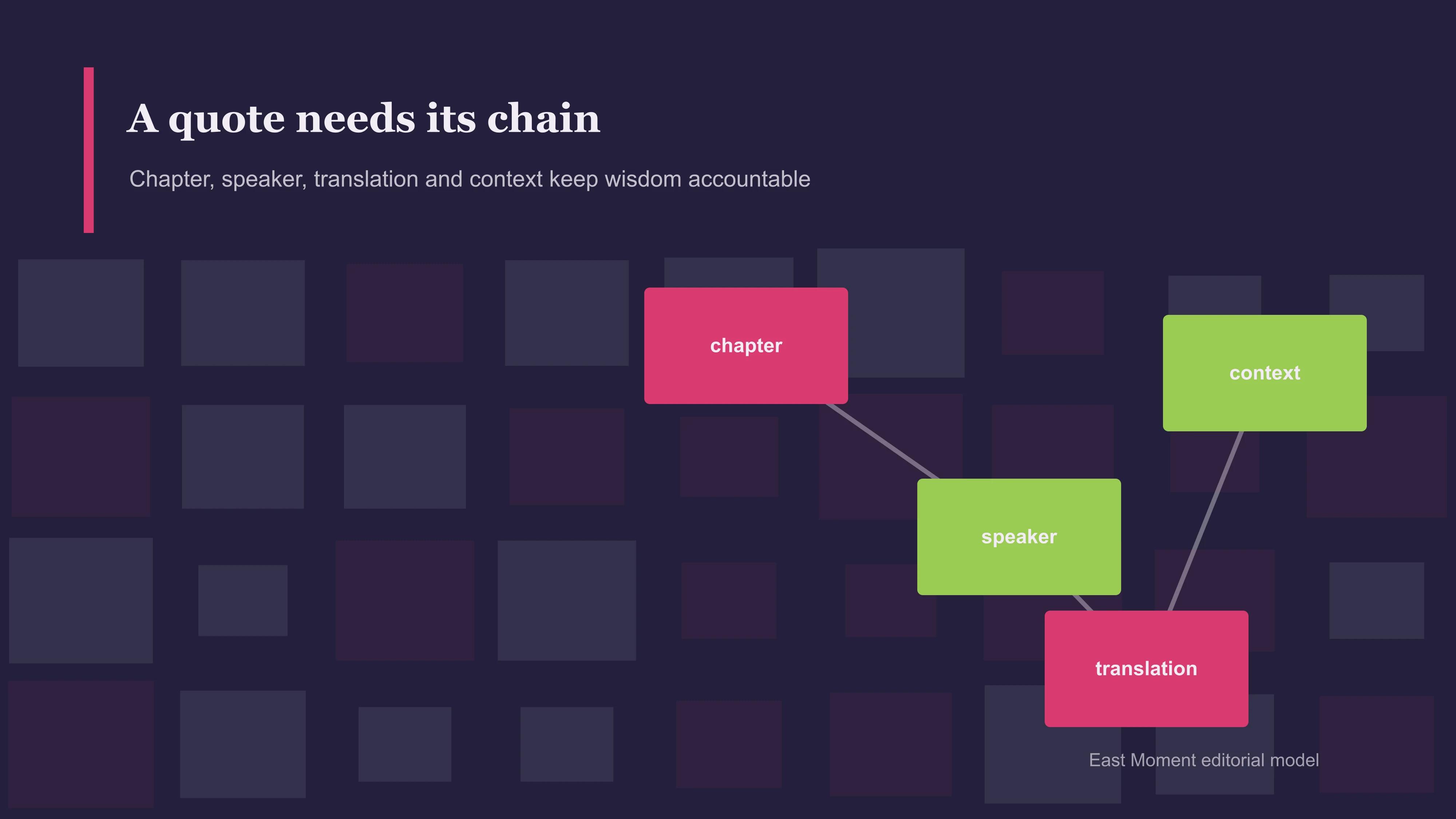
A social-media quote card usually gives you three things: a sentence, the name “Confucius” and a portrait. It leaves out the part that lets you trust it.
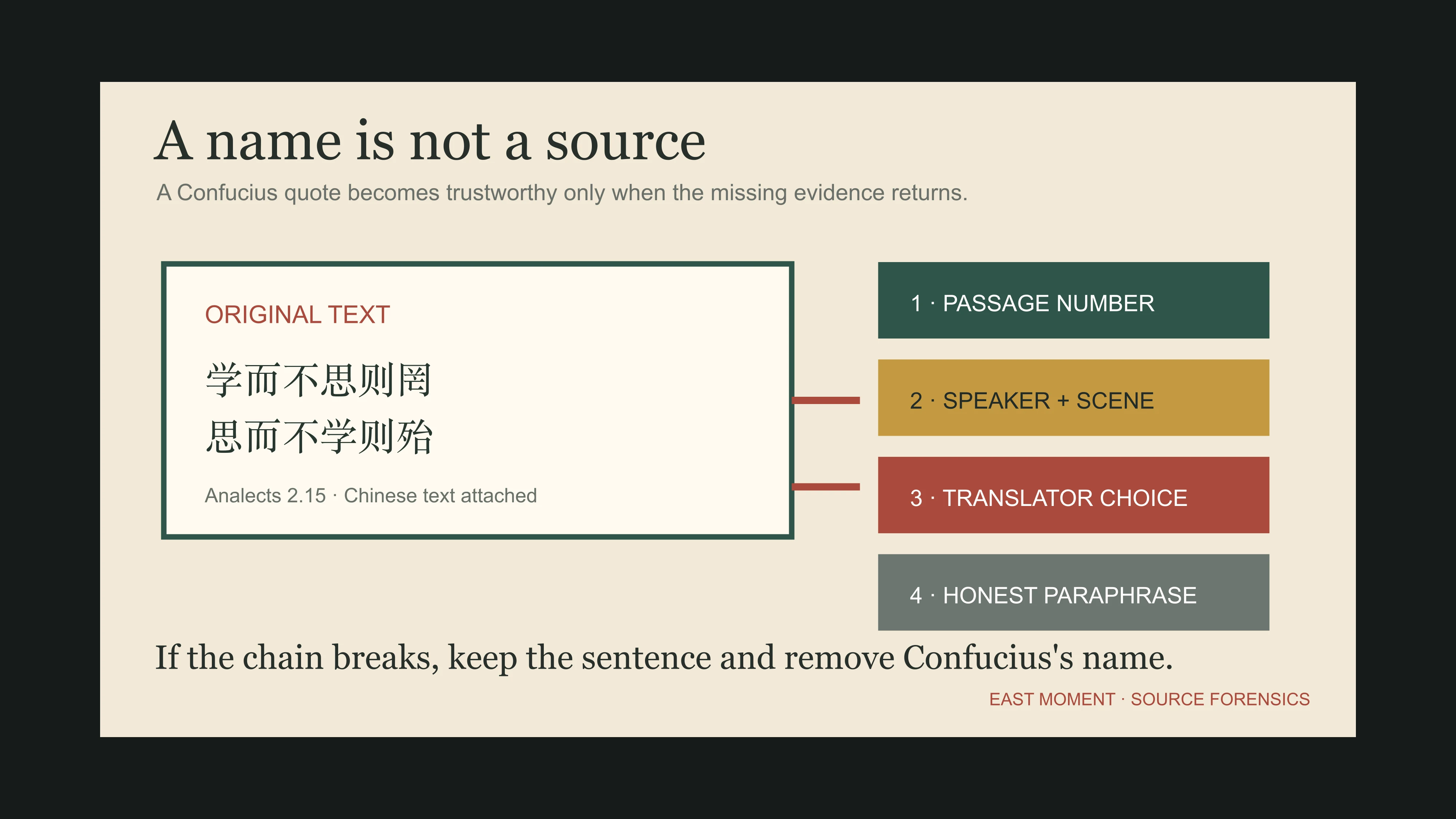
A traceable quote should give you at least:
- the Chinese text;
- the book and passage number;
- the translator, or a clear label saying the English is a new rendering;
- enough context to know who is speaking and what question is being answered.
That standard does not make every translation identical. It makes disagreement visible. Terms such as ren (仁), li (礼 / 禮), dao (道), junzi (君子) and shu (恕) cannot be replaced by one permanent English word without losing something.
There is a second trap beyond completely invented quotations: a real sentence can be made false by removing the sentence around it. “Think three times before acting” is often praised as if the Analects simply rewards maximum hesitation. In the recorded exchange, Confucius responds to a man known for repeated deliberation by saying that twice is enough. The passage is not a universal command to overthink. Context can reverse the motivational lesson.
This is why I treat attribution as a chain, not a badge. Chinese text, passage number, speaker, scene and translator choice should remain connected. Break enough links and a genuine classical line becomes internet décor.
1. Learning becomes real through return
学而时习之,不亦说乎?
To learn and return to what you have learned at the right times: is that not a pleasure?
Analects 1.1
The familiar translation “practice what you have learned” is useful, but shi xi (时习 / 時習) also carries the sense of revisiting or exercising learning at fitting times. Confucius is not praising information storage. Knowledge becomes yours when it is repeatedly brought into action.
The same opening passage continues with friends arriving from afar and with remaining unresentful when others fail to recognize you. The book begins by linking study, fellowship and emotional discipline. A cropped first sentence misses that architecture.
2. Learning and thinking must correct each other
学而不思则罔,思而不学则殆。
To learn without thinking leaves you lost; to think without learning puts you in danger.
Analects 2.15
This is not an argument for “following your own truth.” It is a two-sided warning. Collected knowledge without reflection becomes inert; reflection without disciplined learning becomes self-confirming speculation.
That balance feels unusually current because both failures are easy online. You can hoard summaries without forming a judgment, or form a judgment after watching one confident video. Confucius rejects both shortcuts in twelve Chinese characters.
3. A good example and a bad example both teach
见贤思齐焉,见不贤而内自省也。
When you see someone worthy, think how to equal them. When you see someone unworthy, examine yourself within.
Analects 4.17
The second sentence gives the first its force. Admiration points outward, but criticism has to turn back toward the observer. The passage does not say every bad act is secretly your fault. It says moral judgment becomes cheap when it never tests the person doing the judging.
This is one of the cleanest examples of Confucian self-cultivation as a social practice. Other people are not simply heroes or villains in your feed. They are mirrors that demand different kinds of work.
4. The serious person is slower in speech than in action
君子欲讷于言而敏于行。
The exemplary person wants to be restrained in speech and quick in action.
Analects 4.24
Junzi once referred to a person of rank and is repeatedly reshaped in the Analects into an ethical ideal. Translating it as “gentleman” can sound class-bound and male; “superior person” can sound self-congratulatory. “Exemplary person” foregrounds conduct, which is the point here.
Confucius is not demanding silence. He is attacking a mismatch: moral language that outruns moral performance. The sharper modern paraphrase would be, do not let your public position become more developed than your actual conduct. That paraphrase is ours, not a quotation from Confucius.
5. A life can be reorganized by hearing the Way
朝闻道,夕死可矣。
If I heard the Way in the morning, I could die content that evening.
Analects 4.8
This line sounds mystical when isolated. In Book 4, it sits among compact remarks about ren, profit, worthiness and the junzi. Dao here is not merely a scenic “path” or a supernatural secret. It names a way of living and ordering conduct that can make a life intelligible.
The sentence uses death to measure seriousness. It does not recommend dying for an idea after one morning of inspiration. It says that truly apprehending the right way to live would change what counts as a complete life.
6. Three people are enough to find a teacher
三人行,必有我师焉。择其善者而从之,其不善者而改之。
When three people walk together, I am certain to find a teacher among them. I choose what is good and follow it; I see what is not good and correct it in myself.
Analects 7.22
The popular first sentence is often turned into “everyone has something to teach you.” The second sentence is the method. One companion offers a model; another exposes a fault you can recognize and remove.
This is not indiscriminate respect for every opinion. It is disciplined extraction. Confucius asks what can be learned from a person, not whether that person deserves total imitation.
7. Power can take a commander, not a person's purpose
三军可夺帅也,匹夫不可夺志也。
The armies of three divisions can be deprived of their commander; even an ordinary person cannot be deprived of purpose.
Analects 9.26
Zhi (志) can mean resolve, will, intention or purposeful direction. “Ambition” is too career-oriented. The contrast is political and psychological: an organized army can lose its leader, but another person's inner commitment cannot simply be seized like a military office.
The line does not prove that every strong conviction is good. Elsewhere the Analects cares about learning, judgment and correction. Resolve becomes admirable when its direction can survive examination.
8. Do not impose what you would not accept
己所不欲,勿施于人。
What you do not desire for yourself, do not impose on others.
Analects 12.2; repeated in Analects 15.24
The wording appears in two conversations. In 12.2, Zhonggong asks about ren. Confucius connects the rule to public conduct and freedom from resentment. In 15.24, Zigong asks for one word that could guide a whole life; Confucius offers shu (恕), often translated as reciprocity, consideration or sympathetic understanding, then gives this line.
Calling it simply “the Chinese Golden Rule” helps comparison but can erase its local conceptual frame. The sentence is not floating alone. It is tied to shu, ren, role conduct and the discipline of imagining the burden an action places on someone else.
9. A mistake becomes a deeper fault when left unchanged
过而不改,是谓过矣。
To make a mistake and not change it: that is what deserves to be called a mistake.
Analects 15.30
The Chinese repeats guo (过 / 過), first as error and then as the error that truly counts. The line shifts moral weight away from perfection and toward correction.
That distinction is demanding, not forgiving in a lazy way. You do not escape responsibility by admitting a fault. Recognition creates the obligation to alter conduct.
10. Thinking all night is not a substitute for learning
吾尝终日不食,终夜不寝,以思,无益,不如学也。
I once spent the whole day without food and the whole night without sleep in thought. It brought no benefit. It is not as good as learning.
Analects 15.31
This passage saves Confucius from becoming a mascot for endless inward reflection. Book 2 already warns against learning without thought; here the warning runs in the other direction. Private intensity can feel profound while producing nothing that survives contact with study.
The Analects repeatedly makes thought answer to practice, examples, inherited material and conversation. Confucius does not celebrate the mind for being busy.
A later object shows why translation context matters
The Met identifies this calligraphy with Analects 14.24: “The scholars of the past studied for their own improvement. Today's scholars study to impress others.” Even this apparently direct English sentence contains choices. The Chinese contrast is between learning for oneself (为己 / 為己) and learning for others (为人 / 為人). “To impress others” interprets what other-directed study becomes; it is not a mechanically literal substitution.
That does not make the translation bad. It makes the translator's judgment visible. A responsible quote page lets readers see where explanation begins.
Three famous “Confucius quotes” you should not share as verified
“Choose a job you love, and you will never have to work a day in your life”
No traceable passage in the transmitted Analects says this. It also imports the modern category of choosing a personally fulfilling career into a text preoccupied with learning, ritual, government, family roles and cultivation. It may be useful advice to someone, but attaching Confucius does not make it ancient.
“It does not matter how slowly you go as long as you do not stop”
This sentence resembles a modern motivational summary of persistence. Without a passage and accountable textual route, label it unverified, not “translated from Confucius.” Similarity to a philosophical theme is not authorship.
“Life is really simple, but we insist on making it complicated”
The sentence sounds compatible with a generic image of Eastern wisdom. That is exactly why it travels. The Analects is full of tensions among roles, ritual, judgment, language and political responsibility; reducing that world to simplicity should make a reader more suspicious, not less.
Why a statue cannot verify a sentence

The two Confucius statues on this page are first-hand evidence of modern cultural memory in Macau and Lijiang. They show that Confucius is still made visible in public and institutional spaces far from one single historical site.
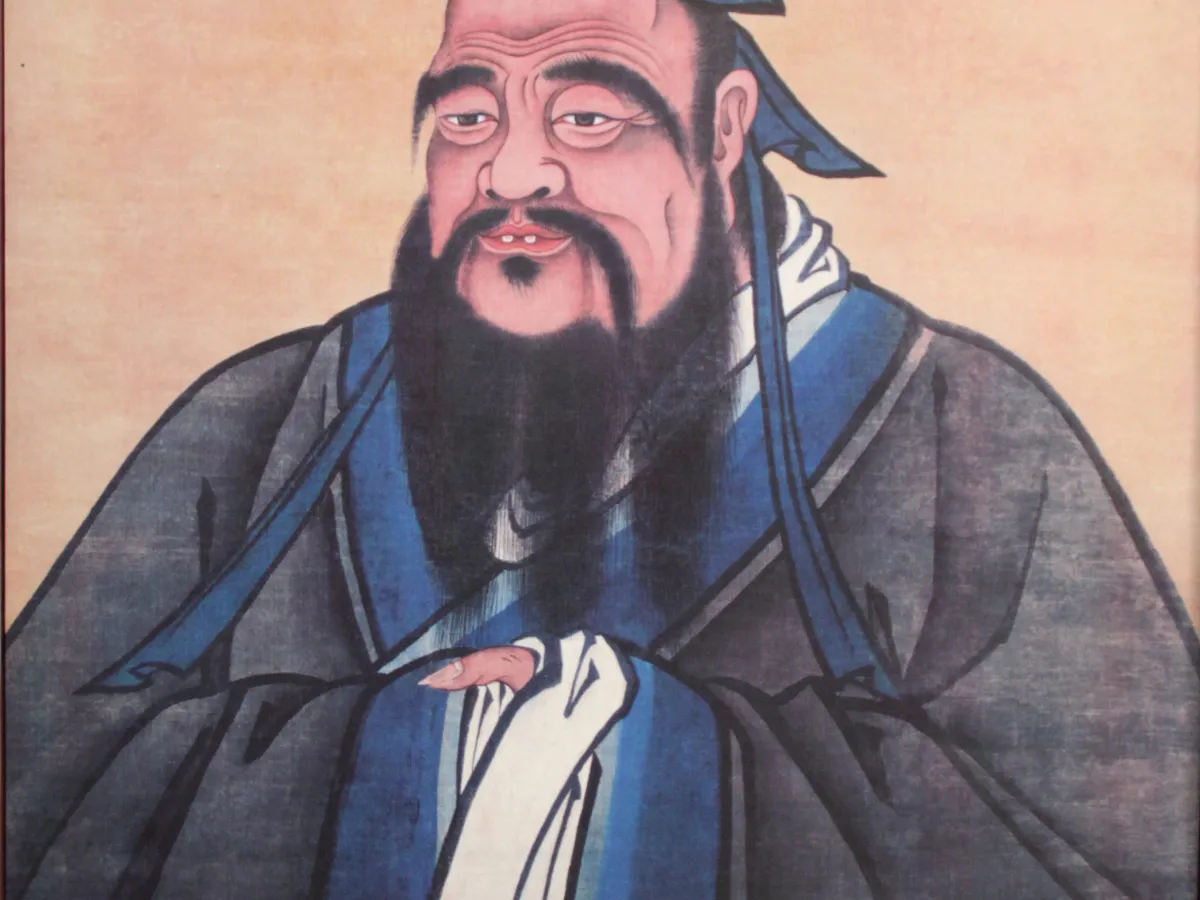
They do not show what Confucius looked like, prove a quotation or establish how every local visitor interprets him. Portraits create authority quickly. Textual provenance creates it slowly. A serious page needs both visual context and source discipline, but it must never confuse their jobs.
A 30-second check before you share a quote
- Search the exact English sentence in quotation marks.
- Look for an Analects book and passage number, not only a page repeating the attribution.
- Find the Chinese text in an accountable edition such as the Chinese Text Project.
- Compare at least two translations when the wording carries a large claim. The bilingual Chinese Text Project edition is a practical place to anchor the passage number and Chinese text.
- Label your own smooth wording as a paraphrase or rendering.
- If no passage appears, write “often attributed to Confucius” only when the history of that attribution is itself documented; otherwise leave his name off.
The Analects guide explains how the twenty-book collection formed and how to read beyond isolated lines. The Confucius profile separates the historical teacher from the many later cultural roles attached to him, while the Confucianism guide follows the tradition beyond one person. The broader Chinese philosophy collection keeps those neighboring questions separate instead of forcing one name to answer them all.
A Confucius quote gets better when its source returns
A good Confucius quote should become more interesting when its source returns, not less. The conversation, the disciple's question, the repeated term and the translator's choice are not clutter around the wisdom. They are the reason the sentence can teach you anything beyond its typography.