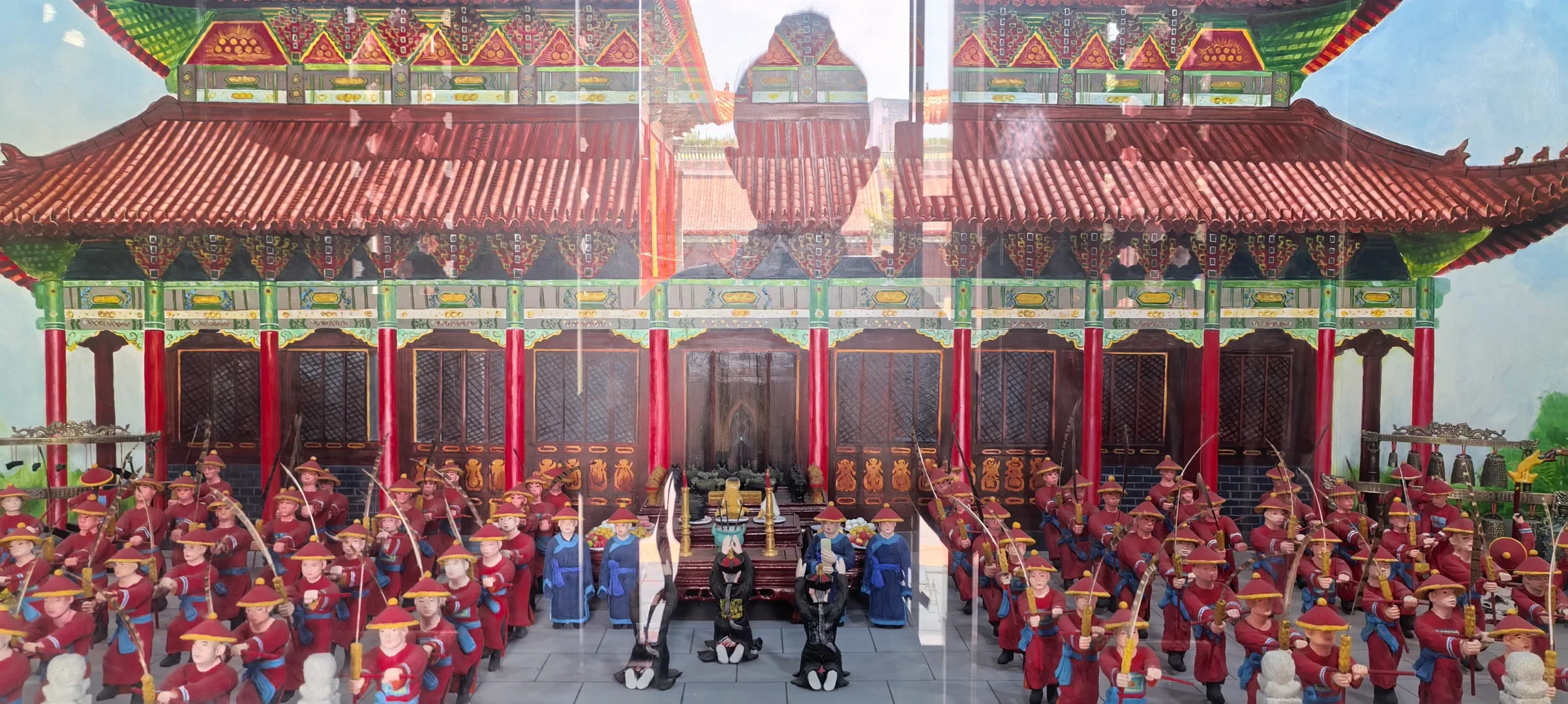
Chinese culture beliefs and traditions are not one creed. They are overlapping ways of thinking and living shaped by Confucian ethics, Daoist ideas, Buddhist practice, kinship, local ritual and modern debate. Concepts such as ren (humaneness), li (ritual propriety), the Dao (the way), and ancestor remembrance can matter deeply, but their meaning changes across regions, histories, families and individual convictions.
Chinese culture beliefs and traditions begin with a difficult decision
When a household decides how to mark the death of a parent, it is making more than a logistical choice. Who gathers, what is offered, whether a grave is visited, which words are used, and whether a younger relative living abroad can take part may all carry feeling and history. The same family may draw on Buddhist memorial practice, kinship obligations, local custom, Christian belief, secular remembrance, or none of these. A guide that calls the result simply "Chinese religion" loses the decision itself.
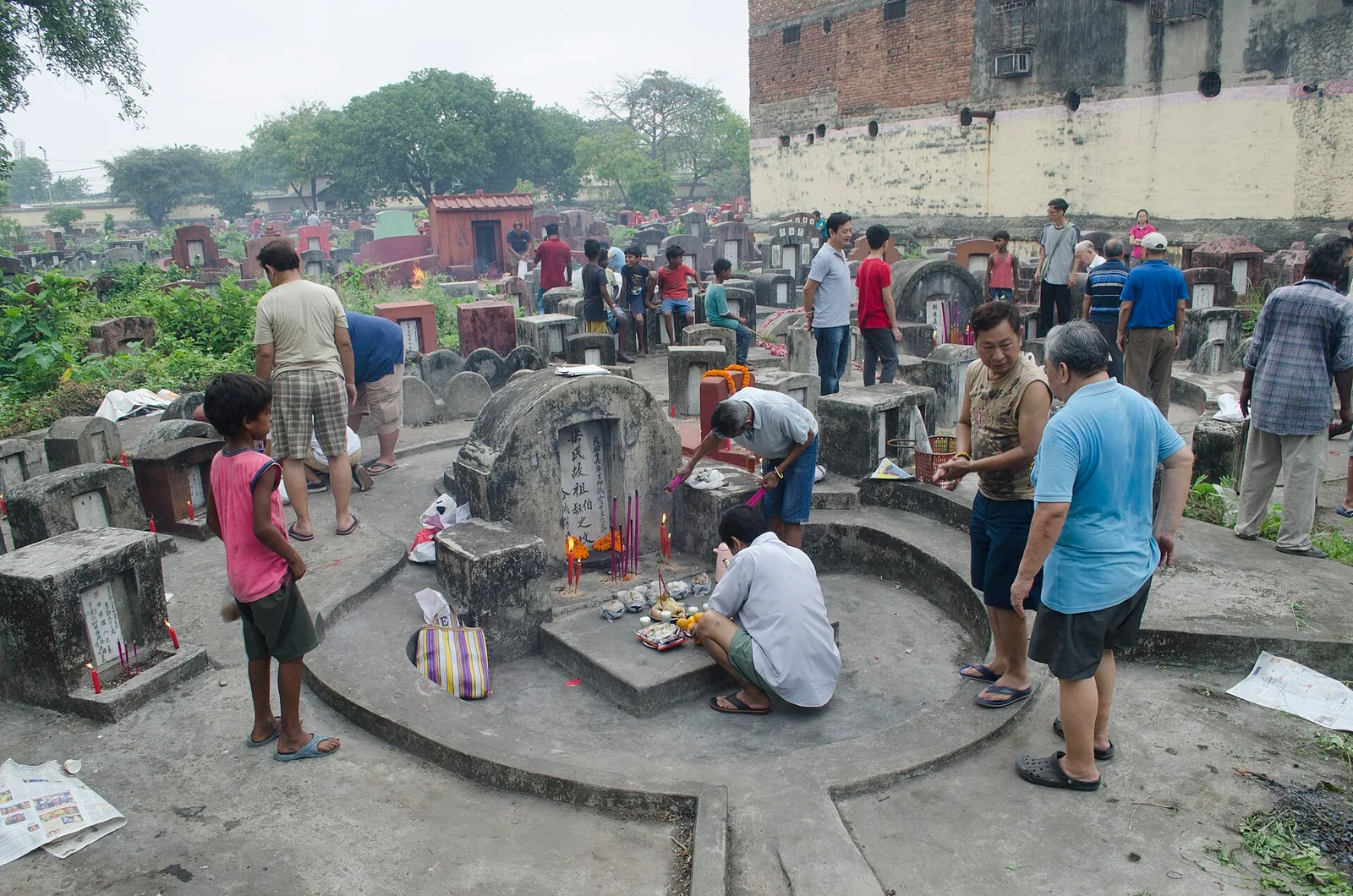
This documented Qingming scene makes the work of remembrance visible: people gather among graves, clear and tend the site, place offerings and include more than one generation in the occasion. It does not reveal each participant's relationship, identity or private belief, and it cannot stand for every family's practice. What the photograph can establish is more concrete: remembrance here occupies bodies, time, tools, food and shared space rather than existing only as an abstract “Chinese value.”
That is a useful place to begin. Chinese beliefs are often encountered through relationships and occasions rather than through a single declaration of faith. A person may speak of respecting parents, study a Confucian text, visit a temple, consult a calendar, keep a family photograph, reject a ritual, or combine several of these without experiencing them as competing labels. Another person from the same city or family may choose differently.
The banquet in the opening photograph is why I refuse to define belief as something hidden only inside a person's head. Tables, dishes, noise, kinship names and the effort of gathering can turn an ancestral hall into social infrastructure. Yet attendance does not tell us what every diner privately believes. The scene proves collective practice; it does not give us permission to invent a shared inner creed.
This does not mean that every tradition is interchangeable. Confucianism has distinctive arguments about learning, ethical relationships and ritual. Daoism has its own texts, lineages and religious institutions. Chinese Buddhist traditions have their own teachings, communities, languages and practices. Local rites, ancestor remembrance and popular religious life have histories that cannot be reduced to any one of those traditions. The point is that historical boundaries and lived boundaries do not always match neatly.
For readers outside China, the temptation is to ask for a short list of "Chinese values." Lists can be useful, but they become misleading when they turn people into representatives of an ancient instruction manual. A better question is: which value, in whose setting, and under what pressure? Respect can feel like care in one relationship and like control in another. Harmony can be a way to avoid humiliation, a way to conceal conflict, or a word people argue over precisely because it matters.
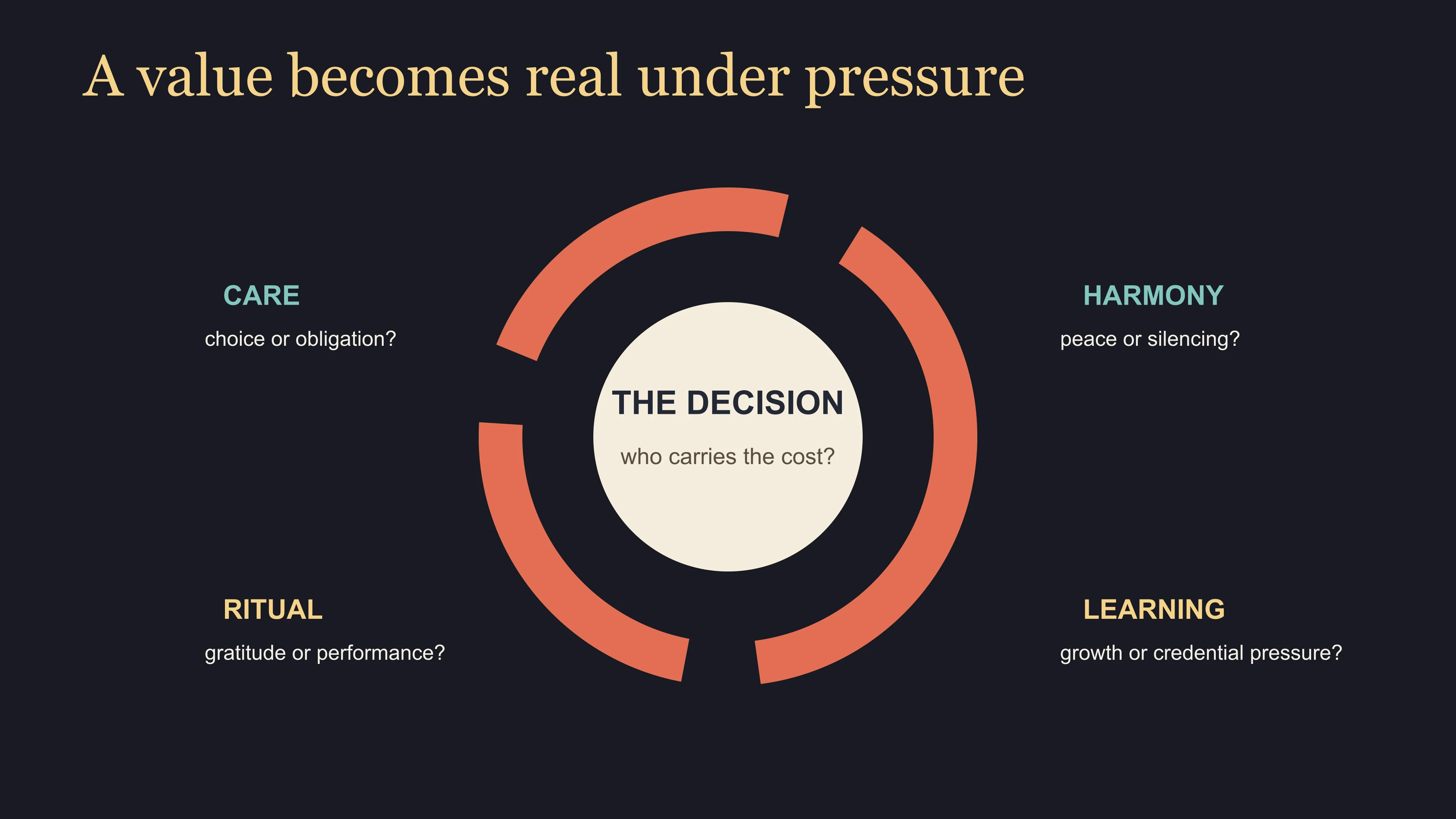
This is East Moment's test, not a canon: a value becomes legible when we can name the decision, the cost and the person carrying it. The model cannot decide what a family should do or tell us what every Chinese person believes.
Historical foundations: texts, institutions and exchange
The words Chinese beliefs and Chinese philosophy cover a very long historical field. They should not be treated as a single system that appeared fully formed. Classical texts associated with Confucian and Daoist thought were compiled, transmitted and interpreted over centuries. The Analects collection in the Chinese Text Project is a valuable primary-text starting point, but it is not a transcript of one moment or a complete guide to later Chinese life.
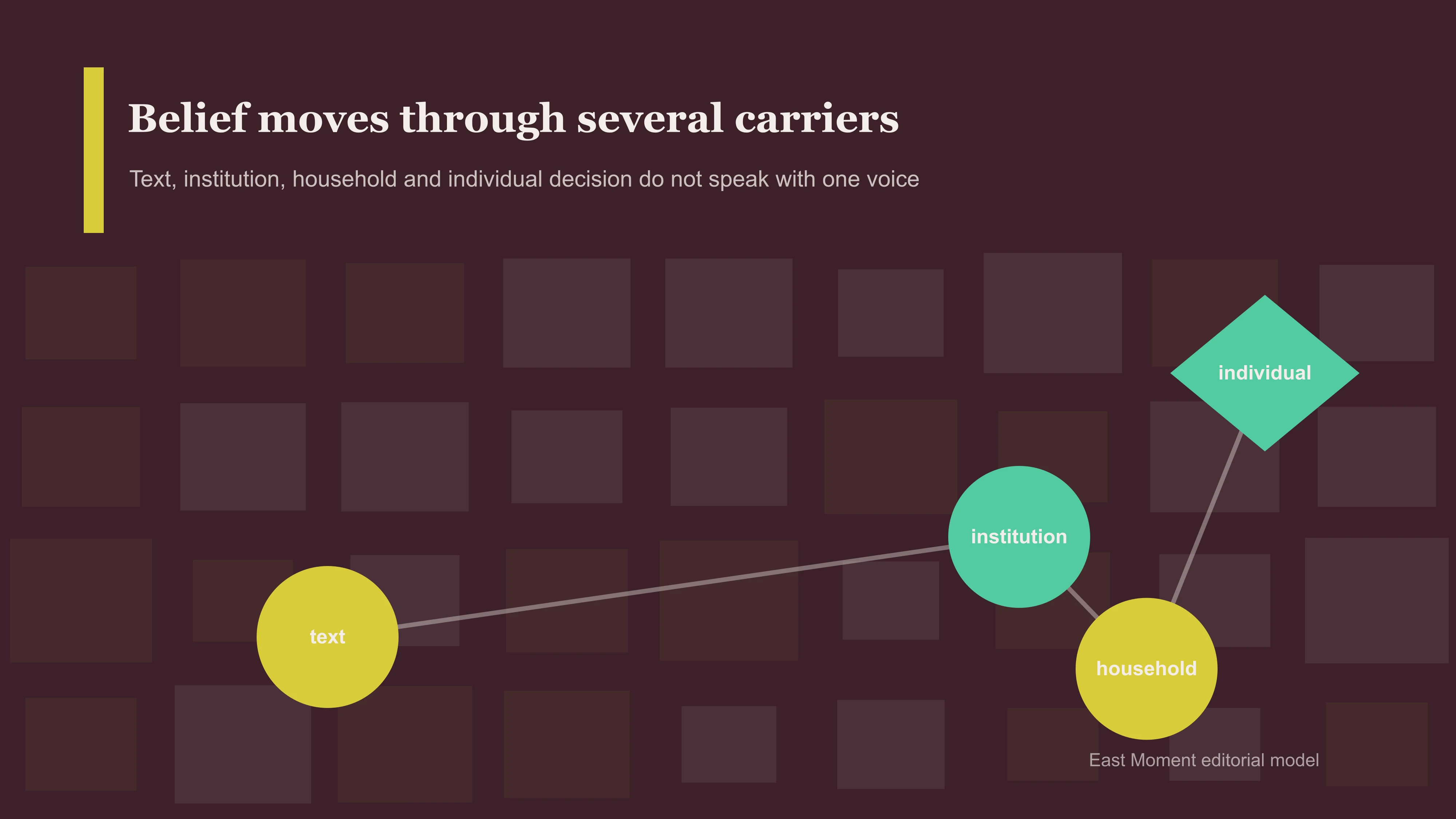
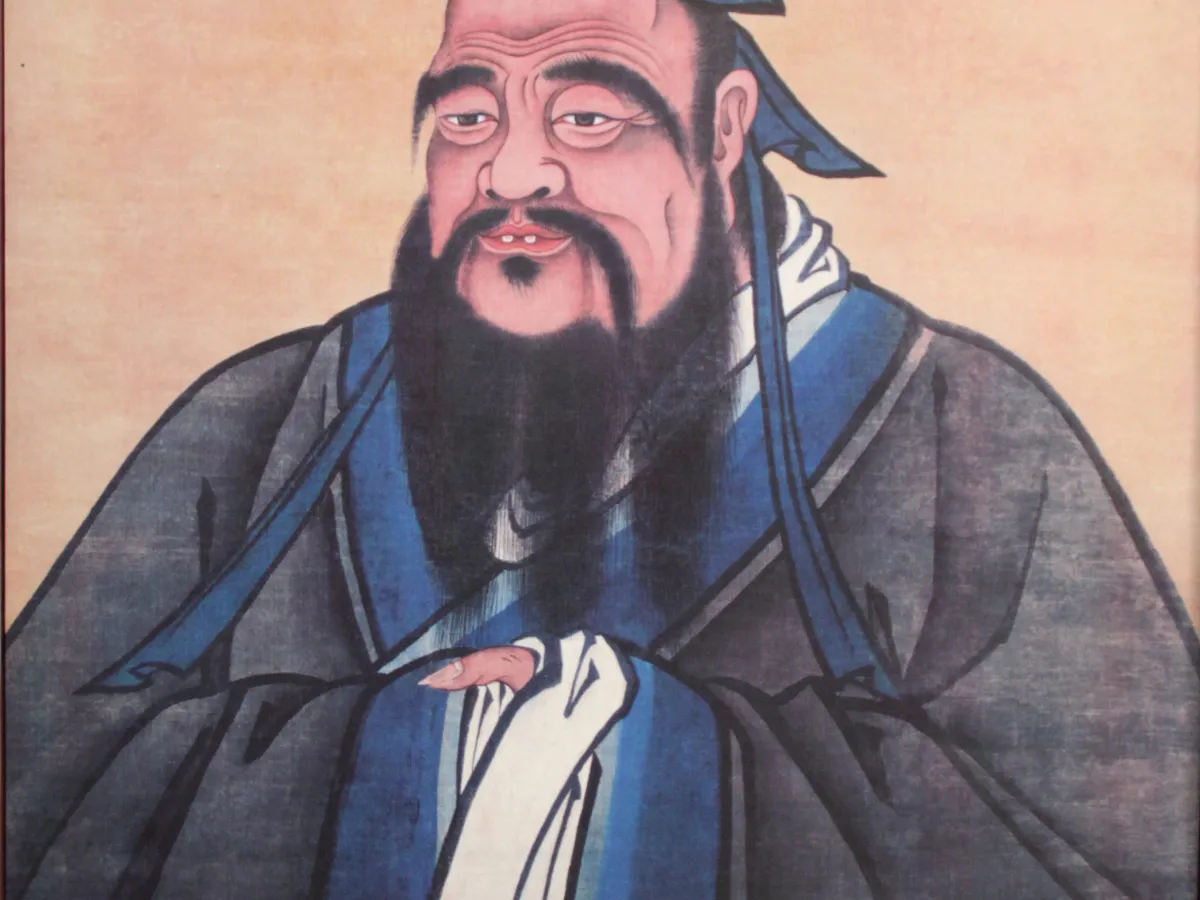
Confucius, or Kongzi, lived during the late Spring and Autumn period. Later thinkers expanded, disputed and institutionalized the ideas associated with him. Terms such as ren (humaneness), li (ritual or appropriate conduct), yi (rightness), and xiao (filial responsibility) became part of enduring conversations about character, learning, family and government. They did not end debate. For example, the question of whether a child should obey an elder, remonstrate with them, care for them from afar, or set a boundary cannot be solved by a single translated word.
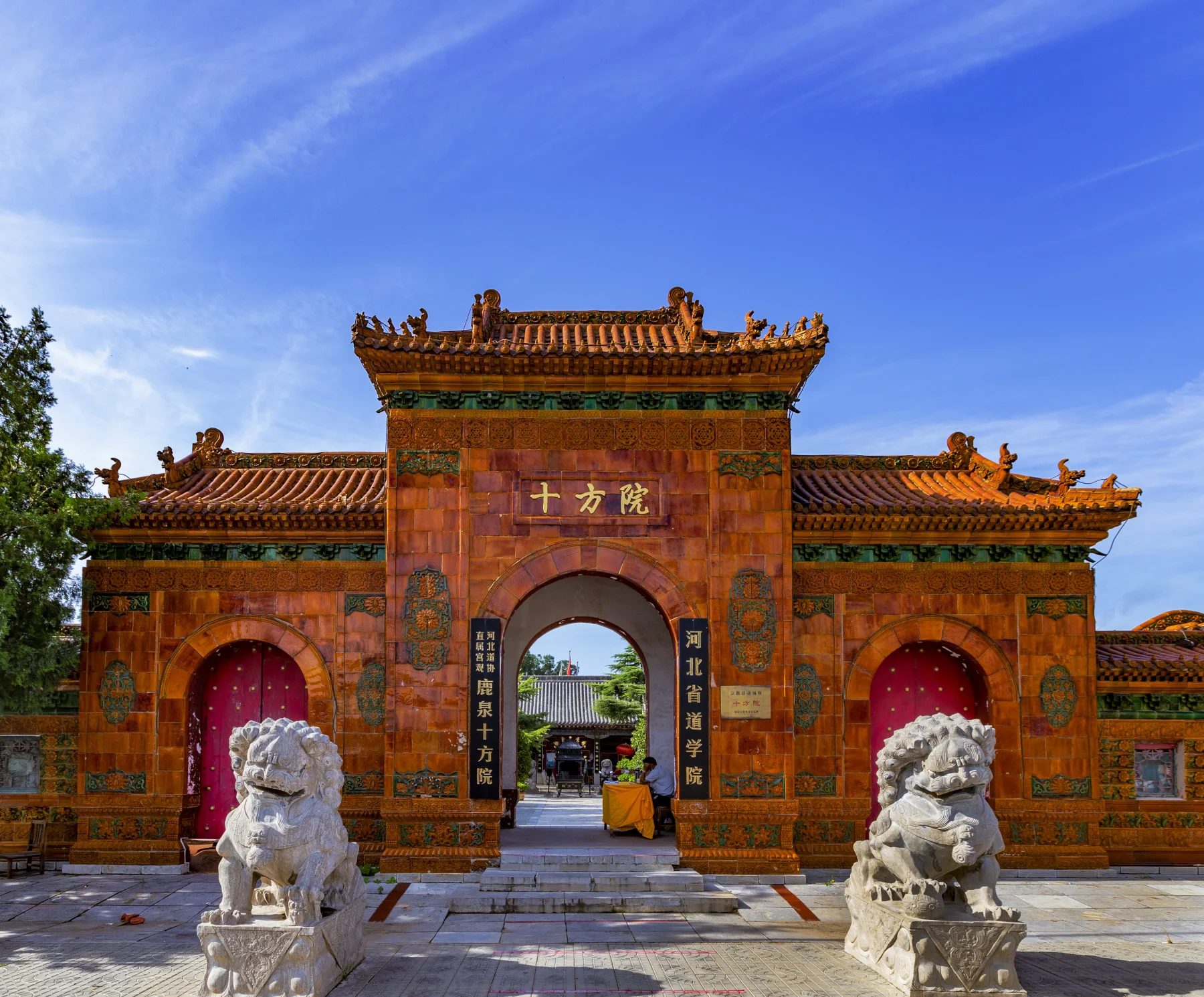
Texts associated with Daoism, including the Daodejing and Zhuangzi, developed different ways of asking about order, language, change and how forceful action can make a situation worse. Religious Daoist communities later developed rituals, priestly lineages, scriptures, temples and local forms of practice. Calling Daoism only a private philosophy removes those communities; calling it only a temple religion removes the reach of the classical texts.
Buddhism entered Chinese cultural worlds through routes of travel, translation, patronage and community formation. It brought new vocabularies for suffering, impermanence, compassion, merit, monastic life and liberation, while also taking Chinese forms in art, ritual, interpretation and institutions. The Buddhist materials associated with Dunhuang make the scale of exchange visible, but a responsible article must identify the particular cave, mural, manuscript, date and collection record before making a claim from an image. The Digital Dunhuang portal is a starting point for that work, not a substitute for an item-level citation.
The familiar English phrase "the three teachings" is often used for Confucianism, Daoism and Buddhism. It is a useful map only if readers remember that it is not a wall. Scholars, officials, monastics, ritual specialists and households could distinguish traditions carefully while also borrowing vocabulary, objects and practices across them. A funeral, household altar, schoolroom or festival can therefore reveal multiple histories at once. Other traditions, including Islam, Christianity and the religious lives of many ethnic communities, are also part of Chinese history and the present; they do not sit outside it as footnotes.
Major forms within Chinese culture beliefs and traditions
The table is a guide to questions, not a box assignment for people. The same individual may value more than one row, revise an inherited practice, or identify with none of them. Terms are given in pinyin, the standard romanization system used here; older English spellings such as Taoism remain common.
| Topic | Core definition | Key examples | Related page | Source |
|---|---|---|---|---|
| Confucian traditions | Ethical and intellectual traditions concerned with self-cultivation, relationships, learning, ritual and humane government. | ren, li, yi, xiao, the Analects, education and family ethics. | Confucianism | Chinese Text Project: Analects |
| Daoist traditions | Philosophical and religious traditions concerned with the Dao, change, naturalness, cultivation, ritual and community life. | Daodejing, Zhuangzi, wu wei, temples, priests and liturgy. | Taoism | Chinese Text Project: Dao De Jing |
| Chinese Buddhist traditions | Diverse communities and teachings shaped by Buddhist scriptures, translation, monastic institutions, ritual, art and local practice. | temples, chanting, merit-making, Pure Land and Chan traditions, Dunhuang materials. | Chinese philosophy | Digital Dunhuang |
| Kinship, ancestor remembrance and local ritual | Practices that connect families and communities to lineage, place, memory and the dead; they may be religious, cultural, secular or mixed. | grave visiting, offerings, clan halls, household altars and local festivals. | Filial piety | A named family, locality and occasion must define the claim. |
| Cosmological language | Ways of speaking about balance, time, transformation and relation that have circulated across several traditions. | yin and yang, the five phases, almanacs and seasonal observance. | Yin and yang | Historical meaning must be separated from modern personality labels. |
Confucian values are relational, not a personality test
Confucian ideas are frequently condensed into a few words: family, obedience, respect, education. That shortcut omits the hard parts. Ren asks about humane regard. Li concerns forms of conduct that can include ceremony but also everyday attentiveness. Xiao concerns responsibilities to parents and ancestors, yet historically it has also raised questions about care, disagreement, unequal power and what a good child owes a parent who is wrong.
In this frame, values are not simply traits stored inside an individual. They are cultivated through repeated conduct with other people: a student accepting correction, an official refusing flattery, a sibling sharing care work, an adult child finding a way to help a parent without surrendering every decision. The language can support generosity and mutual responsibility. It has also been used to defend hierarchy. Both histories belong in the conversation.
Daoist and Buddhist traditions resist tidy stereotypes
Daoism is often marketed abroad as a calm slogan about "going with the flow." That is too small for its philosophical questions and far too small for its religious life. Wu wei is often translated as non-forcing; it does not mean refusing all effort or responsibility. It asks what kind of action is appropriate when control, ambition or rigid categories are making a situation worse.
Chinese Buddhist traditions are similarly flattened when they are described only as meditation or only as funeral ritual. Buddhist life can include scripture study, chanting, images, vegetarian observance, pilgrimage, monastic discipline, funerary practice, ethical commitments and lay community. Which of these matters depends on school, place, period and person. A visitor should not assume that every temple visitor is making the same request, or that a ritual object has one fixed meaning outside its setting.
Local practice is neither a leftover nor a single category
Terms such as "folk religion" can be useful for identifying practices outside formal institutional labels, but they can also make living communities sound like an unexamined remainder. Local gods, temple networks, lineage rites, spirit-medium traditions, seasonal offerings and community festivals have their own histories. They may be shaped by locality, language, social class, migration and state policy. They may also be contested inside a community.
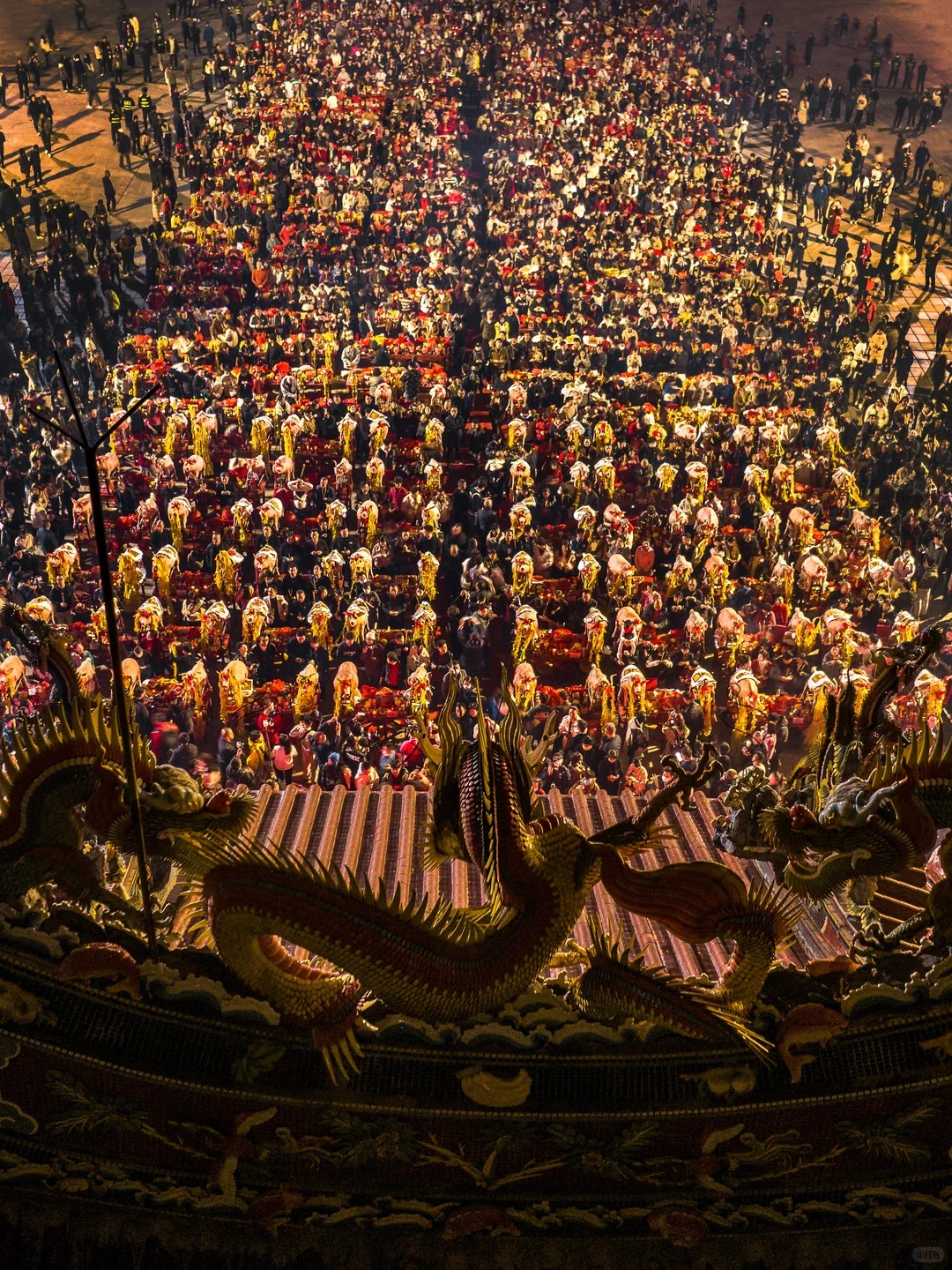
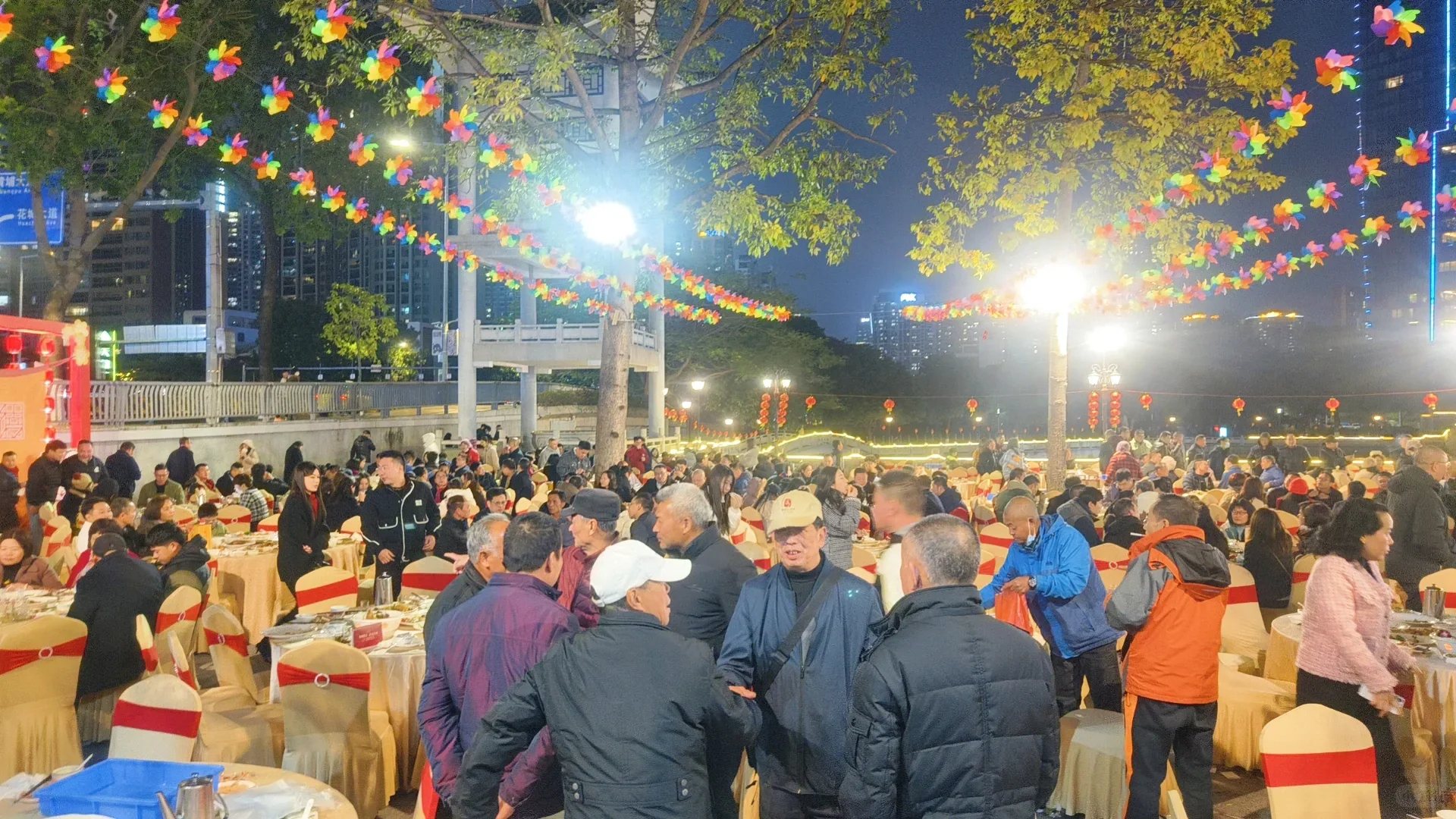
This Bai Tiangong gathering in Zhangzhou destroys the lazy picture of “traditional belief” as a quiet relic. The density, timing and shared labour are the point: people have coordinated an occasion that occupies real space and real hours. I can admire that force without claiming it represents every Minnan household, much less every Chinese person. Local specificity does not weaken cultural meaning; it is where meaning becomes visible.
The most honest vocabulary is precise where evidence allows it. Name the place, community, object and occasion. Say "a family in this recorded account" rather than "Chinese people believe." Say "a nineteenth-century temple inscription" rather than "ancient Chinese wisdom." Precision is not coldness; it is a way of leaving room for real people.
Values and meanings in everyday life
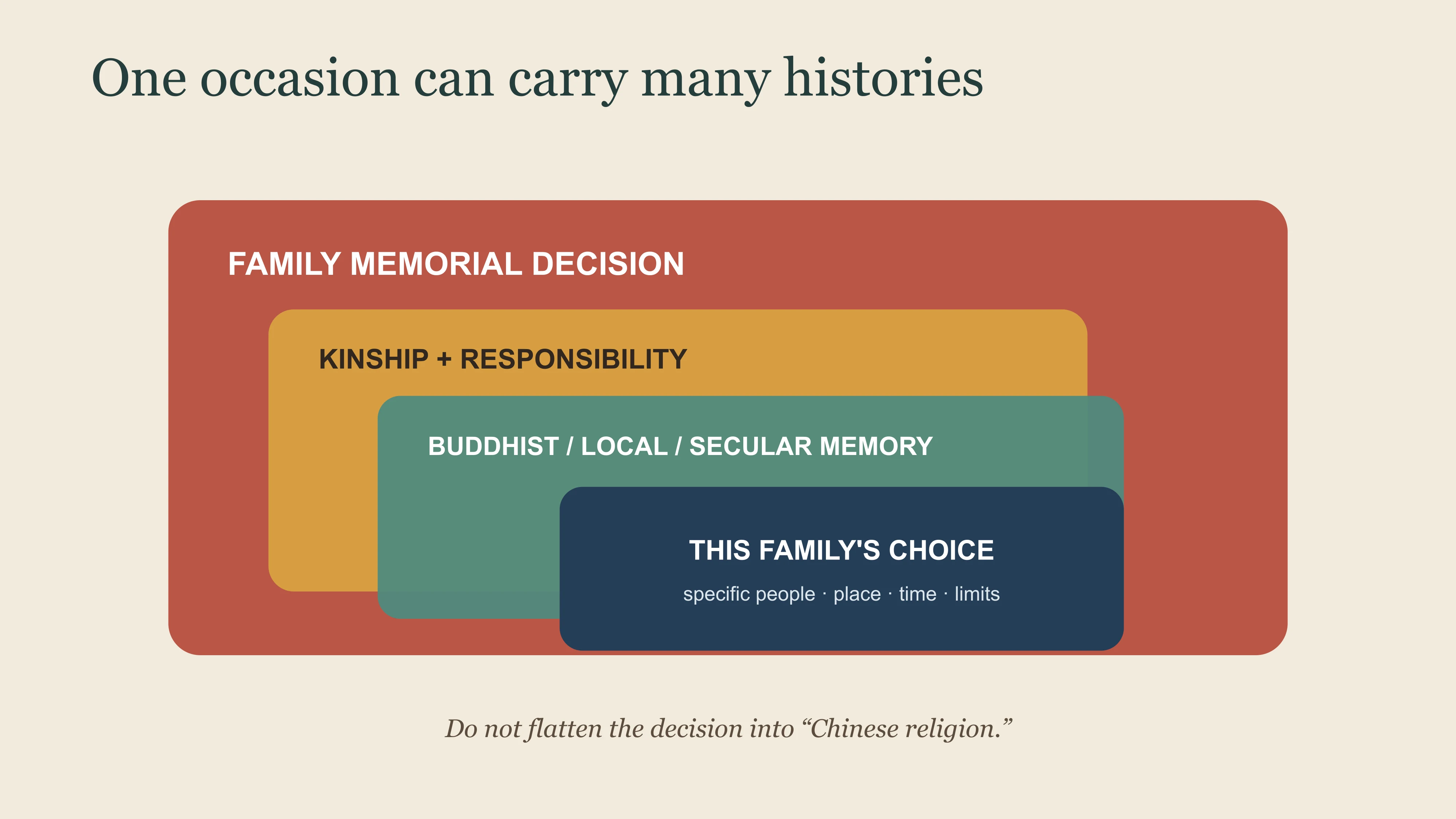
Values become visible in ordinary decisions, but no gesture proves a person's philosophy. Offering the best food to an elder might express affection, habit, hospitality, status or a family joke. A student staying late to prepare for an exam might be pursuing curiosity, responding to competition, honoring a parent's sacrifice, or trying to avoid an argument at home. A relative who calls often may be practicing care; another who lives far away may be doing the same through money, translation, digital help or frequent messages.
Several themes recur in discussions of Chinese cultural values:
- Relationship and responsibility. Kinship, friendship, teaching and work can be understood as roles with obligations, not merely private preferences.
- Learning and self-cultivation. Study can be valued as moral practice, social mobility, family pride, anxiety, pleasure or all of these at once.
- Ritual and appropriate conduct. Formal rites and small gestures can create a structure for gratitude, grief, welcome and respect. They can also feel empty or coercive when detached from care.
- Harmony and restraint. Avoiding public embarrassment can protect relationships, but it should not be romanticized as a universal preference for silence. People disagree, negotiate and speak up in many ways.
- Continuity and adaptation. A ritual may survive because someone changes its place, language, schedule or medium. Adaptation is not automatically loss.
None of these is exclusive to Chinese societies, and none belongs equally to every Chinese person. China contains many regional, linguistic, ethnic, religious and class histories. Diaspora communities add further layers of legal status, racialization, mixed households, language shift and distance from ancestral places. A responsible use of cultural vocabulary starts with that diversity rather than adding it as a disclaimer at the end.
Lived experience and community voices
I recognize these values most clearly when they create a difficult choice rather than a flattering slogan. Care for elders can be loving and exhausting. Ritual can make a relationship visible and still feel compulsory. Harmony can prevent needless humiliation and also postpone a necessary disagreement. My position is not that one side is “authentic,” but that a value becomes real only when we can see what it asks from a person and what room that person retains to answer differently.
Change, diaspora and global influence
Traditions do not move intact from one generation to the next. People translate them, abbreviate them, defend them, abandon them, rediscover them and argue about whether the revised version still counts. Urban housing may change the space available for a household altar. Work schedules may change a festival meal. Migration may replace a grave visit with a video call, a photograph or a different local cemetery. A family language may survive in fragments while a value such as care for elders remains intensely felt.
Diaspora makes these questions especially visible, but it does not create them from nothing. Families within China also negotiate regional migration, housing, education, religious change, divorce, disability, elder care and intergenerational disagreement. The idea that a tradition is "traditional" does not settle how it should be lived now.
There is a second risk: treating change as proof that a culture has disappeared. A red envelope sent digitally, a memorial held on a different date, or a child learning a kinship term in English may be a change in form rather than an absence of relation. The reverse is possible too: a highly visible ritual can become commercial, compulsory or disconnected from personal belief. Neither continuity nor change should be judged from the outside by how picturesque it looks.
Global interest has carried Chinese concepts far beyond Chinese-speaking communities. This can invite serious study, friendship and translation. It can also produce souvenirs of complexity: yin-yang as a vague logo, Daoism as a productivity trick, Confucianism as a defense of unquestioned authority, or Buddhism as a wellness aesthetic. A reader can slow this down by asking where a term comes from, whose interpretation is being used, and what history has been edited out to make it easy to sell.
How to engage respectfully
Start with the specific setting. A temple, cemetery, classroom, family dinner, museum gallery and public festival do not require the same behavior. Ask a host or organizer before taking photographs, joining an offering, touching an object or assuming that a practice is open to visitors. When language is unfamiliar, use the name a community uses for itself and ask for a correction rather than improvising a label.
Avoid turning a belief into a prediction. It is not respectful to tell someone what they must think about marriage, pregnancy, luck, death, gender or work because they are Chinese. The supporting keyword about pregnancy and birth is therefore not treated as a list of purported rules: choices around birth, care and family are personal, medical, religious and regional. This article makes no health or fortune-telling claims.
Read a primary text slowly, but do not assume a line has a single English meaning or that it dictates the life of a contemporary reader. Visit a museum or heritage site as a place with a particular history, not as a stage set for an imagined civilization. And when someone says a custom is not part of their life, believe them. Cultural respect includes room for refusal.
Follow the argument, not a list of traditions
This pillar introduces questions that need more room than one article can offer. Read Confucianism when the pressure concerns reciprocal duty and power; use Taoism when the question is force, naturalness, text and religious institution; examine yin and yang as a relational model rather than a personality label; and take family obligation to the sharper filial piety guide. The Chinese philosophy hub keeps those owners connected without pretending they are one creed.
The broadest lesson is simple: Chinese culture beliefs and traditions are best approached as living arguments about how to relate, remember, learn, change and care. They are not a single rulebook, and they do not belong only to the past.
Frequently asked questions
What do Chinese beliefs, values and philosophical traditions mean?
They describe several overlapping ethical, philosophical, religious and local practices rather than one national creed. Confucian, Daoist, Buddhist, ancestral and community traditions have interacted in different ways across time and place.
Where and when did these traditions develop?
Their roots and institutions developed across many centuries. Classical Confucian and Daoist texts, the spread and translation of Buddhism, local ritual practices, imperial institutions, migration and modern social change all shaped the field.
Do Chinese beliefs and values vary by region or community?
Yes. Language, locality, ethnicity, religion, migration, generation, family history and individual conviction can all change what a value or ritual means in practice.
Are these traditions still practiced today?
Many ideas remain visible in changing forms, including family responsibility, education, temple life, remembrance, festivals, ethical self-cultivation and debate about authority. Continuity does not mean uniform agreement.
How can overseas readers engage respectfully?
Use precise terms, learn the setting before joining a ritual, ask hosts rather than assuming a rule is universal, and treat a person's choice to adapt, question or decline a tradition as meaningful too.
What do Chinese beliefs, values and philosophical traditions mean?
They describe overlapping ethical, philosophical, religious and local practices rather than one national creed. Confucian, Daoist, Buddhist, ancestral and community traditions have interacted in different ways across time and place.
Where and when did these traditions develop?
Their roots and institutions developed across many centuries. Classical Confucian and Daoist texts, the spread and translation of Buddhism, local ritual practices, imperial institutions, migration and modern social change all shaped the field.
Does it vary by region or community?
Yes. Language, locality, ethnicity, religion, migration, generation, family history and individual conviction can all change what a value or ritual means in practice. A practice familiar in one household may be absent, transformed or contested in another.
Is it still practiced or used today?
Many ideas remain visible in changing forms, including family responsibility, education, temple life, remembrance, festivals, ethical self-cultivation and debate about authority. Continuity does not mean uniform agreement or automatic approval.
How can overseas readers engage respectfully?
Use precise terms, learn the setting before joining a ritual, ask hosts rather than assuming a rule is universal, and treat a person's choice to adapt, question or decline a tradition as meaningful too.