Yin and yang begin with a simple correction to the modern habit of choosing sides: two qualities can differ without becoming enemies. Shade and sunlight belong to the same courtyard. Rest prepares action. Winter is not a failed summer.
What do yin and yang mean?
Yin and yang are complementary, interdependent and changing qualities used in Chinese thought to understand relationships and processes. Yin is often associated with shade, inwardness, rest, coolness, receptivity and night. Yang is often associated with light, outward activity, warmth, assertion and day.
The associations are not fixed substances. They describe a comparison. The shaded side of a mountain is yin relative to the sunny side. At another hour, the relationship changes. Warm water may be yang compared with ice and yin compared with boiling steam.
This relativity is the heart of the idea. A thing does not carry a permanent yin or yang passport. Context decides what the comparison reveals.
Yin and yang at a glance
| Yin associations | Yang associations | What the pair helps us notice |
|---|---|---|
| Shade | Sunlight | Position and changing illumination |
| Night | Day | Cycles rather than permanent states |
| Rest | Activity | Recovery and expenditure |
| Inward | Outward | Direction of attention or movement |
| Cool | Warm | Relative temperature |
| Receptive | Assertive | Different roles within interaction |
| Valley | Mountain height | Relational position in a landscape |
These are traditional correlations, not instructions for ranking one side above the other. Shade can protect life; too much shade can prevent growth. Activity can create; endless activity can exhaust. Value depends on relationship, degree and moment.
Yin and yang are not good and evil
The black-and-white image is often interpreted through a Western moral binary: white is good, black is evil. That reading misses the Chinese framework.
Yin and yang are both necessary. The issue is not defeating one side but understanding transformation, proportion and timing. Excessive heat can be harmful; so can excessive cold. Constant speech can overwhelm a relationship; permanent silence can abandon it.
Balance also does not mean a frozen fifty-fifty split. A sleeping household at midnight and a market at noon require different proportions. Living balance moves.
The taijitu symbol came after the ideas
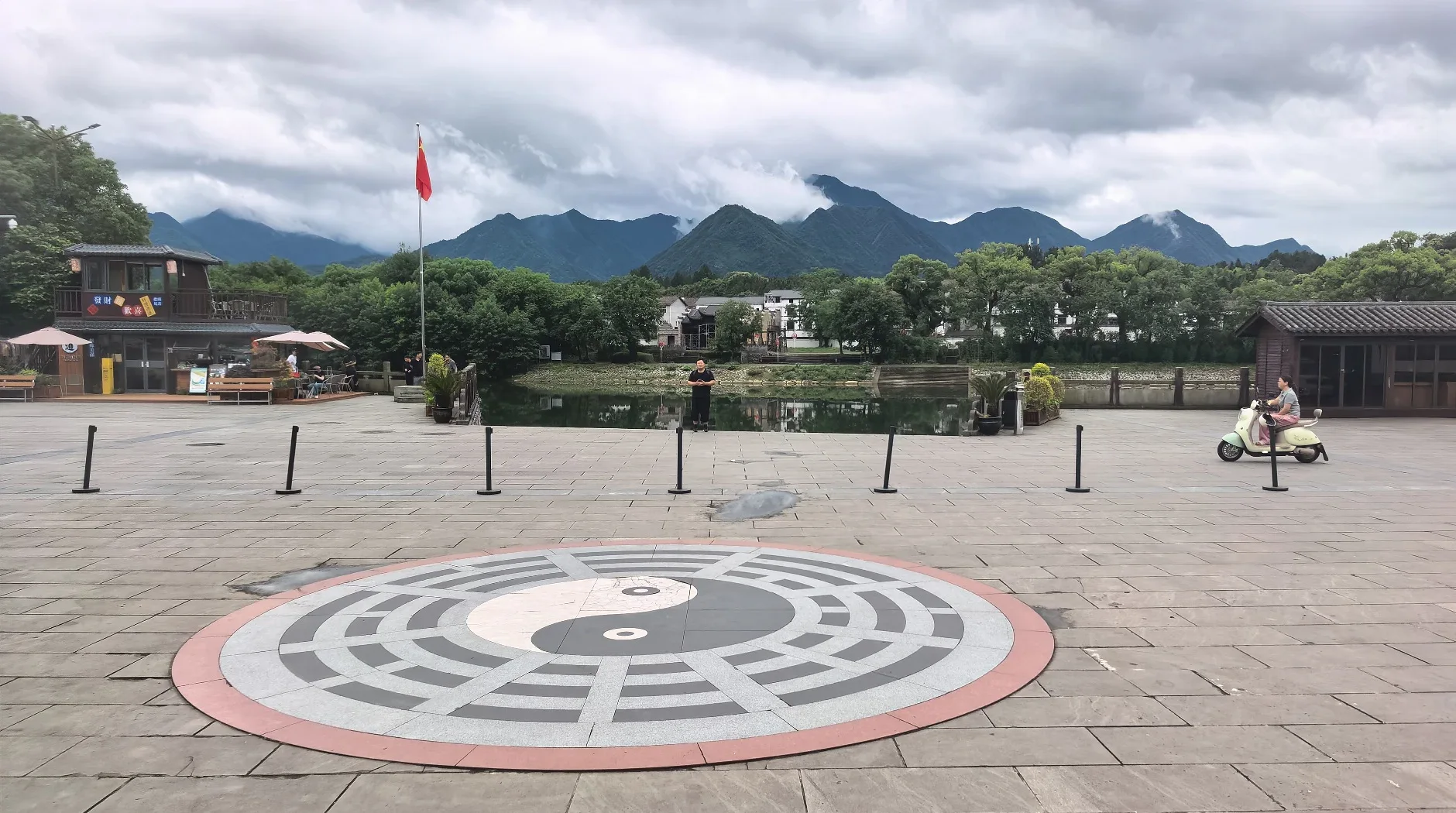
A taijitu in a real forecourt is not a floating app icon. Weather, approach, architecture and the moving bodies around it give the diagram scale and consequence.
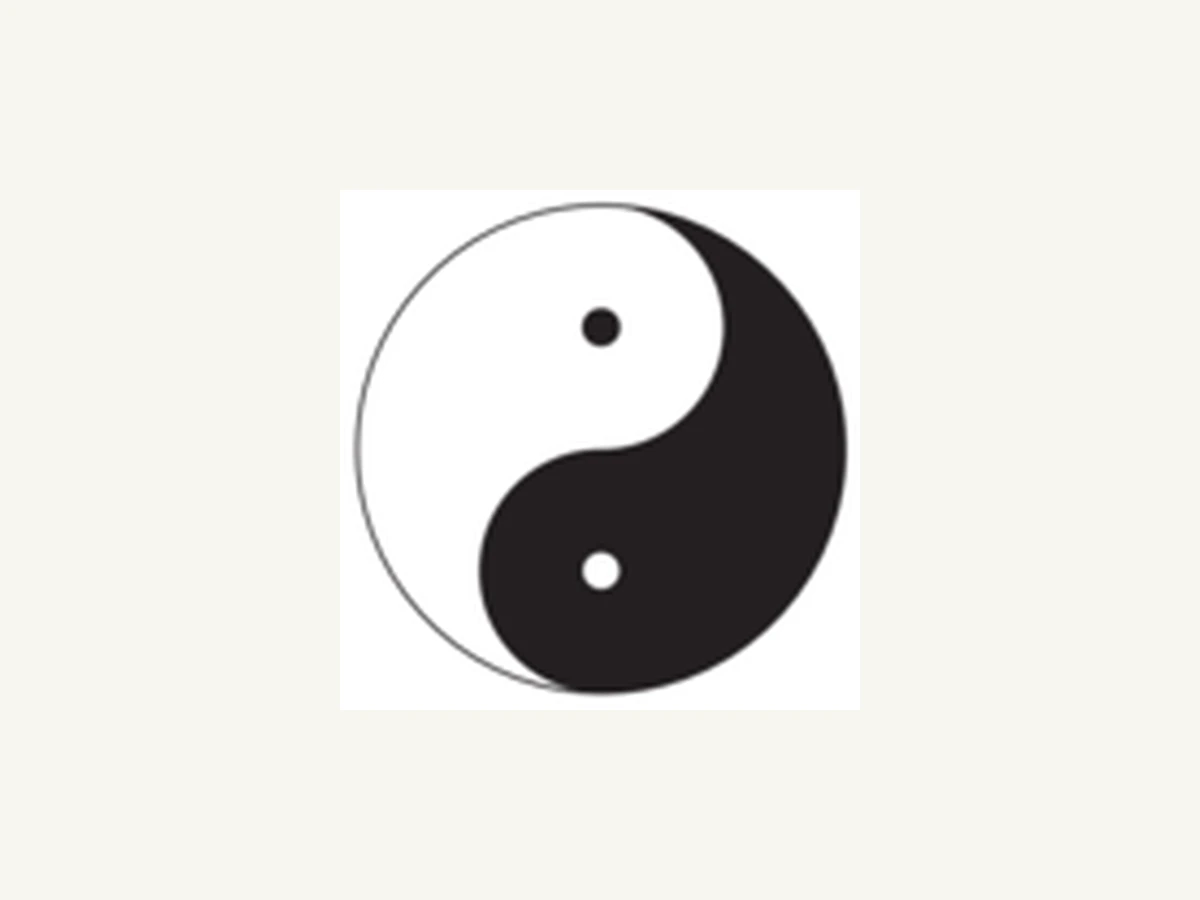
The familiar circular diagram of black and white is commonly called a taijitu (\u592a\u6781\u56fe). Its curved halves suggest movement, while the contrasting dots show that each side contains the possibility or presence of the other.
The modern standard symbol is much later than the earliest yin-yang concepts. Ancient Chinese texts used the terms and their relationships long before this particular graphic became globally recognizable.
That history matters because the symbol can make an old, diverse intellectual tradition look like one timeless logo. The image is useful. It should remain an entrance rather than the whole explanation.
Standing before a floor-sized taijitu changes the first question. I do not begin with “which half am I?” I notice that no visitor can take in the whole figure while standing inside it. You have to move, step back or look from another height. That physical inconvenience expresses the concept better than most personality quizzes: position limits what you see, and a relation becomes legible only when you stop pretending your own square of ground is the entire pattern.
The photograph proves the diagram is used in a contemporary Daoist-site setting. It does not prove every teaching attributed to it online, and it certainly does not verify health, fate or “energy” claims. A strong image narrows the claim; it does not grant permission to say anything mystical beside it.
A brief history of yin-yang thought
The words originally related to environmental conditions such as the shaded and sunny sides of a place. Across early Chinese thought, yin and yang developed into a broader vocabulary for patterned change.
Texts associated with the Yijing, or Book of Changes, explore transformation through broken and unbroken lines later interpreted through yin and yang. Thinkers during the late Zhou and Han periods connected the pair with seasons, government, the body, ritual and the cosmos.
Later Confucian, Daoist and other traditions developed different metaphysical accounts. There was no single committee issuing one final definition. Chinese philosophy grew through argument, commentary and recombination.
The Stanford Encyclopedia of Philosophy's Chinese metaphysics entry is valuable here because it places yin-yang inside changing philosophical systems rather than treating the black-and-white icon as a complete doctrine. I insist on that history: “ancient wisdom” becomes an excuse for invention when no text, thinker or period has to be named.
Yin and yang and the Five Phases
Yin-yang theory is often paired with the Five Phases: wood, fire, earth, metal and water. The phases describe patterns or processes of generation and control rather than five static chemical elements.
The two systems are related but not identical. Yin and yang emphasize paired relationship and alternation. The Five Phases offer a five-part model of process and correspondence. Historical thinkers combined them in cosmology, governance, music, calendars and other fields.
Online summaries sometimes turn the combination into a universal chart explaining everything from personality to furniture. Historical influence does not make every modern application equally well supported.
A four-question test for any yin-yang claim
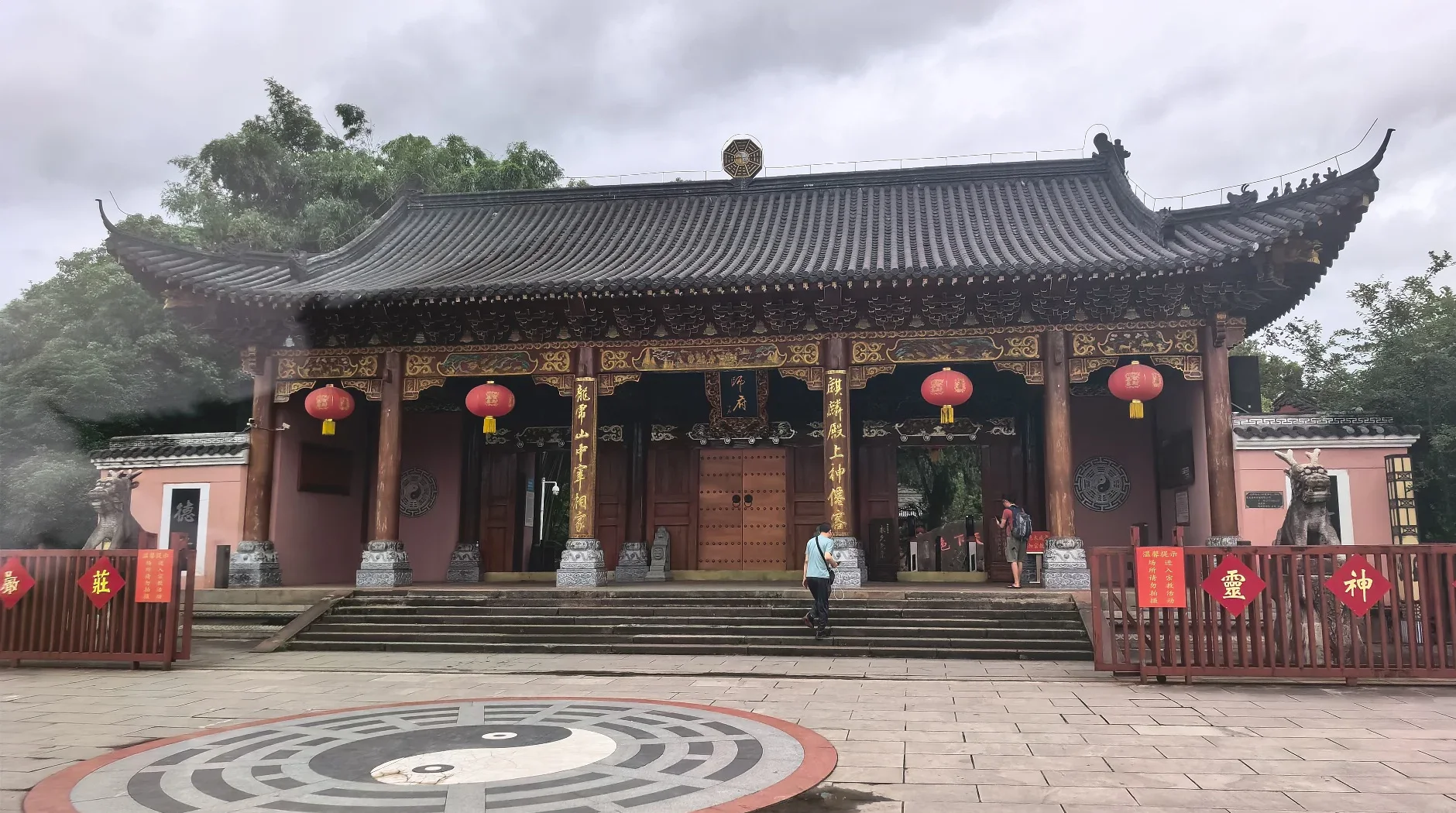
At a threshold the diagram is encountered through movement: approach, cross, turn and leave. That lived sequence is closer to yin-yang than a frozen label.
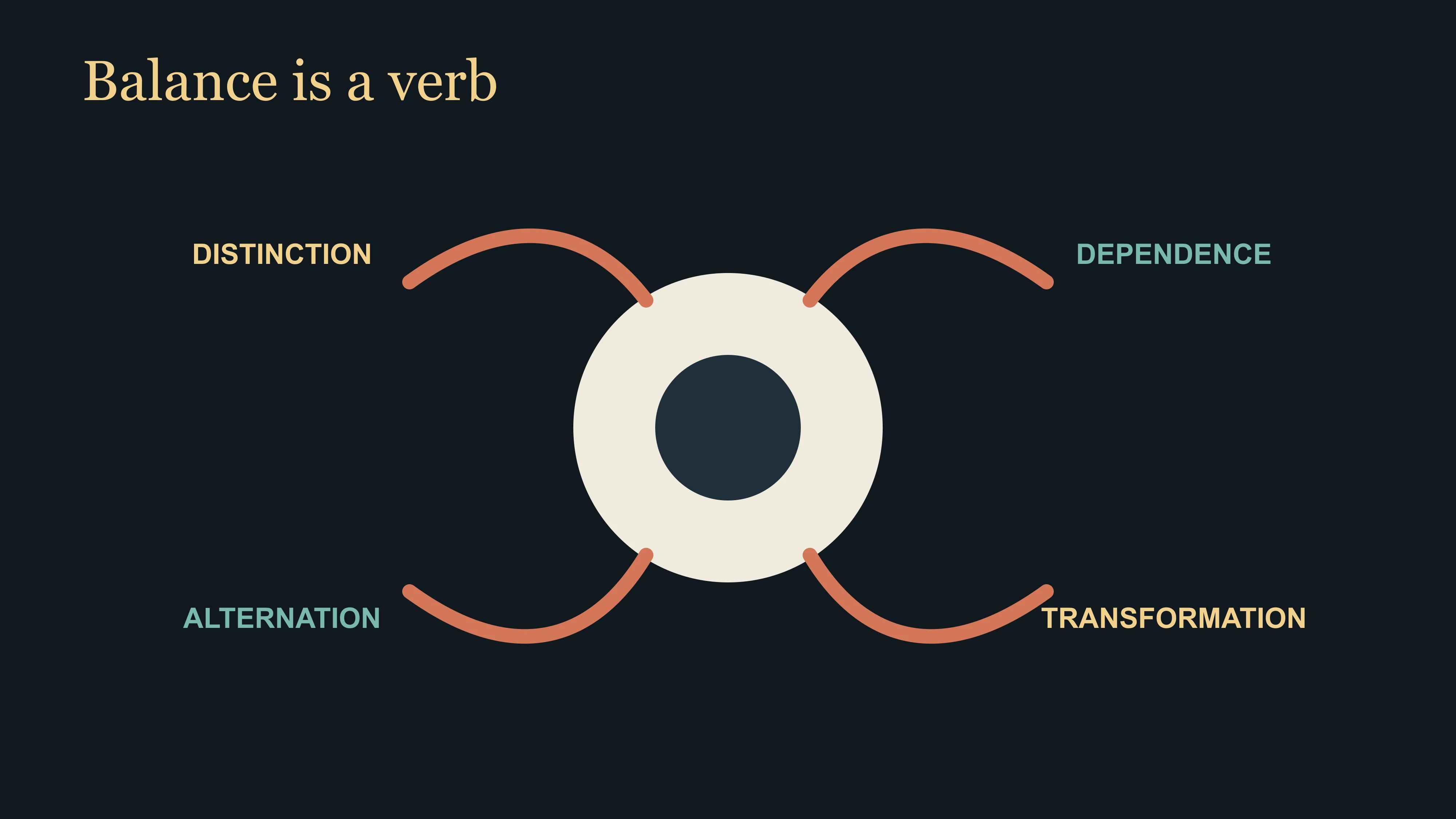
The quickest way to rescue yin and yang from vague “energy” language is to ask four concrete questions.
First, what is the relationship? Hot and cold, movement and rest, exposure and shelter can be compared. “This person is yin” is much less useful because it turns a relational quality into a permanent identity badge.
Second, what is the scale? A dark room may be yin relative to the street, while its bright desk lamp is yang relative to the rest of the room. Change the frame and the description changes. This is not a loophole; it is how relational thinking works.
Third, what is the moment? Dawn, summer growth, physical recovery and a conversation all move through phases. A useful reading notices timing instead of demanding one ideal ratio forever.
Fourth, what transforms? Night becomes morning. Effort becomes fatigue, then rest makes new effort possible. If a yin-yang explanation cannot describe movement, it has reduced the idea to a decorative pair of labels.
The threshold photograph gives these questions somewhere to land. The two halves are visibly distinct; neither can make the circle alone. Their position depends on the shared boundary. A person approaching the hall changes viewpoint with every step. The image does not “prove philosophy,” but it gives the reader an honest observational exercise instead of another vague promise about balance.
This test does not prove that every traditional claim is true. It does something more modest and valuable: it clarifies what the claim is actually saying before we agree, reject or commercialize it.
Balance is not politeness toward every extreme
The word balance has become soft. It is often used to avoid judgment: put cruelty and kindness on two sides, call them complementary, and congratulate yourself for nuance. That is not yin-yang thinking. It is moral laziness wearing a circle.
Yin and yang classify relational qualities; they do not abolish ethical judgment. Harm does not become necessary because a diagram contains two colors. A violent action can be condemned while its timing, conditions and consequences are still analyzed. Good and evil answer a different question from shade and light.
I insist on this boundary because the symbol is too beautiful and too easy to misuse. Complementarity does not mean every opposition should be preserved. Transformation does not mean every outcome is acceptable. A framework for change cannot replace responsibility for what the change does to people.
The Internet Encyclopedia of Philosophy's yin-yang entry is valuable because it follows the concept through philosophical history rather than treating the modern taijitu as a self-explanatory wellness logo.
A relationship can change category without changing substance
Consider water. The same cup can be warm relative to ice and cool relative to steam. Nothing mystical happened to the liquid; the comparison changed. Now add time: water that cools through evening moves along another relation. Add use: cool water may refresh after heat but feel harsh in a cold room.
This is the intelligence of yin-yang language. It makes the observer name frame, moment and process. It punishes fixed labels.
That is why “yin person” and “yang person” are usually dead ends. A person can listen in one conversation, lead in another, withdraw under pressure and become active when responsibility arrives. The useful question is what role, relation and moment make a quality visible—not which cosmic type owns the person forever.
Is yin and yang Taoist?
Yin and yang are central to many forms of Taoism, especially ideas about natural transformation, non-coercive action and the mutual arising of opposites. The concepts are not exclusively Taoist.
They appear across Chinese cosmology, Confucian thought, divination, state theory, martial arts, medical traditions, feng shui and popular culture. Calling the taijitu simply “the Taoist symbol” hides this wider history.
Taoism itself also contains far more than one diagram: texts, temples, deities, rituals, lineages, meditation and community practice.
Everyday examples without turning life into a chart
Yin-yang reasoning can make ordinary relationships easier to notice. A room needs enclosure and opening. A conversation needs speaking and listening. Work depends on recovery. A garden places rock beside water and built shelter beside changing weather.
When I enter a courtyard after a bright street, the shade feels quiet because the street was bright. The sensation is relational. Yin-yang language gives that relationship a cultural vocabulary.
The framework is most useful when it sharpens observation. It becomes less useful when every preference receives a cosmic diagnosis.
That boundary matters online. A black outfit is not automatically “yin fashion,” a loud song is not pure yang, and a personality quiz cannot convert a fluid cosmological vocabulary into two stable consumer types. Those versions feel easy because they remove context. They also remove most of the intelligence from the concept.

The garden does not divide itself into a good side and a bad side. Rock, water, shade, opening and enclosure work through relationship. That movement is closer to yin-yang than any frozen personality chart.
Food, wellbeing and the limit of the claim
Chinese households may describe foods, seasons or bodily feelings through warming, cooling, yin or yang language. These categories belong to living cultural practice and to historical medical systems.
They should not be presented as nutritional chemistry or a guaranteed treatment. A person can document why a family drinks a particular soup in winter without claiming the soup cures disease. Cultural familiarity is evidence that a practice exists, not proof of a medical outcome.
For health decisions, allergies, pregnancy, medication interactions or persistent symptoms, qualified professional guidance remains necessary.
Gender associations need careful handling
Traditional correlations sometimes associate yin with female and yang with male. These pairings have influenced philosophy, family ideology and social roles. They do not prove that every woman is naturally passive or every man naturally active.
Yin and yang are relational qualities found within people, environments and processes. Converting historical correlations into fixed gender destiny erases the flexibility of the concepts and can reinforce hierarchy as though it were a law of nature.
Responsible interpretation states the historical association and refuses to make it a modern biological command.
How to use the symbol respectfully
Learn its name and history before using it as decoration. Avoid presenting the black side as evil or the white side as morally pure. Do not attach invented Chinese characters or promise that a product will “balance energy” without explaining what that claim means.
In design, the symbol is globally familiar and legally easy to reproduce in many forms. Cultural respect still asks for context. Recognition is not the same as understanding.
Balance is a verb
Yin and yang endure because they describe a world that will not stay still. Light moves across a wall. Strength needs recovery. One voice speaks while another listens, then the roles reverse.
The idea does not promise perfect harmony. It asks us to notice relationship before declaring victory for one side.
My rule is blunt: if an explanation cannot show what is changing, what the two terms are relative to, and under which conditions they can reverse, it is decoration—not a serious use of yin and yang.
Continue with the broader Chinese Philosophy guide, explore Taoism as a distinct tradition or see how relational space appears in Feng Shui.