Feng shui begins with a generous suspicion: a place is already speaking before we decorate it. The hill redirects wind. Water gathers and leaves. Morning light reaches one room but not another. A door turns arrival into a decision. Human life is never floating alone; it is always placed.
What is feng shui?
Feng shui (风水), literally “wind and water,” is a family of Chinese traditions for evaluating relationships among environment, orientation, time, buildings, burial sites and human activity. It developed through multiple schools and historical periods rather than one unchanging rulebook.
International popular culture often reduces feng shui to furniture placement and lucky objects. Those practices exist, but the tradition's older scope is larger: mountains, waterways, settlement patterns, compass directions, graves, gates, courtyards and the timing of construction.
Encyclopaedia Britannica's overview confirms the tradition's concern with the siting of buildings and graves in relation to local flows of qi. It is a useful historical orientation, not proof that one modern consultant's rule is universal.
Feng shui is not one doctrine with a customer-service manual. Texts, specialists, regional lineages and household practices have disagreed over methods. A rule that appears absolute in one popular guide may belong to one school, a recent commercial system or an internet sentence that lost its source several reposts ago.
When I enter an old courtyard, my body usually reads the place before my vocabulary does. I slow at the threshold, look toward the open sky and feel how walls hold quiet away from the street. That response does not prove a cosmological claim. It does show why spatial traditions cannot be understood as diagrams alone: people encounter them with feet, skin, memory and habit.
Feng shui at a glance
| Concept | Cultural meaning | Responsible modern reading |
|---|---|---|
| Qi | Vital influence, breath or patterned energy | A traditional cosmological concept, not a laboratory measurement |
| Yin and yang | Relational qualities such as shade/light, rest/activity | A way of thinking through dynamic balance, not fixed opposites |
| Five phases | Wood, fire, earth, metal and water as cycles of change | A correlative system, not five chemical elements |
| Landform | Hills, ridges, watercourses and protective forms | Environmental observation interpreted through tradition |
| Direction | Orientation assessed through compass and cosmology | Can intersect with sunlight and climate but includes symbolic systems |
| Luopan | Specialized feng shui compass | A historical instrument requiring trained interpretation |
These ideas work as a network. Direction is interpreted through time; landform affects how qi is described as gathering or dispersing; yin and yang are read relationally rather than assigned once forever. A shaded room is not metaphysically "bad." Its meaning depends on climate, use, season and the life taking place inside it. The Stanford Encyclopedia of Philosophy's account of Chinese metaphysics is useful here because it treats correlative ideas as relationships and processes rather than a box of isolated supernatural objects.
The responsible boundary is equally important. Traditional cosmological concepts are not measurements recognized by contemporary physics. Practical observations about sun, wind, drainage, access and comfort can be tested separately. Respect does not require blending belief, design and science until none of them remains clear.
Landscape came before the living-room checklist

Historical feng shui examined where a settlement or tomb sat within a larger terrain. A protected site with water nearby could carry practical benefits while also fitting cosmological ideas about qi gathering rather than dispersing.
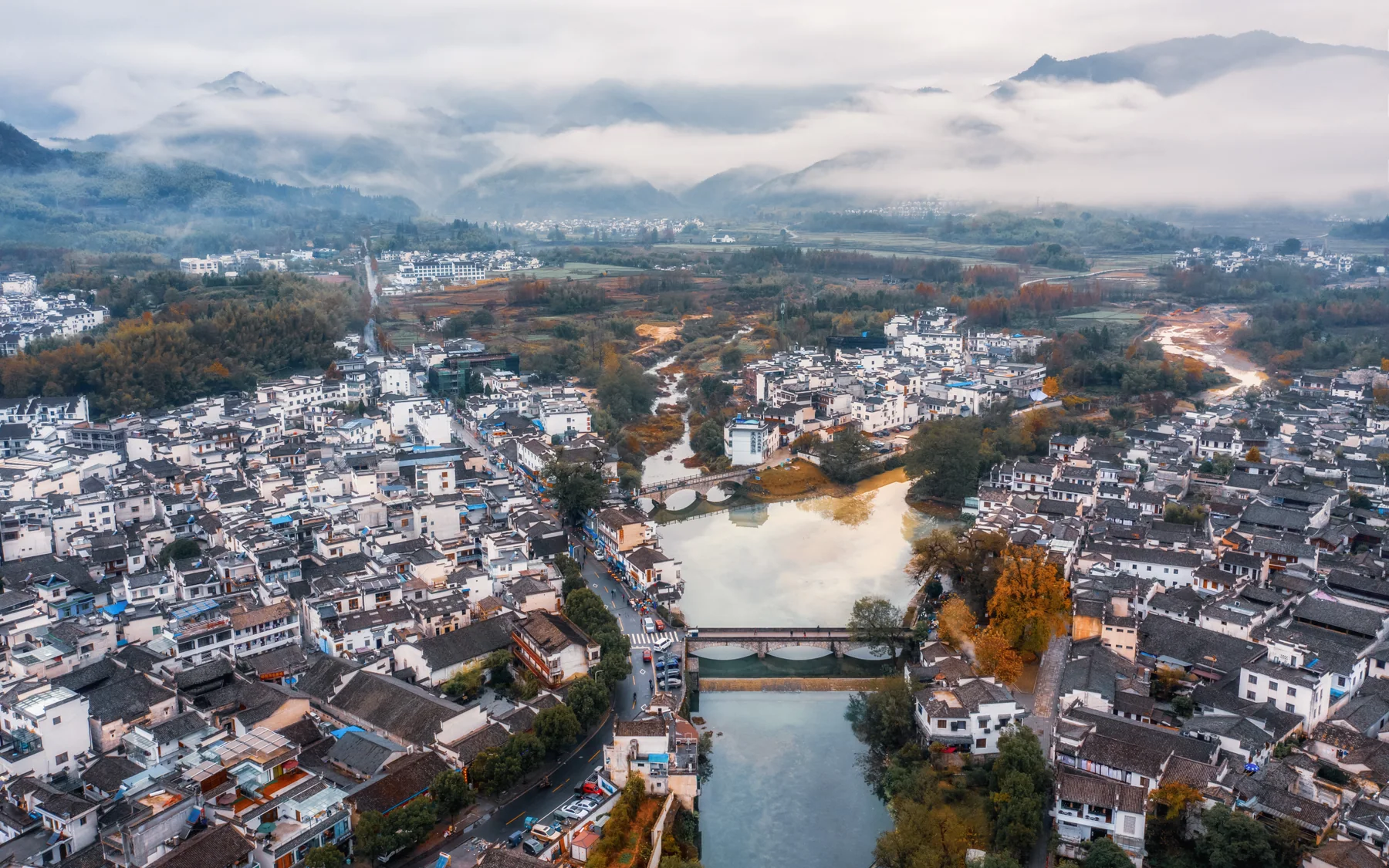
The UNESCO record for Xidi and Hongcun describes Hongcun at the foot of a hill, beside a stream feeding two pools, within a settlement whose houses and water system remain integrated. That documented relationship does not prove every later feng shui story attached to the village. It does prove why flattening feng shui into a lucky-corner chart is absurd: the meaningful unit can be an entire inhabited landscape.
Imagine approaching a village before looking at any room. Which direction does the valley open? Where does rainwater travel? What blocks winter wind? Which slope receives sun? How do paths connect fields, homes and water? Feng shui interpretation placed human decisions inside that larger field rather than beginning with a decorative object on a desk.
Burial sites also mattered because relationships with ancestors extended beyond the living household. Siting a grave could become a family, ritual and landscape decision at once. Reducing feng shui to personal productivity therefore removes one of its most consequential historical dimensions.
No curved hill automatically proves the hand of a feng shui master. Architecture also responds to climate, defense, agriculture, wealth, regulations and available materials. Cultural interpretation becomes stronger when it makes room for several causes.
Feng shui and Chinese architecture
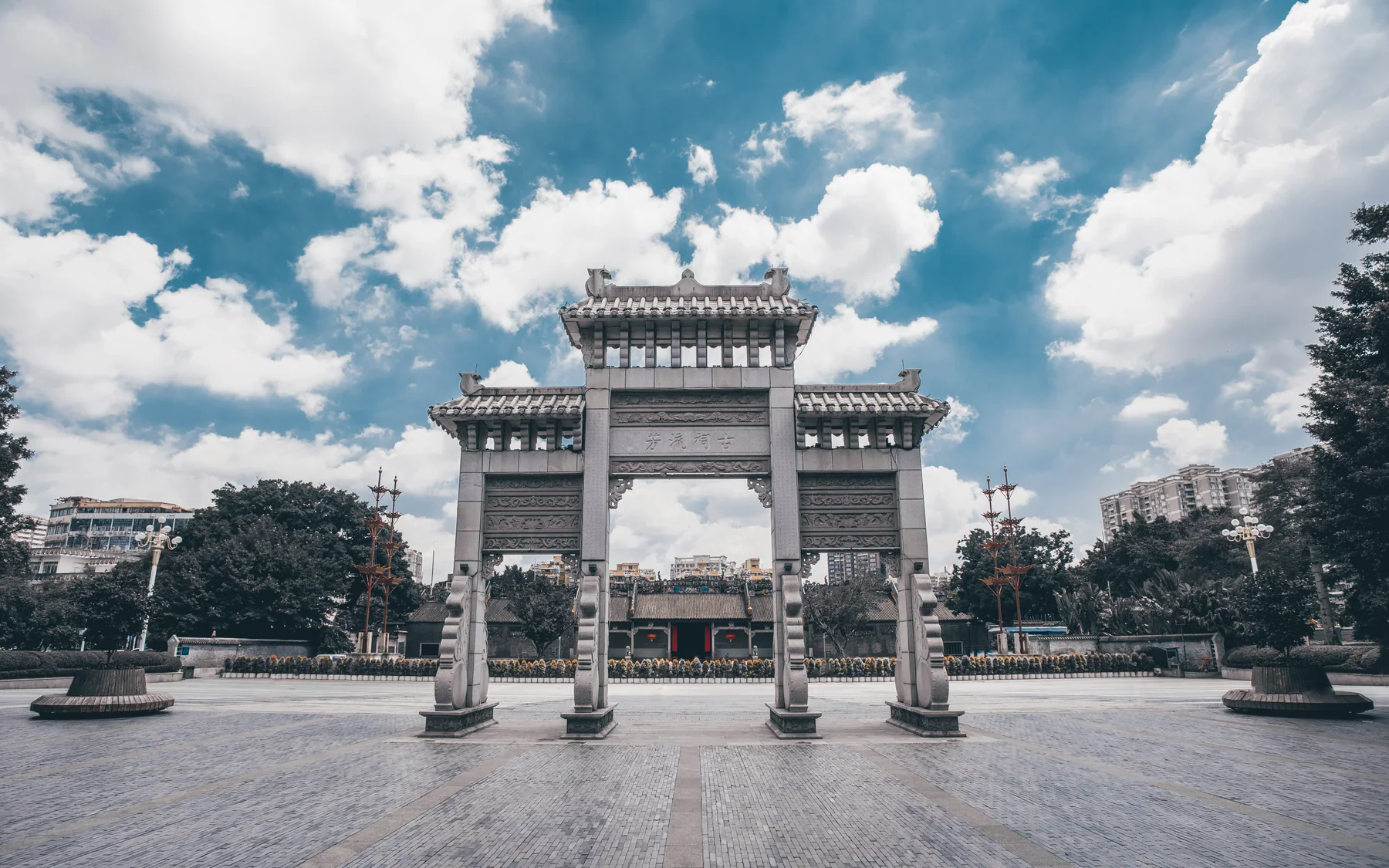
Orientation, hierarchy and sequence are central to Chinese architecture. Courtyard houses organize public and private life through gates, axes, rooms and open space. Imperial complexes use alignment to express political order. Gardens use paths, framed views, water and borrowed scenery to control how a visitor encounters space.
Feng shui may participate in these decisions, but it should not become a magic explanation for every feature.
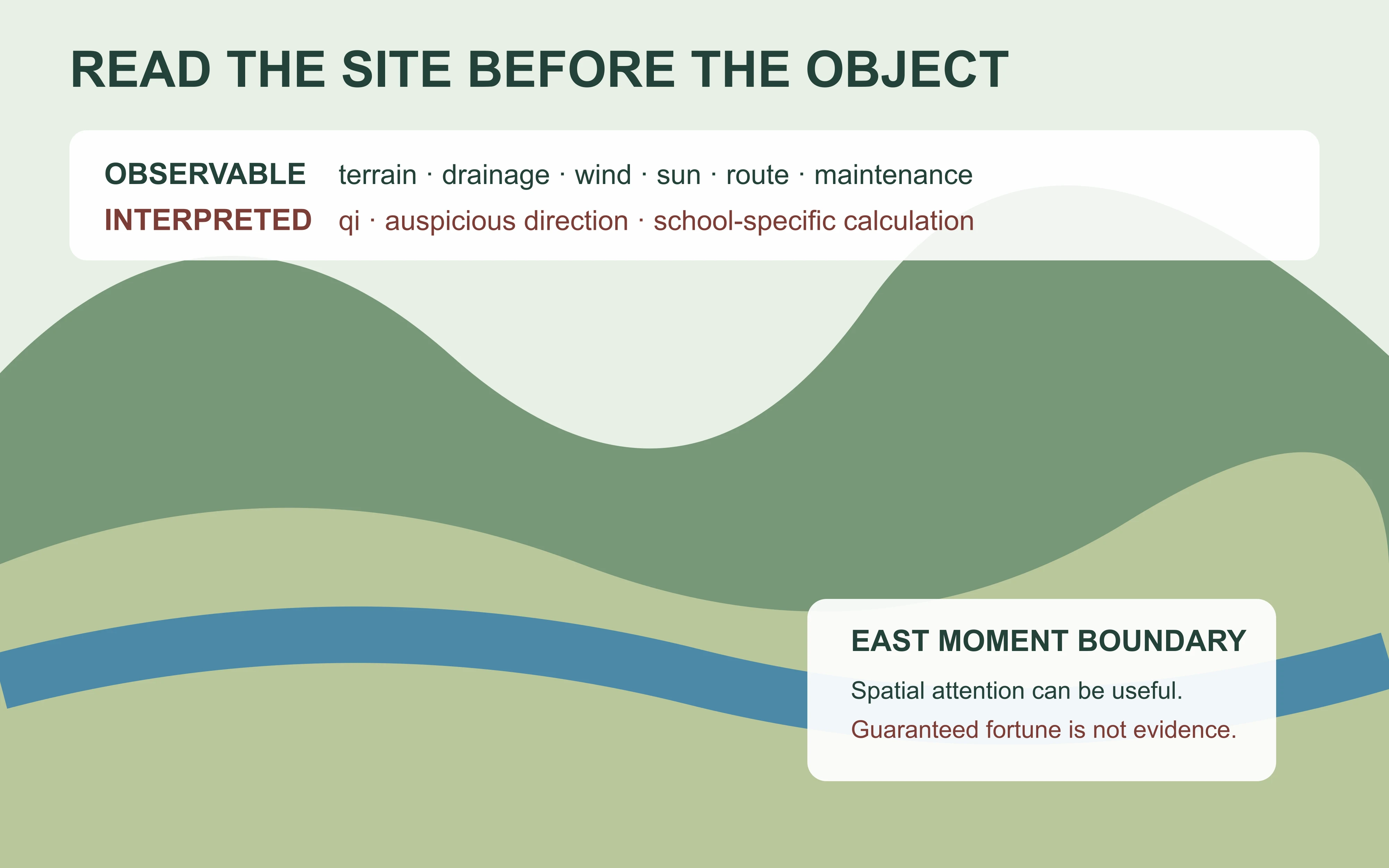
Ask precise questions: Who chose the site? What texts or instruments were used? Was the explanation recorded at the time, remembered locally or added later for tourism?
Major approaches within feng shui
Broad introductions often distinguish a landform-oriented approach, attentive to mountains and water, from compass-based traditions that calculate directions and time through a luopan. In practice, lineages, terminology and methods are more complex than a two-box summary.
That complexity matters because online advice frequently combines unrelated formulas. A “universal feng shui rule” may be a recent commercial simplification, one school's method or pure invention.
The common English labels "form school" and "compass school" are useful orientation, not perfect historical boxes. Landform analysis can include directional ideas; compass traditions still encounter actual terrain. Skilled practice involves interpretation, and interpretation is precisely what a one-screen checklist removes.
A luopan is more than a magnetic arrow with decorative rings. Its markings organize layers of directional and cosmological information for trained use. A phone compass can reproduce orientation. It cannot automatically reproduce the lineage, calculations or judgment through which a practitioner reads that orientation.
Feng shui in gardens and interiors
Chinese gardens choreograph concealment and revelation. A wall blocks the whole view; a moon gate frames part of it; a path turns; water reflects a building that cannot yet be reached. These effects can align with broader Chinese ideas about balance and relational space without every stone requiring a fortune claim.

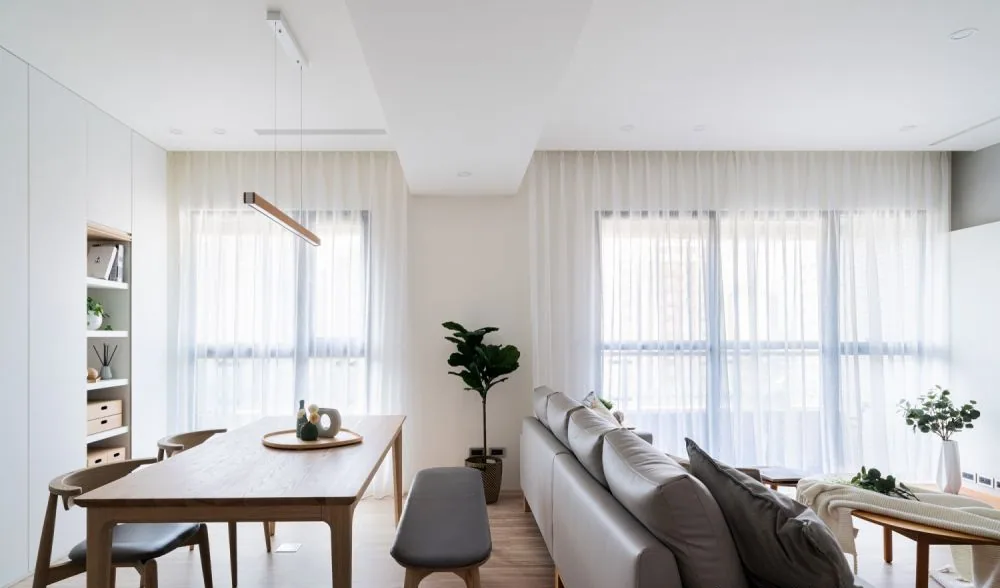
Modern interior feng shui can also encourage attention to light, movement, clutter and the emotional character of a room. Those observations may be useful as design reflection. Claims that an object guarantees wealth, health or romance should be treated as belief or marketing, not fact.
For readers trying to apply those distinctions to a real apartment, the feng shui home guide follows the entrance, sightline, route, seat and changing daylight before recommending any symbolic object.
Why global feng shui became object-based
Landform, burial practice and classical calculation are difficult to package for a renter scrolling at midnight. A mirror, plant, crystal or color chart is easier to photograph, buy and move. Modern publishing, retail, consulting and social media therefore reward advice that turns a large spatial tradition into portable objects.
This does not mean every modern interior practice is fake. Living traditions change, and apartment life asks different questions from village siting. The problem begins when a recent product rule is presented as timeless Chinese consensus.
Short-form video intensifies the effect. A creator can point to a corner, name a danger and promise a fix before the viewer has time to ask about building orientation, climate, household needs or the school being used. Certainty performs well on a small screen. Context does not.
The best modern use keeps the layers visible: this is a traditional belief; this is one practitioner's method; this is an ordinary design observation; this is a commercial object. They may coexist without impersonating one another.
A single room photograph cannot prove good feng shui
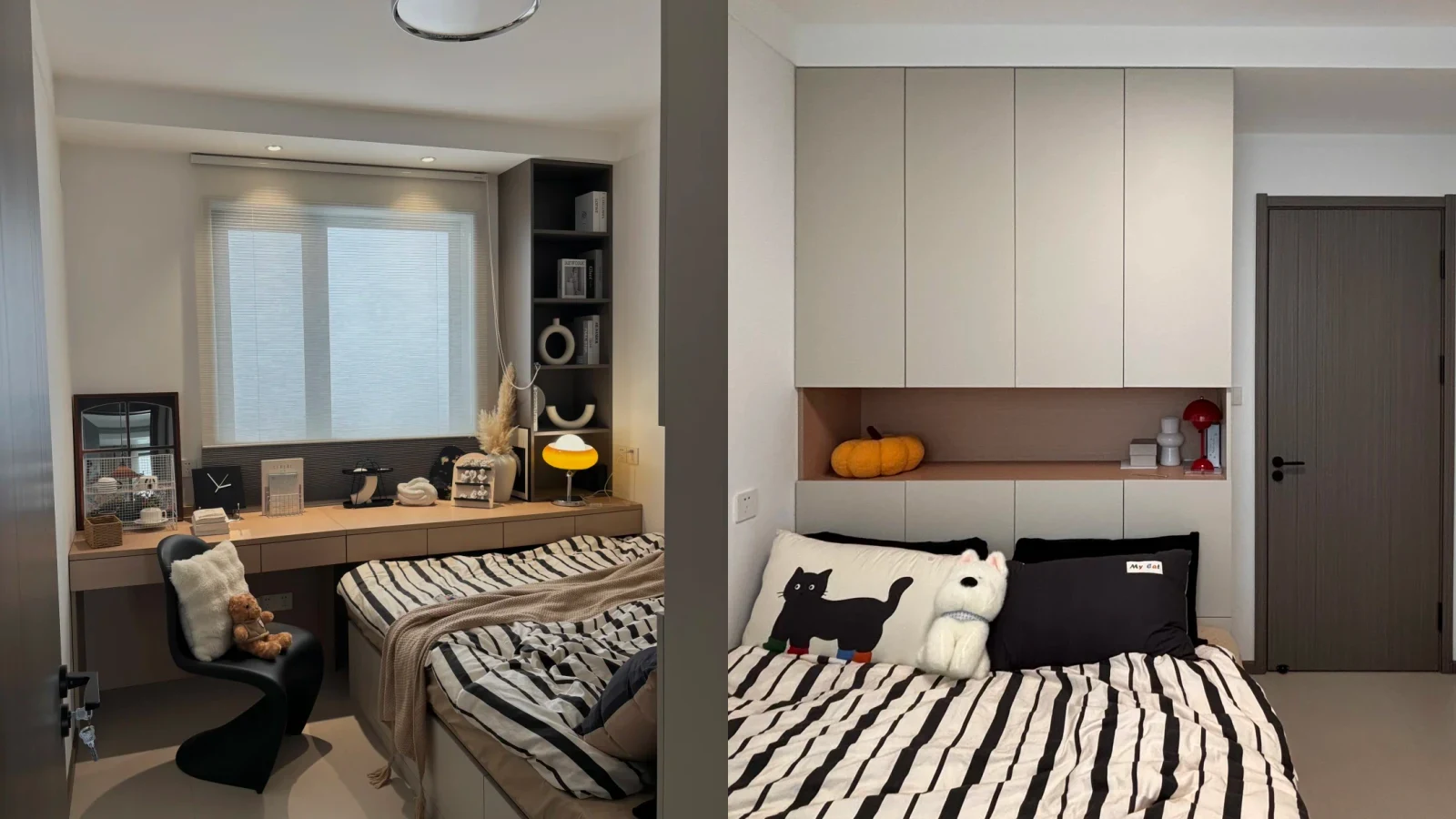
I understand why people want an answer from one photograph. A bed faces a door, a mirror catches the window, and the comments fill with certainty. But the photograph has already removed most of the place. It does not show the hour when direct sun enters, the noise behind the photographer, the route from kitchen to bathroom, the winter draft, the resident's height, or whether the beautiful chair blocks a person who uses a walking aid.
That missing information is not a technical footnote. It is the site.
Before moving anything, I would ask the resident to walk the ordinary route: enter with bags, put down keys, open curtains, sit, cook, wake at night and leave in a hurry. The sequence exposes friction that a styled image hides. A bed may look commandingly placed yet receive street light all night. A screen may produce a calm photograph while making the entrance too narrow. A plant described as “wood energy” may simply be struggling in a dark corner.
This is where I become deliberately unsentimental. If advice ignores sleep, fire escape, humidity, disability, children, pets and maintenance labor, it has failed before luck enters the conversation. Feng shui deserves better than supernatural interior shopping. Its strongest modern question is tougher: what relationship between body, route, weather and place are we repeatedly creating here?
Return to the same room at another hour. Open the windows. Listen from the bed. Follow rainwater outside. The second visit often destroys the confidence of the first photograph, and that is progress.
Read a place in five passes

You do not need to claim professional feng shui expertise to look at space more carefully. Begin with five passes:
- Terrain: Notice hills, open ground, neighboring buildings and what protects or exposes the site.
- Water and weather: Follow drainage, humidity, wind, shade and seasonal sunlight.
- Orientation: See where doors, windows and main rooms face, then ask how that affects actual use.
- Thresholds and movement: Walk from public to private space. Notice gates, turns, pauses, bottlenecks and framed views.
- Lived reality: Ask who uses the place, whose labor maintains it and whether the arrangement supports safety, access and daily life.
This is not a do-it-yourself divination method. It is a way to resist looking at architecture as a flat photograph. A building is terrain, climate, sequence, memory and use happening together.
Compare this approach with Chinese gardens, where paths and framed views deliberately slow perception, and with yin and yang, where relational change matters more than frozen opposites.
What feng shui can and cannot promise
Feng shui can offer a cultural vocabulary for discussing placement, direction, balance, timing and the relationship between people and environment. It can help explain why a family, architect, client or community values a particular orientation. It can also make someone pay closer attention to a room they had stopped seeing.
It cannot guarantee wealth, cure illness, replace engineering or prove that one furniture arrangement caused a future event. When a commercial claim becomes more precise than its evidence, skepticism is not disrespect. It is maintenance.
Digital tools deserve the same boundary. Compass apps, floor-plan software and augmented-reality overlays can measure and visualize space. They may assist a practitioner or curious homeowner, but an interface does not turn a disputed tradition into automated certainty. Technology can calculate faster than people. It cannot decide which assumptions deserve trust.
How to approach feng shui respectfully
Learn the tradition before extracting a life hack. Distinguish historical practice, living belief, professional consultation, symbolic decoration and evidence-based architecture. Avoid using Chinese characters or compasses as exotic visual props without understanding them.
If a feng shui recommendation conflicts with fire safety, structural engineering, accessibility or medical care, practical professional guidance must come first.
Respect also means asking who is speaking. A museum, lineage holder, architect, family elder, commercial consultant and lifestyle creator may all use the term feng shui differently. Name the context instead of forcing them into one authority ladder.
Frequently asked questions about feng shui
What is feng shui?
Feng shui is a Chinese tradition for interpreting and arranging relationships among landscape, orientation, buildings, time and human activity. Historical schools used different methods, texts and instruments.
What does feng shui mean in English?
Feng means wind and shui means water. The phrase points toward environmental forces and the movement or gathering of qi rather than a literal decorating formula.
Is feng shui a religion?
Feng shui is not one organized religion. It has interacted with Chinese cosmology, ritual, ancestor practice, Daoist thought, divination and everyday custom, but its practitioners and uses have varied.
Is feng shui scientifically proven?
Traditional cosmological claims should not be presented as established physical science. Some practical observations about light, ventilation, circulation, terrain and comfort can be evaluated independently, while symbolic claims belong to cultural or personal belief.
Does feng shui mean putting objects in lucky corners?
That is a modern popular simplification. Historical feng shui paid substantial attention to landform, water, direction, graves, settlements, buildings, time and measurement, not only interior objects.
A place is more than an empty container
Feng shui's most enduring insight may be cultural rather than supernatural: human life is relational. We change a room, and the room changes our movement. We build near water, and water gives, reflects, floods and remembers.
Continue with the Chinese architecture guide or explore Taoism for a separate tradition often carelessly blended with feng shui in popular writing.