A good feng shui home is not the room with the most lucky objects. It is the room that lets a body arrive, see, move, work and rest without being repeatedly ambushed by its own layout. Read the space before you buy a cure. Most homes need a better landing place, not another symbol.
A feng shui home begins with relationships, not decoration
Home feng shui applies Chinese ideas about placement, orientation, qi, yin and yang, the five phases and protective form to domestic space. Popular guides usually turn those ideas into object rules: place a mirror here, avoid a door there, add a plant to this corner. Some belong to living traditions; others are recent commercial simplifications.
East Moment starts one step earlier. Walk through the home as it actually operates.
- Where do shoes, bags and keys land when nobody is performing tidiness?
- Can the person sitting down see someone enter without staying on alert?
- Does a route cut through another person's work or rest?
- Which room receives morning light, afternoon heat and stale air?
- What arrangement still works when two people are late and one is carrying groceries?
These questions do not replace traditional feng shui consultation. They stop symbolism from hiding a badly understood home.
I am suspicious of advice that diagnoses a family from one floor-plan arrow and immediately sells the cure. A home is not an abstract compass diagram. It is a sequence of repeated actions. If I want to know whether a layout supports life, I watch what the body has to negotiate every day.
| Layer | What it can tell you | What it cannot promise |
|---|---|---|
| Traditional feng shui | A cultural system for reading orientation, form, timing, balance and the movement or gathering of qi | A scientifically measured energy field or guaranteed future outcome |
| Environmental observation | Light, temperature, ventilation, noise, drainage and physical circulation | Wealth, romance, health recovery or luck by itself |
| Interior design | Storage, scale, furniture relationships, access and visual sequence | One universal layout for every household |
| Symbolic objects | Memory, belief, identity and a deliberate point of attention | Automatic correction of a structural, safety or relationship problem |
The front door should create a pause, not a performance

Traditional domestic architecture often treats the threshold as more than a hole in a wall. A gate, screen, turn or courtyard can slow the movement from public street to private life. In modern apartments, the entrance may be only a square metre. It still performs the same emotional task: outside should not crash into inside all at once.
The real entry above works because several decisions cooperate. The bench gives the body somewhere to change shoes. Closed cabinets keep the route from becoming storage. A slatted screen interrupts the direct view without turning the entrance into a dark box. None of these features proves “good qi.” Together, they create a readable arrival.
This is where the common rule “the front door must not face the interior directly” becomes more useful when translated into experience. Privacy, glare, wind, noise and the feeling of exposure are observable. If a visitor at the open door can see a bed, bathroom or the entire living room, a partial screen may help. If the screen blocks daylight, narrows an escape route or makes wheelchair movement impossible, it has failed the home while succeeding at a diagram.
My test is simple: open the door while carrying two bags. Is there a place to stand, close the door and put something down without stepping around an ornament meant to improve the entrance?
Clutter is often a missing decision, not a moral failure

“Remove clutter” is among the most repeated feng shui instructions because it sounds universal and costs nothing to publish. It can also become a way to blame residents for a home that gives daily objects nowhere to go.
Look at the entry cabinet as a record of behavior. Shoes need different heights. Frequently worn pairs need faster access than seasonal footwear. Bags want hooks. Small objects want a landing surface. Items that leave the home every morning should not be stored deep inside it.
The useful question is not whether the entry looks empty for a photograph. It is whether its storage hierarchy matches frequency of use.
I read clutter as evidence. A pile of bags beside the door may mean the household is careless. More often, it means the nearest hook is too weak, too high, already full or absent. A chair covered in clothes may be “bad energy,” but it may also be the only available transition between worn and clean clothing. Fix the missing category before buying a container.
This changes feng shui from moral judgment into attention. A home that can absorb ordinary mess and recover easily feels calmer than one whose beauty depends on nobody living there.
A screen should filter connection, not punish the room

Screens occupy an important place in Chinese spatial culture because they redirect sight and movement without always becoming a permanent wall. A screen can preserve privacy, stage arrival and make a route turn. It can also become a bulky symbolic barrier installed only because a generic guide declared a straight line dangerous.
The slatted screen above is useful precisely because it is incomplete. Light passes through. People remain perceptible. The entrance gains definition without total isolation.
For a renter, the equivalent may be a low cabinet, curtain, open shelf, plant with a stable base or simply a change in furniture orientation. The object matters less than the relationship it changes.
Ask four things before adding any divider:
- What exact view or movement am I trying to soften?
- Will the divider block useful daylight or ventilation?
- Does it create a narrow collision point?
- Can every household member—including children, older people and anyone using mobility equipment—move past it safely?
The best screen produces a pause. The worst creates an obstacle and calls the inconvenience protection.
The command position is about exposure, not magical furniture coordinates
The popular “command position” usually means placing a bed, desk or main seat so the occupant can see the door without sitting directly in its path, ideally with stable support behind them. As a traditional rule, its interpretations vary. As a bodily observation, it describes something recognizable: people often relax more easily when arrival is visible and the back does not feel exposed.
That does not mean every sofa must touch a wall.

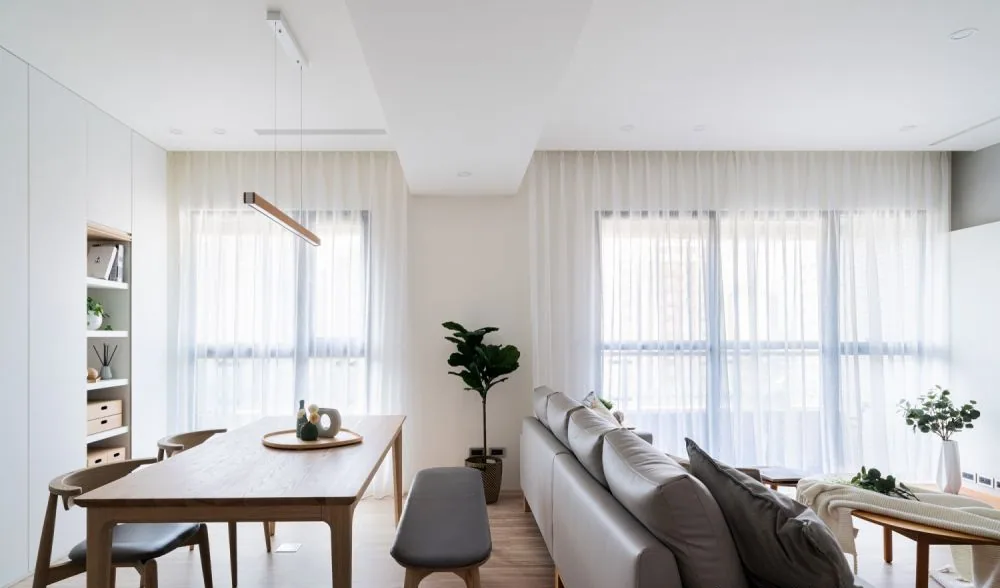
The sofa above floats in an open-plan room. Its back helps divide living and dining zones. The arrangement can work if people do not constantly brush behind seated heads, if there is enough passage width and if the seat has a clear relationship to the room. A console, low partition or quiet secondary zone can provide visual support without masonry.
I would rather sit on a well-placed floating sofa than obey “back against wall” while facing glare, blocking a door or forcing everyone through one narrow gap. Support is a relationship, not a photograph of contact.
For the same reason, a desk facing a blank wall is not automatically wrong and a diagonal view of the door is not automatically right. Screen reflections, calls, window glare, cable routes and the work being performed all matter. Use the command-position idea as a prompt to notice vulnerability—not as a guarantee of authority or career success.
At the whole-home level, the bedroom priority is simple: keep sleeping space out of primary circulation, maintain safe access and make the room support darkness, quiet and recovery. The feng shui bedroom guide tests bed, door, window, storage and night-time routes as one system rather than importing one sentence into every home.
Follow the route that happens when nobody is posing

Feng shui descriptions often speak of qi moving too quickly, becoming blocked or failing to gather. I cannot measure qi as a physical substance. I can observe whether a route accelerates, collides or repeatedly interrupts life.
Trace four real journeys:
- groceries from door to kitchen;
- laundry from bedroom to machine and back;
- a nighttime path from bed to bathroom;
- a guest's path that does not expose the household's most private spaces.
The long interior above looks open, but openness alone is not success. A dining corner projects into the route. A chair pulled back changes clearance. An armchair creates a turn before the sitting area. The room must be read in motion, not as an empty real-estate photograph.
This is where real household voices are more valuable than another universal rule. People repeatedly describe a good home through “动线”—the route of movement—even when they disagree about whether that counts as feng shui or interior design. I agree with the experience and keep the categories honest: a better route can reduce friction; it cannot prove a fortune claim.
For one week, notice every place two bodies negotiate passage. Do not move furniture yet. Mark the collision, the carried object and the time of day. The pattern will tell you more than a bagua map applied without context.
Direction matters because sun, wind and climate are real—and because belief is real too
South-facing homes are often praised in Chinese architectural and feng shui discussion. The practical meaning depends on latitude, climate, building depth, nearby structures and window design.
The Hong Kong Observatory's “Weather Feng Shui?” explains that in Hong Kong, southern exposure can admit winter sun while the building's north side is less exposed to the cold northeast monsoon; summer southerly winds can also provide breeze. It also notes that east–west choices involve different timing of heat rather than one simple winner.
That is valuable because it separates a testable local effect from a global slogan. A south-facing apartment in Hong Kong is not a universal template for Melbourne, Vancouver or a shaded tower canyon. Measure the actual home:
- When does direct sun enter in winter and summer?
- Which windows can safely open for cross-ventilation?
- Where does afternoon heat remain after sunset?
- Which room receives glare during its main use?
- What blocks or channels local wind?
Traditional belief may add directional meanings through a particular school and calculation. Treat those meanings as tradition or consultation, not as substitutes for climate data.
The official Lai Chi Wo village record gives a larger historical example: Hakka village form was related to surrounding hills, water, protective layout and feng shui belief. That scale reminds us how strange it is to reduce an environmental tradition to the color of a cushion.
Yin and yang are not a black-and-white shopping palette
Yin and yang describe relational tendencies—quiet and active, shaded and bright, inward and outward—not two paint swatches. A bedroom may need more darkness and still require morning ventilation. A kitchen may be active and bright while containing one calmer place to sit.
The yin and yang guide explains why neither side is permanently good. In a home, balance changes with use and time. A dim room can be restorative at night and exhausting at noon. An open kitchen can support family contact and overwhelm someone who needs acoustic separation.
Use the framework through verbs:
- increase light where a task cannot be seen;
- soften glare where eyes rest;
- separate noise from sleep;
- connect rooms where care work depends on awareness;
- close storage where visual noise never stops.
The five phases—wood, fire, earth, metal and water—can similarly organize symbolic or material relationships in some feng shui practices. Do not flatten them into “buy one object of each color.” A wooden table, running water, metal fixture and red lamp do not automatically produce balance. The system is about transformation and relationship; retail reduces it to inventory.
Mirrors, plants, water and lucky objects cannot repair the wrong problem
A mirror can return light, check appearance and expand a sightline. It can also reflect glare, expose a private area or startle someone at night. A plant can add life and softness; it can also block a narrow route, harm a pet or die in unsuitable light. An aquarium introduces movement and maintenance; it cannot guarantee wealth.
I use a three-question filter before any symbolic addition:
- What will this object physically do? Reflect, store, illuminate, divide, obstruct, humidify or demand care?
- What does it mean to this household? Inherited memory, living belief, aesthetic preference or fear purchased from a video?
- What problem remains after it is placed? If the door still strikes the cabinet, the room still overheats or the family still argues over one work surface, the cure addressed the wrong layer.
Symbolism is not meaningless because it is symbolic. A family object can change attention and behavior. The boundary is the promise. No vase, crystal, coin, fountain or color can responsibly guarantee wealth, health, romance or protection from structural risk.
A ten-minute feng shui home audit
Do this before moving a major item:
- Stand outside the front door with the objects you normally carry.
- Enter, close the door and place those objects where they naturally go.
- Walk to the kitchen, bathroom and most-used seat without correcting your route for the exercise.
- Sit in that seat for two minutes. Notice the door, back, glare, noise and passing bodies.
- Open the storage used every day. Count what must be moved to reach one common item.
- Check the same room in morning, afternoon and after dark.
- Change one relationship, not five decorations: clear a route, move a landing tray, rotate a seat or remove one obstruction.
- Live with the change for a week before declaring it lucky or unlucky.
Fire safety, structural engineering, electrical rules, ventilation requirements, accessibility and medical needs outrank any feng shui instruction. A practice that makes escape harder or daily care less safe has failed its human purpose.
My verdict: a home reveals its feng shui through repetition
The most convincing home is not frozen in showroom calm. It can absorb wet shoes, shopping bags, work calls, children, guests, tiredness and cleaning—and find its order again.
That is the personal standard I bring to home feng shui. The entrance should receive the real person arriving. The route should respect the person already sitting. Light should belong to the task and season. Storage should admit what the household actually owns. Symbols should deepen meaning, not cover a practical failure with a promise.
Begin with the broader Chinese architecture guide to place domestic rooms beside courtyards, thresholds and regional building systems. Then use the feng shui guide for history and cultural boundaries, and compare how thresholds and courtyards structure privacy in a siheyuan. In the East Moment community, show us one place where your home changes your body before you consciously notice it: the entrance, the route, the light or the seat.