Taoism and Confucianism are not “freedom versus rules.” They are two demanding ways of noticing that ordinary life goes wrong: Confucian thought asks how relationships can become more humane and trustworthy; Daoist thought asks when our urge to control has already made a situation worse. Chinese life has long made room for both questions.
The caricature is tempting because it is fast. Confucius becomes a strict teacher with a timetable; Laozi becomes a relaxed man beside water. Neither can survive five serious minutes with the texts.
The comparison must begin with a live failure, not two mascot personalities. Otherwise “Confucian” and “Taoist” become costumes people choose to flatter habits they already had.
Taoism vs Confucianism: what is the real difference?
The central difference is one of emphasis, not a clean division between social rules and personal freedom. Confucian traditions give extraordinary weight to learning, ethical relationships, ritual form and the cultivation of character in public life. Daoist traditions question forced striving, rigid categories and the confidence that more intervention is always better; they also include religious communities, ritual, scriptures and institutions.
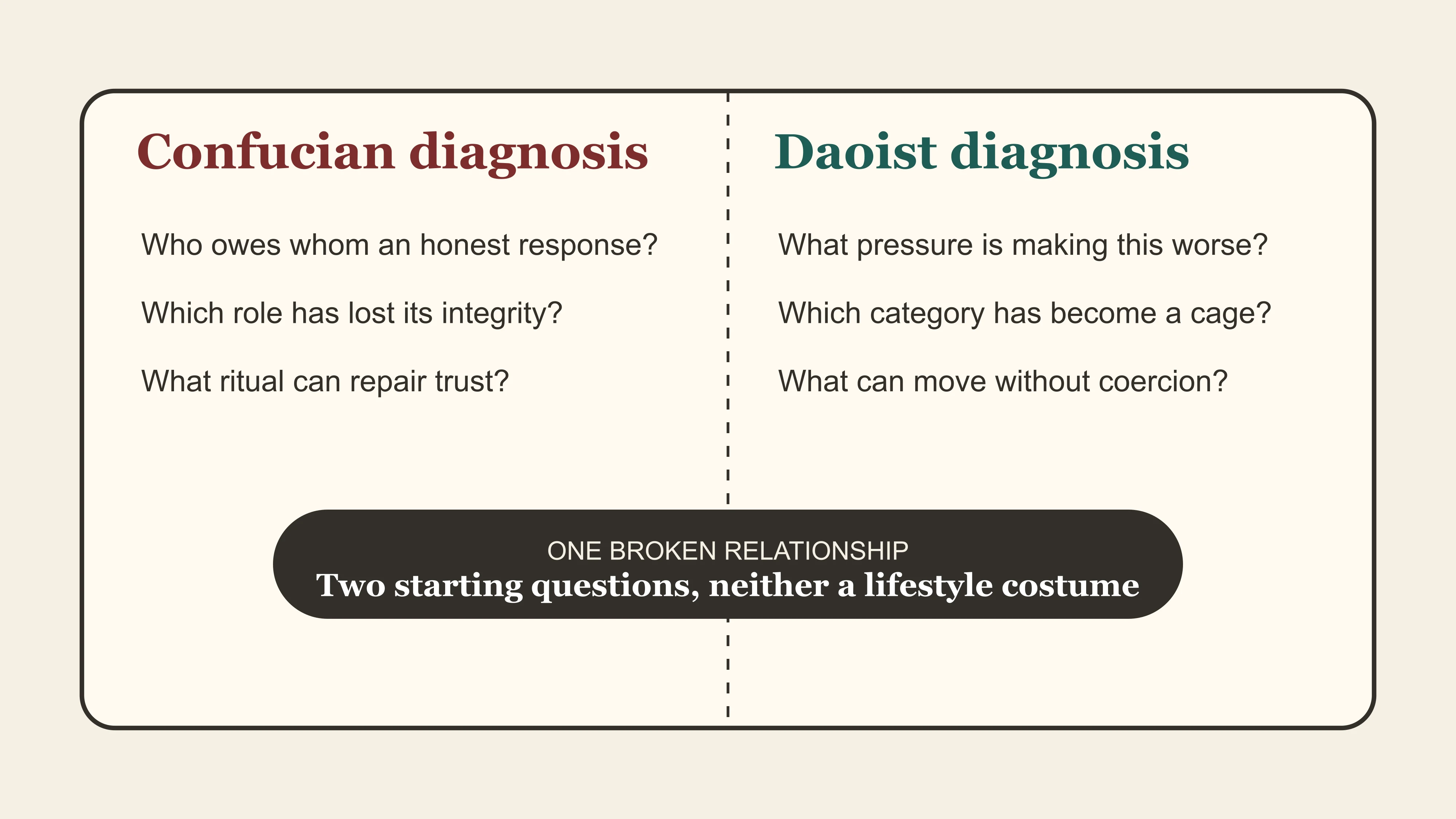
Both traditions ask how a person should live well. They disagree productively about where failure begins. A Confucian response often starts with a damaged relationship or neglected responsibility. A Daoist response often starts with an act of overreach: too much assertion, too much naming, too much faith in the hand that thinks it can arrange everything.
That is a far better comparison than “one cares about society, one cares about nature.” Both have things to say about self, society, government, body, practice and disorder. The Stanford entries on Confucianism and Daoism are useful precisely because they do not turn either tradition into a personality quiz.
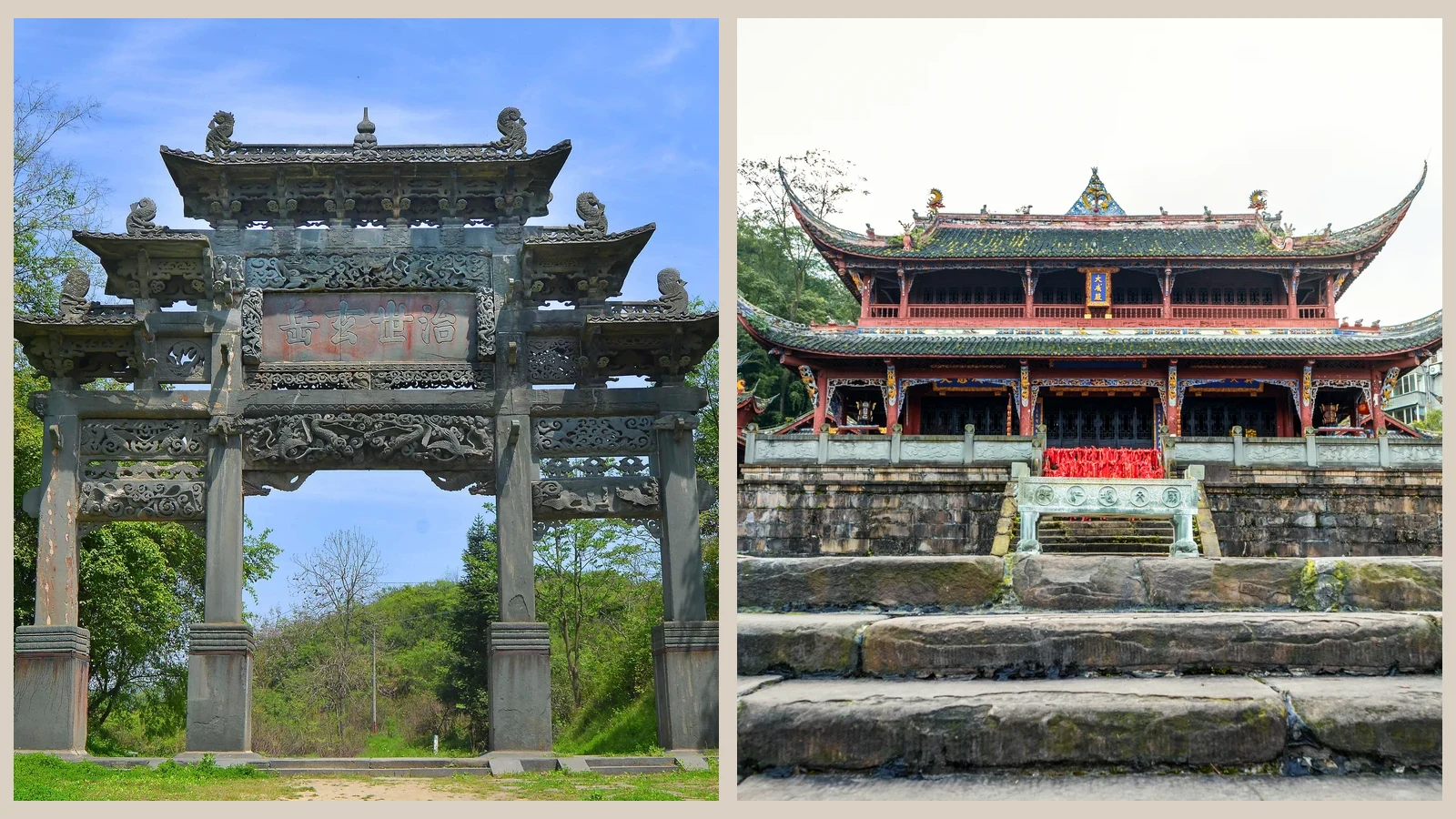
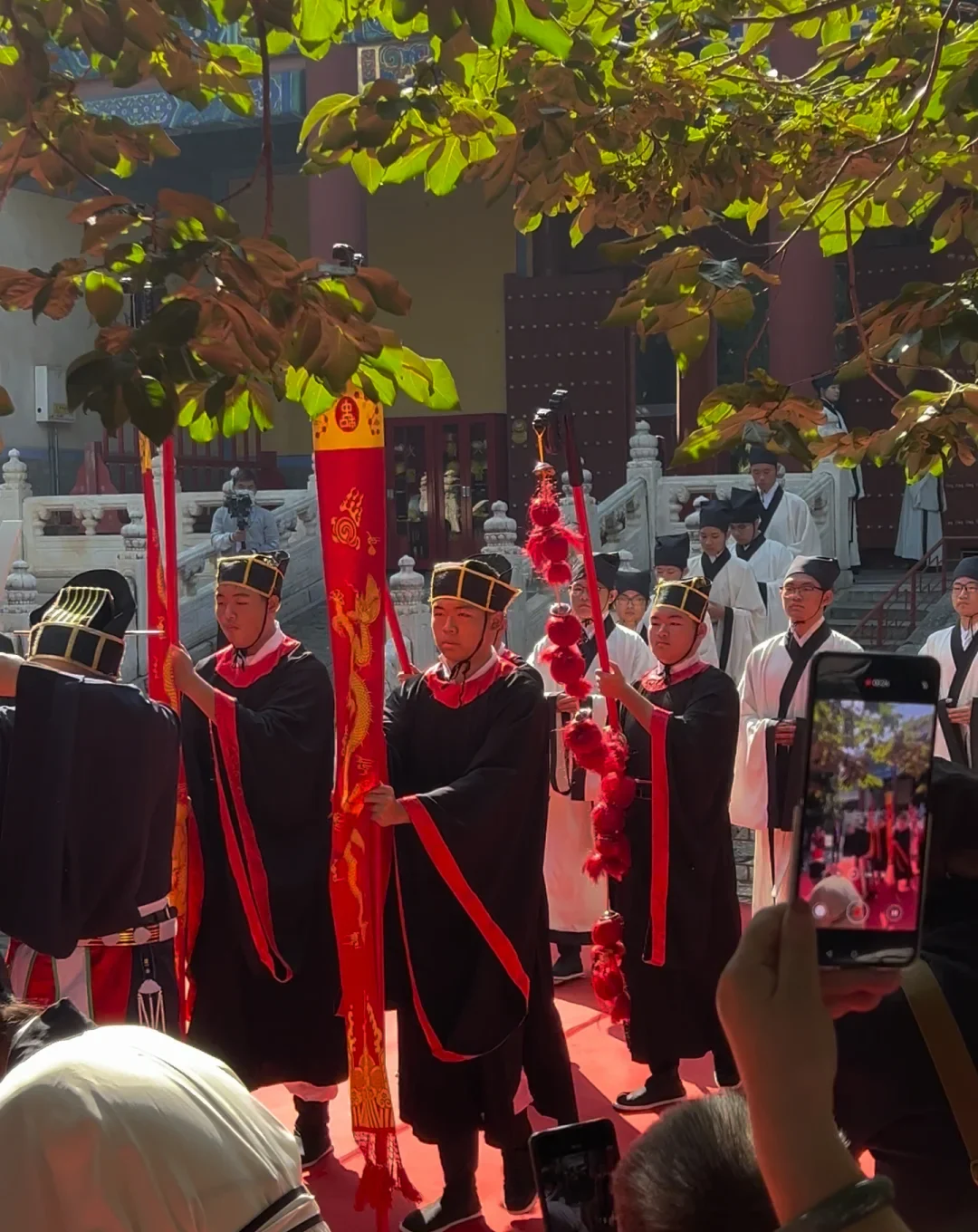
The two separate sites in the cover make one point before the abstractions begin. On the Wudang arch, the inscription Zhi Shi Xuan Yue (治世玄岳) places the sacred mountain inside a language of ordering the world. At Dujiangyan's Confucian temple, Dacheng Hall turns learning and cultivated conduct into public space. Architecture is not philosophy reduced to stone, but it destroys the lazy idea that one tradition simply escaped society while the other alone built institutions.
The same difficult scene, two starting questions
Picture a manager who humiliates a junior colleague in a meeting. The point is not to force ancient Chinese thinkers to run a modern HR department. It is to see how each tradition changes the first question you ask.
| If you begin with… | Confucian emphasis | Daoist emphasis |
|---|---|---|
| A damaged relationship | What respect, role and responsibility were violated? How can conduct become trustworthy again? | Has status made the manager force an outcome that could have been handled with less domination? |
| A broken institution | What norms, education or leadership example have failed? | Which layers of control are producing fear, performance and bad information? |
| A next action | Correction, remonstrance, repair and better conduct | Timing, proportion, a less coercive intervention and fewer self-defeating moves |
Neither answer lets the manager off the hook. That is the point. Confucian li—ritual and appropriate conduct—is not empty politeness when it protects another person's dignity. Daoist wu wei is not passivity when it asks why force has become the manager's only language.
Confucianism begins where another person is standing
Confucian thought makes a large claim: character is not a private possession displayed after it is complete. It is built in relationships—teacher and student, parent and child, friend and friend, ruler and subject, elder and younger person. Ren (humaneness) and li (ritual or appropriate form) give this claim its pressure.
That focus can feel restrictive when hierarchy hardens into obedience. It can also be ethically sharp. A society cannot call itself harmonious simply because no one is allowed to embarrass the powerful. Confucian traditions contain arguments about correction and remonstrance as well as deference; relationships demand duties in more than one direction.
The Analects guide is the best next stop if you want to hear the conversations before later institutions turned their teacher into a monument. Its layered dialogue matters here: Confucian ethics is not a laminated rule card but a practice of reading a relationship, correcting conduct and learning how words become trustworthy.
Daoism begins by doubting the grip of the hand
Daoist texts are not a campaign against responsibility. They are a sustained suspicion that the desire to be visibly in charge can ruin a situation. The Daodejing questions aggressive governance and celebrates the usefulness of what appears empty or yielding. The Zhuangzi uses strange stories to loosen categories that have become too rigid to see through.
This is why wu wei is so easy to misuse. It does not say “never act.” It asks whether an action fits the grain of a situation or merely broadcasts the actor's need to be seen acting. Our wu wei guide turns that distinction into a practical diagnostic without pretending an ancient concept can solve every modern conflict.
The Taoist texts guide follows the larger Daoist library beyond the two famous classics. That larger archive matters because Daoist critique is not one command to relax; it is a long argument about how language, desire, technique, body and government can become clumsy when control mistakes itself for knowledge.

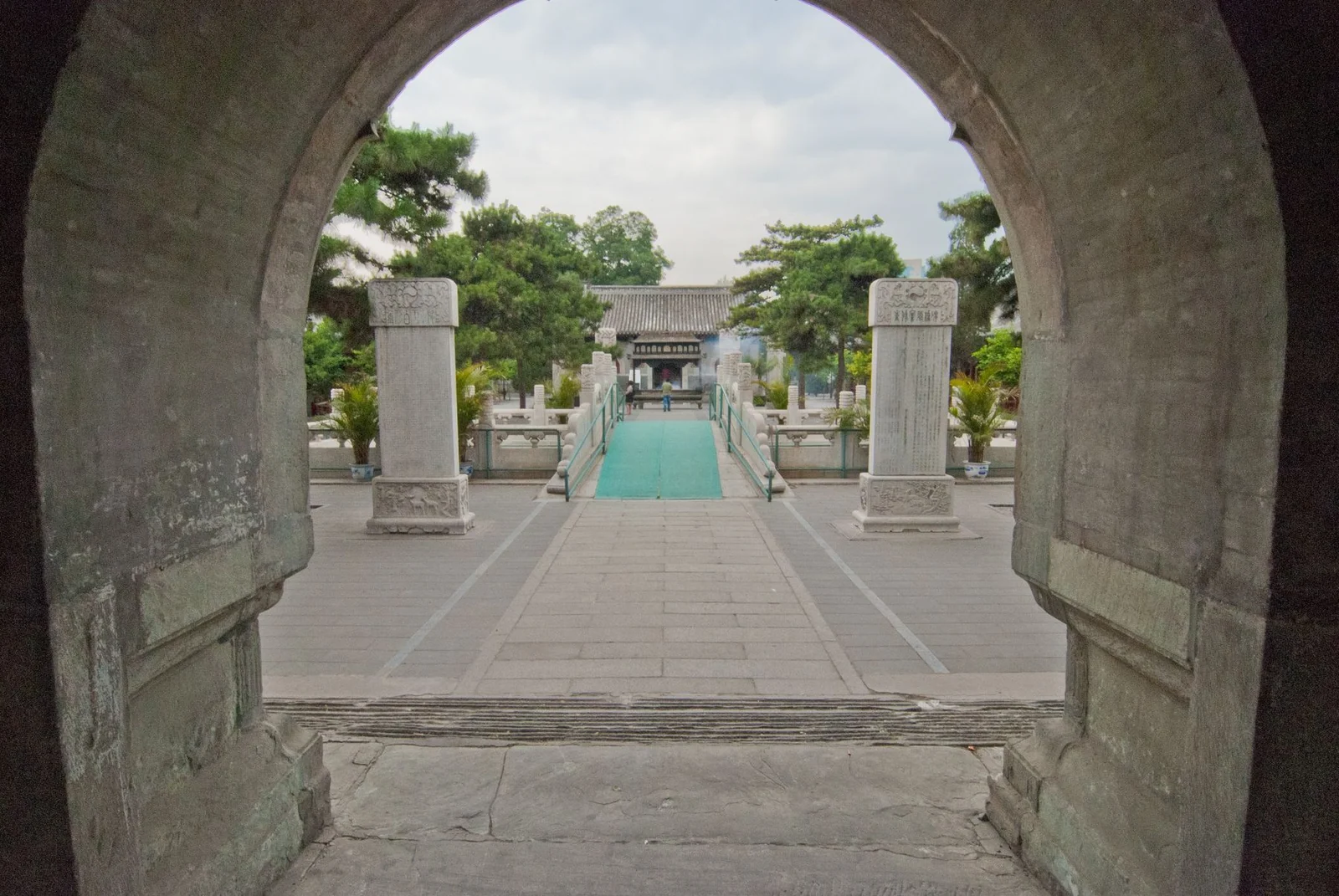
Daoism did not remain a private mood beside a waterfall. This East Moment archive photograph shows a named temple axis, hall, inscriptions and monumental incense equipment at Zhongyue Temple. It proves built institution and public ritual infrastructure; it cannot tell us what every visitor believes or make one temple representative of every Daoist lineage.
This is the visual correction most comparison charts omit. Confucian traditions built academies, temples and ceremonies; Daoist traditions also built institutions, trained specialists and organized ritual life. The disagreement is real, but “society versus nature” cannot survive the sight of an actual Daoist hall.
Chinese life did not require one final choice
Textbook comparisons often imply that a Chinese person had to choose a philosophical team. Historical life is less tidy. A family might use Confucian language for education and responsibility, draw on Buddhist rites around death, and visit a Daoist temple for local religious practice. The boundaries mattered, but so did the crossings.
That does not mean “all Chinese traditions are basically the same.” It means a clean Western-style choice between mutually exclusive labels can miss how institutions, households and local communities actually borrow, argue and coexist. A court may sponsor Confucian education while also engaging Daoist ritual specialists. A scholar may criticize a rival tradition and still write with questions shaped by it.
That is why the comparison cannot remain in a private headspace. Both traditions acquired texts, teachers, institutions, spatial disciplines and public consequences. They are not two moods on a bedroom wall.
Put the comparison under pressure
The easiest way to compare traditions is to list nouns: ren against Dao, ritual against spontaneity, society against nature. The better way is to watch what each approach does when a value becomes distorted.
Take filial responsibility. A shallow Confucian reading says the younger person obeys. A serious Confucian question asks whether parent and child are both fulfilling the relationship in a humane, trustworthy way. Care has form, but authority also has obligations. Remonstrance—speaking against a wrong course—exists because loyalty without moral correction becomes flattery.
A Daoist diagnosis enters from another side. Has the relationship been named and managed so aggressively that neither person can respond honestly? Is a title such as “good child” being used to force a living person into a fixed shape? The Daoist answer is not automatically to leave. It is to stop feeding the machinery that turns care into control, then find a smaller and more truthful action.
Now take education. Confucian learning prizes sustained study, moral example and the transformation of conduct. It refuses the fantasy that sincerity alone makes a person competent. Daoist writing attacks another fantasy: that accumulating names and techniques always produces understanding. Expertise can become brittle when it no longer feels the material in front of it.
I refuse to choose between those insights. Practice matters; so does the moment when practice becomes vanity. A student must repeat scales, characters or movements, but repetition has failed when it only protects the teacher's status. The Confucian question is whether teaching forms a better person. The Daoist question is whether the method still responds to life. A good teacher needs both knives.
Government exposes the real disagreement
The traditions become sharper when power enters the room. Confucian political thought places enormous weight on cultivated rulers, exemplary conduct, education and institutions that make ethical order visible. Its strength is that leadership cannot hide behind procedure: the ruler's character changes the moral climate.
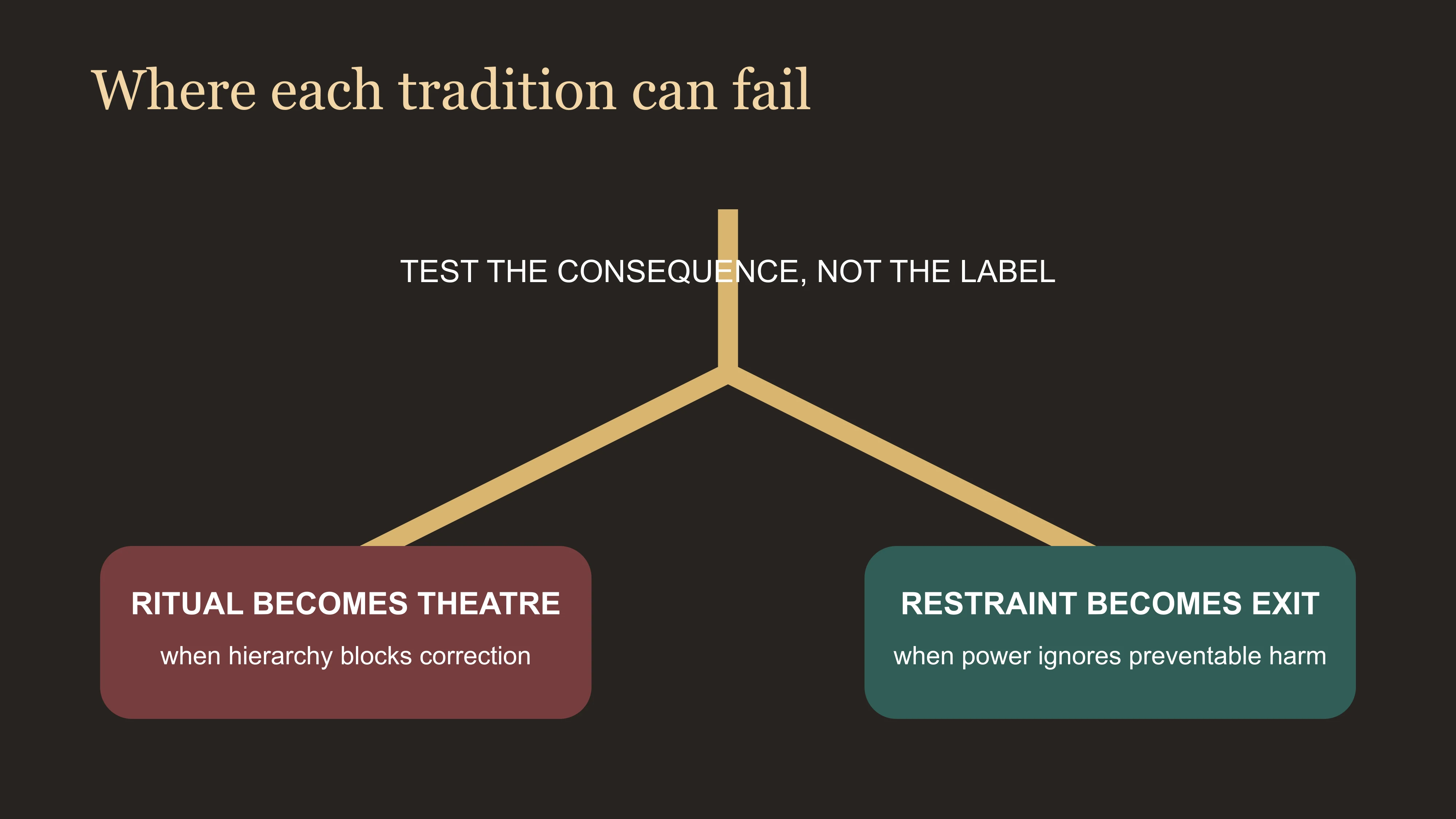
Its danger is equally visible. When hierarchy protects itself, ritual can become theatre performed by subordinates for the comfort of superiors. A polished ceremony does not prove humane government. It may only prove that everyone knows where to stand.
Daoist political passages distrust busy rule, punitive display and rulers who crowd ordinary life. Their strength is diagnostic: power often creates the disorder it then uses to justify more power. Their danger appears when “less intervention” ignores unequal conditions. Withdrawal by a ruler is not freedom if local violence or hunger simply becomes someone else's private problem.
This is why the comparison must include consequence. Confucian form is valuable when it makes responsibility answerable. Daoist restraint is valuable when it removes self-defeating control. Either becomes corrupt when it serves the comfort of the powerful.
A four-question method beats a personality quiz
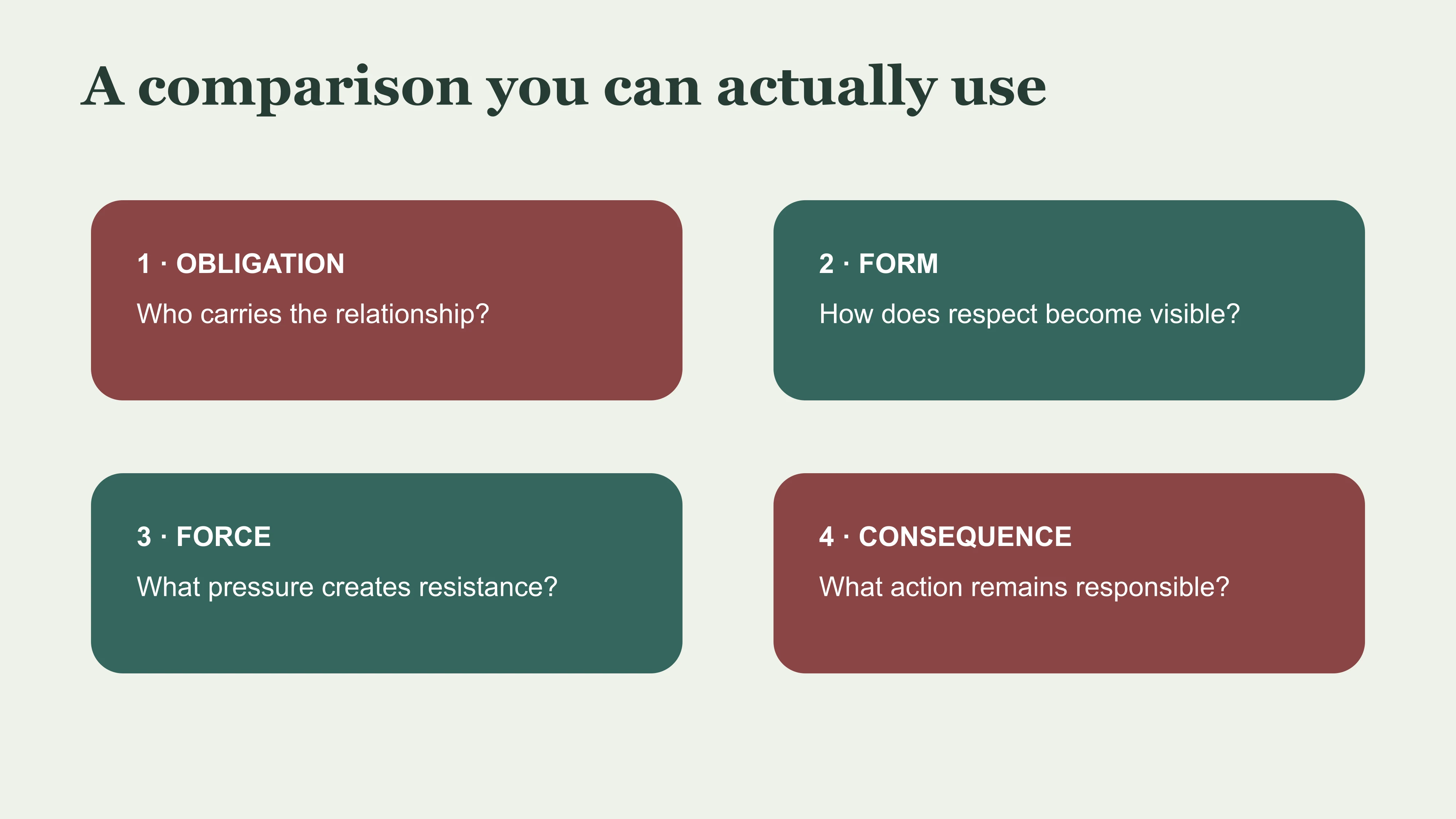
When you face a real problem, do not ask whether you are “more Confucian” or “more Taoist.” Ask four harder questions:
- Which relationship carries the obligation? Name the people and the unequal powers involved.
- Which form could make respect visible? An apology, a boundary, a meeting rule or a repeated practice may matter more than a private intention.
- Which force is producing resistance? Look for surveillance, humiliation, over-explanation, status display or a deadline that makes honest information impossible.
- What action remains responsible after force is reduced? Less coercion never means abandoning the person who bears the cost.
The result is not a synthetic doctrine. It is a better diagnostic sequence. Confucian thought keeps the other person from disappearing inside your private freedom. Daoist thought keeps your moral confidence from becoming another machine of domination. That tension is useful precisely because it cannot be resolved into a motivational poster.
That is also my answer to the search question. The difference is not that one tradition demands rules and the other rejects them. Confucianism tests whether conduct repairs humane relationship; Taoism tests whether control has begun defeating the life it claims to order. Use both tests, then take responsibility for the consequence.
The point is not balance for its own sake. It is sharper accountability: no humane ritual without room for correction, and no non-forcing freedom that leaves the weaker person carrying the damage. The Chinese philosophy collection keeps those disagreements connected without flattening them into one national personality.
Do not borrow either tradition as a costume
Confucianism is not a justification for controlling adult children, silencing women or treating manners as moral achievement. Taoism is not a justification for abandoning commitments, calling avoidable harm “the flow,” or decorating ordinary indecision with Chinese characters.
Each tradition is more demanding than its internet version. Confucian thought asks whether your conduct makes another person's dignity easier or harder to sustain. Daoist thought asks whether your method is generating the very resistance you blame on everyone else. One makes you answer for relationship; the other makes you answer for force.
Those are not rival self-help brands. They are two ways of refusing a bad answer.
Where to begin
Begin with Confucianism if the problem you want to understand is family obligation, learning, public responsibility or ritual. Begin with Taoism if the problem is over-control, naturalness, transformation or the difference between a text and a living religious tradition.
Then read both with a live question in mind. The most interesting comparison is not “Which one do I like?” It is “What does each one notice that I would otherwise leave out?”