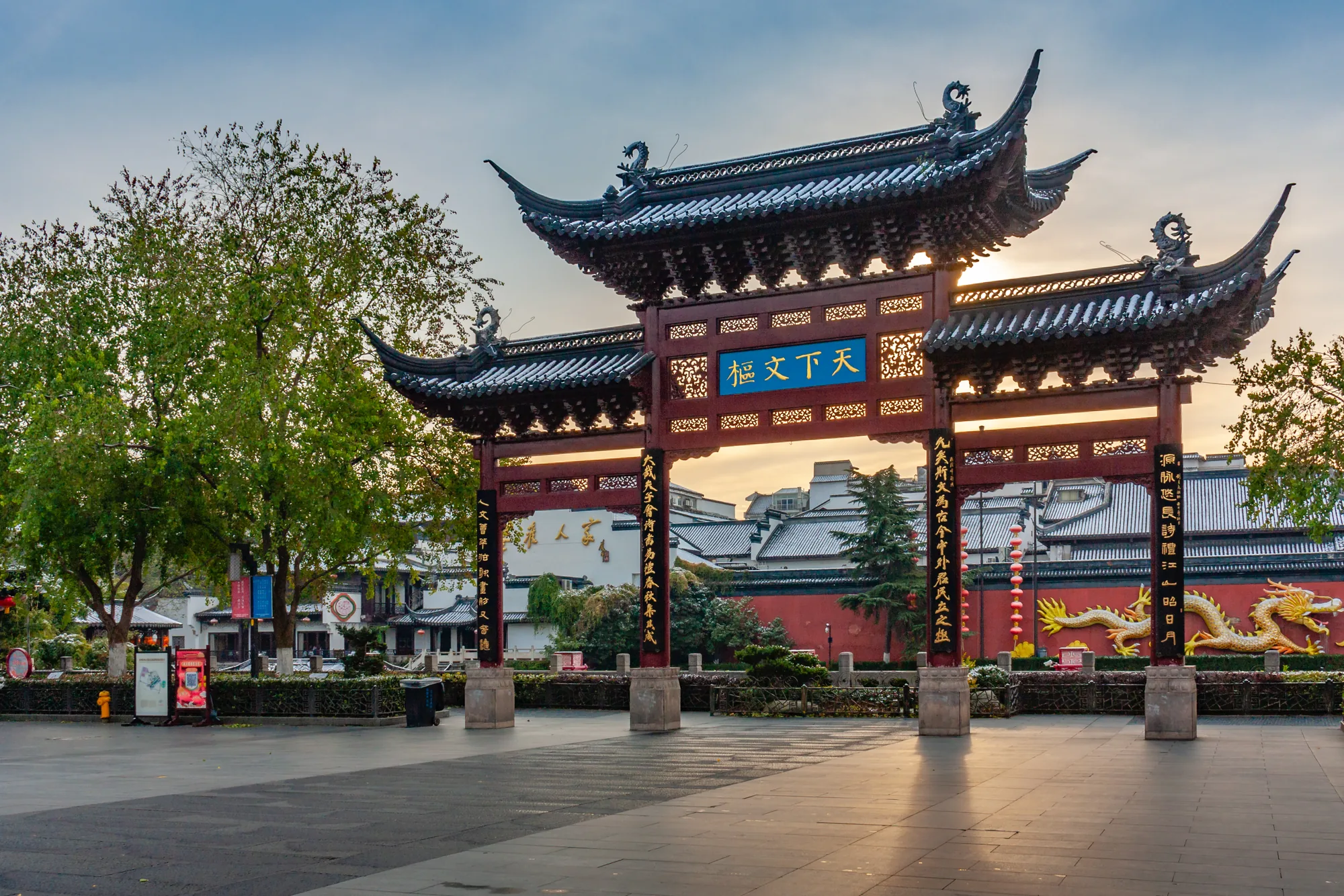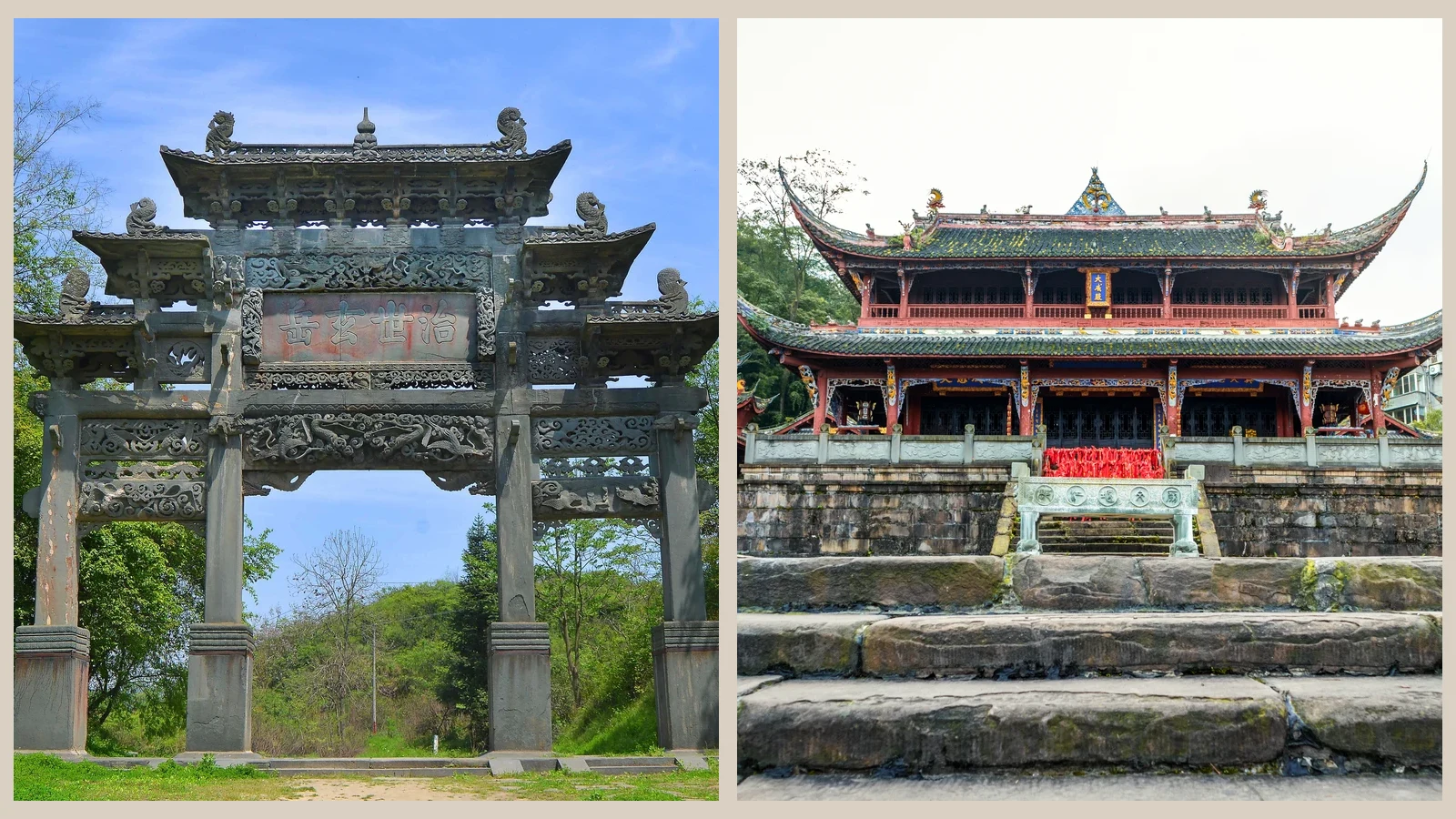
The history of Taoism does not begin once. Early texts explored the Dao; organized communities built ritual authority; revelation traditions created new scriptures and heavens; monasteries and lineages reshaped practice again. Laozi belongs to that history, but he did not establish the entire tradition in one founding moment.
The history of Taoism has several front doors
Ask "Who founded Taoism?" and the fastest answer is Laozi. It is also the answer most likely to make the rest of the history disappear.
I reject the single-founder answer because it makes a vast human tradition look like one man's finished invention. I believe the best history keeps the book, the household register, the revelation, the temple repair and the living ritual in the same frame. The mistake is to call that complexity indecision. I insist on it because Taoism must be understood as work performed by communities across time, not as a quotation factory attached to Laozi's name.
The text known as the Daodejing became central to Daoist thought and religious life, and Laozi became far more than an ancient author: sage, immortal and divine figure. Yet the history of Taoism grew through different communities, texts, rituals, deities and institutions over many centuries.

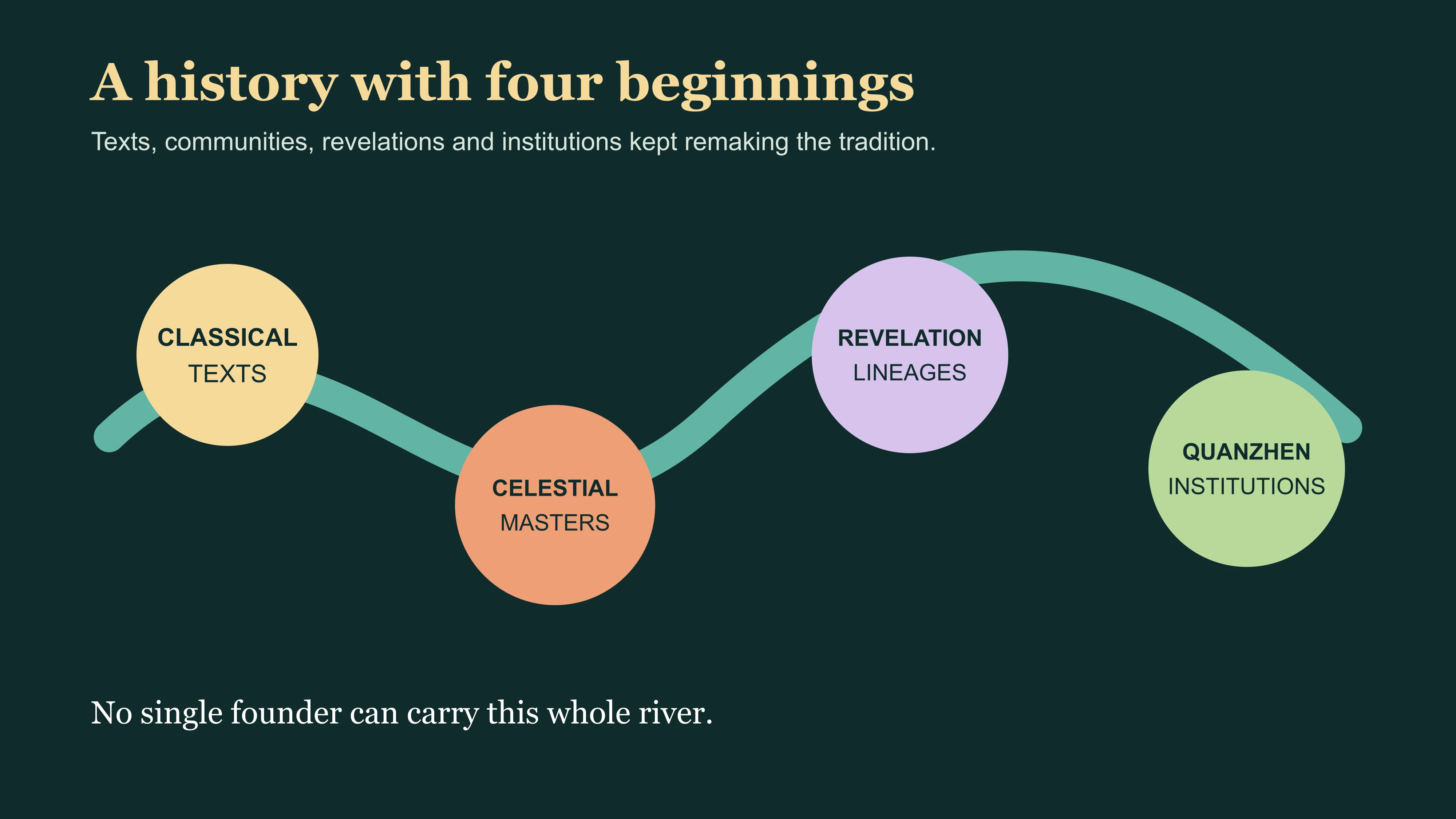
A better timeline asks four questions at every stage: Who was practicing? Which text or revelation carried authority? What did people do with body, household and community? Which later group retold the earlier past?
Before there was one institution, there were arguments about the Way
Texts later grouped under "Daoist philosophy" emerged during the late Zhou and early imperial worlds. The Daodejing speaks through compressed paradox: strength in softness, action through non-forcing, governance that does not crowd life. The Zhuangzi moves differently, using jokes, transformations and unstable viewpoints to loosen certainty.
These texts did not arrive as a complete church manual. Nor were they sealed away from other intellectual worlds. Ideas about self-cultivation, cosmology, governance, longevity and ritual circulated among specialists and courts.
The modern division between "philosophical Taoism" and "religious Taoism" can help a beginner sort material, but it becomes misleading when treated as two unrelated traditions. The Stanford Encyclopedia of Philosophy explains why those Western categories do not map neatly onto the entangled historical field, while the University of Tennessee Martin's Internet Encyclopedia of Philosophy account shows how the philosophical traditions themselves resist a single neat school label.
For terminology, the Taoism versus Daoism guide separates two romanizations from the false idea that they name two different religions.
The Celestial Masters made community part of the answer
In the second century CE, the Celestial Masters movement created an organized religious community associated with Zhang Daoling and later leaders. Households, registers, moral obligations, ritual offices and communal structures made the Dao socially administered.
This is one of Taoism's most important beginnings because it changes the scale. A text can be read alone. A registered community has leaders, responsibilities, ceremonies and boundaries.
The shift also corrects the common image of Taoism as solitary withdrawal into mountains. Hermits and mountain practice matter, but Daoist history also belongs to families, local communities, priests and systems of collective care.

Stars and bureaucratic heavens may look far from the quiet aphorisms overseas readers expect. Historically they occupy the same expanding religious world: the cosmos is not scenery but an order with which ritual life communicates.
Revelations created futures by rewriting the past
From the fourth century onward, Shangqing revelations introduced new scriptures, visualizations and celestial geographies. Lingbao traditions developed another powerful synthesis, bringing ritual, cosmology and salvation into forms shaped partly through interaction with Buddhism.
Calling this "later superstition" added onto pure philosophy would repeat an old hierarchy rather than explain history. Revelation literature allowed communities to claim new authority while connecting themselves to a deeper sacred order.
The focused Taoist beliefs guide explains these layers without pretending every school teaches one creed.
Temples, courts and local gods kept changing one another
Imperial governments alternately patronized, regulated and reorganized Daoist institutions. Courts sought ritual expertise and cosmic legitimacy; Daoist leaders gained resources and recognition; local practice continued to reshape formal systems from below. The Metropolitan Museum of Art's institutional essay on Daoism and Daoist art makes the changing religious field visible through deities, revelations, ritual systems and objects rather than reducing it to one timeless symbol.
This relationship makes a temple more than a preserved philosophy. Architecture organizes movement. Halls separate divine roles. Inscriptions record donors and repairs. Festival days alter the social density of the compound.
Daoism also interacted continuously with Buddhism, Confucian learning and popular religion. The traditions competed, borrowed vocabulary and shared local spaces. A clean three-column diagram may be useful for an exam; lived Chinese religion rarely obeyed it.
Quanzhen changed discipline, institution and daily rhythm
The Quanzhen movement emerged in the twelfth century and developed monastic institutions, disciplined practice and new lineages. Its later importance is visible at Beijing's White Cloud Temple, a major Quanzhen center.
Quanzhen did not replace every older tradition. Zhengyi ritual lineages and many local forms continued. That coexistence is another reason a single-founder story fails: Taoist history accumulates layers without requiring every layer to become identical.
The difference between a lineage label and daily practice also matters. Two temples may share institutional affiliation while differing in local deities, festivals, community responsibilities and historical memory.
Modern survival is not a simple return
The twentieth century brought war, revolution, land and institutional change, restrictions on religious life and damage to temples. Later revival restored sites, ordinations, festivals and public practice, but revival does not rewind history.
Tourism, heritage policy, urban reconstruction, online teaching and global interest now shape what becomes visible as Taoism. A restored temple may be a religious institution, neighborhood landmark and ticketed attraction at the same time.
This is where overseas fascination can become selective. Meditation, softness and "flow" travel easily. Registers, funerary ritual, temple administration and local gods are less likely to appear in wellness language. A complete history needs both.
Three historical shortcuts that break the story
The first shortcut says Laozi founded Taoism in the sixth century BCE. That sentence compresses a transmitted text, a traditional sage, later deification and centuries of community formation into the shape of a modern founder biography. It gives a clean date by erasing the institutions that make a religion historical.
The second shortcut says philosophical Taoism came first and religious Taoism corrupted it later. This story feels flattering to a modern reader who wants wisdom without ritual. It is still bad history. Early imperial worlds already connected cosmology, longevity, governance, specialists and ritual techniques; later communities did not merely pour superstition over a pure book. They created new social forms, scriptures and practices while reinterpreting older materials.
The third shortcut says Taoism simply absorbed whatever Chinese people believed. Interaction with local religion, Buddhism and state institutions was real, but “absorption” is too lazy unless we name who adopted what, when and for which institutional purpose. A liturgy, deity title or monastic rule has a transmission history. Similarity is a clue, not a genealogy.
I am hard on these shortcuts because each one removes people. A founder myth removes households and ritual officers. A purity myth removes revelation communities. An absorption myth removes the authors, translators, patrons and local specialists who made choices. The history becomes more credible when it becomes crowded again.
What changed when a text became an institution?
A book can travel as a copied object, a remembered passage or a commentator's problem. An institution must also decide who teaches, who performs, who belongs, who pays, who records and who answers when practice fails. That change is not administrative clutter around the “real philosophy.” It is where an idea acquires consequence.

The open-access rubbing shows body, landscape and cultivation imagery held in one transmitted diagram. It documents one material Daoist knowledge object; it is not a universal anatomy, medical diagnosis or practice instruction.
Celestial Masters registers linked households to a community and its authority. Revelation lineages established new chains of transmission. Temple complexes gave cosmological order a spatial form: gates, halls, altars and named divine offices taught visitors how the sacred world was arranged. Quanzhen institutions made discipline and communal rhythm durable across generations.
This institutional lens also explains why a modern online quote cannot stand in for Taoist history. A sentence attributed to Laozi has no priest, calendar, ritual role, donor inscription, lineage claim or local obligation. It may be profound. It is still one fragment of a much larger historical machine.
The dedicated Taoist texts guide follows the library that machine produced. Read it after this page, not because texts are secondary, but because a canon makes more sense once you know why communities needed more than one book.
How to read a Taoist site as historical evidence
When you enter a Taoist temple or study a photograph, resist the urge to call everything “ancient Taoism.” Look for dated repairs, plaques, donor records, lineage names, hall dedications and the relationship between public visitor space and specialist ritual space. A building can preserve several historical layers at once.
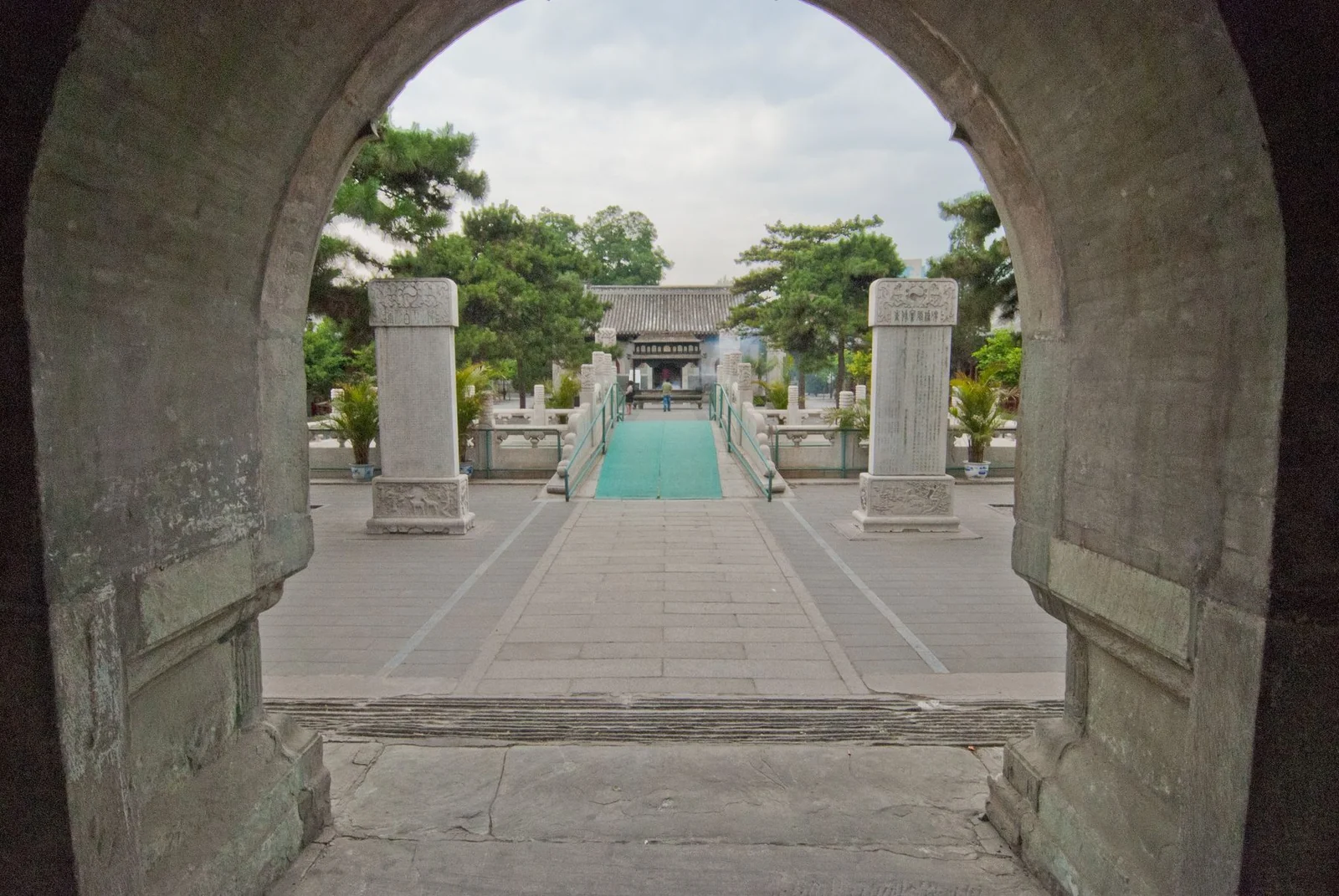
The White Cloud Temple gateway at the top of this page is useful because it opens onto a real institutional history associated with Quanzhen. It cannot prove that every visible structure is medieval, that every visitor shares one belief or that modern management reproduces a past social world unchanged. Restoration is historical evidence too: it tells us what later institutions chose to preserve, rebuild and present.
That distinction matters beyond temples. A modern ceremony may carry older liturgical forms while responding to contemporary heritage policy, tourism and media. Calling it “authentic” or “fake” without examining that layered function is usually an excuse to stop thinking.
The timeline I trust
I trust a timeline that allows several beginnings and refuses a triumphant ending. Classical arguments about Dao and non-forcing became resources. Organized communities made authority social. Revelations expanded sacred worlds. Courts and local societies changed institutions. Quanzhen and Zhengyi lineages carried different forms. Twentieth-century rupture damaged transmission; later revival created living continuity under new conditions.
This is not indecision. It is the firm conclusion the evidence demands: Taoism was repeatedly made, not founded once. Every period inherited something, selected something and changed something. The river survives because it has branches, not because one source remained chemically pure.
Whenever a timeline offers one birth date, ask what kind of beginning it is dating: a text's likely formation, a community's organization, a revelation's reception, a lineage's institutional recognition or a modern restoration. Those events belong on the same map, but they are not interchangeable. Precision does not weaken the story. It gives every historical actor back their work.
It also changes what you notice on a visit. A deity name, a register, a repaired roof and a posted lineage are not decorative leftovers around an abstract philosophy. They are traces of the organizations, patrons, specialists and communities through which Taoism kept becoming historical.
That is the reading habit this history is meant to teach. Do not ask only which ancient idea a modern object represents. Ask who maintained it, which authority named it, what practice gave it consequence and which rupture forced it to be rebuilt. History begins wherever those questions recover human work.
Begin with the Taoism guide for the broad tradition, then return to this timeline with several beginnings in mind: text, community, revelation, temple and lineage. The history becomes less tidy and more human.
The wider Chinese philosophy collection shows how this institutional history intersects with Confucian learning and other Chinese traditions without pretending they merge into one system.
So who founded Taoism?
The most accurate short answer is: no single person founded the whole tradition. Laozi is the traditional sage associated with the Daodejing; Zhang Daoling is associated with the second-century Celestial Masters movement; later revelation communities, lineages and temple institutions created further forms. Those are different kinds of historical beginning.
If a quiz demands one name, it is usually asking for Laozi. If a reader wants the history of a living religion, Laozi alone is not enough. The distinction protects both the text and the communities that made Taoism more than a quotation. It also explains why “founder of Taoism” is a useful search phrase but a dangerous final conclusion.
Below, add one local temple, family practice or remembered festival that broad histories overlook. The goal is not to declare one version authentic. It is to prevent the living tradition from shrinking into a quotation attributed to Laozi.