
Taoism and Daoism are two English spellings for the same broad Chinese tradition. Taoism preserves an older romanization that became established in English; Daoism follows Hanyu Pinyin, the modern standard used to spell Mandarin Chinese. They are not rival religions, denominations or schools. For a new article, use Daoism when following current academic or Pinyin conventions and Taoism when matching established English usage or reader search language.
Taoism vs Daoism: the answer in one table
| Question | Useful answer |
|---|---|
| Are Taoism and Daoism the same? | Yes. Both normally represent terms built around 道, dao. |
| Is one spelling more authentic? | No. Both are Latin-letter systems trying to represent Chinese pronunciation. |
| Which is newer? | Daoism follows Hanyu Pinyin; Taoism reflects older romanization and established English usage. |
| Is Dao pronounced like English “dow”? | Roughly, but the initial consonant is not identical to an ordinary English d. |
| Which spelling should I use? | Choose one system for the context and stay consistent. Preserve official titles and quoted source spellings. |
| Does choosing Daoism settle what the tradition includes? | No. Spelling cannot resolve debates about philosophy, religion, texts, ritual and historical communities. |
That last row is the one most explanations miss. The spelling question is easy. The scope question is where the real cultural work begins.
The spelling changes; the subject does not

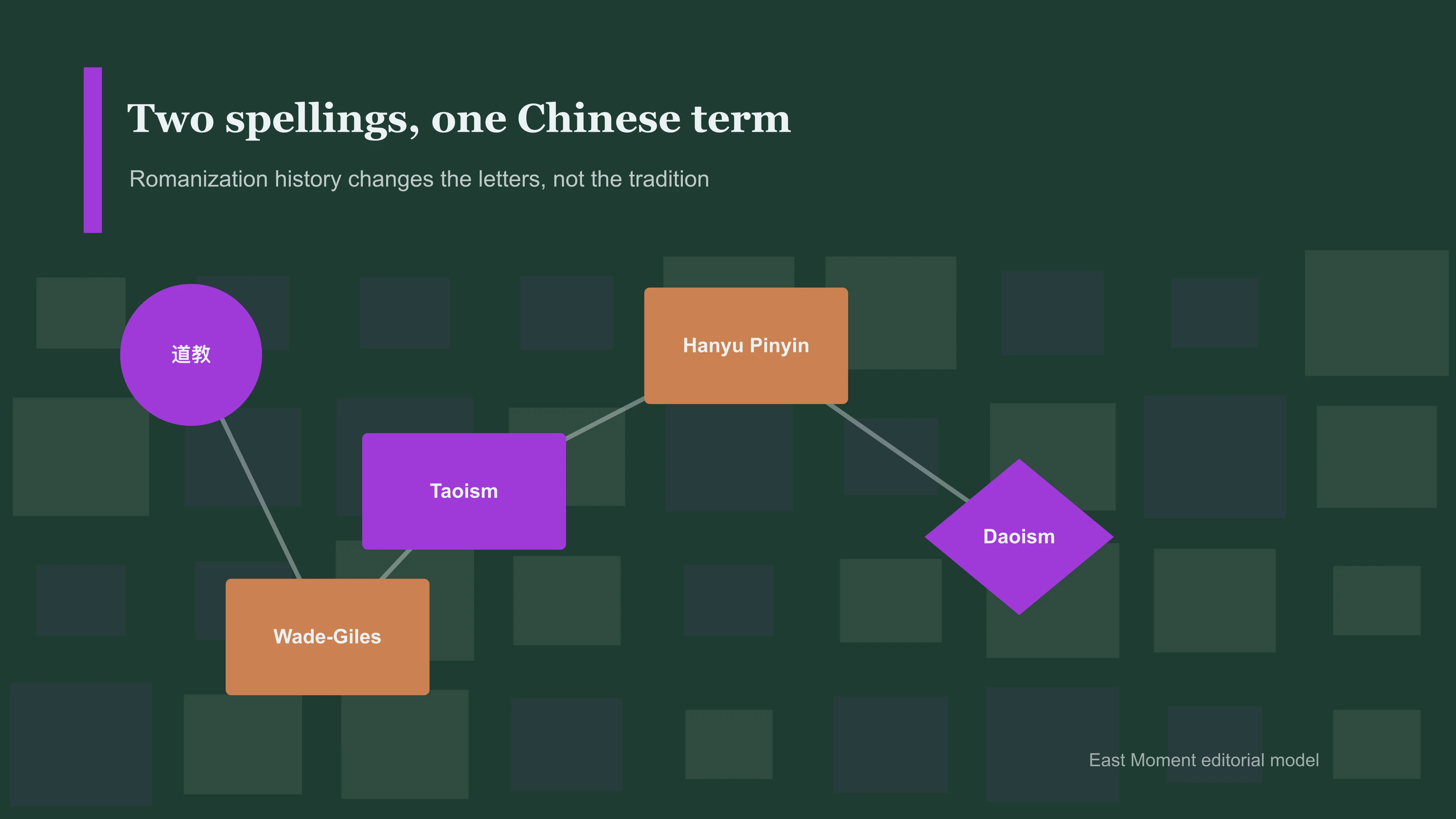
Taoism versus Daoism is a romanization difference, not a theological disagreement. Romanization is the work of writing a language in the Latin alphabet. Mandarin does not naturally arrive with English spelling attached; a system makes choices about how sounds should be represented.
The older English form Taoism became familiar through romanization practices that wrote the initial consonant with t. Hanyu Pinyin writes the same syllable as dao. The Chinese character did not change from one tradition into another while English-language publishing updated its spelling.
This is why the following pairs usually point to the same names or texts:
| Older or established form | Hanyu Pinyin form | Chinese | What it names |
|---|---|---|---|
| Tao | Dao | 道 | The way, path, method or unfolding course discussed in different contexts |
| Taoism | Daoism | 道家 / 道教, depending on context | A broad English label for related philosophical and religious traditions |
| Tao Te Ching | Daodejing | 道德经 | The classic associated by tradition with Laozi |
| Lao Tzu | Laozi | 老子 | “Old Master,” the traditional figure associated with the Daodejing |
| Chuang Tzu | Zhuangzi | 庄子 | The thinker and the text bearing his name |
| Te | De | 德 | Potency, efficacy, character or virtue, depending on passage and translation |
The table is a conversion aid, not a ranking. A library record, museum label or older translation may use Tao Te Ching without becoming incorrect. A recent scholarly book may use Daodejing because it follows Pinyin. The responsible question is not “Which author knows the real religion?” It is “Which spelling system is this source using?”
Why does Tao begin with T if it sounds closer to D?
The short answer is that English t and d are not the only possible consonant categories.
Mandarin distinguishes pairs partly through aspiration: whether a noticeable burst of air follows the consonant. Hanyu Pinyin writes the unaspirated member of one pair with d and the aspirated member with t. That does not make Pinyin d identical to every English d, but it gives an English speaker a better first approximation than pronouncing Tao with the strong t in “town.”
Older Wade-Giles-style spelling represented the contrast differently. An apostrophe could mark the aspirated consonant. In careful Wade-Giles, tao and t'ao were not the same syllable. Once apostrophes disappeared in ordinary printing, signage and typing, the system became harder for casual readers to decode.
That history explains a familiar puzzle: Taoism is normally pronounced as though it begins closer to an English d, even though it is spelled with t. The spelling is historical evidence, not pronunciation instructions written for a modern beginner.
Do not overcorrect into performance. Saying something close to “dow-ism” is enough for ordinary English conversation. Precise Mandarin pronunciation requires hearing a speaker, not inventing a new English eye dialect.
What Hanyu Pinyin changed
Hanyu Pinyin became the dominant international system for writing Standard Mandarin in Latin letters during the second half of the twentieth century. Libraries, publishers, schools and reference works gradually converted many names. Peking became Beijing in most contemporary contexts; Mao Tse-tung became Mao Zedong; Tao increasingly appeared as Dao.
The change was never instantaneous. English keeps old forms when they are deeply established, attached to institutions or preserved in the title of a translation. Search engines also keep every historical layer alive at once. A reader can encounter Lao Tzu, Lao-tzu, Laozi and Lao Zi before breakfast.
The Library of Congress conversion program is useful evidence of the practical problem. Catalogues could not simply replace one letter everywhere. Names, word division, diacritics, old records and source titles required rules. Romanization is infrastructure: invisible when it works, suddenly philosophical when two search results refuse to line up.
Taoism remains a legitimate English word
Some introductions treat Taoism as a mistake that educated readers must delete. That judgment is too simple.
Taoism is an established English word with a long publication history. Major books, translations, organizations and readers still use it. It is also the form many people type into search. Replacing it mechanically can make older sources harder to find and can silently alter official titles.
Daoism has a strong advantage: it aligns with Hanyu Pinyin and with related spellings such as Dao, Daodejing and Laozi. It is common in contemporary scholarship. But consistency is a practical virtue, not a certificate of superior cultural depth. A page can spell every word in Pinyin and still reduce a living tradition to three motivational quotes.
East Moment uses Taoism for the broad guide because that is the established English search term assigned to the page. Inside the article, we use Dao for the Chinese concept and explain Daoism when terminology matters. That choice serves readers without pretending the keyword owns the tradition.
Daojia and Daojiao: the harder distinction hiding behind the easy one
The same English word may translate more than one Chinese expression:
- Daojia (道家) literally suggests the “school” or lineage of the Dao and is often used in classifications of thinkers and texts.
- Daojiao (道教) means the “teaching” or religion of the Dao and often points toward organized religious traditions.
This distinction is useful, but it is not a pair of sealed historical boxes. The Stanford Encyclopedia of Philosophy notes that Western descriptions have repeatedly divided “philosophical Daoism” from “religious Daoism,” while the real histories of texts, practices and institutions are more entangled. The Internet Encyclopedia of Philosophy likewise treats Daoist philosophy as a field with several phases and contested boundaries, not one founder delivering a completed system.
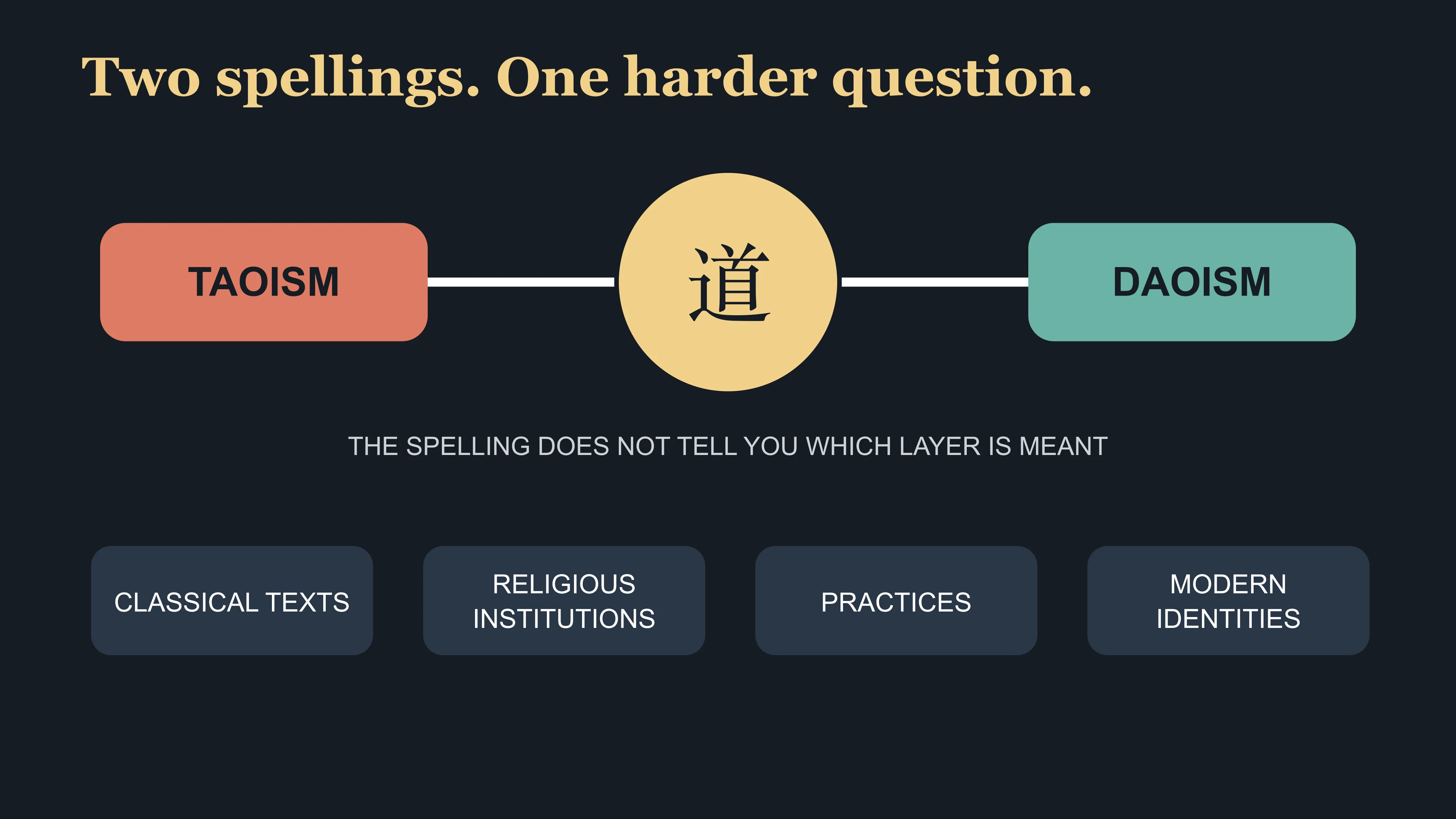
Changing Taoism to Daoism does nothing by itself to solve that issue. Both English spellings can be used too broadly. Before interpreting a claim, ask what the writer means:
- Classical texts such as the Daodejing and Zhuangzi?
- A philosophical family reconstructed by later scholars?
- Organized communities, priestly lineages, liturgy and temples?
- Body cultivation, meditation or ritual technologies?
- A modern global identity built from some combination of these?
A clear article names the layer. A weak one lets the spelling perform scholarship it has not done.
The Taoist beliefs guide applies that rule to claims about the Dao, gods, the body and death. The Taoist symbols guide applies it to visual evidence, where a familiar motif cannot identify a tradition without documented use.
One gate is worth more than two labels
The Shijiazhuang entrance shown at the top of this page is labeled 十方院, Shifangyuan. The vertical inscription identifies it as a Daoist institution in Hebei. Nothing on the gate asks whether an English visitor prefers Taoist or Daoist.
That visible Chinese context corrects a common imbalance. English-language arguments can make romanization feel like the main event, while the tradition itself is carried through Chinese names, buildings, scriptures, ritual roles, local histories and communities. The English label is a door sign translated for us. It is not the building.

Inside Shanghai's Sanyuan Palace Kun Daoist Institute, women practitioners conduct a liturgical service before the Three Officials. The photograph proves that a named urban Daoist institution has people, robes, ritual objects and collective practice behind its sign. It cannot tell us that every Daoist lineage worships, dresses or organizes itself in the same way.
This is the image I want beside a spelling argument. The English internet can spend pages choosing between T and D while real practitioners are already reading, standing, sounding instruments and maintaining a place. A romanization choice helps us find the door. It does not perform the work happening inside.
The Taixu Palace hall in Yantai makes the same point at a larger scale. A real institution contains architecture, named sacred figures, offerings, caretaking, restoration and visitor behavior. Calling it a “Taoist temple” or a “Daoist temple” does not change those responsibilities. Correct spelling cannot replace correct identification.
When should you use Taoism?
Use Taoism when:
- writing for a general English audience that already recognizes the term;
- matching the official title of a book, organization, course or translation;
- discussing the history of English reception;
- preserving a quotation or bibliographic record;
- targeting the established search term while explaining the modern spelling.
Do not change Tao Te Ching to Daodejing inside a book title chosen by its publisher. Titles are records, not raw text waiting for house style.
When should you use Daoism?
Use Daoism when:
- following Hanyu Pinyin consistently;
- writing in an academic context whose style guide prefers it;
- placing the term beside Dao, Daodejing, Laozi and Zhuangzi;
- teaching modern Mandarin pronunciation and spelling;
- creating new metadata that needs consistent name matching.
For a new research note, Daoism is usually the cleaner default. For a public article, search label, museum title or historical bibliography, preserve the language readers and institutions actually use.
Five mistakes to avoid
1. Inventing two religions
There is no general “Taoist church” opposed to a “Daoist church.” If two sources use different spellings, compare their scope and evidence before assuming doctrinal disagreement.
2. Calling Taoism simply wrong
Older romanization is not nonsense. It is a different system with its own rules and historical footprint. Problems often arise because punctuation and system knowledge were lost in everyday use.
3. Mixing systems without noticing
“Lao Tzu wrote the Daodejing about the Tao” mixes several conventions. Readers may still understand it, but a serious article should choose a system unless an established title requires otherwise.
4. Treating Pinyin as translation
Dao is a romanization, not an English definition. Translating 道 as “the Way” begins another interpretive problem; it does not finish it. Our broader Taoism guide explains why the term can mean path, method, teaching or an unfolding course depending on context.
5. Assuming every yin-yang image is specifically Daoist
The taijitu is important in Daoist contexts, but yin-yang thought also belongs to a wider Chinese cosmological field. The yin and yang guide follows that broader history. A Pinyin label cannot turn a generic black-and-white product into evidence of Daoist practice.
A practical style rule
For your own writing, use this sequence:
- Identify the audience and required style guide.
- Choose Taoism or Daoism as the main form.
- Explain the alternate spelling on first use.
- Keep related names in the same romanization system where practical.
- Preserve official titles and quoted spellings.
- Search both forms when doing research.
- Name the specific text, community, institution or historical period behind any larger claim.
A clean first sentence is enough:
Daoism, also spelled Taoism in established English usage, refers to a diverse Chinese philosophical and religious tradition centered on the Dao.
Then stop discussing spelling and start explaining the subject.
The decision
If you came here to decide which word to type, choose Daoism for a new Pinyin-consistent academic text and Taoism for established general-English or title-specific usage. The rule I use is simple: consistency serves the reader, while silent correction erases the source. Search both. Never “correct” a proper title silently.
If you came here to understand Chinese culture, the more important decision is what to read next. Start with the full Taoism introduction, then follow its distinctions among classical texts, religious institutions and modern interpretation. The spelling question should take five minutes. The tradition deserves longer.
Continue through the Chinese philosophy collection when you want to compare this naming problem with other translated Chinese concepts. Then bring one real title into the discussion below: the most useful contribution is not a vote for Taoism or Daoism, but a source trail that helps the next reader find both.