A symbol is not Taoist because it looks Chinese, ancient, balanced or mysterious. It becomes identifiable as Taoist through documented use: a named deity, a ritual object, a temple setting, a scripture, a lineage or an accountable museum record. This is why the yin-yang diagram can appear in Daoist contexts without serving as a one-logo summary of Daoism.
The visual internet rewards the opposite method. Search for “Taoist symbols” and you will find wallpapers, tattoos, generic dragons, trigrams, talisman-like strokes and lists of “religion logos.” The images may be attractive. Their context has usually been removed.
Taoist symbols: there is no single Taoist logo
Many global introductions want one clean sign for each religion. That format works for an interface, but it creates false cultural precision.
Daoism developed through classical texts, revealed scriptures, priestly communities, temples, pantheons, ritual systems and local histories. The Stanford Encyclopedia of Philosophy's Daoism entry is valuable precisely because it refuses to compress those philosophical, textual and religious histories into one logo. No single sign represents every layer in the way a modern organization controls a trademark. The familiar black-and-white taijitu is widely used to represent Daoism today, but it also belongs to a broader Chinese cosmological and philosophical history.
The better question is not “What is the Taoist symbol?” It is:
What exactly is shown here, who names it, where was it used, and what claim can that evidence support?
The five-step context test

Use these steps on a temple photograph, pendant, tattoo reference or museum object.
- Identify: Describe only what is visible before interpreting it: lines, dots, animal, weapon, robe, inscription, arrangement or material.
- Name: Find an accountable identification of the deity, object, character or motif.
- Context: Establish the temple, ritual, text, workshop, tomb, artwork or later commercial setting.
- Source: Prefer the institution, object record, specialist catalogue, lineage or documented practitioner over a reposted image.
- Boundary: State what the object cannot prove. One figure does not define every pantheon; one talisman does not explain an entire ritual system.
If a page cannot complete steps two through four, it has an image lead, not an identified Taoist symbol.
1. The taijitu: important, but not owned by Daoism
The diagram commonly called the yin-yang symbol is a taijitu (太极图 / 太極圖), a “diagram of the Supreme Polarity.” Its interlocking light and dark fields visualize patterned relation and transformation. Each side contains a smaller field of the other, resisting the idea of two sealed substances.
Daoist institutions and modern Daoist identity use the taijitu. Yet yin-yang theory also shaped medicine, cosmology, divination, martial practice and Neo-Confucian thought. The diagram is therefore Daoist in documented Daoist use, not exclusively Daoist wherever printed.
Our yin and yang guide follows that wider history. The practical lesson is simple: a taijitu on a product proves the designer selected a taijitu. It does not prove a Daoist lineage, blessing or ritual function. I insist on this boundary because beautiful symmetry makes people unusually willing to invent a spiritual biography for an object they have not identified.
2. The eight trigrams: a system before they become branding
The bagua (八卦), or eight trigrams, are combinations of broken and unbroken lines associated with the Book of Changes and later cosmological systems. They can be arranged around a center in different sequences.
Trigrams appear in Daoist ritual and temple contexts, but they are not a generic stamp meaning “Taoism.” Their arrangement matters. So does the object: a divination diagram, ritual instrument, martial-arts emblem, architectural ornament and modern mirror are not interchangeable evidence.
A responsible caption should identify the sequence or object when known. “Ancient Taoist protection symbol” is not a substitute for that work. My judgment is blunt: if the arrangement cannot be named, the caption has no right to promise protection.
3. Named deities are more diagnostic than generic atmosphere
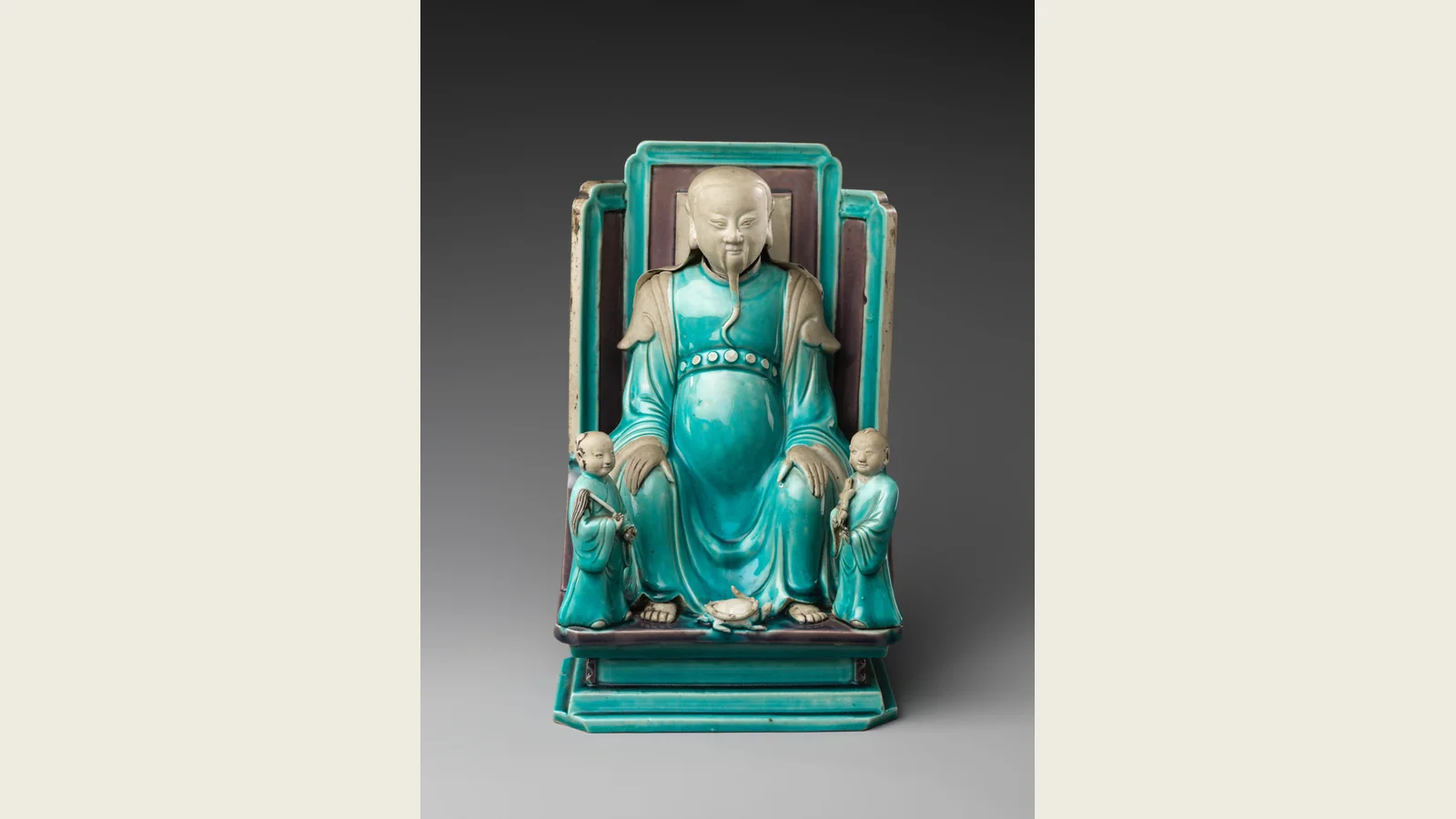
The Met record identifies the seventeenth-century ceramic figure at the top of this page as Zhenwu, the Perfected Warrior, with two attendants. That item-level identification gives the object a stronger evidence chain than visual mood alone.
In other representations, Zhenwu may be associated with the north, the Dark Warrior, martial bearing, loose hair and the entwined tortoise-and-snake motif. Not every feature must appear on every object, and not every warrior figure is Zhenwu. The name becomes reliable through attributes, inscription, provenance and expert comparison working together.
This is the right way to read a temple hall as well. Start with the posted Chinese name and local documentation. Use costume and attributes to confirm, not to overrule, the site.
4. The Eight Immortals: people, attributes and the “hidden” set
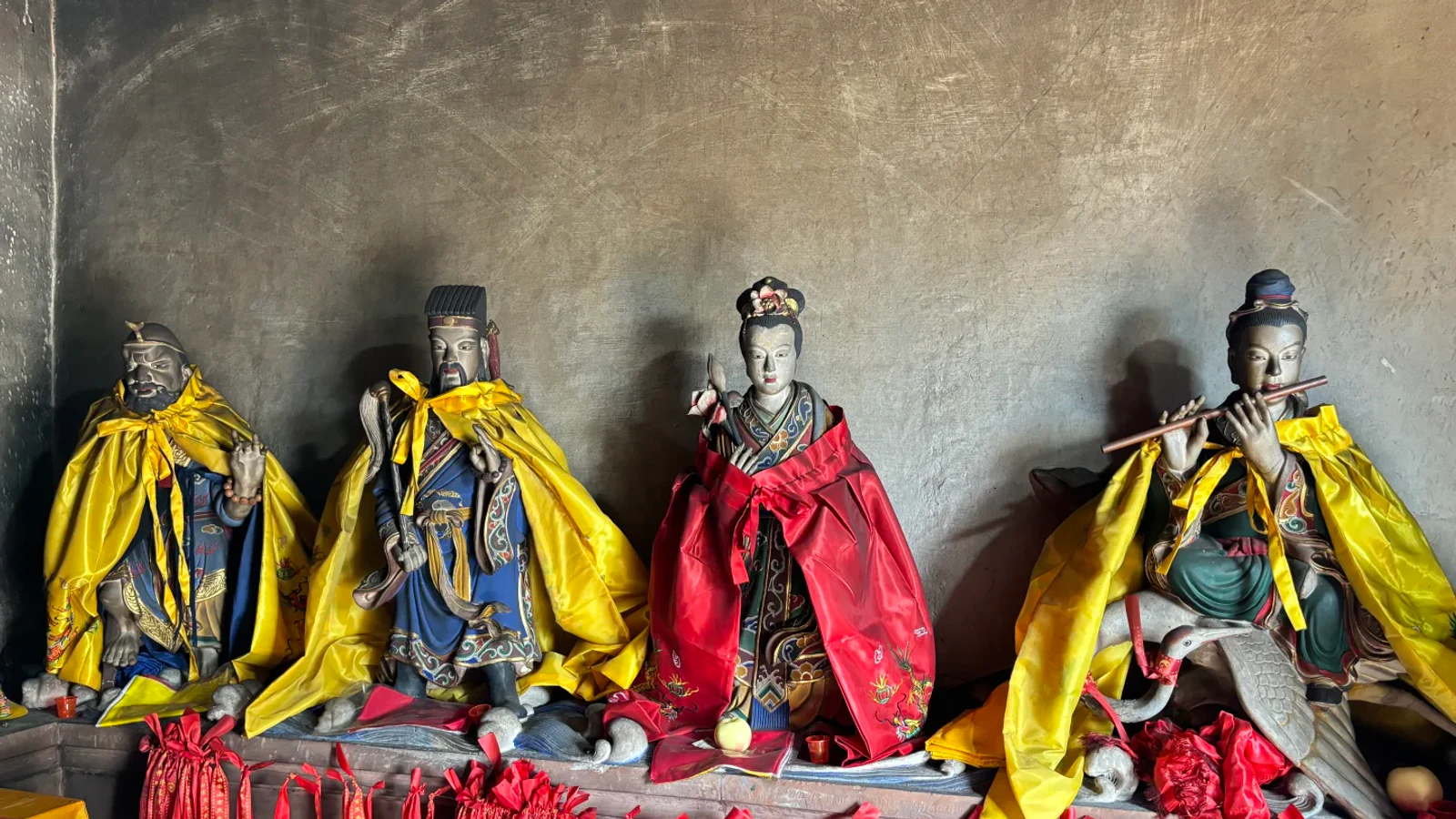
Four figures from the installed group inside the Eight Immortals Cave at Qiyun Mountain. The field photograph establishes a named site and a grouped display; it does not identify every figure without the site's inscriptions and records.
The Eight Immortals (八仙) are a recognizable group in later Chinese art and popular culture. They may appear as figures, as in this cave installation, or through their attributes alone. The attribute-only set is often called the Dark or Hidden Eight Immortals (暗八仙).
Common pairings include a flute, sword, gourd, fan, flower basket, lotus, clappers or court tablet, and a fish drum. Lists and forms vary across objects, so an isolated sword or gourd is not enough. The group becomes visible when several attributes form the expected set or the object record names the figures.
This distinction is useful beyond Daoism. Chinese visual culture often identifies a person through what they carry. Learning attributes turns a crowded object from “many old men” into a specific narrative group.
5. Talismans are ritual documents, not decorative handwriting
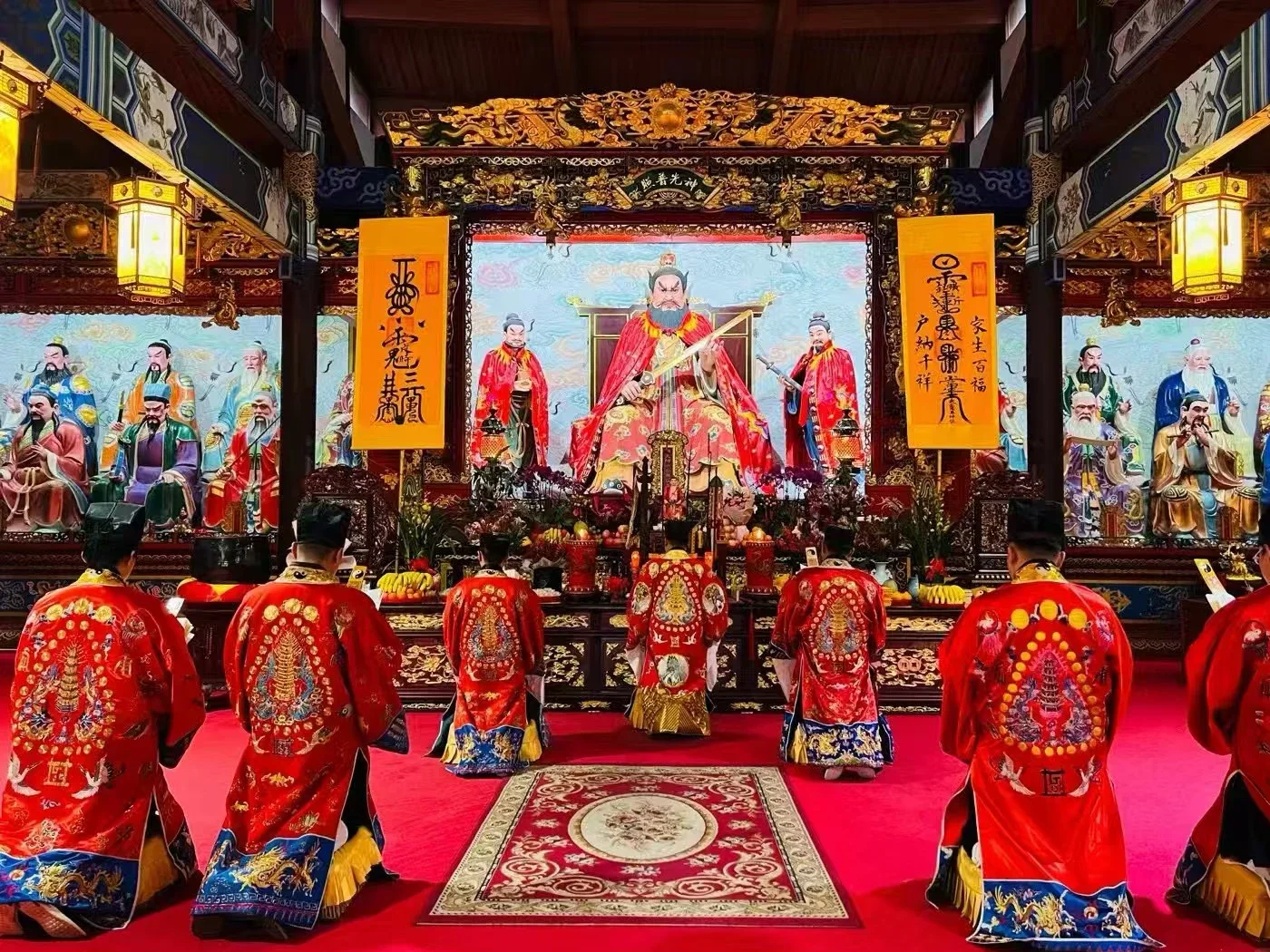
Inside Tianshi Fu, the written forms sit beside deity names, altar space and ritual dress. That surrounding system is evidence; the strokes alone are not.
Daoist fu (符), often translated as talismans, can combine written, drawn and sealed elements. Their production and use belong to particular ritual systems. A talisman may be connected with divine authority, registers, petitions, protection, healing rites or other specific purposes depending on the tradition.
This photograph is exactly why I distrust the internet habit of cutting one yellow strip out of a room and calling it a self-contained “magic symbol.” In the hall, the banners do not float as graphic design. They face an altar, sit among named figures and are encountered through a place with custodians and rules. Remove every relation and the viewer may still copy the line. The viewer no longer knows what the line was doing.
That distinction does not make the photograph a decoder ring. It cannot identify every character or prove what happened in a particular rite. It proves something more basic and more useful: a ritual object receives meaning from people, office, placement and action as well as visible form. Any explanation that supplies a supernatural promise while deleting those four things is selling confidence it has not earned.
Three claims should be avoided:
- “Any red squiggle on yellow paper is a Taoist talisman.”
- “Copying the visible lines reproduces the ritual object.”
- “This design guarantees protection, luck or health.”
The material form, authorized specialist, ritual procedure, inscription and intended use can all matter. A high-resolution tattoo reference preserves the lines while deleting the institution. That may create body art; it does not automatically create the thing the source image once was.
For the same reason, this guide does not provide instructions for manufacturing a talisman. Identification is not ritual authorization.
6. Seals and scripts: authority is part of the meaning
Seals can identify divine, institutional or ritual authority. Specialized scripts may appear on talismans, registers, paintings and temple objects. Their compressed or unusual forms are especially vulnerable to internet reinvention because most viewers cannot read them.
Treat an undeciphered seal as unidentified until a source provides the characters, reading and object context. “Ancient Taoist seal” is a category guess. It may turn out to be a workshop mark, an auspicious phrase, a Buddhist dharani, a modern design or an actual Daoist ritual seal.
The responsible workflow is slower: photograph clearly, preserve orientation, record where it appeared, and ask an institution or specialist who can read the form.
7. Cranes, peaches, clouds, dragons and gourds
These motifs can participate in Daoist stories of transcendence, longevity and immortals. They also circulate across court art, festival imagery, funerary culture, literature, decorative arts and general auspicious design.
| Motif | Possible Daoist connection | Why appearance alone is insufficient |
|---|---|---|
| Crane | Transcendence, immortals, celestial travel | Also a broad longevity and elite-art motif |
| Peach | Longevity and immortal realms | Common auspicious food and birthday imagery |
| Cloud | Celestial movement, divine presence | Ubiquitous in Chinese art and architecture |
| Dragon | Deities, directions, water, cosmic authority | Appears in imperial, local, festival and decorative contexts |
| Gourd | Associated with particular immortals and transformation | Also a practical vessel and broad longevity motif |
This is the page's central discipline: possible connection is not confirmed identity.
8. Color does not carry doctrine by itself
Black and white do not automatically mean yin and yang. Red is not a universal “Taoist color.” Yellow paper does not prove a talisman. Blue robes do not identify every priest or deity.
Color matters inside a documented system of costume, direction, element, rank, material or ritual use. Outside that system, it remains a visible property. Start there.
Tattoos, jewelry and decor: three decisions before using a motif
Can you identify it?
If the only source is a reposted graphic labeled “Tao symbol,” stop. Reverse-search the image and look for an institution, maker or accountable publication.
Are you turning a ritual document into surface style?
A deity portrait, seal or talisman can carry obligations and restrictions in its original setting. Permission to use an image does not automatically settle respectful use of the depicted ritual form.
Are you claiming an effect?
Decor can express taste or interest. It cannot promise protection, healing or spiritual authorization without evidence that a product page almost never supplies.
The safest choices for general design are clearly identified, non-restricted motifs used with accurate language and without supernatural guarantees.
What to notice inside a Daoist temple
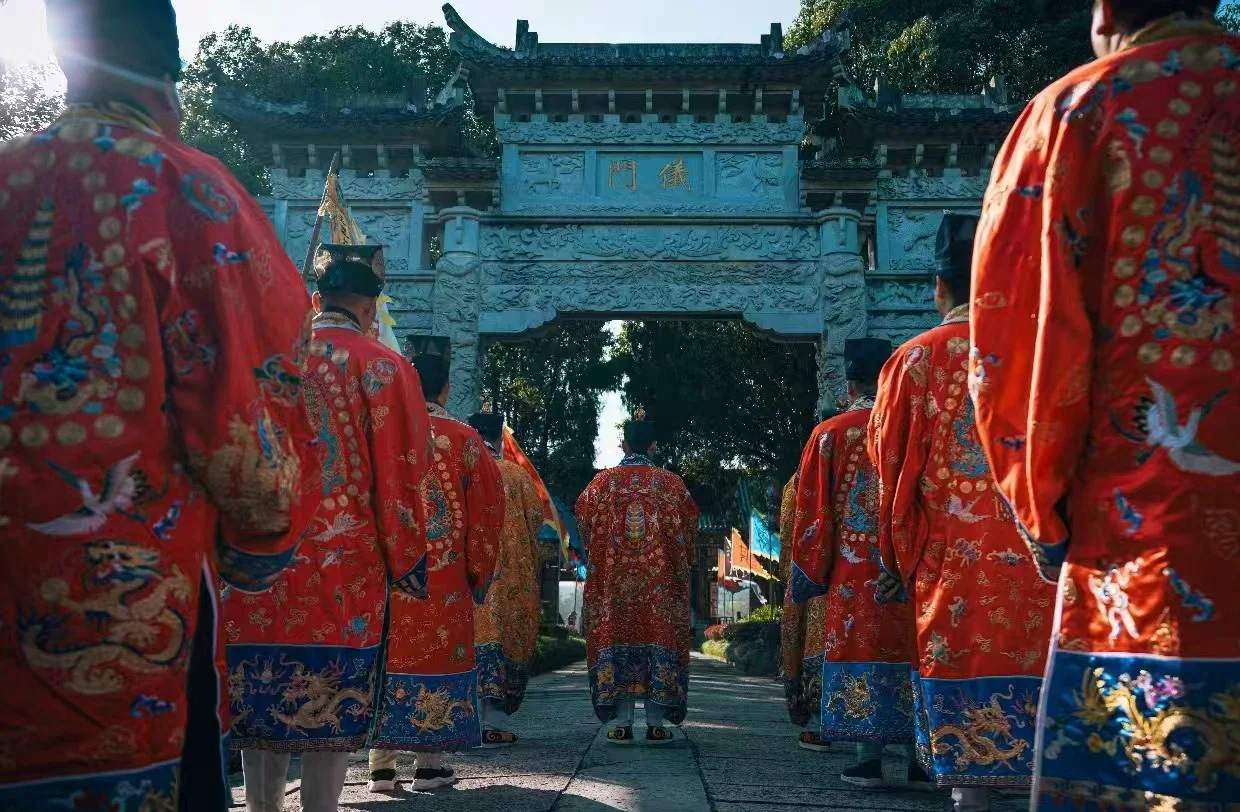
The back of a ritual robe is not generic “Chinese pattern.” Garment, wearer, direction of movement and institutional setting have to be read together.
- Record the temple's full Chinese and English name.
- Read hall plaques and posted deity names before guessing from appearance.
- Look for grouped attributes, directional arrangements and inscriptions.
- Distinguish permanent sacred images from seasonal decorations and visitor merchandise.
- Follow photography rules; ritual participants are not free visual texture.
- Ask what the object does in this place, not only what it “means.”
The robe makes the method concrete. A product listing might isolate the embroidery and label it “Taoist energy.” In the gate photograph, the motif is attached to a body moving through a religious institution. Cut away the wearer and the gate, and the same pixels become a decorative file with an invented backstory. I would rather leave a motif unidentified than give it a romantic meaning that the evidence cannot carry.
The Taoist beliefs guide explains why an object cannot stand in for a creed. The broader Taoism guide places texts and religion in historical relation, and the Chinese symbols hub follows motifs that move across multiple cultural systems.
The symbol market rewards the wrong confidence
Online shops need a product to become searchable in three words. “Taoist protection pendant” sells faster than “modern ornament combining trigrams, clouds and an unidentified seal-script form.” That commercial pressure turns resemblance into attribution, then repetition makes the attribution look traditional.
I reject that shortcut. If a seller cannot name the inscription, deity, ritual use, lineage or documented object being copied, the word Taoist is marketing, not identification. This does not make the object worthless. It makes its claimed history unproved.
The same rule protects living traditions from aesthetic extraction. A talisman is not merely energetic handwriting; production, authorization and ritual setting are part of what it is. Removing those relations while promising luck or protection does not modernize the object. It empties the evidence and keeps the sales pitch.
The Metropolitan Museum's identified Zhenwu figure demonstrates the better standard: named object, material, date range, deity and collection record. The museum entry does not pretend that every tortoise, snake or dark-robed figure automatically proves Zhenwu.
Use the broader Chinese philosophy collection when a motif leads into cosmology rather than a specifically Daoist institution. Context may narrow a claim, but it often reveals a richer network than one religious label.
The conclusion
The strongest Taoist-symbol guide is not the one with the most images. It is the one that knows when to stop claiming. I insist that an honest “unidentified” is more valuable than a confident spiritual fantasy. Identify the form, recover the name, establish documented Daoist use, cite the source and state the boundary. Context is not extra information attached to the symbol. Context is what makes the identification possible.
That standard protects the object, the tradition and the reader from the same lazy certainty.