Taoist beliefs center on living in effective relationship with the Dao, but Daoism has no single creed that erases the differences among classical texts, priestly lineages, temples, deities, rituals and periods. The accurate answer to “What do Taoists believe?” is therefore a map of recurring orientations, not ten rules that every Daoist signs.
The distinction matters because two opposite stereotypes dominate English introductions. One turns Daoism into an atheistic philosophy of relaxing in nature. The other turns it into a fixed pantheon of gods and immortality techniques. Real Daoist history contains philosophy, religion, institutions and cultivation practices without reducing all of them to either picture.
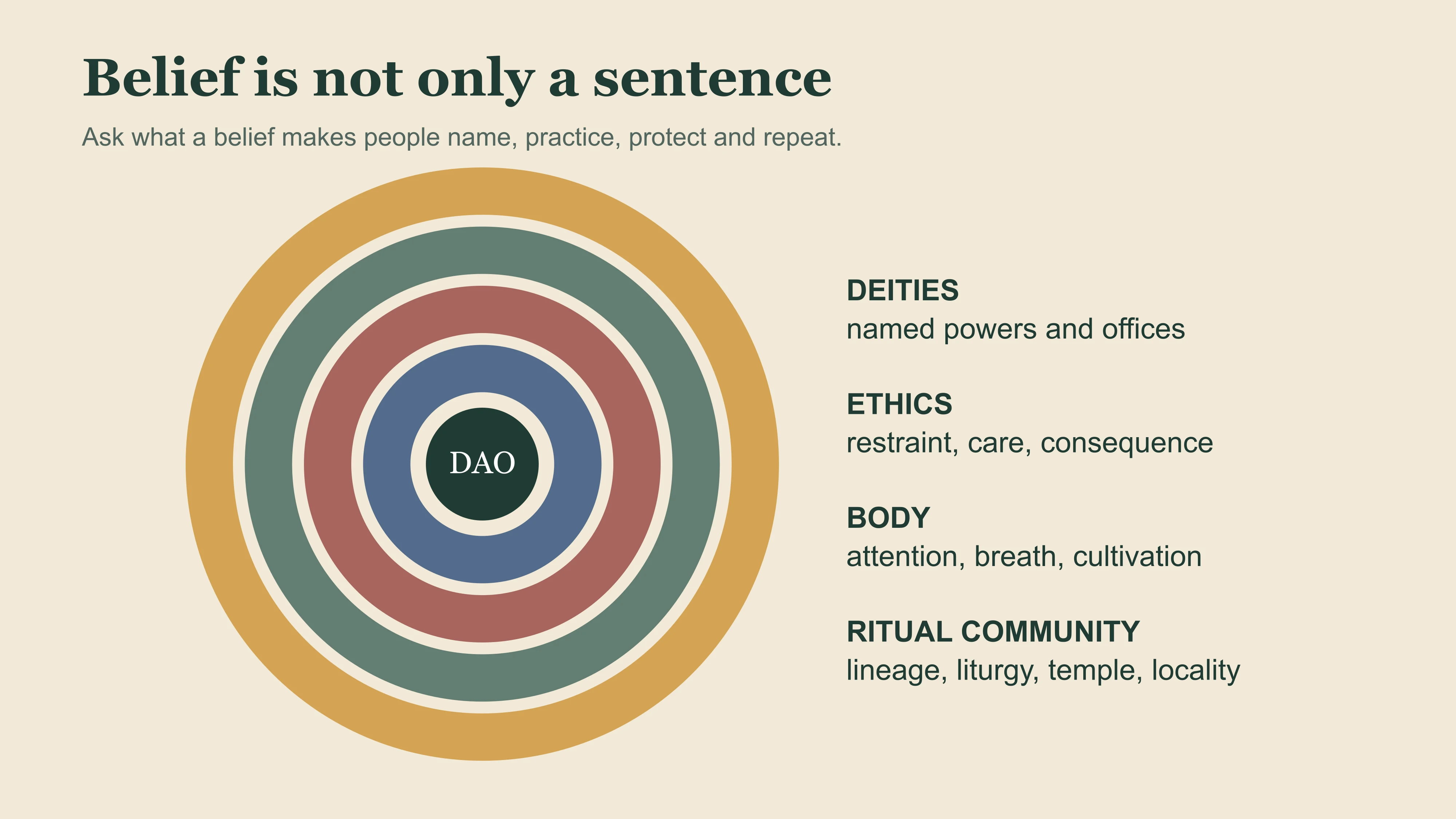
A belief becomes culturally legible when it moves through a text, a body, a ritual and a community—not when an English definition freezes it into one sentence.
Taoist beliefs: the short answer in six questions
| Question | Responsible answer |
|---|---|
| What is ultimate? | The Dao: the course, way or generative ordering through which things arise and move. It is not simply a personal creator god. |
| Do Taoists believe in gods? | Many religious Daoist traditions venerate named deities and divine officials. Texts and communities differ in emphasis and pantheon. |
| How should people live? | With less coercive striving, better timing, disciplined conduct, humility and sensitivity to relationships and consequences. Exact precepts vary. |
| What is the body? | A site of life, breath, attention and cultivation, not merely a shell to escape. Practices differ by lineage and period. |
| What happens after death? | Daoist sources contain multiple models of ancestors, spirits, divine administration, transformation and immortality. There is no single universal chart. |
| Is Daoism “living in harmony with nature”? | Sometimes useful, but too vague unless “nature,” practice and source are named. |
Our conclusion: ask which layer a source describes
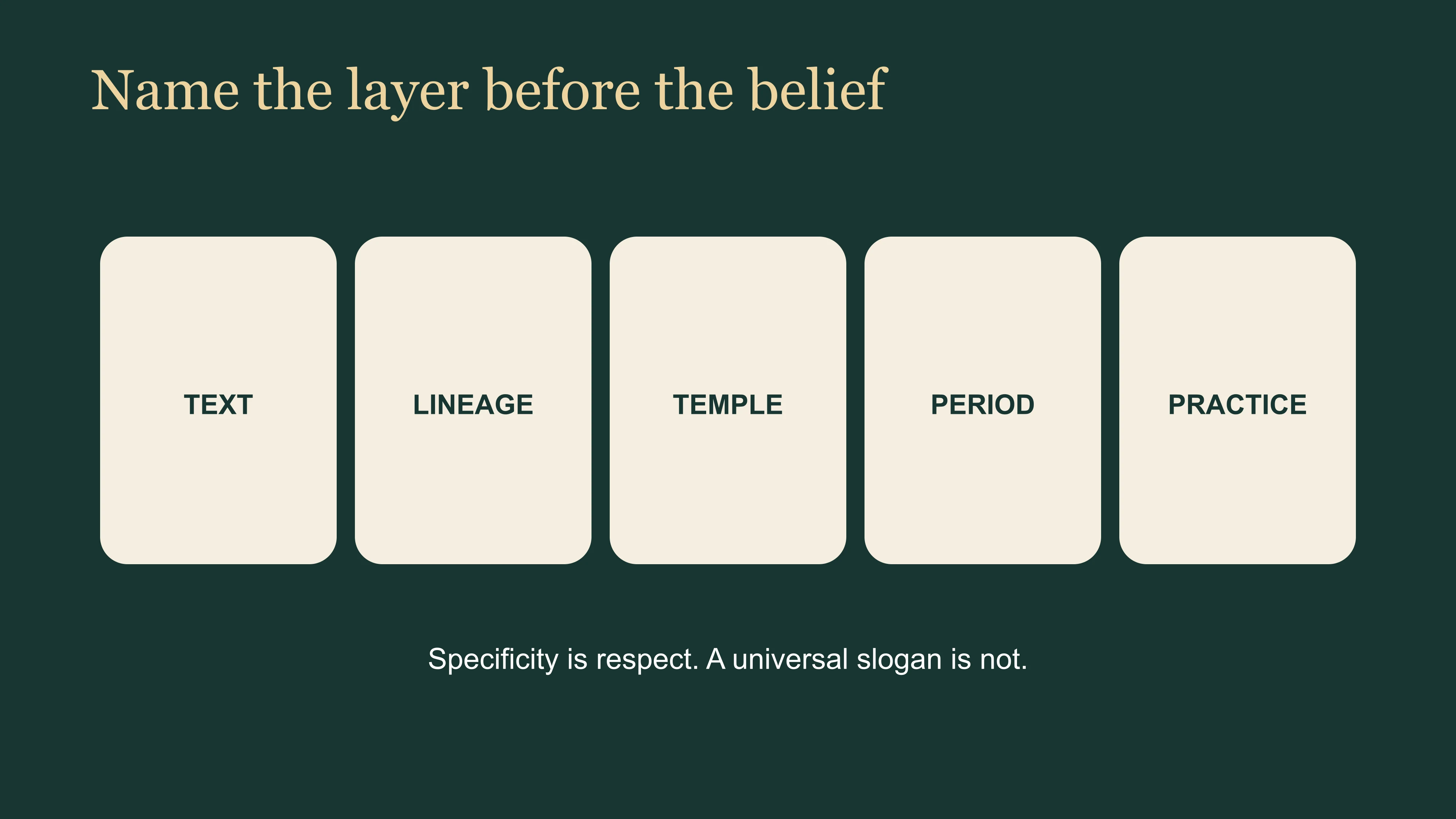

The diagram is a reading tool, not a historical hierarchy. It prevents one common mistake: taking evidence from one layer and pretending it describes the whole tradition.
The Stanford Encyclopedia of Philosophy's Daoism entry is a useful guardrail precisely because it treats the category as a historical argument, not a creed that arrived complete.
- A verse from the Daodejing can support an interpretation of that verse. It cannot prove what every temple teaches.
- A photograph of a deity can document the object's identity and setting. It cannot reveal every worshipper's private belief.
- A modern breathing exercise can show one contemporary practice. It cannot be projected unchanged into the Warring States period.
- A temple regulation can describe an institution. It cannot turn all Daoists into members of that institution.
The phrase “Daoists believe…” becomes trustworthy only after the noun has a scope: which text, community, lineage, place or period?
I insist on this layer test because vagueness is not respect. A claim that names no source, community or period may sound inclusive while quietly inventing a believer who has never existed.
The Dao is not a personal creator god
Dao (道) can mean a road, course, method, teaching or way. In classical Daoist texts, it becomes a way to discuss the generative and guiding course of reality without imagining a lawgiver standing outside creation.
The opening of the Daodejing warns that a dao which can be spoken is not the constant Dao. That does not mean language is useless or that the Dao is an invisible person with a secret name. It warns against confusing a fixed formulation with the ongoing reality it tries to guide us through.
Calling the Dao “God” therefore creates more problems than it solves. The term can help an English reader recognize an ultimate concern, but it imports personality, creation, command and worship in ways the source may not support. Calling Daoism simply atheistic is also misleading, because historical religious Daoism includes rich pantheons, revelations and ritual relations with divine beings.
The precise answer is: the Dao is not normally a personal creator deity, while many Daoist traditions do venerate gods. Those two statements can be true together.
Daoist gods are not interchangeable decorations
The name Sanqing means the Three Pure Ones, high deities in many Daoist traditions. Yet a temple name alone cannot identify every sacred figure inside, establish the site's complete lineage history or tell us what an individual visitor believes. Harvard's Pluralism Project introduction to Daoism is useful here because it treats texts, deities, ritual specialists and communities as a religious field rather than reducing the tradition to one philosophical slogan.
Religious Daoist pantheons can include transcendent deities, celestial officials, immortals, deified historical figures and locally significant beings. Their names, ranks and ritual roles matter. “The god of Taoism” is the wrong singular question, just as “a Chinese god” is too broad to identify an image.
This is also why a living Taoist temple deserves its own reading method. A hall, altar and posted ritual schedule can locate belief inside an institution, but the building still cannot speak for every lineage or reveal the private conviction of every visitor.
The bureaucracy-like language found in some pantheons is not random fantasy. It connects cosmic and social order through offices, registers, petitions, merit and responsibility. But it should not be read as a static copy of one imperial government. Religious systems change, and the same deity can acquire different local narratives and functions.
Laozi can be a philosopher, attributed author and deity
This object makes a distinction that generic introductions often hide. Laozi can refer to:
- the traditional sage associated with the Daodejing;
- an authorial figure constructed around a transmitted text;
- a divine form venerated in religious contexts.
The fifteenth-century metal figure proves that Laozi could be represented as a Daoist immortal in that object's historical setting. It does not prove that the Daodejing began as the scripture of a church founded by one man, or that every reader worships Laozi.
The Taoism vs Daoism guide explains a related language problem: changing the English spelling does not resolve the boundary among Daojia (道家), Daojiao (道教), classical texts and organized religion.
Ethics: less force does not mean no standards
The soft-focus version of Daoism says, “Go with the flow.” That can excuse passivity, convenience or whatever someone already wanted to do. Classical texts are more demanding.
They repeatedly criticize aggressive control, status competition, artificial display and action that defeats itself. Wu wei (无为 / 無為) is not literal inactivity. It points toward action that does not rely on coercive, mistimed or self-defeating force. The person still has to perceive conditions, prepare, respond and accept limits.
The Daodejing also speaks of compassion, frugality and not presuming to stand first. Religious communities developed their own precepts and codes. We should not compress these materials into a universal “Taoist Ten Commandments,” but neither should we pretend Daoism has no ethical demands.
A practical Daoist ethical question is often less “Which abstract rule applies?” and more:
- What pattern is already unfolding?
- Which desire is distorting my perception?
- What action adds unnecessary force?
- What timing allows the smallest effective intervention?
- What consequences return through the relationship?
That is not moral relativism. It is judgment under changing conditions.
The body is part of the religious project
Many Daoist traditions treat the body as a field of breath, vitality, attention, diet, movement, visualization and ritual cultivation. External alchemy historically worked with substances; internal alchemy developed symbolic and bodily practices expressed through technical vocabularies.
Three boundaries are essential:
- Not every Daoist performs the same practice. Lineage and period matter.
- A historical longevity claim is not a modern medical result. This page makes no promise that a Daoist exercise treats disease or extends life.
- Symbolic language is not automatically anatomical description. Terms about furnaces, fields, channels or elixirs can operate within specific systems of practice and interpretation.
The body matters because Daoism often refuses a simple spirit-versus-matter split. Transformation is cultivated within life, relation and embodied process, not only after abandoning the physical world.
Immortality does not have one meaning
“Do Taoists believe in immortality?” invites a yes-or-no answer that the history cannot support.
Daoist materials have imagined immortality as bodily longevity, transcendence, divine status, transformed existence, posthumous continuity or the perfected person's participation in a larger cosmic order. Some stories portray xian (仙), transcendents or immortals, with marvelous abilities. Some practices aim at longevity or refinement. Some texts use death to unsettle the ordinary boundaries of identity.
The responsible conclusion is not that immortality is “only a metaphor,” nor that every Daoist expects the physical body to live forever. Immortality is a family of goals and images whose meaning depends on the source.
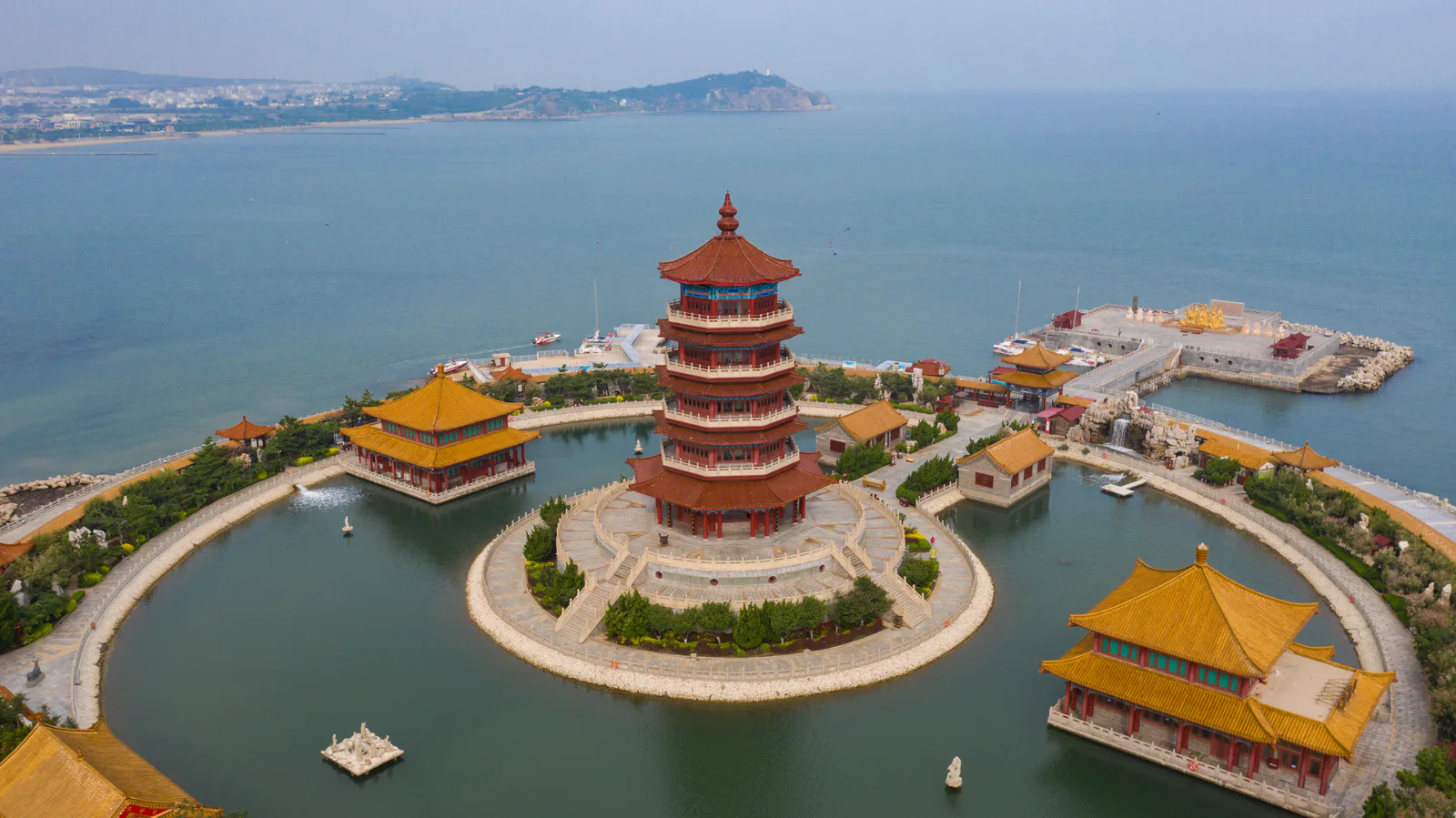
At Penglai, the Eight Immortals have become architecture, waterfront scenery and a visitor route. This East Moment archive photograph proves that immortal stories occupy contemporary public culture. It does not prove a creed, historical event, temple lineage or any visitor's private belief.
I like this image because it refuses the false choice between “serious religion” and “mere legend.” The Eight Immortals can appear in ritual, opera, painting, household storytelling and a coastal attraction without meaning the same thing in every setting. If an English explainer points at this complex and says, “Taoists believe humans literally become superheroes,” it has learned nothing from the photograph. The visible fact is circulation: a religious and literary imagination has moved into tourism, architecture and family memory. Interpretation still has to name the layer.
This also protects readers from commercial misuse. A product, retreat or teacher invoking “ancient Daoist immortality” has not established lineage, safety or efficacy merely by using traditional vocabulary.
Death and the afterlife: several systems coexist
Daoist religious worlds can include ancestors, spirits, celestial administrations, judgment, merit, registers and rites for the dead. These worlds have interacted with local religion, state ritual, Buddhism and changing social institutions.
That interaction makes a single afterlife diagram especially misleading. A family funeral may contain practices with more than one historical source. A deity shared across communities may be classified differently by participants and scholars. A temple rite has trained specialists, liturgical texts and local purposes that a generic “Chinese afterlife” chart cannot recover.
If a source claims “Taoists believe that after death everyone goes to…,” ask immediately:
- Which community?
- Which scripture or ritual manual?
- Which period and region?
- Is this the scholar's description, the institution's teaching or a participant's personal account?
Specificity is respect. Vagueness only looks inclusive.
A temple is a working institution, not proof of one creed
A Daoist temple marks a threshold into an identified institution. A visitor can read names, spatial sequence, incense practice, halls and sacred images as evidence. Yet the building does not behave like a printed catechism.
Temples organize specialists, offerings, festivals, maintenance, local memory and relations with visitors. Belief is carried through actions and institutions as well as propositions. Asking only “What sentence do Taoists believe?” misses how religion is practiced.
The Taoist temples guide owns the full visitor and spatial-reading intent. Its threshold field note turns respectful curiosity into six observable details. The safest visitor habits remain simple: identify the site, read posted rules, do not photograph restricted ritual or people without permission, and do not assume a familiar-looking statue is the deity you remember from another temple.
Is Daoism about harmony with nature?
Yes, if the phrase opens a precise question. No, if it ends the explanation.
The English word “nature” can mean wilderness, environmental systems, an organism's tendencies or everything not made by humans. Classical Chinese terms such as ziran (自然, often “self-so” or spontaneity) and tian (天, sky/heaven/natural order) do not map neatly onto one modern environmental slogan.
Daoist suspicion of over-control can support powerful ecological thought. But it does not automatically make every historical Daoist text a modern conservation document. The better move is to connect a specific passage or practice to a specific environmental question and show the reasoning.
How to answer “What do Taoists believe?” well
Use this five-part sentence:
In [named text, lineage, temple or period], Daoist practitioners or writers understand [specific idea] through [practice, story, deity or argument], which matters because [consequence]; this does not necessarily describe [boundary].
For example:
In many religious Daoist settings, named deities are approached through temple ritual and liturgy; this shows that Daoism cannot be reduced to an atheistic philosophy, but it does not establish one pantheon or one private belief shared by every Daoist.
That sentence is longer than “Taoists believe in balance.” It is also useful.
Continue to the broad Taoism guide for texts and history, the Taoist symbols guide for visual identification, and yin and yang for a concept that belongs to a wider Chinese cosmological history rather than one tradition alone.
The conclusion
Daoism is coherent enough to study and diverse enough to resist a one-page creed. Its recurring questions concern the Dao, effective action, transformation, ritual order, the body, mortality and life within changing relations. The right response to that diversity is not vagueness. It is disciplined naming: text, deity, lineage, practice, site, period and boundary.
Return to the Chinese philosophy collection when you want to compare this practice-first method with Confucian and wider Chinese cosmological questions. In the discussion, do not submit a slogan. Map one belief to the action, object, place or text that actually carries it.