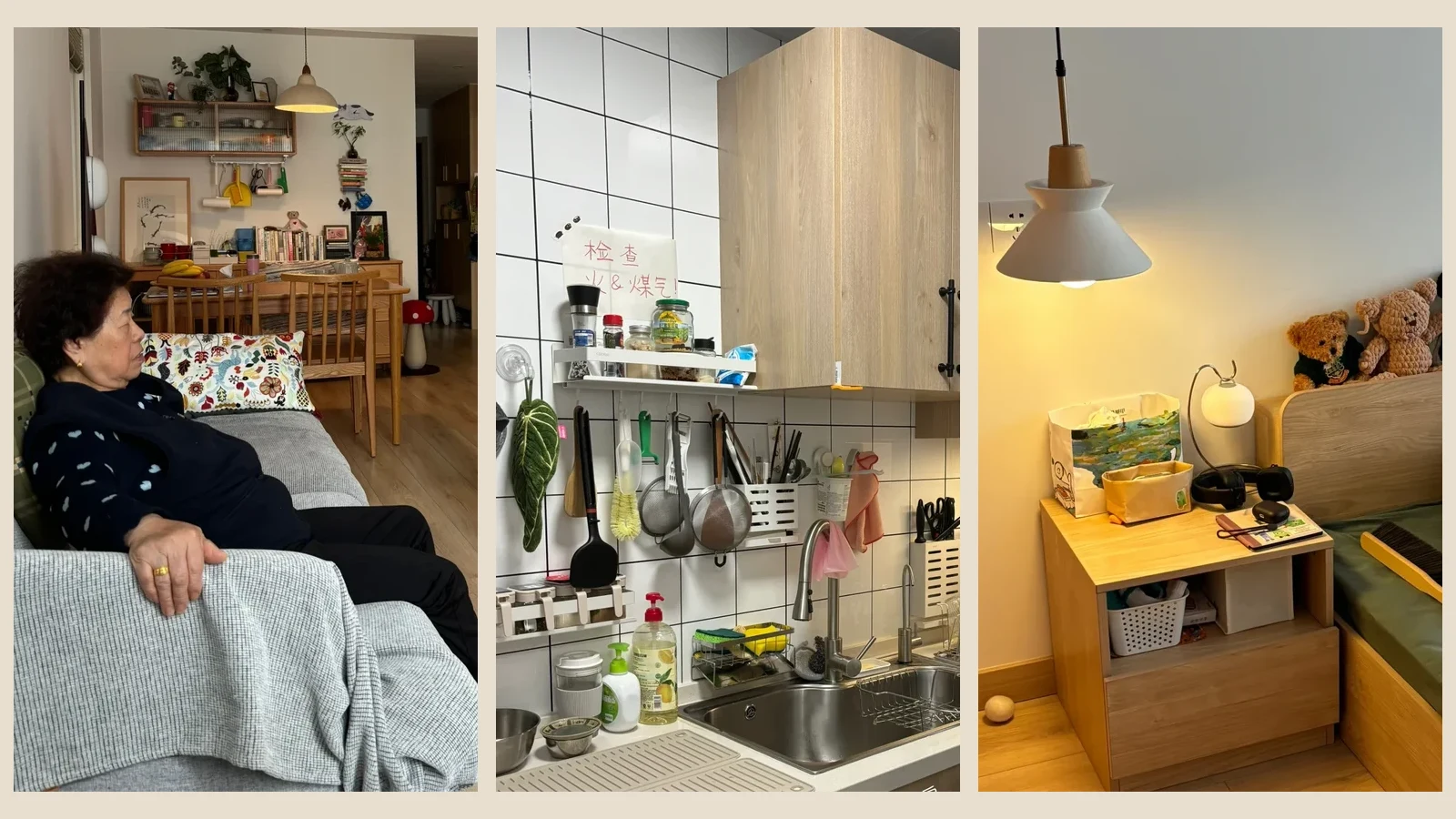
Wu wei does not mean doing nothing. It means refusing the kind of effort that is coercive, badly timed or so self-absorbed that it destroys the conditions it needs to succeed. The hard part is that this takes more attention, preparation and courage than simply pushing.
That is why wu wei is useful and so often misused. “Non-action” looks beautiful on a wall. In a real decision, it asks a much less relaxing question: am I helping this move, or am I trying to prove that I can make it move?
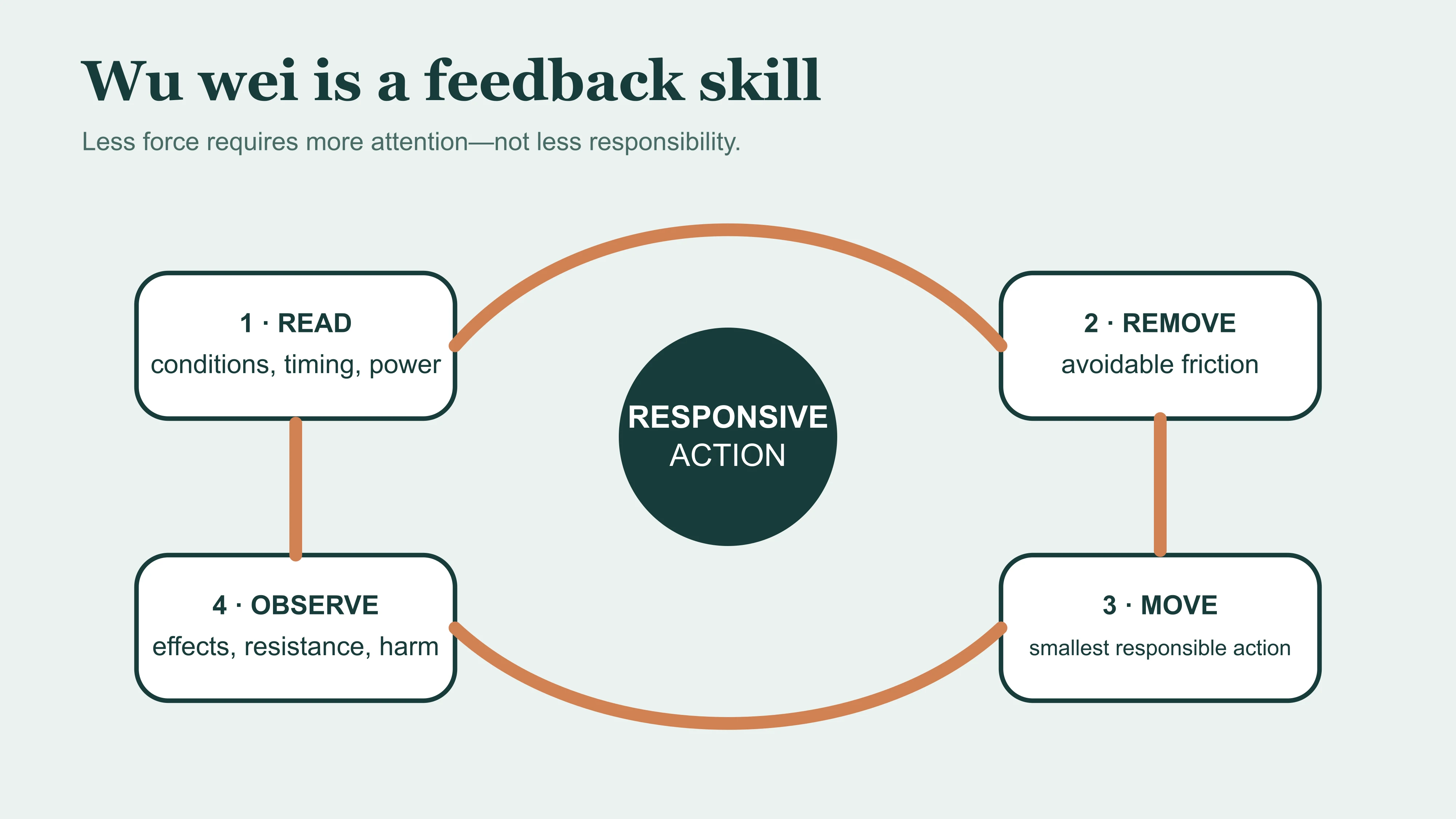
Non-forcing is a feedback discipline: read the conditions, remove useless friction, make the smallest responsible move, then look honestly at what changed.
What is wu wei?
Wu wei (无为 / 無為, roughly “woo way”) is a classical Chinese term often rendered as non-action, non-forcing or uncontrived action. In Daoist texts, it criticizes action driven by compulsive control rather than a careful reading of conditions.
The translation “doing nothing” is too literal to be useful. A farmer who ignores a field, a manager who avoids a necessary decision, or a friend who refuses to speak when someone is being harmed is not practicing a profound Daoist method. They may simply be absent.
Wu wei asks whether action fits the situation so well that it does not create unnecessary resistance. The Daodejing keeps returning to this problem in images of water, empty space, smallness and restraint. They are arguments about the cost of grabbing too hard, not instructions to float through a life someone else has organized for you.
A tea pour is not a historical proof of wu wei. It is a useful contemporary analogy: the hand must still decide temperature, angle, pace and when to stop. The ease that looks effortless depends on attention to conditions. Our gaiwan guide shows the same difference in practical terms—control is not the same as force.
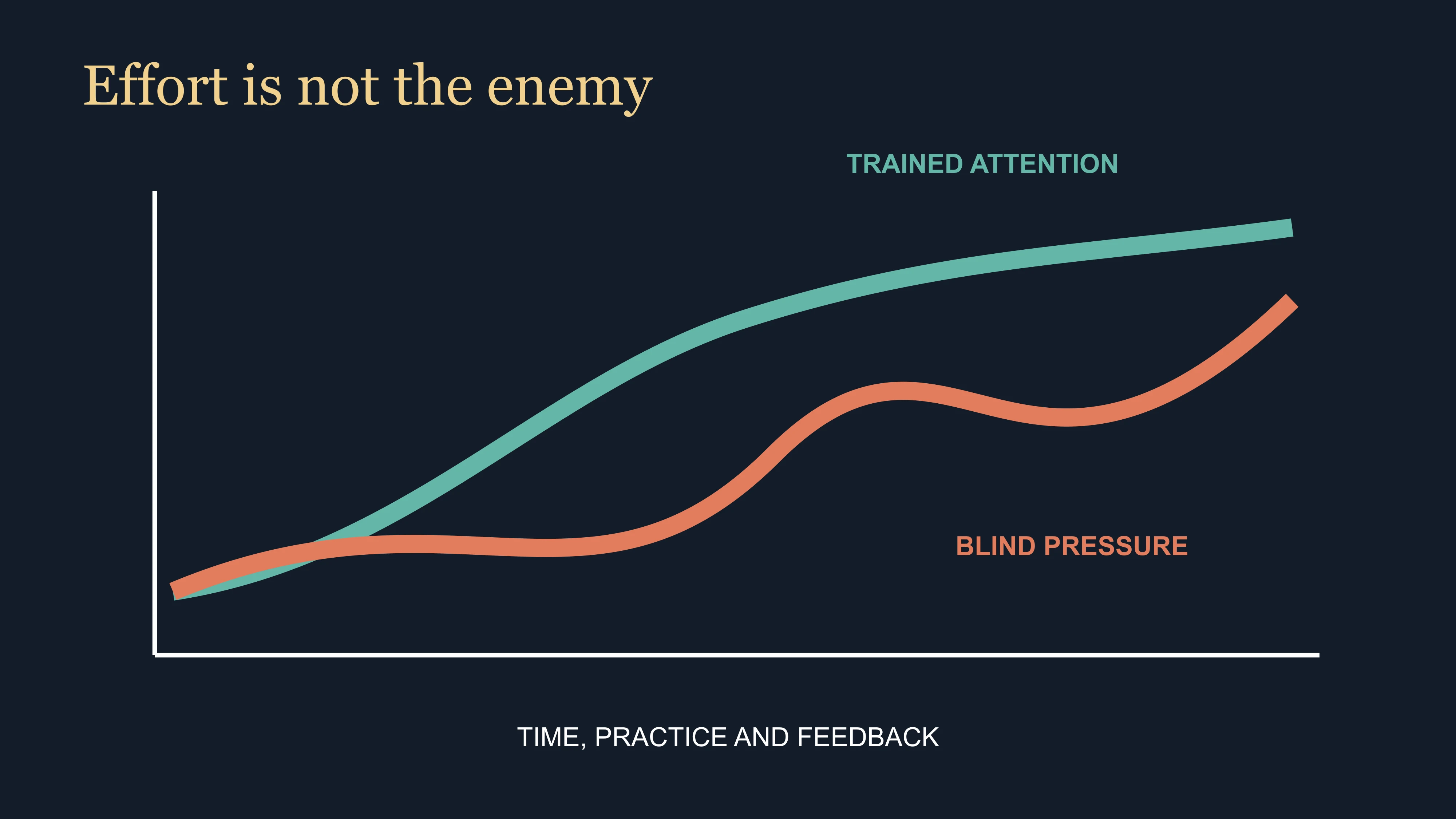
The opposite of wu wei is not effort. It is blind force.
People often hear wu wei as an excuse to abandon ambition. Classical Daoist writing is more suspicious of a particular kind of ambition: the urge to impose a pre-decided outcome on a changing world and call the collateral damage “decisiveness.”
Imagine three people facing the same closed door:
| Response | What it looks like | What wu wei asks instead |
|---|---|---|
| Force | Keep shoving because movement feels like progress | Is the door actually locked, or are you ignoring its hinge, handle or timing? |
| Withdrawal | Walk away because any effort feels inauthentic | What responsibility remains even if force is the wrong tool? |
| Attuned action | Inspect, prepare, ask, return, change the conditions | What is the least coercive action that still meets the moment? |
The third response is the one people skip because it lacks a dramatic slogan. It might mean learning a skill before making a demand, reducing the scale of a plan, waiting for information, changing the environment, or admitting that a fight cannot be won by volume. It is not passive. It is disciplined enough to stop mistaking pressure for intelligence.
Why the Zhuangzi makes this idea feel alive
The Zhuangzi does not hand you a tidy definition and then let you leave. It uses stories of cooks, swimmers, trees and impossible transformations to make expertise visible as responsiveness. The famous butcher story is not about supernatural knife skills. It is about someone whose long practice lets him follow the natural spaces in a body rather than hacking through it as though every obstacle were the same.
That story matters because it removes the romantic fog. The butcher's ease is trained. He has watched, failed, adjusted and learned where not to cut. Wu wei is not the absence of technique; it is what technique becomes when it no longer needs to show off how hard it is working.
The later Neijing Tu should not be collapsed into the Zhuangzi, nor should it be used as health instruction. It earns a place here for a narrower reason: it makes visible how Daoist traditions kept thinking with changing relationships—between body and landscape, cultivation and cosmos—rather than treating the self as a machine that can be fixed by force alone.
Wu wei begins before the visible action
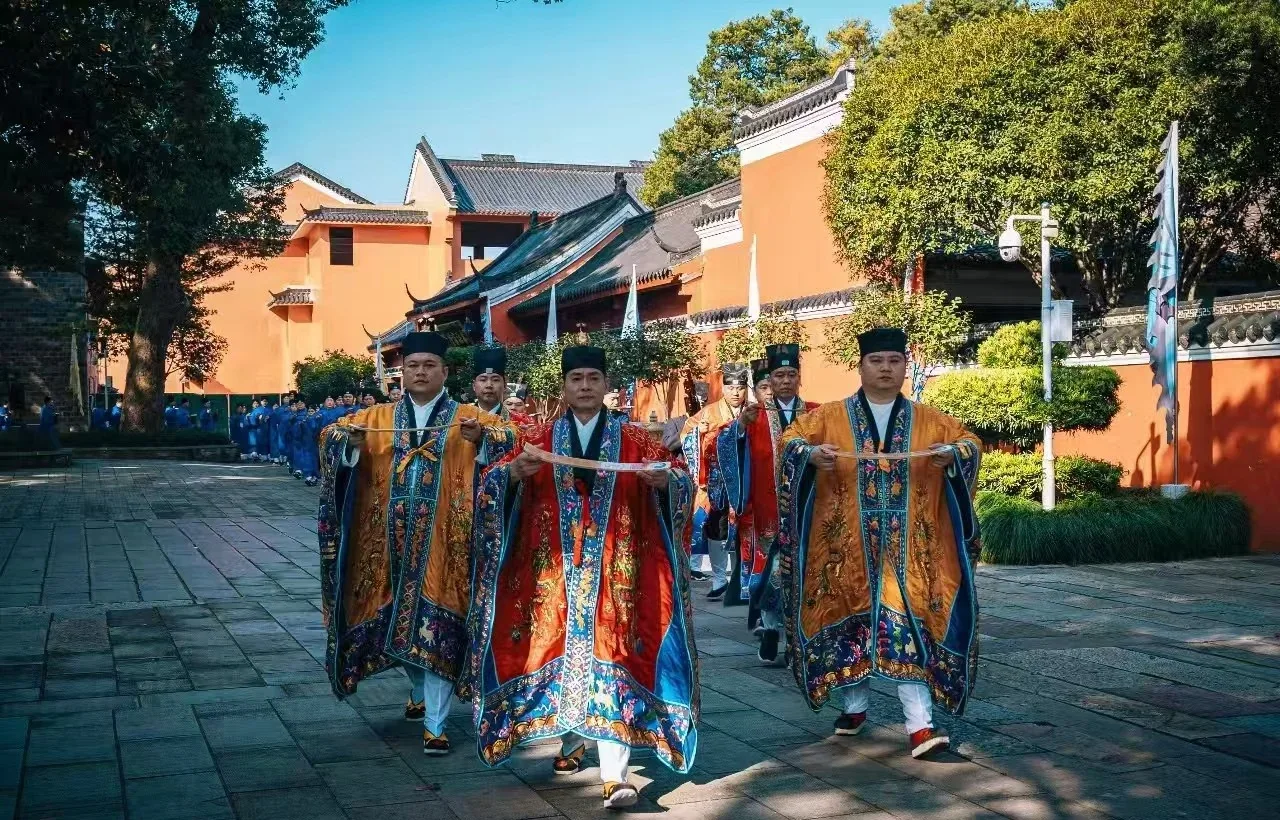
This procession does not prove that every participant understands the event through the term wu wei. It proves something narrower and more useful here: an action can look composed only because bodies, roles, spacing and timing were prepared before the visible moment.
The part most people call effortless is usually the final ten percent. Before the butcher's knife appears easy, there is long attention. Before a musician enters a phrase without strain, there are scales, listening and muscular correction. Before a difficult conversation becomes simple, someone has separated the actual request from the speech they were preparing to win.
That hidden preparation is essential. If wu wei meant the absence of work, beginners would be its masters. They are not. A beginner often uses too much pressure because pressure is the only feedback they can recognize. Skilled action becomes lighter because perception becomes finer.
I distrust every version of wu wei that flatters people for being unprepared. Arriving late, refusing to learn a tool, ignoring a promise or leaving emotional labor to someone else is not alignment with the Dao. It is dependence disguised as wisdom. Non-forcing begins with enough competence to notice which force is unnecessary.
The feedback loop in the visual above therefore starts with reading conditions. It does not start with withdrawal. You observe timing, material, power and consequence; remove friction that serves no purpose; make the smallest responsible move; then watch what changed. If nothing changed, the lesson is not automatically to become even softer. You may have misread the condition or avoided the necessary boundary.
Four cases where “try harder” is the wrong instruction
Learning. Repeating the same error at greater speed does not create mastery. Reduce the movement, slow the feedback, isolate the weak transition and rebuild. The effort remains real, but it stops feeding the mistake.
Creative work. Forcing a final form too early makes every new observation feel like sabotage. Make a small version, expose it to reality and let the material answer. This is not waiting for inspiration. It is refusing to protect an imagined masterpiece from useful evidence.
Relationships. Ten explanations cannot manufacture consent or trust. State the request, hear the refusal, clarify the consequence and stop using eloquence as a lever. Less force can reveal that agreement was never available—and that a boundary, not persuasion, is the honest next action.
Organizations. More reporting can reduce knowledge when workers learn to perform metrics instead of describing problems. Remove the ritual that punishes bad news, shorten the decision path and see whether information improves. Wu wei is brutally practical here: if management creates resistance, management must stop congratulating itself for overcoming that resistance.
These cases share one pattern. The actor is not asked to care less. The actor is asked to stop spending effort on preserving an image of control.
Wu wei has a moral limit: do not use it to abandon people
This is the boundary most online versions erase. “Let things unfold” can be wise when you are over-managing a conversation, a creative process or a plan that lacks information. It becomes evasive when someone has less power, needs protection, or faces harm that will not correct itself.
You do not answer a colleague's harassment, a child's danger, a broken promise or an unjust rule with an aesthetic shrug. The question changes from “How can I avoid forcing this?” to “What action is necessary, proportionate and answerable to the people affected?” That may involve directness, conflict, institutions and sustained work.
This does not betray wu wei. It applies its sharper lesson: force is not automatically strength, but neither is silence automatically wisdom. The relevant contrast is not action versus inaction. It is responsive action versus ego-driven compulsion.
A useful way to test the idea in daily life
Before reaching for more pressure, ask four questions:
- What am I actually trying to move? A person, a deadline, a habit, a system, or my own anxiety?
- Which condition is missing? Skill, trust, information, consent, time, resources or a clear boundary?
- What does less force make possible? Listening, practice, a smaller experiment, a better request, or a necessary pause?
- What cannot wait? Non-forcing must not become a disguise for avoiding a responsibility.
These questions will not solve a hard situation for you. They do something more honest: they reveal whether “trying harder” is an intervention or a performance of control.
The force-to-feedback test
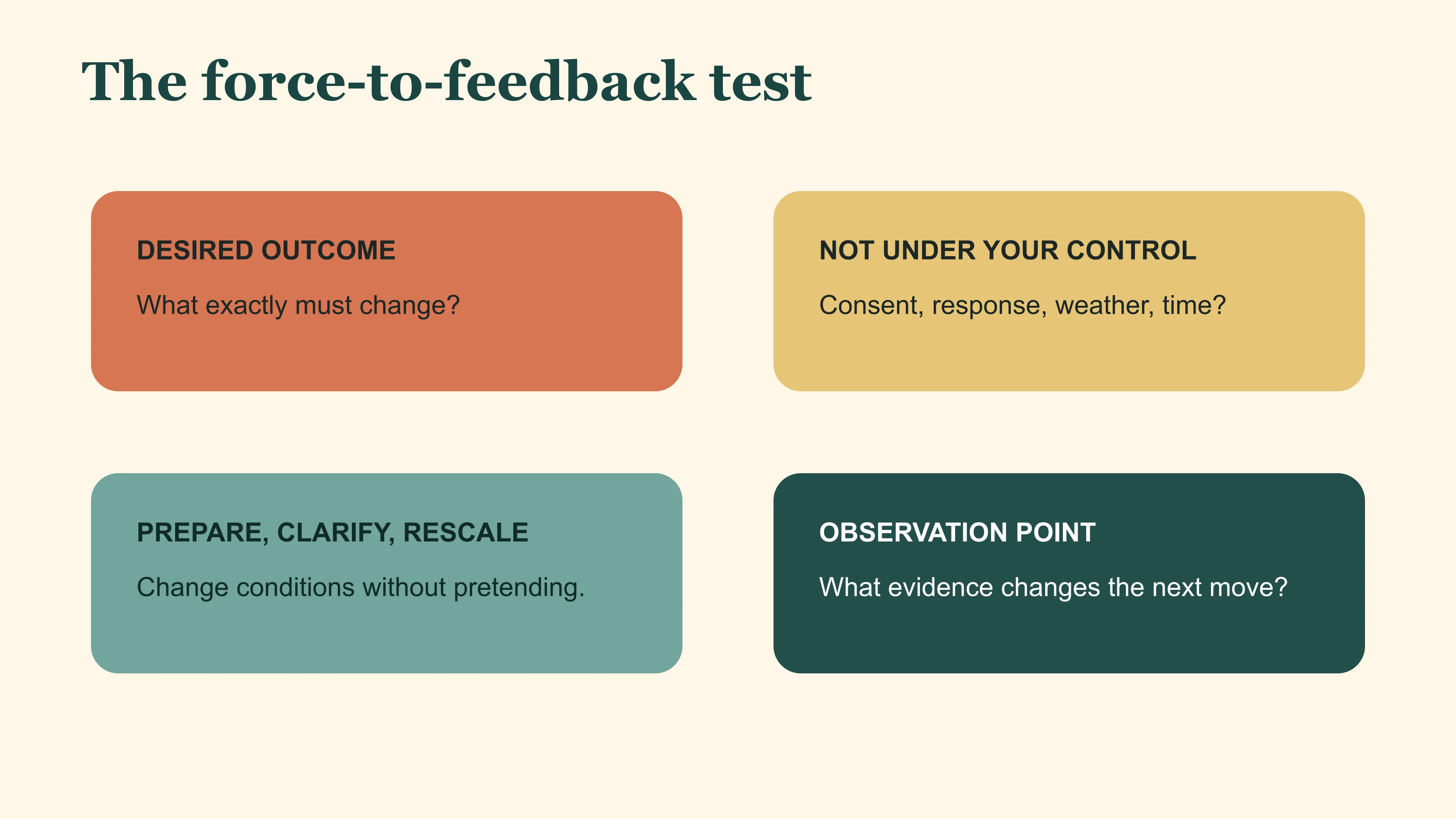
Use this test on one decision, not on your entire personality.
First, write the outcome you want in one sentence. Then list the condition you do not control: another person's consent, a market response, weather, recovery time, a child's development, a material limit. If your plan requires that condition to obey your schedule, you have found the forcing point.
Next, identify what you do control: preparation, clarity, scale, timing, environment, the quality of a request and the boundary you will keep. Choose one change that improves those conditions without pretending to command the rest.
Finally, set an observation point. What evidence would show that the smaller move helped? What evidence would require firmer action? Without feedback, “non-forcing” becomes a story you tell about yourself. With feedback, it becomes a method that can admit error.
This is also where wu wei differs from generic productivity advice. The purpose is not to extract the same output with less visible effort. Sometimes the desired output is itself the problem. A team may need fewer features, a relationship may need a clear ending, and a creative project may need a different question. Efficiency can optimize a bad direction. Wu wei asks whether the direction deserves your force.
What wu wei cannot decide for you
The concept cannot supply your values. It can expose coercion, mistiming and self-defeating effort, but it cannot decide whose safety matters, which promise binds you or what justice requires. Those judgments need ethical and political reasoning beyond one Daoist term.
That boundary is a strength. Chinese concepts become ridiculous when imported as total operating systems. The Taoism versus Confucianism comparison shows why attention to relationship and obligation must remain beside the critique of force. The wider Chinese philosophy collection gives that conversation room to continue.
Use wu wei where it is sharp: when effort is multiplying resistance, when status is pretending to be competence, when a fixed plan refuses new information, or when a smaller action can reveal more than a louder one. Do not use it to make abandonment sound elegant.
Wu wei is not a brand of calm
Modern wellness culture often photographs Daoism as mist, mountains and a person who has never received a difficult email. The actual intellectual challenge is rougher. Wu wei asks you to give up the narcotic pleasure of forcing every problem into a shape that flatters your will.
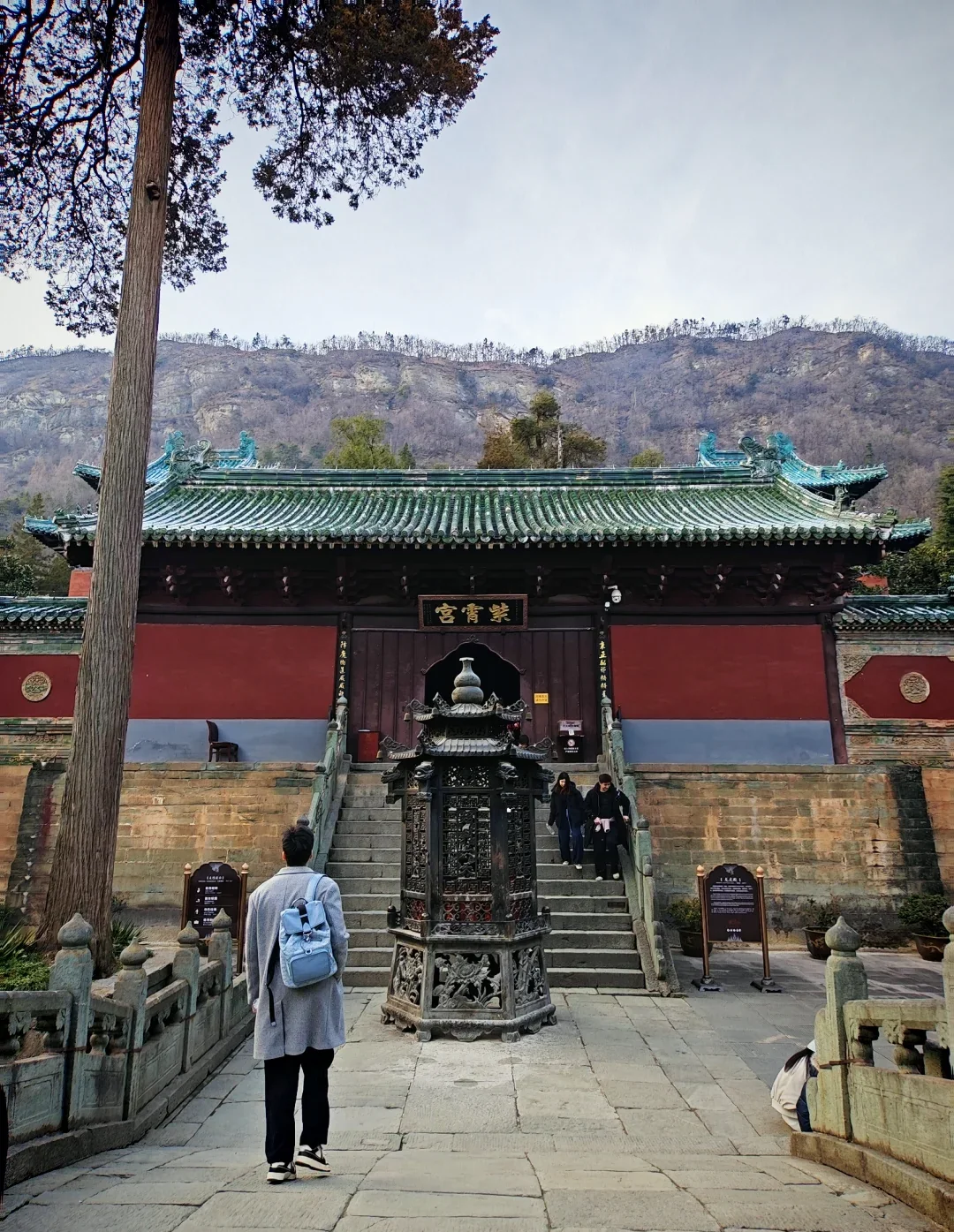
This ordinary arrival is more honest than another fantasy of a solitary sage above the clouds. People enter, read signs, climb steps, pause at an incense burner and move around one another inside a maintained institution. The photograph cannot establish anyone's belief or define wu wei. It does puncture the imported wellness fantasy: Daoism also exists amid architecture, visitors, rules, labor and public life.
The Taoism guide places the concept within a tradition that includes texts, temples, rituals and communities; the Taoist texts guide explains why one translated phrase cannot carry that whole world. Read them before making wu wei your personal operating system.
What survives the simplification is still powerful: the best action is often not the loudest one. It is the action that sees where pressure is waste, where preparation is care, and where a firm response is finally required.