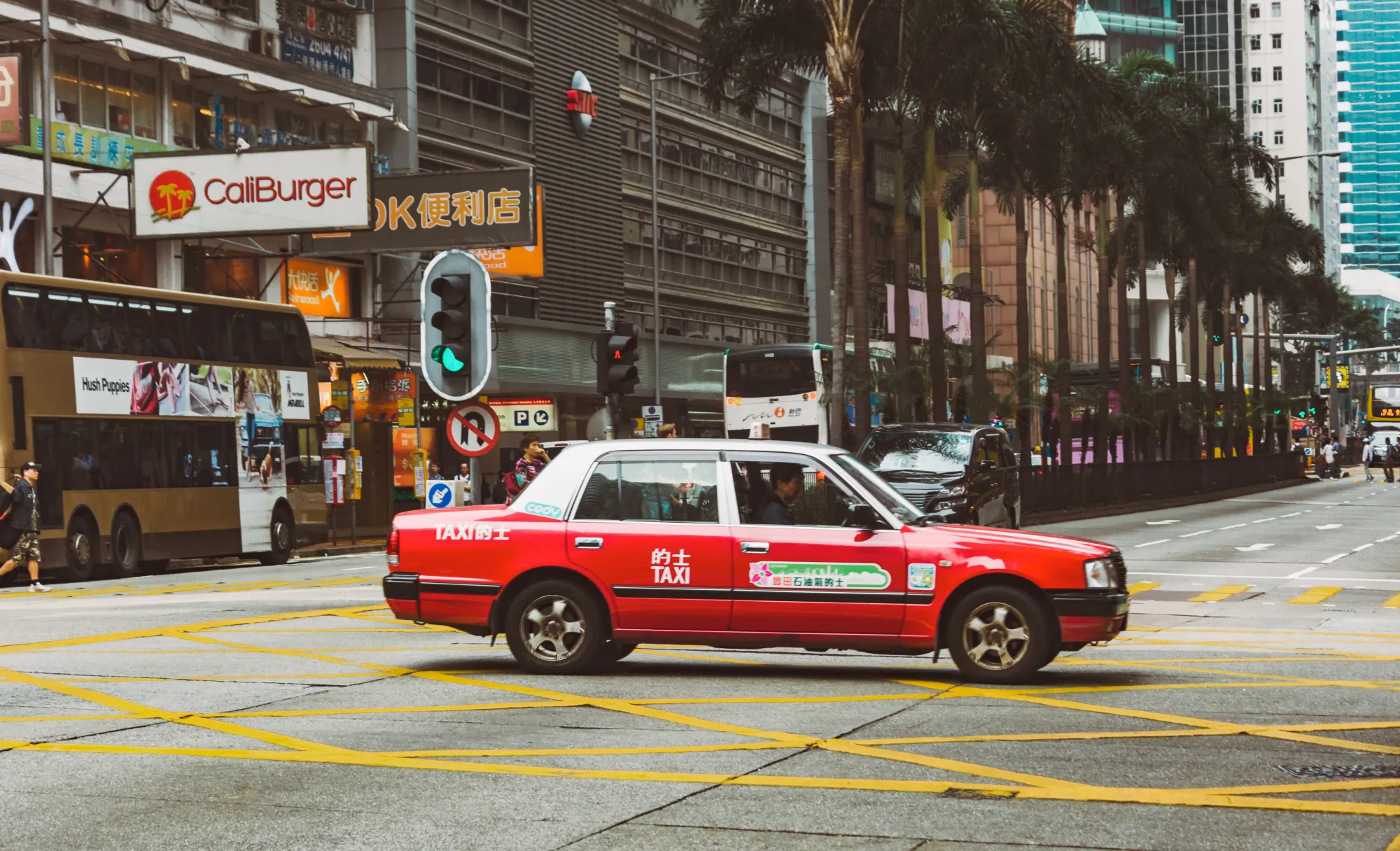
Chinese cultural differences are most often misread because people keep trying to explain China with an East-versus-West scorecard. The useful comparison starts closer: a Chengdu tea house, a Quanzhou temple district, a Shanghai footbridge, a family table, a workplace chat. The same gesture can mean something different when place, language, generation and relationship change. That is the real comparison worth learning.
Chinese cultural differences cannot be reduced to an East–West duel
Most culture-comparison content gets China wrong before it begins. It places "Chinese culture" on one side and "Western culture" on the other, then starts assigning personality traits: indirect versus direct, collective versus individual, traditional versus modern. The chart looks efficient. It also flattens people into an airport-lounge quiz.
I believe the strongest way to understand Chinese cultural differences is to compare contexts before countries. Begin inside China: Chengdu does not behave like Shanghai; a Minnan family history does not duplicate a northern wheat-growing region; an office conversation is not a festival meal. Then move outward to the actual people, places and decisions being compared.
That does not mean difference is imaginary or that every answer is "it depends." It means a useful answer has a boundary. "What does this invitation mean in this relationship?" is a better question than "Are Chinese people indirect?" The first can lead to attention. The second usually leads to a stereotype with a flag attached.
The Hong Kong street in the cover makes the rule visible before any diagram does. A red taxi, double-decker buses, bilingual signs, convenience retail and dense housing share one frame. A viewer who calls it simply “Chinese” has already discarded language, colonial history, transport design, commerce and neighborhood scale. Place, language, relationship, moment and power must enter the frame before nationality. Skip those lenses and a confident comparison becomes a stereotype before the first paragraph is finished.
The wider Chinese culture guide gives the long view. This page is a field guide for comparing without turning that long view into a pile of personality labels.
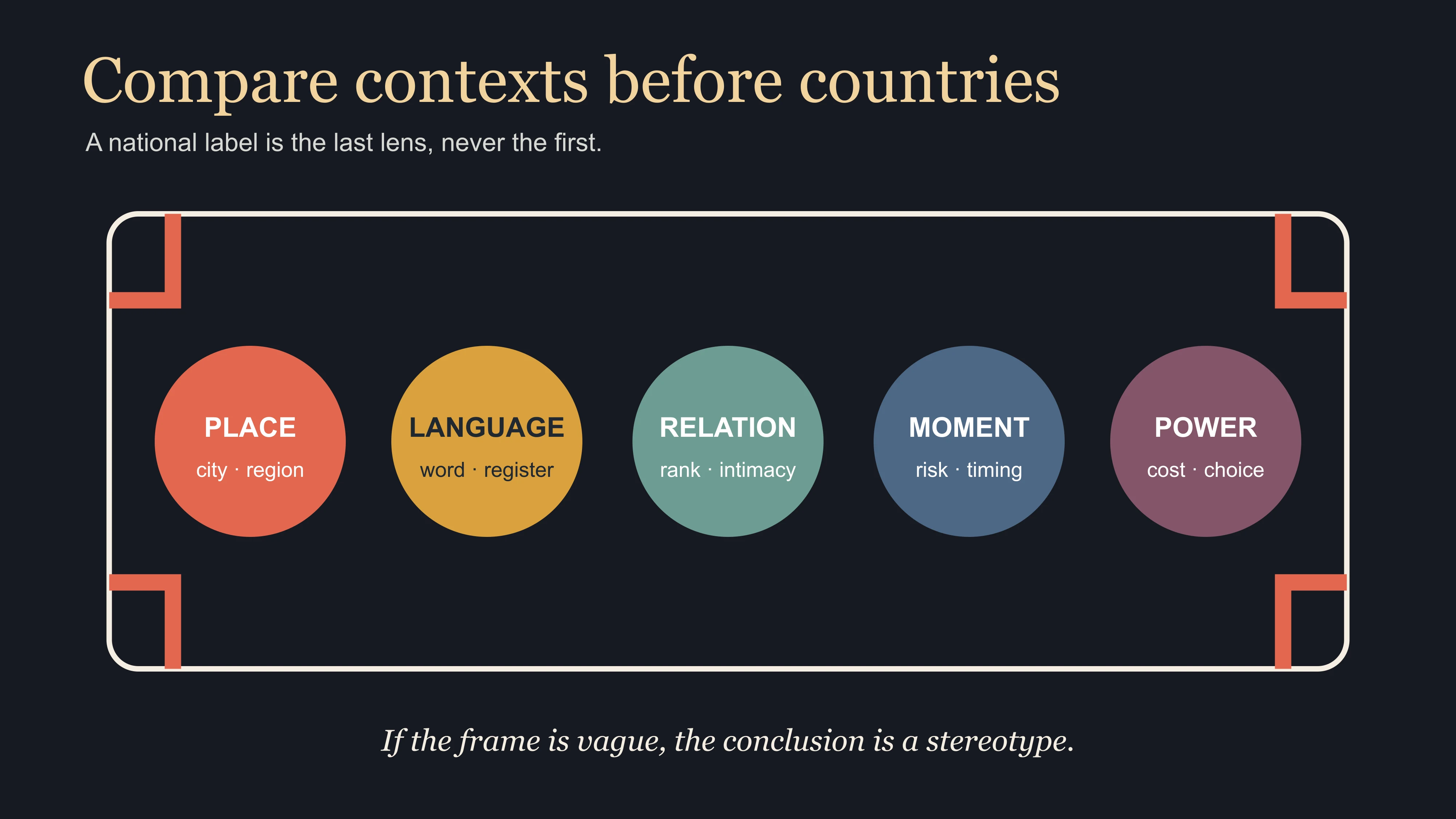
The five lenses are a brake on national stereotypes, not a formula that explains every encounter. They tell us what evidence a comparison still lacks before it becomes confident.
Start with scale: city, language, relationship, moment
One national label hides several scales of difference. A good comparison names which scale matters before drawing a conclusion.
| Before making a claim, ask | Why it changes the answer | A better move |
|---|---|---|
| Which city or region? | Food, climate, language, migration and local history shape ordinary expectations. | Name the location rather than saying "in China." |
| Which relationship? | A close friend, a host, a senior colleague and a stranger do not share the same social stakes. | Notice status, intimacy and who is responsible for the next step. |
| Which language? | Translation can lose tone, kinship terms, humor and the degree of directness. | Ask what was said, in which language and to whom. |
| Which generation and setting? | A family dinner, a group chat, a factory floor and a creative district make different demands. | Compare the setting, not an imagined national personality. |
| What is the actual decision? | People do not live inside values; they decide whether to accept, refuse, invite, pay, visit or speak. | Describe the choice and its consequences. |
This is not academic fussiness. It is how you avoid behaving badly in a real room. If you are invited to dinner, you need to know whether the invitation is casual, ceremonial, business-related or part of an existing friendship. The word "Chinese" alone will not tell you.
The National Bureau of Statistics' Seventh National Population Census records enormous differences in region, household structure, urban–rural residence, mobility and ethnic identity. Those numbers do not explain how any individual thinks. They do destroy the fantasy that one national adjective is enough context for more than a billion lives.
Place changes the meaning of the same idea
The project archive makes this visible without pretending to explain it all. A crowded tea house in Chengdu, red-tile roofs in Quanzhou and a pedestrian path in Shanghai all sit inside Chinese cultural worlds. They do not tell the same story.

This authorized Shanghai scene fixes the comparison in a named urban setting where public movement, water, light and skyline meet. It does not tell us what any person in the frame believes or turn Shanghai into a national personality.

Minnan roofs and later construction share one view in Quanzhou. The photograph matters because it shows a named city carrying multiple periods at once, not because it reduces the city to heritage scenery.
Quanzhou is a strong corrective to the idea that Chinese culture moves from an isolated ancient past into a separate modern present. UNESCO's Quanzhou World Heritage record describes a network of maritime trade, production, transport, administration and religious sites in Song-Yuan China. That history helps explain why local architecture, overseas kinship and commercial life belong in the same conversation. It does not turn every modern resident into an artifact of the medieval port.
Chengdu makes another point. A tea house may hold leisure, gossip, cards, business or simply the right to occupy time without buying a second coffee every twelve minutes. That does not make Chengdu "relaxed" by nature. It tells you to look at the social infrastructure: seating, affordability, habit, weather, parks and the value placed on lingering. See the Chengdu culture guide for the city-specific evidence rather than borrowing its atmosphere as a national rule.
Language is not a transparent window
Family, obligation and independence are not opposite teams
Another lazy comparison says Chinese culture values family while other cultures value the individual. Real life is less tidy. Chinese families can create profound care, financial support and multi-generational responsibility. They can also contain pressure, disagreement, distance and people drawing necessary boundaries. Individual choices exist inside relationships; relationships exist inside individual choices.
Confucianism is relevant because it carries a long conversation about learning, humane conduct, ritual and responsibility. It is not a software update installed in every family. Nor does it cancel Buddhist, Daoist, Muslim, Christian, secular, regional or diasporic lives. The point is not to announce that family matters. The point is to ask how a specific family distributes care, money, choice and respect.
The companion guide to Chinese culture beliefs and traditions takes that question further: a value becomes visible when a real decision reveals who receives care, who carries the cost and who still has room to refuse.
For an overseas reader, this changes a practical decision. Before interpreting a slower reply, a careful refusal or an involved parent as proof of a cultural type, ask whether you are looking at a relationship under pressure. You may still disagree with what you see. At least you will be disagreeing with the situation, not a cartoon of a civilization.
Modern China is not tradition with Wi-Fi attached
There is a stubborn visual formula for China: a temple on one side, a skyline on the other, as though the two were competing in a design duel. It is photogenic and intellectually lazy.

A pedestrian lane at Chengdu's Eastern Suburb Memory combines public art, retail and contemporary entertainment. Modern Chinese cultural life has its own designed places of leisure, not just an inherited past with neon added.
Most people get this wrong. The real contrast is rarely ancient versus modern. It is often between different ways of remaking the present: a family adapting a festival to work schedules, a city converting industrial space into cultural space, a musician turning dialect into a contemporary flow, or a designer placing an old motif in a new product without pretending it never changed.
That is why Chinese festivals, Chinese food and Chinese tea should be read as living systems rather than heritage displays. UNESCO's tea-processing record is useful for the specific proposition that tea involves techniques and associated social practices. It is not evidence that every cup of tea is a ceremony, or that heritage removes the right to change.
What the project images add that a comparison chart cannot
The three field photographs and one original method diagram do not offer a census of Chinese life. Their value is more honest and more useful: they make one editorial judgment testable. Culture changes scale with the setting.

Public movement beside transit infrastructure in Shanghai makes a particular metropolitan scale visible. It is evidence of one urban environment, not a national attitude to modernity.
Look across the images. The opening diagram makes the comparison method explicit. Quanzhou's roofs make local material history visible. Eastern Suburb Memory makes an actively designed contemporary leisure district visible. Shanghai's elevated path makes movement through a dense metropolitan system visible. The point is not that one photograph equals one cultural trait. The point is that comparison gets better when it has to look at something real.
This is where East Moment can add information that a generic answer cannot: a reader can return to the Chengdu, Quanzhou and Shanghai pages to test this argument against fuller local evidence. Saving the article is useful because the table becomes a reusable check before a trip, a conversation, a class discussion or a design brief.
Two focused routes make the framework harder to misuse. Use Chinese culture vs American culture when the United States is genuinely one side of the situation. Use Chinese culture facts when you need to replace a floating claim with a named object, place, practice and limit.
Use difference to make a decision, not a diagnosis
Culture becomes useful when it changes what you do next. A comparison should not end with "Chinese people are more X." It should leave you with a better decision: how to ask, wait, invite, decline, design, listen or research.
| Situation | The lazy diagnosis | The useful decision | A question that keeps the door open |
|---|---|---|---|
| You are offered tea at a host's table | "This must be a formal tea ceremony." | Accept the hospitality, then follow the host's pace rather than performing a ritual from a video. | "Would you like me to wait, or should I start with this cup?" |
| A colleague gives a cautious answer | "They are avoiding the truth." | Separate the issue from the public setting; a direct answer may be easier in a different channel or after more information. | "Would it help to look at this together and come back with your view?" |
| A family invitation sounds vague | "It is only politeness" or "I must attend no matter what." | Clarify who is gathering, what the occasion is and whether a reply is needed. | "Thank you. Is this a family meal, and is there anything I should bring?" |
| A brand wants a "Chinese" visual identity | "Use red, dragons and brush characters." | Name the product, audience, city, medium and historical reference before choosing a form. | "What does this motif mean in this setting, and who will recognize the reference?" |
| A traveler sees a crowded public space | "People here value the group more than privacy." | Notice time, cost, transport, weather, available seating and the purpose of the space. | "What makes this place useful to people who come here regularly?" |
The table is not a manual for decoding strangers. It is a brake pedal. It stops the first dramatic interpretation from rushing out before the evidence arrives. That small pause is where respect begins.
The tea example matters because it is easy to overperform. A visitor sees small cups, a tray or a careful pour and immediately reaches for an online rulebook. But a cup can be an everyday welcome, a business meeting, a family habit, a focused tasting or a public performance. The practical skill is not memorizing every gesture. It is letting the host's setting lead.
Food works the same way. Shared dishes can create a moment of generosity, but no one should be forced to treat a meal as a loyalty test. Dietary needs, budget, schedule, health, religion and personal preference remain real. The Chinese food guide helps readers see regional foodways; good manners begin when a guest lets the people at the table explain what matters tonight.
Design is where bad comparison becomes visible fast
The fastest route from stereotype to bad design is a mood board assembled from "Chinese" visual fragments. A dragon on a packaging mockup, a random character in a typeface, a pagoda outline behind a luxury logo: each can be beautiful in the right project. None becomes meaningful just because it signals an imagined East.
The better method starts with a decision a designer can defend. What is the object? Who is it for? Is the reference literary, regional, ceremonial, commercial, popular, historical or personal? Does a written character remain readable? Does the color carry a relevant occasion, or has it been selected because the brief needed something "Asian" by 4 p.m.?
This is not a request for sterile minimalism. It is a request for specificity. The Chinese calligraphy guide shows why writing is language before it is pattern. The Chinese symbols guide shows why a symbol has a user, a medium and a history before it has a marketing function. A good cultural reference makes the object more legible. A lazy one asks a culture to do the work of an empty concept.
For a young designer, the practical decision is clear: choose one documented reference with a real reason to be there, rather than six decorative references with no context. That choice improves the work and gives you a credible answer when someone asks, "Why this?"
The difference between respect and performance
Respect does not require pretending you have already mastered an unfamiliar setting. In fact, the performance of expertise is often the thing that makes a visitor difficult to host. Someone who insists on using every etiquette tip they watched online can turn a normal meal, studio visit or family gathering into a test for everyone else.
Better behavior is quieter. Learn names. Ask before photographing people. Do not turn a local person's explanation into a universal rule while they are still speaking. Notice who is organizing the room and who gets interrupted. Say when you do not understand. Those are not small gestures. They are the infrastructure of an honest exchange.
There is a sharp distinction here. Curiosity asks, "What does this mean here?" Performance declares, "I know what this means for your culture." The first makes room for correction. The second makes correction expensive. If this guide does one useful thing, it should make the first response feel more natural.
The default comparison is not neutral
English-language culture writing often uses the United States as an invisible control group. Its habits of speech, dating, work, family, privacy and individual choice are treated as ordinary life; Chinese practices then appear as the interesting deviation. That frame does not produce neutral knowledge. It produces a one-way mirror.
China is not best understood by asking whether it is more or less like an American suburb, a London office, a Korean family table or a Tokyo café. Each comparison can be useful when it has a reason. None should become the master key. A student researching family obligation might need a China-US comparison. A designer looking at Minnan roof forms may need regional and material history instead. A traveler entering a Chengdu tea house needs local etiquette, not a theory of the West.
This is why good comparison begins by naming its baseline. What exactly are we comparing: a legal system, a meal, a language register, an urban space, a family decision, a media genre or a historical period? Who has the power to define the terms? What gets lost when one side supplies the categories for the other? These questions make comparison more demanding. They also make it far more fair.
When a China-US comparison actually belongs elsewhere
There is a legitimate question about differences between Chinese and American cultural settings. It deserves its own page, its own evidence and its own caveats. It should not be smuggled into every global comparison as the default measure of normal.
This page therefore refuses to turn the United States into the silent baseline. It explains how to compare. The dedicated China-US page will compare named domains, histories and social contexts without pretending that either country has a single personality. That separation protects both pages: this one owns the method, while the future page owns the bilateral question.
A better way to enter a new cultural setting
Use this sequence when you are invited, traveling, designing, studying or simply trying not to sound foolish online:
- Observe the setting before interpreting it. Who is present, what is happening, and what has already been arranged?
- Ask one specific question. "How do you usually do this here?" is better than asking for the Chinese rule.
- Let the answer stay local. One host's preference does not need to become a national fact.
- Notice what changes when the relationship changes. The right tone with a friend may not be right with an elder or colleague.
- Return to sources that name places and people. General claims should lead you toward more precise pages, not away from them.
The practical decision this guide helps you make is simple: do not perform certainty when curiosity will do better. That applies to a tea invitation, a family dinner, a brand campaign, a museum label or a comment thread. You can be interested without appointing yourself an expert on 1.4 billion strangers.
Chinese cultural differences are real. But China is most easily misread when a neat East-versus-West chart is treated as an explanation. The real reason these differences matter is that they train better attention: to the location, the relationship, the language and the person in front of you. That is a comparison worth saving, sharing and bringing back when the next easy stereotype arrives.
Keep this page as a prompt, not a verdict. Bring back the detail that complicates it: the phrase that did not translate cleanly, the custom that changed from one family to another, the public space that made a city feel different from its online image. Those are the details worth asking Lijun about, because they are where a culture guide becomes a continuing conversation instead of a page you finish and forget.