Shanghai (上海) is a city of crossings: river and sea, Jiangnan and the world, lane house and supertall tower, factory memory and cultural reinvention. Come for the Bund and Pudong skyline, but stay for breakfast steam, plane-tree streets, museums, ferries, neighborhood groceries and the quieter intelligence with which Shanghai keeps translating change into daily life.
Shanghai culture guide: the city is an editor, not a mixture
The Shanghai Municipal People's Government culture portal is useful for current institutions and events. My sharper reading is that Shanghai culture is not a cabinet of imported and local objects. It is an editing practice: the city takes an outside form, tests it against commerce and limited space, then makes it behave like Shanghai.
| Cultural question | East Moment answer |
|---|---|
| What is the city's core habit? | It translates an outside form, tests it through use and returns something recognizably Shanghai |
| Where is that habit visible? | Bund commerce, lilong housing, haipai publishing, qipao tailoring, benbang food and industrial reuse |
| What does “cosmopolitan” conceal? | Unequal power, migration, labor, selective access and the local work that made imported forms usable |
| What should an overseas reader notice? | The seam where polished public image meets breakfast, housing, transport and ordinary work |
| What is the lazy interpretation? | “East meets West,” as though two complete cultures met politely and remained unchanged |
| Lijun's verdict | Shanghai's confidence comes from editing. Its danger is editing inconvenient people out of the finished picture |
Five places where Shanghai culture edits an outside form
| Field | What entered the city | What Shanghai did with it |
|---|---|---|
| Architecture | Foreign building systems and dense row housing | Facades, lanes and shared thresholds acquired Chinese commercial and domestic lives |
| Fashion | Robe lineages, imported tailoring and a modern public gaze | The qipao changed length, fit, fabric and social use instead of remaining one costume |
| Food | Jiangnan ingredients, migrant appetites and Western restaurant forms | Breakfast counters, benbang braises and haipai dining learned different speeds |
| Media | Printing, cinema, advertising and recorded music | Shanghai made modern identity reproducible, sellable and open to argument |
| Industrial space | Warehouses, docks and factories | Reuse turned production land into museums and promenades while raising new questions about access |
Shanghai is often presented as China's effortless cosmopolitan city. The word effortless hides too much. Its urban character emerged through commerce, foreign power, migration, industrial labor, political change, demolition, preservation and relentless rebuilding. The beauty is real, but so are the conflicts that produced it.
If a Shanghai guide gives you only a timeline and a restaurant list, it has missed the city's real talent. Shanghai directs the eye: across the river, down a lane, through a shop window, along a plane-tree street and upward into a skyline designed to announce arrival. The deeper story lives in who built those views, who gets to occupy them and how quickly their meaning can change.
Read Shanghai through the Huangpu River
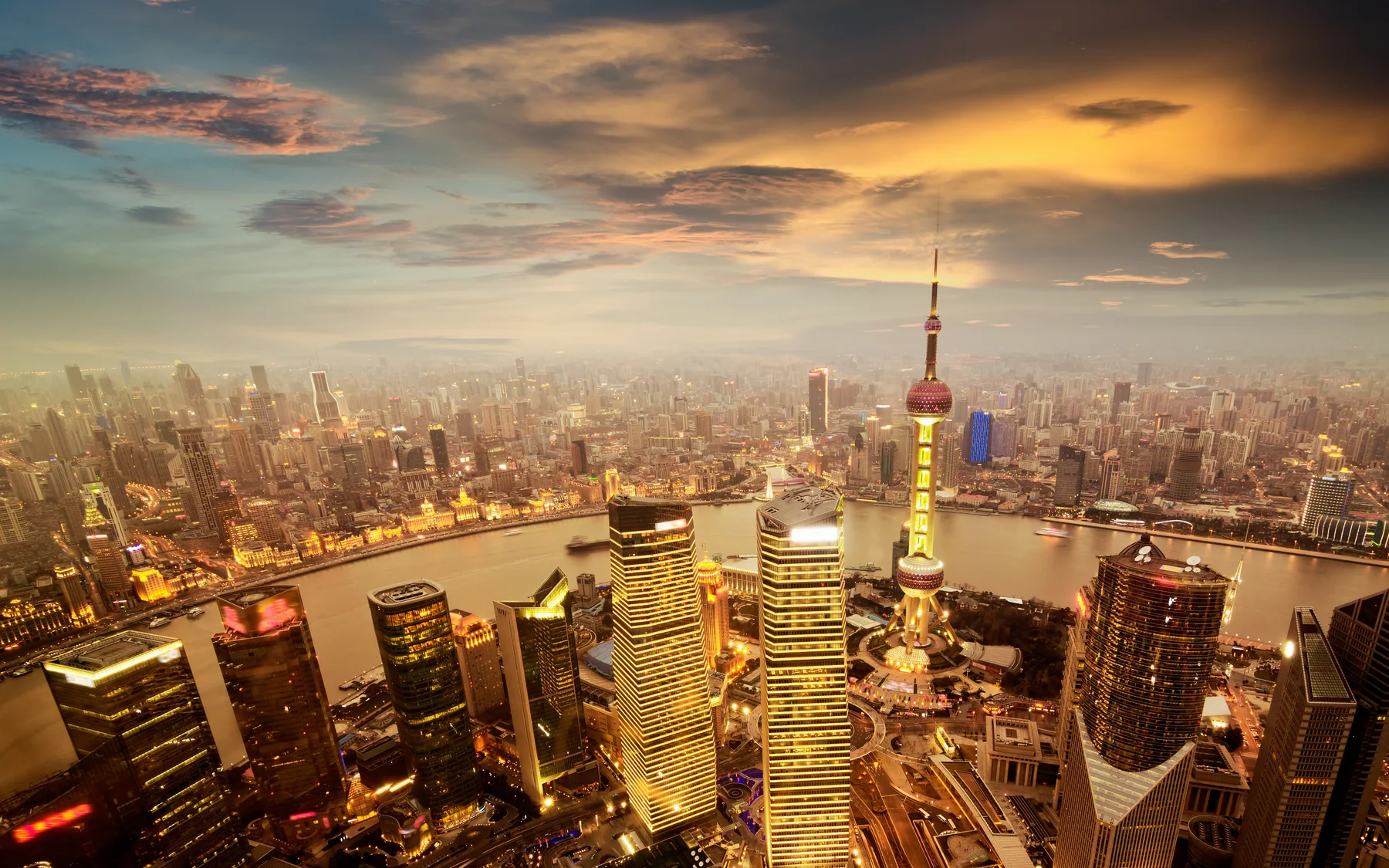
The Huangpu River is the clearest introduction to Shanghai because it holds several versions of the city in one view. On the west bank, the Bund preserves monumental commercial architecture associated with Shanghai's treaty-port era. Across the water, Pudong presents the infrastructure and visual ambition of China's reform-era metropolis.
Do not treat the river as an empty foreground for photographs. It is part of the city's economic reason for being. Ships, warehouses, docks, ferries, financial institutions and industrial land all shaped Shanghai before the waterfront became a polished public spectacle.
Crossing by ferry can be more instructive than simply looking from one bank. The skyline changes scale, working vessels interrupt the postcard and the river becomes transport again.
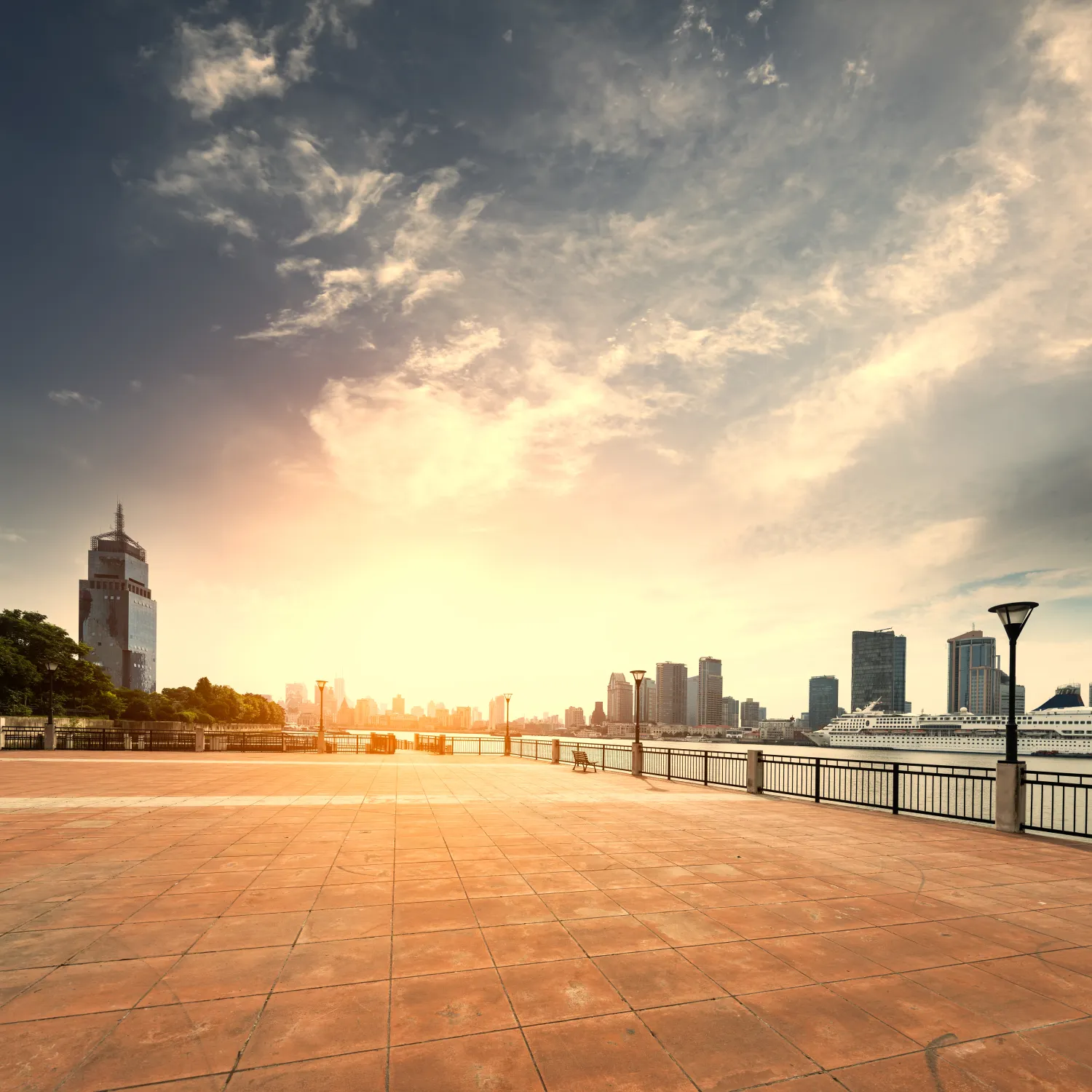
Shanghai's waterfront is also everyday civic space: a place for walking, running, waiting, meeting and understanding how much of the city is organized around water.
The Bund: beauty, commerce and unequal history
The Bund (外滩, Waitan) is one of the world's great urban waterfronts. Its sequence of banks, trading houses, hotels and civic buildings creates a stone wall of institutional confidence facing the river. Architectural styles vary, but the ensemble communicates finance, law, technology and international connection.
Its beauty should not erase its historical setting. Shanghai's treaty-port expansion followed war and unequal treaties. Foreign concessions created spaces with different legal and administrative systems, while Chinese merchants, workers, migrants and residents built lives within and around those structures. The Bund is therefore neither simply foreign nor simply local. It is evidence of power being imposed, negotiated, localized and remembered.
Walk once close to the facades and once from the promenade. At street level, entrances, stonework and building names become legible. From the river, the district becomes an urban composition.
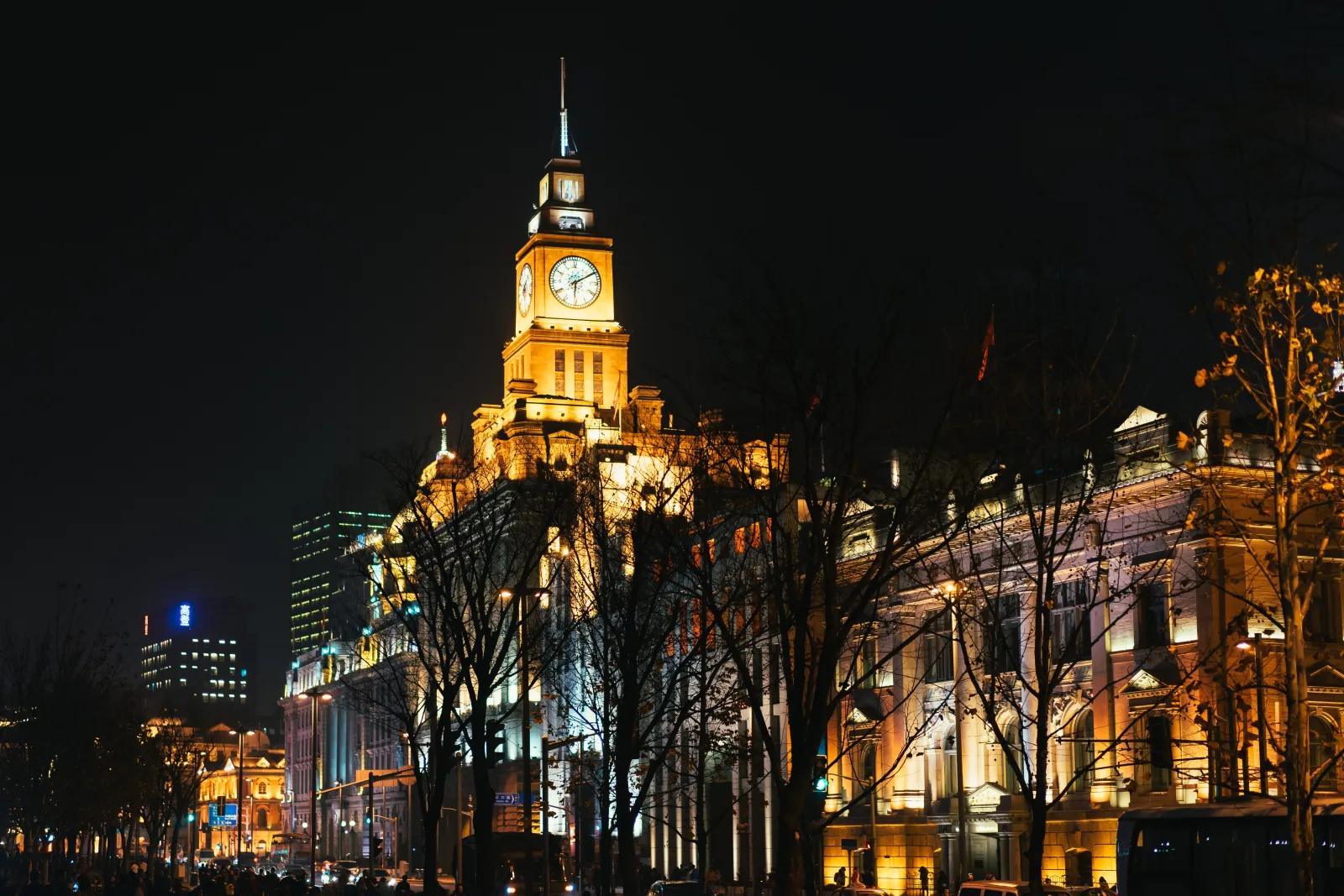
At street level, the Customs House is not a generic European-looking ornament. Its clock tower, stone facade, road traffic and tree line make treaty-port power part of an ordinary Shanghai night rather than a sealed historical display.
Pudong is not Shanghai's whole future
Pudong's towers are among the clearest symbols of contemporary China. The Oriental Pearl Tower, Jin Mao Tower, Shanghai World Financial Center and Shanghai Tower create a skyline that developed with extraordinary speed after Pudong's large-scale opening and development.
Calling Pudong futuristic is easy; reading the machinery underneath is more interesting. Elevated roads, metro connections, underground systems, shopping complexes and office towers work together at metropolitan scale, turning planning, finance and infrastructure into a public image you can walk through.
Yet Shanghai's future is not contained in Lujiazui. It is also being shaped through reused industrial land, neighborhood preservation, suburban development, universities, logistics, digital culture and arguments about how much historical fabric a fast city can retain.
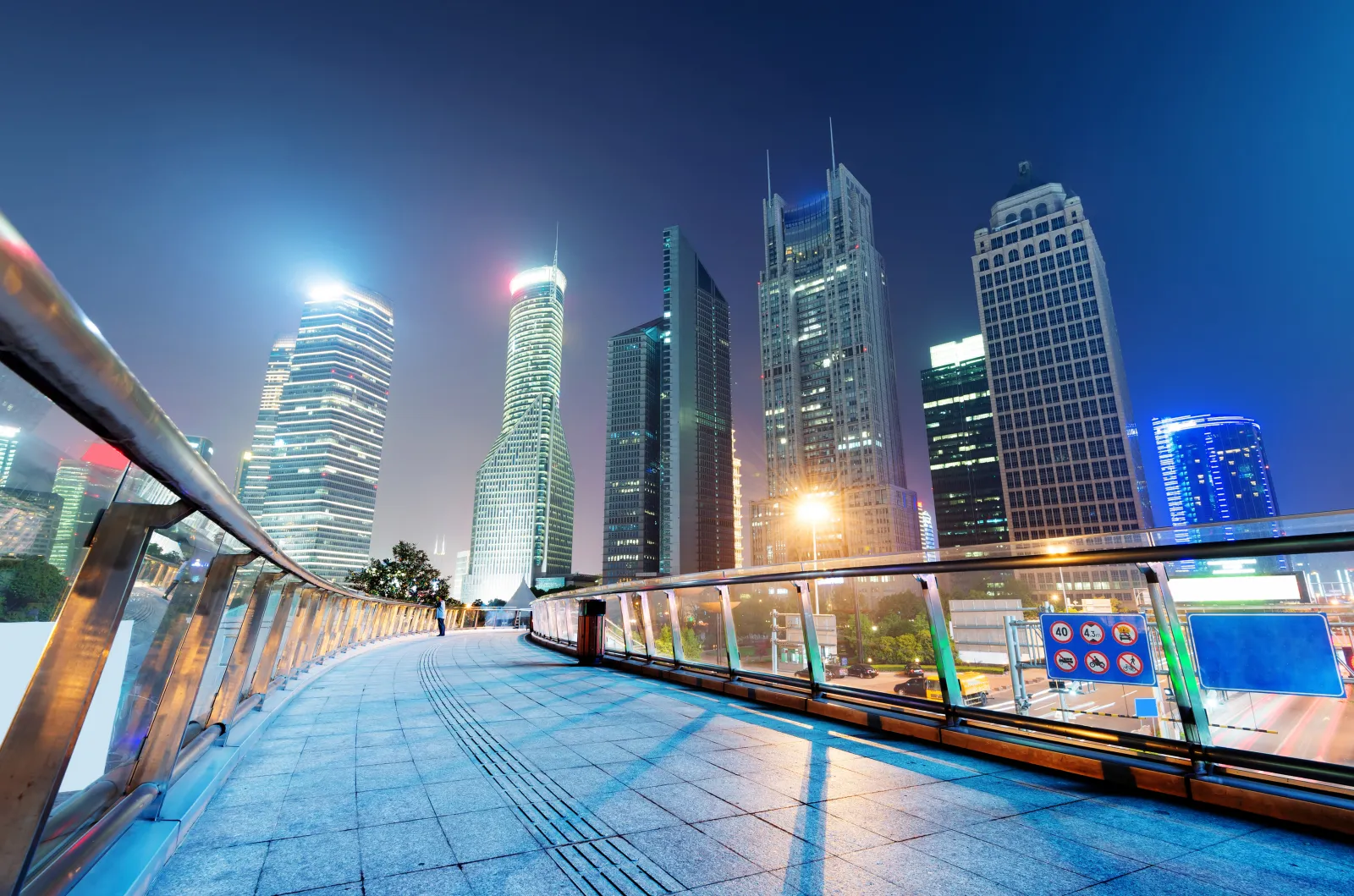
At ground level, Pudong is experienced less as a silhouette than as a network of walkways, station entrances, plazas and climate-controlled interiors. These systems can feel impersonal, but they also reveal the design problem Shanghai must repeatedly solve: moving immense numbers of people through dense commercial space.
The modern city is built from circulation as much as towers. Elevated paths and connected interiors shape where pedestrians can pause, cross and enter.
Lilong and shikumen bring the city back to human scale
Lilong (里弄) describes lane-based residential forms that became central to modern Shanghai. Shikumen (石库门) houses, recognized by stone-framed gateways and row-house organization, combined aspects of Chinese domestic life with urban building forms shaped by Shanghai's particular history.
These neighborhoods made density social. Shared lanes, close thresholds, laundry, deliveries, cooking smells, bicycles and repeated encounters turned circulation space into community infrastructure. But lilong life should not be romanticized. Housing could be crowded, facilities limited and privacy scarce. Redevelopment has displaced residents as well as preserving selected architecture.
When walking in older neighborhoods, distinguish living residential lanes from commercial reconstructions. Both can be interesting, but they tell different truths. Do not photograph through doors or turn residents into visual evidence of an imagined old Shanghai.
Haipai culture is a method of translation
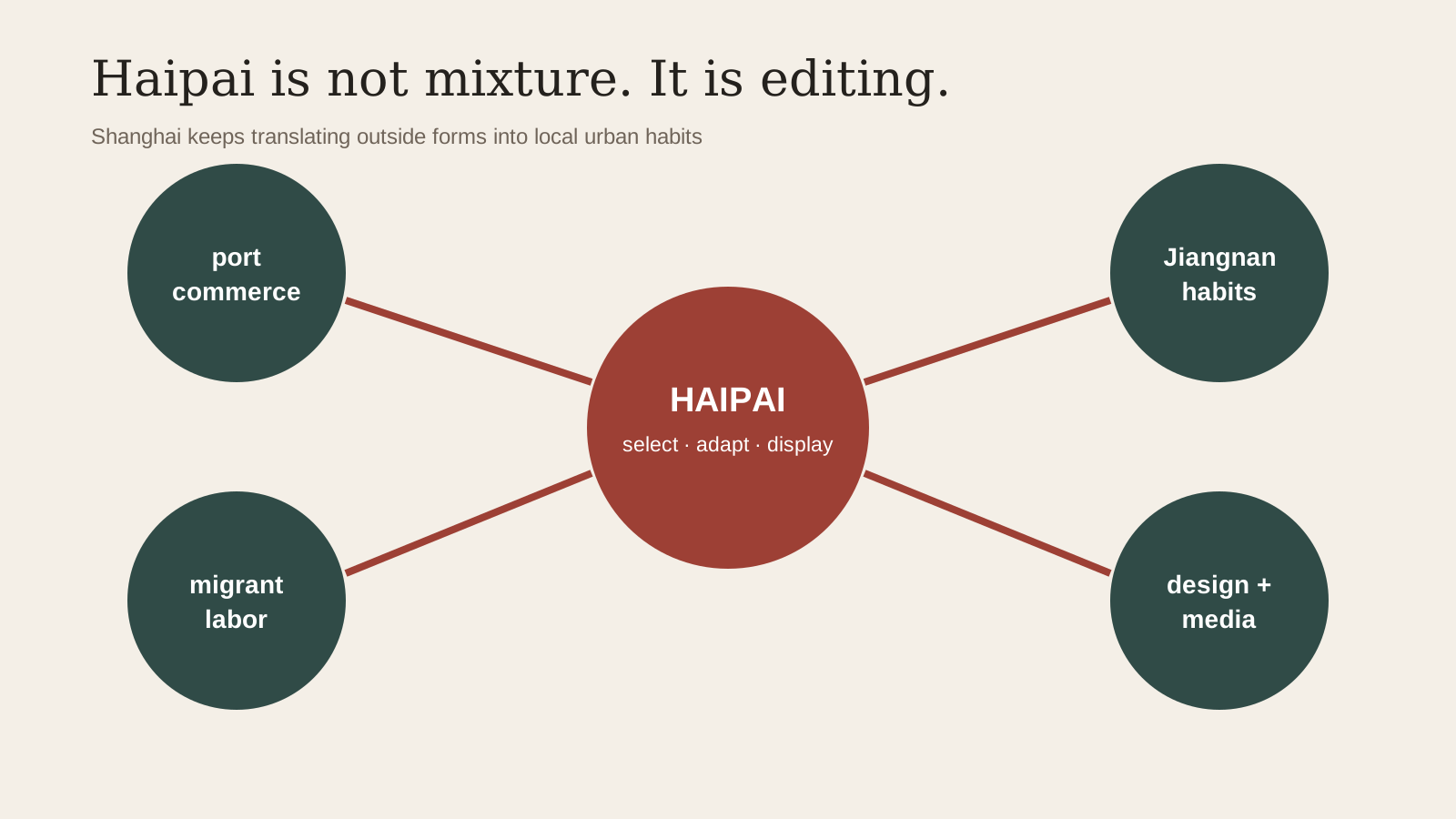
The term haipai (海派) is often used for Shanghai's cosmopolitan cultural style. It can refer to ways the city absorbed, reworked and circulated influences through art, publishing, fashion, architecture, cinema, advertising, food and popular entertainment.
Haipai should not mean that Shanghai merely copied the West. The more interesting process is translation. Imported forms entered Chinese institutions, businesses, homes and arguments. Local artists, designers, writers and consumers changed what those forms meant. Shanghai style emerged from selection and recombination, not passive imitation.
That habit continues. Contemporary Shanghai moves confidently between luxury and practicality, global references and neighborhood preferences, preservation and aggressive novelty. Young culture in the city is often most visible where these categories overlap: in a converted industrial building, a small publication, a fashion label, an exhibition or a cafe inside older residential fabric.
Gardens and museums slow down the skyline
Yu Garden (豫园, Yuyuan) offers another spatial language. Its halls, rocks, water, walls and changing views belong to the traditions of Jiangnan garden design rather than the monumental scale of the Bund or Pudong. Visit early if possible and separate the historic garden from the surrounding commercial district in your mind.
Our Chinese gardens guide opens up the spatial logic behind Yuyuan: routes, framed views, borrowed scenery and controlled concealment matter more than decoration alone.
Shanghai's museums then widen the story. The Shanghai Museum's official collection portal is the practical starting point for Chinese art and material culture. Institutions along the West Bund and elsewhere connect contemporary art to former industrial land and new cultural infrastructure. Five rushed venues create less understanding than one collection seen properly and a walk through the district that made room for it.
From above, Shanghai becomes less a collection of icons than a metropolitan system of river bends, residential density, business districts and transport corridors.
Shanghai food rewards contrast
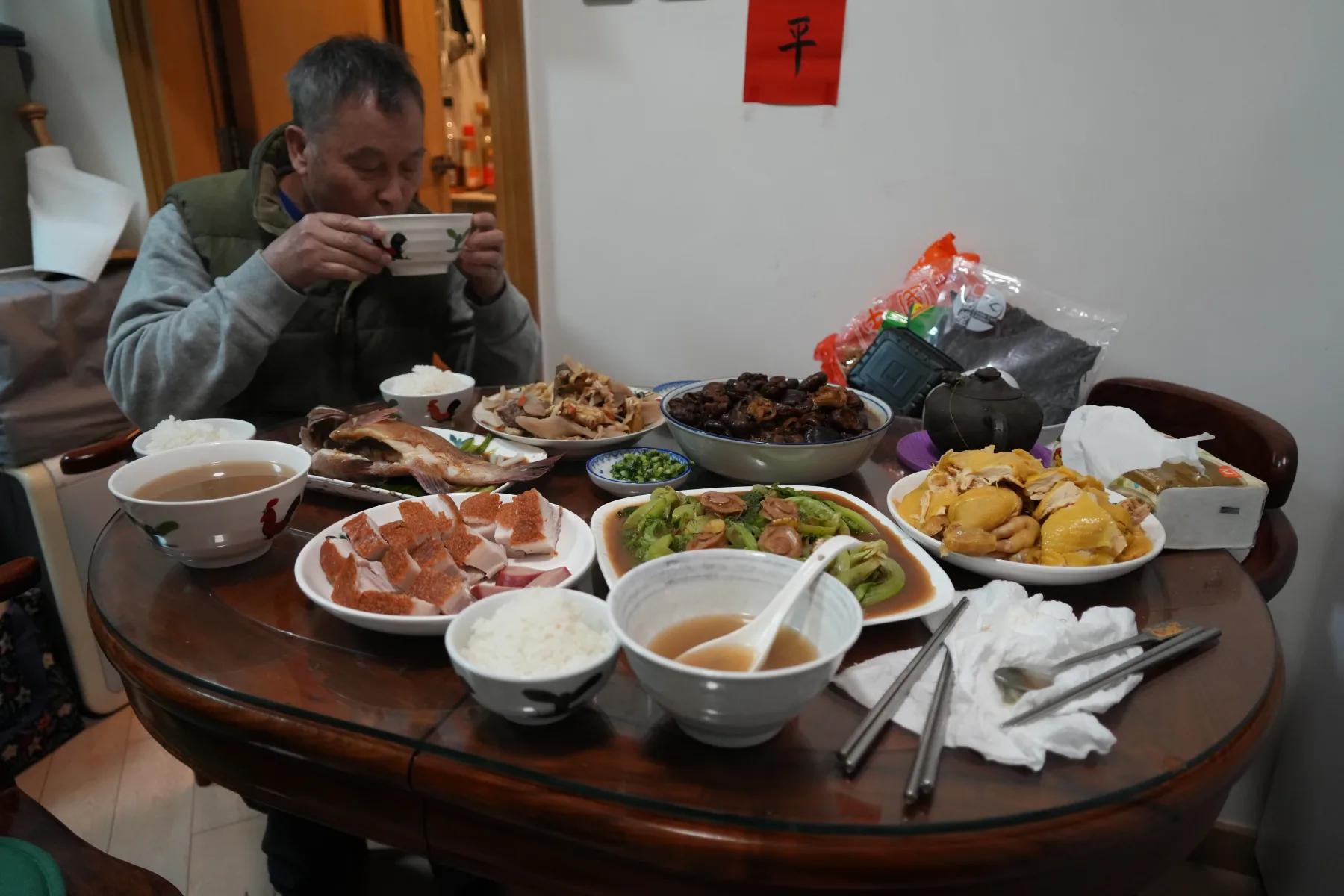
Shanghai is famous for xiaolongbao, shengjian and red-braised dishes, but its table is larger than a snack checklist. Local benbang cooking uses soy sauce, rice wine, measured sweetness, freshwater ingredients and seasonal vegetables. Migrants and international contact continually enlarged the city's appetite.
For a first day, breakfast on shengjian or noodles, then use dinner to explore smoked fish, kaofu, one braised dish and a seasonal green. Our full Shanghai food guide explains why the cuisine is not simply "sweet Chinese food" and how to order without repeating the same dark, rich flavors.
The municipality extends into water-town landscapes
Central Shanghai can make the municipality feel entirely vertical, but its geography includes river towns, canals and landscapes connected to the wider Jiangnan region. Zhujiajiao is the best-known water-town excursion within Shanghai, while other districts and towns reveal different relationships among water, commerce and settlement.
A water-town day is useful when it adds historical geography, not when it becomes a search for an untouched village. These places are lived, restored, commercialized and heavily visited in varying proportions. Go early, move beyond the first shopping street and pay attention to how buildings meet the water.
Qipao proves that Shanghai modernity was worn on the body
The qipao belongs here because Shanghai did more than display a fashionable dress. Twentieth-century urban life changed how the garment was cut, photographed, sold and read in public. Sleeve length, collar height, fabric and ease moved with work, leisure, cinema and a new visibility of women in the city.
I dislike the phrase “timeless Shanghai elegance.” It removes every decision from the dress and leaves only a glamorous outline. A qipao is interesting because the outline did change. Tailors negotiated robe ancestry, imported cutting methods, local bodies, available textiles and the wearer's actual day. The garment carried modernity at the shoulder and side seam. No abstract slogan could do that work.
Film intensified the association. A fitted dress moving through a narrow hallway can make space feel socially dangerous. Pattern changes can mark passing days without a calendar. Yet cinema is only one life of the garment. Family wardrobes, Southeast Asian Chinese communities, restaurants, schools, weddings and contemporary designers kept adjusting it after a particular Shanghai image travelled abroad.
Wong Kar Wai makes Shanghai memory travel
Wong Kar Wai was born in Shanghai and raised in Hong Kong. I refuse to turn that biographical fact into municipal ownership. Hong Kong supplied the compressed rooms, crossings, food counters, languages and production relationships that made his cinema possible. Shanghai survives differently: as an origin separated by childhood migration, as a remembered cultural frequency, and eventually as the explicit world of Blossoms Shanghai.
That distinction is more interesting than calling him a “Shanghai director.” It shows how a city can remain inside an artist without dictating every street on screen. Read the Wong Kar Wai page beside this one and two urban habits come into focus: Shanghai edits contact into public style; Wong edits distance into private time. The relationship is not a location checklist. It is a migration line that changes what memory can do.
Shanghai rap scratches the polished surface
Shanghai's international image favors control: straight facade lines, designed retail, finance, fashion and a skyline that seems to have rehearsed its entrance. The city's rap argues with that image.
Pharaoh is useful precisely because he complicates the city label. He comes from Haining in Zhejiang, while Shanghai's independent hip-hop network and Living Dead history helped shape his public career. Origin and scene are different facts. Keeping both visible stops Shanghai from claiming every artist who worked through its cultural infrastructure.
His hard-core attack, elaborate story worlds and deliberately foolish characters expose something the polished-city story cannot hold: embarrassment, provincial memory, fan arguments and the urge to puncture authority before it turns stiff. Shanghai provided stages, collaborators and competition. It did not manufacture one “Shanghai sound.” A scene is a network where incompatible voices can meet, never a municipal personality test.
That friction is healthy. A city that exports only its expensive surfaces becomes an advertisement. Music returns awkward speech, private jokes and people who do not fit the render.
Reuse can preserve a building and erase its former public
Shanghai is exceptionally skilled at giving old structures a new visual life. Warehouses become galleries. Factories become design compounds. Residential blocks acquire cafes and boutiques. The physical result can be excellent, and the city gains spaces that younger people actually want to use.
The bill still matters. A preserved shell does not guarantee continuity for workers, residents or small businesses. New cultural use can widen public access along a waterfront while narrowing access inside a renovated block through rent, tickets and consumption. I want Shanghai to keep reusing its architecture. I also want every polished reuse story to answer two blunt questions: who used this place before, and who can afford it now?
This is where haipai translation remains alive rather than becoming heritage branding. The city takes an inherited structure and assigns it a new function. Good editing leaves enough of the earlier sentence visible to understand the change. Bad editing makes displacement look like an empty room waiting for taste.
The separate travel to Shanghai guide owns hotels, seasons, transport and itineraries. This page owns the cultural argument underneath the route: Shanghai keeps turning contact into form, then arguing over who gets included in the finished version.
Travel respectfully through a changing city
Shanghai's historical neighborhoods are not open-air sets. Ask before photographing people closely, avoid pointing cameras through residential doors and do not confuse visible age with permission to enter. When interpretation is available, learn whether a site is original, reconstructed, commercially adapted or preserved after residents were relocated.
The city also rewards precision in language. "French Concession" remains a common geographic shorthand, but the former concession areas were products of unequal power. "Old Shanghai" can describe many different periods and communities. A thoughtful traveler notices which history is being packaged and which voices remain outside the frame.
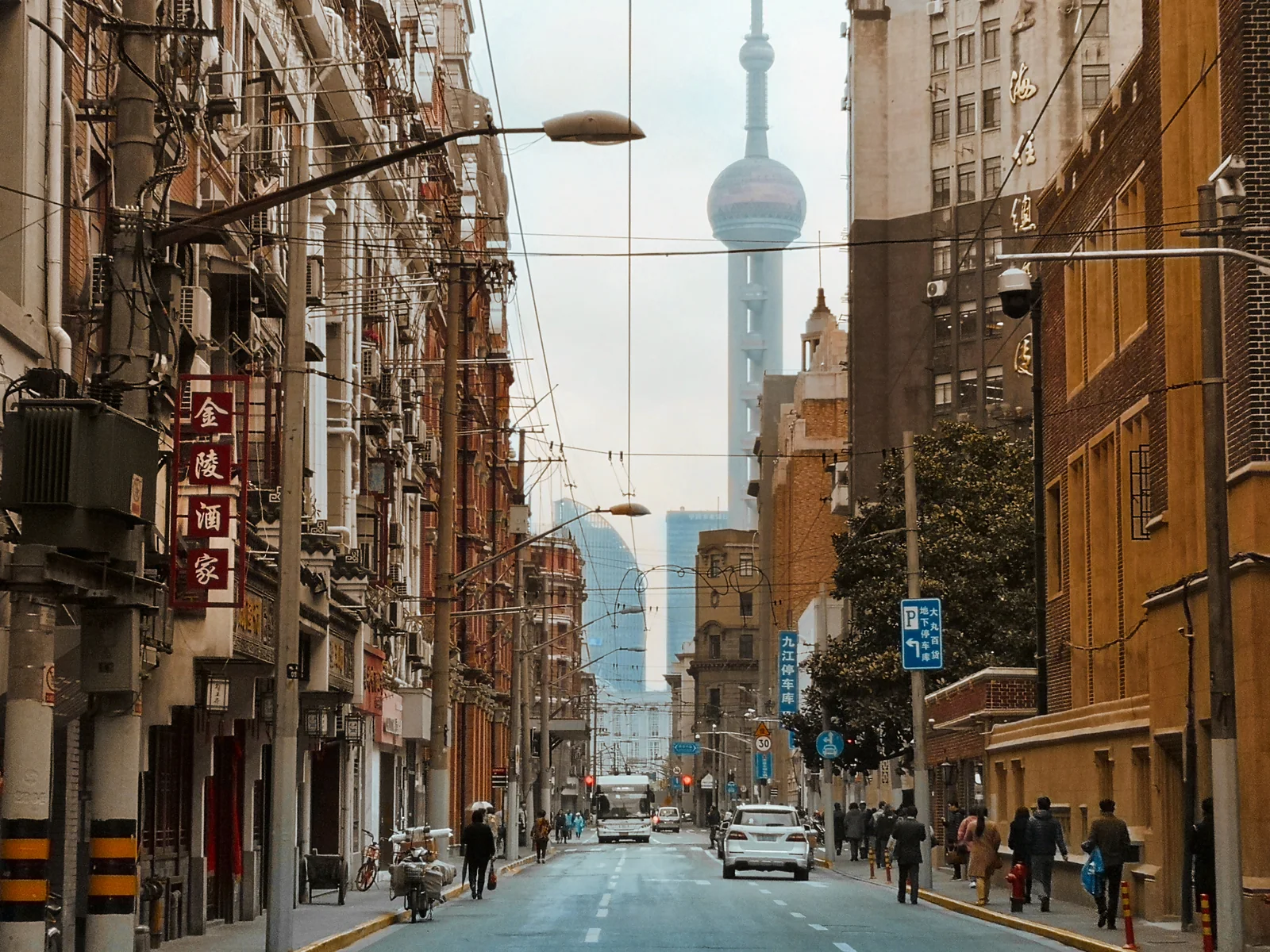
This is the Shanghai transition I keep returning to: older commercial facades do not disappear when the new skyline enters the frame. The road between them makes both histories part of the same working city.
Frequently asked questions about Shanghai
What makes Shanghai culture distinctive?
Shanghai culture is distinguished by its habit of translating outside forms through local commerce, Jiangnan habits, dense urban life and Chinese public taste. The result appears in architecture, publishing, fashion, food, film and music rather than in one fixed historical style.
What does haipai culture mean?
Haipai describes cultural practices associated with Shanghai's urban cosmopolitanism and selective adaptation. It does not mean passive Westernization; Shanghai artists, businesses and residents changed imported forms as they put them to local use.
Why are lilong and shikumen important to Shanghai?
Lilong lanes and shikumen housing placed dense domestic life, shared circulation and street commerce close together. They explain Shanghai at human scale while also exposing crowding, redevelopment and the cost of turning residential history into a fashionable image.
What is the best time to visit Shanghai?
Spring and autumn are generally the most comfortable for walking. Summer is hot, humid and rainy, while winter is damp and can feel colder than the temperature suggests. Holiday periods and major events can affect crowds and accommodation prices.
What should first-time visitors not miss in Shanghai?
A strong first visit combines the Bund, a Huangpu River crossing, a lived neighborhood walk, one museum or art district, a public waterfront and a meal that includes both Shanghai snacks and seasonal dishes. The contrast between old commercial Shanghai and the contemporary city is more revealing than either skyline alone.
Shanghai is most revealing between its icons
The Bund and Pudong deserve their fame because their confrontation across the river is genuinely extraordinary. Shanghai becomes memorable when that skyline connects to the systems beneath it: the ferry timetable, the lane entrance, the breakfast queue, a qipao seam, a rap verse, the museum label and the shade of a plane tree.
That is the Shanghai worth understanding: a city that repeatedly turns conflict, exchange and speed into form, then makes the new form answer to daily life.
Return to Chinese culture, explore Chinese architecture, or continue with the full Shanghai food guide.