Shanghai food often arrives before its explanation. A pan lid lifts, steam runs into the morning air and broth waits inside a browned bun like a small trap. A bowl of noodles carries little more than scallion oil, soy and the memory of heat. My verdict is already in that restraint: Shanghai food is strongest when the sauce has time to settle and the diner leans closer.
Shanghai food at a glance
| Choose your route through this guide | Start here |
|---|---|
| First visit | Breakfast buns, benbang classics and the balanced order |
| Interested in everyday Shanghai | Shengjian, noodles, rice cakes and neighborhood formats |
| Interested in seasonal food | Crab, freshwater ingredients and the Jiangnan calendar |
| Worried the food is too sweet | The benbang balance section and ordering guidance |
| Comparing dumplings | The shengjian-versus-xiaolongbao table |
| Interested in food migration | The Shanghai-food-abroad analysis under quality guidance |
| Dish | Chinese | Taste and texture | Best moment | How specifically Shanghai? |
|---|---|---|---|---|
| Shengjian mantou | 生煎馒头 | Crisp fried base, soft yeasted top and juicy filling | Breakfast or a casual snack meal | One of Shanghai's defining street foods |
| Xiaolongbao | 小笼包 | Thin wrapper, tender filling and hot broth | A focused snack stop | Strongly associated with Shanghai and nearby Jiangnan traditions |
| Red-braised pork | 红烧肉 | Soy-rich, glossy, tender and gently sweet | A shared benbang meal | A classic expression of local red-braising technique |
| Shanghai smoked fish | 上海熏鱼 | Firm fried fish with a dark sweet-savory glaze | Cold starter | A recognizable Shanghai preparation despite its confusing English name |
| Four-happiness kaofu | 四喜烤麸 | Springy wheat gluten, mushrooms, peanuts and settled braising flavors | Cold starter or home-style meal | Closely tied to the city's home-cooking repertoire |
| Scallion-oil noodles | 葱油拌面 | Fragrant oil, soy and direct wheat texture | Quick lunch or simple breakfast | Everyday Shanghai rather than ceremonial restaurant food |
| Crab dishes | 蟹粉菜肴 | Rich, marine and seasonal | Autumn when ingredients are clearly identified | Part of the wider lower-Yangtze seasonal table |
What is Shanghai food?
Shanghai food is the cooking of a city built within the waterways and seasonal habits of Jiangnan, then enlarged by trade, migration, industry and a restless urban appetite. Its local tradition is often called benbang cai, literally “local cuisine.” Benbang cooking is known for red braising, soy sauce, rice wine, freshwater ingredients and a controlled sweetness that rounds savory flavors rather than replacing them.
The city's official cultural overview supplies the institutional frame. The table supplies the human one: Shanghai food makes most sense as an urban system of breakfast counters, home braises, seasonal Jiangnan ingredients and restaurant formats built for different amounts of time.
That definition is only the front door. Shanghai is not a sealed culinary province. The municipality includes old urban neighborhoods, river towns, farmland and coast. People arrived from Ningbo, Suzhou, Wuxi, Anhui, Guangdong, Sichuan and many other places, bringing tastes that became part of the city's daily life. Restaurants absorbed foreign techniques and dining habits. Factory schedules, alley kitchens, breakfast stalls and banquet rooms all left their own marks.
Calling everything “Shanghai cuisine” is convenient for a menu. Understanding it requires more patience. The city's food has several voices, and they do not always use the same volume.
| Part of the Shanghai table | Typical character | Foods that help explain it | What visitors often miss |
|---|---|---|---|
| Benbang home cooking | Soy-rich braises, rice wine, gentle sweetness and seasonal vegetables | Red-braised pork, braised fish, kaofu, oil-braised bamboo shoots | Dark color does not mean every dish is heavy or sugary |
| Jiangnan seasonality | Fresh shoots, greens, river fish, shrimp and crab | Spring bamboo shoots, malantou, river seafood, autumn crab dishes | The calendar matters as much as the recipe |
| Street and breakfast food | Hot, compact, affordable and built around repetition | Shengjian, xiaolongbao, scallion-oil noodles, rice cakes | The best-known “snacks” may function as a complete meal |
| Haipai and urban restaurant culture | Adaptation, cosmopolitan service and selective borrowing | Western-influenced pastries, soups and banquet dishes | Foreign influence was translated through local taste, not merely copied |
| Suburban and water-town traditions | Rustic fish, poultry, preserved foods and grain dishes | River fish, mutton in some districts, rice cakes and farmhouse preparations | Central-city restaurant menus are not the whole municipality |
The useful distinction is between ownership and presence. Sichuan, Ningbo, Cantonese or international food can be essential to modern Shanghai life without becoming benbang cuisine. A city guide should acknowledge that abundance while keeping regional terms precise. This page answers what to eat in Shanghai and how local formats work; the broader Jiangnan cuisine guide explains regional relationships beyond the municipality.
Shanghai's food geography is also larger than the postcard center. Lane neighborhoods, market streets, suburban water towns, malls and new business districts support different price points and schedules. A polished dining room may preserve a braise carefully; a breakfast shop may show more about the city's daily timing. Neither format owns authenticity by itself.
Benbang cooking uses sweetness, soy and time as tools
The fastest description of Shanghai cuisine is often “sweet and oily.” It is memorable, and it is incomplete.
Sugar does appear in recognizable ways. In a red braise, it can soften salt, deepen color and give the sauce a quiet sheen. In Shanghai-style smoked fish, sweetness meets soy, spice and the firm structure of fried fish. In four-happiness kaofu, it gathers wheat gluten, mushrooms, peanuts and daylily into a cold dish whose flavor becomes more settled after resting.
But a Shanghai meal made entirely from dark, sweet braises would feel as unbalanced as a paragraph written with one adjective. Good ordering moves between density and relief: a glossy meat dish beside fresh greens, cold kaofu before hot fish, a clear soup after something fried. Seasonal bamboo shoots may taste clean and grassy. Scallion-oil noodles can be spare enough that poor oil or scorched scallions have nowhere to hide.
Sweetness is therefore not the destination. It is one tool in a kitchen that understands contrast.
Benbang red braising turns time into sauce
Red-braised pork is among the dishes most readily associated with Shanghai. Pieces of pork belly cook slowly with soy sauce, rice wine, aromatics and sugar until fat and lean lose their argument. The sauce darkens. The meat holds its shape but yields without resistance.


Red-braised pork shows the glossy, soy-rich side of the benbang table. A complete Shanghai meal normally balances it with vegetables, soup or a lighter seasonal dish.
The appeal is not merely richness. The dish is an exercise in proportion and heat. Too much sugar makes the sauce blunt. Too much soy buries the pork. Hard boiling breaks the texture before flavor has moved inward. The cook is waiting for several changes to meet at once: fat softening, lean meat relaxing, liquid reducing and color deepening.
This is why a good red braise feels patient rather than aggressive. It tastes as though the kitchen has allowed time to become an ingredient.
Shanghai smoked fish is fried, steeped and badly translated
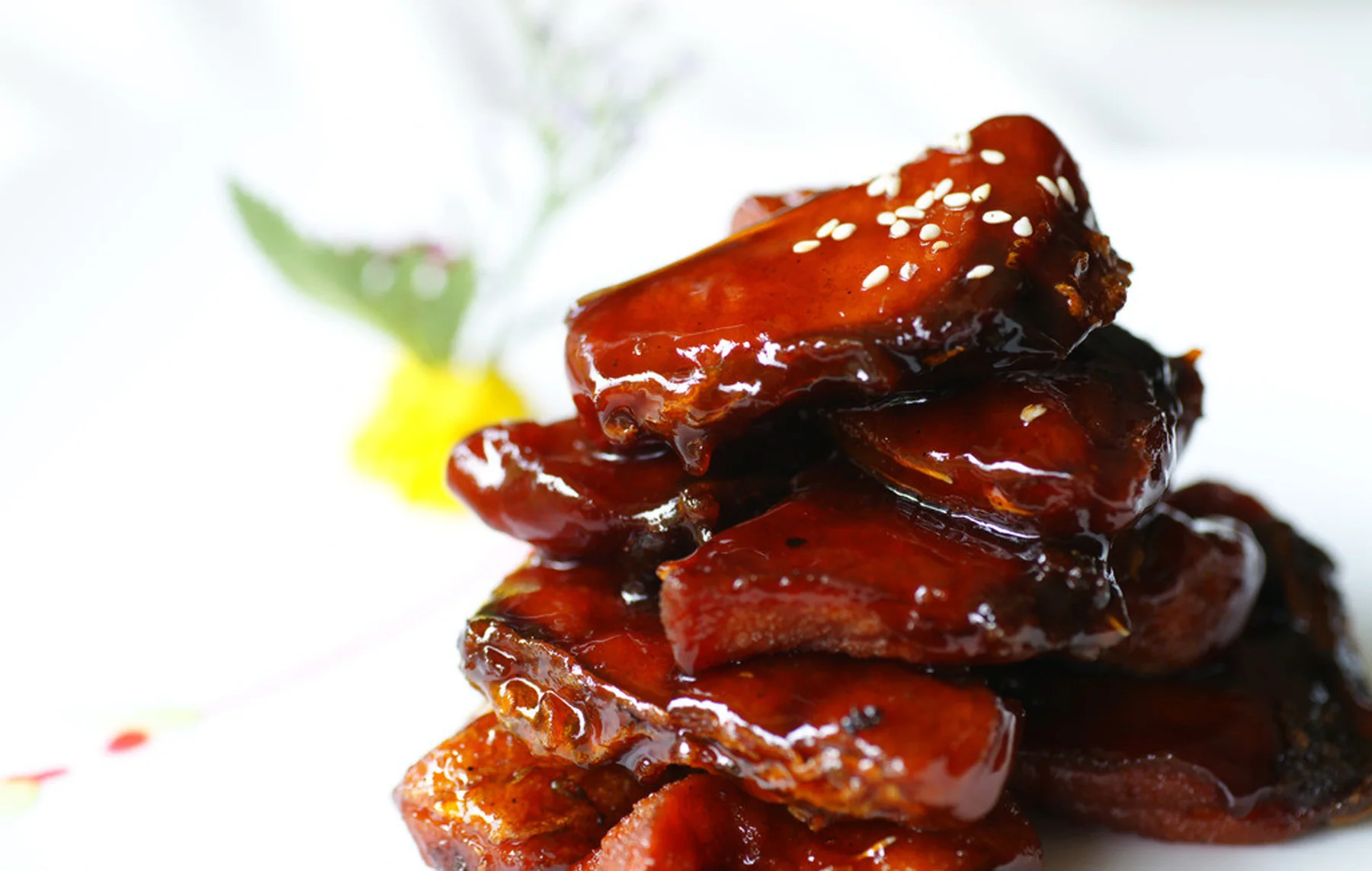
The English name “Shanghai smoked fish” causes immediate confusion because the fish is not necessarily smoked. Xun yu is commonly made by frying pieces of fish and then soaking or coating them in a seasoned liquid. The exterior takes on a dark shine; the flesh remains firm enough to lift cleanly with chopsticks.
Served cold or at room temperature, it often appears before the hot dishes. This change of temperature matters. The glaze settles, the fish tightens, and sweetness becomes less obvious than it would in a steaming sauce. A good piece has edges that still remember the fryer and flesh that has not dried into fibers.
The dish also offers a useful lesson for reading translated menus: a familiar English word may point toward a category without describing the exact technique. Eating well sometimes begins by letting the Chinese dish correct the translation.
Four-happiness kaofu makes a feast from absorption
Kaofu is wheat gluten, porous enough to drink whatever surrounds it. In si xi kaofu, often translated as four-happiness kaofu, the gluten is braised with ingredients such as dried mushrooms, wood ear, peanuts and daylily buds. Recipes vary, as home dishes should.
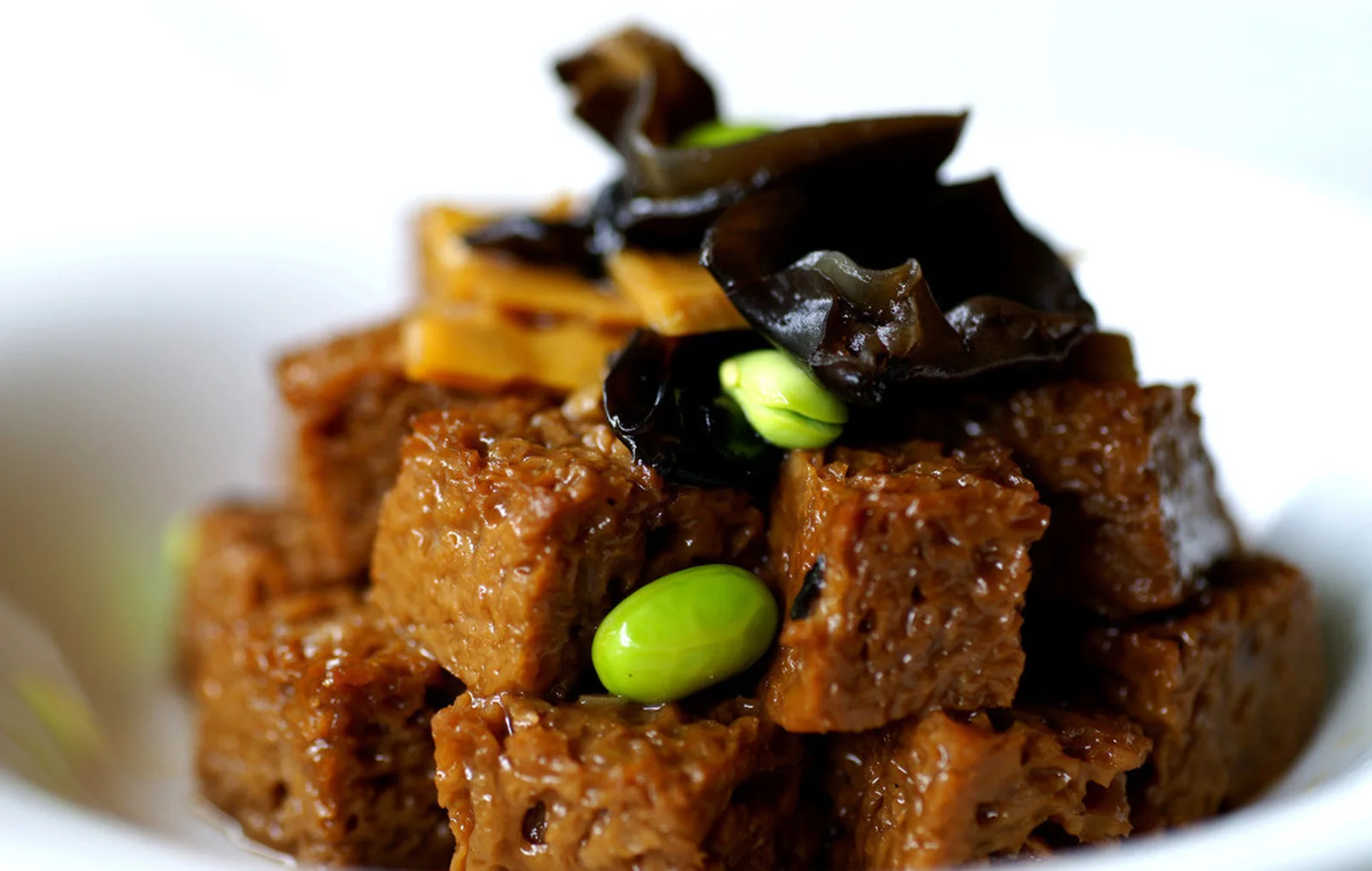
Four-happiness kaofu depends on the sponge-like structure of wheat gluten, which holds the seasoned liquid and releases it as the dish is chewed.
The first bite can surprise a diner expecting tofu. Kaofu is springier and more open, with pockets that hold sauce. Mushroom brings depth, wood ear brings a clean snap, and peanuts slow the rhythm of the mouth. It is usually served cool, which makes it particularly welcome beside hot or fatty dishes.
There is something deeply Shanghai about the way the dish behaves. Humble ingredients are not disguised as luxury. Instead, they are arranged so carefully that absorption itself becomes the pleasure.
Crab, tofu and the gold of autumn
Autumn in the lower Yangtze is closely associated with freshwater crab. In Shanghai restaurants, crab roe and crab meat may be worked into tofu, noodles, dumplings or richer banquet dishes. The most prized versions depend on season and labor: shells must be opened, meat picked and the concentrated flavor used without losing it beneath oil or starch.
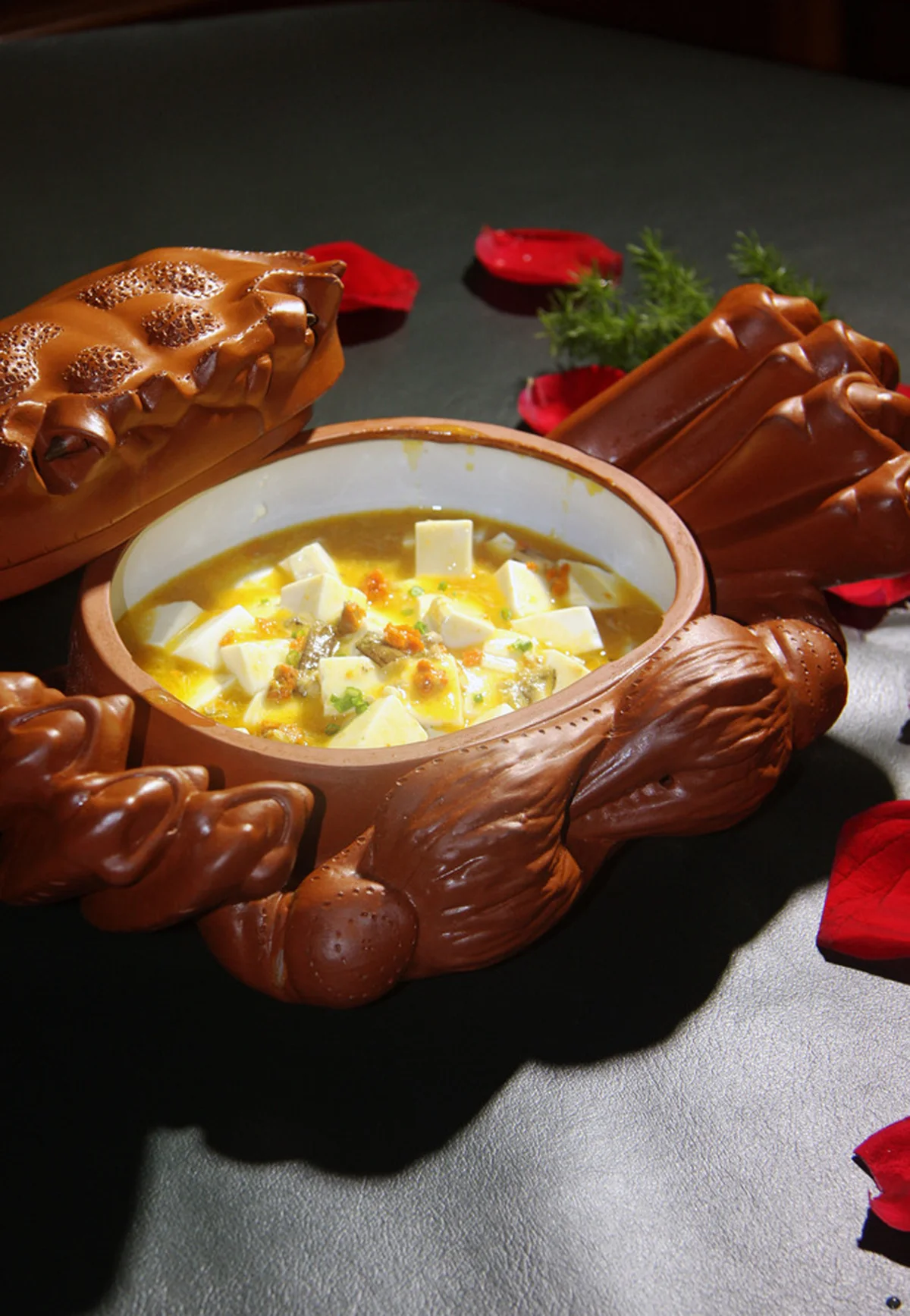
Crab tofu pairs a fragile ingredient with a concentrated seasonal sauce; the pleasure lies in keeping both the tofu and crab recognizable.
Crab tofu can look almost too soft to have structure. Cubes of tofu tremble in a golden sauce, and the spoon must reach underneath rather than attack from above. The dish is rich, but its best quality is fragrance: marine sweetness, warm fat and the clean quiet of tofu.
Outside the season or far from the region, menus may use substitutes, blended crab products or salted egg yolk to create a similar color. Those dishes can still be enjoyable, but naming the ingredients honestly matters. A golden sauce is not proof of crab roe.

The crab calendar is only the most famous expression of season. Spring bamboo shoots, tender greens, river shrimp and summer cold dishes can change the table just as clearly. Ask what the kitchen is buying now rather than assuming the most expensive seasonal label is automatically the most revealing choice.
Freshwater sourcing deserves care. Avoid raw or undercooked freshwater products, ask how fish is priced and do not use rarity as a substitute for quality. A simply cooked vegetable at the right moment may tell more about Shanghai's Jiangnan inheritance than an off-season luxury dish with an impressive name.
Shanghai breakfast begins at the bottom of the bun
Shengjian is one of Shanghai's most convincing arguments for getting up early. The buns are arranged in a wide pan, cooked with water and covered so steam sets the dough while the base fries against the metal. When the lid lifts, sesame and scallion may be scattered over the tops. The bottom should be browned and crisp; the upper dough should remain soft; the filling should be juicy without turning the wrapper sodden.
Shengjian is pan-steamed rather than basket-steamed. Its browned base is not decoration but one of the food's defining textures.
The first bite requires judgment. Bite carelessly and hot broth escapes toward the chin or the person opposite. Wait too long and the crisp bottom softens. Regular eaters develop small private methods: nibble a vent, sip first, use a spoon, turn the bun sideways. None is elegant enough for ceremony, which is precisely why the food belongs so comfortably to morning life.
Order one basket or plate first. Freshness changes by minutes, and a second hot order is better than six cooling buns arranged for a photograph. Pair shengjian with a light drink or soup rather than adding every famous dumpling to the same breakfast.
Shengjian and xiaolongbao are not the same dumpling
| Feature | Shengjian mantou | Xiaolongbao |
|---|---|---|
| Dough | Usually yeasted and thicker | Thin, unleavened wrapper |
| Cooking | Pan-steamed with a fried bottom | Steamed in a basket |
| Texture | Crisp base, soft upper bun, juicy filling | Tender wrapper, juicy filling, no fried crust |
| Typical experience | Breakfast shop or casual snack meal | Snack shop, dim-sum-style service or restaurant |
| Common mistake | Treating the browned base as accidental | Calling every soup-filled bun xiaolongbao |
Both can contain broth-rich pork filling, and both punish impatience. Yet their dough and heat create entirely different foods. One speaks through contrast between iron and steam; the other through the delicacy of a wrapper that must hold liquid without becoming thick.

Xiaolongbao should have a thin wrapper strong enough to contain broth. Unlike shengjian, it is basket-steamed and has no fried base.
Continue with the broader baozi guide for the many Chinese filled buns that sit beyond these two Shanghai forms.
The best comparison uses separate stops. Eat shengjian one morning and xiaolongbao another, or at least order them as distinct courses while each is hot. Their difference is not a technical footnote; it is the reason both foods deserve independent attention.
Noodles and rice cakes reveal the everyday city
Not every Shanghai meal arrives with a celebrated name. Scallion-oil noodles may be the more accurate portrait of an ordinary appetite: noodles, dark seasoning and scallions slowly cooked until their aroma moves into the oil. The bowl looks simple because the work has been compressed into the condiment.
Shanghai also has a strong affection for nian gao, sliced rice cakes whose dense chew stands up to stir-frying and sauce. They may appear with pork and greens or in other seasonal combinations. For overseas diners, the English word “rice cake” can suggest a sweet or crisp snack; here it means a soft, chewy staple cut into pieces and cooked as part of a savory dish.

Shanghai's noodle repertoire extends beyond scallion oil. Stir-fried noodles offer a denser, more sauce-coated texture suited to a complete everyday meal.
These foods explain the city without spectacle. They are practical, repeatable and hospitable to variation. A famous restaurant may polish them, but their emotional weight comes from how easily they can enter a weekday.
Explore Chinese noodles to place Shanghai's bowls within China's wider traditions of wheat, rice and starch noodles.
Where to eat Shanghai food by format
| Format | Best use | What it teaches |
|---|---|---|
| Shengjian specialist | Hot breakfast or snack meal | Pan timing, dough and crisp-bottom texture |
| Xiaolongbao shop | A separate focused stop | Wrapper strength, broth and steaming |
| Benbang home-style restaurant | Shared lunch or dinner | Braising, cold dishes, vegetables and seasonal balance |
| Noodle shop | Solo meal | Scallion oil, toppings and repeatable everyday standards |
| Seasonal Jiangnan restaurant | One planned group dinner | Fish, crab, shrimp, shoots and current market conditions |
| Water-town or suburban restaurant | A trip beyond the central-city canon | Municipal food traditions not represented by downtown greatest hits |
Choose by meal purpose, then check current opening hours and recent local use. A permanent “best restaurant” list cannot account for new branches, changed kitchens or seasonal supply. Specialization, turnover and a menu that explains ingredients are more durable signals.
Shanghai's scale makes clustering important. Eat breakfast near where the morning begins, use lunch for a noodle or snack format and travel for only one significant dinner. Food becomes harder to judge when every stop follows a long ride and a queue.
How to order a balanced Shanghai meal
A first encounter with Shanghai food is clearer when the table changes temperature, color and texture.
| Group size | A balanced order | What to avoid |
|---|---|---|
| Solo | Shengjian or scallion-oil noodles, plus one small cold dish | Ordering several famous snacks when one fresh, well-made item would be clearer |
| Two people | Smoked fish or kaofu, one braised dish, one seasonal vegetable and rice or noodles | Filling the table with three similar dark soy dishes |
| Three to four | Two contrasting cold dishes, one centerpiece, one river or seasonal dish, greens and a staple | Treating xiaolongbao and shengjian as interchangeable side dishes |
| Breakfast | Shengjian, xiaolongbao, wontons or noodles chosen as separate experiences | Rushing broth-filled buns or ordering more than can be eaten while hot |
Ask what is in season. A modest seasonal dish may say more about Shanghai than a permanent greatest-hits menu.
For two people, restraint is especially useful. Red-braised pork, smoked fish and kaofu can all be excellent, but together they may repeat the same dark palette. Add green, clear, fresh or crisp elements and the cuisine becomes easier to hear.
How to recognize thoughtful Shanghai cooking
Look beyond the darkness of the sauce.
- Braised meat should be tender without collapsing into loose fat and fibers.
- Sweetness should complete soy and wine, not erase them.
- Fried fish should retain structure beneath its glaze.
- Shengjian should have a genuinely crisp base and properly cooked dough.
- Seasonal vegetables should taste of themselves rather than only the sauce.
- Crab dishes should state clearly whether they contain roe, meat, a blend or a substitute.
- Cold dishes should feel composed, not like leftovers served at a lower temperature.
Authenticity is not a contest in which every restaurant must reproduce one remembered plate. Shanghai cooking has always changed with neighborhoods, supply and the movement of people. The more useful question is whether a dish understands the technique and balance it claims.
Shanghai food beyond Shanghai
Outside China, Shanghai food often travels under the names of a few famous snacks. Xiaolongbao becomes a global restaurant specialty. Shengjian appears wherever cooks can manage its two kinds of heat. Red-braised pork enters broader “Chinese comfort food” menus, sometimes without a regional label.
Migration changes ingredients and scale. Flour behaves differently. Pork has another fat ratio. Freshwater fish may be unavailable, and health rules may reshape the workflow of a breakfast counter. These changes do not automatically make the food false. They make the route visible.
What matters is whether translation preserves the dish's central logic. A shengjian without a crisp base has lost more than a decorative feature. A scallion-oil noodle overwhelmed by a dozen toppings has forgotten the concentration that made it persuasive. Adaptation succeeds when it knows what must remain.
A city that lets sauce settle
“Sweet, dumplings, crab” is the lazy Shanghai menu
Plenty of Shanghai menus make the same three moves: call the cuisine sweet, list soup dumplings and jump to luxury crab. The result is expensive and strangely empty. Cold dishes disappear. So do ordinary noodles, suburban traditions, seasonal greens and the different clocks of frying, resting, steaming and braising.
Shanghai is often photographed through speed: trains, towers, traffic, crowds moving beneath electric light. Its food remembers another rhythm. Fish cools before serving. Gluten rests in its braising liquid. Pork waits for sauce to reduce. A pan of buns cannot be hurried past the moment when steam has cooked the top and iron has browned the bottom.
The city does not become less modern because its appetite understands waiting. That may be the most enduring quality of Shanghai food: movement everywhere, patience inside the pot.
East Moment recommends two breakfasts, one ordinary noodle or rice-cake meal and one balanced benbang dinner. Separate shengjian from xiaolongbao, surround one dark braise with green and clear dishes, and ask what the kitchen is cooking for the current season.
Continue into the Shanghai culture guide to see how the same habit of adaptation appears in housing, fashion and design. If you are planning meals around real districts, use the travel to Shanghai guide. The broader Jiangnan cuisine guide explains what Shanghai shares with the lower Yangtze instead of letting the city claim the whole region.
Frequently asked questions about Shanghai food
What food is Shanghai famous for?
Shanghai is famous for shengjian mantou, xiaolongbao, red-braised pork, Shanghai-style smoked fish, scallion-oil noodles, four-happiness kaofu and seasonal dishes made with freshwater fish, bamboo shoots, greens and crab. No single list represents the whole city, but these foods reveal its balance of home cooking, snack shops and Jiangnan seasonality.
What does Shanghai food taste like?
Many classic Shanghai dishes use soy sauce, rice wine and measured sweetness to create a deep, glossy savor, but the cuisine is not uniformly sweet. Fresh river foods, clear soups, spring bamboo shoots, lightly seasoned greens and simple noodle dishes can be delicate and clean.
What is benbang cuisine?
Benbang cuisine means the local cooking tradition of Shanghai. It is commonly associated with red braising, soy sauce, rice wine, sugar used for balance, freshwater ingredients and seasonal vegetables. The term is useful, but modern Shanghai food also includes suburban traditions, migrant cooking, restaurant innovation and haipai influences.
What is the difference between shengjian and xiaolongbao?
Shengjian are yeasted buns cooked in a pan so the base becomes browned and crisp while the upper dough remains soft. Xiaolongbao use a thin, unleavened wrapper and are steamed in baskets. Both may contain hot broth, but their dough, cooking method and texture are different.
Is Shanghai food always sweet?
No. Sweetness is noticeable in some red-braised, soy-braised and cold dishes, especially when compared with saltier or hotter regional cuisines. It normally works with soy, wine, vinegar and savory ingredients rather than turning the meal into dessert.
What should a first-time visitor order in Shanghai?
A balanced first meal might include shengjian or xiaolongbao, a red-braised dish, a seasonal vegetable, Shanghai-style smoked fish or four-happiness kaofu, and a simple noodle or soup. Ordering contrasting textures gives a clearer picture than choosing several rich brown-sauce dishes at once.