My verdict on baozi: the best bun is not the one with the most perfect pleats. It is the one whose dough, filling and steam are working together when you pick it up. Baozi can be a paper-bag breakfast, a northern meal, a tea-house bite or a diaspora adaptation; the useful question is not whether it looks photogenic, but whether the soft bread still carries the filling with purpose.
What is baozi?
Baozi (包子) are filled buns most often made from leavened wheat dough and cooked with steam. The dough rises before or during cooking, producing a soft crumb around meat, vegetables, mushrooms, sweet bean paste or another filling.
That simple definition contains a wide range of foods. A large northern meat bun eaten at breakfast and a delicate Cantonese char siu bao served with tea are both baozi, but they do not have the same dough, filling, scale or social setting. Some are tightly pleated; others are smooth. Some reveal the filling through an open top; some split into a white, cloud-like crown. Others are placed against a hot pan until the base turns crisp.
English speakers increasingly shorten baozi to bao or say “bao buns.” Those expressions are understandable, especially on international menus, although bao already carries the idea of wrapping or a bun. The more useful habit is to learn the specific name when one is available.
Baozi, mantou, jiaozi and xiaolongbao compared
The English word dumpling often gathers these foods into one basket. Chinese naming is more precise, although regional speech creates its own exceptions.
| Food | Dough or wrapper | Filling | Main cooking method | Eating character |
|---|---|---|---|---|
| Baozi | Usually leavened wheat dough | Savory or sweet | Steamed; some styles are pan-cooked | Soft, bread-like exterior around a filled center |
| Mantou | Usually leavened wheat dough | Commonly unfilled in standard Mandarin usage | Steamed | Staple bread served with dishes or eaten alone |
| Jiaozi | Thin, unleavened wheat wrapper | Usually savory | Boiled, steamed or pan-fried | Tender or crisp wrapper with no bread-like crumb |
| Xiaolongbao | Thin wheat wrapper, generally unleavened | Meat and gelled broth | Steamed in small baskets | Delicate skin containing hot soup |
| Wonton | Thin wheat wrapper | Usually a smaller savory filling | Boiled, often served in broth | Loose, flowing wrapper around the filling |
In much of northern China, mantou usually means an unfilled steamed bread and baozi means a filled bun. Around Shanghai and parts of Jiangnan, naming can work differently: foods such as shengjian mantou are filled. A dictionary rule should never be allowed to flatten regional language.
Baozi belongs to the hour when a city wakes
Before baozi becomes a cultural symbol or a beautifully pleated photograph, it is breakfast.
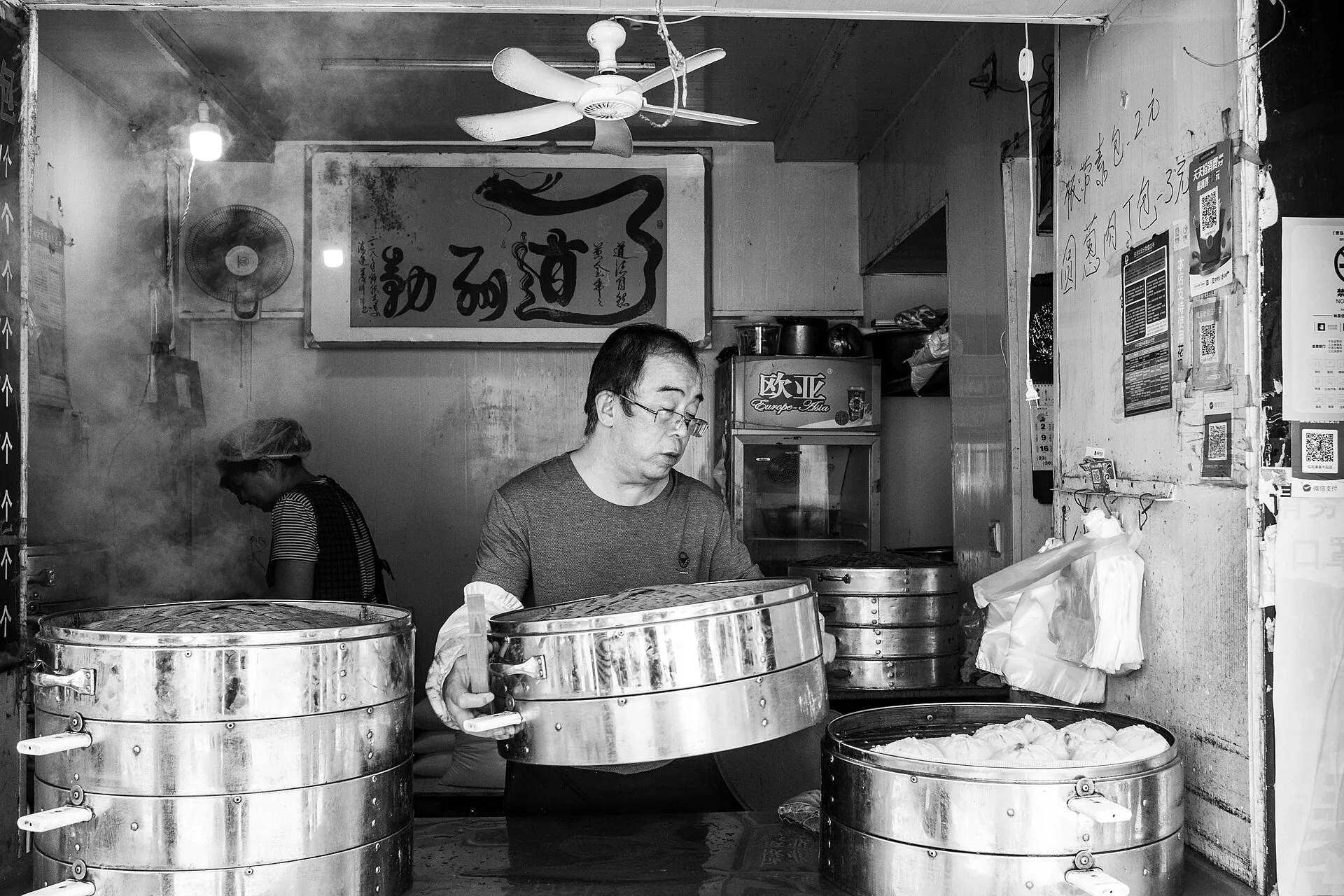
A neighborhood shop begins while the street is still gray. Trays are stacked. Lids lift and release a short cloud against the window. Customers point to cabbage, pork, beef or sweet bean paste; a bun disappears into a thin bag and warms the palm through the walk to work.
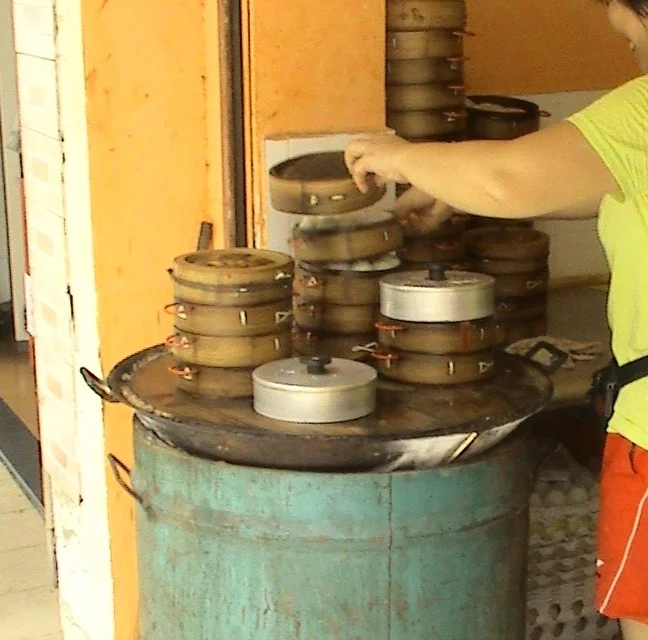
Haikou, 2009: one service action sits inside a much larger capacity system. The hand, stacked bamboo steamers and full steam barrel are visible; the photograph cannot show the filling, proofing time or what happened inside any bun. Photograph by Anna Frodesiak, public domain, via Wikimedia Commons.
The production rhythm matters: proofing begins before the customer arrives, stacked steamers create capacity, and the bun must remain soft long enough to cross a real breakfast queue. Portability is engineered through labor, not invented by modern branding.
This everyday setting explains part of baozi's endurance. A bun joins staple and filling in one portable form. It can be prepared in quantity, held in a steamer and sold without a formal meal. Yet convenience alone does not make every baozi equal. Dough needs time. Fillings need balance. Steam must circulate. A cheap breakfast can still contain years of practiced judgment. Even an official 2026 Chongqing baozi map has to leave the generic bun behind and name local forms—from winter-vegetable filling to mushroom and water-shield versions—because regional baozi becomes legible through what people actually put inside it.
The overseas image of “bao” often leans toward restaurant presentation: perfect pleats, dramatic baskets, novelty fillings. That is one contemporary life of the food. It should not eclipse the ordinary shops, school mornings, factory canteens and home kitchens where Chinese steamed buns are valued precisely because they are familiar. The wider Chinese street-food guide explains why a portable breakfast belongs to a city system of rent, heat, queue speed and repeat customers—not to an Instagram category. The Chinese fast-food guide follows that hidden production clock from early proofing to the ten-second sale.
A history wrapped in stories rather than one proven invention
Popular accounts often credit the strategist Zhuge Liang with inventing filled steamed buns during the Three Kingdoms period. In the legend, he replaces a ritual offering with dough shaped like a human head. The story is memorable, and it has long circulated in discussions of mantou.
It is not a secure recipe origin.
Steamed grain foods developed through long histories of wheat cultivation, milling, fermentation and cooking technology. Names changed meaning across time and region. The broader scholarship collected in Yale University Press's The Food of China is a better frame than a single-inventor anecdote: the modern distinction between filled baozi and unfilled mantou should not simply be projected backward as though every historical text used today's vocabulary.
A trustworthy history therefore begins with limits: baozi has deep roots in Chinese wheat-food traditions, but the exact person, date and first filling cannot be established from a famous legend. That uncertainty does not diminish the bun. It returns invention to the many unnamed millers, cooks, vendors and households who refined dough under steam.
The craft is hidden inside the white dough
Baozi looks forgiving because the dough is soft. It is not. The wrapper must expand without becoming coarse, hold moisture without turning gummy, and seal around a filling that may release fat or broth.
Fermentation creates more than volume
Yeast or an older fermented dough culture produces gas within the dough. Time lets that gas open the crumb while gluten gives the bun enough structure to hold its shape. Temperature, flour strength, water and fermentation time all affect the result.
Under-proofed dough may be dense and resistant. Over-proofed dough can weaken, smell overly fermented or collapse after steaming. Cantonese bao dough may use different flour and leavening systems to achieve a pale, fine texture or the familiar split crown of some char siu bao. There is no single ratio that defines all baozi.
Pleats are structure before decoration
Pleating gathers a round wrapper around the filling while controlling the thickness at the top. Skilled hands rotate the bun as finger and thumb make a repeated pinch. The motion looks effortless only after it has been repeated thousands of times.
A smooth, seam-side-down bun can be equally legitimate. Pleat count is not an authenticity test. The seal matters because steam expands both dough and filling; a poorly closed bun may open before the crumb has set.
Steam has its own timing
Steam transfers heat gently and keeps the dough surface moist. Crowded buns may touch as they expand. Condensation can drip from the lid. Opening the steamer abruptly may expose delicate buns to a sudden temperature change and encourage wrinkling or collapse.
Experienced cooks adjust for steamer material, bun size and the strength of the boil. A bamboo steamer absorbs some condensation and carries a particular visual romance, but metal steamers and commercial cabinets are also part of real baozi production.
How baozi is made
The workflow is simple enough to describe and difficult enough to spend a lifetime improving.
| Stage | What happens | What the cook is judging |
|---|---|---|
| Mixing | Flour, water and leavening become a dough | Hydration, flour absorption and initial strength |
| Fermentation | The dough rests and expands | Temperature, aroma, elasticity and readiness |
| Filling preparation | Ingredients are chopped, seasoned and mixed | Moisture, fat, texture and food safety |
| Dividing and rolling | Dough becomes small rounds with thinner edges | Even size and enough strength at the center |
| Filling and sealing | Filling is enclosed by pleating or smoothing the seam | Capacity, seal and balanced dough thickness |
| Final proof | Shaped buns rest before cooking | Expansion without weakening |
| Steaming | Heat sets the dough and cooks the filling | Steam strength, spacing, time and condensation |
| Resting | Buns remain covered briefly before serving | Stable structure and protection from sudden cooling |
Home recipes often present exact minutes as universal. They are only starting points. A winter kitchen, a humid summer shop, frozen buns and a large meat bao do not move at the same speed.
Baozi fillings form a map of appetite
Pork and cabbage may be the most internationally recognizable filling, but baozi can hold almost anything that can be balanced inside dough.
| Filling family | Examples | Cultural and practical context |
|---|---|---|
| Pork | Pork with cabbage, chives, scallion or preserved vegetables | Common across many regions but not universal |
| Beef and lamb | Beef with onion, lamb with scallion or carrot | Important in northern, northwestern and halal Chinese foodways |
| Poultry | Chicken with mushrooms, vegetables or seasoned sauces | Common in home cooking and commercial production |
| Vegetables | Cabbage, chives, mushrooms, tofu, glass noodles or greens | May be vegetarian; sauces and shared equipment still need checking |
| Sweet fillings | Red bean paste, lotus seed paste, sesame, custard or sugar | Served as snacks, breakfast foods, desserts or dim sum |
| Soup-rich fillings | Meat mixtures set with cooled gelled stock | Require strong seals and careful eating because the interior becomes hot |
A good filling belongs to its dough. A wet mixture that would be pleasant in a dumpling may flood a slowly proofing bun. A dry filling can make the surrounding crumb feel larger and duller. The cook is composing two foods at once.
Famous types of baozi
Northern meat and vegetable baozi
Across northern China, substantial baozi may be filled with pork and napa cabbage, chives, beef, lamb or seasonal vegetables. They can function as a staple rather than a small side dish. The dough is often less sweet than overseas restaurant versions, and size varies from compact breakfast buns to large, meal-sized forms.
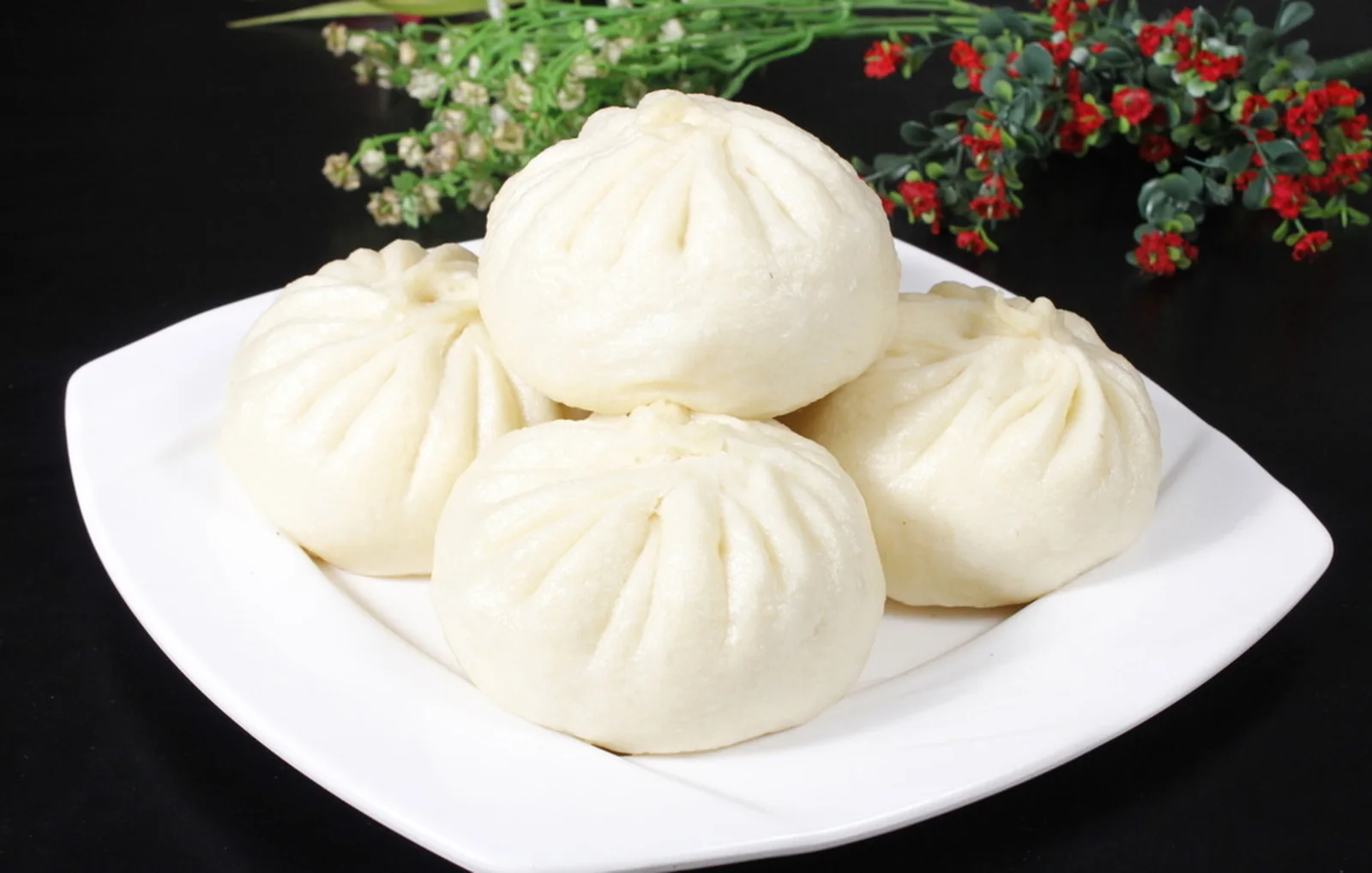
Size changes the eating problem. A larger northern bun needs a wrapper strong enough to carry moisture and weight while remaining soft; the photograph lets us inspect scale and seam rather than treating every steamed bun as the same delicate dim-sum object.
Tianjin Goubuli baozi
Tianjin's Goubuli is among China's best-known baozi names. Its reputation is tied to carefully proportioned meat filling and an established pleating style. The familiar brand story tells of a young bun maker nicknamed Gouzi who became too busy to speak with customers, giving rise to a name interpreted as “Gou ignores people.”
That story is part of the business's public identity, not neutral proof of every historical detail. Famous-shop narratives often mix memory, marketing and local pride. They are worth recording, but not repeating as unquestioned folklore.
Cantonese char siu bao
Char siu bao encloses Cantonese barbecued pork in a soft bun. Steamed versions often have a pale exterior that opens at the top; baked versions develop a glossy brown surface. In yum cha, the bun belongs to a sequence of small dishes shared with tea rather than the northern breakfast-shop rhythm.
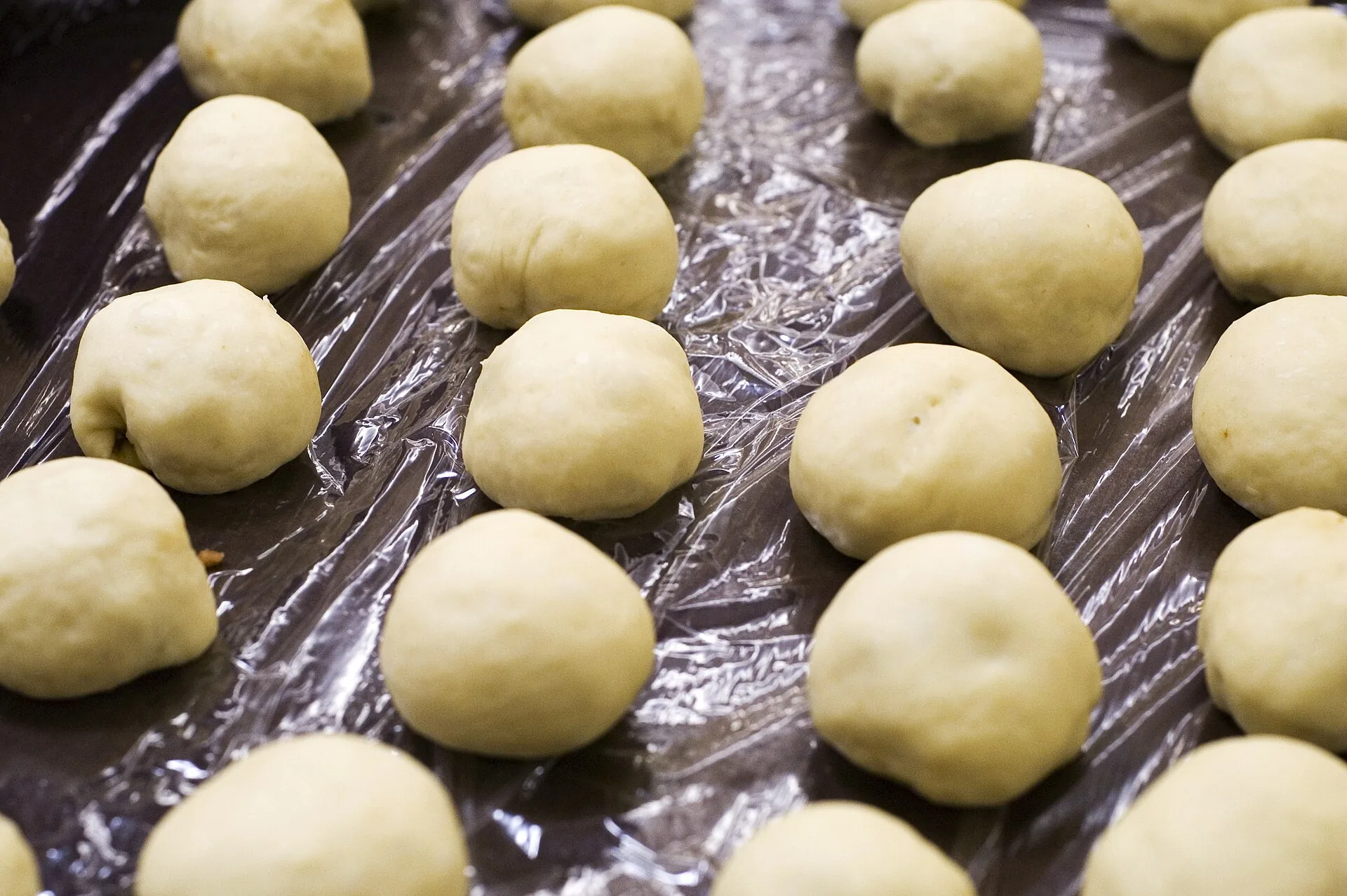
Cantonese char siu bao. Photograph by Paul Goyette, CC BY-SA 2.0, via Wikimedia Commons. License record.
The red or reddish-brown filling seen in many restaurant versions reflects char siu seasoning and sometimes added coloring. It should not be treated as the visual standard for every steamed pork bun.
Shanghai shengjian mantou
Shengjian mantou, often called shengjian bao in English, is a Shanghai specialty cooked in a pan. The base browns in oil while water and a lid create steam for the upper dough and filling. The result combines a crisp underside, soft bread and hot broth or meat juices.
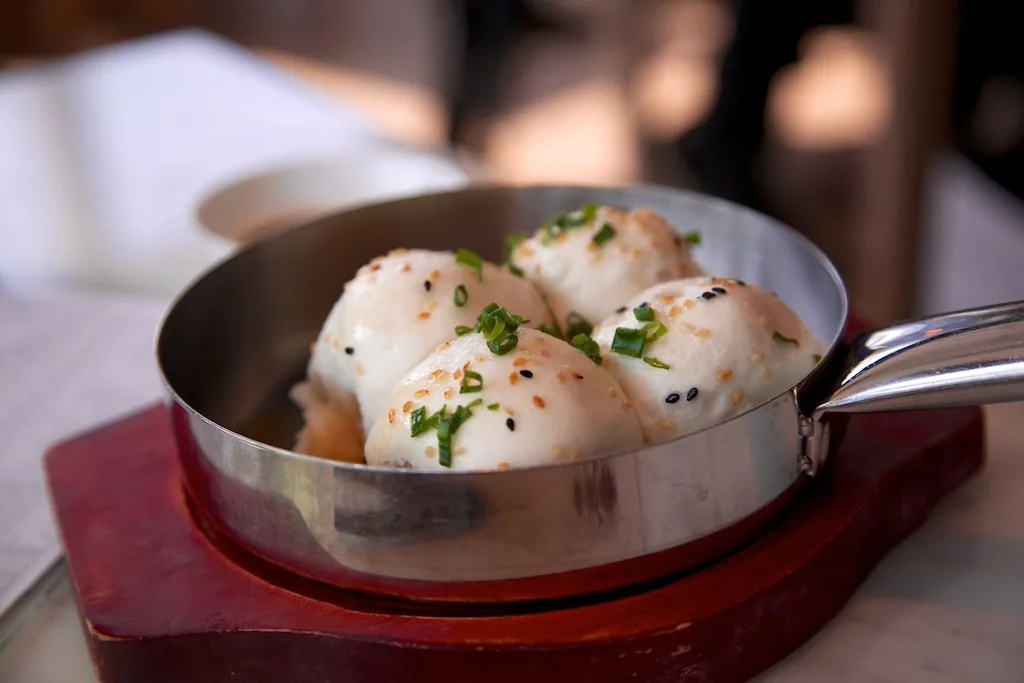
Shengjian mantou cooking in a pan. Photograph by Luca Mascaro, CC BY-SA 2.0, via Wikimedia Commons. License record.
The Shanghai use of mantou for a filled bun is a useful reminder: regional language is not a mistake waiting for standard Mandarin to correct it.
Baozi beyond China
Filled steamed buns traveled with merchants, workers, families and restaurant traditions. In Japan, nikuman developed as a familiar convenience food. Across parts of Southeast Asia, names such as bakpao or bakpau reflect Chinese migration and long local histories. Overseas Chinese bakeries and modern restaurants continue to change fillings, size and presentation.
These foods should not be described only as copies of a Chinese original. Migration creates cuisines with their own memories and standards. A Dutch supermarket bapao, an Indonesian-Chinese bakery bun and a family baozi recipe in North America may all reveal different paths through language, labor and local ingredients.
The global popularity of “bao” has also produced folded steamed breads resembling small white sandwiches. They are often inspired by Taiwanese gua bao, which is a folded bun rather than a sealed baozi. Calling every folded bun baozi makes both foods harder to understand.
How to eat baozi without turning breakfast into a ceremony
Baozi generally needs little instruction. Hold a small bun in the hand, use chopsticks, or place it in a bowl. Let it cool before biting. Larger buns may be divided. Soup-rich varieties deserve particular caution because the filling can remain dangerously hot after the exterior feels manageable.
A few practical habits are enough:
- Take a small first bite when the filling may contain hot broth.
- Keep the paper square or leaf beneath the bun if it helps prevent sticking.
- Use serving utensils when buns are shared.
- Ask about the filling rather than assuming every white bun contains pork.
- Do not require soy sauce or chili oil before tasting; many baozi are seasoned to stand alone.
The absence of formal ritual does not mean the food lacks culture. Ordinary repetition is itself a tradition.
Buying and reheating Chinese steamed buns
The cut-open bun is more honest than the pleats
I trust the first cut more than the top knot. The cut reveals whether the dough has a wet, compressed band around the filling; whether the filling occupies the bun or merely decorates its center; whether broth has soaked one side while the other remains dry; and whether the crumb recovered after steaming. Pleats can advertise dexterity. The cross-section records what heat actually did.
That does not mean every baozi needs a huge filling-to-dough ratio. A breakfast bun may deliberately offer more wheat; a char siu bao needs enough bread to carry a sweet, concentrated center; a soup-rich bun needs a stronger wall. The honest standard is proportion with purpose. If the maker cannot explain why the dough is that thick, the bun probably cannot either.
Fresh baozi should have a cooked, resilient crumb rather than a wet or raw layer around the filling. The exterior may be smooth, softly wrinkled or deliberately split depending on style. Brilliant white color alone does not prove quality.
For frozen baozi, follow the producer's instructions and heat until the center is thoroughly hot. Steaming usually protects the dough's moisture better than dry heat. A microwave can work quickly, but covering the bun and retaining some moisture helps prevent a hard surface. Raw meat products require full cooking; ready-to-eat buns still require safe reheating and storage.
This cultural guide does not describe baozi as healthy or unhealthy in the abstract. Bun size, dough, filling, sodium and the rest of the meal matter. Dietary or allergy claims should be checked against actual ingredients and kitchen practices.
What baozi keeps beneath the lid
The steamer lid rises and the scene lasts only a few seconds: white buns, wet bamboo, steam disappearing into colder air. Then breakfast moves on. A customer leaves. Another tray replaces the first.
Baozi does not need to be rare to deserve attention. Its craft is protected by repetition: knead, wait, divide, fill, close, steam. Every region and household bends that sequence a little differently. The bun remains soft enough to accept those differences.
Explore the Chinese dumplings and buns collection or compare baozi with Chinese dumplings to understand how wrapper, dough and place create distinct foods.
If one breakfast counter deserves a return visit, take its evidence into the Proof to Steam Atlas. Keep the pre-steam form, cooked bun and cut-open crumb attached to one batch; record the hour, place, dough, filling, condensation and any collapse. Return when another maker solves the same problem differently. The next reader needs more than a generic “must eat.”