My verdict on Chinese dumplings: “dumpling” is a useful English doorway, but it is too wide to be the final answer. Jiaozi, wontons, baozi, xiaolongbao and potstickers use different doughs, techniques and eating situations. Learn the wrapper and cooking method first; the family memory, New Year symbolism and perfect pleat make sense after that.
I reject the glossy idea that a flawless row of identical crescents is the highest form of dumpling knowledge. I would rather see one clumsy jiaozi that a child was allowed to fold beside an experienced hand: the seal, flour and correction reveal how the food survives. Technique matters, but technique becomes culture only when somebody is trusted to join the work.
What are Chinese dumplings?
The Kaifeng soup dumplings guide takes one regional basket further, testing whether a thin wrapper actually carries its broth to the spoon. Use it when the question is not only “what counts as a dumpling?” but “how should I judge this Kaifeng guantangbao?”
In English, Chinese dumplings can mean almost any Chinese food made by wrapping dough or a thin skin around a filling. That broad label is convenient, but it can erase the differences between foods that a Chinese speaker would not normally place under one name.
Jiaozi (饺子) usually have an unleavened wheat wrapper folded around a savory filling. They are especially prominent in northern Chinese foodways, although they are now eaten throughout China and around the world. They may be boiled as shui jiao, steamed as zheng jiao, or cooked against a pan as guotie or pan-fried jiaozi, depending on local terminology and method.
That is different from baozi, whose leavened wheat dough rises into a soft bun; xiaolongbao, thin-skinned steamed buns associated with Jiangnan; and wontons, which commonly use thinner wrappers and are often served in broth. English menus may call all of them dumplings, but their dough, structure and culinary histories are not interchangeable.
| Food | Wrapper or dough | Typical form | Common cooking method | Important distinction |
|---|---|---|---|---|
| Jiaozi | Unleavened wheat dough | Crescent or half-moon | Boiled, steamed or pan-cooked | The central subject of this guide |
| Guotie / potstickers | Usually jiaozi-style wheat wrapper | Often elongated or crescent-shaped | Browned in a pan, usually with steam added | A cooking style or related form, not the English name for every jiaozi |
| Wonton | Thin wheat wrapper, often made with egg in commercial production | Folded parcel with a looser skin | Boiled, commonly served in broth | Wrapper and folding tradition differ from jiaozi |
| Baozi | Leavened wheat dough | Round, fully enclosed bun | Steamed | Bread-like dough rather than a thin jiaozi skin |
| Xiaolongbao | Thin wheat dough | Pleated, purse-like bun | Steamed in baskets | Gelled broth melts inside during steaming |
| Har gow | Translucent starch-based wrapper | Pleated crescent | Steamed | A Cantonese dim sum dumpling, not jiaozi |
The useful question is therefore not simply “What are Chinese dumplings called?” It is “Which wrapped food, from which place and meal, are we talking about?”
A history older and less certain than the familiar legend
The most repeated origin story names the Eastern Han physician Zhang Zhongjing. In the legend, he filled ear-shaped pieces of dough with warming ingredients and distributed them to people suffering through winter. The story is culturally meaningful and explains why some people call dumplings jiao er, or “tender ears,” in retellings.
It should not be presented as a proven moment of invention.
Food rarely begins in one dramatic afternoon. Dough, fillings and cooking methods change gradually, while later generations attach memorable names to them. Archaeological evidence offers a firmer, although still incomplete, trail.
In a 2024 Xinhua report drawing on museum and archaeology specialists, researchers described triangular, filling-like foods discovered in a sealed bronze vessel from a roughly 2,500-year-old tomb in Tengzhou, Shandong. Wang Dongmei of the Shandong Museum explained that the fragile pieces crumbled after the vessel was opened, making the original filling impossible to identify. The report also documents dumpling-like forms on Eastern Han and Three Kingdoms-period chef figurines from Sichuan and Chongqing, and well-preserved Tang dynasty dumplings excavated from the Astana Tombs in Turpan, Xinjiang.
These finds show a long history of filled dough foods across distant regions. They do not prove that every object belongs to an unbroken recipe identical to modern jiaozi, nor that one province alone owns the idea.
The evidence supports a long history of filled dough; it does not turn the Zhang Zhongjing account into archaeology or appoint one surviving object as the first modern jiaozi.
The real center of jiaozi is often the table
A finished dumpling can look self-contained: wrapper sealed, filling hidden, edges pressed into order. Making a tray of them is the opposite. The work tends to spread.
Someone mixes the filling. Someone rolls ropes of dough and cuts them into small pieces. One person turns those pieces into wrappers while others fill and fold. The quickest hands set a rhythm; beginners make thick edges, crooked moons and occasional leaks. The tray fills anyway.
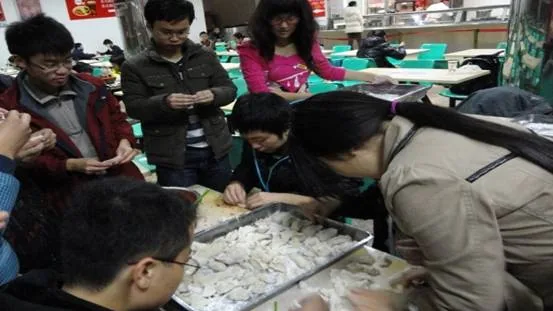
This open-access photograph shows the work before the plate: separate wrappers, filling and repeated hand-shaped forms. It documents one making session, not a universal folding method or proof that every household divides the labor in the same way.
At many family tables, instruction arrives in fragments rather than formal lessons: a wrapper is turned in the palm, a thumb presses the seam again, an older hand quietly repairs a dumpling that carries too much filling. The learner understands texture before vocabulary. Years later, the memory may return through the drag of a rolling pin or the flour left on a sleeve. Skill is inherited through correction, watching and repetition as much as through written measurements.
The labor also changes the social message. Heating frozen dumplings can be generous when time is short. Filling ready-made skins says, “stay and help.” Mixing the filling, kneading the dough and rolling every wrapper turns a guest into part of the household rhythm. I do not rank those meals by purity, but I notice who is invited behind the finished plate. Hospitality becomes deepest when someone is trusted with the messy work, the misshapen dumpling and the conversation that lasts until the tray is full.

The useful evidence is not a perfect final pleat. One person demonstrates the motion while another works through a pile of uneven dough pieces. That awkward first batch is exactly how jiaozi becomes transmitted skill rather than a recipe watched from a distance.
Chinese dumpling fillings follow place, season and household
There is no single “authentic Chinese dumpling filling.” Pork with napa cabbage is familiar; pork with garlic chives is another classic combination. Beef and lamb appear in northern and northwestern traditions, including Muslim foodways where pork is excluded. Coastal households may use shrimp, fish or other seafood. Vegetarian fillings can combine egg and chives, tofu, mushrooms, cabbage, glass noodles or preserved vegetables.
The wrapper creates a small enclosed cooking environment. Vegetables release water, ground meat gives fat and structure, and aromatics perfume the steam inside. Good filling is therefore not simply a list of ingredients. Moisture, chopping, seasoning and mixing determine whether the center remains juicy or breaks the wrapper.
| Filling family | Common examples | Context to remember |
|---|---|---|
| Pork and vegetables | Pork with napa cabbage, garlic chives, celery or fennel | Widely familiar but not universal; household ratios vary |
| Beef or lamb | Beef with scallion, lamb with carrot or onion | Important in northern, northwestern and halal Chinese foodways |
| Seafood | Shrimp, fish, mackerel or mixed seafood | Especially associated with some coastal traditions; species are local |
| Egg and vegetables | Egg with garlic chives, zucchini or vermicelli | May be vegetarian, but sauces and shared equipment still need checking |
| Mushroom and tofu | Shiitake, wood ear, tofu, cabbage or glass noodles | Texture and seasoning matter more than copying a meat filling |
“Traditional” is most useful when it names a tradition: a Shandong coastal fish dumpling, a Hui lamb filling, a grandmother's chive-and-egg mixture. Without that specificity, the word becomes decoration.
Boiled, steamed and pan-cooked Chinese dumplings compared
The same filling can feel like a different food when the cooking method changes. Water makes the wrapper supple. Steam preserves a drier surface and a clean wheat aroma. A pan builds a brittle, toasted base against the soft upper skin.
| Method | Chinese term commonly encountered | Texture | What requires attention |
|---|---|---|---|
| Boiled | Shui jiao (水饺) | Tender, elastic wrapper | A strong seal and enough room for the dumplings to move |
| Steamed | Zheng jiao (蒸饺) | Soft to chewy, with a drier surface than boiled jiaozi | Wrapper thickness and protection from sticking |
| Pan-cooked | Guotie (锅贴) or pan-fried jiaozi | Crisp base, soft or chewy upper wrapper | Heat, oil, water and timing must work in sequence |
How to cook boiled jiaozi responsibly
Bring a generous pot of water to a steady boil, add the dumplings without crowding the pot, and stir gently enough to prevent them from settling and sticking. Fresh dumplings usually cook faster than frozen ones; large dumplings and thick skins need more time.
Many family methods add small amounts of cool water when the boil becomes vigorous. That rhythm can help the wrapper and filling cook without tearing, but it is a technique rather than a universal law. Floating is a useful sign, not proof that raw meat or seafood has reached a safe temperature. Check that the wrapper is cooked through and follow reliable food-safety guidance for the filling.
A broken jiaozi is not merely an ugly one. Filling escaping into the pot changes the cooking water, strips flavor from that dumpling and makes the remaining wrappers harder to judge. The repair therefore begins before boiling: control vegetable moisture, resist overfilling, press out trapped air and make the seam continuous. A decorative pleat cannot compensate for an open path to the filling.
Why potstickers stick on purpose
The English word potsticker translates the image behind guotie: something attached to the pot. A small amount of oil browns the base. Water is then added and the pan covered so steam cooks the wrapper and filling. After the water evaporates, the bottom crisps again.
Restaurant language is inconsistent. Some menus use potsticker for any pan-fried dumpling; others distinguish guotie by shape or by whether the top is fully sealed. Treat the menu as evidence of that restaurant's food history, not as a universal dictionary.
Chinese New Year dumplings: important, but not universal
Jiaozi are closely associated with the Spring Festival in many northern Chinese households. Their curved form is often compared with historical silver or gold ingots, making them an image of prosperity. Making them together can also turn the hours before the new year into shared family time.
Yet “Chinese people eat dumplings for New Year” is too broad. China contains many New Year food traditions. Families in different regions may give greater importance to fish, rice cakes, tangyuan, spring rolls, turnip cake or foods specific to a village, dialect group or migration history. Even within a dumpling-making family, the filling, hour of eating and symbolic explanations may differ. I insist on that distinction because a warm reunion symbol turns cold the moment it is used to erase somebody else's New Year table.
UNESCO's 2024 inscription of the Spring Festival, social practices of the Chinese people in celebration of traditional new year emphasizes a living complex of family reunion, community activities, wishes for good fortune and knowledge transmitted across generations. Jiaozi can belong to that larger field of practice; they should not be turned into a mandatory national ritual.
The Chinese festivals guide places New Year dumplings beside the many other foods and customs that shape the festival across regions and the diaspora.
Regional Chinese dumplings do not fit one crescent
Even within the jiaozi family, regional identity enters through flour, thickness, fold, filling, sauce and the role the dumpling plays in a meal.
In parts of Shandong, seafood dumplings reflect a long coastline and local catch. In the northeast, substantial boiled dumplings suit both household tables and celebratory gatherings. Muslim Chinese traditions contribute beef and lamb fillings shaped by religious practice and northwestern food systems. In Sichuan, Zhong shui jiao are small pork dumplings served with a sauce in which red chili oil, garlic and sweetness meet.
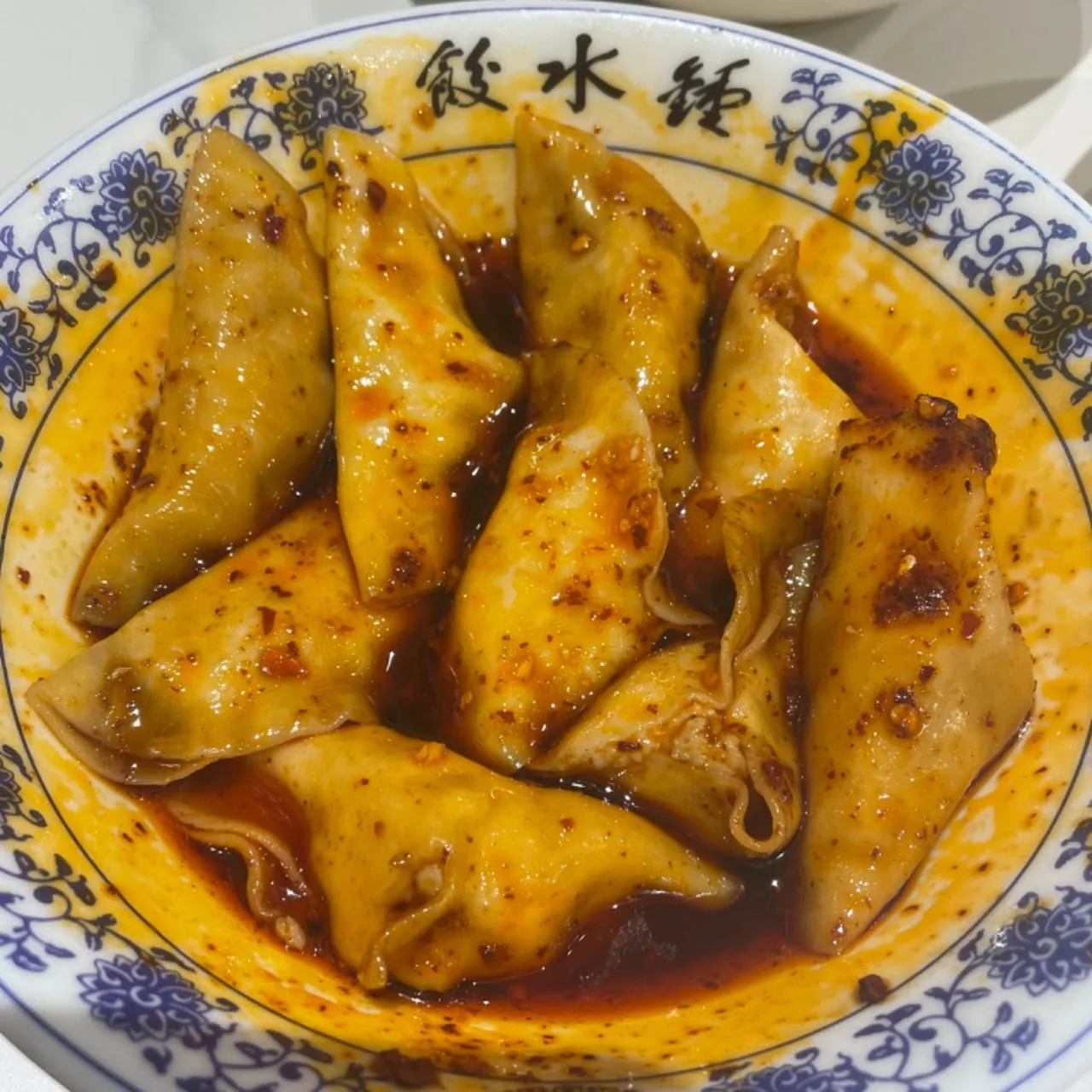
Zhong shui jiao in Chengdu, a regional expression of Chinese dumplings served with seasoned red oil. Photograph by Yushinye, CC0, via Wikimedia Commons. License record.
The point of these examples is not to produce a definitive top-ten list. It is to show how quickly “Chinese dumplings” becomes plural once place is allowed back into the story.
How to eat Chinese dumplings without inventing etiquette
There is no single formal dumpling ceremony. At an ordinary meal, diners may lift jiaozi with chopsticks, bite them whole if small enough, or divide a large hot dumpling carefully. A dipping sauce might be dark vinegar alone, vinegar with garlic, soy-based sauce, chili oil, or nothing at all.
Practical courtesy matters more than theatrical rules:
- Let freshly cooked dumplings cool enough to avoid burning yourself.
- Use the serving utensils provided at a shared table.
- Do not assume every table wants the same soy-vinegar-chili mixture.
- Ask before adding sauce to a shared dish.
- Learn the dumpling's specific name when the cook or restaurant provides it.
- Treat an imperfect handmade fold as part of the meal, not a defect to grade.
The last point deserves emphasis. Uniform pleats can reveal great craft, especially in restaurant and specialist settings. At home, irregular dumplings may reveal something equally valuable: several generations were willing to let a beginner join the table.
Frozen dumplings and diaspora kitchens are part of the story
Chinese dumplings travel well. They can be frozen, sold in supermarkets, adapted to local ingredients and produced at scales ranging from one kitchen table to an industrial line. None of that automatically makes them culturally empty.
For migrants and international students, a bag of frozen jiaozi can be an affordable meal, a taste remembered from home or the beginning of a new shared routine. Restaurants may adjust fillings, wrapper thickness, dipping sauces and English names to local expectations. Some changes emerge from ingredient access; others from labor costs, customer preferences or the histories of a particular Chinese community.
Authenticity is clearer when it finishes the sentence: authentic to a northeastern family recipe, a Taiwanese dumpling shop, a Chinese American restaurant tradition, or a cook's present-day kitchen. The word should open a history, not end an argument.
What to notice in a well-made jiaozi
A good dumpling does not require decorative pleats, but its parts should cooperate.

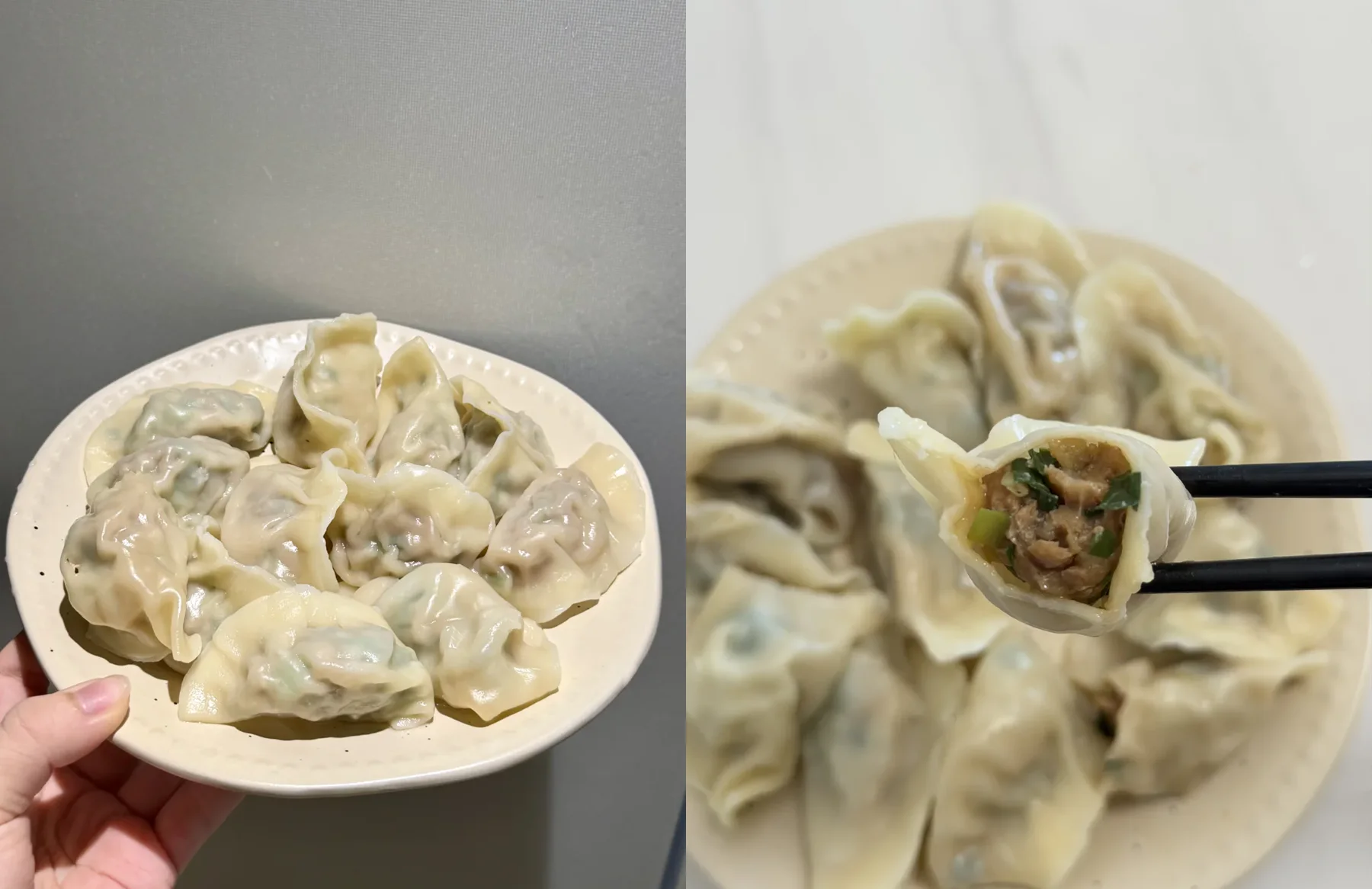
The left side makes the seal visible; the right shows why one filling does not require one ornamental fold. The evidence is structural: continuous skin, contained filling and enough flour to keep an uncooked batch separate.
- The seal holds through cooking without becoming a rope of raw dough.
- The wrapper has enough strength for the method yet does not bury the filling.
- Vegetables remain identifiable rather than dissolving into water.
- Meat or seafood is cooked safely without becoming dry and compact.
- Seasoning supports the filling instead of making dipping sauce compulsory.
- The form suits its purpose: boiling, steaming and pan-cooking ask different things of the skin.
These are observations, not a universal scorecard. A rustic, thick-skinned boiled dumpling and a fine restaurant jiaozi can both succeed on their own terms.
Chinese dumplings hold more than filling
The most moving thing about jiaozi may be how little ceremony they need in order to carry memory. Flour lands on sleeves. A wrapper dries while someone tells a story too slowly. The experienced hands move ahead; the youngest person places one overfilled dumpling on the tray and recognizes it later in the pot.
History gives Chinese dumplings depth, but repetition gives them intimacy. Across archaeological sites, northern New Year tables, Sichuan snack shops and diaspora kitchens, their forms have never stopped changing. The fold survives because people keep finding reasons to sit down and make another one.
Explore the full Chinese dumplings and buns collection, then continue with baozi to see why the English word “dumpling” contains several different culinary worlds.
If you want to move from recognition to practice, use the Chinese food recipes route to learn techniques in sequence. If your question is why jiaozi becomes emotionally louder at one time of year, continue to the Chinese festivals guide rather than assuming every Chinese family serves the same New Year table.
Then make the table visible in the Wrapper to Pot Atlas. Keep one batch connected from wrapper work to the cooked result, name who rolled, filled or quietly repaired the awkward dumpling, and return when another table divides the labor differently. A growing comparison can show how hospitality is practiced, not merely claimed.