Chinese street food is the city speaking at cooking temperature. Before office doors open, batter circles a griddle and soy milk clouds a metal pot. At noon, a cleaver works through braised meat while bread waits in a paper sleeve. After dark, smoke from skewers catches the light above folding tables. If you want the best Chinese street food, do not begin with a national top-ten list. Begin with the hour, the queue, the cooking surface and the kind of hunger you actually have.
Yale University Press's Food in Chinese Culture gives the wider anthropological frame. My street-level rule is sharper: the hour, cooking surface, queue and price tell you more about a stall's place in the city than an “ancient recipe” sign ever will.
I was born in Henan, where wheat food is not a side category. I have worked in Guangzhou for more than ten years, but I still eat noodles more often than rice. That bias matters here: I notice dough, broth, chew and the speed of a griddle before I chase a photogenic skewer or an oversized night-market novelty. It is not a national ranking. It is my honest route into a food culture that is too large to flatten.
What is Chinese street food?
Chinese street food is food prepared or sold for immediate eating from carts, temporary stalls, market counters and small storefronts built around rapid service. The definition describes a commercial setting more than a recipe. A steamed bun can be street food when sold beside a station, breakfast at home, or part of a restaurant meal. The bun does not change identity simply because a roof appears above it.
This matters because overseas lists often treat Chinese street food as a cabinet of unusual objects: one item from Beijing, one from Xi'an, one from Chengdu, arranged for maximum surprise. Everyday eaters experience something else. They know which stall opens before dawn, which queue moves fastest, which vendor makes the crisp layer thin and which bowl is worth missing the next bus.
Street food is therefore both food and infrastructure. It fills the distance between home and work. It turns a market edge, school gate or transit lane into a temporary dining room. It also changes as cities regulate smoke, traffic, waste, fire and public space. The romantic cart and the licensed indoor counter may sell related food under very different conditions.
How to choose the best Chinese street food on your first try
The best first order is not the strangest dish on the menu. It is the portion that lets you understand the stall's strength without making you solve the whole country at once. Use the time and setting as your first filter:
| When and where you are | Start with | What to notice |
|---|---|---|
| Before work or school | Jianbing, youtiao with soy milk, baozi or savory tofu pudding | Heat, queue speed, batter or dough texture and whether the food travels well |
| At a school gate or commuter corner | A small stuffed bun, scallion pancake, guokui or a simple noodle bowl | Portion size, hand-held design and how quickly the vendor resets for the next customer |
| At lunch on a food street | Roujiamo, regional noodles, rice rolls or a filled flatbread | The relationship between bread or rice, filling, sauce and the local grain tradition |
| After dark at a night market | Lamb skewers, Sichuan chuanchuan, grilled seafood or a regional fried snack | Smoke, seasoning, shared eating and whether the market is serving locals or mainly performing for visitors |
| At a famous tourist street | One item with a visible cooking process, then one ordinary nearby stall | Whether the spectacle is supported by repeat customers, clear technique and a sensible price |
My strongest recommendation for a first visit is breakfast, not the loudest night market. Morning food shows the city before it starts performing for visitors. In a northern city I would begin with a wheat-based breakfast; in Guangzhou I would look at rice rolls, congee or noodles and pay attention to freshness and steaming time. If you want a second order, change the texture, not just the spice level: move from soft and brothy to crisp and griddled.
This is also where the broader Chinese noodles guide becomes useful. For me, noodles are not a side quest from Chinese street food. They are one of the clearest ways to see how a region turns grain, water, labor and local appetite into an everyday meal. The Henan cuisine guide explains the wheat-heavy Central Plains background, while Guangzhou food shows why a southern breakfast counter can feel entirely different without being less substantial.
One country does not produce one street-food menu
China's scale makes any definitive "top ten" unreliable. Wheat-based breakfasts are prominent across many northern cities; rice noodles and rice sheets are central in numerous southern regions; Muslim Chinese vendors have shaped celebrated beef, lamb and bread traditions; coastal markets rely on seafood that inland cities encounter differently.
| Broad setting | Foods commonly encountered | Staple or technique | What the setting reveals |
|---|---|---|---|
| Northern morning stall | Jianbing, youtiao, baozi, savory tofu pudding | Wheat dough, griddles, steamers and frying | Breakfast is designed around speed, warmth and commuting |
| Northwestern market | Roujiamo, lamb skewers, noodles, breads and sweets | Wheat, beef or lamb, grilling and braising | Hui, Uyghur and other regional traditions require specific context |
| Sichuan or Chongqing snack shop | Cold noodles, dumplings in chili oil, skewered foods, guokui | Chili oil, preserved ingredients and layered seasonings | A snack can carry the same flavor architecture as a larger meal |
| Southern breakfast counter | Rice rolls, congee, rice noodles, fried dough | Rice batter, steaming and broth | Texture and freshness often matter more than heavy seasoning |
| Contemporary night market | Grilled foods, sweets, drinks and social-media novelties | Mixed regional and commercial techniques | Tourism and online visibility can rapidly reshape the menu |
The table is orientation, not a border map. Vendors migrate, chains standardize, ingredients travel and customers ask for new combinations. A food can be deeply local and widely mobile at the same time.
The morning stall is an unofficial clock
Chinese street food begins early. Breakfast vendors work while apartment windows are still dark because their customers are buying minutes as much as calories. The food must be hot, portable and familiar enough to order without study.
Youtiao, long strips of fried dough, may be torn into warm soy milk, wrapped inside a crepe or eaten beside congee. Baozi offer soft dough around meat, vegetables, sweet bean paste or many regional fillings. Savory tofu pudding can arrive with soy, pickles, aromatics or chili, while sweet versions belong to other regional preferences. The national argument over whether tofu pudding should be sweet or savory is playful precisely because both answers have real homes.
Breakfast is not a museum of old recipes. Electric griddles, disposable packaging, mobile payment and delivery apps have altered how it is sold. Yet the basic exchange remains intimate: the vendor remembers a regular's preferred sauce; the customer trusts that the next portion will resemble yesterday's.
Jianbing: breakfast assembled in a minute
Jianbing is often translated as a Chinese breakfast crepe, though "crepe" does not fully describe its grain batters, crisp insert and sauce. A vendor spreads batter thinly across a round griddle, cracks and distributes an egg, adds herbs and seeds, turns the sheet, applies savory and chili sauces, then folds it around something crisp.
Regional and commercial versions differ in batter, cracker, fried dough, sausage, vegetables and sauce. Tianjin's jianbing guozi carries a particularly strong local identity and should not be collapsed into every oversized, heavily filled version sold elsewhere.
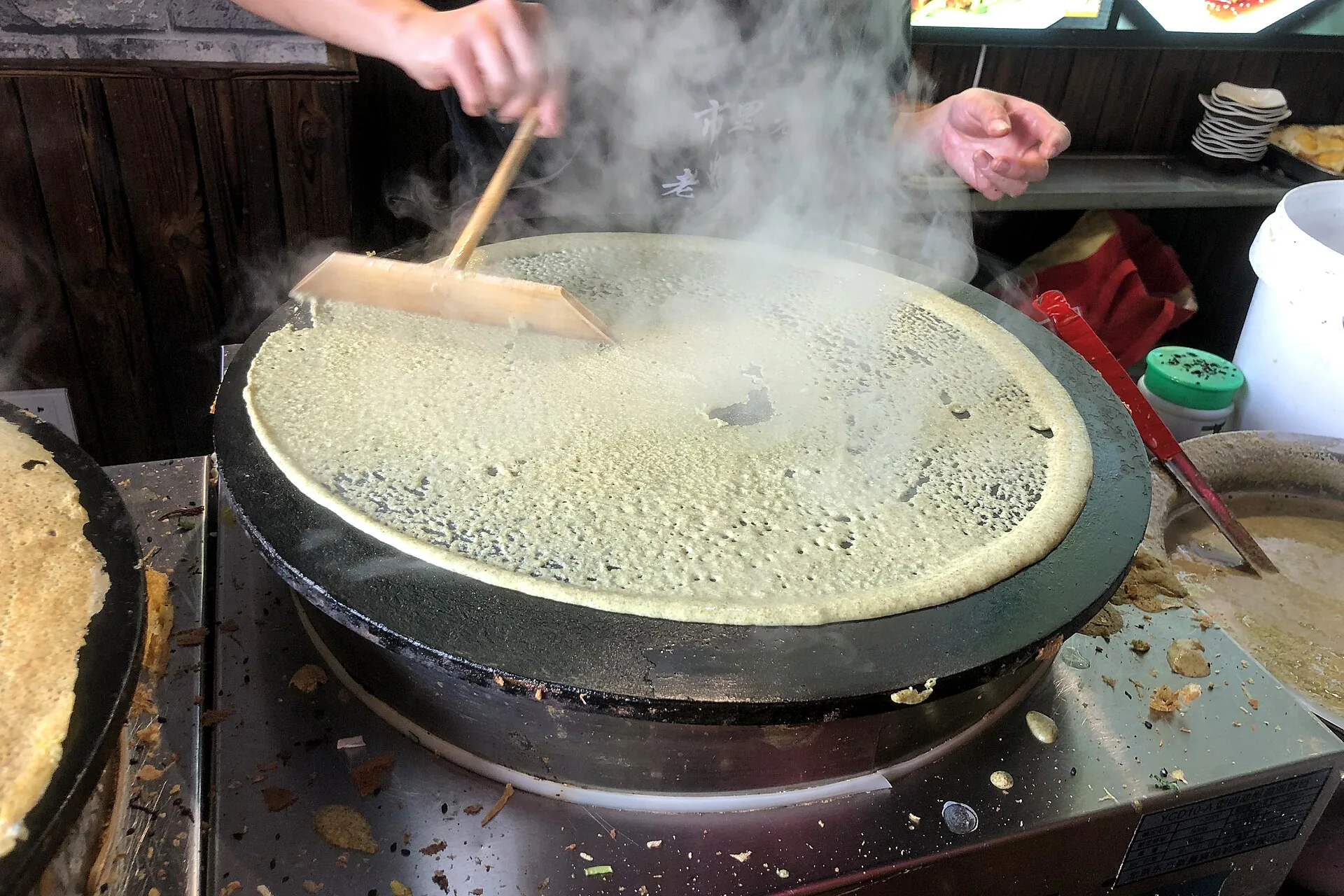
Jianbing batter meets a hot griddle in Tianjin. The vendor's speed depends on repeated control of thickness, heat and folding. Photograph by N509FZ, CC BY-SA 4.0, via Wikimedia Commons. License record.
The pleasure is architectural. A tender wrapper holds egg, herbs, fermented sauce and a brittle center; each bite breaks and bends at once. Its Tianjin roots, common components and modern variations deserve attention without pretending that every stall follows one fixed formula.
Youtiao, soy milk and foods designed to accompany one another
Some street foods make the most sense as relationships. Youtiao alone is crisp, airy and rich. Soy milk alone is gentle and warm. Together, they alternate salt, fat and softness. In other breakfasts, youtiao is wrapped in rice sheets or sticky rice, or served with savory tofu pudding.
This is why translating a food as "Chinese doughnut" can mislead. Youtiao is fried dough, but it does not normally carry the sweetness, glaze or dessert role implied by an American doughnut. Translation should offer a handhold without replacing the food's actual companions.
The familiar Qin Hui origin legend also needs care. The story linking the paired dough to a hated historical official is culturally important, but folklore and documented invention are not the same kind of evidence.
Roujiamo: a small meal held inside bread
Roujiamo joins chopped or shredded braised meat with a split wheat bread. It is strongly associated with Shaanxi, but meat, bread and seasoning vary. Pork-filled la zhi roujiamo is widely known around Xi'an; Muslim vendors may prepare beef or lamb versions within their own dietary traditions. Calling the food simply a "Chinese hamburger" explains portability while hiding the bread craft, braising liquid and regional distinctions.
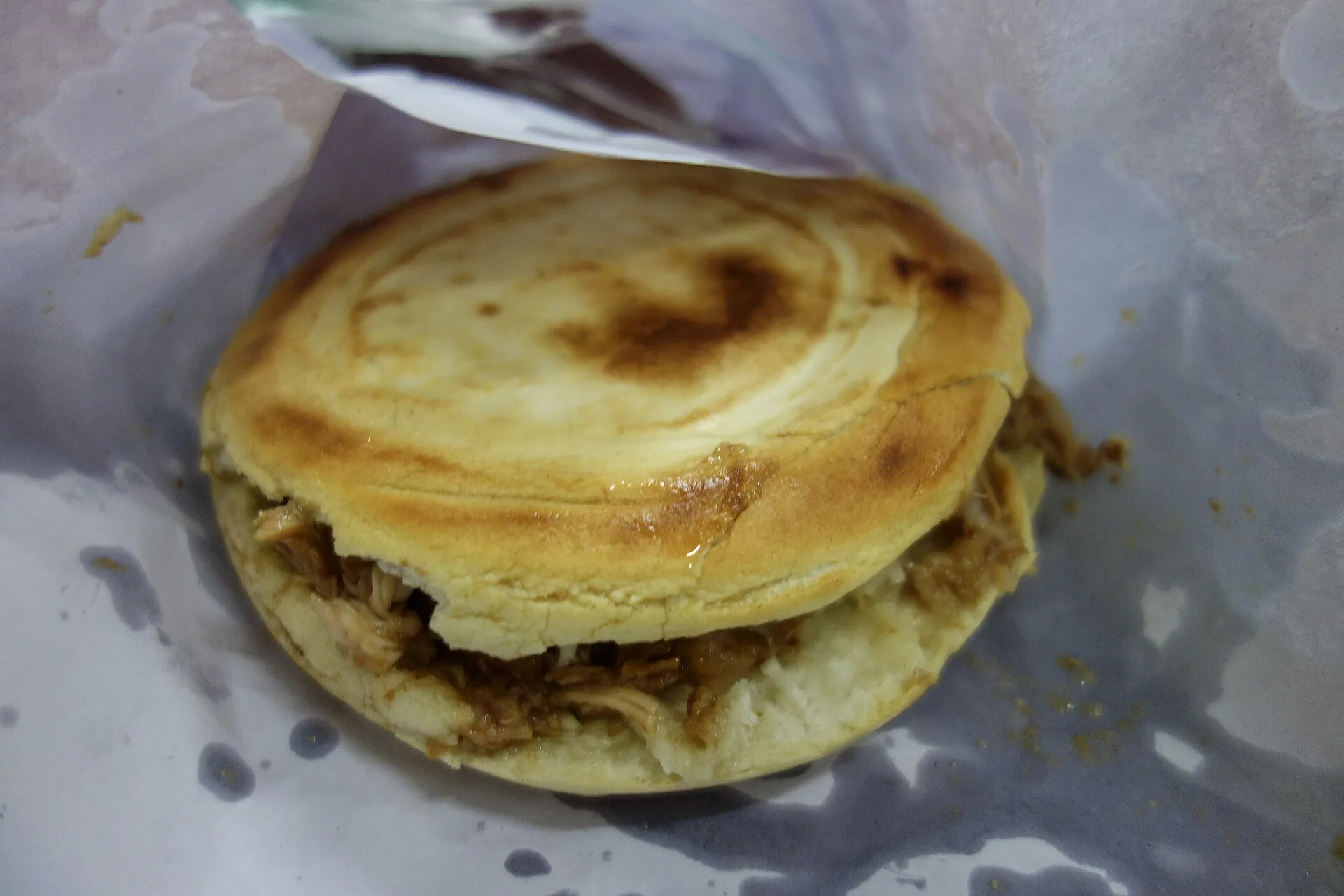
Roujiamo in Xi'an: bread is not merely a container but half of the texture. Photograph by KQuhen, CC BY-SA 4.0, via Wikimedia Commons. License record.
A good roujiamo balances crumb and juice. The bread must hold long enough to be eaten by hand without becoming indifferent and dry. The meat should season the bread rather than dissolve it. That compact engineering is why the food survives both a hurried lunch and a deliberate search for a respected shop.
Common Shaanxi styles use different breads and meat traditions, distinctions that disappear when roujiamo is reduced to the phrase “Chinese hamburger.”
Xi'an food streets and the danger of looking only for spectacle
Xi'an's Muslim Quarter is one of the most photographed food areas in China. Visitors encounter breads, beef and lamb dishes, skewers, sweets, nuts and crowded evening streets. The visual abundance is real. So is the Hui community whose religious, commercial and family life cannot be reduced to a tourist backdrop.
Descriptions should distinguish Muslim Chinese foodways from a generic idea of "northwestern food." Pork is not an interchangeable filling in a Hui context. Halal practice, called qingzhen in Chinese settings, concerns sourcing, preparation and trust, not simply replacing one meat with another.
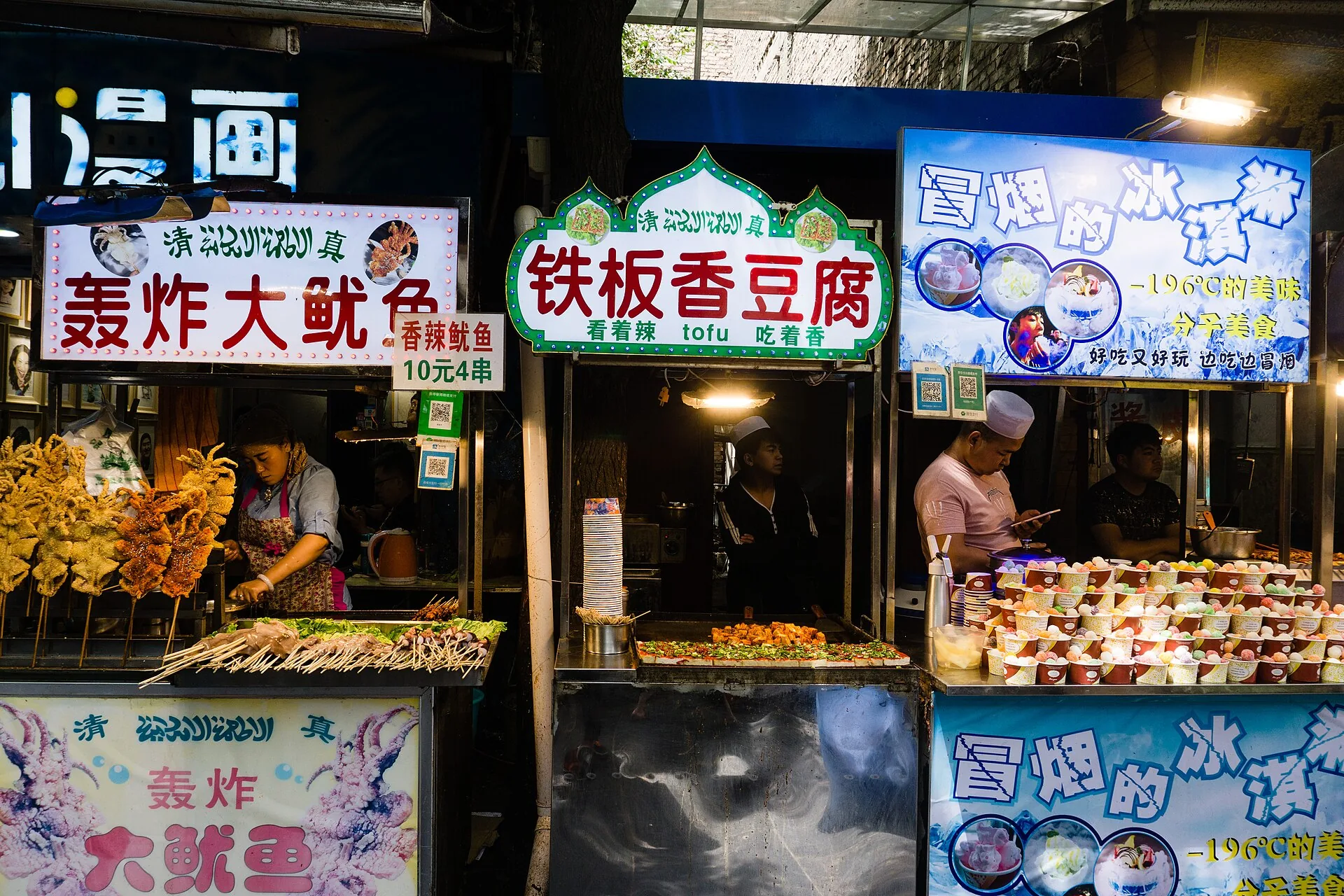
The street itself also changes. Tourism can raise rents, reward photogenic products and encourage multiple stalls to sell the same recognizable item. A famous market is still a workplace. The vendor framed in a travel photograph may be managing heat, stock, rent, inspections and a queue rather than performing timeless tradition.
Skewers, smoke and the evening table
Skewered food appears across China in many forms. Northwestern lamb chuanr may be seasoned with cumin, chili and salt over charcoal or another heat source. Sichuan chuanchuan organizes vegetables, tofu products and meats on sticks for cooking in broth or serving with seasoned oil. Cantonese and coastal night markets bring their own seafood and grilled items.
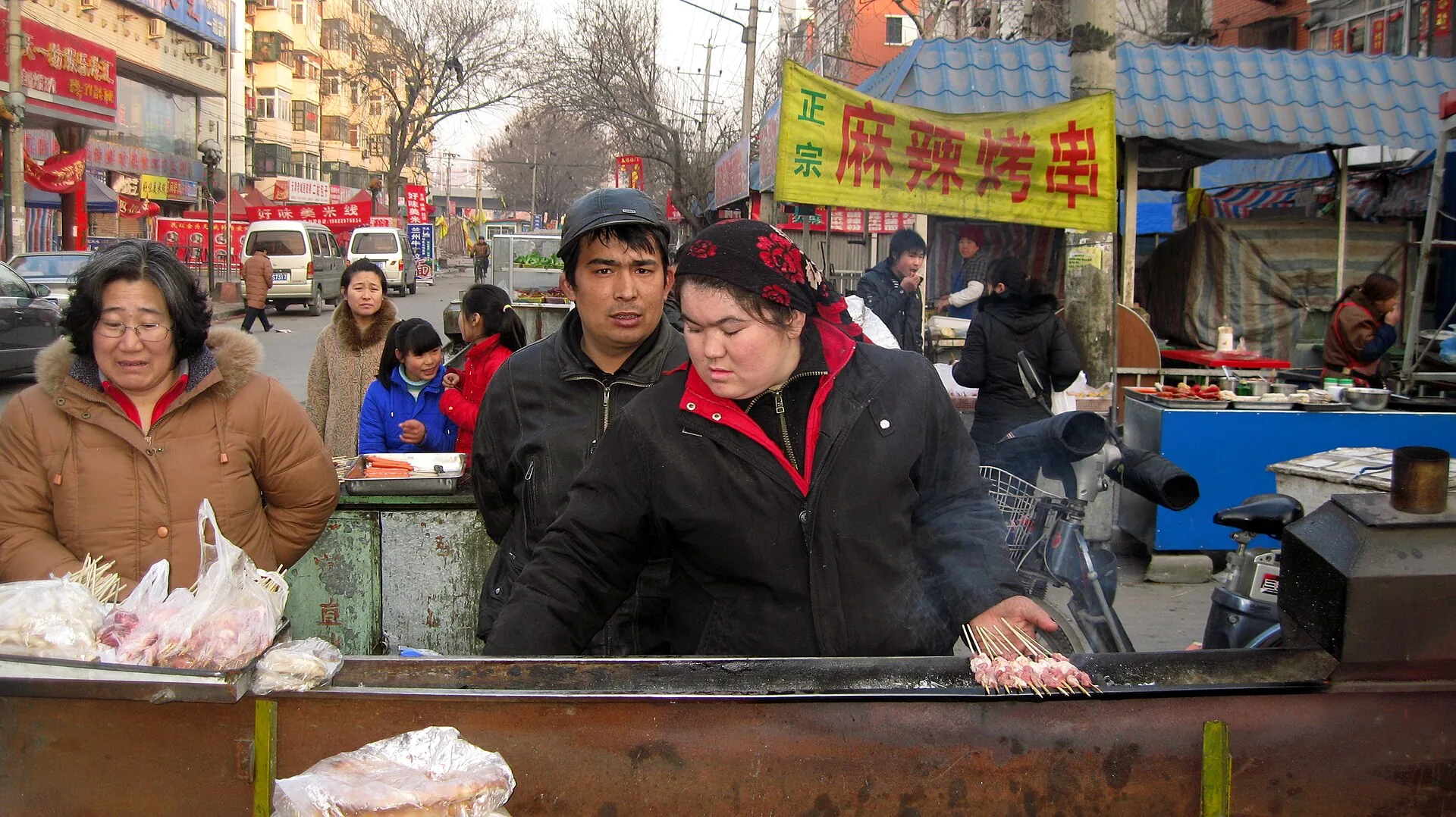
Mutton skewers prepared at a Tianjin street stall. The surrounding street is part of the food's working environment, not decorative scenery. Photograph by Kilroy238, CC BY-SA 3.0, via Wikimedia Commons. License record.
"Food on a stick" is only the visible mechanism. The meaningful differences are meat, cut, marinade, heat, fuel, seasoning and community. Even smoke carries policy: many cities have restricted open charcoal cooking or moved vendors into managed market spaces to address air quality and fire risk.
Sichuan snacks: small portions, complete flavor structures
Sichuan street and snack foods are often summarized as spicy. Chili matters, but a well-composed snack may also rely on Sichuan pepper, sesame, garlic, vinegar, sugar, fermented beans, preserved vegetables and aromatic oils.
Zhong dumplings use a seasoned chili-oil sauce that differs from the broth-centered northern image of dumplings. Cold noodles balance chili, vinegar, sesame or nutty elements and crisp vegetables. Guokui may be baked or griddled into a thin, crisp bread with savory fillings or seasoning. Skewered foods can be cooked in hot broth and dressed after cooking.
Heat is not a contest. It is one instrument among several. Asking only "how spicy?" can obscure fragrance, fermentation and texture, just as photographing only the red oil can hide the labor beneath it.
Compare the broader Chinese dumplings guide and Chinese noodles guide to see how street portions connect with larger regional food systems.
Southern streets: rice batter, broth and sea air
Southern Chinese street food is no more uniform than northern street food. In Guangdong and Hong Kong, steamed rice rolls known as cheung fun may wrap shrimp, beef, pork or fried dough, or arrive plain with a seasoned soy-based sauce. Congee shops, wonton noodles, fish balls and baked or steamed snacks serve different hours and neighborhoods.
In Guangxi, rice noodles carry city-specific identities, including Guilin styles with braising liquid, meat, pickled vegetables and toppings. Yunnan's rice-noodle traditions include many local bowls beyond the internationally familiar crossing-the-bridge story. Fujian, Chaoshan, Hainan and Taiwan each complicate any attempt to define one southern night-market menu.
Rice is not merely a substitute for wheat. Steaming a rice batter into a tender sheet and grinding rice for a resilient noodle require their own technical knowledge. The soft surface of a rice roll can be as deliberate as the brittle center of jianbing.
Street, market, snack shop or restaurant?
The border among street food, market food and restaurant food is porous.
| Selling format | Typical strengths | Common constraints | Cultural effect |
|---|---|---|---|
| Mobile cart | Low footprint and close access to commuters | Weather, storage, permits and limited equipment | Can follow demand but is vulnerable to enforcement changes |
| Fixed street stall | Specialized equipment and a visible routine | Smoke, waste, traffic and exposure | Often becomes a neighborhood landmark |
| Managed market counter | Water, electricity, seating and formal oversight | Rent, standardized hours and curated tenancy | Preserves foods while changing their street setting |
| Small snack shop | Consistency, storage and all-weather service | Higher overhead and less mobility | A former street food may become an everyday shop specialty |
| Chain or food-court outlet | Scale, branding and predictable service | Standardization may narrow regional variation | Helps a local food travel nationally or globally |
Moving indoors does not automatically make a food inauthentic. Regulations may improve sanitation and working conditions. At the same time, higher rent and standardized spaces can exclude small operators or change what can be profitably sold. The loss people mourn is sometimes not the recipe but the social geography around it.
Night markets are contemporary cities, not ancient stage sets
Night markets compress eating and public life into the same illuminated space. Friends share skewers, families buy sweets, visitors follow queues and vendors test products designed to travel on social media. Some foods have long local histories; others are recent inventions, imports or commercial hybrids.
There is no need to force antiquity onto every successful snack. A modern cheese-filled, oversized or brightly colored item can reveal contemporary youth culture and platform economics even when it tells us little about an imperial kitchen. Tradition remains visible beside innovation rather than being proven by it.
The best observation is temporal. Visit a market at opening, peak hour and closing, and three different systems appear: preparation, performance and cleanup. Street food includes all three, though photographs usually keep only the brightest middle.
A practical guide to ordering Chinese street food
Ordering is often easier than the crowded scene suggests.
- Watch what the vendor is making and whether customers order by item, weight, skewer or bowl.
- Confirm the price before adding optional toppings or choosing seafood sold by weight.
- Indicate quantity clearly with words or fingers, taking care that hand-number conventions can vary.
- State dietary restrictions directly; do not rely only on appearance.
- Keep payment ready and step aside after collecting the food so the queue can continue.
- Return reusable bowls, skewers or trays where local practice requires it.
- Ask before placing a camera close to a vendor's face or work surface.
Pointing is useful when language fails, but people are not display objects. A simple request and a willingness to accept "no" preserve more dignity than a technically perfect photograph taken without consent.
Food safety without false confidence
Street food can be carefully prepared or poorly handled; the same is true indoors. A polished sign is not proof of safety, and a modest stall is not proof of danger. Useful observations include whether raw and cooked foods are separated, perishable ingredients are kept at safe temperatures, utensils and hands are managed cleanly, water appears reliable and cooked food is served hot.
Choose vendors with steady turnover. Be cautious with food that has remained warm rather than hot, raw seafood, unpasteurized products, damaged shellfish, cut fruit exposed for long periods and sauces handled by many customers. Travelers should consider local water conditions and their own medical risk.
People who are pregnant, immunocompromised, very young, older or managing serious allergies may need stricter choices. No general article can certify an individual stall. Safety is a chain of sourcing, storage, cooking and service, much of which a customer cannot see.
| Visible signal | What it may suggest | What it cannot prove |
|---|---|---|
| A long local queue | Fast turnover and community familiarity | Safe sourcing or correct internal temperature |
| Food cooked to order | Less holding time and a hot final step | Clean water, utensils or raw-food separation |
| Gloves | A barrier when changed correctly | Clean hands if the same gloves touch money and food |
| Covered ingredients | Protection from dust and handling | Proper refrigeration or freshness |
| Official market setting | Some level of infrastructure or oversight | Perfect compliance at every counter |
Chinese street food after migration
Outside China, street-food traditions enter Chinatowns, mall food courts, weekend markets, food trucks, festivals and compact restaurants. Licensing rules may require equipment that changes a technique. Local flour alters dough. Customers expect larger portions or a menu that combines foods from distant Chinese regions.
Adaptation does not erase origin, but honest naming helps. A Tianjin-inspired jianbing in London, a Xi'an-style roujiamo in New York and a Taiwanese night-market stall in Sydney have different relationships to place. Their stories are richer when the operator explains the route rather than claiming one generic authenticity.
Diaspora street food also becomes a form of translation. It gives a neighborhood something immediate to smell and hold. A person may learn the word jianbing only after watching batter circle a griddle; vocabulary follows appetite.
Frequently asked questions about Chinese street food
What is Chinese street food?
Chinese street food is food prepared or sold for immediate eating from carts, stalls, market counters and very small shops. It is not one cuisine: breakfast crepes, buns, noodles, skewers, rice rolls and sweets vary by region, time of day and community.
What are the most popular Chinese street foods?
Widely recognized examples include jianbing, youtiao, baozi, roujiamo, lamb skewers, scallion pancakes, rice noodles, cheung fun and regional dumplings. Popularity is local, so no single list represents every Chinese city.
Is Chinese street food always spicy?
No. Some Sichuan, Chongqing, Hunan and northwestern foods use abundant chili, but soy milk, youtiao, steamed buns, Cantonese rice rolls and many noodle soups can be mild. Condiments and regional taste matter more than the selling format.
Is Chinese street food safe to eat?
Safety depends on water, ingredients, storage, cooking temperature, utensil hygiene and local oversight. Choose busy vendors who cook food thoroughly, keep raw and cooked ingredients separate and protect food from contamination; people at higher medical risk should be especially cautious.
How do you order food from a Chinese street stall?
Observe the queue, identify the food and quantity, confirm price and available options, then pay using the method the vendor accepts. Keep the line moving, use simple pointing when language is limited and ask before photographing people at close range.
Where can you find Chinese street food outside China?
Chinese street-food traditions appear in Chinatowns, food courts, night markets, festivals, breakfast shops and restaurants worldwide. Overseas versions may adapt ingredients, portion sizes and licensing requirements while retaining a recognizable technique or regional identity.
What remains after the stall closes
At the end of service, street food disappears with unusual completeness. The griddle is scraped. Steam collapses. A folding table becomes a stack of metal legs, and the corner returns to traffic. Unlike a dining room, the restaurant can vanish before midnight.
What remains is repetition. The vendor will reconstruct the kitchen in the morning; customers will return with the same hurry; dough will enter oil and batter will meet iron again. Chinese street food carries culture not because every item is ancient, but because knowledge is made public, portion by portion, in the ordinary path of a city.
Browse everyday Chinese food and street-food culture, then continue with baozi, Chinese noodles and Chinese dumplings.
Keep one purchase intact in the Corner to Portion Atlas: photograph the stall inside its street and the finished portion from that same vendor, then record the city, hour, price, queue and cooking surface. Return for repeat observations that treat street food as a changing urban system, not a disposable bucket list.