Chinese fast food existed long before a glowing menu board tried to number it. Morning vendors folded pancakes for commuters, bun shops opened steamers, noodle cooks repeated one practiced sequence, and rice canteens learned that hunger at noon arrives all at once.
What counts as Chinese fast food?
Chinese fast food is any Chinese meal system designed for quick ordering, preparation or service. That broad definition includes street breakfast, specialist noodle shops, steamed buns, rice plates, cafeteria lines, convenience counters, delivery kitchens and overseas takeout.
Speed describes the service, not one flavor or nutritional profile. A bowl of wontons, a fried chicken combination plate and a vegetable rice canteen may all be fast while sharing little else.
This page belongs to East Moment's guide to everyday meals and street food. It separates a service system from the larger Chinese street-food question of where food is sold.
The historical studies published by Yale University Press are a useful guardrail against treating one modern takeout format as the whole country. The service-system framework below is East Moment's own synthesis.
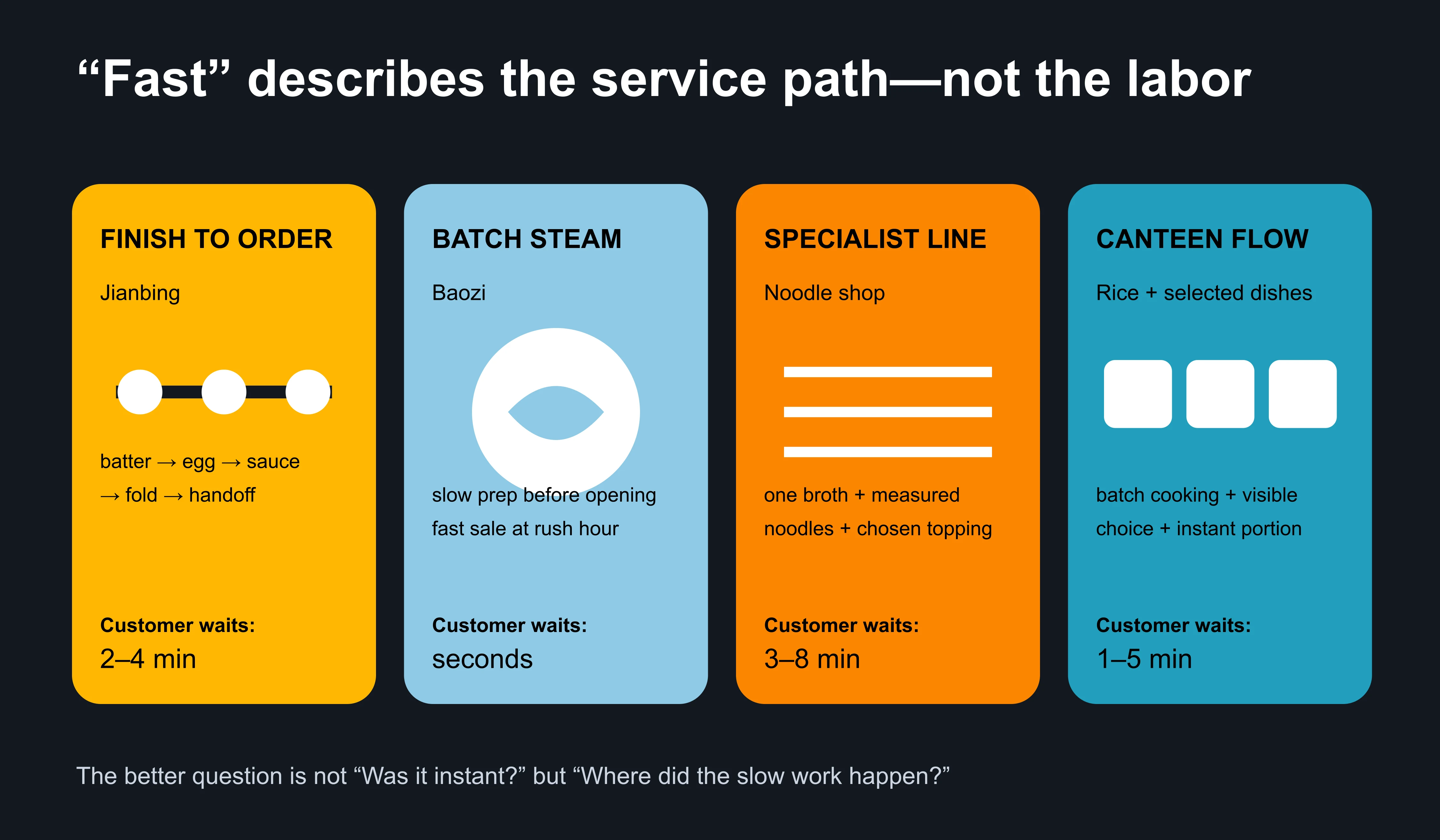
Three clocks matter: preparation time, service time and eating time. A broth can take most of a day to prepare and ninety seconds to assemble. Baozi dough may rise before sunrise so a commuter can buy breakfast in ten seconds. Calling the final meal "fast" describes the customer's experience, not the total labor inside it.
This distinction separates Chinese fast food from the assumption that speed always means factory production. Standardization is part of the story, especially in chains and delivery kitchens, but repetition can also belong to a small specialist shop whose cook has made the same bowl for years.
Chinese fast food is organized by place and time
| Setting | Typical foods | Why service is fast |
|---|---|---|
| Breakfast stall | Jianbing, youtiao, soy milk, baozi | Components are prepared early and finished to order |
| Specialist shop | Noodles, wontons, dumplings | A narrow menu allows repetition and speed |
| Rice-plate counter | Braised or stir-fried dishes over rice | Dishes are batch-cooked and portioned quickly |
| Canteen | Vegetables, proteins, soups and staples | Diners choose from prepared trays |
| Convenience and delivery | Buns, rice meals, noodles, snacks | Packaging and logistics shape the menu |
| Overseas takeout | Combination plates, fried rice, familiar dishes | Standardized stations and transport-friendly sauces |
The most revealing difference is often menu width. A specialist shop may offer one noodle family with several toppings. A canteen offers many prepared dishes but a simple service path. A chain uses recipes, purchasing and packaging to make the same promise across locations. These are different technologies of speed.
Fast food also follows rent and movement. Transit exits favor portable breakfasts. Office districts create a sharp noon rush. University areas reward price, late hours and filling portions. Residential neighborhoods may support congee, buns or noodle shops whose customers return often enough that ordering becomes a nod rather than a conversation.
Breakfast may be China's most poetic fast-food hour
Jianbing begins as batter spread across a hot griddle, then gathers egg, sauce, herbs and a crisp element before being folded into a portable breakfast. It is fast in the customer's hand because the vendor has rehearsed the movement thousands of times.
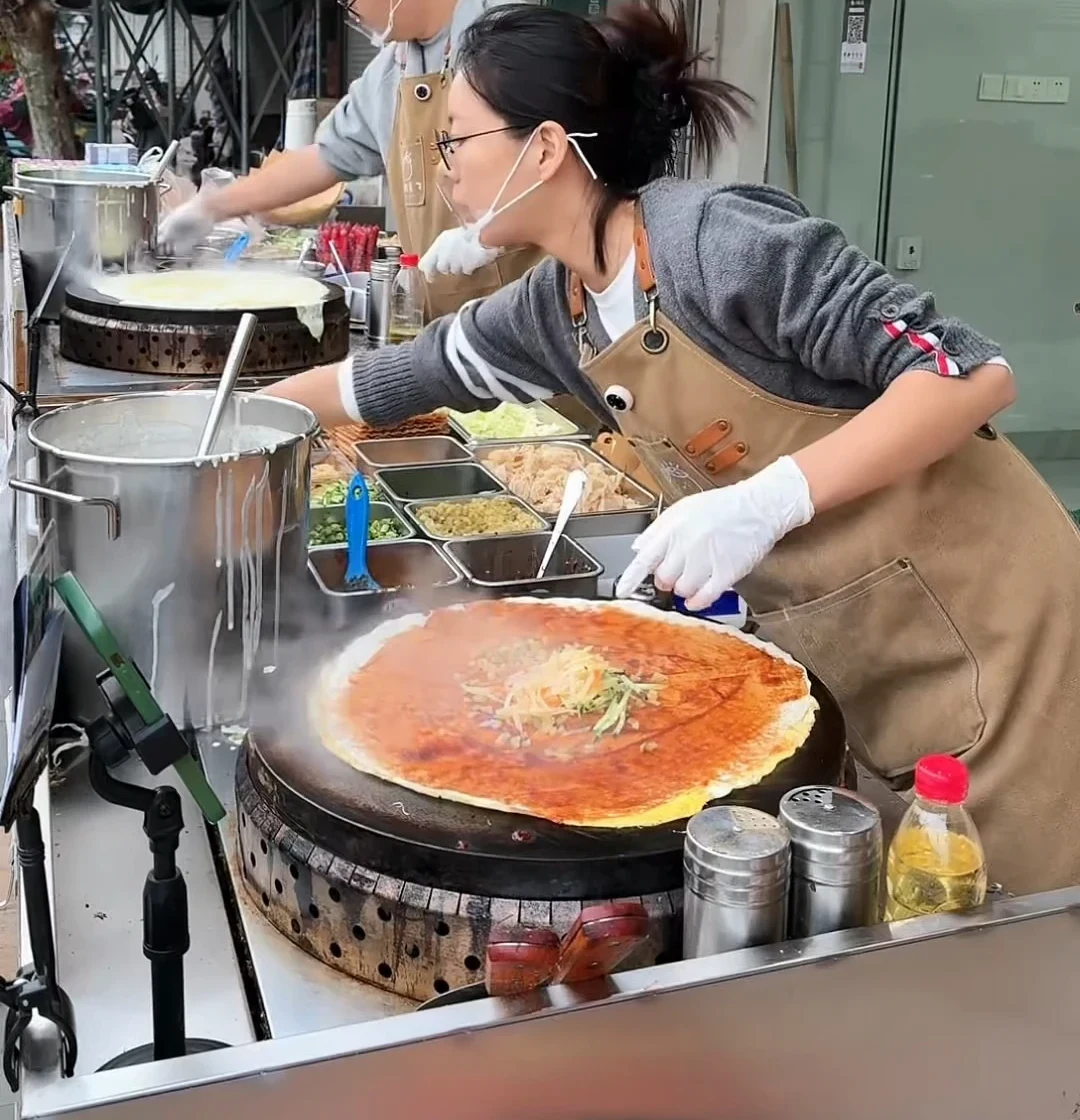
The real speed is simultaneous work: one pancake is already sauced and filled while the second griddle is still setting its batter. Ingredient bins sit within a single arm's reach. The customer sees a quick handoff; the photograph reveals a two-person production line built in less space than many home kitchens.
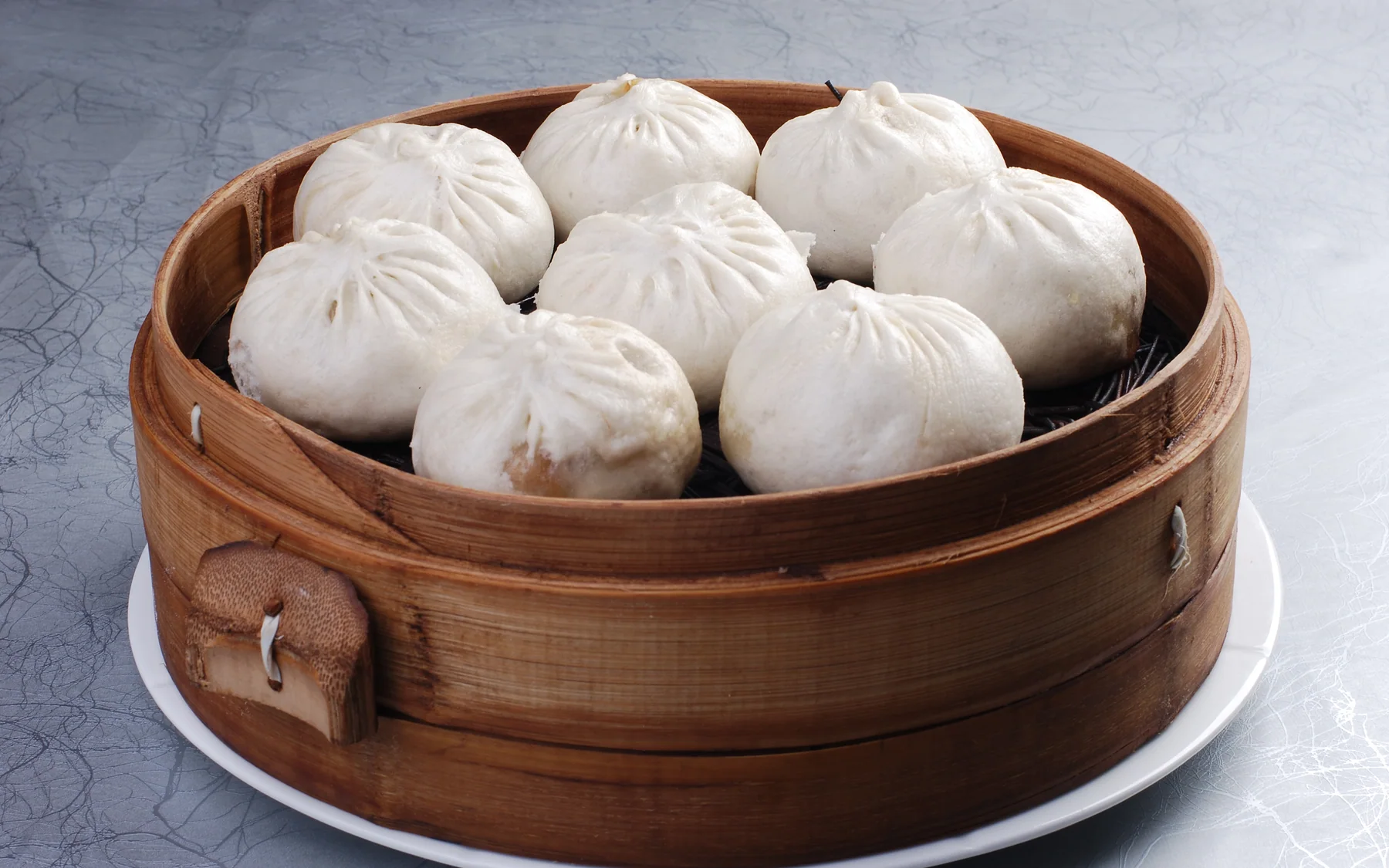
Baozi uses another clock. Dough rises and fillings are prepared before service; steaming creates batches ready for the morning rush.
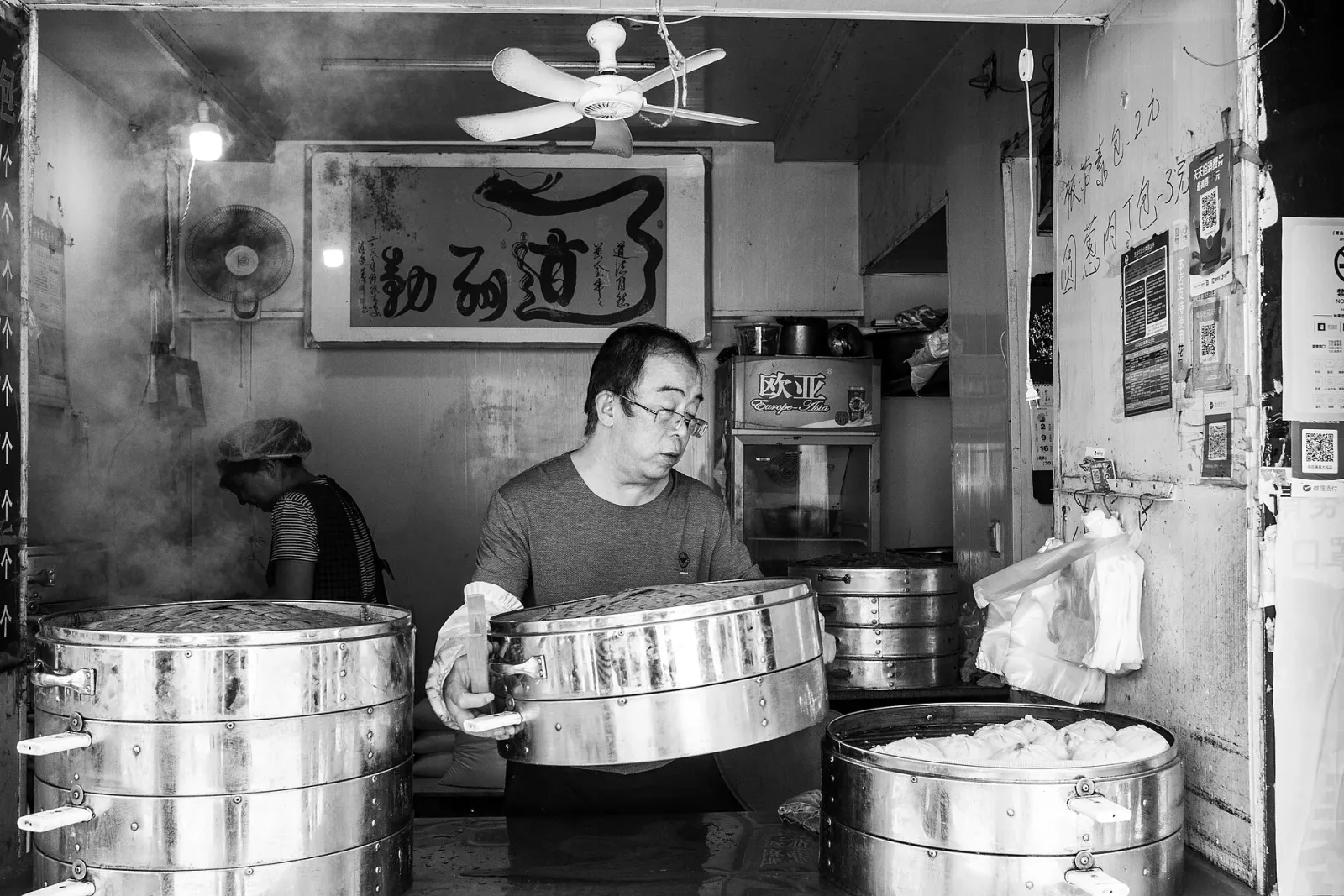
Fast service is built before the order. The steamers are stacked for capacity, not nostalgia: dough was mixed and proofed, filling enclosed and batches organized before the first commuter asked for a bag. Steam in the room is evidence of an operating breakfast system, not a generic white-bun beauty shot.
Fast service often hides slow preparation. Broth may simmer for hours. Dough may ferment. Meat may braise overnight. Speed is frequently the final performance of earlier patience.
Breakfast makes this visible because the city and the kitchen wake together. Steam gathers on metal lids. Soy milk moves into cups. Batter meets a griddle. Customers are not looking for a themed experience; they are trying to arrive somewhere on time. The food succeeds when craft fits inside that pressure.
Regional difference survives the rush. Northern cities often make wheat especially visible through buns, flatbreads, noodles and fried dough. Southern breakfasts may lean more strongly toward rice noodles, congee, rice sheets or local soups. Migration complicates every neat map, which is exactly why a station district can be such an interesting place to eat.
Noodles, dumplings and rice plates
Specialist noodle shops are efficient because decisions have already been refined. A cook portions noodles, broth and toppings through repetition. The variety explored in Chinese noodles shows why “noodle shop” still covers very different regional systems.
Dumplings and wontons can be folded in advance and cooked quickly. Rice plates turn a braise, roast meat or stir-fry into an individual meal. Fried rice uses intense heat and preparation discipline rather than mysterious restaurant magic.
The canteen may explain modern China better than a famous dish
A canteen line is not visually romantic, which is why travel media often ignores it. Yet it reveals how meals are organized around work, school, factories, hospitals and office towers. Trays of prepared dishes let diners build a plate quickly from vegetables, meat, tofu, eggs, soup and a staple.
The essays collected in Yale University Press's Food in Chinese Culture are useful here because they place eating inside social organization rather than treating named dishes as isolated attractions. A canteen is not one timeless national tradition, but it makes the relationship among labor, schedule, choice and shared infrastructure visible in a way a signature restaurant rarely can.
The format creates choice without requiring every dish to be cooked from zero after ordering. It also makes budget visible. Diners can add one more vegetable, choose a smaller protein portion or judge which tray has just arrived from the kitchen.
For an overseas visitor, a busy canteen can be more educational than another greatest-hits restaurant. Watch how people combine dishes, how quickly tables turn and which foods disappear first. The meal is ordinary, but ordinary systems are where a culture spends most of its time.
Chinese fast food outside China
In North America, Chinese takeout developed recognizable containers, combination plates and dishes designed to travel. In other countries, Chinese communities created different quick-service forms based on local migration and taste.
This belongs to the history of Chinese American food and other diaspora cuisines, not to a universal definition of food in China. A takeout box is a cultural object, but it is not a map of the entire country.
Overseas quick-service Chinese food also records migration. Restaurant owners worked with local ingredients, customer expectations, labor limits and delivery distances. A dish that became standard in one country may be nearly unknown in another. "Chinese takeout" therefore names a local history as much as a national cuisine.
The strongest diaspora fast food does not need to apologize for changing. It needs to be described accurately: Chinese American, British Chinese, Indian Chinese, Peruvian Chifa or another named tradition, each with its own routes and regular customers.
The craft hidden inside a quick meal
A good quick meal respects texture despite speed. Noodles should not wait until they surrender. A crisp wrapper should survive the short trip to the table. Greens should remain green. Rice should support rather than merely occupy space.
Modern delivery creates new pressures: longer travel, sealed steam, discounts and packaging waste. Restaurants adapt dishes to arrive acceptably after twenty minutes, which can favor sauces and fried textures. That technological context is now part of food culture too.
Delivery apps changed the shape of a quick meal
A restaurant menu once had to work mainly in a room or over a phone. On an app, the dish must survive a thumbnail, a search filter, a discount label, a courier journey and a sealed container. This changes which foods are easy to sell.
Crunch softens in trapped steam. Noodles continue absorbing liquid. Soup requires reliable lids. Small snacks can become uneconomical after platform fees and packaging. Kitchens respond by separating sauces, venting boxes, enlarging portions, creating bundles or choosing dishes that travel with less damage.
The app also compresses geography. A customer can compare regional noodles, rice plates, fried chicken and milk tea on one screen. That convenience expands discovery while encouraging price competition and visual sameness. The most clicked photograph does not always represent the meal that travels best.
For young urban diners, delivery is not a side story. It changes working hours, neighborhood demand, kitchen layouts and the distance between craving and purchase. Chinese fast food now moves through both street-level habit and digital infrastructure.
How to choose a more interesting quick meal
Look for a specialist. A shop that makes one regional noodle or one kind of bun may reveal more craft than a menu attempting two hundred unrelated dishes. At a canteen, choose contrasting colors and textures. At a street stall, watch turnover and food-handling practices.
Fast food should still be approached with ordinary safety awareness: hot food should be hot, cold food properly chilled, and allergen questions taken seriously.
Do not judge a place only by whether the menu looks traditional. High turnover, a focused specialty and visible care with ingredients matter more than decorative nostalgia. A polished chain can execute well; a photogenic stall can handle food badly. Atmosphere is evidence of atmosphere.
If you are exploring a city, try the same category at two times of day. Eat breakfast near transit, lunch in a canteen or specialist shop, then notice what remains open late. The changing menu reveals who the neighborhood serves.
Read the queue before reading the decorations
A queue only proves demand; it does not prove quality. What matters is how the line moves. At a jianbing cart, each order should pass through a visible sequence without finished pancakes sitting in trapped steam. At a noodle counter, cooked noodles should not wait for the customer. At a canteen, high turnover can be useful evidence because trays are replenished, but the newest tray is often a better choice than the most photogenic one.
I trust a narrow menu when the staff can execute it without panic. Ten regional noodle toppings built on one coherent broth make sense. Dumplings, sushi, burgers, hot pot and milk tea under one sign usually mean the kitchen is buying breadth at the expense of attention. Speed is persuasive when the system is legible.
Order for the service architecture
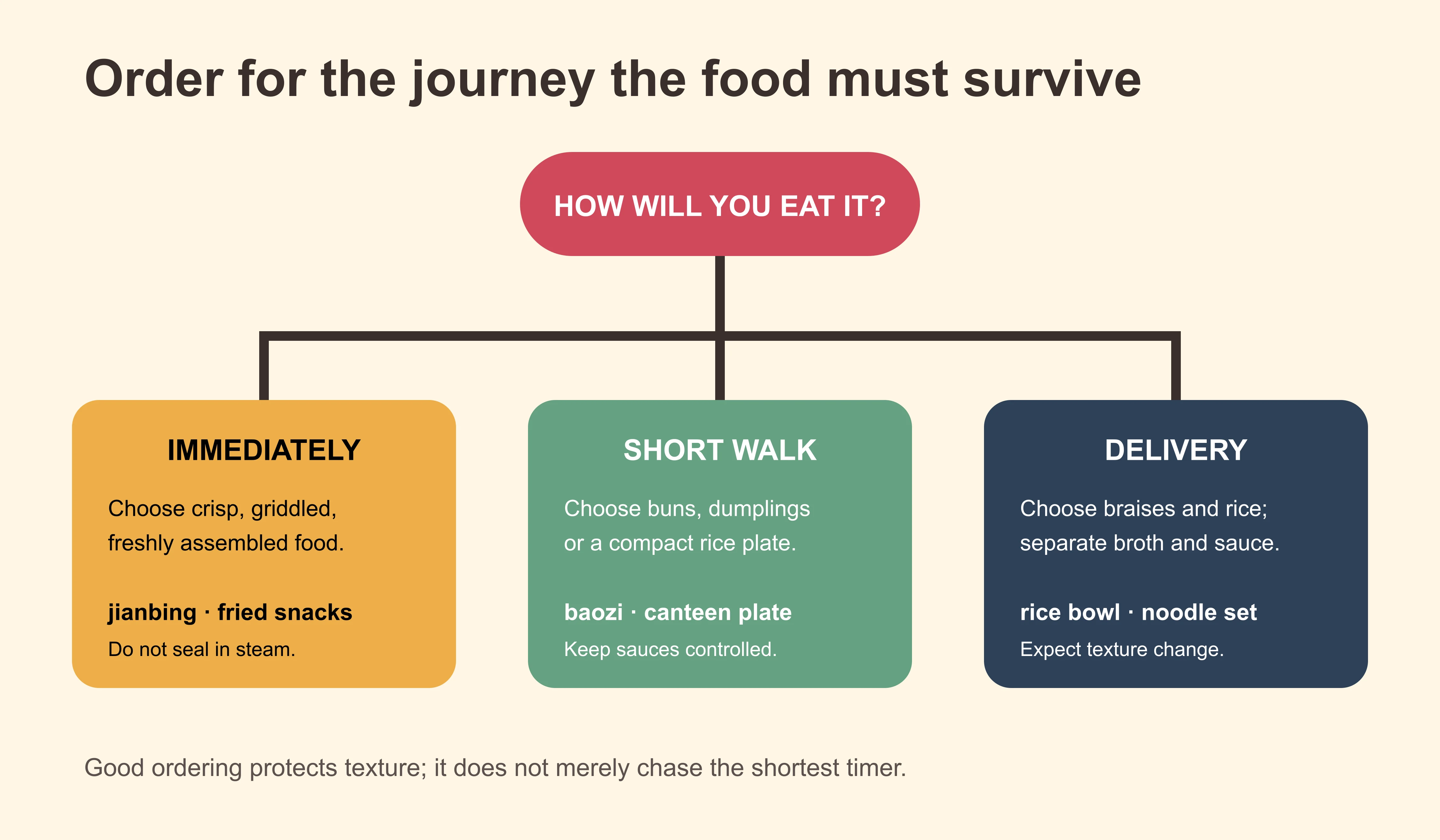
Choose food that fits the way it reaches you. Eat crisp griddled food immediately. Let a braised rice plate tolerate a short journey. Ask for noodle broth separately if delivery time is uncertain. In a canteen, pair one strongly seasoned protein with a plain vegetable, rice and soup instead of choosing four glossy dishes that compete for the same appetite.
The point is not to optimize every lunch into a research project. One simple question is enough: where did the slow work happen? If the answer is broth, fermentation, braising, folding or practiced repetition, the quick meal may still carry craft. If the answer is nowhere—only reheating, packaging and discounting—the speed has eaten the food rather than served it.
Frequently asked questions about Chinese fast food
What is Chinese fast food?
Chinese fast food includes meals designed for quick preparation or service, such as breakfast pancakes, steamed buns, noodle bowls, rice plates, dumplings, cafeteria dishes and overseas Chinese takeout. It is a service category, not one cuisine.
What are popular fast foods in China?
Common examples include jianbing, baozi, youtiao, noodle soups, dumplings, wontons, fried rice, rice plates, roujiamo and regional flatbreads. Popularity varies by city and time of day.
Is Chinese takeout the same as Chinese fast food in China?
No. Overseas takeout developed through local restaurant histories and customer expectations. In China, quick meals include many breakfast stalls, specialist shops, canteens and delivery dishes that may not appear on overseas menus.
Is all Chinese fast food fried?
No. It may be steamed, boiled, griddled, braised or assembled over rice. Baozi, congee, wonton soup and many noodle dishes are quick-service foods without deep-frying.
Is street food always fast food?
The categories overlap but are not identical. Street food describes where and how food is sold; fast food describes speed and service. Some street foods require long preparation, while many fast meals are served indoors.
Speed has a cultural memory
Chinese fast food is not tradition losing a race against modern life. Often it is tradition learning the city's timetable. The bowl is quick because the cook is practiced; the bun is ready because someone woke before you.
Continue with Chinese street food for public-space stories, or return to the larger Chinese food guide.
Then record one quick meal in Moments: photograph the queue or service counter, name where the slow work happened, and tell us whether the first bite survived the speed. I want the operating system of the meal, not another list of dishes.