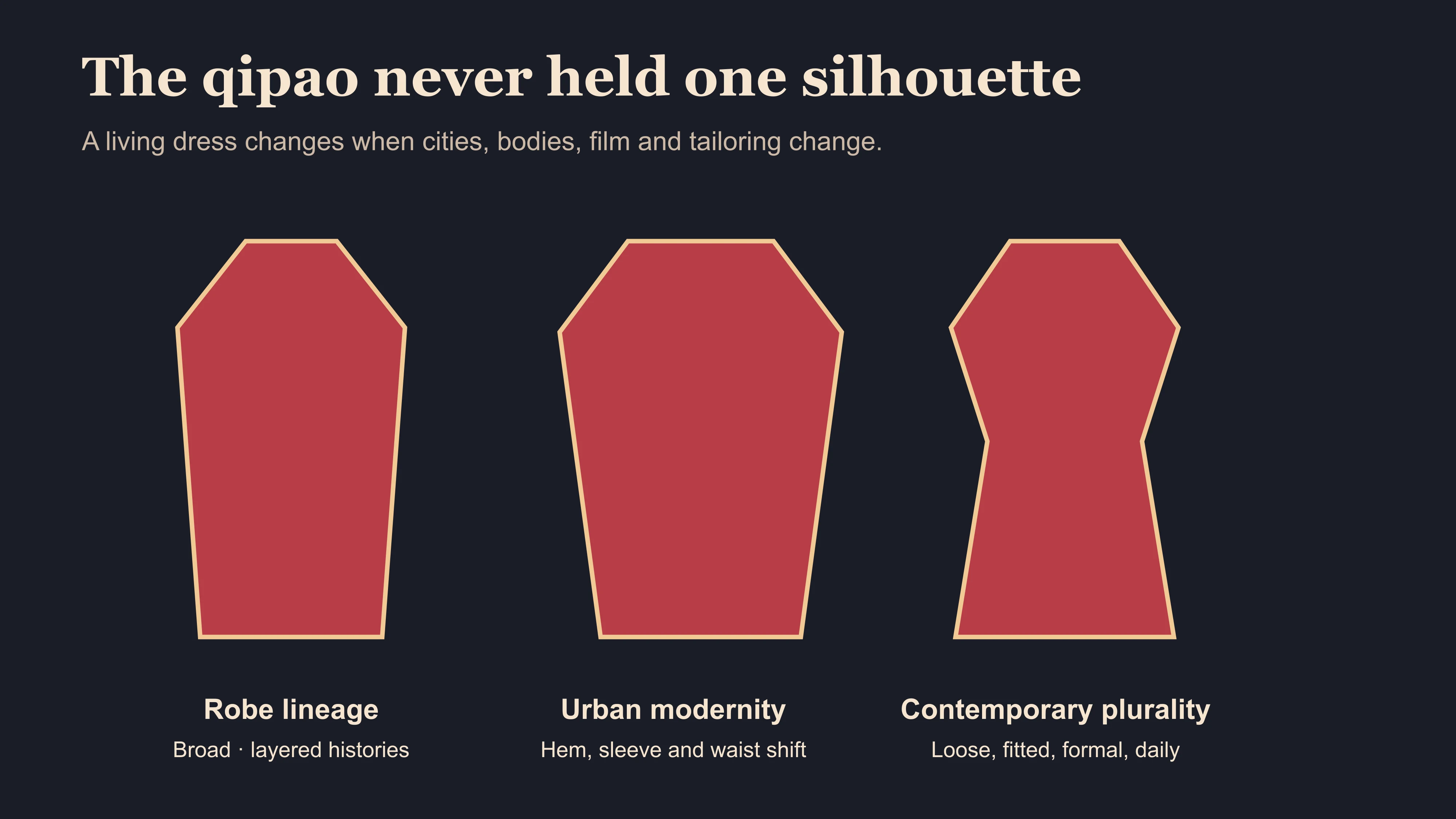
Qipao is not a single ancient Chinese dress preserved under glass. It is a changing garment shaped through Manchu robe heritage, twentieth-century city life, tailoring, migration, cinema and the body wearing it today. Calling every fitted dress with a high collar “timeless tradition” makes its real history smaller.
Qipao begins with a changing silhouette
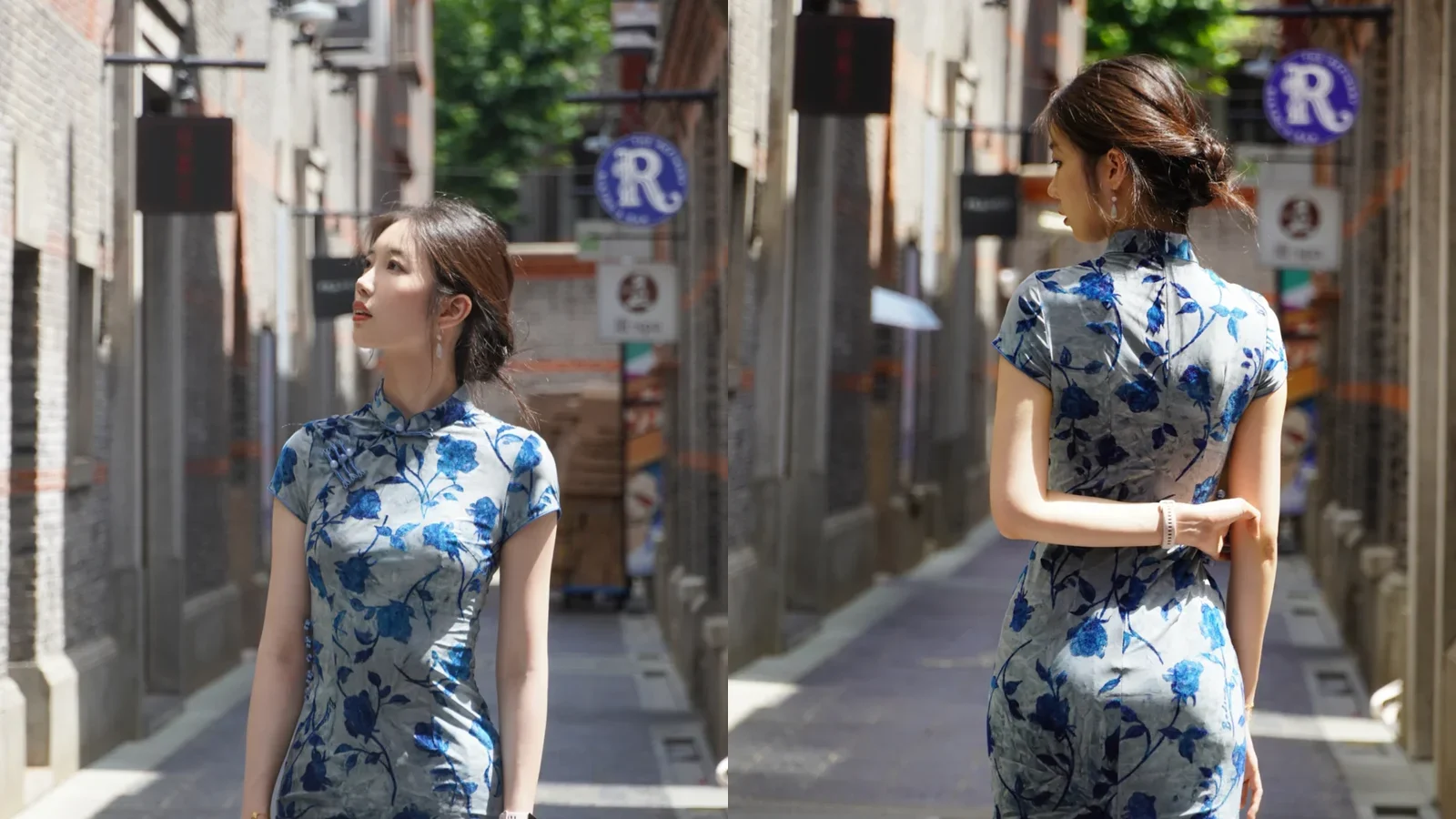
The qipao—often called cheongsam in Cantonese-derived English—is recognizable through a standing collar, asymmetrical fastening, side opening and one continuous dress line. Those are useful visual clues, not a rule that every qipao must be tight, slit high or made from glossy silk.

Laid flat, the dress loses the cinematic pose and becomes a constructed object. The collar does not float by itself; the diagonal opening, repeated fastenings, sleeve length, side line and hem have to cooperate. I find this view more honest than a model standing perfectly still because it lets the garment explain its own architecture.
This museum garment matters because it restores construction to a word that film and fashion photography often turn into atmosphere. Collar, fastening, textile and opening work together. The Peranakan Museum record places that language within twentieth-century Shanghai and Southeast Asian Chinese fashion history—a more precise story than “the traditional Chinese dress.”
Cheongsam is not another word for every Chinese dress
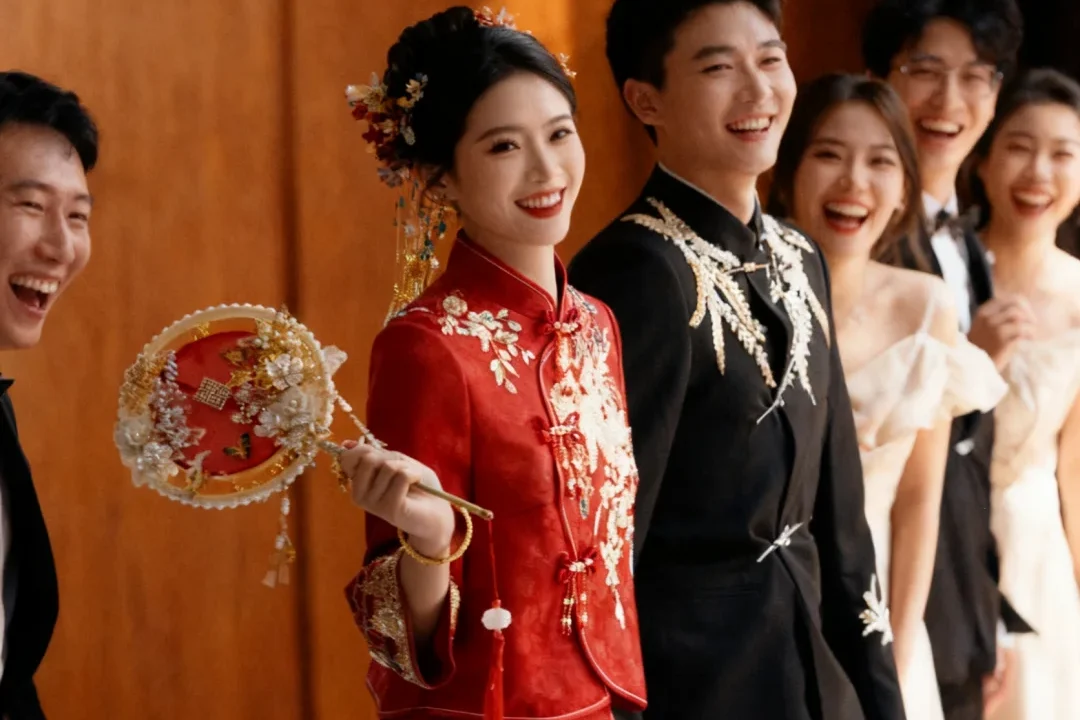
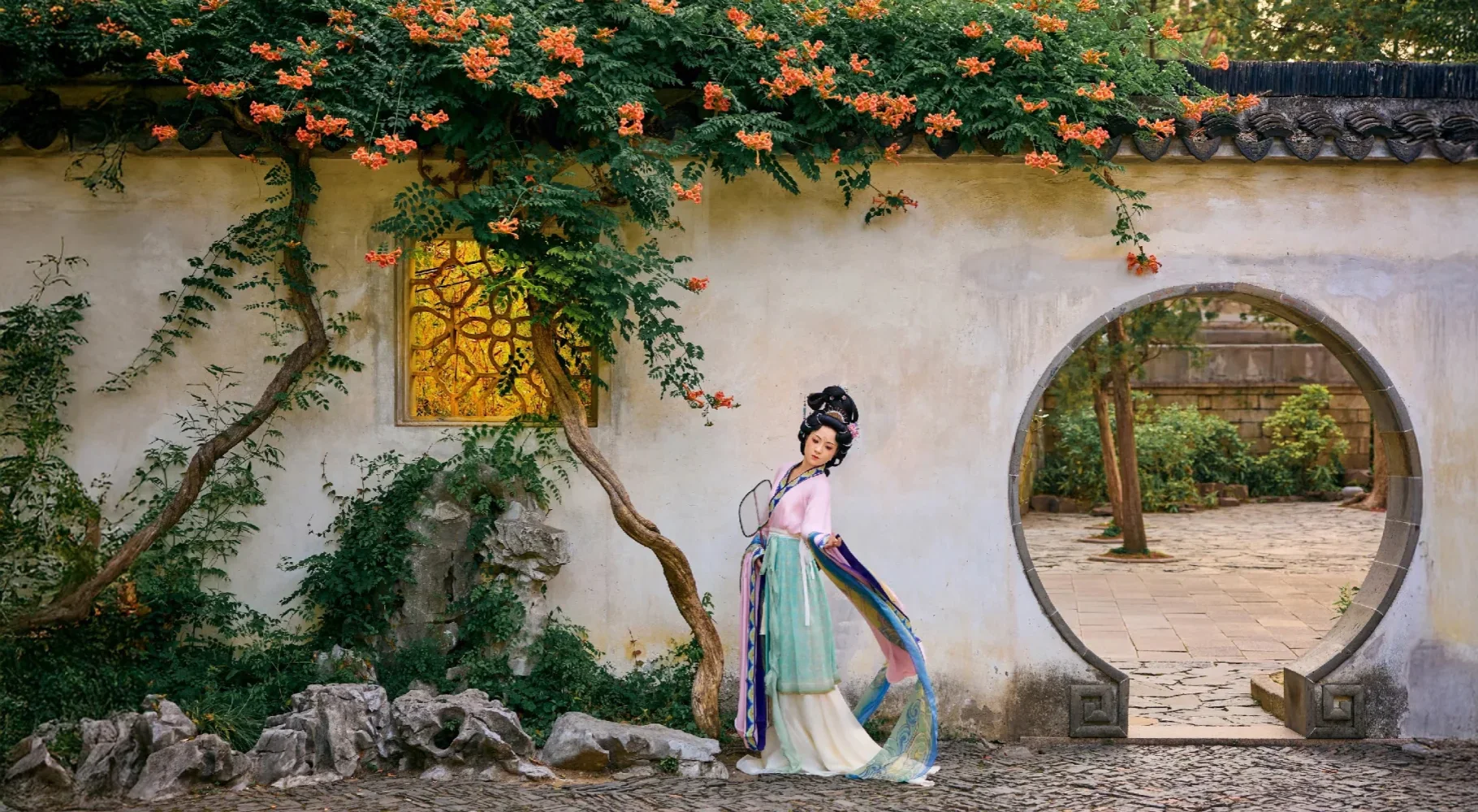
I start with this boundary because it is where most overseas searches go wrong. Hanfu is a broad term used for historical Han Chinese clothing traditions across many periods. A qipao belongs to a different modern history, shaped by Manchu robe traditions and urban fashion. Ethnic clothing traditions across China have their own names, construction and communities.
The distinction is not pedantry. It lets each garment keep its own body language. Flowing layered robes, a fitted qipao, an imperial robe and a contemporary Chinese-inspired dress may share a photograph, but they do not share one origin or social meaning. Use the traditional Chinese clothing guide when you need the wider wardrobe rather than one glamorous shorthand.
The word itself also carries migration. Qipao reflects Mandarin usage; cheongsam entered English through Cantonese-speaking communities. Neither name makes the dress belong to only one city. Shanghai is central to its twentieth-century transformation, while Hong Kong, Southeast Asian Chinese communities and overseas wardrobes gave it other climates, fabrics and social lives.
That is why an image search is such a poor historian. The Victoria and Albert Museum's cheongsam collection records show dresses with different textiles, sleeve lengths, proportions and dates. A high collar and side fastening can connect a family of garments without making every member identical. When a shop uses “qipao,” “cheongsam,” “vintage” and “traditional” as if they were interchangeable sales adjectives, ask which garment, period, cut and community it actually means.
How to tell a qipao from hanfu, a changshan or a modern Chinese-inspired dress
The fastest way to classify a garment is to look at how it is built, not how loudly it signals China. A high collar is a clue, not a verdict. So are frog buttons, a side opening, satin and floral embroidery. Those details travel between garments, designers and decades.
| Garment or label | What to inspect first | What the label can and cannot tell you |
|---|---|---|
| Qipao / cheongsam | One main dress line, standing collar, shaped opening and side seam or slit | Identifies a modern garment family; it does not prove a specific decade or “ancient” origin |
| Hanfu | Layering, collar direction, garment components, sleeves and historical period | A broad umbrella for Han Chinese historical dress traditions, not one fixed silhouette |
| Changshan | Long robe construction, straight body and masculine tailoring traditions | A distinct robe family; a high collar alone does not turn it into a qipao |
| Contemporary Chinese-inspired dress | The designer's cut, references and construction | May borrow a collar or pankou without claiming to be a historical qipao |
I use three questions when a photograph is ambiguous. What closes the garment? A diagonal overlap, a zipper, frog buttons and a wrap tie create different dressing systems. Where does the garment carry ease? A close-cut one-piece dress has a different relationship with the body than a layered robe that can be adjusted at several edges. What does the maker call it, and is that claim supported by the object? A product title is marketing evidence, not a museum catalogue.
This test is useful because it protects the reader from two opposite errors. One error calls every Chinese-looking garment a qipao and erases other traditions. The other treats any modern alteration as cultural betrayal. A contemporary designer may preserve a collar-and-opening logic while changing length, lining, closure or fabric. That is a design decision worth describing; it does not need to pretend the garment came unchanged from a palace.
“Traditional” is a claim that needs a time and place
When a seller or caption says traditional qipao, ask “traditional when, where and for whom?” The answer may point to a Republican-era Shanghai silhouette, a family dress from Singapore, a stage costume, a wedding uniform or a present-day made-to-measure interpretation. Each can be meaningful. None should be used as a universal template.
I am wary of captions that use tradition as a finishing gloss. They often combine a modern body-conscious cut, a synthetic satin, a machine-printed dragon and a generic red colour, then imply that the whole package is an unbroken ancient inheritance. The problem is not that the dress is modern. The problem is that the description hides the decisions that made it modern.
A more useful caption names the evidence: “contemporary qipao with a Shanghai-referencing collar,” “mid-century cheongsam with a side closure,” or “modern Chinese-inspired dress using pankou-style fastenings.” Specific language gives the wearer more freedom, not less. It lets someone enjoy a silhouette without performing a false history.
This distinction also matters for photographs. A posed editorial image can show line, colour and styling, but it cannot by itself establish date, fibre, maker or community use. A museum record may establish provenance but not tell us how comfortable the dress is on a staircase. A fitting video can reveal movement while saying nothing reliable about the garment's historical origin. Every source has a job; a persuasive page should not make one image prove everything.
Why Shanghai changed the dress
The qipao became a modern urban language because it could change with the city. Length, sleeve, fabric, seam, collar and fit shifted with work, leisure, dance halls, photography, cinema, international tailoring and ideas about who could be visible in public.
The Shanghai culture guide describes the city's strongest habit as editing: an outside form enters through trade or media, local makers test it against use, and the result returns with a Shanghai accent. Qipao tailoring makes that process visible at body scale. A shoulder line or slit is more convincing evidence of urban modernity than another speech about East meeting West.
That is why I dislike the word “unchanged.” A qipao can be deeply recognisable precisely because it has adapted. It can be looser or more fitted, everyday or formal, modest or deliberately dramatic. The garment has never been only a museum object; it has also been a negotiation between posture, movement, gaze and occasion.
In In the Mood for Love, the cheongsams are not decorative proof of “old Shanghai.” They make time and restraint visible. Pattern changes mark repeated days; the fitted line makes a hallway feel narrower and a glance harder to escape. Film gives the dress emotional power, but film should not become the only place we imagine it living.
Fabric changes the dress before the wearer moves

Online shopping reduces fabric to a color name. Real cloth refuses that simplification. Directional light can reveal a woven rib, embroidery sitting above the ground, or a surface whose sheen grows stronger on a curve. The same pattern can feel quiet in diffuse daylight and theatrical under restaurant lighting.
This is why I do not describe every satin-like surface as “silk,” or every floral design as hand embroidery. A photograph can show texture and light; it cannot confirm fibre, technique, age or maker. Exact material claims need a garment label, maker record or museum catalogue.
Pattern scale also changes the body. A large motif does not simply decorate a dress; seams and darts decide where it breaks. A skilled cut can let a branch continue across an opening. A careless one turns a face, wheel or flower into accidental anatomy. The print must survive construction, not only look beautiful on an uncut roll.
The body is part of the design
A qipao asks practical questions before it earns any symbolic answer. Can the wearer sit through dinner, take stairs, reach for a bag, enter a car, breathe after eating, work, dance or greet family without constantly managing the collar, armhole, seams or slit?
This is why fit cannot be separated from meaning. A beautiful qipao that traps its wearer is not elegance; it is a pose with a person inside it. The Chinese wedding dress guide treats the garment as a moving part of a real day—tea service, transport, greeting tables and dinner—rather than a red-carpet symbol.
The recurring frustration in real fitting discussions is not “my body failed the dress.” It is that standardized sizing often pretends a close-cut garment can ignore torso length, shoulder angle, bust, waist, hip, armhole and desired ease. I agree with the most practical conclusion: the body is not the defect. Fit is a relationship between a particular cut, material and person.
Before judging the mirror, try five movements:
- Sit fully rather than perching on the chair edge.
- Raise both arms as if reaching for a shelf.
- Walk stairs and take a normal-length step.
- Eat, breathe and remain dressed for the actual event duration.
- Check whether the collar rotates, the side seam twists or the slit changes exposure in motion.
“Tighter” is not automatically more authentic, refined or flattering. Ease can preserve the continuous line while allowing a life to happen inside it.
A qipao fitting needs a map of one body, not a verdict on that body
The most useful fitting records are wonderfully unromantic. They talk about shoulder width, torso length, bust and hip position, armhole depth, collar pressure, hem, slit and the amount of ease required for the actual event. This is where the qipao stops being an image and becomes clothing.
Ready-to-wear sizing often forces a bad bargain: the size that closes across the torso may be too long; the length that looks right may pull at the hip; the collar may fit in a standing product photograph and rotate after ten minutes of walking. None of these problems means the wearer has the wrong body. They mean a close-cut, largely vertical garment is exposing the limits of a generic block.
Fabric changes the solution. A firm brocade holds a clean line but forgives less. A softer fabric drapes, yet may reveal seam tension or collapse where the pattern expected structure. Lining adds heat and friction. Dense embroidery can make an alteration line expensive or impossible. This is why ordering only from bust-waist-hip numbers is not precision; it is three measurements pretending to describe a moving person.
I would send a tailor photographs of the intended shoes and underlayer, a short walking video, the chair height at the event if sitting matters, and one sentence describing the feeling I want: close but easy, formal without stiffness, or relaxed enough for an ordinary dinner. A good commission begins with use, not with the fantasy of becoming the model in someone else's photograph.
The firmest rule is simple: never let a shop use “traditional fit” to silence discomfort. Historical continuity does not require numb arms, shallow breathing or a slit that changes height every time you sit. The qipao has survived because makers and wearers kept adapting it. A garment that fits your present life belongs to that history more honestly than a painful costume does.
Details should reward closeness, not shout “Chinese” from across the room

This close view is dense with flowers and wheels, yet the most interesting detail is not a fixed symbolic translation. It is the layering: fine outlines, areas of filled colour, quiet ground fabric and the way one motif disappears beyond the frame. I would rather describe what is visible than announce that every flower guarantees one universal blessing.
A qipao does not need dragons, red silk, gold thread or a “mandarin” pattern to prove its identity. Construction can carry the identity more quietly than decoration. When every visible element is asked to signal China at maximum volume, the wearer can disappear under the costume message.
Wearing qipao now does not require pretending the present vanished
The dress can enter a wedding banquet, graduation portrait, restaurant, gallery, subway or ordinary dinner without becoming historical reenactment. Shoes, coat, bag and hairstyle do not have to manufacture a complete 1930s film set. Contemporary styling is not disrespectful merely because it admits the current year.
Context still matters. A family heirloom deserves its own history. A mass-market fashion dress should not be advertised as museum-authentic. A designer adaptation should name what it changes. Respect grows from specificity, not from forcing every wearer to perform one ideal of “Oriental femininity.”
Buy a qipao with a brief, not a fantasy
Before opening a shopping tab, write down the job the dress has to do: a two-hour dinner, a wedding tea ceremony, a graduation photograph, a performance, or ordinary city wear. Then send a maker or shop six precise questions:
- What are the garment measurements? Ask for shoulder, bust, waist, hip, armhole, sleeve, dress length and slit height—not only a size label.
- What is the fibre and lining? “Silk feel” is a surface description, not a material specification. Ask whether the fabric has stretch and how it behaves when seated.
- Where is the closure? A diagonal front, side zip, concealed zip and decorative frog fastenings produce different fitting and dressing realities.
- What can be altered? A side seam may be adjustable; a heavily patterned or beaded panel may not be. Confirm this before paying for an exact-looking size.
- Can I see the dress moving? Request an unedited walking, sitting and arm-lifting video in a comparable size. A front-facing product pose conceals most fit problems.
- What claim is the seller making? “Shanghai-inspired contemporary qipao” is an honest design description. “Exact Qing dynasty original” needs much stronger evidence.
This is not a demand that every wearer become a costume historian. It is a way to protect the pleasure of choosing. The more specific the question, the less likely you are to buy a photograph and receive a garment that cannot share your evening.
If you are borrowing a family qipao, use the same brief with more care. Photograph its condition before cleaning or altering it; look for faded folds, brittle lining, weakened fastenings and seams that have already been moved. An heirloom can be worn, but it does not have to survive an all-day wedding, a crowded dance floor and hurried transport to prove that it matters. Sometimes the most respectful choice is to study the original, have a contemporary version made for the day, and let both garments keep their own truth.
My verdict: a qipao should belong to the person wearing it
The qipao stays alive because it refuses to stay in one era. It can carry a grandmother's photograph, a Shanghai film memory, a Southeast Asian family wardrobe, a wedding dinner or a contemporary designer's experiment. None cancels the others.
The best way to respect the dress is to name the context, look at the cut, and let the wearer remain more important than the fantasy projected onto them. Continue to Chinese women's clothing for the wider comparison, then bring one qipao image to East Moment's community and describe the movement it makes possible.