Traditional Chinese men's clothing is not one long robe with a dragon added. The useful choice begins with three questions: Which clothing system is this? What does the silhouette make the body do? Where will you wear it? Read collar, closure, belt and length before embroidery. A restrained garment that fits its occasion will look more convincing than a luxurious one assembled from unrelated historical signals.
Traditional Chinese mens clothing begins with the occasion
The Victoria and Albert Museum's record for a 1920–1940 man's robe gives one dated, material object to examine. It is evidence against treating every long Chinese garment as the same timeless costume.
The museum's separate Zhongshan suit record proves why a date and a garment system matter more than a shop category: its twentieth-century front, pockets and political history answer a completely different question from a Tang robe or a Republican changshan.
The first mistake happens before the garment arrives. A buyer searches for “traditional Chinese men's clothing,” sees a flowing robe, a shiny knotted jacket and a fitted long gown, then assumes color is the main decision.
It is not.
Those garments may belong to pre-Qing Han clothing traditions, Qing and Republican long-gown history, a modern tangzhuang category or twentieth-century national dress. They do not promise the same posture, movement or social meaning. The occasion should eliminate most options before taste enters.
| If you need clothing for... | Begin with | Look for | Avoid |
|---|---|---|---|
| A historically informed hanfu event | A named dynasty and male garment system | Period-specific collar, belt, layers, headwear and footwear | A generic “ancient Chinese robe” listing |
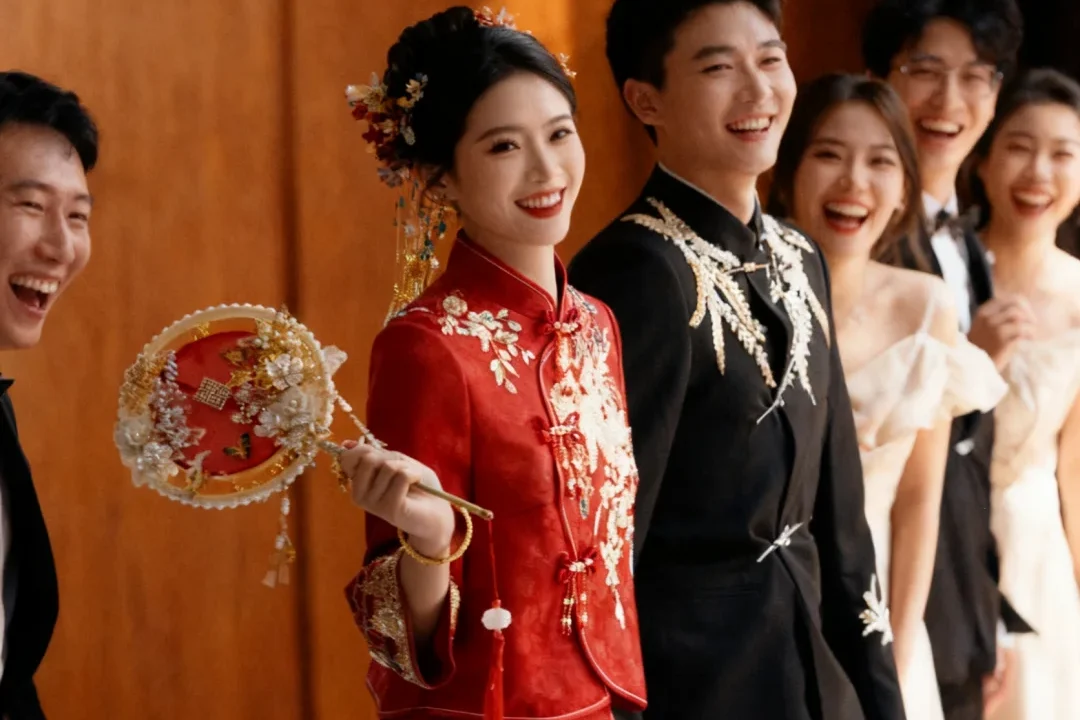
| A Chinese wedding | The couple's chosen ceremony and level of formality | A coordinated male outfit that supports, rather than copies, the partner's clothing | Treating every red jacket as historical wedding dress |
| A formal cultural event | Changshan, restrained modern tangzhuang or Zhongshan suit, depending on context | Clean fit, sober fabric and a clear modern identity | Imperial motifs worn as generic formality |
| Everyday styling | A simplified jacket, shirt, trousers or historically inspired layer | Pockets, washable fabric, manageable sleeves and ordinary shoes | Full court costume stripped of its headwear and context |
| Performance or photography | A silhouette that reads from distance | Strong movement, controlled volume and accurate labeling | Calling fantasy costume an archaeological reconstruction |
This distinction matters because I understand the desire to solve everything with one outfit. I want a garment to feel recognizably Chinese, work in a photograph, survive lunch and still look natural when I walk into a cafe. But one outfit cannot be court dress, everyday hanfu, wedding clothing and modern formalwear at the same time. Honest editing is part of dressing well.
Read the collar before the embroidery
Decorative motifs attract attention because they are easy to sell. Structure tells more truth.
Begin at the neck. A crossed front should show which panel closes over which. In the familiar jiaoling youren structure, the wearer's left panel crosses over the right, producing a rightward closure. A round collar changes the frame of the shoulders and usually belongs to a different garment logic. A standing collar with frog fastenings points toward later or modern categories; it does not become Tang-dynasty clothing because a shop calls it a Tang suit.
Then follow the garment downward. Where does the belt sit? Does it organize the robe or merely decorate the waist? Are the sleeves cut for ceremony, scholarship, work or stage movement? Is the robe one visible layer in a system, or has the manufacturer printed the appearance of layers onto one synthetic shell?
I use a simple test: remove the embroidery in your imagination. If the silhouette still makes sense, the garment has a structure. If everything “Chinese” disappears with the dragon, cloud and knot buttons, decoration was doing work the cut could not do.
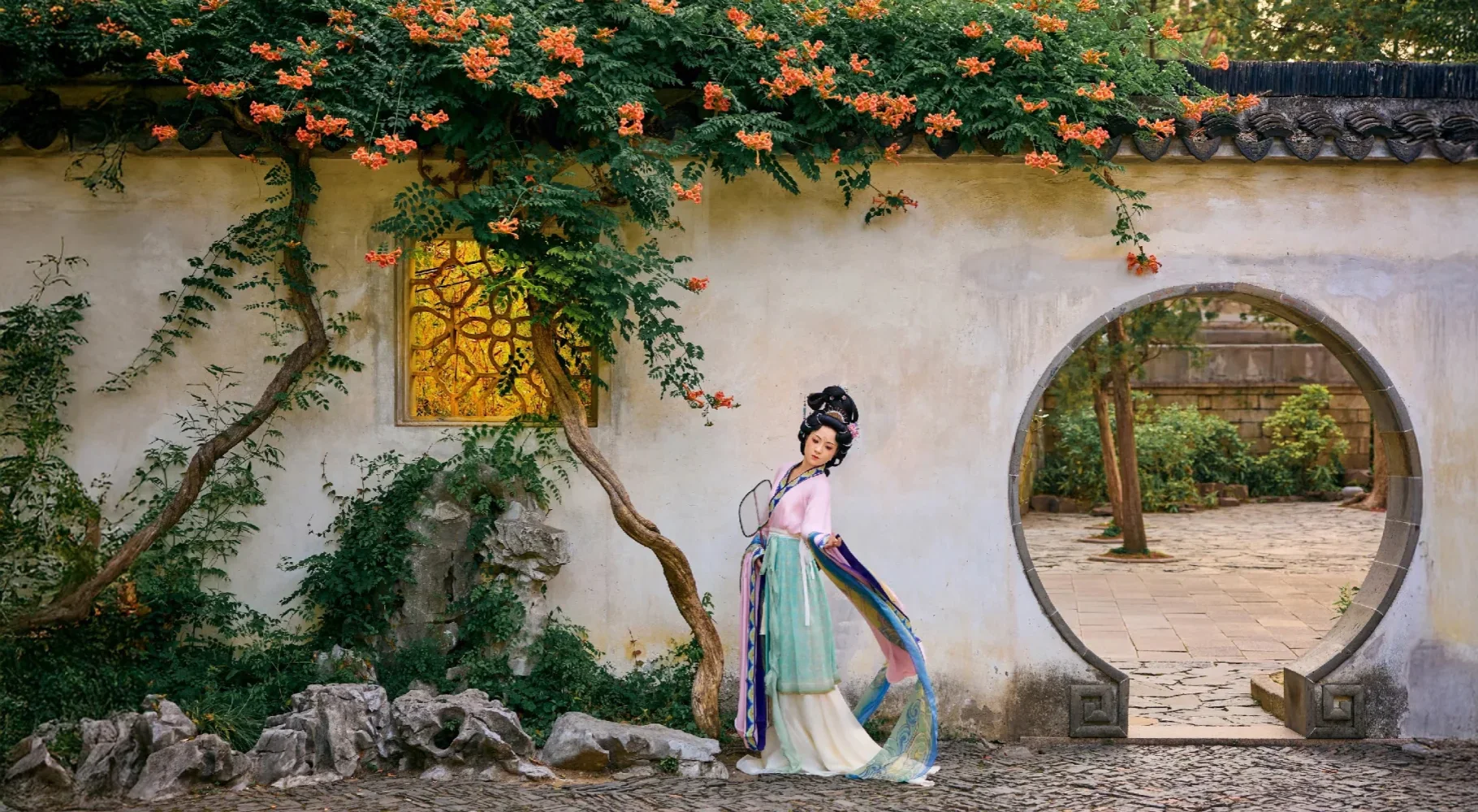
Hanfu is plural, especially for men
Hanfu is a broad modern umbrella for historical Han Chinese clothing traditions. It is not the name of one male robe.
Men wore cross-collar garments, round-collar robes, jackets with trousers, deep-bodied robes and many formal, occupational and period-specific systems. Cut, permitted details, textiles and accessories changed. The court wardrobe of one reign cannot stand in for a farmer, merchant or scholar in another century.
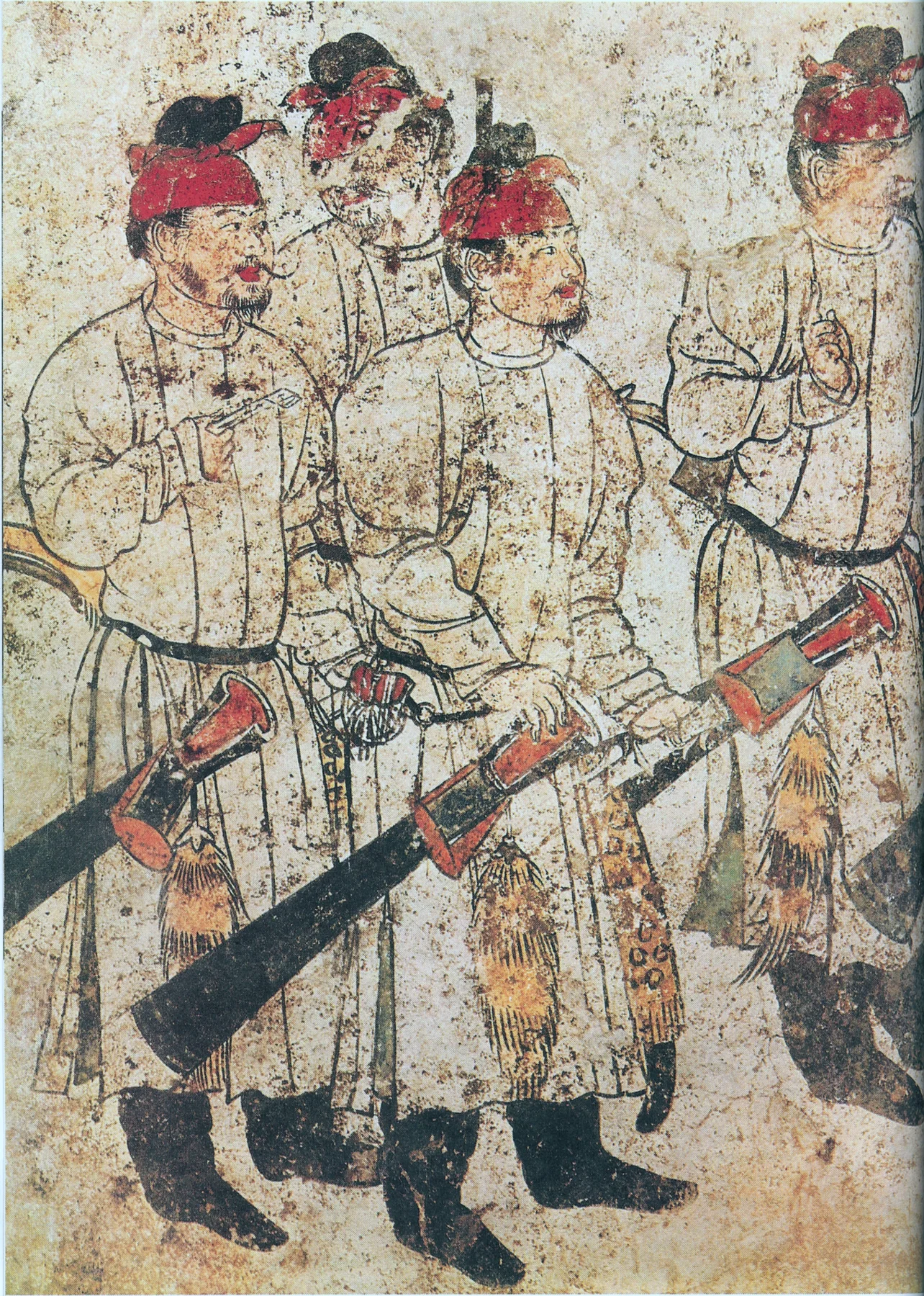
Tang visual evidence is a good antidote to the floating-sleeve stereotype. In the opening tomb cortege, male bodies are organized by belts, robe lengths, headwear and procession. The figures look like people occupying roles, not fantasy heroes waiting for wind machines. That period image gives relationships a product flat lay cannot—several men, repeated silhouettes, movement and hierarchy—without pretending to show what every man in Tang China wore every day.
Ming formal portraiture makes a different body. The robe broadens the seated figure; the belt fixes the center; headwear completes authority. Copying only the robe while ignoring proportion and setting produces the familiar costume problem: expensive details with no governing silhouette.

This is court clothing, not an everyday outfit recommendation. Its value is precision: one person, one status, one formal visual system.
If historical accuracy matters, do not shop by dynasty name alone. Ask for the Chinese garment name, front and back photographs, flat measurements, fabric composition and the evidence used for reconstruction. “Song style” or “Ming style” can be a useful fashion label, but it is not automatically a construction record.
Our dedicated hanfu guide will own the deeper dynasty-by-dynasty history. On this men's page, the practical rule is enough: choose one coherent system before choosing accessories.
Changshan and changpao belong to a later male wardrobe
The long gown called changshan or changpao is strongly associated with men's dress in the Qing and Republican periods. It carries a long vertical line, relatively controlled sleeve volume and side fastening in many versions. It may look timeless in an old portrait because the surface is restrained. Its history is not timeless.

The studio arrangement isolates three solutions to wet weather: straw capes, broad hats, an umbrella and a restrained long jacket-and-trouser silhouette. Even a posed photograph reminds us that clothing answers rain before it answers nostalgia.
That lived context changes how I see a modern changshan. I do not want it cut like a theatrical cylinder that prevents a normal stride. I want enough room through hip and thigh to sit, climb stairs and cross a wet street. Side openings, fabric weight and hem length are functional decisions before they become style.
A changshan can work for a wedding, performance, portrait or formal cultural occasion when the event supports it. It should not be marketed as generic “ancient hanfu.” The Qing dress system, Manchu rule and Republican urban wardrobe belong inside its story.
For a wedding, coordinate rather than improvise. The separate Chinese wedding clothing guide should determine the couple's complete visual system; this page should not pretend that one red men's gown solves every regional or family ceremony.
A Tang suit is usually modern, not clothing from Tang China
The English phrase “Tang suit” and Chinese tangzhuang commonly refer today to a modern jacket with a standing collar, front opening and knotted fastenings. The word performs cultural identity more reliably than historical dating.

This is where modern tangzhuang is easiest to understand: contemporary tailoring used as diplomatic and cultural presentation. It is not a reconstruction of the Tang cortege shown earlier.
That does not make the garment fake. Modern identity clothing can be useful, elegant and emotionally direct. The problem begins only when sellers give it an invented ancient biography.
For a modern formal event, I prefer a tangzhuang jacket with quiet fabric, properly placed fastenings and enough collar structure to stand without biting the neck. Heavy gold brocade, oversized dragons and plastic-looking knots often push the garment toward banquet costume. One strong material choice is usually better than five symbols competing for recognition.
The Zhongshan suit is twentieth-century modernity
The Zhongshan suit, widely called the Mao suit in English, is not ancient Chinese dress. The V&A describes its development from Sun Yat-sen's attempt to create national clothing for a modern republic, followed by changes and widespread use after 1949.

Four pockets, a controlled collar and a buttoned center create a modern, disciplined front. The silhouette speaks through symmetry rather than flowing antiquity.
The distinction matters because search pages often place Zhongshan suits beside hanfu and tangzhuang as interchangeable “Chinese men's outfits.” They are better understood as different answers to different historical questions. Hanfu revival looks backward through reconstruction and fashion. Modern tangzhuang presents cultural identity through a jacket. The Zhongshan suit tried to make a new political citizen visible.
Its clean front can still look formal, but the political history does not disappear when the jacket changes color. Wear it with that history in mind, not as a neutral ancient costume.
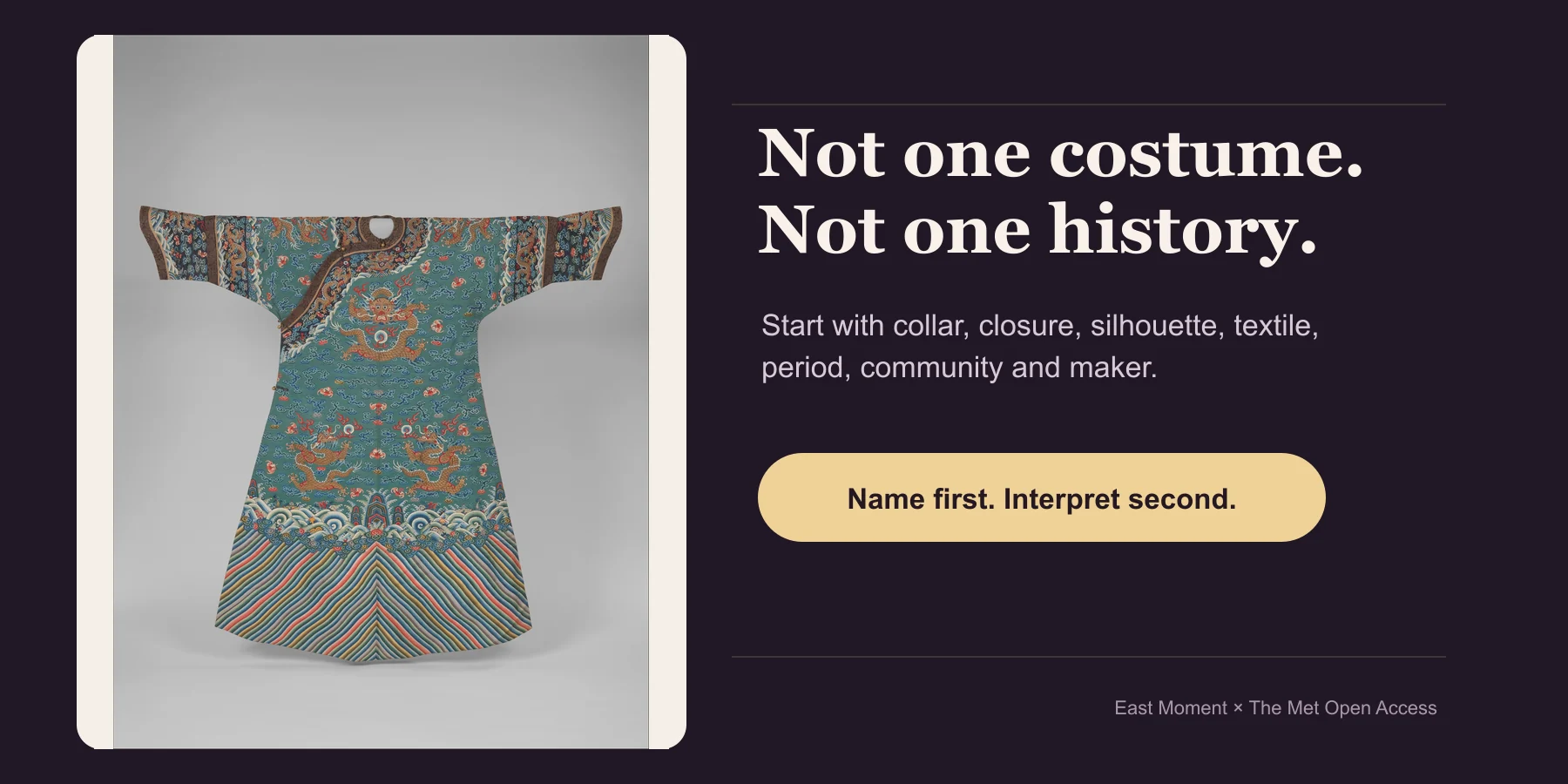
Qing court clothing is not a general-purpose robe
Qing official dress used regulated components, insignia, hats and forms tied to rank and occasion. It cannot be reduced to “a fancier changshan.”

The rank badge and hat are not optional decoration around a generic robe. They are evidence that the outfit belongs to an official system.
This is where costume listings cause the most confusion. A bright dragon robe may be sold for Lunar New Year, a wedding, a stage performance and an “emperor experience” under the same product title. But historical authority was not a print placed anywhere on red satin. Garment, emblem, color, headwear and wearer were regulated together.
For contemporary celebration, choose clothing designed for contemporary celebration. Do not borrow official rank or imperial identity simply because it photographs loudly.
Fit decides whether the outfit becomes clothing
Size charts based only on height and weight are not enough for long or layered garments. Measure a garment you already wear well, then compare six points.
Shoulder: A dropped shoulder may be intentional, but the sleeve must still begin and move as the cut expects. A narrow modern shoulder inside a broad robe creates pulling across the back.
Chest and underarm: Leave room for the inner layer and a full breath. Frog fastenings should lie flat rather than become stress points.
Sleeve reach: Test with arms forward, not only hanging at the sides. Long ceremonial sleeves can be beautiful; sleeves that enter soup are simply the wrong choice for dinner.
Robe length and side openings: Walk, sit and climb stairs. A changshan hem that looks perfect while standing can trap the knees when the side opening begins too low.
Belt position: A historical belt does not automatically belong at the narrowest modern-fashion waist. Its position controls proportion and sometimes carries objects.
Trouser volume and rise: Trousers are not invisible support. Tight modern trousers beneath a wide historical upper layer can make the outfit top-heavy and restrict the stride the robe requires.
Photograph the outfit from front, side and back, then record ten seconds of walking. The moving image reveals collapsing collars, twisting hems and sleeve problems that a posed mirror selfie politely hides.
Fabric must survive the actual day
The most repeated practical anxiety in contemporary male hanfu discussion is summer. It should be. A handsome layered outfit that becomes translucent, soaked or unbearable after twenty minutes has failed its occasion.
Hold light-colored fabric against a window before wearing it outdoors. Check whether inner trousers or underwear show through. Natural-fiber labels do not guarantee comfort: weave density, lining, dye, layer count and humidity matter. A tightly woven “linen look” polyester may photograph matte and feel like a sealed bag.
For warm weather, prioritize breathable inner layers, washable fabric and a silhouette that allows air to move. For winter, do not assume a glossy outer robe provides insulation; historically shaped clothing may need historically compatible or discreet modern layers beneath it.
Inspect construction at the collar, underarm, side opening, knot fastening and belt loops. These are the places movement tests first. Loose decorative thread is repairable. A distorted neckline or twisting side seam changes the whole garment.
Style the man, not a national symbol
The wearer should remain visible.
This sounds obvious, but men's Chinese clothing is often styled as a pile of symbols: dragon robe, folding fan, jade pendant, scholar hat, sword and boots added until the person disappears. The result explains China less clearly than one well-cut jacket worn with confidence.
Choose a dominant line. A long gown already supplies verticality; it does not need every accessory to repeat grandeur. A wide Ming-inspired robe needs controlled shoes and headwear to finish its proportions. A modern tangzhuang jacket can sit naturally with plain trousers. A Zhongshan suit is strongest when tailoring, pockets and posture remain legible.
Hair and headwear require the same honesty. A historically informed ensemble may be incomplete without the correct hat or hair arrangement. An everyday inspired look can omit them precisely because it is not claiming full reconstruction. “Inspired by” is not a downgrade. It is often the sentence that prevents clothing from becoming false evidence.
I would rather see a man wear one restrained Chinese jacket on the subway for five years than wear a perfect court costume once and treat it as a museum selfie. Revival becomes culture when clothing survives ordinary bodies, weather, embarrassment, repair and repetition.
The East Moment verdict
Choose traditional Chinese men's clothing in this order:
- Name the occasion.
- Choose one historical or modern system.
- Read collar, closure, belt, layers and length.
- Verify full-body fit in motion.
- Test fabric against heat, light, sitting and cleaning.
- Add only the accessories the chosen system or occasion actually needs.
The best outfit is not the one that advertises “China” from across a ballroom. It is the one whose structure remains convincing after the novelty fades.
Continue with the traditional Chinese clothing guide, go deeper into hanfu or bring a real outfit and its fit problem to East Moment's community. Tell us what you wore, where it stopped feeling like costume and what you would change before wearing it again.