The best Chinese wedding dress is not the one that looks most “traditional” on a hanger. It is the one that can complete the job your wedding gives it: leave home, enter a car, serve tea, kneel or stand safely, greet relatives, eat dinner and remain recognizably yours. Choose the ceremony first. Then choose Xiuhe-style clothing, qun kua, qipao, hanfu or a modern Chinese bridal dress.
Chinese wedding dress choices in one minute
| Garment | Best use | What makes it distinct | Main mistake |
|---|---|---|---|
| Xiuhe-style jacket and skirt | Door games, family photographs, tea and a long morning | Modern red bridal category with a jacket, broad skirt and dense auspicious embroidery | Calling every jacket-and-skirt set an ancient “Xiuhe dynasty dress” |
| Qun kua / long feng gua | Southern Chinese and Cantonese family rituals, especially tea | More fitted jacket and straighter skirt; metallic embroidery often dominates the surface | Renting by height alone when the fitted jacket cannot be altered |
| Qipao / cheongsam | Reception, tea, banquet entrance or toasting | One-piece fitted dress with high collar, side opening and variable slit | Choosing a dramatic slit or rigid collar before testing sitting and stairs |
| Hanfu wedding ensemble | A deliberately researched hanfu ceremony or portrait | Period-aware layers, robe, skirt, belt and headwear designed as one system | Mixing dynasties and calling a costume package historically exact |
| Contemporary Chinese bridal dress | Mixed ceremony, destination wedding or one-outfit day | Modern tailoring using Chinese textile, fastening, color or motif language | Assuming “modern” makes inaccurate historical marketing harmless |
There is no single national Chinese bridal uniform. Han Chinese, Cantonese, Teochew, Hakka, Peranakan, Manchu and many other regional, ethnic and diaspora histories do not collapse into one red dress. Even within one family, a bride may wear a Western gown for the main ceremony, a qun kua for tea and a qipao for dinner—or one comfortable outfit for everything.
The choice becomes much easier when you stop asking, “Which is the real Chinese dress?” and ask, “What must my body and family do while I am wearing it?”
Xiuhe is a modern name with an old-looking silhouette
The name Xiuhe fu became popular after the character Xiuhe wore Ye Jintian's costume design in the television drama The Orange Is Red. A Chinese university account of the garment is unusually clear: the familiar name comes from a modern screen character, and the design should not be treated as one untouched historical wedding uniform.
That does not make today's Xiuhe-style clothing fake. It makes it a successful modern wedding category. Designers combine the jacket-and-skirt logic of older Chinese clothing with contemporary zippers, shaping, embroidery, photography and rental needs. A garment can carry history without pretending it arrived unchanged from a dynasty.
I like Xiuhe-style sets when the wedding morning is active. A broader skirt can accommodate sitting on a bed, entering a car and moving through a crowded room more easily than a narrow dress. The jacket keeps the visual focus high in close family photographs. The danger is weight: metallic embroidery, lining, head ornaments and layers can turn a comfortable-looking silhouette into several hot hours.
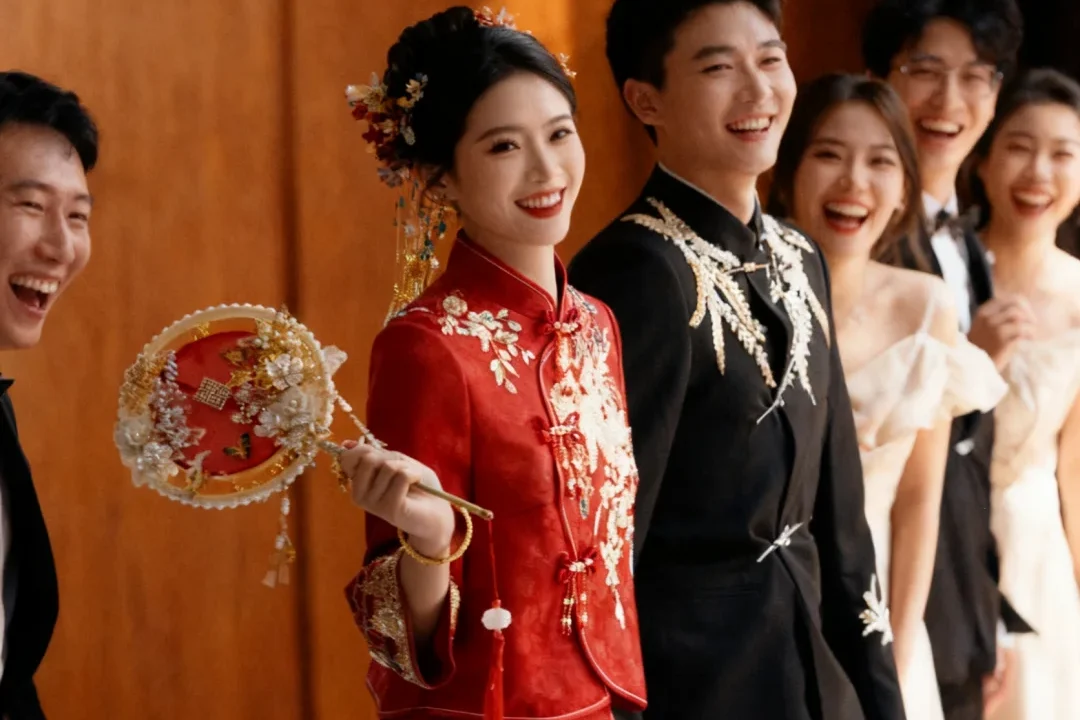
The authorized bride shown here chose a hand-embroidered silk set and valued it because it was light, soft and flattering. Her most useful point is practical: the pickup outfit may be worn longer than the main gown and photographed at closer range. That makes comfort, fabric quality and movement more important than a dramatic first impression in the fitting room.
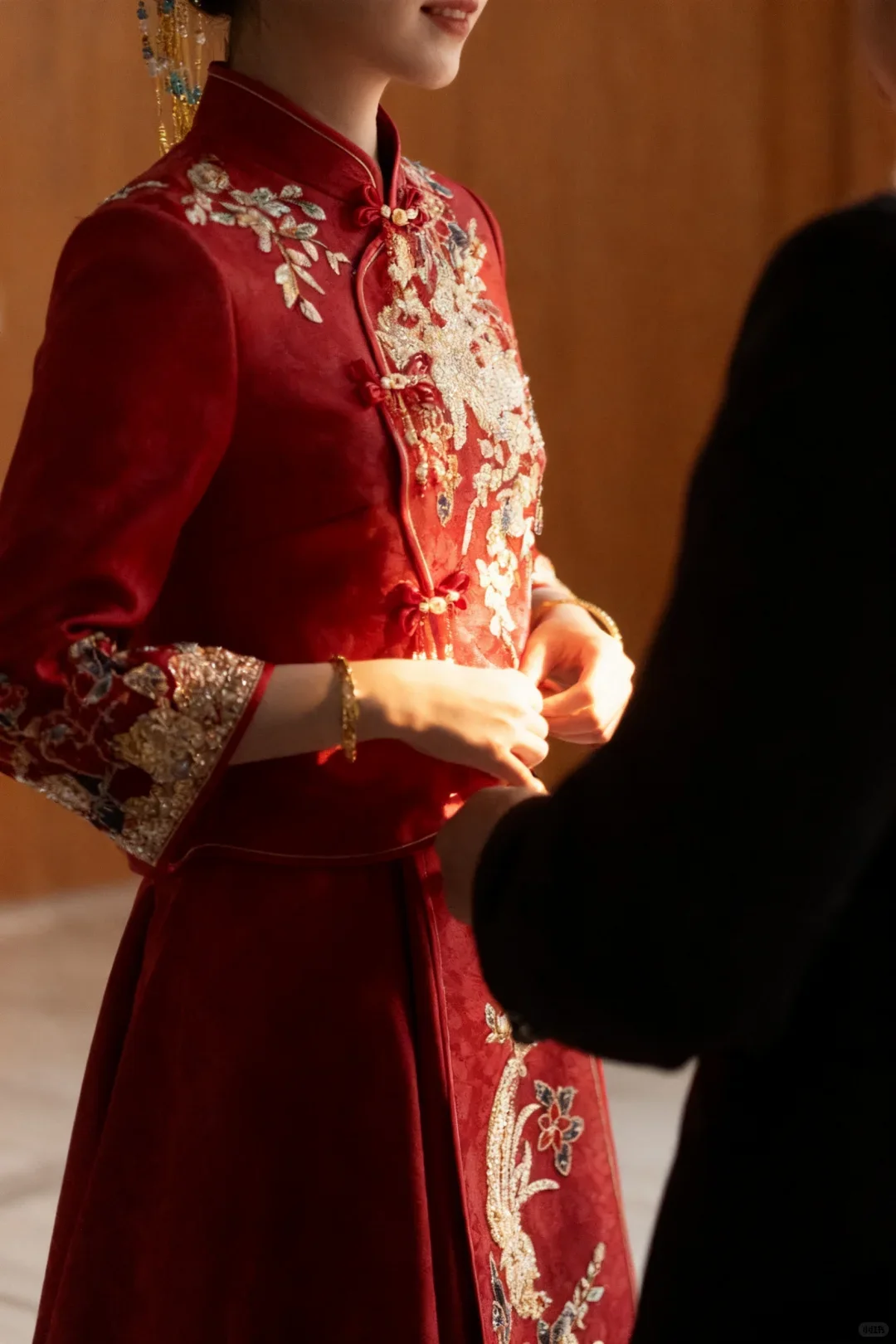
This close view makes the construction questions visible. The standing collar, piping and front fastenings must sit straight after the bride moves; the heavy embroidered panel must not drag the front edge out of alignment. The image can prove surface placement and fit at one moment. It cannot prove whether the embroidery was made by hand, how the jacket feels after three hours or whether the commercial label “Xiuhe” is historically precise.
Qun kua is a Southern Chinese garment, not a gold-density score

The qun kua (裙褂), often marketed in English as long feng gua or dragon-phoenix wedding dress, has especially strong Southern Chinese and Cantonese associations. Its fitted jacket and straighter skirt create a different body from the fuller Xiuhe-style set.
The National Museum of Singapore's 1937 ensemble is a useful correction to today's all-red search results. Mrs Kwok Swee Ying's jacket is black, the skirt red, and phoenix and peony embroidery crosses both pieces. She likely wore it for tea after a Western wedding gown; her granddaughter reused it in 1995. One object therefore holds migration, mixed ceremony and inheritance together.
Modern shops often rank qun kua by how densely metallic embroidery covers the red ground. That vocabulary can help compare labor and surface, but it can also make the dress sound like a percentage meter: more gold equals more authentic, more expensive and more worthy. I do not accept that equation. Embroidery density cannot fix a pulling shoulder, a twisted center front or a skirt that prevents a safe step.
Renters should test the jacket first. Can you lift a tea cup with both hands without the back pulling? Can you sit while the hem remains controlled? Can the collar close without pressing the throat? A heavily embroidered rental often has less alteration freedom than a custom piece. The most expensive category is still the wrong dress if the body disappears inside the invoice.
A qipao works when the wedding keeps moving

A qipao or cheongsam can be the main dress, tea outfit, banquet entrance or toasting dress. Its advantage is not that it is “more modern” than every two-piece outfit. It is that one continuous silhouette can move through a restaurant, greeting line and dance floor without managing a broad skirt.
The Peranakan Museum's qipao record identifies the high collar, side opening, ornamental fastenings and hem slits while placing the form in twentieth-century Shanghai and Southeast Asian fashion history. That is the correct scale of the claim. A qipao is not shorthand for all ancient Chinese women's clothing; the broader traditional Chinese clothing guide explains the difference.
For a wedding, test the qipao after eating and sitting, not only while standing before breakfast. Walk up stairs. Enter the actual car or a car of similar height. Reach forward as if offering tea. Sit for fifteen minutes. Check whether the collar turns, the armhole bites, the side seam rotates or the slit reveals more than intended when movement replaces posing.
A beautiful qipao that requires the bride to hold her breath is not elegant. It is a photograph with a person trapped inside.
Fengguan xiapei and hanfu require a complete system
The English phrase “Chinese wedding dress” often produces a red robe, phoenix crown and xiapei (霞帔) as if these pieces form one timeless bridal package. They do not.
Ming-inspired wedding clothing can be magnificent when the couple has chosen a researched period, construction and ceremony. But robe, skirt, collar, belt, xiapei, crown, shoes and the groom's clothing should agree. Buying a dramatic crown and attaching it to an unrelated rental does not create historical accuracy.
Choose this route when the research itself is part of the pleasure. Work with a maker who can name the reference period, explain which parts are reconstruction and which are modern adaptation, and show how the complete outfit moves. If the seller answers every question with “ancient Chinese tradition,” leave.
For many couples, a modern hanfu-inspired ensemble is the more honest choice. Name it accurately, fit it for the real day and enjoy the design without asking the garment to impersonate a museum label.
The fitting room needs six wedding movements
A wedding dress should be tested as equipment. Perform these six actions in the complete outfit, including shoes, inner layers and major headwear:
- Sit on the lowest seat you expect to use. Beds, tea stools and hotel chairs produce different skirt problems.
- Enter and exit a car. Check headwear height, skirt volume, side openings and whether another person must hold the garment.
- Offer a cup with both hands. The shoulder and back must allow forward reach without lifting the whole jacket.
- Walk ten stairs and turn. A skirt that survives a straight fitting-room walk may twist during a landing turn.
- Eat and breathe for fifteen minutes. Collar, waistband and underarm comfort change after the body relaxes.
- Use a restroom with one helper. Decide who manages the skirt, where ornaments rest and whether the outfit can be secured without touching the floor.
Photograph front, side and back, then record twenty seconds of walking. Video reveals bouncing ornaments, collapsing collars, restricted stride and a rotating hem that a still mirror will forgive.
This is where the Chinese wedding tea ceremony guide becomes part of clothing research. If the couple will serve seated relatives, the dress must protect the cup, the recipient and the bride's balance. Ceremony and clothing are not separate Pinterest boards.
Coordinate the couple without turning both people into symbols
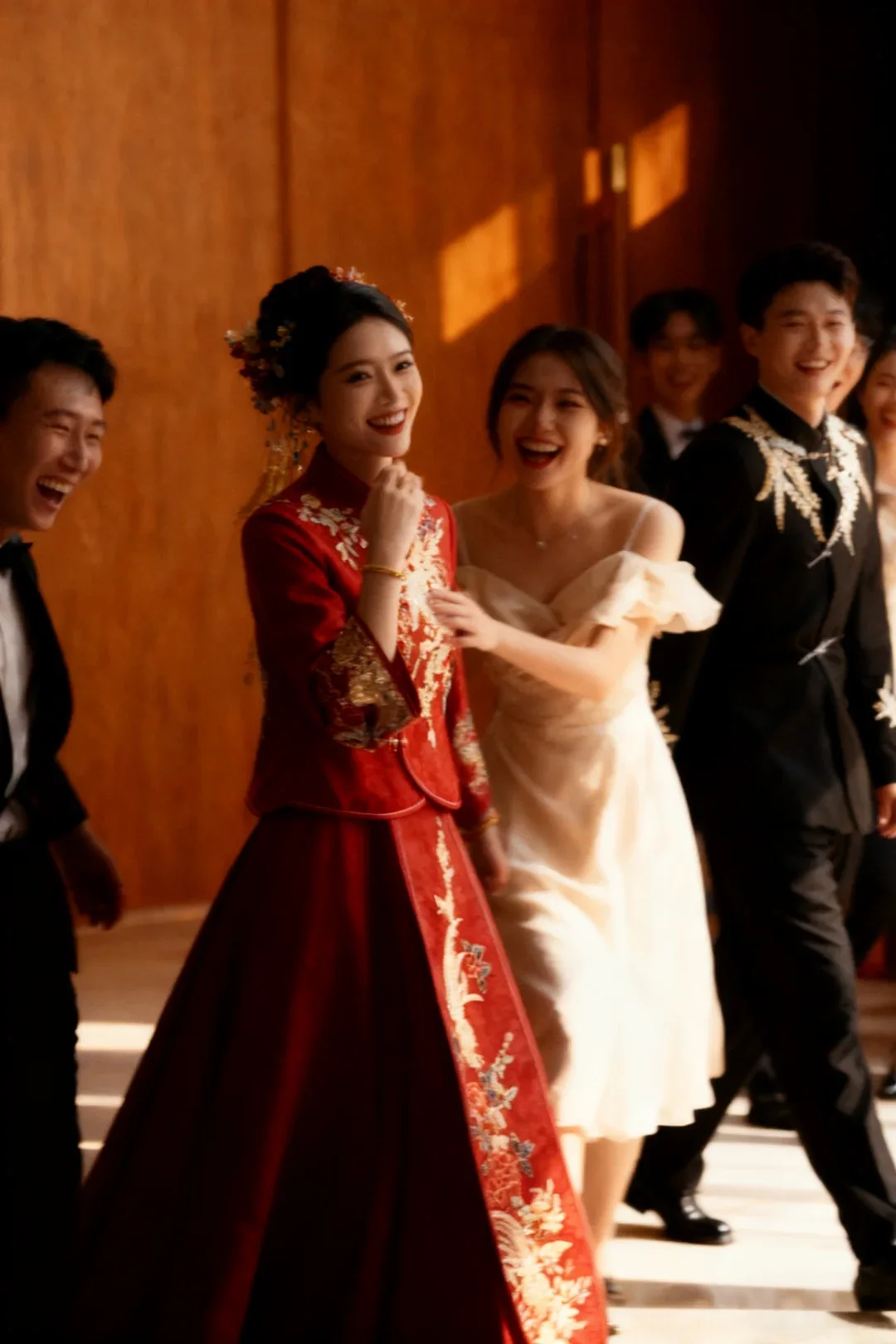
The groom or second partner should not be styled after the bride as an afterthought. Matching does not require two identical red surfaces. It requires agreement in formality, textile weight, color temperature and visual density.
In this authorized wedding record, the bride's red embroidered two-piece outfit carries the brightest surface while the groom's black jacket answers it with pale botanical embroidery. Friends in Western formalwear make the choice even clearer: the couple coordinates without forcing the entire party into one costume vocabulary. The photograph proves one contemporary styling decision and the joy of the room; it cannot make that decision a universal Chinese wedding rule.
Use the Chinese men's clothing guide to distinguish a modern tang-style jacket, changshan, hanfu ensemble and suit. Use the Chinese women's clothing guide to keep qipao, hanfu and contemporary Chinese-inspired design from collapsing into one category.
Avoid assigning dragon to the man and phoenix to the woman as an eternal rule. Their histories and gender associations are more complicated than wedding-shop shorthand. The Chinese symbols guide shows why motif, object and context must be read together.
Red is powerful, but it is not a passport checkpoint
Red is strongly associated with celebration, happiness and auspicious action in many Chinese wedding settings. Gold thread amplifies visibility and wealth; phoenixes, peonies, pomegranates, bats and paired creatures can carry blessings whose meanings depend on place and object.
None of that means every Chinese bride must wear red. Families may choose white, gold, blue, black-and-red, several outfits or no specifically Chinese garment. Ethnic and regional traditions use their own colors and forms. Diaspora families have mixed Western gowns and Chinese clothing for generations—the 1937 museum garment already proves that this is not a social-media invention.
Ask the family what a color means to them before treating a search result as law. A white gown may belong to the main ceremony and red to tea. A bride may avoid a color because of mourning, religion, personal taste or family history. Tradition should create recognition, not erase the person being married.
Rent, buy or commission according to alteration risk
Rent when the outfit has one short job, the shop carries your actual size and you can perform all six movement tests. Confirm deposit, stain rules, accessories, cleaning, pickup time and whether any adjustment is allowed.
Buy ready-made when measurements match, return terms are real and the garment can be altered locally. Ask for garment measurements, not only S/M/L or height and weight. Shoulder, bust, armhole, jacket length, waist, hip, skirt length and collar circumference matter.
Commission when embroidery placement, body proportion, cultural reference or a multi-hour role makes fit consequential. Require a sketch, fabric sample, motif map, fitting schedule and written definition of hand versus machine work. “Handmade” should identify what a hand actually did.
Order early enough for one full-outfit fitting and one correction after shoes and underlayers arrive. Do not let the dressmaker see the headwear for the first time on the wedding morning.
One dress can be enough
Six beautiful outfits do not create six meaningful moments. Every change consumes hair, makeup, photography, transport and attention. A real wedding wardrobe may justify several changes because the day is long and each garment has a role. Copying the number without copying the schedule creates a private fashion show that the couple is too tired to experience.
Use one of these simpler plans:
- One-outfit wedding: a comfortable Xiuhe-style set, qipao or contemporary Chinese dress handles tea, ceremony and dinner.
- Two-outfit wedding: Chinese clothing for pickup and tea; a gown, suit or second dress for the main ceremony and reception.
- Three-outfit wedding: pickup/tea, main ceremony and a genuinely easier dinner outfit. The third garment must solve movement, heat or formality—not merely create another photo folder.
My preference is the smallest wardrobe that makes every part of the day physically and emotionally legible. The dress should help the couple meet their families. It should not make the family wait outside a changing room.
My verdict: let the garment carry a relationship
Choose the Chinese wedding dress that makes your ceremony possible. If Southern Chinese family history makes qun kua recognizable, let that recognition matter. If a Xiuhe-style set gives you room to move through a long morning, modernity is not a defect. If a qipao lets you greet every table without managing a heavy skirt, that practicality is part of its beauty. If historical hanfu research brings the couple joy, build the complete system honestly.
The right garment does not prove that you are Chinese enough, traditional enough or wealthy enough. It gives the body room to complete a relationship.
In the comments, tell me which action decided your outfit: tea, stairs, a car, dinner, photography or a family request. Then bring one authorized image to the East Moment community and explain what the clothing allowed you to do. Continue through the traditional Chinese clothing collection when you want the wider history behind the wedding wardrobe.